My left thumb has been aching a lot recently, in what medical professionals would know as my first metacarpophalangeal joint. I have a lot of little aches in this and that joint, no doubt arthritis mostly due to the wear and tear of years, but this one is worse; it throbs. That is probably because arthritis is accelerated by injury. I remember the injury that is now making itself felt.

My then-husband, Matt, and I were driving around the rural roads around Syracuse, New York, in 1992, looking at apartments to rent. We didn’t have a lot of time; we were just in Syracuse for a few days, trying to get things set up before we moved there for graduate school. Matt had a lot of anxieties and phobias, and one of them, apparently, was doing anything on the road that might attract the negative attention of other drivers, such as halting too long at a stop sign. He was always terrified of someone regarding him badly, even a stranger.

Matt was driving. We stopped at an intersection and I, looking at the map, was confused. Right or left? I was just saying that I wasn’t sure what he needed to do, when his anxiety boiled up into fury. He grabbed my thumb and pulled it back toward my wrist. I screamed in fright and pain, and he let go.

In the weeks after that, no one would have been able to tell that I was hurt. I can’t remember whether there was any bruising or swelling, just a lot of pain in that joint. It lingered for a long time, and then after it was mostly healed, it made itself felt again whenever I needed a strong left thumb. For example, it took months before I could grip a can opener strongly enough with my left hand to keep the opener locked on a can as I turned the wheel with my right.

We have now been divorced for 15 years, and Matt has been deceased for 12, but I still have this reminder of him. It’s not a way he would have liked to be memorialized, but my thumb remembers in its own way.

I kept a list of everything I read during my sabbatical two years ago. It’s been on this blog as a separate page, and as part of some blog housekeeping, I’m converting it to a post.


Books read during study leave & sabbatical, 2016

Anil’s Ghost, Michael Ondaatje fiction (f)

Promoting Diversity and Social Justice: Educating People from Privileged Groups, Joan Goodman nonfiction (nf)

Christ for Unitarian Universalists, Scotty McLennan nf

Armada, Ernest Cline f

El Cuaderno de Maya, Isabel Allende f

Through the Children’s Gate: A Home in New York, Adam Gopnik nf

The Immortal Life of Henrietta Lacks, Rebecca Skloot nf

Between the World and Me, Ta-Nehisi Coates nf

Dawn, Adulthood Rites, Imago (the Xenogenesis Trilogy), Octavia Butler f

The Thief Lord, Cornelia Funke f

Harry Potter and the Cursed Child, Jack Thorne f (play)

Walk Two Moons, Sharon Creech f

Assassination Vacation, Sarah Vowell nf

John Henry Days, Colson Whitehead f

My Grandfather’s Blessings, Rachel Naomi Remen nf

All the Light We Cannot See, Anthony Doerr f

The Amateur Marriage, Anne Tyler f

The Andromeda Strain, Michael Crichton f

The Great Train Robbery, Michael Crichton f

An Artist of the Floating World, Kazuo Ishiguro f

The Invention of Wings, Sue Monk Kidd f

 My Brilliant Friend, Elena Ferrante f

Inkspell, Cornelia Funke f

Unfamiliar Fishes, Sarah Vowell nf

Take the Cannoli, Sarah Vowell nf

Persuasion, Jane Austen f

Malafrena, Ursula K. Le Guin f

The Wanderer, Sharon Creech f

Lock In, John Scalzi f

Orsinian Tales, Ursula K. Le Guin f

Unlocking the Air, Ursula K. Le Guin f

Family Sabbatical, Carol Ryrie Brink f

The Woman Who Walked in Sunshine, Alexander McCall Smith f

Midnight’s Children, Salman Rushdie f


plus numerous mysteries just for fun

and Emily Dickinson poems when I remembered.

The kvelling over Senator John McCain shows how low the bar has fallen recently. We know why, but if we’re going to grade politicians on a curve, let’s not just look at the past two years. “Greatest American hero of the past 50 years,” a man of “honor and integrity,” “a maverick” . . . Are we talking about the same person? I believe in speaking respectfully of the dead when one possibly can, and remaining silent when one can’t, with rare exceptions (for example, when someone finally puts a stake through Kissinger’s heart, I’ll spit on his grave). So I am fine with respectful words for a complex, flawed person. These showers of praise go beyond that. They make bold claims about the meaning of honor, integrity, and independence that drag those fine qualities through the mud, and insult far greater heroes of our time.

Surely there are public servants of more integrity and honor than the Keating Five; I know, that’s barely a scandal by today’s measure, or maybe we just can’t recall any history more than five years back, but his “poor judgment” ruined many lives. Surely decency requires choosing better than Sarah Palin to be a heartbeat from the presidency. While people of integrity can differ about public policy, my heroes don’t get a 100% rating from the National Right to Life Committee or a 17% from the NAACP. The people who inspire me care more about leaving a livable environment for the next generation than guaranteeing profits for today’s businesses. I admire mavericks, but it takes more than one or two issues and one prominent vote to earn the title. (Okay, three issues. The best thing I know about McCain gets little attention: he shifted from being an implacable foe of gun control to a moderate supporter.) Yes, his vote last year rescued the Affordable Care Act; but if we resist the availability heuristic in which the most recent event gets undue prominence, we see a long career of making health care less accessible to most of us.

Even the most exalted politician leaves a trail of bad decisions, and even the best people do a lot of harmful things. I hope I will be remembered as a decent person, even though I am often unkind, selfish, apathetic . . . But for a public servant to receive such glowing praise as I’ve seen since yesterday, the preponderance of his deeds should glow, and McCain’s just don’t. Not for African-Americans, LGBTQ people, immigrants, poor people, or those who care about any of the above.

I like the way Obama put it, that at his best McCain showed us what it means to put the greater good above one’s own. That is true, and the best I can say.

P.S. If you aren’t familiar with the strictly non-partisan resource Vote Smart, check it out. For a citizen of the United States who wants to make informed choices, it’s an indispensable tools.

I don’t do too well without deadlines. I imposed one on myself for this series; I would write about every song before I went to see the show. But then it became clear that I wasn’t going to make it, and I just lost steam. It’s been over a year.

In the absence of deadlines, however, polite requests are very effective, and someone at church asked if I were going to get back to this. Even more influentially, he indicated that he’d read them all and they’d helped spur him to listen to the album. All right, then! Onwards to “Take a Break”!

When we see a driven, brilliant person who accomplishes more in his profession than seems possible for any mortal, we might wonder, what is he like at home?

It’s hard to pull him away from his desk, even for dinner. He has to be nagged into spending a few minutes with his son on the child’s birthday. It’s almost impossible to get him to go on vacation. “I will try to get away,” Hamilton tells Eliza. Yeah, right. Every workaholic has uttered these words, and every spouse, child or friend of one rolls their eyes when they hear them. He will try, but then he’ll discover that he has to write one more draft, talk to one more Congressman, add one more argument, recalculate one more set of figures . . . The work will always be there, there will always be more of it, and it will always loom in his mind as too important to put aside. His family can’t possibly compete.

But he does adore them, and this song shows that both sides of that tug-of-war have force. When he’s finally compelled by Eliza to come hear Philip (“He’s been practicing all day”), he hears not more piano, but a novice rap. Don’t you love it? So does Alexander–“Hey, our kid is pretty great!”–and it’s a sweet moment. It’s just a snapshot, but enough to show the love in the family.

The dialogue with the off-stage Angelica also sketches a complex relationship in a few strokes. When I finally read Ron Chernow’s biography (see? I wasn’t wasting those months of non-blogging), one of the questions on my mind was “Did Alexander really write a letter that began ‘My dearest, Angelica’?” It seemed like a small but significant piece of evidence on which one could build a case that they had an affair, at least an emotional one (they were separated by an ocean most of the time). But no; it appears to be Lin-Manuel Miranda’s invention. What does have a historical basis is that brother- and sister-in-law had a relationship that was close, intellectual, playful, and supportive. Chernow writes that their flirtatious banter raised eyebrows, though it might not have done had Alexander not already had a reputation as a ladies’ man.

We see all of those elements here. Close:

Eliza: Angelica!
Angelica: Eliza!
Hamilton, with audible longing: The Schuyler sisters.
Angelica: Alexander–
Hamilton: Hi.
Angelica: It’s good to see your face.

Intellectual: “You must get through to Jefferson,” she advises; “Sit down with him and compromise / Don’t stop ’til you agree” Hamilton takes his sophisticated work problems to her. Playful: They banter via Macbeth references, though Angelica is the opposite of Lady Macbeth. “If you take your time, you will make your mark,” she tries to reassure him, and when she teases, “Screw your courage to the sticking-place,” she isn’t urging him to be more ambitious, but to put down his work and be with his family. Supportive: “Your favorite older sister . . . reminds you / There’s someone in your corner all the way across the sea.”

The way the sisters’ voices weave in and out around Alexander’s protests, it seems as if they must be irresistible. But when they go away for a quiet lakeside summer, he stays behind. Bad move.

(Consider this backdated a week. I have been too tired from full days of museum-walking and street-exploring to do much blogging.)

In case Paris decides it needs a new slogan, I suggest “It lives up to the hype.” I loved Paris when I visited as a college student, and however it may have changed in the subsequent decades, its reputation as one of the world’s best cities, if not the best, is completely deserved.

Great food: check. Every grubby little place has excellent bread and delicious French onion soup. Even the tourist trap we reluctantly went to when we were famished and too near the Eiffel Tower for anything else was terrific. Boulangeries and patisseries are on just about every block, and we never ate anything at any of them that was less than delicious (French people must faint dead away when they taste what most U.S. bakers pass off as croissants).

I’m sure someone in Paris knows how to knock out a crappy meal, but we were fortunate enough not to order anything from that person’s kitchen. It really is a city of cooks who love and know food. We had precisely one disappointing meal, and that was only because it was billed as the best Chinese food in the city, which I doubt it really is. It was pretty good anyway, but we happily went back to French cuisine the next day.

Eiffel Tower: check. It’s the world’s most overviewed tourist attraction, and you know what? It’s still gorgeous. Each of us had seen it on her previous visit and put it low on the list of things to do this time around, but when we had gone all the way to the city’s museum of modern art to see a mural that turned out to be closed to view, and discovered we were half a mile from the tower, we couldn’t resist.

Also, you have to love a place where the street vendors are selling champagne to accompany your picnic. We did not buy any; for that matter, we didn’t picnic. But we walked up close.

Mona Lisa: Check. As I wrote last week, it’s hard to see it afresh, but it’s still a beautiful work of art. So are the Venus de Milo and the Nike (Winged Victory) of Samothrace, the other two items at the Louvre that are so requested that the museum just posts signs all over saying “This way.” Probably the guards got tired to giving people directions. My favorite of the three is the Nike, but none could be called a disappointment. The Louvre piece I would personally walk miles to see (actually, I think I did) is Michelangelo’s “Dying Slave.”

Beautiful city: check. Cobbled streets, graceful old buildings, spires rising here and there–it’s just lovely. Standing on a bridge at sunset watching the Seine wend through the city is even nicer than romantic movies lead one to expect. We even saw swans on the river once, though boats filled with tourists are far more common.

I have some thoughts on the shadow side of the city’s beauty in my next post.


(Catching up on blogging–this was written during our stay in Paris a week ago)

Joy and I both had a decent knowledge of French back in college, but that was a long time ago. Being in Paris is re-activating it, but the brain seems to have a “you are speaking a foreign language” switch which makes one respond to being addressed in a foreign language by spewing words in any language except one’s native tongue. These are not necessarily words of the local language, and for both of us, they tend to be Spanish.

It makes me aware of which Spanish words and phrases I know so solidly that I’m not translating from English but thinking in Spanish. They just pop out: I say “señor” instead of “monsieur,” “gracias” instead of “merci,” unless I stop and think and deliberately translate what I want to say into French. This makes common words the hardest: maintenant, aujourd’hui, aussi. Ironically, aussi (French for “also:) gave me trouble when I was learning Spanish. I distinctly recall having trouble remembering the word “tambien” (Spanish for “also”) because “aussi” kept coming to mind instead, which is when I started consciously suppressing my French.

My French pronunciation is coming back to me, but again, Spanish infects words that look similar. “Rue St. Martin” becomes “San Mar-TEEN.” The similarity of a word can make me doubt whether I’m remembering it right, but yes, semaine is the French word for “week,” not just my invention of something likely when my brain reaches for semana.

In general, knowing French grammar helped me to learn Spanish 20 years later. It meant, for example, that I already understood reflexive verbs. But the differences between the grammars are now coming back to get me. In Spanish one does not need a subject pronoun unless it’s necessary for clarity. If one wants to say, “I’m going to watch a movie,” “Voy a mirar una pelicula” will do just as well as “Yo voy a mirar una pelicula.” This has become so ingrained that when I brightly walked up to a store clerk to say, “We’re looking for soy milk”–“Cherchons du lait de soja”–and oh, how proud I was of remembering that it’s lait, not leche–the woman of course looked at me in confusion. “Of course” because, by leaving off the nous, “we,” I was saying to her, “Let’s look for soy milk!”

French. A lovely language. Not the same as Spanish. We’re going to be so happy to get to Barcelona. That is, if we don’t offend the Catalan speakers by speaking Spanish.

We went to the Musée d’Art Moderne with the express purpose of seeing a mural called “The Electricity Fairy” by Raoul Dufy. Joy’s discovery of this mural’s existence was an occasion for amazement, since she loves Dufy and, well, electricity is her career and her passion. So off we went to the museum, only to discover that the mural is not available for viewing.

One silver lining to this disappointment was that, as I wandered the permanent collection looking for the mural, I came across this painting by Anton Räderscheidt, a German artist who lived 1892-1970.

raderscheidt

 I looked at the face of the artist and the face on his drawing and said to myself, “It’s going to be called ‘Self-Portrait.'” And it is! He painted it in 1928.
Genderqueer? Surrealist? Both? Other? Whatever, I wanted to share it with all my gender nonconforming dear ones. And Räderscheidt joins the growing list of Artists I Need to Learn More About.

Today, our third full day in Paris, the schedule was:

  • Musee de L’Orangerie, with its two oval rooms immersing the viewers in Monet’s water lilies. There are lots of other Impressionist paintings as well, and a temporary exhibition on the influence of Impressionism on U.S. American Abstract Expressionists.
  • On the walk over, a surprise encounter with the United States’s biggest Francophile. You know how you run into your countryfolk whenever you’re abroad . . . This one was in Paris meeting lots of different ladies.jeffersoninparis
  • Musee d’Orsay, the former train station that’s a work of art in itself and that houses hundreds of Impressionist and related works.
  • Great food before, after, and in between.

Favorite overhead remarks from Musee D’Orsay:

(pointing) “That’s famous, and that’s famous, and that’s famous . . .”

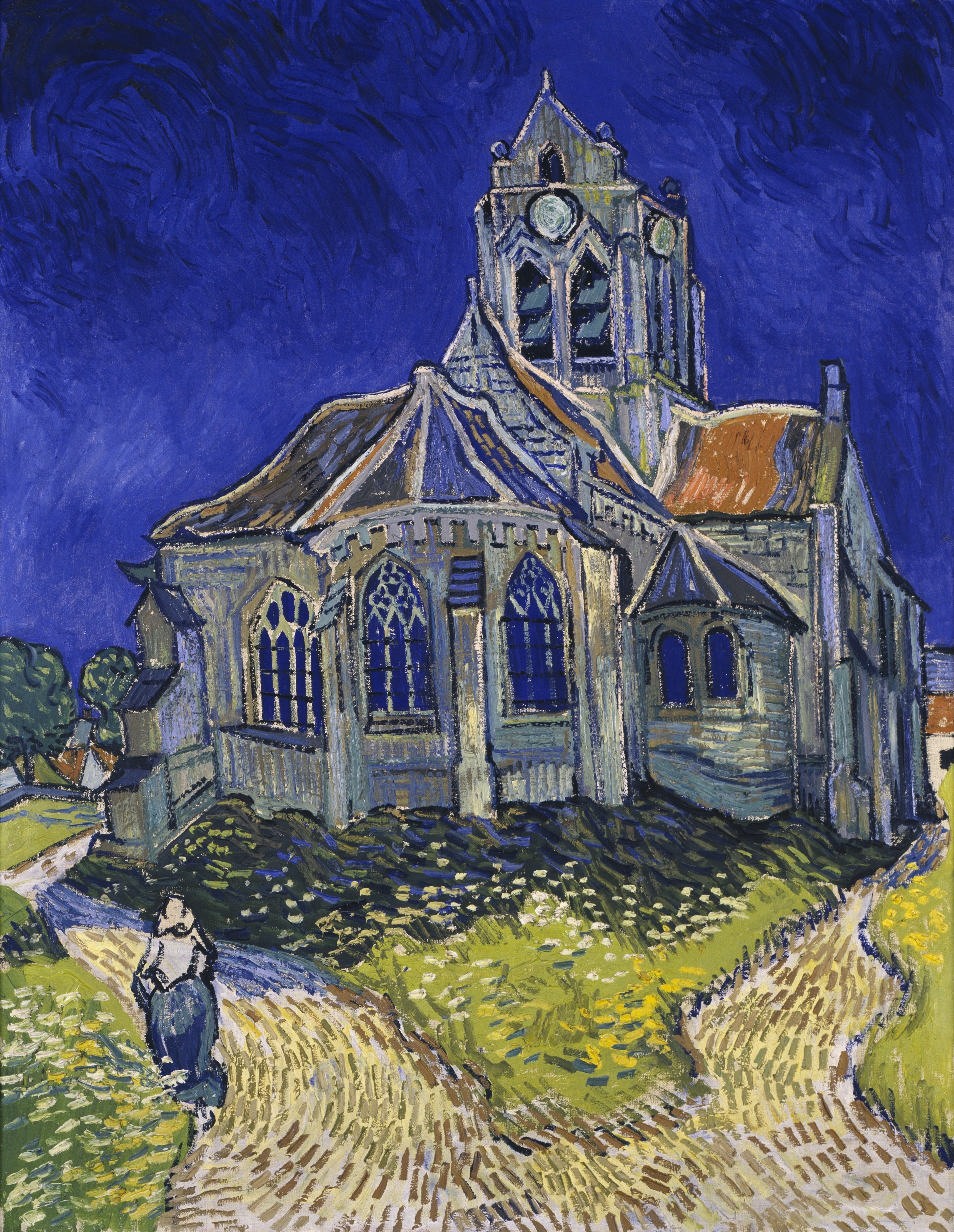
This made me smile because, as far as I could see, she didn’t give the famous paintings more attention. She just wanted to note which ones she’d seen before. Many years ago, I was given a book of this museum’s collection, so today I didn’t always know whether the familiarity of a piece meant I’d seen it in the book, it was widely known, or maybe it had showed a dangerous alien in a window, galvanizing the 11th Doctor to travel to Auvers to find van Gogh.

The Church at Auvers, Vincent van Gogh, 1890. Image: Wikimedia Commons.

If you look closely at the windows, you will note that there is no longer an alien. Thanks, Doctor! (You’ll just have to watch the whole episode, which is called “Vincent and the Doctor” and aired June 5, 2010. It’s a really good one.)

Mother, with daughter by a Van Gogh painting: That’s a self-portrait.

Daughter: How’d he do that? Oh, wait. I bet he took a picture of himself.

I heard no response. I’d really like to know how the mother answered, if at all.

Person looking at same self-portrait, to friend: Do you think he was really a redhead, or just painted himself that way?

I love that painting. The swirls of the background and the swirls of his hair, face, and clothes meld, as if he is trying to express how much he is at the mercy of his environment, or perhaps how seamlessly he fits into it. His expression makes me lean toward the former interpretation.

The Musee D’Orsay also had a temporary exhibit of beautiful Baltic paintings of the same era, and not enough time left for us to contemplate them. The exhibit focused on symbolism in the art, much of which drew on folktales of the region; Latvia, Estonia, and Lithuania were becoming independent nations, and artists, like others, might have been pondering what created a sense of national identity. Now I want to find out more about Mikalojus Čiurlionis, Balder Tomasberg and Pēteris Krastiņš–the three whose pieces, in my too-rapid trot through the exhibit, caught my eye enough for me to stop and do that annoying thing of snapping photos of the pieces and their labels rather than taking the time to look at them. But it was almost 6 p.m., and needs must. About half of my ancestors emigrated from Latvia, yet I know nothing of these folktales or these artists (Krastiņš was Latvian).

Amongst the stunning works by Degas, Cassatt, Cezanne, Sisley, Seurat, van Gogh, Gauguin, an artist neither of us had ever heard of named Eva Gonzales, and another named Maximilien Luce who was a political (!) pointillist (!), we saw many by Renoir. Only a very few of these last did not make us want to scratch our eyes out. I cannot stand his paintings, which, as Joy articulated perfectly, look like someone smeared Vaseline on the lens, the way, for example, a Star Trek director will do to show Jill Ireland from a smitten Spock’s point of view. I’m so glad to be married to someone who also loves to go to art museums and hates Renoir, as does God. She’s wrong about Rothko, but you have to have some differences in a marriage.

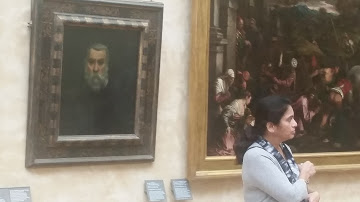
The Mona Lisa is instantly recognizable by the crowd of people standing before it, most of them taking photos. It’s in a large hall with lots of other paintings, most of which aren’t very interesting to me, but one of which is.

tintorettoIt’s a self-portrait by Tintoretto. He looks thoughtful, even sad, and directs his gaze straight into the viewer’s eyes. He isn’t getting a lot of attention. As with every other painting in this room, most visitors have their backs to this one, as they strain to see the celebrity nearby.
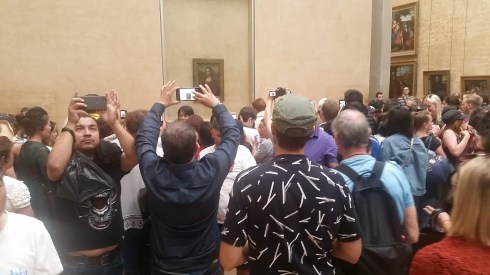
mona lisaOn the other hand, even when one is looking right at the Mona Lisa, it’s hard to see it. It’s a gorgeous painting–did Leonardo paint any other kind? But there are so many layers of marketing, jokes, pop culture, parody, etc. making a thick veil of familiarity between us and her. Simply encountering the painting face to face is impossible. So maybe Tintoretto’s sadness is not for himself, but for her and her creator. Or even for us.


bicycles, Amsterdam
angel in Nieuw Kerk, Amsterdampigeons, Amsterdam

Enter your e-mail address to receive e-mail notifications of new posts on Sermons in Stones

Links I like