You are currently browsing the category archive for the ‘art’ category.
I haven’t been posting most of the art I’ve been making, so over the next few days I’m going to post a piece per day.
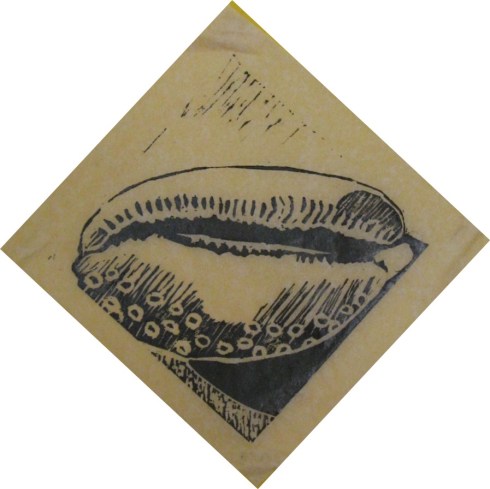
This is a linoprint, about 4 x 4 inches. I was in the studio we all go to together most weeks, Ishuakara (I finally found out the origin of the name; it means “rebirth” in the owner’s native Zapoteco), with extra time on my hands, and no particular idea for a print. Armando had a field guide to shells on his bookshelves, and since my daughter loves cowrie shells, I started in that section and zeroed in on this one, a measled cowrie. I’m going to frame one of the prints for a Christmas or Hanukah present for her (shhh).
It’s the second linoprint I’ve made. His methods are a bit different than those at Burro Press down the street. For example, rather than using a press, each was printed by hand, with the pressure applied with the back of a spoon. Nice to learn these different ways to do things.
There’s a passage in the novella “Seymour: An Introduction” by J. D. Salinger, advice from Seymour to his younger brother, Buddy, a writer, with which I have an ambivalent relationship. It has been sitting in my quotations file, mocking me, for several years. On the one hand, it seems very wise. And I don’t know if Salinger succeeded in following it (or even thought he should), but he was a very fine writer and so when his alter ego, Buddy, gets a piece of writing instruction, I listen up. I’ve rewritten it here to be advice to a visual artist:
You . . . sit very still and ask yourself, as a [viewer], what piece of [art] in all the world Buddy Glass would most want to [see] if he had his heart’s choice. The next step is terrible, but so simple I can hardly believe it as I write it. You just sit down shamelessly and [create] the thing yourself.
My ambivalence arises from the fact that I don’t think I have ever managed to make a piece of art in this way. I see art that makes me gasp and sigh with instant recognition: it has given shape to something in my spirit. And I’ve made lots of art that I like, that expresses something of what I perceive. But to have an image come to me that is just what I most want to see? . . . no. I can’t think of a time when that’s happened.
It’s not that such art would necessarily be better. What I seek is that fluid connection between the images in my mind and the longing of my spirit. And this week I felt that connection in a way I can’t recall feeling before. This is the piece I most wanted to see, or close to it:
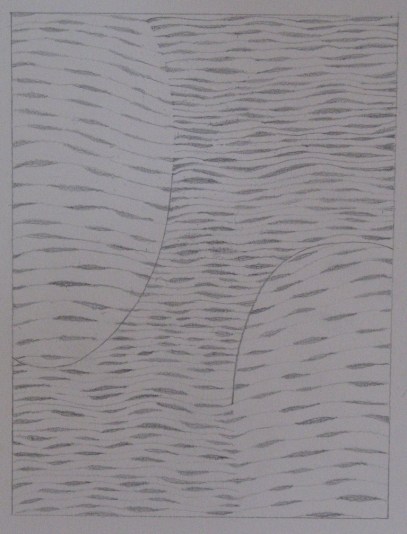 Untitled, pencil on paper, 4.5 x 6 inches

Grief (with thanks to Denise Levertov), conte crayon on paper, 11 x 12 inches
Levertov’s poem “Talking to Grief” gave me this image that helps me to acknowledge and honor such sorrows; I’m so grateful. And grateful also to my spiritual director, the Rev. Sandee Yarlott, for the language of “acknowledging” and “honoring.”
While I was working on the drawing, I returned to the poem and decided to try to translate it into Spanish. Robert Frost said that poetry is what gets lost in translation, and it’s probably more than I can do to get a literal translation right, much less evoke the poetry of the original. I have a lot of questions for my Spanish teachers when we meet next week, such as “what’s the nearest Spanish equivalent to ‘grief’?” and which of the various terms for “mat” evokes the kind you’d be likely to give to a stray dog, and whether the tone is at all like Levertov’s. But here’s my first pass at it. Friends who are fluent in Spanish, I’d love your input on the translation, if you’re so inclined. The English original is here.
Hablando a Luto
por Denise Levertov
Ah, Luto, yo no debería tratarte
como un perro sin hogar
que venga a la puerta trasera
por una corteza, por un hueso sin carne.
Yo debería confiar en ti.
Yo debería engatusarte
para entrar la casa y darte
tu propio rincón,
Una estera gastada para acostarte,
tu propio plato de agua.
Tú piensas que yo no sé que hayas estado viviendo
debajo de mi porche.
Tú añoras que tu verdadero lugar esté preparado
antes de que el invierno venga. Necesitas
tu nombre,
tu collar y chapa. Necesitas
el derecho de ahuyentar intrusos,
considerar
mi casa la tuya
y yo tu persona
y tú mismo
mi proprio perro.
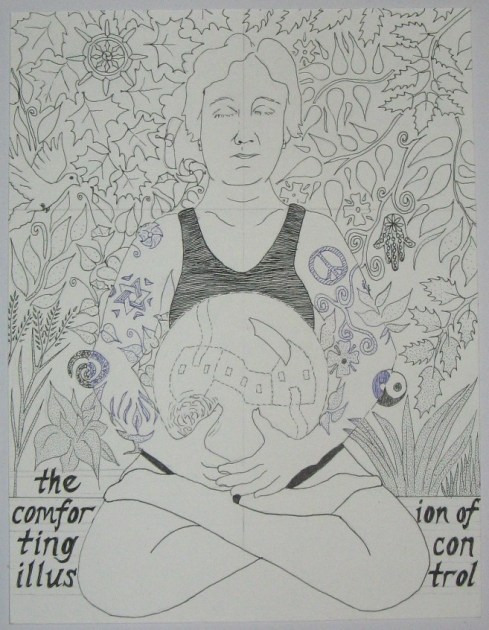
Pencil & ink, 9.5 x 12.5 inches, July-August 2016
Moving along finishing some pieces. These two little critters have been almost-done for several weeks. The cat is 5″ long, the armadillo 4″, not counting their tails.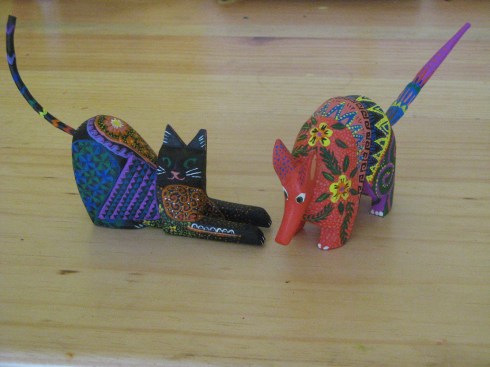
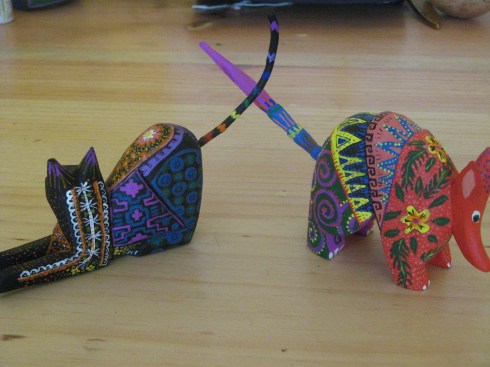
Heaven knows we aren’t going to have room in our suitcases even for the things we’ve made and bought, but I think we need to buy more unpainted alebrijes to bring home. We’re already thinking, “Alebrijes-painting party!”–for the munchkin’s next birthday if she wants, sure, but also for grownup friends.
Some art works start with an image that comes to my mind, some with an idea I want to express, some with something I see that begs to be re-created on paper. And then there are some that begin with a powerful desire for an excuse to buy more fine-tipped markers.


I think I’ll be doing more in this vein, but I’ve promised myself: no new pieces until I’ve finished most of the ones that are half-done.
With a printmaking class coming up starting September 3, I thought it would be a good deadline for finishing the various half-done pieces I have in process. It’s been luxurious to start any piece that comes to mind, knowing I have lots of time to cycle through them, but when I counted I thought of eight pieces currently in process, not including a couple of designs that will probably be turned into prints. I often find it difficult to call a piece complete, and I wanted to nudge myself to just do it.
Well, today’s Tuesday, I thought. We’ll be going to the studio where we do ceramics, and our pieces will be out of the kiln, so I’ll glaze my two–a great start toward my goal for September 3. However, when we got there, the pieces had not returned from the kiln. So I . . . . started on a new piece, a linocut. Which, of course, is now unfinished piece number nine. Oh well! At least I can finish it at home, having splurged on a set of tools yesterday.
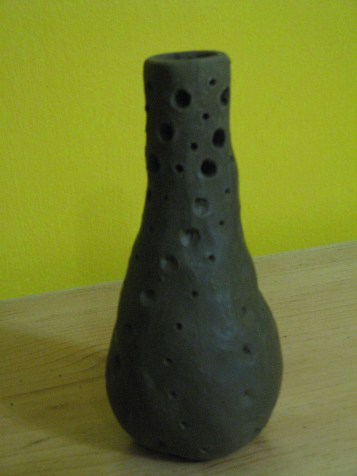
Last Saturday we went to a workshop on barro negro (black clay) with an artist from San Bartolo de Coyotepec. Incredibly, the method is pure pinch pot: building it up with one’s hands, without coils (for the most part), slabs, or pottery wheel. I really liked the vase I made, but the bottom is much too thick and has developed cracks that would break it right apart in the firing. So I am going to dissolve it back into clay and start over–now that I’ve documented what it looks like.
Then, yesterday, we went to Burro Press and got a lesson in linocuts, called suelografía in Spanish, to my amusement–suelo means floor. Here’s the first proof of my first linocut, and the placa (what’s it called in English? plate?) below.
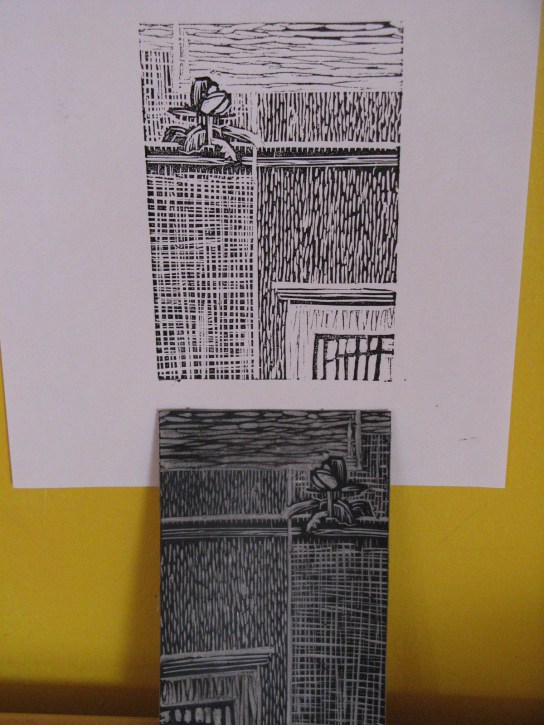
There are two changes I’ll make now that I can see how it’s come out, and one change I wish I could make but can’t. I will make the sky and the area around the door more purely white, and I wish I could change the cross-hatching on the left-hand building (left-hand in the print, that is, not the plate). I wanted it to look lighter in color than the building to its right, but I think it is too busy. If I had it to do over again, I would use the same technique of vertical white lines, but make them denser.
And I will have it to do over again, because I’m taking a class in woodcut and linocut at the Casa de la Cultura Oaxaqueña starting in two weeks. (I won’t really re-do this piece, though. I have other plans.)
Joy & Munchkin made beautiful pieces in both media, and we’ll be picking up their fired barro negro later today.
I’ve finished the building phase of two ceramics pieces, both coil built. Eventually they’ll be fired and ready for the next phase.
Vase with roots (approx 10″ high, 4″ at widest point):

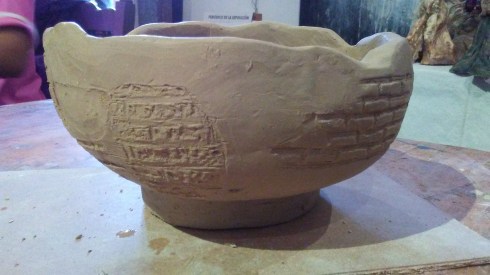
Walls of Oaxaca (approx. 6″ high, 10″ wide):
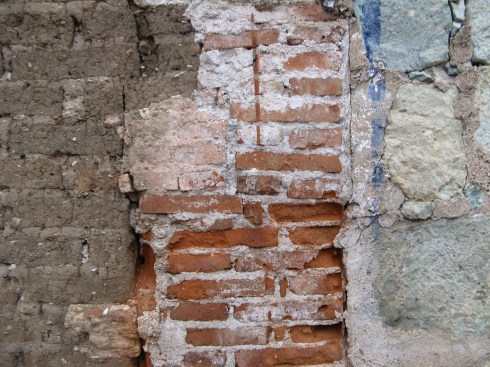
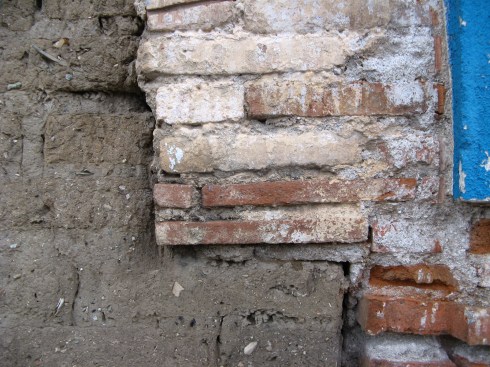
This is a common sight in Oaxaca. A wall with several layers exposed: paint, stucco, brick, stone, adobe. It’s like a telescope that looks into the past. It sees the history of that building, and also the earth of which it was built.
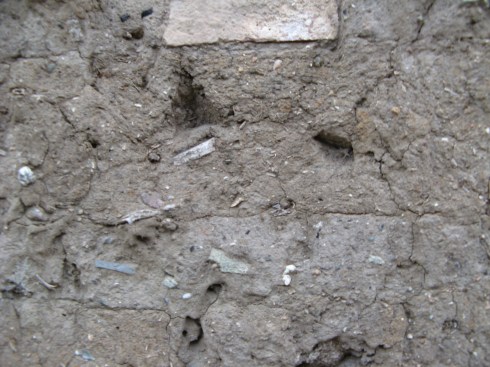
The adobe in particular is fascinating, being made in part of straw that grew during the season when it was built, and pebbles that were made by the earth of that place millions of years before.
Today we were back in the ceramics studio–we get there about once a week–and I finished the basic shaping of a coil-built bowl that is going to pay homage to these walls. When I’d done that, I had about half an hour to begin carving the outside of the bowl. It will have the textures of brick, mortar, stone, adobe–all these inhabitants of Oaxaca that are never out of sight for more than a block or two.
I was so tired during the afternoon that I told Joy and Munchkin to go to the studio without me. I would stay and sleep, I said. But I got a breath of second wind and decided to go along. I was very glad I did. Working on the clay woke me up.

 Sermons in Stones
Recent comments