


All in my 5×7 sketchbook in graphite.

Finding the sacred everywhere. Thoughts on religion, art, books, politics, philosophy, and life in general from a Unitarian Universalist minister.
All in my 5×7 sketchbook in graphite.
Thanks to friends of our family who owned a house near the Headlands in Rockport, Massachusetts, I got to visit this lovely town once when I was a child. All I remember from that visit is a house with circular rooms, the quality of the light in the house, and a feeling of complete delight.

When we got the chance to visit Rockport this month, I knew I had to find that house. It turned out to be easy to find online: my mother confirmed my memory of its being round, so I put “round house Rockport” into a search engine and was immediately taken to a vintage photo of the studio of Harrison Cady, who was a well-known illustrator in his day. I hadn’t remembered that it was once his house, or that he had lived in Rockport, but I knew he was related to our friends, so there you have it: that’s how they came to have a house here. Joy and I walked up to it on my first day here.
It’s right on the water:

The view from the place we’re staying is no slouch either:

From the Harrison Cady house, we went on to the Headlands, which looks out across the harbor and out to the Atlantic, which is located where an ocean ought to be. I’m sort of joking, since after 20 years living a few miles from the Pacific, I’ve stopped thinking of it as being on the wrong side, but it still feels more natural to have the water “on my right” as I face north.


Another difference between here and California is how much longer Europeans have been here in New England. You don’t see buildings from the 17th and 18th centuries in California.


This house was constructed more recently. In the period when our daughter had tiny imaginary friends everywhere, she would have loved it.


Also on my first day, we walked around the corner to the Unitarian Universalist Society. I didn’t expect it to be open on a weekday morning, but when I tried the front doors anyway, a man waiting in a car called out that he was a member, and could he help us? That question is used so often to mean “What do you think you’re doing?” that it’s hard to convey that he really meant it, but he really meant it. He and his wife had stopped by to take care of a couple of things, so they immediately gave us a tour. In the lovely, sun-drenched sanctuary, we discovered that, like UUCPA, they have a chalice shaped like a tree. Isn’t it striking? I like the nest for the flame.
They have beautiful rooms upstairs too, especially the tiny room for the tiniest children, with its windows on three sides giving views onto the ocean and town. We also got to see their solar panels, installed just last summer. Sadly, I am fitting this vacation in between Sundays, so I can’t attend a service. But it was great to meet a few UUs, who were as warm and friendly as could be.
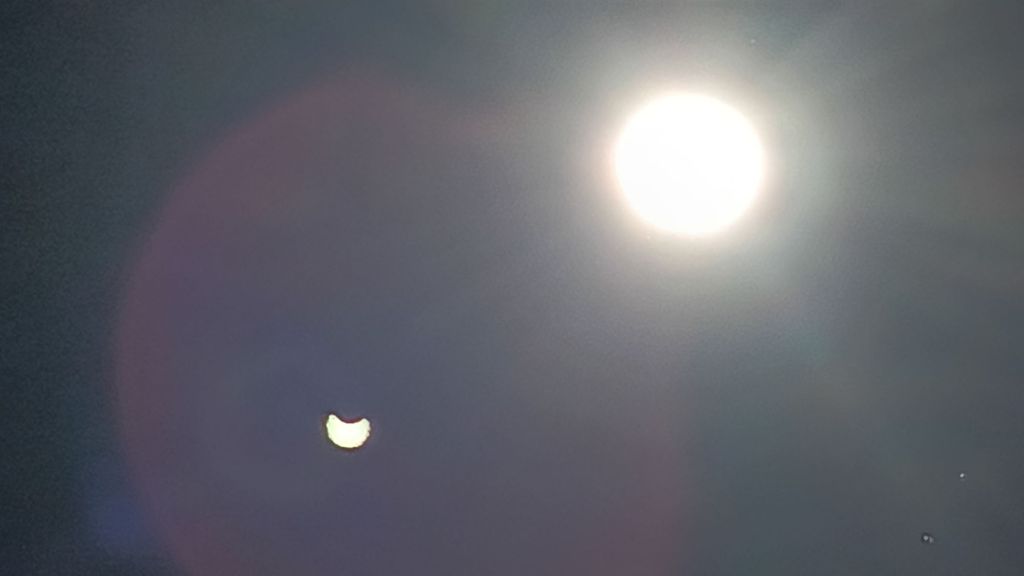
This is as close to totality as we got in San Francisco. But at least the sky was unclouded. The “big sun” must be some kind of glare effect.
Listening to scientists describe totality, I want to see one before I die. Maybe I’ll go to Alaska in 2033, take in Denali and the Northern Lights while I’m at it. In the meantime, I’m watching it on NASA’s livestream right now.
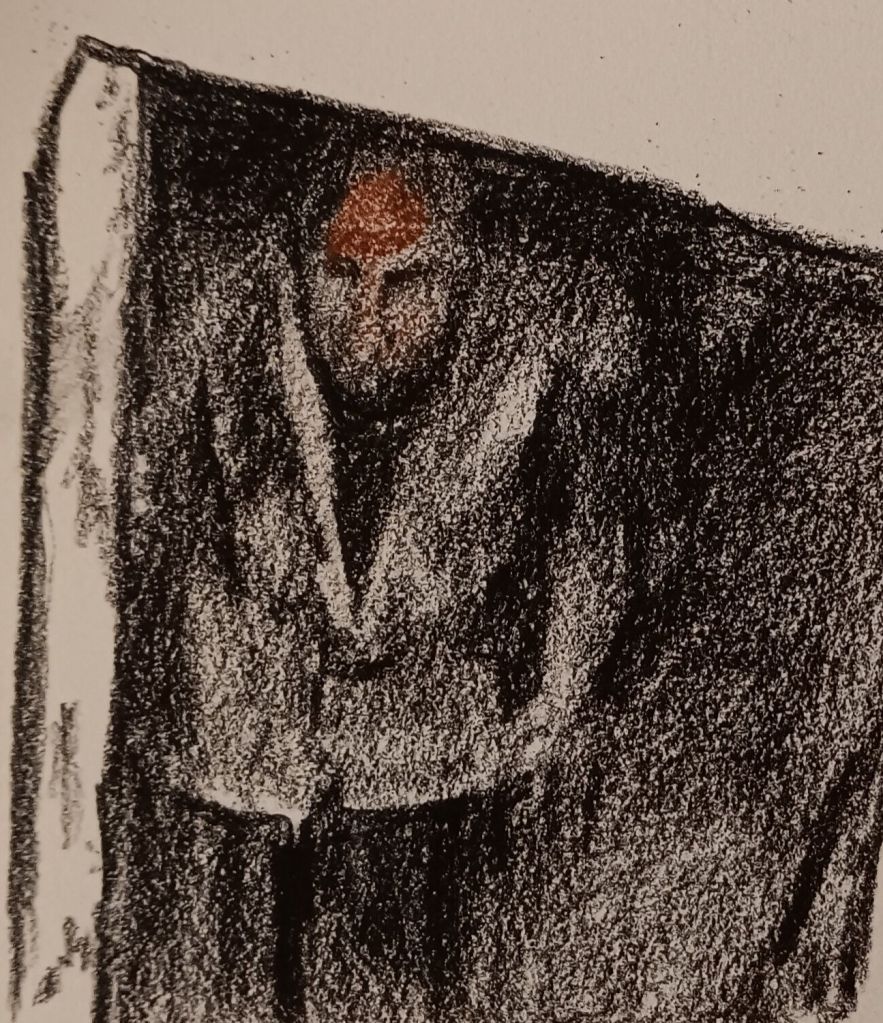
I have been listening to people’s stories from Israel and Palestine (This American Life has had several lately) and looking at photos of the devastation. In one photo, the figure of a man standing in a doorway of a shattered building (his home?) seems so small, but also immovable in both dignity and grief. I was hearing the same in the stories, all the stories. I kept coming back to that photo until I realized that he was the person I needed to draw.
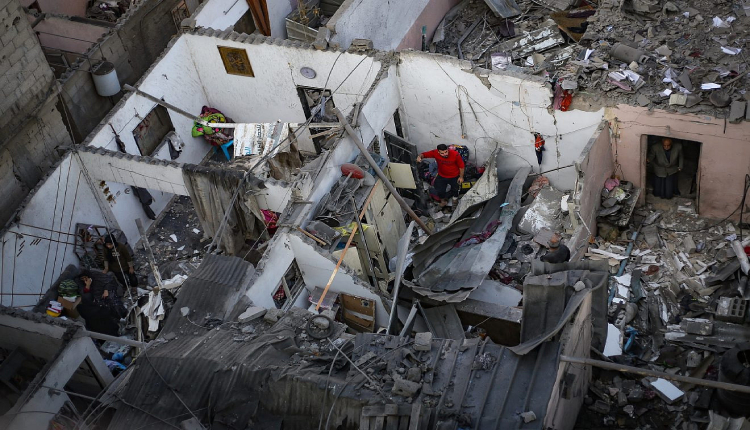
The drawing is conté crayon, about 4″ x 3″. The photo is below. I have seen it with various captions on different websites, usually with some editorial slant, but all agree that the photo is of Khan Yunis, in the southern Gaza Strip, and shows the result of an airstrike by the Israel Defense Force on December 6, 2023.
I have a gym membership, but a few times recently, I’ve put together a home, calisthenics (bodyweight only, no weights) workout in order to keep up with my schedule while traveling. I liked it pretty well, so I thought maybe I would switch to these workouts entirely. It would certainly save me a lot of money. My main concern was whether they would be rigorous enough, being that we have no equipment except a couple of five-pound weights. Bodyweight is all very well, but eventually it may get too easy, and then I won’t have weights on hand to add difficulty.
I can now rest easy on that point. I did some research, created a four- or five-exercise regimen for a pull day, and started in on it. I completed one of the exercises this afternoon, a superman, and have been knocked absolutely flat ever since. Whoof. Lying in bed, aching all over, and now going to take a couple of ibuprofen and a nice soak. It’s possible that I’ll eventually get so fit that I’ll need to get some equipment, but that time is clearly a long way off.
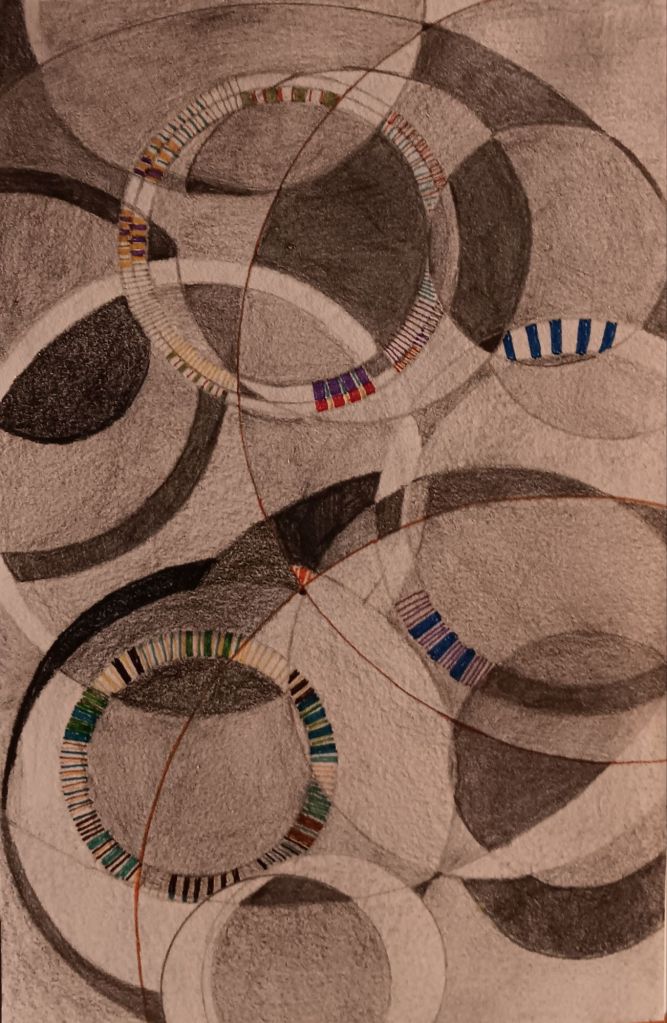
What I’ve been drawing for the past two weeks. One small sketchbook page of pencil and marker doesn’t seem like much, but I’ve been doing it every day–sometimes for a long stretch, sometimes for only five or 10 minutes–and making art a steady part of my life even as job, family, and household fill my time, is an effort and an anchor.
Also, there’s a story with this one. The image came into my mind of dark, receding layers of concentric and overlapping circles, and some brighter rings in the foreground. As is often the case, I had no idea why, or what it might come to mean, but I was intrigued. “Huh,” I thought. “I’ll have to draw that one of these days,” and I went on with whatever I was doing.
Well, I had just given a sermon on the difference between our popular conception of some people’s being geniuses and the much more liberating, fruit-bearing idea of occasionally having a genius, like a spirit that visits. Elizabeth Gilbert writes about this in her book Big Magic, and as soon as I read it I was captivated, or rather, freed, by it. In the sermon, I talked about ways we might invite a genius to visit us, and keep it around when it does, and the most important one was to heed what it says.
So I heard myself not-heeding. Telling the genius this wasn’t a very convenient time. And it wasn’t because I was performing open-heart surgery or driving to an urgent appointment. I just didn’t feel like sitting down and making art. All the little habits of fear and hesitation had me shooing the genius out the door. But thanks to Elizabeth Gilbert, and giving the sermon, and having so many people respond to it, this time I noticed myself saying no and how diametrically that contradicted the advice I had just given. I pushed aside my shabby excuses, got a compass out of the “Sharp things!” drawer in the art room, and tried to put on paper what the genius had shown me in my mind.
Until I said “Maybe later” to the genius, and heard myself saying it, and heard the contradiction, I didn’t realize how habitually I say “Not now.” How I am, in fact, in the habit of saying “no” rather than “yes” to the genii who, by my great good fortune, knock on my door pretty often. I am really excited to discover what might happen when I start to welcome them in.
I’ve just published my 20th Ask Isabel column. I’m still having fun.
Ask Isabel: God and infinity and eternity, oh my!
If you like, please share. If you want to get a ping each week when it posts, please subscribe.
Joy and I went to my mom’s in SoCal for the long weekend, and before plans had even taken shape, all three of us said, “Let’s go to Luna Luna!”
Luna Luna was a combination art extravaganza and amusement park, conceived by André Heller and created by an incredible roster of artists: Sonia Delaunay, Keith Haring, David Hockney, Salvador Dali, Jean-Michel Basquiat, Kenny Scharf, Rebecca Horn, Roy Liechtenstein, Georg Baselitz, and many others. Heller asked them if they wanted to create an art amusement park, and they said YES. It opened in Hamburg in 1987, ran for six weeks, and then . . . disappeared. The plans to go on to more cities fell through, and there was nothing to do but pack it all up into 44 shipping containers.
There was a documentary at the time, and these artists weren’t exactly obscure, yet it was all but forgotten. Several years ago, after pulling together a team that crucially included Drake as a funder, Heller and his son brought the pieces out of storage. A small number of them are resurrected in Los Angeles, and even though you can’t go on the rides, it really feels like an amusement park, not a gallery. After this run ends in May, Luna Luna will go to New York. Maybe one day kids will be able to ride the Keith Haring carousel and a classical violinist will once again perform with a professional flatulist in Manfred Deix’s Palace of the Winds (fart jokes were apparently even more amusing to 18th-century Austrian adults, including Mozart, than they are to 21st-century US American fourth graders).
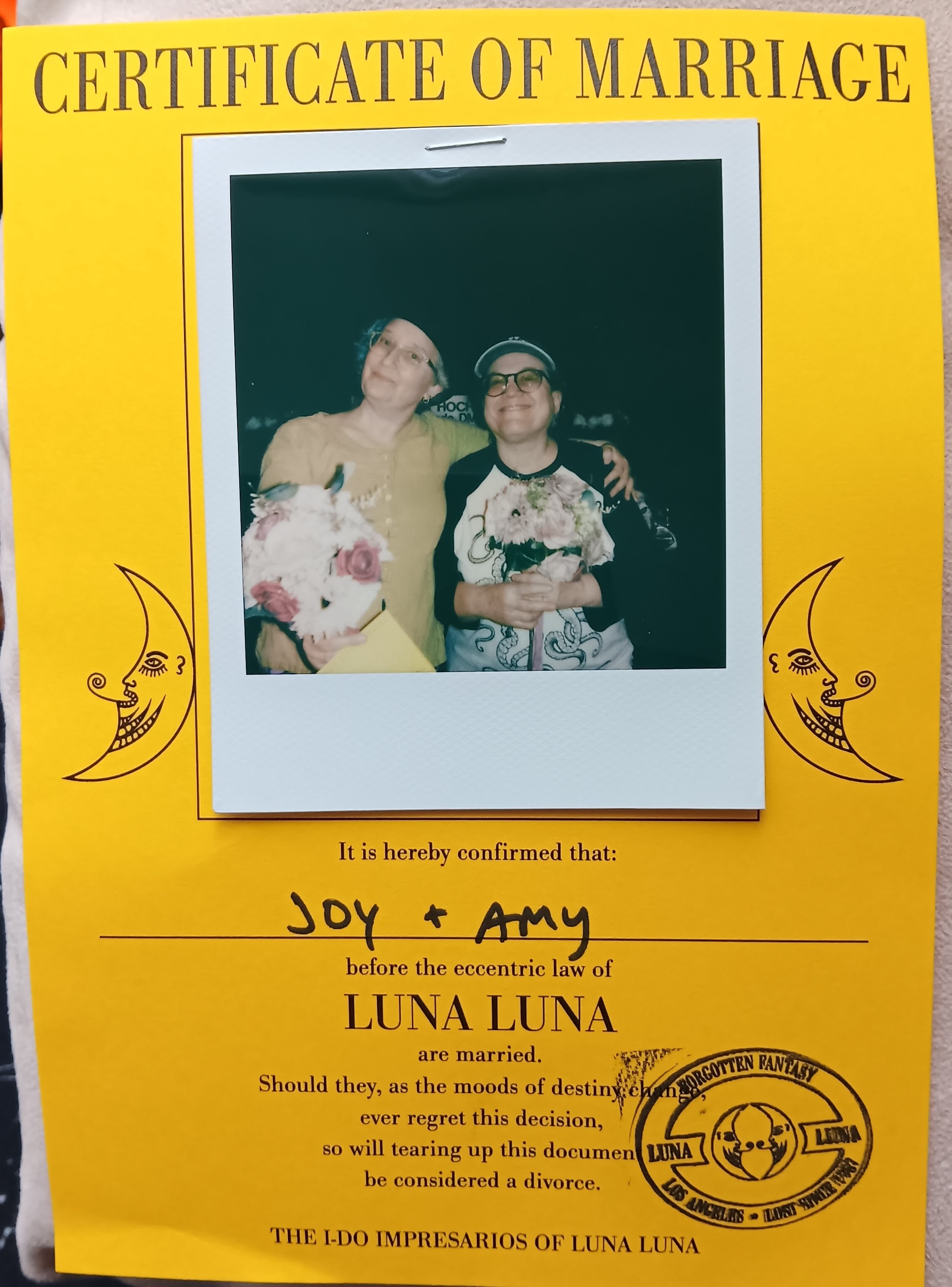
No one need wait for another of Luna Luna’s features, however: André Heller’s Wedding Chapel. “Do you want to get married?” I joked to Joy. “Yes!” she said, sincerely, and soon we were standing before a very sweet celebrant, who took the time to ask how long we’d been together and other details of our lives, sighing sympathetically when we said our first wedding wasn’t recognized by the law. Then we picked up bouquets and I put on a top hat. Joy already had her Flying Spaghetti Monster baseball cap, and I thought that it introduced a key spiritual element, so I urged her to stick with it rather than take one of the top hats or veils the chapel offered. We re-exchanged rings and kissed. My mom video’d the whole thing, and the people gathered around cheered, while one impresario rang a bell and another took our photo. It was fun and funny and lighthearted and art-infused, just like our life together. And to look into my wife’s eyes as she was asked if she would “venture an adventure through galaxies of love” with me, and to have her gaze back as she said that she would–that was a sacred moment I will always remember.
We were married in the eyes of our family and church in 2005, and again in 2008 when the state of California opened its eyes. So now we have our third marriage certificate. It’s good to revisit our decision now and then and remind ourselves that we would marry each other all over again.
That’s the question asked this week on Ask Isabel. It happens a lot, it’s a tender time, and it’s hard to find people who will help us along on our own journey at these moments. Most want to convert us to something new. Or they congratulate us on seeing things more the way they do. Or they try to talk us out of our “backsliding” (which is what a new stage can look like to the others in our community–see Stage 4 here). Here’s my take.
Ask Isabel: Losing My Religion
If you want to be pinged each week when the new column is up, you can subscribe here. It’s free and spam-free. And you can share any column with friends, on social media, wherever you think someone would benefit from reading it.
Photo by Karl Fredrickson on Unsplash
The Judaism I was taught regards trees as a particularly beautiful and sacred part of creation. It is a mitzvah to plant them. Given their slow growth and long lifespans, they are a gift to the future. Humans’ nurturing of trees symbolizes the very essence of ethical living: to think beyond oneself and take actions that may benefit oneself only minimally, but will greatly benefit others, as an oft-retold Talmudic tale relates.
My own tender love for trees came up hard against a fact that, may I be forgiven, I did not know until this newest stage of the bitter war between Israel and the Palestinian people, even though it has been reported in the news over many years. This fact: that the government of Israel has destroyed hundreds of thousands of trees on Palestinian land, and protected Jewish “settlers” as they have destroyed thousands more, dating back at least to 1967, the Six-Day War, and with the destruction (with or without the IDF’s support) if anything only worsening over the past few months. This piece stems from my grief and alienation, which have intensified over the years, took a sharp turn upwards with Israel’s brutal conduct of this war, and are crystallized in the assault on Palestinian trees. To destroy trees in order to attack people is thoroughly despicable. It bears no resemblance to the Judaism I was taught, but of course, the government of Israel has long been out of step with what I love and respect about Judaism.
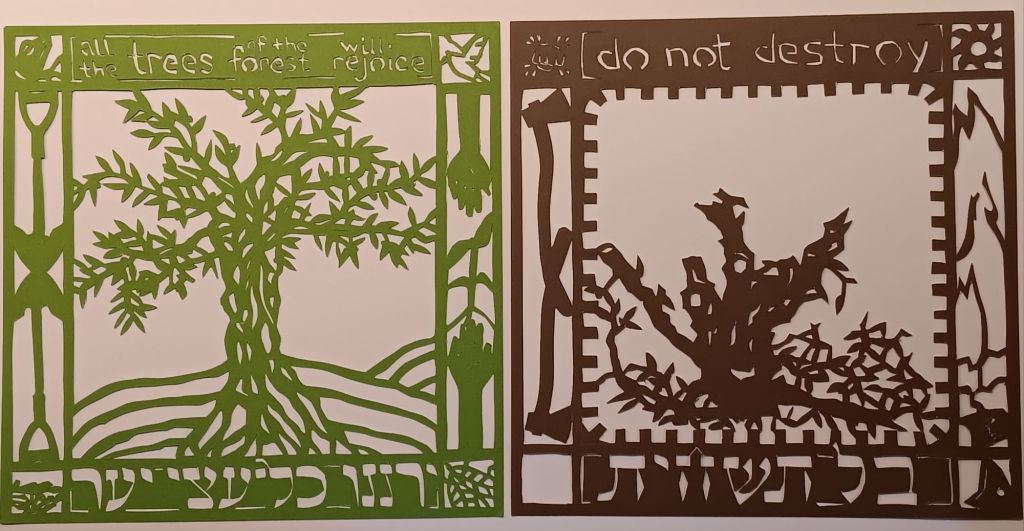
The beautiful vision of the latter appears here on the left panel, with a phrase from Psalm 96 in Hebrew and English, “y’ranenu kal atzei ya-ar,” “all the trees of the forest will rejoice,” framing a thriving olive tree. Around it are (clockwise from upper right) a dove, hands planting a seedling, an insect that lives symbiotically in olive bark, a birds’ nest, shovels, and a lizard that makes its home in olive trees. (I provide this guidance in recognition that my paper-cutting skills are not quite up to my artistic vision, LOL.) On the right side of the diptych, another of the central ethical teachings of Judaism, “ba’al tashchit,” “do not destroy,” frames a dead olive tree. Around the edge are (clockwise from upper right) a bulldozer sprocket, flames and a tear gas canister, a bulldozer blade, emptiness, axes, and a punching fist.

 Sermons in Stones
Recent comments