The latest Ask Isabel column answers a parent whose child has learned about a heavy topic–from a church Sunday school.

Ask Isabel: Advice for the Spiritually Perplexed and Vexed

By the way,  if you enjoy Ask Isabel, two things you can do to support it is subscribe (it’s free) and share the column on social media, or with any friend who might take an interest.

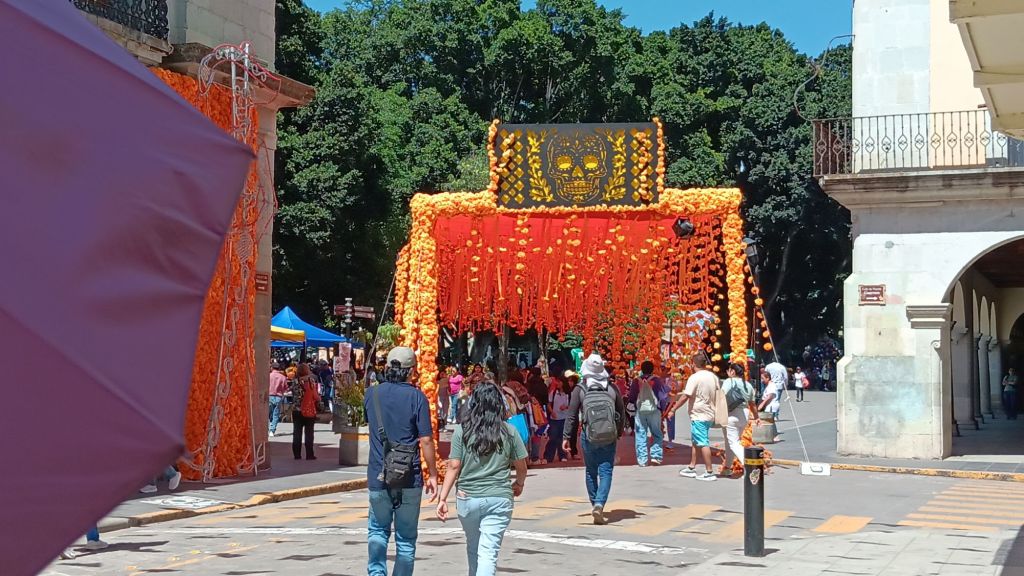
A lot of the decorations around doorways and such use fake cempazuchiles, but the real ones are also brought in by the truckload.
The corners of the Zócalo, the main square, have these entrances set up.
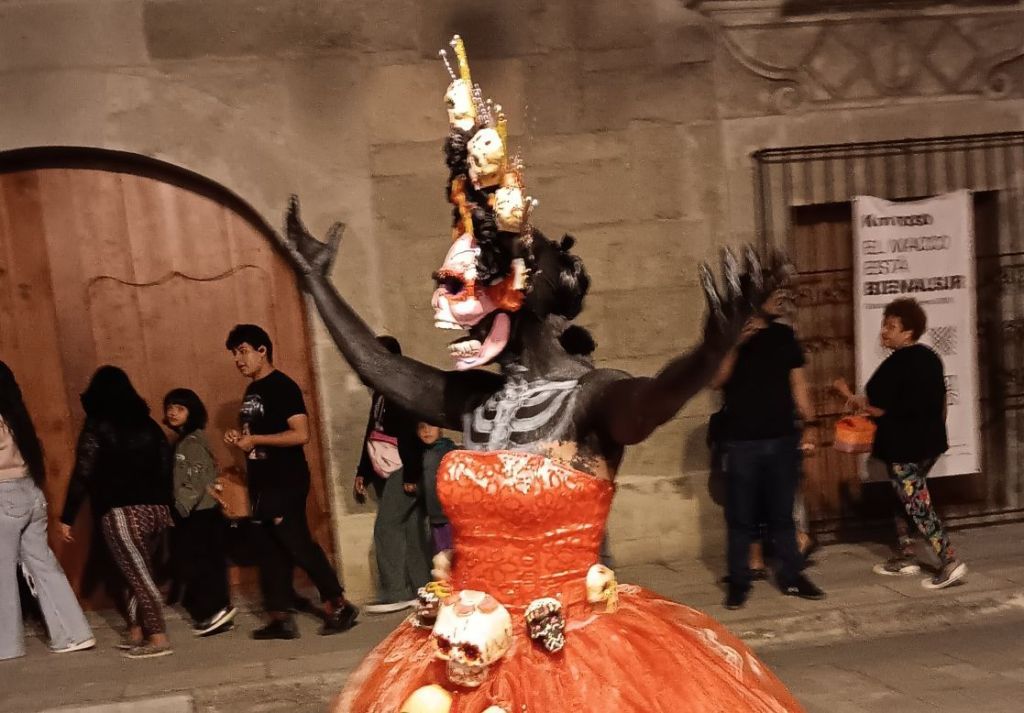
On the Alcalá, the pedestrian street running south to the Zócalo, there have been lots of dances, songs, theater performances, and parades–more than usual, or I guess all I can be sure of is more than six years ago. I think the intensity has increased because of the fiesta.
I hope the person who did this performer’s makeup knew a lot of the applause was for them. Just gorgeous.

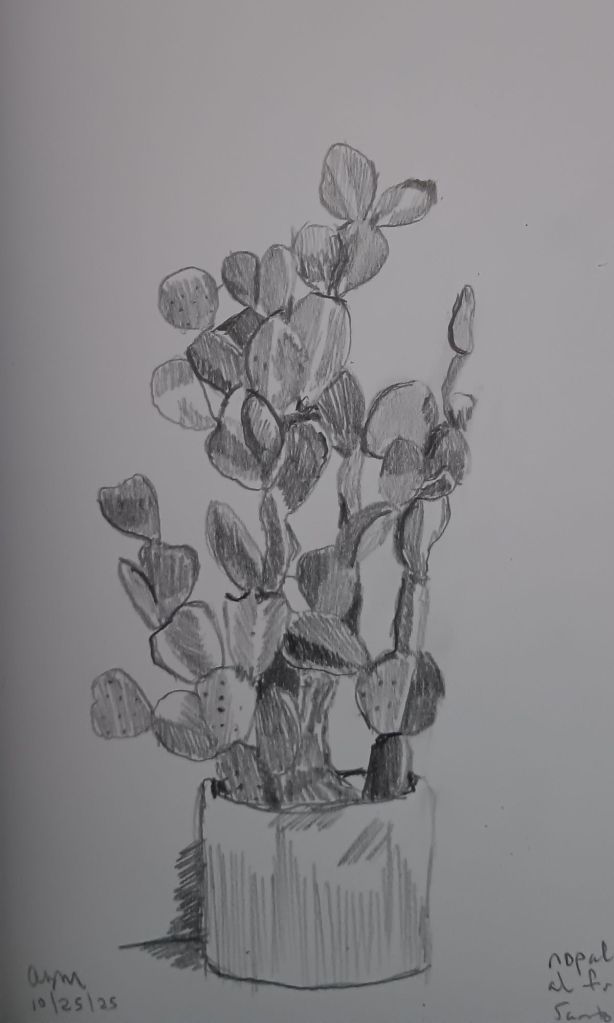
Why I carry my sketchbook and notebook with me. When our feet get tired and it’s time to sit and rest, I can write or draw, which makes the extra several ounces in my backpack very worthwhile. Yesterday, when the heat and elevation forced a rest, this nopal cactus across the street from the Santo Domingo church caught my eye.

Pencil, 5×8 sketchbook page

I think I’ve probably adjusted to the elevation now. I used to dream of going to Macchu Pichu, but I don’t know if I could now. A jump from sea level to a mere 5,800 feet–Oaxaca’s elevation–takes me a couple of days. As with so many things, sufficient water and sleep help a lot.

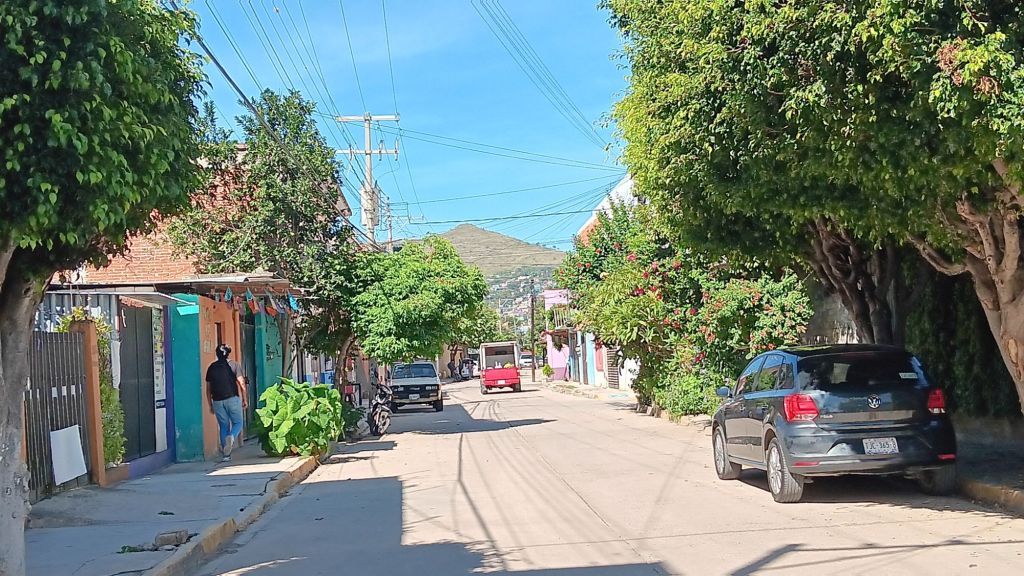
The street just outside the place we’re staying
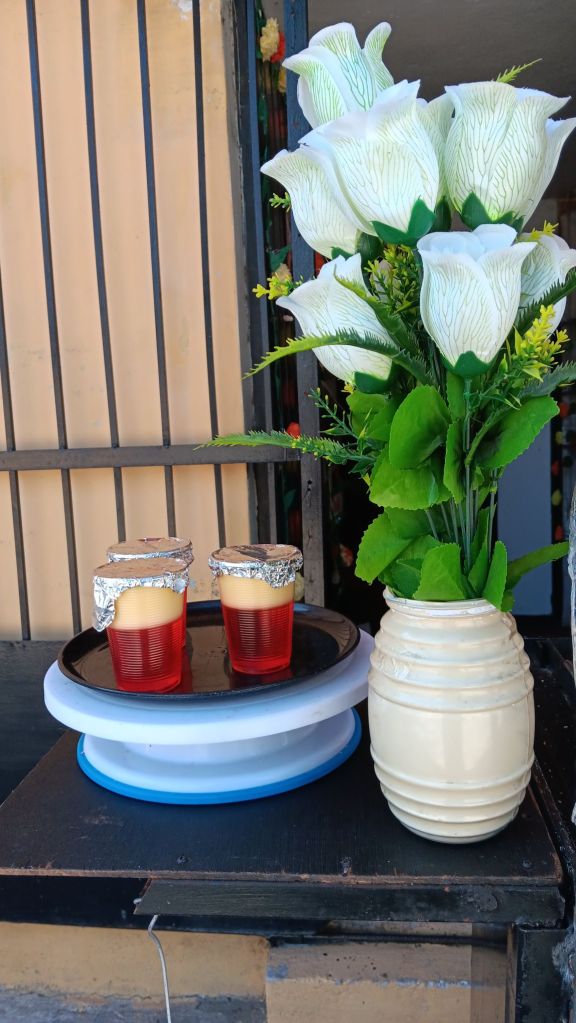
I don’t want to eat gelatina for breakfast (or ever), but I feel a pleasant nostalgia seeing it set out at tiny little home-based establishments.
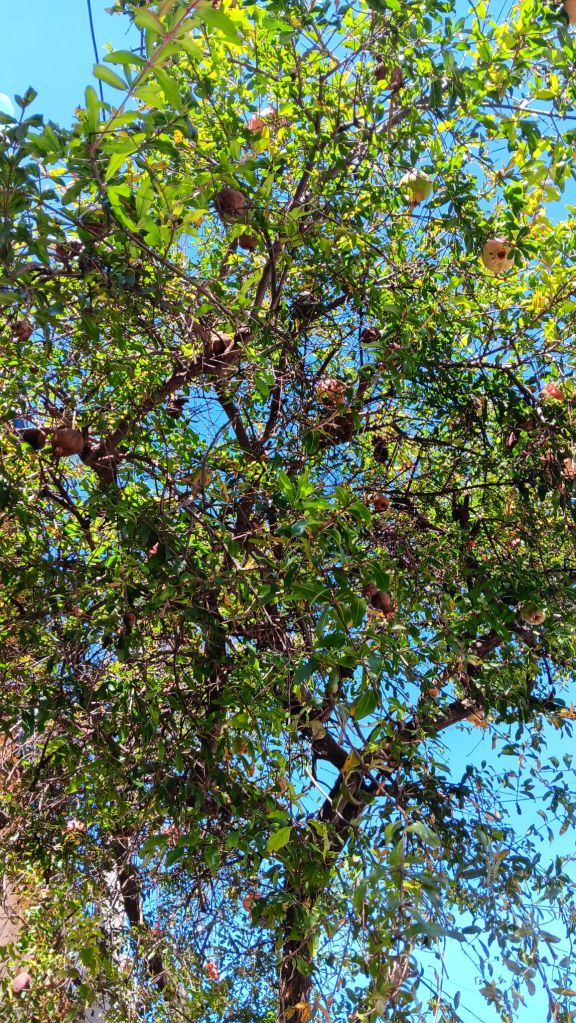
Pomegranate tree
“Movimiento,” a beautiful mural a few blocks away. Oaxaca’s indigenous people show up here and so many places.
Is this what happens if you let an impatiens grow into a tree? It might be. 
Día de los Muertos is coming soon and already celebrated, with cempazuchiles (marigolds) everywhere.
This made me laugh. The sign asks drivers please not to park in the pedestrian crosswalk, marked by steel bumps and orange paint. It’s having no effect.

I was headed to a café several blocks from our place, but gave up–I think Google Maps is out of date–and went to the local huge supermarket for oat milk and other necessities.

I love the way in their Mexico marketing, Kellogg’s just drops the euphemism and calls Frosted Flakes “Little Sugars.” Like Calvin’s “Sugar Bombs” in Calvin and Hobbes.
There’s great stuff at the supermercado, though, like an entire bakery with lots of fresh bread.  Naturally, I brought home one of these crocodiles.
Walking a different route home. We, too, can have sidewalks like this if we get rid of all those pesky regulations and the agencies that enforce them. It looked like a drop of 10-15 feet. Fun!
And when you come to the curb, a chasm opens between the sidewalk and the street. In case you missed the opportunity to plummet through the concrete before. US Americans, we could save so much tax money and our boring, “safe” sidewalks would soon disappear!

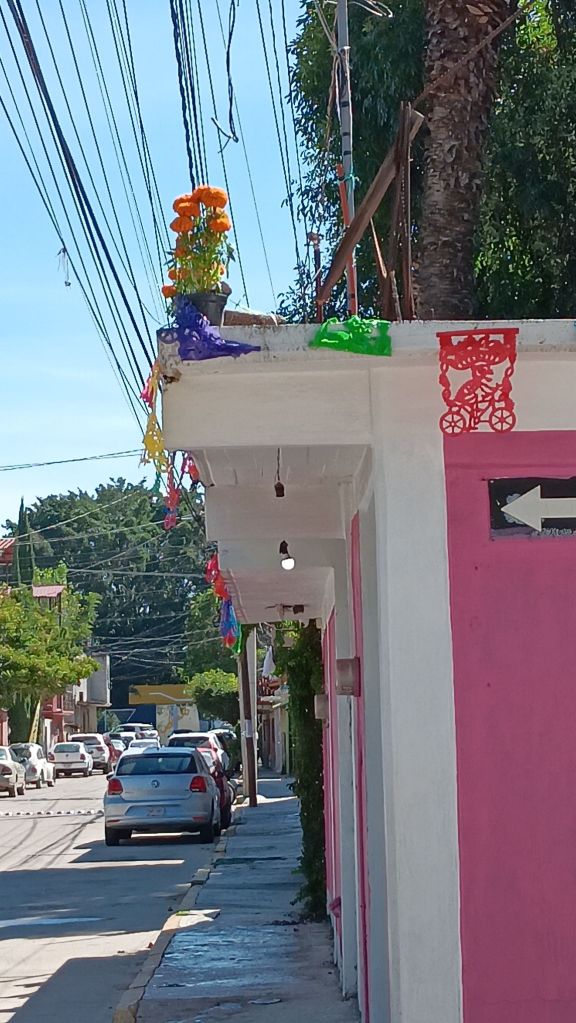
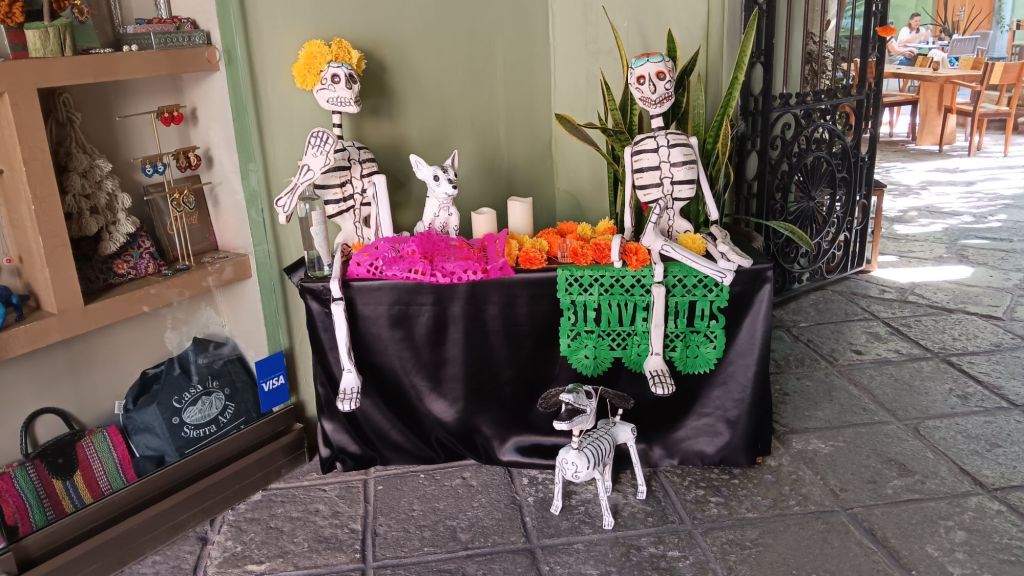
We had breakfast at the house and then headed to the centro. Altars and special decorations for the fiesta are everywhere.

What pictures can’t capture are the smells, like the heavenly scent of tortillas cooking all through the neighborhood. The feel of the round bumps of paving stones underfoot, and the necessity to duck now and then where a guy wire crosses the sidewalk. The sound of the very annoying truck driving all around with a recording of a woman speaking that was loud yet unintelligible. When the truck passed close by me as I explored, I realized she was listing all the tamales the truck driver sold. Yum. Maybe tomorrow I’ll flag it down, though I hate to reward such an obnoxious method of advertising. And then there were the sounds of dogs distantly barking, roosters crowing, people chatting with their neighbors. It all adds up to a place so familiar and beloved, I can’t believe we stayed away for six years.

Can you picture this?: A member of your family, or a dear friend, has been taken by ICE and locked in Alligator Auschwitz. Do you have someone specific in your mind? Okay.

You’re incredibly worried about them, of course. You get a lawyer, and you check the ICE database every day to see if there is any news of them.

Then, one day, they aren’t in the database. You check to see if you had a typo. No. They just aren’t there. You call your lawyer. The lawyer can’t get any more information than you can. This person you love has disappeared. Been Disappeared by the US government.

Mtenaespinoza, CC BY-SA 4.0 https://creativecommons.org/licenses/by-sa/4.0, via Wikimedia Commons. The spray paint says “No one deserves to disappear,” and the heading in red before his name and other information says “Until we find you!!!”

You are desperate for someone to help you–to do something–to force the administration to tell you where they are.

Now what happens? Either thousands, millions, of your fellow-citizens demand answers, pressuring their representatives and senators to demand hearings and ask the administration tough questions, keep shining a light into this dark corner of the country until whatever is hidden there becomes visible–

–or they don’t. There is no help. You and your beloved family member are left to suffer alone.

We’re not going to let that happen. We’re calling our members of Congress, now (or using the contact forms on their websites). We’re doing it again tomorrow, and again the day after that. We’re putting it on our to-do lists, and we won’t stop, because the life of someone’s father, sister, husband, best friend, child, grandson is at stake. And we know if one day it is our beloved who disappears, we will need the solidarity of our sibling-citizens to save them.

The Arts Praxis course I took last semester at the United Theological School of the Twin Cities culminated in a group show called Nexus and a gallery talk by all of the artists, some of whom made visual art and others of whom did music or theater. I kept checking for the video for a while, then got distracted by the rest of life, and just discovered that it has been up for a while. My part begins at 1:25:00, though I certainly recommend watching the whole thing to take in some beautiful work by other students. Our professor and the presiding genius of the Arts Praxis–and of the Theology and the Arts concentration–was Dr. Jennifer Awes-Freeman.

Nexus: 2025 Arts Praxis Showcase

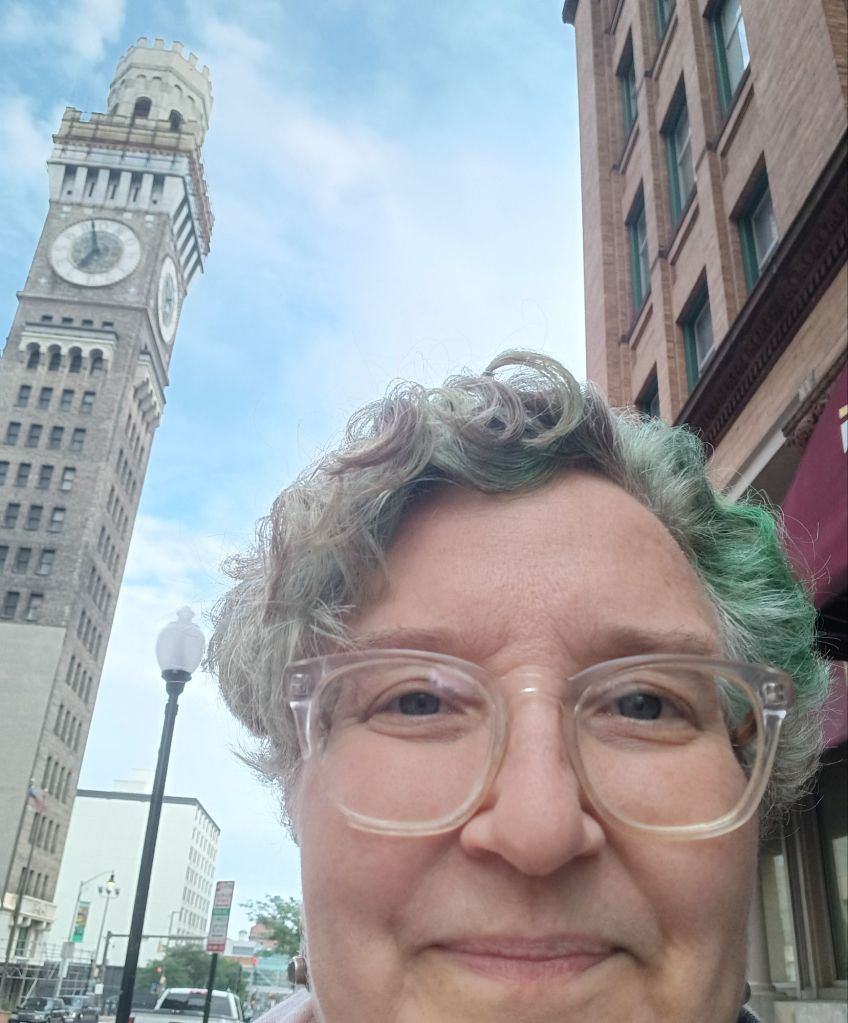
I looked up at the clock tower that rises above this district and discovered it said Bromo-Seltzer. Hence the name Bromo Arts District.

It also seems to be the Erstwhile Banks District. My hotel and several other nearby buildings are old banks, with the stately architecture of 19th century capitalism: no first-floor windows, Corinthian columns, high and sculpted ceilings, the bank’s name carved above the entrance like Ozymandias’. Oh, and the art is about money and wanted bank robbers.

In the convention center hotel–not the one I’m staying in–I saw this poster of a writer I love. Makes sense, as Poe is one of Baltimore’s most famous children, but it turned out it was marking the door to the Poe Room. Can you imagine: a meeting in the Poe Room?! I’d be afraid the door would be bricked up and we’d never escape.

The Calloway Room looks like much more fun.

As far as I can tell, there is no John Waters room. Regrettable.

I helped staff Harvard Divinity School’s booth for a couple of hours. About half of the people who swung by were interested in seminary, and half wanted to say “Stay strong, Harvard!” Amen. I think Harvard learned from Columbia’s experience what Columbia should have known: the only reward for giving a shakedown artist what he wants is to be shaken down more.

After dinner with West Chester, PA’s minister, Dan Schatz–he’s my bestie from seminary, and with our birthdays a week apart in June, whenever we’re both at GA we have a birthday dinner in between–we came outside to light rain and bright sun. The building we’d just exited blocked our sight of any rainbow, but we walked around it and there it was!

People congratulate me wherever I go, and it takes a few minutes of conversation to discover whether I’m being congratulated for 25 years in ministry (the ministers have a service celebrating 25- and 50-year anniversaries, so people know), my retirement from FT work, my completion of a long ministry in Palo Alto, or Indigo’s graduation and college plans. This is how lucky I am.

I sang in the choir for the Service of the Living Tradition (celebrating milestones for religious professionals), something I’ve done only once before. It was an utter joy, and also I now have an india.arie earworm.

I have taken almost no selfies despite running into a zillion dear friends and colleagues. I rush over and hug, but it doesn’t occur to me to snap a picture. Sorry, y’all. I hope you know I love you.

You cannot open more than one lateral file drawer at a time, of course. So I can’t take a picture of the three drawers of this four-drawer lateral file that are empty. But I’m sure you believe me.

In case I failed to post it here before, June 30 is my last day at UUCPA. I promised myself I’d have the lateral file, which was quite full, cleared out before leaving for our General Assembly (and the ministers’ conference that precedes it), which I do on Monday. The first three drawers took a couple of months, but I’m on a roll and confident that I’ll clear out the last one tomorrow. That will be awesome, even though the bummer of file cabinets is that the office looks the same whether they are full or empty. I don’t care. I will know they’re empty,  and that a dreaded task got easier and easier until I was done with it.

I have accumulated a lot of paper in 22 years. I should plant several trees in compensation. Between meetings today, I took boxload after boxload to the recycling dumpster, feeling lighter each time. And I did a few rounds of distributing Stuff from my office to its former and future homes, such as the office-supplies cabinet in the main office, the kitchen, and the art-supplies shelves. Lighter! Lighter! By the way, no one at UUCPA need ever buy file folders, hanging files, index cards, three-ring binders, or paper clips again. I’m not sure anyone, anywhere need ever buy paper clips again, since I have never bought any and yet I never run short at either home or work, but that’s a mystery I don’t need to solve.

We’ll have lots of both members and guests at the service on Sunday, so my goal is to have the files cleared out and the office looking tidy by the end of tomorrow, Friday.  (It was tidy before the last few whirlwind weeks of clearing stuff out. Things get so messy as they’re being reorganized.) I am dearly fond of my beautiful, orderly office–in the last several months, I’ve repeatedly thought of an old Onion headline, “Nine-month Fetus Finally Has Womb Just the Way He Likes It”–and I want it to look good, even if very few people pop in. A few will, for sure, because they are giving new homes to a bunch of my books, which are waiting for them in boxes and bags along one wall.

The desk is almost empty or, in the case of some supplies and files that our interim minister will need, neatly organized. The surface of the desk, though, not so much. So that’s tomorrow’s task, after drawer number four, and between some more key meetings.

And the question is on religion and science.

Occasionally, it’s crossed my mind to wonder whether my parents would want me to say Kaddish for them after they died. I don’t think I could promise getting to a morning minyan every day for the full 11 months, but if it were important to them, I’d make it a regular practice. I know that for my own sake, I will light yahrzeit candles every year. Seeing one on the kitchen counter now and then kept the rhythm of the year, reminding me that my mother had her own heart-calendar. (I remembered exactly which dates of the secular calendar my aunt and grandmother died, but one marks the yahrzeit on the Hebrew calendar, and I didn’t know those dates. But Mom did.) Without ever consciously deciding, I’ve always known that I would have that candle for my family in time, a reminder and beacon for over 24 hours until it was entirely consumed. L’dor va’dor, from generation to generation, is a common phrase in Judaism, and lighting a candle continues a ritual that speaks to me and that each generation has observed before me. Kaddish is different, though, at least as it is usually observed: not in the privacy of one’s own home, but communally. It’s one of the prayers that requires a minyan, the quorum of ten adults.

Never having asked him while he was alive, I thought about it after Dad died last month, and was pretty sure that if we had talked about it, he would have made a dismissive gesture and said that he didn’t believe in that stuff anymore. Then he probably would have told a story about helping make up a minyan for the sake of a friend in the synagogue when they were saying Kaddish, or said something else to move the moment on. Or said that if it were meaningful to me, then sure, I should say it. I am still Jewish in some indelible ways, but since the Kaddish is famously focused on praising God (it doesn’t mention death), and since lauding a God I don’t believe in doesn’t bring me comfort, I haven’t said it for my own sake.

Today, though, I went to shul for the first time since my nephew’s Bar Mitzvah, as part of Neighboring Faith Communities, a program I’m co-leading in our congregation. We learn about. I’m teaching the adults and a few lay leaders are teaching a group of middle schoolers, and they make the visits together. I haven’t joined them so far because the visits have all been on Sunday mornings, but as soon as we set the date to visit Congregation Beth Am, on a Saturday morning of course, I put it on my calendar. I had never been, and it was enjoyable.

What I didn’t consider until a few minutes into the service, though, was that there would be a Mourner’s Kaddish at the end of the service and that I was a mourner. I quickly looked over the prayer to make sure I could still say it, as I know my Hebrew reading is a little rusty; the Reform prayer book has transliterations of everything, but I find them harder to read than the Hebrew script. (To be precise, the Mourner’s Kaddish is in Aramaic, but the script and pronunciation of the two languages are the same.) And I felt a strange frisson, to enter the world of Jewish mourners, visibly and audibly, and with members of my congregation around me to boot. When we got to that point in the service and it turned out that Beth Am’s practice is for everyone to say it together, the frisson was replaced by an equally unexpected letdown. But the rabbi asked us to call out the names of anyone we were remembering, I said “David Zucker,” as others spoke the names beloved to them, and then, as we began the prayer, I was back on the long, upholstered pews of Temple Beth Sholom, my father rising next to me to say Kaddish for his father. L’dor va’dor, no question. The tears rose, my voice dried up, and I had to whisper the beginning of the second paragraph: “Yitbarach v’yishtabach, v’yitpa’ar v’yitromam v’yitnaseh” . . . I managed to get my voice back by “b’rich hu,” but I was wrung out.

We’ll say the Kaddish as part of Dad’s memorial service in April. It’s an important part of my sister’s practice, and it seemed right to suggest it when she and I met with the (Unitarian Universalist) officiant, but I wasn’t thinking about what it would mean for me personally. Now I am.

Enter your e-mail address to receive e-mail notifications of new posts on Sermons in Stones

Recent comments

Links I like