Is it unethical to be a fair-weather fan? Of course it is if you actually diss or ignore your team when it loses, and become the world’s biggest supporter when it’s on a roll. But what about less overt cases, such as the baseball lover who’s lived in the team’s radius for several years, made it to only a few games, and utterly failed to follow the standings or know who was who on the team until it went to the playoffs? Just to give a for instance. Not, you know, resembling anyone who might write this blog.

I seek absolution, because I didn’t even know the Giants were in a race for a playoff spot until I came off the BART escalator one morning to see a special edition of the Chronicle, screaming “PLAYOFFS!” Oh. Was it a near thing? Um, yes, actually, it was decided in the final game of the season.

So now I’m having Giants fever and feeling guilty about it. I have a long history of borderline behavior with ball teams, you see. My first experience of baseball was our family’s annual trip to Boston, culminating each time in a night at Fenway, and I proudly claimed the Red Sox as my team. To me, a Connecticut kid, cheering for the Red Sox instead of the Yankees was a matter of cultural loyalty, declaring myself as a New Englander instead of a resident of a mere satellite of New York. (No one paid attention to the Mets.) Besides, given the choice between a perennial underdog and US Steel, the moral choice is clear; I hated the Yankees as a matter of principle. But I wasn’t really a baseball fan. In fact, when I was in Damn Yankees! one summer in high school, I recorded in black and white in my program bio that I hated baseball, a fact that my family and a boyfriend, all of whom were big baseball fans, later threw in my face on a regular basis.

Because after that, Darryl Strawberry came to New York, and my dad became a fervent Mets fan, and the rest of the family with him, including me. In 1985 he and I went to opening day at Shea, a brutally cold outing that ended, gloriously and to our toes’ great relief, with newcomer Gary Carter’s 10th inning homer. I brought home a “K” card with Doc Gooden’s picture on it and tracked his strikeouts on it all through that 24-4 season. I made a Gooden snowman that winter. The next year, of course, was their year, and this is where my Boston-fan friends defriend me, because I cheered for the Mets all the way.

I still maintain that you can have one AL team and one NL team, so Boston is still my AL team. Although the Mets have a place in my heart, I haven’t followed them at all–my dad’s occasional updates on the team’s progress are a swirl of unfamiliar names–and I have made half-hearted attempts to pay attention to my local team. After all, my daughter, native-born northern Californian that she is, will be a Giants fan.

But a baseball stadium is no place for a toddler, with its towers of steep concrete steps, so this summer was the first one that we could have brought her along to a game, and we were out of the country most of the season and . . . well, we’ll just have to get ourselves some tickets for next year. At least we’re teaching her “Take Me Out to the Ballgame,” and at school she seems to have learned to chant “Go, Giants, go! Go, Giants, go!”

None of which resolves my dilemma: I’ve just moved to this city and its team has a chance at its first championship since it moved to this city 53 years ago. I’m burning with excitement, and desirous of a knockoff Giants warmup jacket, and wondering if I’m entitled to partake of the thrill, as long as I promise to go to a game next season and never to kick them when they’re down.
Two years ago I thought we were headed for a serious depression and almost everyone else seemed to think so too. Not Great Depression levels, maybe, but a worldwide crisis, with U.S. unemployment remaining in double digits for years, perhaps pushing 20%. But two years later, the people who’ve been trying to hold the roof up seem to have done it. It’s leaking, and props like stimulus spending are causing their own, predicted problems (a high deficit, but since when have Republicans cared about those? Oh, right, since the Democrats took power). But still, it’s over our heads instead of down around our ears.

So you would think that “We kept things from being really, really bad and held them to just pretty bad” would be a strong campaign slogan (okay, after some editing), but instead, it seems to be conventional wisdom that that argument will get the Dems nowhere. Certainly, Obama has stopped campaigning on what they’ve done over the past two years and is instead trying to focus on the future. Judging from the polls, the party that saved our butts is about to take a licking, as angry voters try to return Congress to the people who created this mess to begin with.

I’m wondering how things were different in 1934. FDR had taken office with a landslide win in the 1932 election, 57.4% of the popular vote; like Obama, he also saw his party take control of both houses of Congress that year (moving from a slight to a commanding majority in the House, and winning the majority in the Senate). So the Democrats went into the 1934 midterm elections in a comparable situation to today’s party, having been able to pass legislation to address the economic crisis over Republican opposition. The Depression was far from over. Unemployment was at 21.7% that year (the Bureau of Labor Statistics can no doubt provide a month-by-month account if you’re curious).

So what happened in those midterms? The Republicans lost big.  And then, in 1936, with unemployment and other effects of the Depression still ravaging the country (the world), FDR won re-election in a landslide.

So what gives?

There are differences between 1934 and 2010, of course. The Depression was well underway when FDR ran in 1932; Hoover and a Republican Senate had had three years to turn it around, but between the 1929 crash and the election, things had only gotten worse. In contrast, Obama came into office at a time when, while almost everyone was predicting economic disaster, the tidal wave had not yet struck. It’s much less psychologically convincing to point out a disaster averted than to turn around a bad situation.

But geez, FDR and his Democratic Congress had barely turned around a bad situation, themselves. They’d created a barrelful of new programs meant to end the depression, and yet the unemployment rate had dropped an undramatic 1.9 points. Why didn’t the voters say “You’ve had two years and things are still a mess!”?

Got a theory? Know some history to fill things in for us? Recommend any books on the political history of the ’30s?


ETA on 10/28: Hendrik Hertzberg just took up the same question in this week’s The New Yorker.

Humorous Pictures

We were talking about our late cat Chewie, a real fighter in his youth. He got pretty torn up sometimes–a chunk out of one ear, all the fur on his tail stripped off one time–but at some point he aged out of it. Instead of getting killed by whichever ascendant young tom bested him, he must have opted out. Cats do this. You can watch them fight; they seldom fight to the death or to dangerous injury (although bites can turn septic). Instead, they size each other up and after some hissing, growling, and possibly a tussle, one backs down. Rather than get killed, or pull its gang into it to start a war, it crouches down a little (“See! I’m smaller than you! I’m not going to take you on!”), slinks away, and settles down to lick its literal and figurative wounds.

We humans have some ways of ritualizing our dominance struggles–Go Giants!–but we still have a lot to learn from “the lower animals” like the cat on the right about how to extract ourselves from a fight before we, and a lot of other people, get killed.

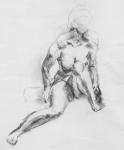
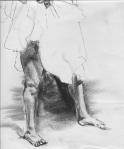
It took several weeks, but I finally checked out one of the non-instructional figure drawing sessions nearby. The session is held every Monday morning for three hours, and it’s a pleasant walk from the 24th and Mission BART station. If all the models are as good as today’s, I’m going to want to go every week. The lighting on strong musculature, and the props (ropes for the model to hold on to, allowing for very interesting standing and leaning poses), took it to a whole new level. Based on the owner’s warm welcome today and his teaching philosophy as outlined on his website and an American Artist interview, I’d love to take a class with him sometime, too, but the available times aren’t good right now.

So this was my day off so far: I went and drew for three hours, walked back to Mission Street, and finished reading Cat’s Eye over a lunch of ceviche tostadas. Yum on all counts.

Along the way, I stopped to browse at the outlet of a favorite clothing source, which I discovered by chance is right here a couple of blocks from that same BART station. The last thing I need is more clothes, but I do like them, and I’m going to use it as a reward: when I’ve gotten rid of those boxes full of old papers and stuff that are clogging up the garage, I can buy myself a few things there. It’s funny how we create these little games for ourselves. “Write for half an hour more and you can play a computer game.” It worked for my clean-out-the-e-mail-inbox project a couple of years ago (reward: fancy new planner), and just thinking about the clothes I saw today, I can feel my motivation to get into that garage rising.

1:  Two evenings ago, Joy called me and the munchkin over to the door to the deck, saying to hurry.  A young opossum was sniffing around our things (we still have some unpacked items there), maybe attracted by the lingering smells of the dinner we’d eaten out there an hour earlier.  The lights were on inside and outside, and the possum must have seen us, but it didn’t seem disturbed, and just went on exploring.  I had never seen one alive before, except running away from the sound of my approaching car.  It was cute.  Its ears were black and outspread, and we could clearly see the long fingers on its pink hands. 

Our cat Luna was out there somewhere, but I guess they avoided an encounter.  Luna is a non-hunter anyway–in a year and a half, she’s never brought home so much as a mouse–but in a fight with this opossum Luna would probably have come out the loser.

2.  I was perplexed by a strange erosion on my desktop blotter, as if acid had been dropped on it and had eaten away several layers of paper.  Then the stickers on my paper drawers mysteriously appeared partly peeled off, as if a vandal had come in and tried to remove the “New White Paper,” “One Side Printed,” and “Letterhead” labels just to create confusion for my next printing job.  It wasn’t until several days later, when I actually spotted a snail on one of the plants on the desk, that I put it all together. 

I was on the phone at the time, so I left it alone until I had a moment to put it outside–then I couldn’t find it.  Apparently it had used its speed and wiles to get away from me.  The next day, I saw it again and this time I took it outside.  By that time, the rampaging beast had also eaten a hole through several papers on my desk (nothing irreplaceable).  I hope it will be happier on a bush.

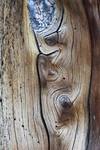
So went the title of an e-mail a man in the church sent me a few days ago, and to my delight it included these photos of a tree he and his wife saw in King’s Canyon National Park, which, he said, reminded them of the patterns in some of the images here.  Beautiful!  Thank you both!

(All photos by Paul Albertus.)

They liked “thinking about what this tree was up to through many cold and snowy Sierra winters and hot and dry Sierra summers to come up with such patterns.”  And that is what I love about things like strata in rock, the patterns the tide leaves on the sand, the marks that remain on agave leaves after the outer leaves have opened, the insect-munched trail on the oak leaf I found at Bass Lake last week:  the way they hint of a history that is mostly unknown to the observer who comes along later.  Each of us bears those signs too, some on our bodies and many more on our personalities.

When I was in seminary, most students did their parish-based internships concurrently with two years of school (part-time internship), or else as a year taken between the second and the final year of school (full-time internship).  The part-time option requires that you have an internship opportunity near school, which was true for many students, since we were in the Boston area, where congregations and internships abound.  But failing that–or if, like me, you didn’t want your internship church to be around Boston (I lived in Vermont)–the beauty of the full-time internship before senior year was that you could go before the Ministerial Fellowship Committee before your senior year, begin looking for a position during your senior year, and potentially have a job waiting for you after graduation.

Also, since you were on leave from a degree program, you were still considered a student during that internship year, so that you didn’t have to repay debt during that period.   Since the official guidelines on internship compensation were that it be, I quote, “High enough so that you don’t end up more in debt than when you began the year”–i.e., not by any definition an actual salary–this was important.

Judging from Bay Area students, this is now a rarity.  They do their internship the year after they graduate.   Since one can’t go to the MFC until after the midpoint of one’s internship, they can’t look for a job that year.  So there they are in June, done with school, done with their internships, with their 1 from the MFC (congratulations!), and with over a year to go before they’ll have a position.  What an insane system.  What do they eat?  An M.Div. leaves you with a huge debt and not a lot of qualification to do anything except UU ministry–and of course, it’s very hard to find a job that pays a living wage when potential employers know you’re going to leave in a year.

When I’ve asked individual seminarians about this trend, they’ve looked rather blank, as if they had no idea there was another option.  Has something changed?  Do seminaries, or churches, or the MFC, press for internship after degree?  And if so, how do today’s students pay the rent during that thumb-twiddling year?

Bass Lake, California as photographed by Guy Welch

I’ve just come back from our church’s weekend at Bass Lake, at Skylake Yosemite Camp, which is, as you’d imagine, just outside Yosemite National Park, and is therefore, as you’d also imagine, breathtakingly beautiful. As torn as I was about being away from my family for two days (since Joy had to work, and being the munchkin’s sole parent for that long, in that setting, is not my idea of relaxation, they stayed home together), I was so happy to be there.

It had been too long. Our practice when I started at UUCPA was to alternate years with our Minister of Religious Education (MRE); as much as it would be nice for us both to go, mid-September is a busy time for UU ministers and we thought someone should keep the home fires burning. I went to Bass Lake in 2003 and 2005, but 2007 was our then-MRE’s last year, so she went, then the next year it seemed like such a good idea for our newly-arrived interim MRE to get to know families there that she went, another time the weekend (switched to June) coincided with our big family vacation . . . so, one way and another, I had not been for five years.

I won’t let that much time elapse again.  It is a really special way to connect with the congregation members who are there, and both the drive across the state and the campsite connect me again to some of California’s tremendous beauty.

In the days before I left, I was trying to think of an apt worship service for that place and time, since I always lead a short service there. The first thing that came to mind was a hymn I love, “There is a Balm in Gilead”–a simple and profound song, and very apropos for Yom Kippur, too (which Saturday was), in our UU, interfaith way–and as I made myself a sandwich for the drive, I came up with a new verse inspired by Bass Lake. I composed a second on the way. Details are here, under “Sermons etc.”

I know a great arrangement from Ysaye Maria Barnwell’s teaching tapes, Singing in the African American Tradition, so with the help of one of our fine singers, who kindly learned it in a hurry from me the day before, we sang it in two parts. I would like to abolish the rumor that UUs can’t sing. That little group made a spirit-filled sound, all right.

The weekend begins on Thursday afternoon, but I got there on Friday just before dinner. Here are some of the things I did in my less-than-48-hours:

  • looked through a telescope at an incredible view of Jupiter, one astronomers wait several years for: the shadow of its largest moon, Ganymede, on the planet’s surface. I wanted to stay up to see the Great Red spot come around again, but was too tired.  That happens every three days, so I’ll get another shot
  • saw the Milky Way. For that, you don’t need a telescope, just your own eyes–but you also need a dark sky that isn’t available here in my urban area
  • kayaked
  • laid on the dock listening to the lap of the water and the sounds of other people playing
  • drew, on my own and with others who wanted to do “nature drawing without fear”
  • toasted marshmallows and ate more s’mores than I intended
  • learned how to do paper embossing and stencilling and made some pretty cards for Christmastime
  • went out looking for scorpions with an ultraviolet light–in that light, plain black scorpions are a fluorescent green. I had no idea. I also had no idea that there were scorpions in the area, but I was relieved to see that even at night, their active time, they prefer to curl up under pine needles. (The man who led the scorpion walk said he looked all around and under his cabin and couldn’t find a one.)
  • stopped dead in wonder at the shape of the manzanita outside my cabin
  • read on a sunny deck, the lake in the distance, Ponderosa pines overhead
  • had a visit from a tiny lizard who froze on my cabin doorstep as I came outside
  • laughed until I cried at some of the talent show skits
  • found an oak leaf that bore the marks of an insect that had eaten its meandering way all across its landscape
  • got to know people from my congregation with whom I’d never had a conversation beyond a few minutes at coffee hour
  • heard a story read aloud to us by a wonderful reader (talent show again)
  • learned the Spanish ABC song from the mom of a child who goes to a Spanish- immersion school
  • talked, crafted with, carried children from the congregation (and their friends not from the congregation)
  • sang ridiculous camp songs
  • put together jigsaw puzzles
  • woke up in the woods.

Here are things I didn’t do that others enjoyed:

  • yoga
  • motorboating
  • tubing/waterskiing behind the boat
  • canoeing
  • swimming
  • horseback riding
  • tie-dyeing
  • playing cards
  • tetherball
  • ping-pong
  • seeing deer
  • hiking at Angel Falls.

Incredibly, the weekend almost didn’t come off for lack of sign-ups, but our feisty registrar persevered and made it happen.  My question is, why isn’t this fabulous trip oversubscribed every year? It can’t be because of the scorpions, because only a few people knew about them until I spilled the beans just now. (I swear, they are very shy! You will never see one unless you go peering into piles of pine needles at night with an UV flashlight!) At $200/person for three nights, meals and an astounding array of available (optional) activities, it’s not an expensive three-day weekend trip. The food is good and the staff are friendly, fun, and unobtrusive, stepping in when wanted and leaving us to enjoy the camp’s resources as we like.  It’s one of the best intergenerational activities of our church’s year, which is why I recommended to our interim that she be there instead of at church on that weekend of her first September with us.  It suits introverts and extroverts alike, and you can spend your time in rigorous outdoors activities like hiking and riding, or just sit on the deck knitting for three days.

We advertise it to the several dozen churches in the district, and it’s open to non-UUs as well.  I hope by the time the next Bass Lake weekend rolls around (maybe next September, or maybe next June), demand will be so high that the registrar’s job will be a breeze.

My Palo Alto colleague Dan Harper posted a teaser at his blog, Yet Another Unitarian Universalist, about “possibly the most famous Universalist that ever lived” who, like several other of our forebears, celebrates a 200th birthday this year. I confirmed my guess at Wikipedia, then ran a search to see if the biography actually identified the person as a Universalist. Nope. (There is another article, called “List of Unitarians, Universalists, and Unitarian Universalists,” where the person does appear.)

On a slow day or ten, I may go through each Wikipedia biography of a U, U, or UU, and add one line identifying their religion. If you get the time before I do, go for it. The references have already been provided by the editors of the “List” article. It’s very nice of us to be so reluctant to push our religion down anyone’s throat, but ridiculous to conceal our existence under a bushel basket.

One of my “43 things to do in year 43” is to list ten books I want to read and read them. It may seem superfluous, since I read many more than ten books every year, but I wanted to be a little more deliberate, and also to specify fiction or poetry. I read lots of non-fiction and want to feed my imagination instead. Also, without saying so, I was excluding mysteries, since I gobble them down like peanuts but they rarely stimulate any part of my mind except the one that likes puzzles; they are a pleasant way to pass the time, and perhaps, like crossword puzzles, even make me a little smarter, but that’s all. (Gaudy Night, which I just reread–I reread all the Peter Wimsey books regularly–is a rare exception in that it gave me a lot to think about.)

The list:

A Passage to India, E. M. Forster. I’ve meant to read it since seeing the movie when it was released. I just finally did (since drafting this post, so I’ll keep it on the 43/43 list), and am now gobbling down Forster. Therefore:

Howards End, E. M. Forster READ 9/17 ETA I carried on with the Forsterfest and read A Room with a View, finished 9/20. It was perfect reading for Bass Lake, and I loved it. I may have to watch the movie again. Since we never got to see Alice in Wonderlnad on the big screen, we may have to just have a home Helena Bonham Carter film festival, in fact. That should make the Tim Burton fan in the family very happy.

Anansi Boys, Neil Gaiman–I love Gaiman, and loved American Gods so much that I have reread it twice since Anansi Boys was published, but couldn’t get anywhere with Anansi Boys itself. I am going to give it another try.  READ March 2011. Excellent.

Self-Help, Lorrie Moore–have wanted to read this since it came out at least 10 years ago. It sounded intriguing.

Something by Margaret Atwood. Atwood is very hit-or-miss with me. The Blind Assassin, The Handmaid’s Tale, and Alias Grace immediately went onto my All-Time Favorite Works of Fiction list; Oryx and Crake was a “wow, love it” until it turned into a “well, that ended with an unsatisfying thud” (and I then discovered that she is so painfully, cluelessly disrespectful of science fiction, despite excelling at writing it, that I’ve been disinclined to read the sequel); and there have been a few, like The Robber Bride, that I just couldn’t get into at all and put down after page three. So I don’t know which of the many still-unread novels or short story collections of hers I’ll read. But I’ll try a few, knowing that there’s another Blind Assassin somewhere out there. READ Cat’s Eye 10/25. Definitely one for the “loved” column. READ The Robber Bride 10/30, having found Cat’s Eye so terrific that I was emboldened to take on one that I hadn’t liked. This time I liked it, even though it didn’t rock my world the way Cat’s Eye did.

Voices and Gifts, Ursula K. Le Guin, speaking of science fiction and people who do get it. I read the first in this trilogy, Powers, just before going to Mexico, and so the other two eluded me, but I am now home and in possession of a San Francisco Public Library card and nothing can stop me.  READ Gifts May 2011, went on a LeGuin tear, wore myself out, so am going to wait on Voices.

Whichever book someone knowledgeable recommends by John M. Ford. He wrote the poem “110 Stories” I linked to earlier today, and on searching for more by him, I was very excited to learn he was primarily a science fiction writer. I’m always looking for good ones and so seldom find any I like. He wrote some Star Trek books, and while I don’t usually read those, I don’t think I can resist one titled How Much for Just the Planet?; still, I’d like to read a stand-alone book of his. Poetry or scifi or scifi poetry all welcome. Friends, do you have a recommendation?

Beloved, Toni Morrison. I’ve never read it and I can’t imagine why not. I love Morrison. I think this is one to read via audiobook; her own reading of Sula made it so wonderful for me, and she also reads Beloved in its audio version. Not yet, but READ A Mercy, which was the Morrison audiobook I could find at the library when I got the hankering, and which was heartbreaking.

Open Closed Open, Yehuda Amichai. I don’t read much contemporary poetry, but whenever I encounter Amichai I really like him. I actually set out to buy his Selected Poetry, but the book was so badly printed that I put it back. Don’t look at me in that pitying way–I know my eyesight and hearing are getting worse, but I’m nearsighted, not farsighted, and books never give me trouble. Oh well, I’ll take it as a sign: I don’t buy collections of favorite singers’ greatest hits; I buy the albums. So I will read Amichai’s latest volume instead of his greatest hits.

ETA Zeitoun, Dave Eggers. It’s San Francisco’s 2010 One City One Book choice, so, having just moved into the city, reading it is part of my “OMG! I live in San Francisco!” celebration.  READ December or January.  Disturbing and eye-opening enough to make up for the cheap-journalism style of the writing; I’m glad I read it, and am wondering how I lived in the US during the same period that Zeitoun was locked up and had no idea this kind of thing was happening. Is it still? How would we know if it were?

Enter your e-mail address to receive e-mail notifications of new posts on Sermons in Stones

Links I like