The most exciting social justice idea I’ve come across in ages is happening right here in San Francisco. It’s called Carrotmob, as in carrot as opposed to stick, because the basic idea is to reward businesses for socially responsible behavior. Specifically, the organizer engages businesses in a bidding war–e.g., which one will commit the biggest percentage of one day’s proceeds to making environmental improvements to the property?–and promises to send a crowd of shoppers to the highest bidder on that day. In the first campaign:

[Brent Schulkin] went to 23 convenience stores in San Francisco and identified the store willing to make the strongest environmental improvements in exchange for a large number of new customers coming and spending money. Carrotmob was born when hundreds of people came to the store at the same time to buy anything they wanted. The “mob” more than tripled the store’s daily revenue in a few hours, and that revenue is how the store financed an energy efficiency retrofit of their lighting system.

I’m joining, but that’s not enough. I want to organize a Carrotmob. How about a congregation-based Carrotmob group?

I missed drawing last week because Joy and Munchkin had the day off and we had plans together. As it turned out, I was too sick to do anything but sleep.

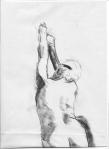
I went in today focused on how to use the whole range from white to black with sufficient transitions in between. A rare glitch with a model meant we only had time for five drawings aside from the warmup gestures; here are the first three.

(Click on thumbnail to see larger version)

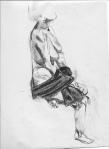
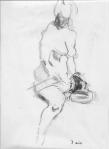
These are the only other three from last week that I like enough to post. On (e), the only really successful part was the hat, so I cropped it to that detail.

I’m pushing myself to go darker with the blacks, and the result is a kind of florid appearance that I dislike, as in (g) here. I’m trying to figure out what I did in the drawings where I went dark and had plenty of contrast but not that florid appearance. Why is (h), the one on the right, a success and (g), the one in the middle, is not?

photo by Gary Vanderlinden

While the monks of Drepung Loseling Phukhang Monastery were at our church this week, they had for sale malas (beads used for counting mantras or prostrations), flags reading Om Mani Padme Hum, wall hangings with various writings of the 14th Dalai Lama, and so on. This quote caught my attention, especially the part I’ve emphasized.

Let me explain what we mean by compassion. Usually, our concept of compassion or love refers to the feeling of closeness we have with our friends and loved ones. Sometimes compassion also carries a sense of pity. This is wrong–any love or compassion which entails looking down on the other is not genuine compassion. To be genuine, compassion must be based on respect for the other, and on the realization that others have the right to be happy and overcome suffering just as much as you. On this basis, since you can see that others are suffering, you develop a genuine sense of concern for them.

As for the closeness we feel toward our friends, this is usually more like attachment than compassion. Genuine compassion should be unbiased. If we only feel close to our friends, and not to our enemies, or to the countless people who are unknown to us personally and toward whom we are indifferent, then our compassion is only partial or biased.

Genuine compassion is based on the recognition that others have the right to happiness just like yourself, and therefore even your enemy is a human being with the same wish for happiness as you, and the same right to happiness as you. A sense of concern developed on this basis is what we call compassion; it extends to everyone, irrespective of whether the person’s attitude toward you is hostile or friendly.

I have wanted a proper mala (all 108 beads) for some time, but as with all such purchases, have felt the tension between the wish to have one and the desire not to be acquisitive, especially about spiritual things. This week, offered the excuse that I was helping the monks build more dormitories for their monastery, I bought one from them. I will not be using it to count prostrations, the way the Tibetan Buddhists do, thank you very much, but on my walks I’ve been using it to meditate as I go, and trying to work up some respect, and thus genuine compassion, for people I tend to pity or dislike.

Previous post on the monks’ visit
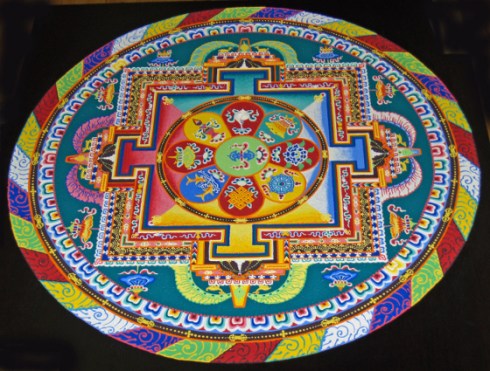
Several Tibetan Buddhist monks are creating a sand mandala this week at the Unitarian Universalist Church of Palo Alto (photos here). The mandala is beautiful, and it is also instructive to watch the monks work. A daycare and a school rent our space, and children gather around the monks to watch. When a kid touches the table, the translator patiently tells him or her to stand a couple of feet back (we also have chairs for them to stand on for a better view), but the monks show no anxiety that anyone will brush their arms or bump the table, even though either one would mean recreating many hours’ work. It’s happened, too, the translator told me.

I like to build marble runs, a childhood pleasure I have been reliving since Joy bought me lots of Quadrilla for my birthday a couple of years ago. Munchkin is now old enough to place the blocks carefully, but she still sometimes brushes against it and brings it down by mistake, or semi-mistake. After even ten minutes’ work on a marble run, I find it difficult to stay calm about the prospect of its being knocked down. I mean, what if I can’t remember how I built it? Attachment, anger, yep, the Buddha had my number. I was not clear on how the creation of a mandala was supposed to increase compassion, but I’m starting to get it.

Pope John Paul II, it is now clear, put enormous effort into covering up the sexual abuse of children by Catholic priests, which enabled it to continue.  Then the Vatican invited Cardinal Bernard Law, of all people, to lead one of the Pope’s funeral masses:  a great honor to Law, a rebuke to those who dared criticize him for actively covering up child molestation in his archdiocese of Boston, and an unmistakable message that he had the late Pope’s full approval.  And now the church, including Pope Benedict, is rushing to make John Paul II a saint.

“Saint” has a very specific meaning in the Roman Catholic Church.  To be canonized, one must be a confessor of the faith, martyr and/or miracle worker. But even so, the word also carries its common meaning of “person of extraordinary virtue or benevolence.” Apparently that meaning is being suspended in this case.

Another day when I felt like I wasn’t hitting a groove, but now that I look at these, especially the third one, I think I actually did. It has a subtlety of shading I’ll have to study again before next time. That won’t be next Monday, because Joy and Munchkin have the day off, so it will be a family day.

This past Monday’s was definitely a session when I did not seem to be able to make the kind of marks I wanted to.  The charcoal seemed either too hard or too soft, which may have been true, as I was using some different charcoal than usual, and/or the too-hardness and too-softness might have been in the hand.  And yet hand and charcoal and model did connect in that torso of (c).  Moments of grace.

Leadership is a partnership. Just as some of my peak moments occur when I am helping to bring out the best in my congregation, others occur when the people of the congregation are bringing out the best that I have to give. I had one of those moments this past Sunday. I’d changed my topic the moment I heard the news (and oh, how glad I was that I’d turned on the computer. I could have found out about Tucson on Sunday morning on my way in to church . . . ). I didn’t have the kind of time for reflection and writing that I usually do, but that was how it had to be.

Looking down at the mishmash of paragraphs and margin notes and don’t-forget-to-mentions in my hand as I came to the pulpit, I was very tempted to preface the sermon with an apology, which was really an excuse: “Please bear with me if this isn’t as cohesive as I’d like. I was up most of the night, I’m sure you understand . . . ” But that would be a disservice to the listeners.

So I just plunged in. I spoke from the heart, and a bruised and uncertain heart it was, and I could do that because my congregation values it. Sure they want the preacher to make sense, but they care most about passion and are willing to bounce over the rough spots. Because they’ve made that clear, I could let go of my own nerves about wanting to give a more polished presentation than was possible, and give them the passion. They are making me a better preacher all the time. I’m so happy they’re my partners in this ministry.

Polls often reveal that gun owners oppose legislation being pushed by the National Rifle Association (NRA). This is true to a large extent even of gun owners who belong to the NRA. For example, Frank Luntz, who is a Republican pollster and frequent analyst on Fox News, found that 69% of NRA members support closing the loophole that allows buyers at gun shows to circumvent background checks (the figure was 85% for all gun owners). Seventy-eight percent of NRA members support requiring gun owners to report lost and stolen guns (88% of all gun owners). I’m just citing Luntz because he’s a conservative, though of course the NRA disputes his findings; there are other studies that also show that the NRA is too extreme for many of the people it claims to represent.

I used to belong to AAA; my parents bought me a membership when I got my driver’s license, and for many years it was synonymous in my mind with “roadside assistance.” Gradually, as I read the AAA magazine and paid attention to the news, I realized that “the highway lobby,” with which I disagreed on almost all issues, was in fact the better synonym for AAA (see what you can learn if you’re a compulsive reader?). Roadside assistance and those handy little tour books were just a sideline use of our membership funds, while the major use was to pay lobbyists to get Congress to increase highway funding, oppose un-American activities like rails-to-trails conversions, and generally resist any policy that might move us more toward other forms of transportation than the almighty automobile. As soon as I learned that there were other roadside-assistance plans available, I stopped sending my money to AAA.

The NRA is forever hiding behind “responsible gun owners” and “hunters” and implying that anyone who does target shooting, goes deer hunting, or for that matter, keeps a handgun in their home for self-defense, supports their positions. If you are a gun owner, please have a look at what the NRA wants to accomplish, and if you disagree with them, don’t fund them. There are other organizations for gun owners, responsible ones that, unlike the NRA, are not the bane of police departments. Join one of them. (And that gun in your house? Lock it up well. There are kids around.)

Federal judge dead, Congresswoman among 12 wounded in shooting

I’m watching the events in Tucson unfold and thinking about what to say for tomorrow’s service. There are a lot of places in the world where the one with the biggest guns makes the rules, and when public officials live under the threat of death, we edge closer to that reality.

It’s my dad’s district, and I believe he worked on her last campaign, which was a squeaker. And I was a little afraid to write that, in case some lunatic looks him up. I know that that is paranoid, but this is what I’m talking about: the chilling effect violence has on open conversation.

Enter your e-mail address to receive e-mail notifications of new posts on Sermons in Stones

Links I like