The Palo Alto Art Center is about to host an installation by Patrick Dougherty, who will be in residence here for three weeks beginning on January 11. I’ve seen his work before, several years ago at Villa Montalvo in Saratoga, and liked it. If you’re in the Bay Area, you may have seen Dougherty’s sculptures at the Bay Area Discovery Museum in Sausolito.

The PAAC’s press release quotes a critic who calls him “the Jackson Pollack of sculpture,” an opinion I don’t share because I think Dougherty is much more interesting. Just because two artists have a similar use of line doesn’t mean their intentions or results are similar.

The installation will apparently be up for a year, and during the three weeks he’s in residence, there are tie-in activities, at least for kids. Adults who want to learn to make sculptures out of twigs might not be in luck.

It seems to be my week for environmentally interesting art. A friend posted a link to this page of Areca Roe’s website on Facebook. Wow. She has found the visual language to express so much of what I feel about the relationship between wildness and us. Hence her new spot on my blogroll.

The Ninth Circuit Court of Appeals is grappling with standing, an unsexy but important question in the Proposition 8 federal case.  Namely:  the plaintiffs–couples who want to marry and are denied access to marriage–have standing to bring their complaint to the federal courts.  But who has standing to defend Proposition 8?  One county tried to claim it, and the judges threw that part out.

When they heard the case several weeks ago, the judges asked many interesting questions, and some challenging ones, about the question of standing.  One judge was quite sharp in asking whether the governor (then Arnold Schwarzenegger) and attorney general (then Jerry Brown) had effectively vetoed a law by refusing to defend it in court.  I thought that was going a little far, but it did get at a good point:  if the government of the state won’t defend a law when it is challenged, is that government doing right by the legislators, and by the will of the people?

Years ago, when I was living in Vermont, and the state Supreme Court was tackling the question of whether the state’s equal protection clause mandated marriage equality, I bought a raffle ticket from my county Democratic Party and won a lunch with the state’s attorney general.  I knew he was named in the lawsuit, and asked him about the fight.  He said frankly that it was one of those cases where plenty of people in his office agreed with the challenge to the law.  (He didn’t say his own opinion, and I neither thought it was appropriate to ask him, nor would reveal it here if he had.  He paid for the lunch.)  But, he said, part of the job description of the state’s attorney general is to represent the state in any lawsuits against it, and since Vermont was the party named in the suit, their role was to take its side.

In that regard, he and his staff were like the defense attorney in a criminal case (this is my extrapolation–he knew the difference between civil and criminal law).  Defendants must have representation; their lawyers must do their best to get them acquitted; our justice system depends on it.  Switching back to the realm of civil laws and state governments, Vermont had duly passed various laws and it was the attorney general’s job to defend them.  If he didn’t, then the people who passed the laws (the legislators) and the people whom they represented (the citizens) were being shortchanged.  I don’t know if this is legally compelling, but I find it morally so.

So I ought to look askance at Schwarzenegger and Brown’s refusal to defend Prop 8.  I do think it might have been bad strategically, but I don’t think it was morally wrong.  Instead, it illuminates one of the major problems with our crazy ballot proposition system:  the people, voting on a ballot measure, are a fourth branch of government that has not been fit into the system of checks and balances.

Remember checks and balances?  You learned about them in civics, or maybe it was called social studies.  We have three branches of government, with different roles, and they check each other.  The executive has to abide by the laws set by the legislature.  The legislature can’t create any laws that violate the constitution, as interpreted by the judiciary.  The judiciary is chosen by the executive, with confirmation by the legislature.  Et cetera.  Now California has created a fourth branch, but where are the checks and balances?

Plenty of people argued that the state Supreme Court didn’t have the right to cancel out the people’s vote by ruling unconstitutional laws that excluded same-sex couples from marriage. Well, they’re idiots.  Of course it did.  Ruling on the constitutionality of a law is not only the judiciary’s right, it’s its obligation, and furthermore, in doing so, it is doing its part to uphold the will of the people as well–the will of the people as enshrined in the constitution. 

The people then did the only thing they could do to remedy such an injustice, if they thought letting same-sex couples marry is an injustice, which for some reason they did:  amend the constitution, in this case via a ballot proposition.  Game over.  The state Supreme Court might like the amendment or it might not, but there it is, a part of the constitution:  marriage is only allowed between one man and one woman.  (Of course, this new line contradicts other parts of the constitution, but I won’t even go into that.  Nor will I rant about the stupidity of having a constitution be so easily amended–at least not today.)

But here’s the rub.  I’ve read many ballot propositions, and some of them build in an immunity to checks and balances.  Their text says that if they’re passed, no legislature can overturn them, or only a supermajority can do so.  This is absurd.  Any act of the legislature can be reversed by a subsequent act of the legislature.  They don’t get to say “. . . and neener neener, if you don’t like this, future legislators, too bad.”

Yet that’s what these ballot propositions say:  that a direct vote by the people supersedes a vote by the people’s representatives.  This just does not work, unless it is part of a carefully calibrated system of checks and balances, such as applies to the other three branches of government.

So if “the people” lack standing, well, we asked for it.  If legislation passed by direct vote isn’t subject to the checks of the other branches of government, then it’s a bit much to ask another branch to defend it.

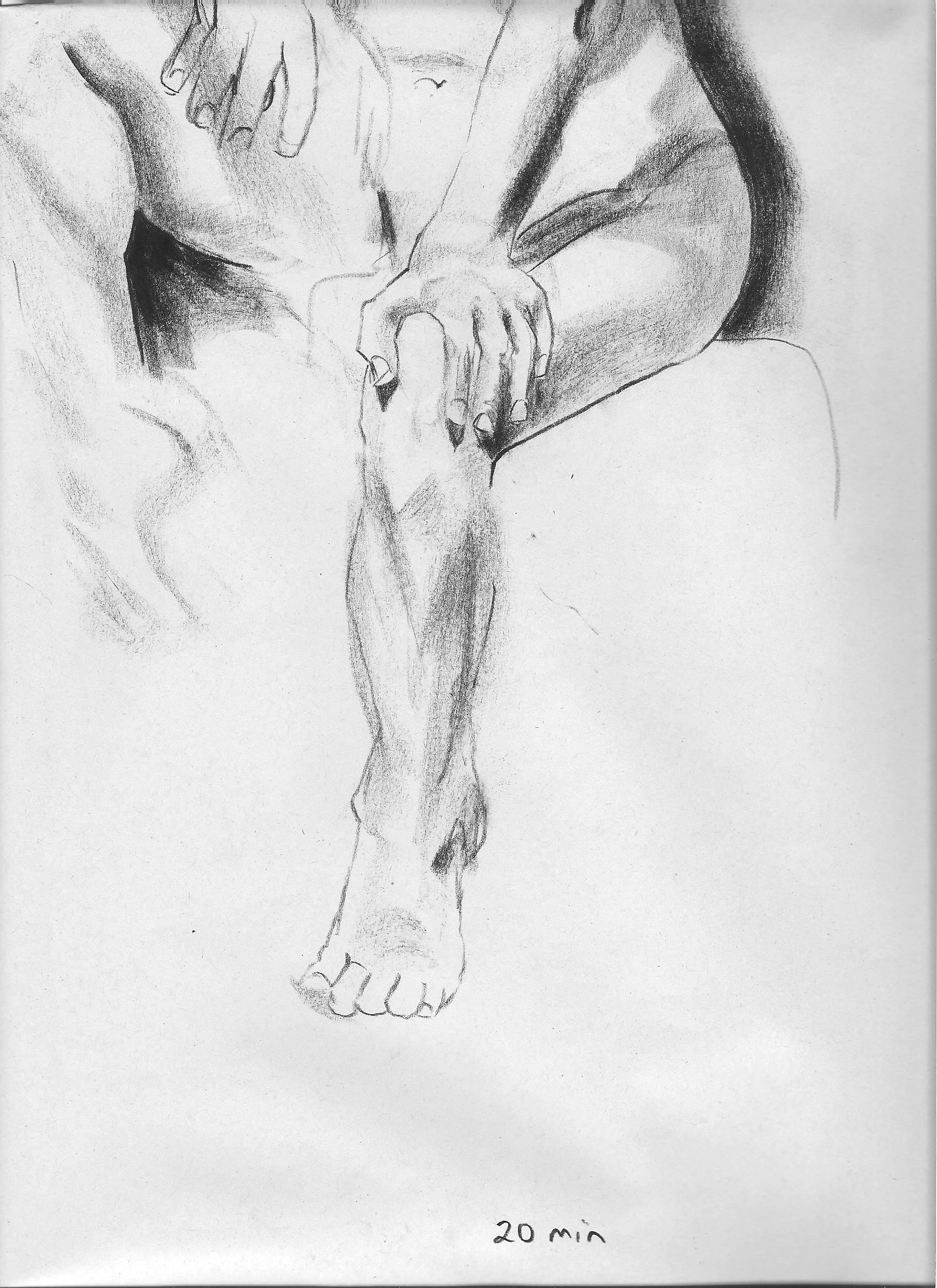
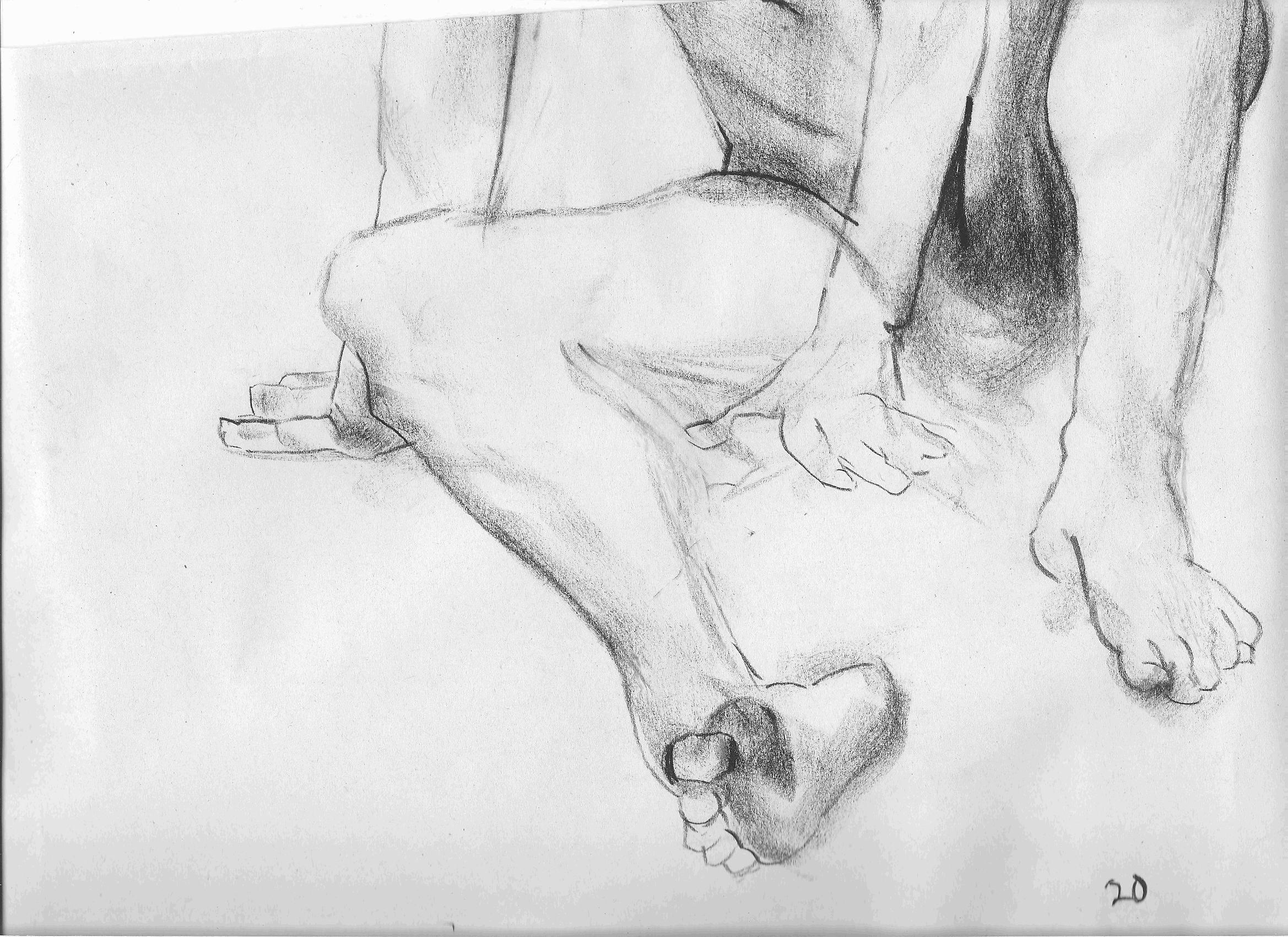
Some days, you’re in the drawing zone, and other days . . . not.  Today I just could not make anything I was really happy with.  On a couple of drawings, I thought the hands and feet were the best part (hence the detail shots that follow).  Maybe that was my problem–too much time spent on the hands and feet, not enough on the rest?  Whatever.  It’s all learning.

What continues to amaze me is how much I look forward to this time every week.  I know I’ve said it many times, here and elsewhere.  I just can’t get over how totally different I feel than a year ago, when I was about to go to San Miguel and (despite the thrill of going to Mexico) felt a sense of duty and dread about taking a drawing class.

It’s also striking how much harder it is for me to draw on my own than in the group.  I’ve experienced the same thing with meditation; the only time I’ve meditated regularly, and without more than minor resistance, was when I was part of a sangha.  One aspect is simple peer pressure.  I would be ashamed if I were one of the few people who didn’t show up.  Not exactly an enlightened motive, but as one of my favorite Buddhist aphorisms says, lotuses grow out of the muck at the bottom of the pond.  Attachment it surely was, but that attachment to status kept me planted on the cushion.

Buddhists give thanks for the three jewels:  the Buddha, the dharma, and the sangha.  Originally the sangha meant the community of monastics, but when I give thanks for the sangha I always think of it primarily as the local community of practitioners.  I seem to rely on a sangha for art too.

Our Sunday morning worship theme for the month of January is “home.”  We kick off the canvass this month as well, so I’m thinking a lot about the idea of one’s congregation as one’s home.  It’s a common enough metaphor, but what does it mean?  It depends on what “home” means.  If it means “comfort,” I’m not crazy about that being a primary quality of any congregation I belong to (and/or serve).    I want it to be comforting, absolutely, when we need to be comforted.  But not entirely comfortable.

Tangentially, but not unrelatedly, I’d like to pass along this New Year’s wish from the blog of a favorite writer of mine, Neil Gaiman: “May your coming year be filled with magic and dreams and good madness.  I hope you read some fine books and kiss someone who thinks you’re wonderful, and don’t forget to make some art–write or draw or build or sing or live as only you can.  And I hope, somewhere in the next year, you surprise yourself.”

I wish all those things for myself in 2011, and for anyone who reads this.  And now I am going to turn off the computer, go kiss two someones who think I’m wonderful (the feeling is mutual), and get some sleep in the hope that tomorrow morning I’ll be able to say some words as only I can say them, and so help my dear, beloved co-congregants to live as only they can.

In my 43/43 goals, I planned to walk the Civil Rights Half Marathon in January, 2011, in San Francisco. However, it clearly isn’t going to happen (I guess the organizers quit), so I’ve been looking for other races, and I’ve found the one I want to train for: the Canyon Meadow Trail Run, in Redwood Regional Park in Oakland, the first Saturday in June. It’s a serious hike, so I’ll be glad of the long, slow leadup–giving myself six months to become able to walk 13.1 miles with an 1900′  elevation gain sounds good. Training in San Francisco should do nicely.

So, I’ve laid out a training schedule, and begin on Monday. Whee!

Given at the Unitarian Universalist Church of Palo Alto, CA

December 24, 2010

Homily

I’ve been without my regular life-drawing session, as the regular schedule is suspended for December (it resumes Monday, yay), but there have been a few sessions here and there, and last night there was finally one at a time I could manage. It was great to get back to it.  (My plan to draw on my own every Monday morning lasted one week; I’ve had to either work or take care of the munchkin the rest of the Mondays of this month, though of course I could have found a different three hours.)

I’m feeling, and resisting, the urge to try (1) some color and (2) better paper than the newsprint I’ve been using. I probably will try other paper soon, because it really makes a difference to the process and appearance, but using newsprint helps keep my punishing perfectionism at bay; it reminds me this is just practice, stuff to be thrown away (though frequently scanned first, so I can look back and learn from what I’ve done). As for color, with this figure drawing I just want to keep working on the basics for a while yet.  Maybe a long while.

Here are several from Wednesday, in the order I drew them, and from the shortest to the longest pose.  Interestingly, I think that besides the 45-minute pose, the most successful are two of the 7-minute poses (drawings 12 29 10 d and 12 29 10 f).  I do like the hands and foot on the 20-minute pose, though.

According to the Stanford Blood Center, I’m a gallon donor. But they’re just being nice. They mean I’ve had over eight appointments. I think only about three of them have ended with my giving an actual pint of usable blood. I’m on the verge of giving up, and it has me feeling really sad.

To me, donating blood has always been one of those no-brainer acts of mercy, like giving clothes you don’t need anymore to a clothes closet instead of throwing them in the trash. That pint of blood is the difference between death and life to the recipient, while to the donor it costs nothing but the mildest of pain and a couple of hours (including the time spent getting to and from the center and eating the re-energizing snack of cookies and juice). Also, when my dad was badly injured some years ago, he received about 40 units of blood. He barely survived; blood donors gave me my father, and I’ve felt ever since that I owe the world some blood. I hear from blood center staff that that’s a common motivation.

Still, it took me years to start donating even after that, because I’ve always been queasy about needles, and have even been assured by nurses that they would really rather not deal with people who are shaky about the whole thing. However, when I shared my ambivalence with a nurse at church, she urged me to try at a blood center (as opposed to a blood drive). Not long after that conversation, I got pregnant, and while that ruled out donating for several months, the many blood tests involved made me sanguine (heh) about needles. I figured, how much worse could donating be?

So a couple of years ago, I donated for the first time, and it was true: it isn’t really any tougher than a blood test. And I felt fantastic. I bounced out of there, absurdly pleased with the little bruise on my arm, determined to donate once every eight weeks for the rest of my life.

However, it hasn’t gone so well. More often than not, I leave without having donated much blood, if any. I flunk the hemoglobin test, or no one can find a good vein, or the flow is so slow that I can’t fill a pint in the allotted time, or all of the above. I’m stubborn. I take iron, I drink my eight cups of water a day for three days before giving, I tell them up front that with my veins, they’re going to need a small needle and their best blood-drawer. But I’m getting discouraged. In October, when the very expert nurse said time was up, she said, “Maybe this isn’t your ministry.” Damn the woman. She knew just the language that would reach me, and she said it with such compassion. I barely got out of there without crying.

I decided to give it one last try, so last week I went in again (deliberately on a different day of the week, to avoid the mind-reading nurse), having observed a strict regimen of three days’ iron supplements and having drunk enough herbal tea over the same three days to float the QEII. The finger stick turned up a sub-par hemoglobin level. Sometimes you just need to warm up your hands, so the nurse asked if I wanted to do that and try again; I did; the second level was worse. I took a consolation cookie and went to work.

I had said that that was the last try, but I’ve got to give it one more. This time I’m going to take iron every day (which, clearly, I ought to be doing for my own health anyway), drink my eight cups every day (ditto), warm my hands before the hemoglobin test, the works. But it still might not be enough. It might be that this is just not one of the ways for me to bless the world. I wish that it bothered me purely because I want to help people, and not because my ego can’t abide my failing at anything I set out to do.

My colleague Dan Harper blew my mind with a casual mention of Richard Thompson singing “Oops! I Did It Again,” so of course I had to go find it. And you know, I liked it. Thompson deemed it “a pretty good song,” and, hearing it sung by a singer I really like, and unburdened by the “oh no, more bubblegum pop” expectation I bring to top-40 radio (do we still have top 40, or am I dating myself?), I agreed.

I guess it shouldn’t be a surprise. Hey, one of my favorite songwriters, Ira Gershwin, said, “I never knew how good our songs were until I heard Ella [Fitzgerald] sing them.” IMHO, they hold up pretty damn well no matter who is singing them, but it’s true, a great singer can make a mediocre song great, or at least “pretty good.” (And vice versa–I heard a version of Joni Mitchell’s “River” the other day that really should never have hit the airwaves.)

I wonder how far we can take this. I recently tuned in NPR and stumbled on an analysis of the Song Most Likely to Make Amy Scream and Reach for the Dial, “Light My Fire.” Lord, how I hate that song. But I didn’t change the station, because the speaker, one of the songwriters, was walking us through the process of writing it, and that was interesting, plus I only had to listen to his playing the piano and talking, not the original with those noodling instrumentals and that pompous Jim Morrison voice.

Of course, at the break they did play the original, and I shuddered and turned it off. But now I wonder if even “Light My Fire” could be redeemed if someone else sang it.

Nah, there’s only one way to make a line like “no time to wallow in the mire” bearable, and that’s to listen to it in the same state the band was no doubt in when they wrote it: seriously stoned.

On Saturday, we went to the annual Our Family Coalition multifaith holiday party, held at St. Gregory of Nyssa in the Potrero Hill neighborhood of San Francisco.  Aside from the pleasures of getting together with lots of other LGBT parents and their kids, I was looking forward to seeing the inside of this church again.

In the center of the rotunda is the table where they serve communion, and carved on it are words about Jesus welcoming sinners to his table.  (On their website, they say, “We welcome all people–especially strangers—to communion.”)

Then, up above, all around the inside of the rotunda, is a gorgeous mural of several dozen dancing figures, led by Jesus, Lord of the Dance. These “Dancing Saints” include actual saints of the Episcopal Church and many other saints chosen by the congregation in partnership with the artist, Mark Dukes.  Malcolm X holds hands with Queen Elizabeth I; Charles Darwin’s hand is on Saint Symeon’s shoulder. Cesar Chavez dances along in front of Anne Frank. Many of the dancers are barefoot (if not totally naked, as is King David); many wear sandals; Eleanor Roosevelt wears loafers. All have haloes. It’s almost enough to make me want to convert to Episcopalianism and join this church.

Okay, to be honest, it doesn’t come close.  I am just never going to be a Christian.  But I can’t stop smiling when I look up at those dancers. What I love about St. Gregory’s is not only that this beautiful mural reminds me of the people I also wish to emulate, but that they have done three things any religious community needs to do to thrive:  they have proudly laid claim to their tradition; they have given that tradition a form particular to their time and place; and they have declared in a beautiful, striking, and literally indelible way what they stand for. Walk into St. Gregory and you know that their religion is about joyously welcoming everyone into a circle where all may eat and, more, celebrate.

And they do dance in their services . . .

Dancing along with the saints (c) 2006 David Sanger

. . . and from the reports of those who’ve gone to services there, they keep the promise made on their altar and their website–all are welcome.  They host a weekly food pantry and it is held around the altar, under the dancing saints in the rotunda.  And of course they welcome our families every year.

Fun assignment for membership committees (worship committees, altar guilds, buildings and grounds committees, etc.): pretend you are a visitor to your congregation. What do the architecture and art, the chosen or accidental icons of your space, communicate about the congregation’s purpose? Do they get it right?

Icon of Sojourner Truth by Mark Dukes; Photo (c) 2006 David Sanger

Enter your e-mail address to receive e-mail notifications of new posts on Sermons in Stones

Links I like