I’ve been on study leave this week, and pursuing projects under three categories:

Reading:  From the Palmer Raids to the Patriot Act: A History of the Fight for Free Speech in America, Christopher Finan, and In Between: Memoirs of an Integration Baby, Mark Morrison-Reed. Maybe a book on strategic planning in congregations too.

Spanish: Remember the old days of language lab? Now you get CDs with your textbook–much better. I keep the CDs in the car and do the exercises while I’m driving, but I’d gotten past the chapters that I’d studied, and didn’t understand the grammar the CD was trying to make me practice. So, I’ve gone back to the textbook to review the subjunctive, discover just how much basic conjugation I’d forgotten, and at last learn the imperative properly. That plus some vocabulary about clothes from the same chapter will help me practice with Munchkin as she’s getting dressed in the mornings. Together we’re going to become bilingual.

Cleanup: Okay, this probably doesn’t count as a study leave project. But it is a wonderful feeling. Joy threatened to throw out any of those old boxes of my stuff that were still in the garage come January 1. I welcomed the challenge, knowing I’d never go through them if I didn’t have a firm deadline. Some of them have made several moves with me, unopened; not surprisingly, most of their contents turn out to be completely unimportant. My spiritual guide as I decide what to keep and what to toss: an elderly man at church who said he had a dozen packed file cabinets in his house and never looked into any of them.

New Year’s resolutions are usually just one more thing to start feeling guilty about, usually by February. I love Woody Guthrie’s list, but it seems a tad ambitious.

So I am going to make just one single, simple resolution: eat three servings of fruits and four servings of vegetables a day. Some days that might mean apple, apple, apple, carrot, carrot, carrot, carrot. Or apple, chocolate, apple, chocolate, apple, chocolate, carrot, chocolate, carrot, chocolate, carrot, chocolate, carrot. Whatever. I’ll have made good on my commitment as long as I fulfill those servings. Ready, set, go.

My Christmas Eve homily from a few hours ago.

Read the rest of this entry »

photo by Emma Pease

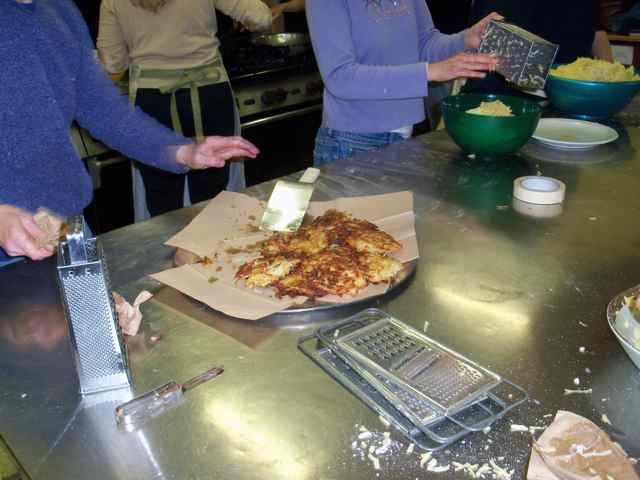
Last night’s midweek service, which was about Hanukah, was preceded by a latke feast, and I invited people to come even earlier than that to join in making the latkes. Over a dozen did, and we had a great time.

I billed the dish as the World’s Best Latkes and then had to come up with an actual recipe, since the way I really cook these would go more like, “Buy twice as many potatoes as you think your family can eat. Peel and grate. Add enough grated onion to make it look right. Add enough egg for it to stick together . . . ” etc. Not very helpful, though my great-grandmother in the Old Country would approve. Attendees and cooks asked for the recipe, so here is what we did last night. The only way to improve on it would be to make sure you always have a dozen fun people to cook with.

I forgot to tell everyone last night that there’s a reason latkes are the quintessential Hanukah dish: you are supposed to eat fried foods as a tip of the hat to that miraculous oil. That’s what we call a handy theological excuse. Now, in addition to the miracles of a small army defeating a large one and the oil’s lasting for an extra seven days, do you suppose there’s a miracle by which the calories from oil in which latkes were cooked disappear?

Or let’s just appreciate this miracle, pointed out by Rabbi Brad Hirschfield:

that people dared to light that tiny bit of oil and trust that somehow things would work out. Perhaps the enduring miracle which Hanukkah celebrates is that there is always more light than we first imagine and that the fuel to create it is really there when we look hard enough and dare to trust its power.

Amen to that, and Happy Hanukah, everyone!

The World’s Best Latkes

A radio story interviewed prospective voters in the GOP Iowa caucuses, coming up in a couple of weeks, to answer the breathless question of who would be the Mike Huckabee of 2012–Rick Santorum? Michele Bachmann? Ron Paul? The reporter did not ask why anyone would want to be the Mike Huckabee of 2012.

Huckabee, of course, did not get his party’s nomination in 2008. Nor are Bachmann or Santorum or Paul likely to get it this year, even if one of them wins in Iowa. Caucuses, even more than most primary processes, favor the extremes, and the GOP has seldom gone with its rightmost option. Yet here is the Iowa caucus, threatening to knock out what passes for a centrist in the Republican party in favor of whoever can please right-wing evangelicals the most.

So I went and looked up just how much of a bellwether Iowa has been for the GOP. It’s not impressive, but it’s not bad.  Asterisks indicate the winner of the nomination.

  • 2008 – Mike Huckabee
  • 2004 – George W. Bush*
  • 2000 – George W. Bush*
  • 1996 – Bob Dole*
  • 1992 – George H. W. Bush*
  • 1988 – Bob Dole
  • 1984 – Ronald Reagan*
  • 1980 – George H. W. Bush
  • 1976 – Gerald Ford*

Six out of the last nine Iowa winners won the nomination. But it doesn’t look even that good when you take out the candidates who ran unopposed: Reagan in 1984, George H. W. Bush in 1992, and George W. Bush in 2004.  That leaves six years of contested caucuses, with only three predicting the eventual winner.

  • 2008 – Mike Huckabee
  • 2000 – George W. Bush*
  • 1996 – Bob Dole*
  • 1988 – Bob Dole
  • 1980 – George H. W. Bush
  • 1976 – Gerald Ford*

I don’t think any Republican candidate should lose sleep over losing in Iowa. What we all might lose sleep over is why the party gives so much power to the extremists who can’t get their favorites to win on the national stage. In 2008, John McCain rose to prominence as an honorable moderate (a reputation he subsequently threw away by embracing every crazy idea, not to mention every crazy VP candidate, that came along–he’s scrapped the rest of his principles since, in his determination to oppose anything supported by the man who defeated him). This year, who of that description has survived even to the first primary?

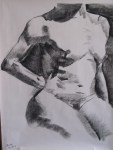
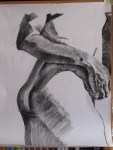
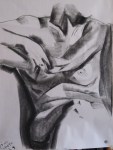
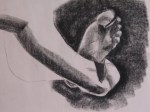
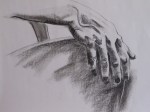
There’s been no one drawing I’m very happy with over the past few weeks, but certain bits make me say, “That’s what I’m trying to do”: in the shadow of a hand, the folds of skin under a breast, the pressure of a finger on a shoulder, the wrinkle of an elbow, the veins of a foot, the fall of a shadow.

We state the short version of the purpose of our congregation in every service: to transform ourselves, each other, and the world. I wrote this much longer version in one feverish journal-writing session about a year ago, and shared it in three consecutive newsletter columns this fall.

Read the rest of this entry »

Yesterday evening’s service was about control and letting go. I played everyone a song by Suzzy Roche about being in a plane in a lightning storm, and repeated my favorite line: “There’s a whole lot, baby, you can’t control, so put your seat back and roll, Mag, roll”–“Mag” is her sister, I’m guessing. (At that point E. said, “Were you thinking about today’s windstorm?” I hadn’t heard about it. Turned out there were 100-m.p.h. Santa Ana winds in Southern California, a historic storm.)

We meditated on the song and on a couple of quotes such as Reinhold Niebuhr’s well-known “serenity prayer,” and I led a meditation in which we literally made fists as we envisioned gripping tightly whatever we seek to control, then relaxed and let go so it could float.

The hardest thing I could have chosen would have been my daughter. I focused on something a little easier, but then I got to my final words, introducing a song we often sing in this service, “Ubi Caritas”–

The words of our song mean, “where there is love, there God is.” It doesn’t say holiness lies in control, or certainty, or permanence. It lies in love, which is sometimes about holding on and sometimes about letting go, and usually about both

–and I choked up, and thought of a passage I’d just read, in the speech Neil Gaiman gave when he accepted the Newbery Medal for The Graveyard Book. He’s speaking of writing the last couple of pages.

And my eyes stung, momentarily. It was then, and only then, that I saw clearly for the first time what I was writing. I had set out to write a book about a childhood–it was Bod’s childhood, and it was in a graveyard, but still, it was a childhood like any other; I was now writing about being a parent, and the fundamental most comical tragedy of parenthood: that if you do your job properly, if you, as a parent, raise your children well, they won’t need you anymore. If you did it properly, they go away. And they have lives and they have families and they have futures.

It is a happy book, and a happy thought that our daughter will go on to have a life and a family and a future beyond us, but my eyes stung, too, reading this paragraph. It’s hard to imagine that I will be ready when she is.

I encounter a lot of new music via my drawing class, where the model chooses the music from the studio’s collection of over 1000 CDs. For two days solid, I have been singing to myself the bits I can remember from a folk opera of the Orpheus story, Hadestown, by the songwriter Anaïs Mitchell, with Greg Brown, Justin Vernon, and Ani DiFranco among the other singers (arranged by Michael Chorney). Since we usually change the music after each break, and the model takes a break every 20 minutes, I’ve heard the first half of a lot of albums, including this one. So I don’t know whether the end is as terrific as the beginning, but I will when the copy I’ve ordered arrives.

Hadestown puts me in mind of Neil Gaiman, which is always a compliment, as he’s one of my favorite writers. The connection is oblique: no explicit overlap, but a shared steeped-ness in mythology and Gaiman’s knack for moving fluidly between ancient myths and modern events, concerns, and language. Specifically, it’s reminding me of American Gods, even though the memorable underworld scenes there draw on Egyptian and Norse stories, and actually, of the dozens of gods Gaiman portrays and plays with in that brilliant novel, the Greek pantheon barely makes an appearance. But Greg Brown as Hades sounds like the kind of thing Gaiman would approve.

I am not a big fan of Mitchell’s voice, which can attain a level of cute-little-girlishness that makes Nanci Griffith sound gritty, but the opening lyrics were so arresting that I kept listening hard. That first song, “Wedding Song,” sounds like it must have grown over the centuries, as if Mitchell found it instead of writing it. It’s a dialogue:

Lover, tell me if you can
Who’s gonna buy the wedding bands?
Times being what they are
Hard and getting harder all the time

Lover, when I sing my song
All the rivers sing along
And they’re gonna break their banks for me
To lay their gold around my feet
All a-flashing in the pan, all to fashion for your hand
The river’s gonna give us the wedding bands

Lover, tell me, if you’re able
Who’s gonna lay the wedding table? etc.

Photo by Bob Tubbs, released into the public domain

The other song I can’t get out of my head is “Why We Build the Wall.” Mitchell has remembered that Hades, god of the underworld, is also god of money, and when I hear this song I think of all the walls we “haves” put between us and the “have-nots.” Literally walls–why else do I lock my front door, except to keep people with less property from making off with some of the stuff I’ve accumulated?–and then there’s the fence between the U.S. and Mexico, the wall between Israel and the territories it occupies, the Berlin Wall, the wall once outlining a stockade in New Amsterdam that probably gave its name to Wall Street, Robert Frost’s wall that his narrator keeps mending, though he would prefer to let it collapse. Figuratively, it’s about everything that these and other walls stand for: the way we shut others out and, in the same act, shut ourselves in; or shut others in, and in the same act, shut ourselves out.

This song is also in dialogue form: Hades catechizing a chorus that represents Cerberus. (Or as we Harry Potter fans call him, Fluffy.) (ETA: Now that I have the CD, I see that whatever website I pulled the lyrics from was wrong. There is a character Cerberus, but that’s not who is singing; it’s the chorus.)

HADES
Why do we build the wall?
My children, my children
Why do we build the wall?

CERBERUS
Why do we build the wall?
We build the wall to keep us free
That’s why we build the wall
We build the wall to keep us free

HADES
How does the wall keep us free?
My children, my children
How does the wall keep us free?

CERBERUS
How does the wall keep us free?
The wall keeps out the enemy
And we build the wall to keep us free
That’s why we build the wall
We build the wall to keep us free

HADES
Who do we call the enemy?
My children, my children
Who do we call the enemy?

CERBERUS
Who do we call the enemy?
The enemy is poverty
And the wall keeps out the enemy
And we build the wall to keep us free
That’s why we build the wall
We build the wall to keep us free

Just as the “War on Poverty” turned into a war against the poor, the enemy seems to be not poverty itself, but poorer people. Hades says we build the wall “Because we have and they have not!,” and when he asks, “What do we have that they should want?,” Cerberus replies with chilling circularity:

We have a wall to work upon!
We have work and they have none
And our work is never done
My children, my children
And the war is never won
The enemy is poverty
And the wall keeps out the enemy
And we build the wall to keep us free
That’s why we build the wall . . .

That same circularity is what keeps the poor always with us. Divide ourselves, conquer ourselves, and fight, not want, but those who want what we have got. That suits the powers that be (the powers that have the most) very well.

Mitchell evokes the irony of how, even while we cut ourselves off from each other and the vast possibilities on the other side of the wall, we’re often motivated by a desire “to keep us free.” The driven, chain-gang chanting of Cerberus makes it clear that it isn’t working.

My mother was here for Thanksgiving and, bless her, she urged me and Joy to go out on Saturday night while she took care of the munchkin. We were going to pick a nice restaurant, but Joy wasn’t feeling so well, so we opted for a cafe where we could just sit and have an actual uninterrupted adult conversation. We headed for the Mission District, where cafes are plentiful, and walked around in search of the right place.

My criteria were (1) food substantial enough to constitute dinner for me, since my stomach was fine and empty, and (2) a nice atmosphere. We walked by a place neither of us had been to or heard of before, which, judging from the outside, had atmosphere galore. I like Cuban, and there were veggie options, so in we went. I had an interestingly international veggie plate: samosa (always black-humorous in a Latin American context), Cuban black beans, basmati rice, and salad. The interior decor was very entertaining.


Our table was covered with life-size anatomical drawings of the muscles of the leg. The walls included memorial altars to Roque Dalton and John Lennon–twenty years later, I still painful to see the front page of the next day’s New York Post, which was the Lennon altar’s backdrop. Altered Barbies were much in evidence, some of them engaging in activities that you wouldn’t want your prepubescent Barbie-loving daughter to see. (We missed last month’s Altered Barbie show,so this was a nice consolation.) A very determined octopus threatened to come into the bathroom via the air vent. All in all, atmosphere out the wazoo.

Also, the exterior alone makes it a place that should be on my upcoming tour of public art in the Mission, which seven generous and lucky bidders won in our church auction. I’ve also been looking for a lunch place that has vegan dishes, since one of the seven is vegan, so I asked Radio Habana if they were open for lunch, but alas, no. So, returning to Plan A (a taqueria), today I researched a taqueria that has a lot of vegan options. How burdensome and laborious. It was delicious.

Enter your e-mail address to receive e-mail notifications of new posts on Sermons in Stones

Links I like