Joy, the Munchkin and I have been in London for a week. This makes us experts entitled to generate a list. Originated by Joy and compiled by all three of us, here it is:

Things at which the British excel:

Smoked salmon. Specifically, the smoked salmon at the Mall Tavern, conveniently located across the street from the Kensington Unitarians–eating that salmon was a religious experience of its own–but elsewhere too.

IMG_6250

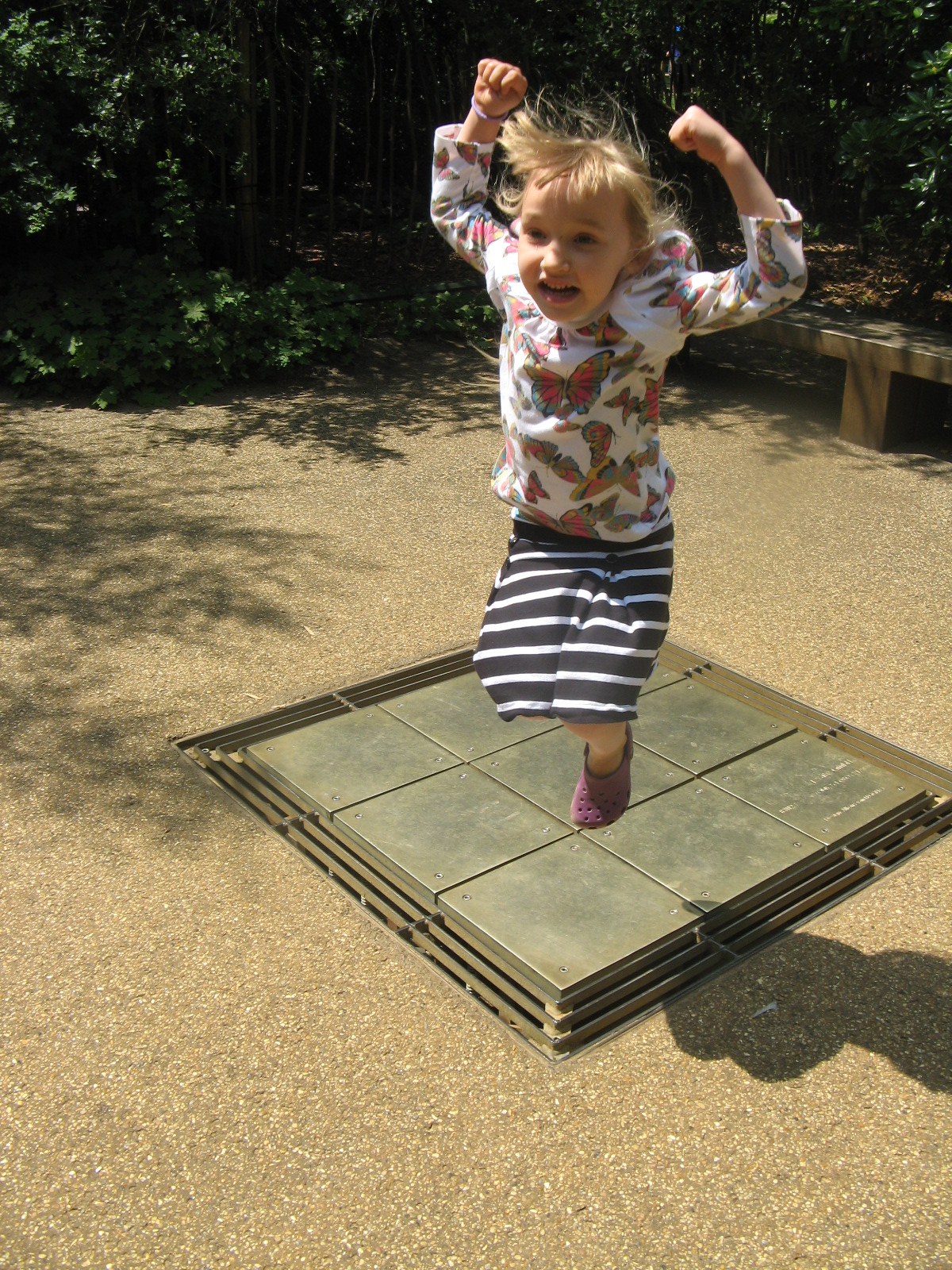
Playing the xylophone the fun way in the Sound Garden of the Diana Memorial Playground (Photo: Joy Morgenstern)

Playgrounds, and we’re not just talking about the astoundingly fantastic Diana Memorial Playground in Kensington Gardens, though it is astoundingly fantastic. There are four or five playgrounds within an easy walk of our flat. It’s not just outdoor space where they grok kids, either. It seems like every museum has highly developed children’s activities (watch and learn, San Francisco).

Coming up with creative pronunciations of non-English words. Yesterday we encountered a name that is pronounced Joe-a-kim, probably spelled Joachim.

Parks and gardens. Joy theorizes that while the men were off expanding and shoring up the Empire, the women had time to garden like mad.

Drinking.

Writing plays. Acting in them too, especially character roles.

IMG_6243Double-decker buses. Why doesn’t every place have them? This is the way to see a city, as Doggie attests.

Self-deprecation and understatement. I love the ad I’ve been seeing on the buses for a moisturizer. After the tagline comes the hard-selling line, “This moisturizer isn’t the whole answer, but at least it’s a start.” Where I come from, the right moisturizer makes you beautiful, wins you the love of a sexy partner, gets you that dream job, and brings about world peace, so this is refreshing.

Takeaway food. In fact, food in general.  We haven’t had a bad meal yet. (Though even one of the best places, where Joy got a delicious roast dinner, boiled the carrots into flavorlessness. Roasted carrots are so yummy that it seemed like a particularly sadly wasted opportunity.)

Ethnic diversity. Of course, most big cities have people from all over, but it’s really striking here. It doesn’t hurt the food situation, either.

Funding museums. Admissions are mostly free.

Sweets. Fortnum and Mason’s toffees are just one shining example (I hope our dentist isn’t reading this).

Tea, the beverage and the meal. Again, why don’t all other countries have a meal that consists of tiny sandwiches, rolls, cakes, and tea? Such a brilliant idea.

Not so much:

Quitting smoking. Man, do Londoners smoke. I thought San Francisco was bad (people smoke there so much more than twenty miles south on the Peninsula, you would think the surgeon general’s warnings didn’t apply to city folk), but London leaves it standing. I am starting to suspect that every twenty-something who comes to London is issued an Oyster card and a pack of cigarettes. And while the restaurants seem to have a smoking ban, people can and do smoke at the tables just outside the doors, which are open for the summer so that the indoor diners can breathe the fumes. England, your food is unfairly maligned, but to have great food you have to remove the tobacco smell.

Not acquiring head injuries while biking. To be fair, maybe they don’t fall off their bikes often. I hope not, because almost none of them wear helmets.

Still and all, well done, Brits. You’re showing us a lovely time.

Falling water drops

A Unitarian Universalist friend and I were talking about class tensions in church, and he said that he found Water Communion hard to bear because it was so much about the places people had gone on their summer vacations.

Oh yeah. I’ve been to some Water Communions that felt that way too. It is so easy for our ingathering ceremony, in which people bring water and pour it into a communal bowl, to turn into a “what I did on my summer vacation” recitation, which can make the ritual obliviously exclusive of those who don’t have summer homes, or summer vacations, or the money for airfare, or the luxury to stop working for even one week out of the year. What a shame; it’s so opposite of what the Water Communion can be.

The core symbolism of the Water Communion is that we all come from water: as a species on a planet where life began in the ocean, as mammals who float in amniotic fluid as we are readied for birth, as beings whose cells are mostly water. And yet we are separate from each other, and we have been apart–since there tends to be a slowing-down, a different rhythm in the summer months, even in churches that have services and religious education right on through the summer–and now we are reuniting. We are separate and together, the way water scatters into rain and streams and clouds and springs and ponds and puddles and yet flows together again and again, one great planetary ocean. Not only is no drop of water superior to any other; all water comes from the same place.

So the class issue is only a part of what’s awry with the “where I went this summer” approach to the ritual. Even if everyone in the world had a summer home in Provence, “This water comes from our summer home in Provence” would not be what I wanted this ceremony to be about. It’s so trivial, whereas “We are separate beings and yet all one” is one of the profoundest truths we try to encompass.

I’ve deliberately shaped our Water Communion at the Unitarian Universalist Church of Palo Alto (UUCPA) with these concerns in mind, and that conversation with my friend made me realize that other UUs could learn from that process, so I’m going to share it here. I’d also like to learn from readers: judging by this description, or by your experience of UUCPA’s Water Communion if you’ve been there, have we succeeded? And what do you do in your congregation to keep our attention focused on the deepest meanings of the Water Communion?

Here are some dos and don’ts that have guided me.

Don’t: have an open mike where everyone describes where the water came from. Not only is this impractical for any but the smallest congregations, but it just about orders people to say “We brought this from the Mediterranean, where we went on a beautiful cruise.”

Do: provide a way for people to share the significance of the water they’ve brought, and have a leader or leaders share a precis. Doing this has allowed me to rephrase people’s descriptions in a way that honors the most important aspects, while playing down the others. So, for example, if someone writes, “This water comes from our family’s summer home on Cape Cod, where I’ve gone since I was a small child visiting my grandparents–this year I was there with my grandchildren,” I might share, “Water from the Atlantic Ocean,” or “Water from a place made sacred by five generations of one family,” or “Water from a multigenerational family gathering,” or some combination of those.

Do: frequently model modest origins for your own water. I usually bring mine from my home tap, even if I’ve been somewhere exotic. (In the spirit of full disclosure, one reason is that when I do travel, I always forget to bring back a little bottleful . . . !)

Do: make reference to the water’s many sources. At UUCPA, we have banners that artistically express the four directions and elements; sometimes we use those in this service and people pour their water into a bowl under one of the banners. They can have a time of meditation to think about where their water comes from, symbolically or literally, and choose the direction/element accordingly. Jane Altman Page wrote nice words to accompany something like that here, on the Worship Web.

Don’t: just pour the water down the drain. While keeping it in the water cycle, that doesn’t honor the sacredness of the ritual. People are bringing something of themselves when they bring that “water from a special day at the beach” or “tap water from my great-grandfather’s house,” so it’s important to let them know that it will be treated with due reverence.

Do: do something important with the water. For example, carry it out ceremoniously after the service and water a special tree. . . . Bless it and invite everyone to put it on their foreheads / hands / feet / hearts. . . . We save some of ours for dedications throughout the year, and pour some in from last year’s dedication water so that the water is now gathered from many years of rituals (does anyone else do this? I don’t even remember if I came up with that idea, or inherited it on arriving in Palo Alto). I usually pour the rest out on our grounds with some words of thanks and praise. (A comment by a church member just reminded me of another possibility: invite people to bring some of the mingled water home, the way we do with the flowers at Flower Sunday, and encourage them to mindfully use it, e.g., to water a plant.)

Do: frame the ritual in terms of its larger meanings. There are so many. Our Minister of Religious Education, Dan Harper, has done a wonderful, geeky demonstration of just how many molecules of water we’re talking about, and how big a number that is. (Remember, we’re serving in Silicon Valley. When you ask, “Are there any geeks here who can come hold this paper for me?,” many hands shoot up.) He uses that to prove our literal interdependence. The year Water Communion was preceded by Hurricane Katrina, we had to talk about the destructive power of water, and that was a chance to go into some theological depth.

And, if you’re reminding folks about Water Communion now, as summer starts, don’t emphasize that they should bring their water back from special travels. There’s no need to mention travel at all. This year, my reminder in the newsletter said “We bring water from the places of our lives.”

I’d love to hear what others do.

June 3 has come around again. Even though I was only not-quite-six years old on this date in 1974, when my aunt, Roslyn Shapiro Lewisohn, died, I think of her each year. She was 38 years old, which means she has now been dead for as long as she was alive. Her four children grew up without her. Her younger sister, my mother, was suddenly rendered an only child, and when their mother died several years later, my mother mourned without a sister to share her sorrow and memories.

Aunt Rozi was shot by her husband. He was drinking–he was often drinking–and they had an argument. At the end of it, she was dead on their kitchen floor. The reason he had a gun, according to what he had said some years earlier, was to defend himself from his enemies. What enemies a poet and college professor might have had to worry about, there in their home on the Maine coast, is hard to imagine. His own demons, I guess, and when those are your enemies, the very last thing you need is a gun. But he certainly didn’t have to prove he had anything rationally to fear in order to own a handgun and keep it loaded. He didn’t have to show that he didn’t abuse substances or his wife. He didn’t even have to show that he didn’t have a criminal record or any dangerous mental illnesses. It was just the way the “no to background checks” people want it to be.

When people talk about how we need to make sure “the good guys” are allowed guns, they are talking about people like my uncle Jimmy. He was a middle-aged, middle-class, white, college-educated poet and English professor. He was Jewish, for crying out loud. If we had decided to arm the good citizens of Cape Elizabeth, Maine, so that they might protect us from machine-gun-wielding drug dealers and mass murderers, Jimmy could have been first in line, and he would have been handed a lethal weapon with a smile. And taken it home and used it exactly the way he did use it.

Twenty-one years after Rozi’s death by handgun, another good guy tried his best to murder my father. This good guy was also middle-aged, middle-class–no, wealthy; white, a college graduate, a member of the Congregational church in town, a respected businessman and pillar of his community: again, just the kind of person who, in the mythical world of black hats and white hats, is supposed to defend us from the bad guys. When his wife left him for my father, Malcolm went berserk. He sought Dad out at the college where he (my father) taught, and stabbed him half a dozen times. Fortunately for Dad, Malcolm was scared of guns; otherwise he would surely have used one. Two very brave students wrestled him off my dad. Would they have dared to if he’d been wielding a gun instead of a knife? Not that it would have mattered. If Dad had been shot even once in some of the places he was stabbed–his chest, his temple–he would have died then and there, instead of arriving at Yale-New Haven Hospital on the brink of death and being dragged back from it by their highly expert trauma team. Not a visit goes by without my being keenly aware how close I came to losing him at age 26. Not a fatal shooting appears in the newspaper without my thinking, That would have been my family, if Malcolm had had a gun.

We have a myth taking hold in this country, a myth of bad guys vs. good guys. It says that there are violent thugs, or crazed mass-murderers, and then there are fine, upstanding citizens. But as we know, most murders aren’t Aurora or Newtown. They happen in ones and twos, and aren’t planned, but result from the heat of the moment combined with a highly fatal weapon. Most murder victims know their killer; many, in fact, are killed by a relative, or a girlfriend or boyfriend. My aunt’s death and my father’s near-miss were typical: personal dispute + alcohol or other drugs + a person who is prone to irrational thinking and violent behavior. The difference between them was that in one case, the attacker had a gun, and in the other one, he didn’t. You can certainly kill someone with a knife, with a baseball bat, even with your bare hands, but bullets are vastly more likely than any of these to be fatal.

To those who say that good guys with guns could have saved my aunt, or made a more effective rescue of my dad, I have several questions from the real world.

  • Can you imagine my aunt pulling out a gun and telling Jimmy to back off? It would only have confirmed his paranoia, and paranoid people do not surrender their weapons. In a movie, he’d drop the gun, but in real life, he was drunk and enraged and irrational, and he didn’t take any crap from his wife (let me translate that for you: he was in the habit of beating her up). He’d be more likely to pull the trigger than to drop the gun.
  • Can you imagine being a college student who hears cries for help and comes running, to find one man stabbing another over and over? If you have a gun, what do you do with it? Shoot the assailant? Please don’t–that’s my dad a few inches from him, the walls are tile and metal, and the chances of you or Dad getting killed by a ricocheting bullet are high (a hostage was just killed, instead of rescued, by police in such a situation). Or should you yell, “Freeze!”? Great idea, but again, this guy is not exactly in the grip of reason. If he were, he wouldn’t have wrecked his own life by committing a felony just because his wife had had an affair.
  • Now, turning to the mass-murder scenario, where millions of Americans fantasize that an armed security guard or elementary school teacher or heroic passerby will save the day by plugging the bad guy. We’ll set aside the fact that this being the real world, heroes are not protected by the Principle of Evil Marksmanship,  and even trained gun users can’t just pull out their guns and hit their target (and while the linked-to video is not of a scientifically rigorous experiment, the attempts to debunk it are comical in their desperation. The experiment didn’t happen when Diane Sawyer told the subjects it would! The defender was wearing a long shirt over his gun! How unrealistic!). As my brother-in-law points out, if we follow the advice of the NRA and Gun Owners of America, when someone starts shooting in a crowd, what you will have now is a crowd with several people pointing guns. How is anyone–police, terrified bystanders, other would-be heroes–supposed to know which of them is a good guy and which was the original shooter? The scenario resembles nothing so much as the firing squad in the ethnic joke, except with dozens of innocent parade-watchers or elementary school students or moviegoers added to the mix.

There are good guys and bad guys in the world, definitely. But it’s not usually that simple. Often, a bad guy is someone who was a good guy until the moment he had too much liquor in him, too much wounded pride, too little ability to manage his anger, and a deadly weapon in his hands. That is one reason the gun in your house is far more likely to kill you or someone you love than any of your “enemies.” (Another reason is that it’s more likely to become a suicide weapon than anything else, but that’s another subject. So is the Second Amendment, which in my opinion doesn’t mean remotely what the gun-rights advocates, or half the gun-control advocates for that matter, think it does.) Let’s be clear, “armed citizenry” advocates: when you set out to arm the “good guys,” you are talking about handing guns to Jimmy Lewisohn and Malcolm Todt.

Of all the grief and fear that a tragedy like the Newtown massacre instills in me, the most terrifying development is the advance of the notion that arming more citizens will make us safer. It’s a profoundly dangerous idea, based on fiction and fantasy, and it is just plain wrong.

We are honored and inspired by hosting those who are fasting for family unity and immigration justice today. Under the leadership of the UUCPA Immigration Task Force, we have joined thousands of Unitarian Universalists across the country who are currently studying and taking action on the moral issue of immigration. This is a crucial moment in the history of U.S. immigration policy, as Congress weighs the possibilities for real reform. We are proud to stand beside the other member congregations of Peninsula Interfaith Action in making sure the legislation represents our values. Our religious principles guide us to insist upon an immigration system that respects the dignity of all workers;  seeks to unite, not divide, families, including those with same-sex partners; allows freedom of movement and empowers those who wish to remain in their countries of origin to find gainful work there; and warmly invites into citizenship those who wish to join our country.

The current system is broken. It demands cheap, migratory labor, then scapegoats those who come here to work. It makes migrants of those who would prefer to stay in their native lands, and expels those who consider the United States their home and want to continue to stay and serve here. It treats people as criminals for seeking to do what is best for their families and to keep those families together.

As the descendant of despised immigrants, I respect the courage and strength of today’s would-be US citizens. As a parent, when I hear stories of parents and children kept apart by economic necessity and by an irrational and destructive immigration policy, I feel a wrenching pain inside. I am joining in the fast today because I feel this solidarity. I hope that the pangs of hunger will make it impossible for me to forget the pain millions of families feel when they are torn apart.

Some tell us that we need to build walls that keep some of us on one side of a border and others on the other side. We recognize that national boundaries may be necessary, but just the same, our hearts can be, and remain, with the people on both sides of the border. If we must choose sides, then as we sing in one of our Unitarian Universalist hymns, “we are standing on the side of love.”


Do you love San Francisco too? We’re renting out our house for a month this summer . . .

Here are a few things I love about this city, inspired during a recent trip through Civic Center /  UN Plaza.

 I, Sailko [GFDL (http://www.gnu.org/copyleft/fdl.html) or CC-BY-SA-3.0 (http://creativecommons.org/licenses/by-sa/3.0)], via Wikimedia Commons

Fountain at United Nations Plaza, designed by Lawrence Halprin. Photo: I, Sailko, via Wikimedia Commons

The F line. It’s a special treat when I have reason to go up Market Street, because I love the streetcars on this line, which are restored trolleys (often antique) from all over the world, including Milan, Mexico City, Brooklyn, Los Angeles, and Zurich. If you’re really lucky, or fanatical enough to check the schedule and hold out for No. 952, you can ride a streetcar named Desire.

Buskers. There appear to be no rules governing buskers in the streets, squares, and stations of the city, as I am reminded every time my trip through the Civic Center BART station coincides with the shift of the impassioned, apparently insane “musician” who thinks a stringless bow on a battered violin makes beautiful music. I have to clench my teeth to keep them from shaking loose, but the reward comes at other times, when we come up the escalator to hear a marvelous cellist playing Bach, or there’s an out-of-work operatic baritone singing at the base of the Simon Bolivar monument at the Civic Center Farmers’ Market. He was there the day my daughter’s class took a field trip to the market, and sang a great rendition of “Fiddle-I-Fee” for the preschoolers. Another day, I was part of the lunchtime crowd at the market, and a busker had set up and gave us beautiful Spanish guitar with our tamales and rotisserie chickens.

Street Sheet. This newspaper, funded partly by the American Friends Service Committee, is sold by people living on the street. The sellers get the proceeds, the buyers get to help people who really need it and get an informative paper at the same time. Whereas simply being asked for money leaves me discontent, whether I give it or not, these interactions always make me happy.

Truth in Trash-Talk. The trash cans in this area, as in many parts of the city, have three categories: Recycling, Compost, and–no, not Trash–Landfill. I like that gentle reminder in our green city of what really happens to whatever we throw “away.”

Anyone who’s kicked around in the field of congregational growth for more than about ten minutes has encountered the concept that there are several kinds of growth. As outlined by Loren Mead in More Than Numbers: The Way Churches Grow, they are numerical growth, organizational or organic growth (appropriate changes in structure–e.g., a 75-member church needs different structures than a 250-member church), missional or incarnational growth (how well people live out the mission of the congregation day to day), and  maturational or spiritual growth (he also calls this “growth in wisdom”). To our detriment, we tend to focus overmuch on numerical growth, for a variety of reasons, a major one of which is that it’s the easiest to measure.

Since other kinds of growth are important as well, though, it’s important to measure them too.  I have been thinking about ways one might measure the maturational or spiritual depth of a congregation and its members: the extent to which the congregation “challenge[s], support[s] and encourage[s] each one of its members to grow in the maturity of their faith, to deepen their spiritual roots, and to broaden religious imaginations”; members’ growth in wisdom. What if we randomly sampled a group of members each year and asked them some questions that would reveal the maturity of their spiritual lives? Or followed several over the course of several years, in a longitudinal survey? What questions might we ask?

What do you think of these?:

I have a regular spiritual practice. (y/n)

I have people at church with whom I can talk about spiritual or religious matters. (y/n) How many? _____

I have people outside church with whom I can talk about spiritual or religious matters. (y/n) How many? _____

In the past month, I have had conversations after church, and/or outside church, about an issue that was talked about in the service. (y/n/I haven’t gone to any services)

Participating in my small group gives me insight and inspiration. (y/n/I’m not in a small group)

I have called upon members of the congregation to help me in some way in the past month.

I have responded to a request for help from other members of the congregation in the past month (examples: brought a meal for our Baby Cafe or Get Better Bistro, gave someone a ride, followed up with someone who shared a sorrow at Caring and Sharing).

I ponder deep questions ___________ (frequently / occasionally / rarely / never).

Things I learn in church help me in my relationships outside church (frequently / occasionally / rarely / never).

In the past month, I have had an experience one might call transcendent, spiritual, or powerfully meaningful at church. (y/n)

In the past month, I have had an experience one might call transcendent, spiritual, or powerfully meaningful outside church. (y/n)

What else would you ask to discern wisdom or spiritual depth? Does your congregation have a process for measuring maturational growth?

As a side note: although Mead is an Episcopal priest and the organization he founded to strengthen congregations, the Alban Institute, is non-denominational, putting his terms into a search engine turns up mostly Unitarian Universalist sites. I’m curious what that’s about.

I’m passionately concerned about the environmental catastrophe that is already upon us and only getting worse. We need to reverse climate change as soon as possible, and ending our dependence on fossil fuels is a key step. There seems to be a groundswell for the idea that the best way to do so is to divest from fossil fuels. So I have been reading up on divestment, and finding that no one, least of all Bill McKibben in his article “Divest from Fossil Fuels. Now,” has explained to me yet how this movement would further the goal of reducing fossil fuel use. I’m frustrated, because his organization, 350.org, and Naomi Klein, who’s also working on divestment, have been two bright lights in the environmental movement in recent years. I would love to be convinced that they are not wasting everyone’s time and a whole lot of activist energy on a project that divestment supporter Isaac Lederman, a Princeton student, says ” is attractive primarily because of the symbolic weight it carries.”

Granting that divestment helped end apartheid in South Africa (which is of course debatable, but I think the evidence is strong that it did), is this situation analogous? In one crucial way, it is not: it comes accompanied with no demands. And I fear that that dooms it to being merely symbolic.

In the South African divestment campaign, the message was simple. To corporations:  cease operations in South Africa and we will re-invest in you. To the South African regime: end apartheid and we will support you and the return of corporations’ capital to your country.  I strongly supported this movement, which was at its peak during my college years. I not only urged my university to divest its Shell holdings (on one occasion, by leading the crowd outside a trustees’ meeting in singing “Blowin’ in the Wind,” I cringe to recall), I stopped buying Shell.

But I can’t stop buying fossil fuels and the energy they produce–not yet.  I use them to get to work, to do my laundry, to keep my food cool, to power this computer. (Unlike Mr. McKibben, I can’t afford to convert my home to solar power, though it’s on the list of improvements we’d like to make.) So if I support divestment, I’m asking people to stop funding Exxon’s oil exploration, while I’m pumping its gasoline. While I’m not advocating purity as a moral stance, this is too much cognitive dissonance for me. You scum, stop drilling! And give me that gas!

McKibben argues that these companies have so much political clout because of the value of their stock. That may be true in part. But no matter how low their stock drops, they’ll still drill, because we’re still buying their products, and they’ll still have political clout, because the economy can’t continue without them. Again: yet.

A change movement has to ask, what change are we hoping for and what’s the leverage that will bring it about? In South Africa, the answers were clear. With the Divest from Fossil Fuels campaign, I don’t get it. It seems to just be saying “Fossil fuels companies are horrible” (no argument there) and “If they extract and burn everything they’re trying to extract and burn, the warming of the planet will accelerate” (again, I agree). But as long as we are so dependent on extracting and burning them, nothing will change. A heroin junkie might be completely justified in demanding the arrest of all the heroin dealers, but if it were to happen, he’d be up a creek. He still needs his fix. I still need to get to work, 35 miles away.

The situation is too dire for symbolic gestures. We need to take real action. I love the idea of putting economic pressure on these companies, and the first question to ask–the question their directors and executives will surely ask–is “Pressure them to do what?,” a question that not even McKibben, the man who started the divestment movement, has answered. One colleague of mine has–thank you, Earl Koteen; he suggests that what we are asking fossil fuel companies to do is to switch their operations to sustainable sources and become (alternative) energy companies, as the savvier ones are beginning to do. That sounds promising. Now if only the movement, and not just one of its fans, would make a concrete demand like that, then it might make a difference. Even better, we could do the much more difficult work of funding alternative infrastructures that would allow us to break our fossil fuel addiction.

For all of us who have been following the news of the Boston Marathon bombing and feeling the impact even at thousands of miles’ distance, here is Yehuda Amichai’s great poem “The Diameter of the Bomb”:


The diameter of the bomb was thirty centimeters
and the diameter of its effective range about seven meters,
with four dead and eleven wounded.
And around these, in a larger circle
of pain and time, two hospitals are scattered
and one graveyard. But the young woman
who was buried in the city she came from,
at a distance of more than a hundred kilometers,
enlarges the circle considerably,
and the solitary man mourning her death
at the distant shores of a country far across the sea
includes the entire world in the circle.
And I won’t even mention the crying of orphans
that reaches up to the throne of God and
beyond, making a circle with no end and no God.


I feel very much within the diameter of destruction today.

Reading some more about Emily Dickinson before giving today’s sermon on some of her poetry and its power, I came upon the description of her  “earliest friend,” Benjamin Franklin Newton. He died young, but before he did, he had a great influence on her that she referred to throughout her life. Among other things, he introduced her to Emerson, whose poetry, she wrote in wonder, “has touched the secret Spring.” Hm, I thought. Wonder if he was  a Unitarian. Sure enough, his minister was Edward Everett Hale.

I wrote yesterday about the loss of creative programming for kids under 10 during General Assembly. Other parents have inquired, and the General Assembly Planning Committee has added details to the Child Care section of their pages:

The theme for childcare this year is, It’s Good to be Green:
Alright kids! Ready, Set, GO GREEN! Taking care of each other and the planet is on everyone’s mind these days and being eco-friendly can be fun! From craft projects made with recycled materials to puzzles and games about our planet, we’ll learn about our environment in a fun, playful and creative way. Our nature theme tents and tunnels will give the feeling of playing in the great outdoors. Exploring our surroundings could lead us to a great scavenger hunt. Divided into teams and following clues, let’s see which team finds the most eco-friendly items hidden throughout the room. From using recycled materials to special projects directed at environmental learning, children will leave the program feeling positive about themselves and becoming eco-friendly.

Sounds much better than “child care from 6 months through age 9.” It’s still not clear what ages get this programming (a member of the committee said in an e-mail it was for 8- and 9-year-olds), and all day in one room doesn’t sound great for anyone over about 4, but it’s more appealing than what was on there before. Thank you! Please extend it to 6- and 7-year-olds if at all possible!

The Fahs Lecture, sadly, appears to have no chance of being restored this year, since the Planning Committee, in what was described as a respectful conversation, said there is no such thing as a guaranteed spot at General Assembly. However, there used to be, and I am one GA regular who thinks that that provided a much richer program than the more recent process of confining most program decision-making to a small group. If anyone thinks that our current method is the best way to meet the wonderfully diverse needs and interests of the thousands of GA attendees, I offer the Fahs Lecture decision as a counter-example.

Enter your e-mail address to receive e-mail notifications of new posts on Sermons in Stones

Links I like