Inspired by an exchange on the UU Growth Lab

We Unitarian Universalists sometimes assume that people in other religions are “more comfortable with hypocrisy” or  “comfortable pretending to believe things they don’t believe.” That must be true of some people, but I don’t think that it is a fair or true way to explain why many people remain in religious communities where they don’t believe in the whole package. I stayed involved in Judaism for years after developing serious doubts, and I can articulate several reasons why.

The rituals were beautiful and still meaningful to me in many ways. Some of the meanings were about a vision of God or human destiny that I didn’t believe anymore, but many others were still consonant with my beliefs. Also, the rituals and practices were very wrapped up in family life. I hadn’t lighted the Shabbas candles with my family for all those years only because I believed that God commanded us to rest; I had done it as part of a treasured family gathering, a time of togetherness and mutual blessing. Absenting myself from that would have been removing myself from a special meal at week’s end lit by the glow of candlelight, the beginning of a day we committed to spend together and with gathered friends, instead of scattered all over town on various errands and activities. Dropping the practices that had lost much of their meaning was not as simple as “don’t go to services anymore” or “eat whatever you like.”

Photographer unknown; if it's you, please tell me, and let me know if I may use it and credit you.

The things that I still did believe in, and the values that my religion helped me to practice, were so important to me that I was not willing to give them up just because there were also elements of the religion that appalled me. I knew of no other community that would support these values and beliefs–not yet. I certainly knew of no other community that would support these values and beliefs in the context of a culture that I had known from birth, that is shared by my ancestors, and that goes back thousands of years, and I still don’t. (I finally decided that I would have to do without that. It was a sad, painful choice.)

So there I was, going to synagogue, participating in many aspects of Jewish life. I was not pretending. All the people closest to me knew about my struggles with my faith. Some knew sooner than others, and of course the people sitting in the next row at shul might not have known at all, and might have assumed that because I was singing along with the service, I believed what they believed. That bothered me, but it’s not as if every person in a synagogue believes exactly the same thing even at the best of times. I’m sure some of them had similar internal struggles to mine.

I eventually left, but I don’t think that I am truer to myself than others who shared my doubts but chose to remain. People may stay for a lifetime in a religion that is not a perfect fit, because it’s the best fit. We don’t get to create religions from scratch, not if we want things like 5,000-year-old roots; we choose from a limited list of options. I’m really no different today than anyone who chooses an imperfect religion (or job or place to live or marriage or . . . ). Unitarian Universalism suits me very well, but not perfectly. Just the same, I’m staying here. Does that make me insincere? Of course not.

There are good reasons for people to stay in a religion with which they have profound disagreements. If that’s strange to us, perhaps instead of assuming that they are faking it, we could approach them with curiosity and compassion and inquire about what they seek and what they have found.

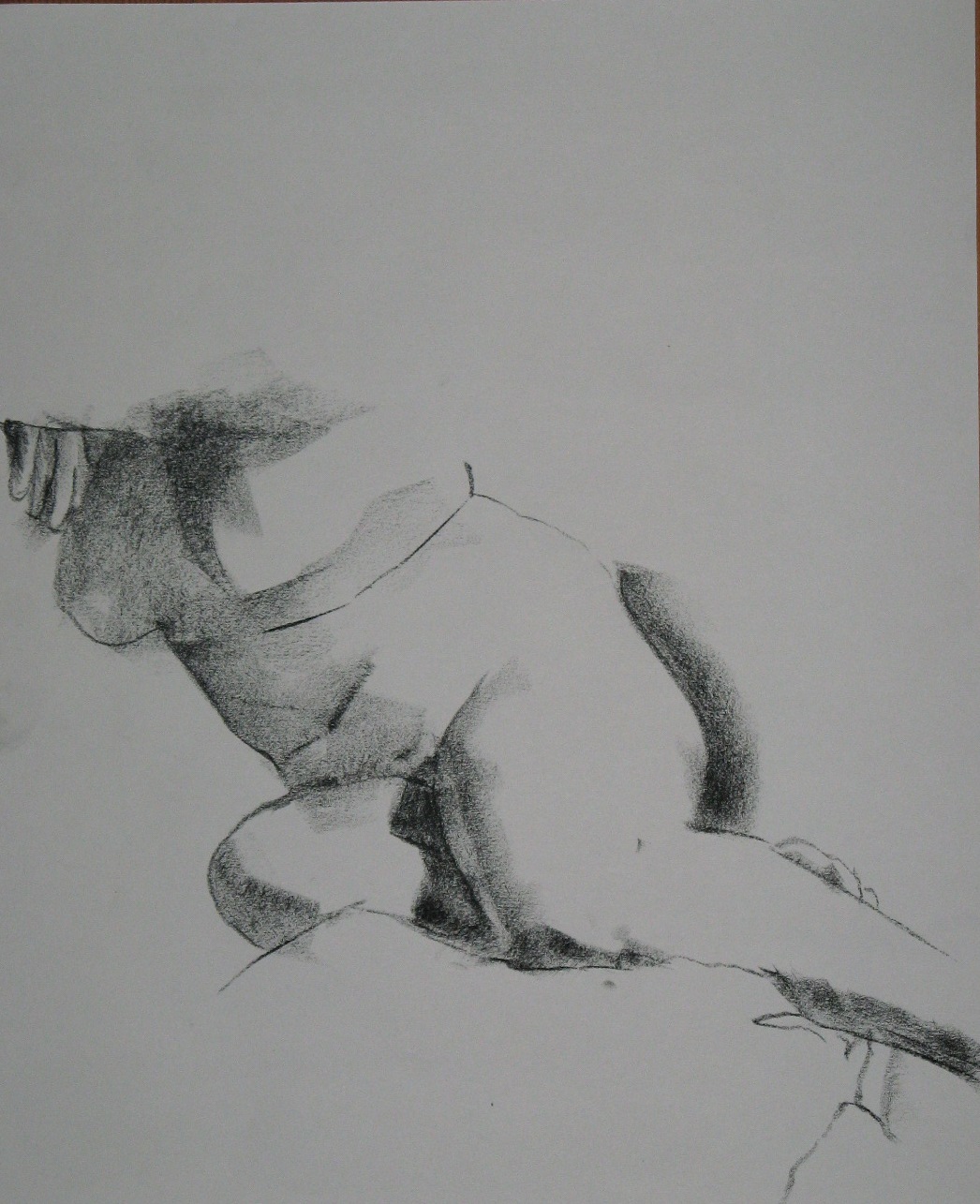
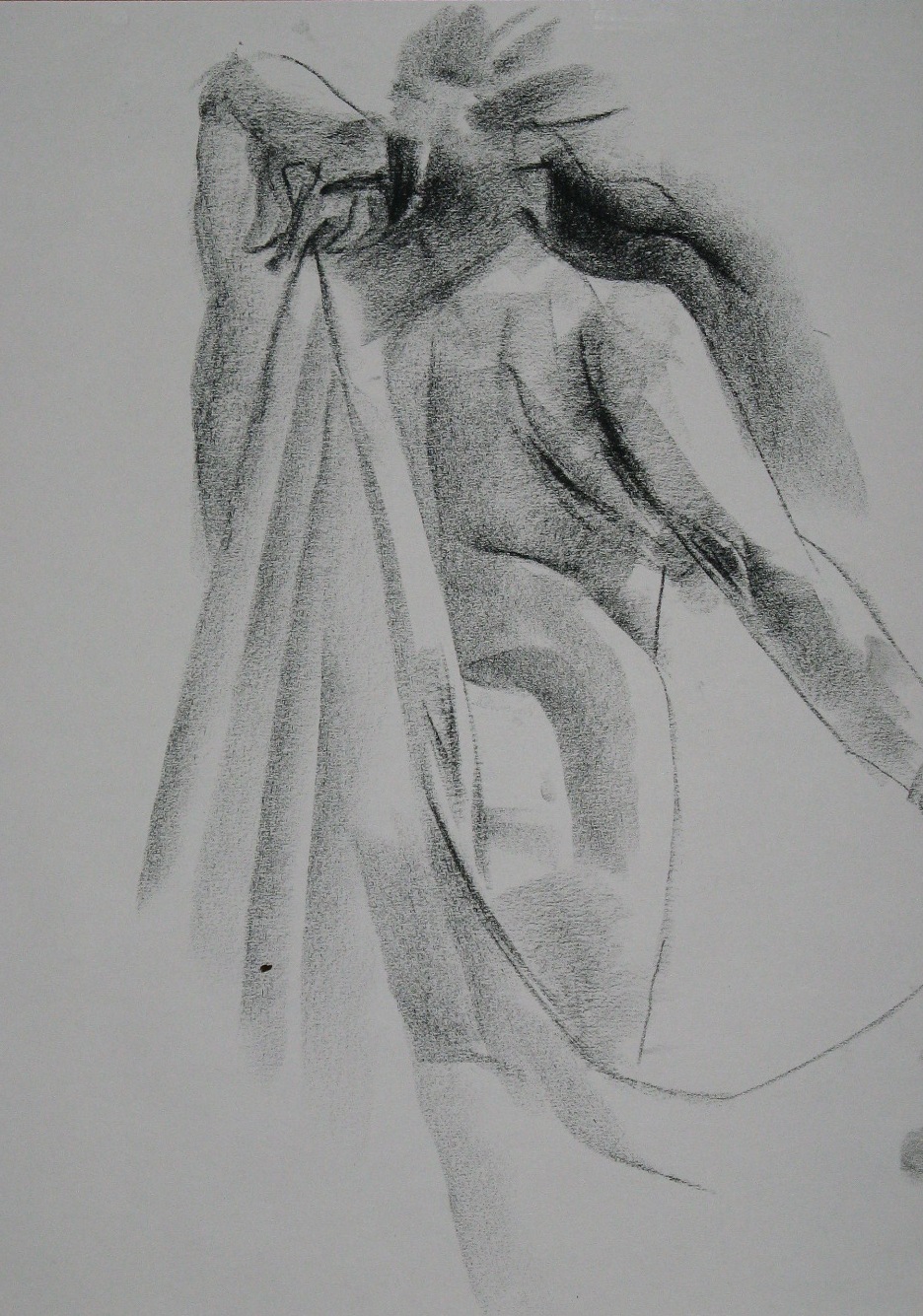
As part of my study leave last week, I did an extra session at the figure drawing studio, so today’s session was the third in eight days. The cumulative effect was very positive–unless it is a coincidence that last Wednesday was better than last Monday and today was better than last Wednesday. I don’t think so. I think I powered through to a better place, because today was full of “aha”s. I was working small and with a fair amount of detail, but I mostly kept the gestural quality that I like instead of going all stiff, and I know how I did it. The first “aha” was with this one. Sometime during this seven minutes, I realized that the life was in the parts that had no lines, but were just drawn in with shadows:

10 14 2013 7 min c

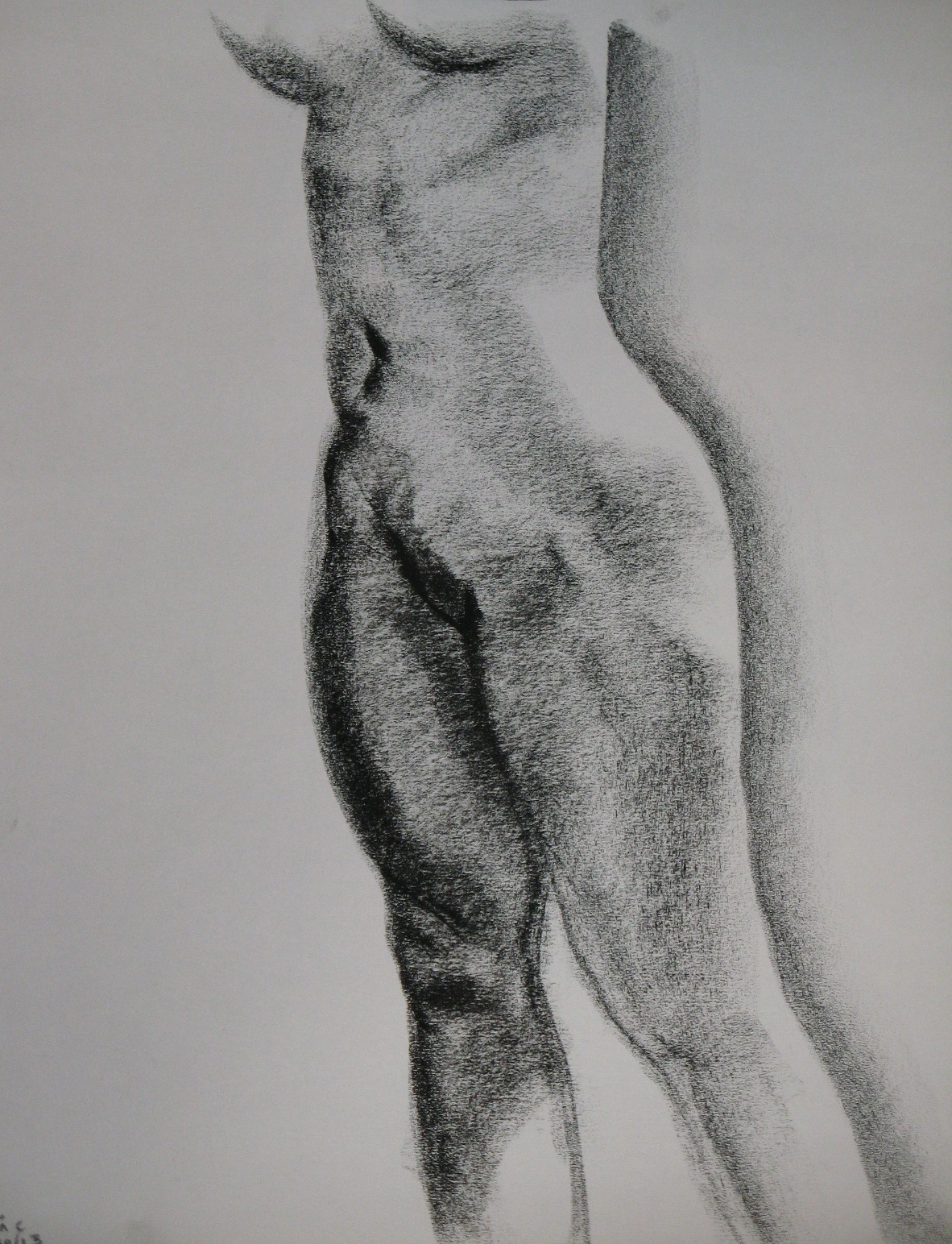
So I set out to draw almost nothing but the shadows, and this was the result:

10 14 2013 10 min d

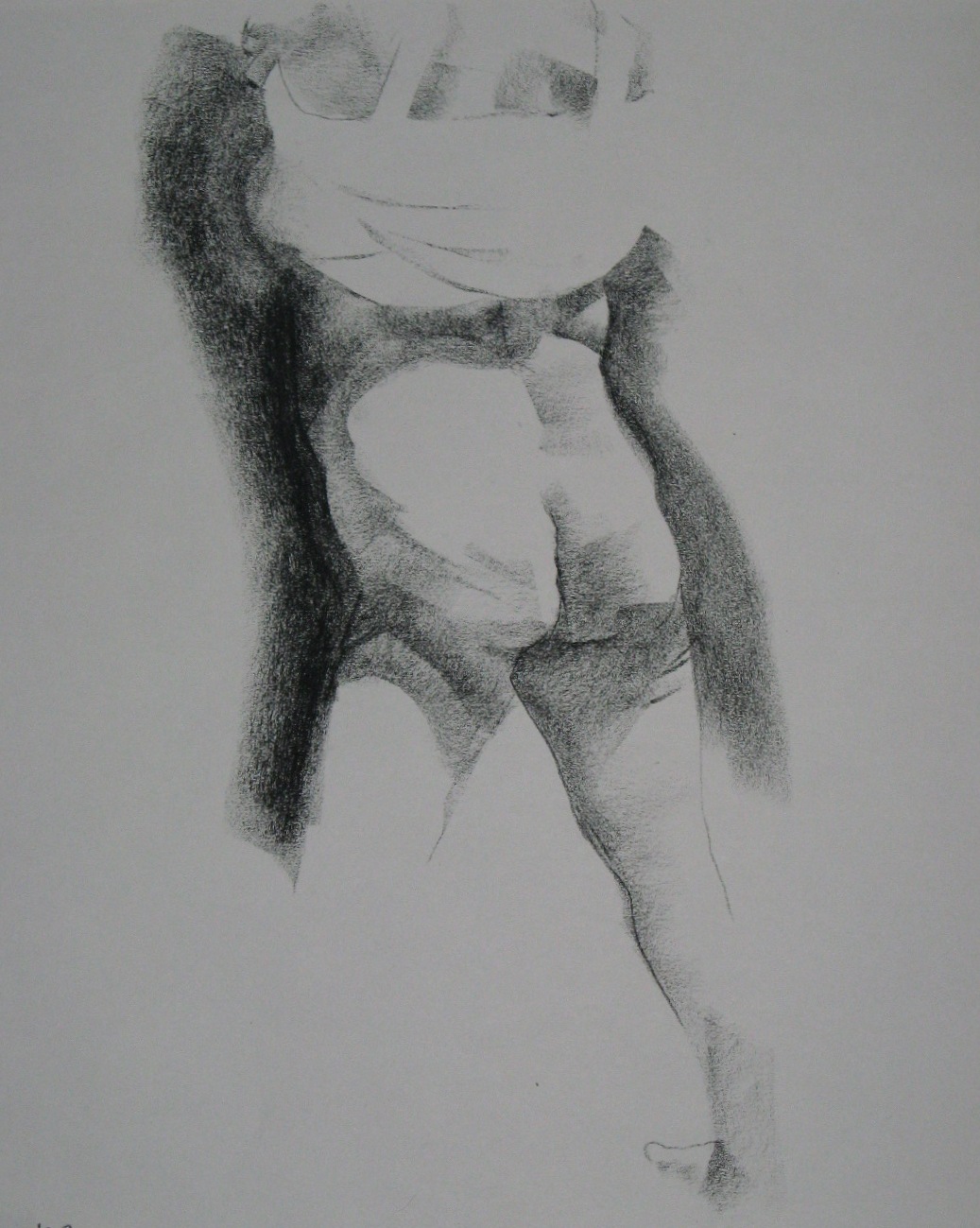
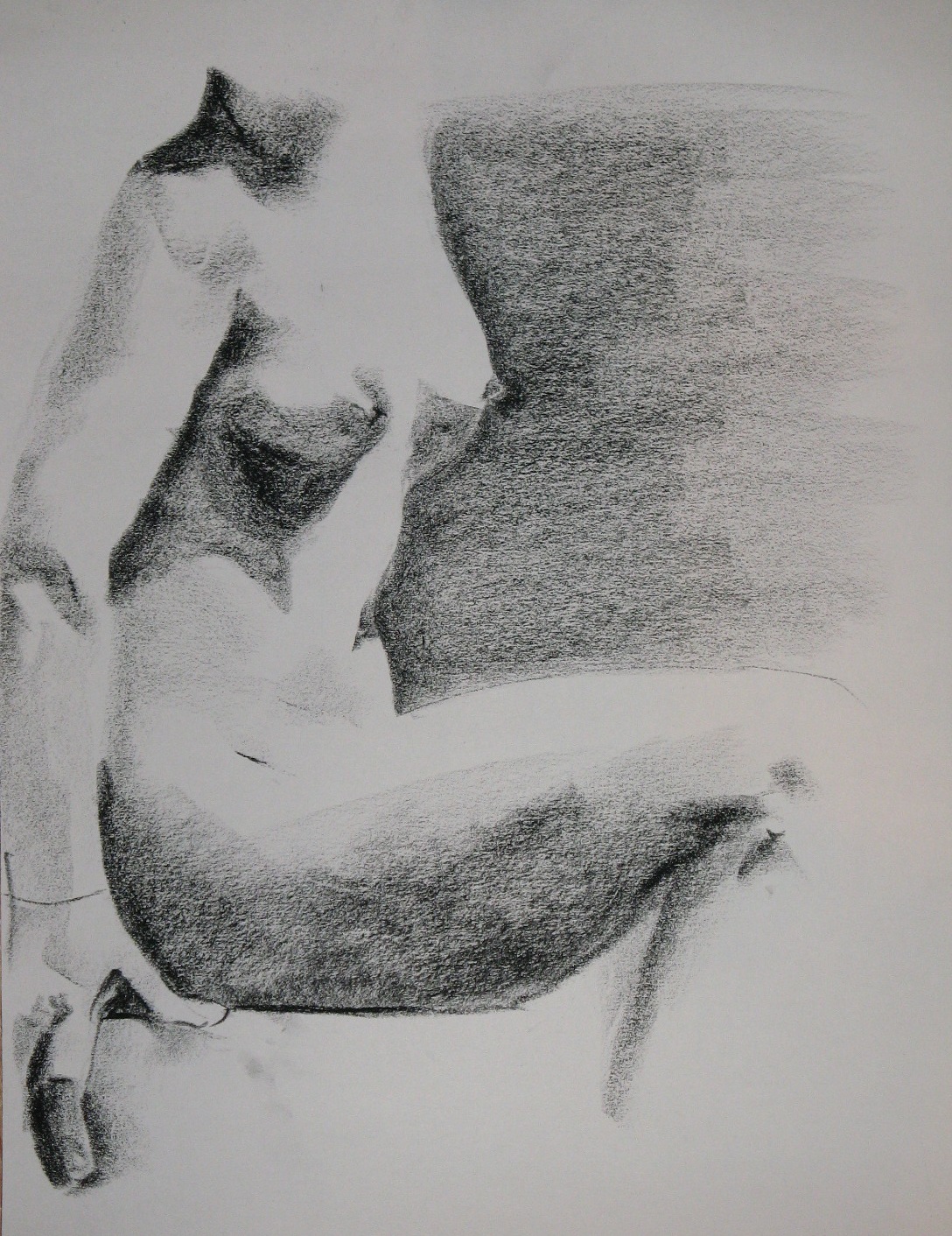
AHA! Definitely getting somewhere! I did the same for this gorgeous pose:

10 14 2013 10 min e

The above is my favorite of the day. I wanted to stay with that pose for the rest of the session, but alas, it was only ten minutes.

We had a forty-minute pose, and I am happy with both the face and the body in the drawing that resulted, but d’oh! they are out of proportion to each other. It’s really hard not to go too large on a section that I do last and give lots of attention:

10 14 2013 40 min g

I needed a few more minutes on the legs, too. But I used the time to tackle the hair, something I usually ignore, and it’s not bad.

Here are the first two of the day. Not bad, but pre-breakthrough. The fabric on the first one works pretty well even though (because?) I gave it only the most cursory attention.

10 14 2013 7 min a

10 14 2013 7 min b

I never note scale on these drawings, and I ought to for my own purposes down the line (I toss most of the drawings, so I only have digital versions and will never remember the original dimensions). These are on 11 x 14 paper; I went to that smaller format deliberately because the larger paper was “making it harder to capture subtleties of light, not easier.” If I can remember what I’ve done today, it may work well to go back to a larger sheet. I’m not even sure what was going on there–just that I am now at the point that I have to use little tiny pieces of charcoal in order to work in the space I’ve allotted myself, and that’s getting old. This was also the first day that I didn’t use newsprint at all, and I didn’t freeze up, so I’m going to keep on doing everything but the warmup gestures on the good paper and see where that leads.

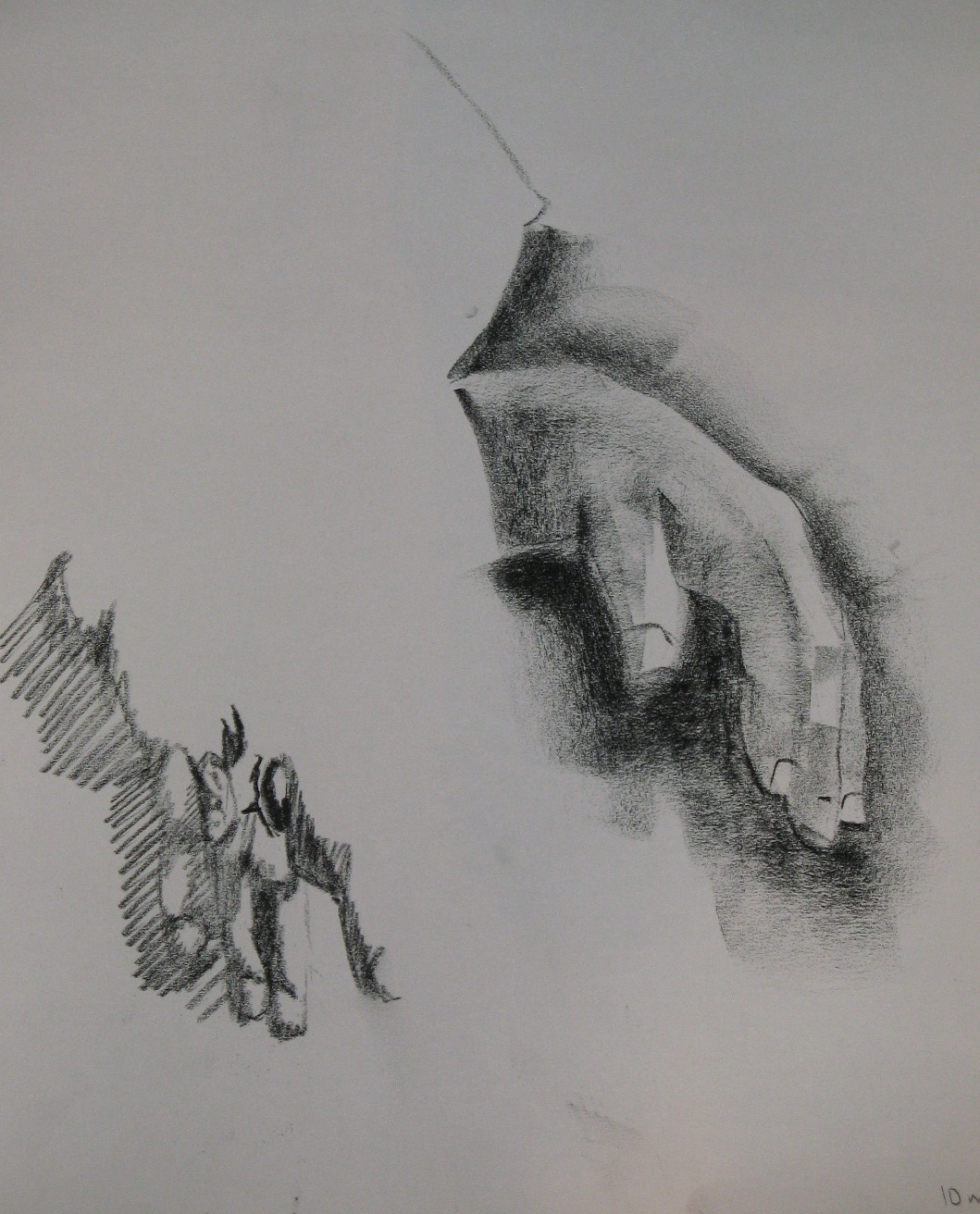
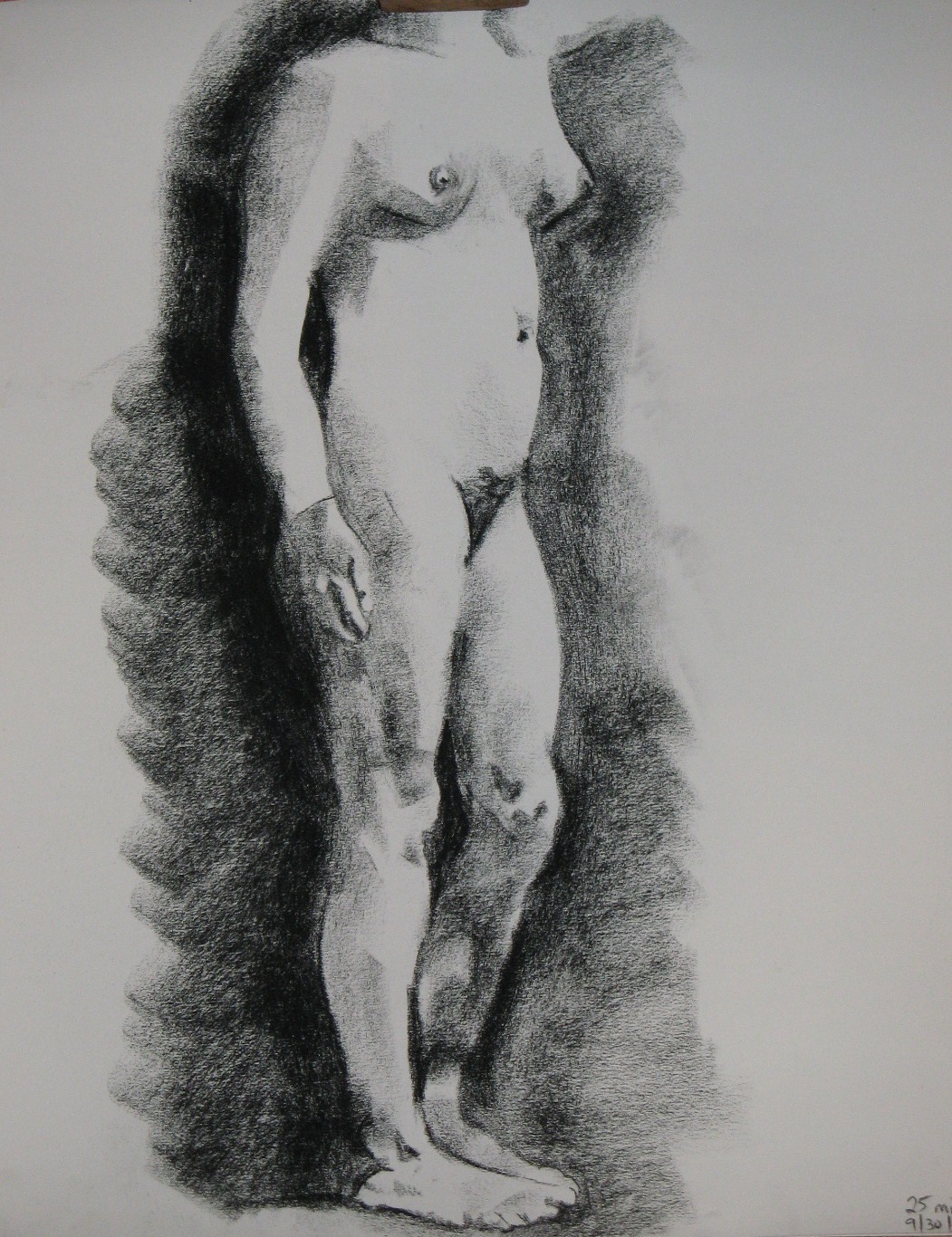
Some I like, at least bits of them (nice light / hand / knee!), some I don’t (so stiff!), one I threw out without wanting even to look at it anymore, much less photograph it. But I haven’t posted any drawings in ages, and I am going to dispense with commentary and just get them up here.

9 30 13 7min a

9 30 13 7min c

9 30 13 10min d

9 30 13 10min e

9 30 13 10min f

9 30 13 10min g

9 30 13 20min h

9 30 13 25min i

I’m posting audio of my sermons as often as possible from now on. I’m hoping these will be on the UUCPA website or blog soon, but until then this is a simple way to get them out there. I welcome your responses regarding format as well as content. How do you like to get your audio? Is this format providing that?

“Free and Responsible,” given at the Unitarian Universalist Church of Palo Alto, August 25, 2013

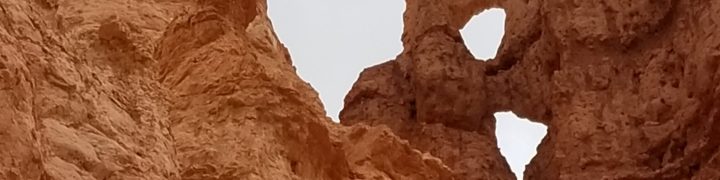
I’m just about to start a photo-a-day challenge. Among other things, the organizer, Michelle Favreault, predicts it will “allow you to expand ways of integrating visual arts into your ministry.” Even before I signed up for it, it had recently occurred to me that I could build an entire worship service around Annie Leibovitz’s photograph Susan Sontag, Petra, Jordan.

This photo is one of dozens on the postcard rack that lives in our house. We have many more postcards than display slots, so most are hidden behind others, emerging at different times. When we got back to our house after a month’s absence, this one was visible and turned toward the sofa, from which I have been contemplating it. I recommend backing away enough that your experience of it is something like mine when I look at a 4″x4″ square image from a distance of a few feet.

I won’t write the whole sermon today; I’m a bit preoccupied with the one I’m giving on Sunday. But my thoughts, to give them in the vague and chaotic form they take before they’re pulpit-ready, include:

  • it’s a vivid example of negative space, compelling the eye to travel between the foreground and the background. Which one is the subject? Or is neither one the subject?
  • at least three elements balance here: the very small human figure, the very tall buildings of Petra (built by people), the massive rocks (built by no one) that dominate the foreground.
  • it suggests a relationship among the natural world, human-made artifacts, and humans.
  • furthermore, one of the most memorable points about human beings and Petra is: there aren’t any there. The people who created it are long gone, and we’re not sure who they were. The only living person in the photo is a mere silhouette.
  • the overall shape of the glimpse of Petra is evocative of a standing person.
  • the three elements occupy different time scales. In the scale of Petra, Sontag’s life is a blink of an eye (she will in fact be dead ten years after this photo is taken); in the scale of the living rock into which Petra is cut, the buildings and the civilization that carved them are no more than that; and what is the lifespan of the rock, in galactic terms? Nothing more than a blink either. I’m thinking “Ozymandias” would be an appropriate verbal text to go with the visual “text” in this service.
  • the building seen in the photo is called the Treasury, evoking questions of where and what treasure is. The fact that it was probably not a treasury at all, but a mausoleum, only deepens the questions of what we claim has value, what really has value, and what any of it means in the face of impermanence. Knowing that no one and nothing lasts forever, how would we answer the question: what is most precious?

That’s enough. If I actually develop the sermon, I’ll give a heads-up here.

The Chariot, from the Phantomwise Tarot © 2004-2013 Erin Morgenstern

I have just read The Night Circus, by Erin Morgenstern (no relation). Very few books have created a place that I longed to be able to go to in real life. I have wished Hogwarts were real, and that I could slip through the ivy-covered door into the Secret Garden; and now, oh how I wish the Cirque des Rêves were really touring around the world, bringing its exquisite magic to us. I would be a Rêveur, one of the people who follows it around, a beauty groupie. I would knit a Rêveur’s crimson scarf for me, and one for Joy, and we would go into the Cloud Maze tent, and the Ice Garden, and the Hall of Mirrors, and see the illusionist work impossibilities, and take in the intricacies of the clock, and wander through tents where everything is made of paper and covered in words. I don’t know if the Munchkin would need to come along (though she would enjoy Widget and Poppet’s acrobatic kittens). She already seems to live in a magical world.

But then, according to the author, we all do.

“Is magic not enough to live for?” Widget asks.

“Magic,” the man in the grey suit repeats, turning the word into a laugh. “This is not magic. This is the way the world is, only very few people take the time to stop and note it. Look around you,” he says, waving a hand at the surrounding tables. “Not a one of them even has an inkling of the things that are possible in this world, and what’s worse is that none of them would listen if you attempted to enlighten them. They want to believe that magic is nothing but clever deception, because to think it real would keep them up at night, afraid of their own existence.”

Or as Stan Shunpike, conductor of the Knight Bus, says when Harry Potter asks him why the Muggles don’t hear the bus,

“Them!” [said Stan contemptuously.] “Don’ listen properly, do they? Don’ look properly either. Never notice nuffink, they don’.”

“But,” Widget says, “some people can be enlightened.”

Jordinn Nelson Long, at Raising Faith, has posed some questions of interest to her and other seminarians, such as who ministers to ministers, if it’s true that on becoming a minister, one loses one’s church. My answers are in this guest post. Thanks for the invitation, Jordinn!

In a great addition to our Sunday services, our Associate Minister of Religious Education, Dan Harper, is going to be doing something special in the 9:30 service three Sundays a month. This past Sunday morning he led a chant, a quasi-call-and-response called “Have You Got the Spirit?”

Have you got the spirit? / Oh yeah!
Let me see it in your head!

He drafted our music director to stand beside him and lead the congregational part, and we all shook our heads and waved our arms as called upon. As in education, there are theories that worship should engage the whole person–you want elements that use different modes and appeal to different aspects of ourselves. This one had laughter, using our bodies, music (rhythm), camaraderie, and definitely lots of spirit.

Return engagement is this Sunday, 9:30 a.m. Oh yeah!

Several years ago, several months B.B. (Before Blog), I addressed our Humanist Group, sometimes known as the Humanist Roots Group, which has a potluck one Saturday evening a month followed by a discussion of an interesting topic. The description I sent out to the Humanist Roots Group was:

Science and Religion: What’s the Problem? What’s the Solution?

When we talk about the conflict between science and religion, what do we mean by religion? Both those who see them as hopelessly conflicting AND those who try to show they’re compatible often get it wrong, in our presenter’s opinion. Their trouble is that they don’t know about Unitarian Universalism!

I’m moved to post my presentation now because I just read a quote from Sam Harris, who is emphatically not my favorite “new atheist”; I think he is arrogant, illogical, and Islamophobic (he of course says there is no such thing as Islamophobia). Others can take him on about his views of Islam (as Glenn Greenwald has done), and arrogance is I suppose a matter of taste. However, I have a lot to say about the logic.

“Your problem is with fundamentalist witchcraft. It’s much more nuanced than that. There’s no conflict between witchcraft and science.”

Now, replace witchcraft with religion, and you have the kind of criticisms I receive. (Source: “Sam Harris Makes an Excellent Analogy for Religion,” http://www.youtube.com/watch?v=TPuS9-IhpPs)

I do not agree that “witchcraft” is an excellent analogy for religion, and while I was fuming about the shame that one of atheism’s most prominent representatives is this irrational and impermeable to evidence, I realized I’d written out my thoughts on the subject way back when I had my lovely evening with the Humanist Group, on February 7, 2009. The presentation itself was not given from a word-for-word text. What follows is the text I used. I wish I had a record of the Q & A and discussion that followed, but alas, I do not.

———–

It’s Evolution Weekend, at least here at UUCPA. Most of the 900 congregations that are involved are celebrating it next week, but among other considerations, I wanted to make my Feb. 8 sermon match up with the Humanist potluck. Besides, this way we’ll all have done our profound thinking about Darwin and Lincoln BEFORE their bicentennial this coming Thursday.

I have long been interested in the supposed conflict between science and religion. I say supposed not because it isn’t real, because it obviously is. Look how many people don’t accept the basic truth of evolution by natural selection—and it’s not because the idea is so difficult to grasp, or that there isn’t plenty of evidence, or that the rival ideas that first challenged it are fighting for prominence (such as that changes in species come mostly from creatures’ passing along acquired characteristics). It’s that they feel that they need to choose between accepting evolution and accepting the teachings of their religious traditions—and with good reason, because there are a lot of religious voices out there telling them exactly that. The reason I say the supposed conflict is that while some religion is implacably opposed to science, or some of the findings of science, it is a grave mistake to assume that religion per se is in conflict with the scientific method per se. And yet you hear that from both fundamentalists and scientists.

Exhibit A: any creationist you care to name. Religion is about faith; it shouldn’t try to follow the scientific method; and when it comes to discerning reality, it trumps science.

Exhibit B: Richard Dawkins, who routinely says things like “Any belief in miracles is flat contradictory not just to the facts of science but to the spirit of science” by way of dismissing all religion. He really seems not to know that there might be religions that are as skeptical about miracles as he is. I know he is partly posturing when he makes assertions like “What makes anyone think that ‘theology’ is a subject at all?” (“The Emptiness of Theology,” Free Inquiry, Volume 18, Number 2) but despite his assertions, I don’t think he knows what happens in a theology class.

Or, to a lesser extent, Daniel Dennett, who despite working at a Universalist university doesn’t seem to know about liberal religion. He touches on its potential briefly at the end of Darwin’s Dangerous Idea, which is an improvement, but the book is 500 pages long and he gives it a few dismissive paragraphs at the end.

My solution lies right here, at this church, and at any Unitarian Universalist church. I think we are living proof that religion and science are compatible because they use fundamentally the same approach to knowledge and have fundamentally the same aims. And because where this is not true—where they diverge in their aims—those aims are in separate spheres that are not contradictory or incompatible.

So, to delve into the conflict, let me give an imaginary dialogue to illustrate what happens. You can take notes about which principles of scientific method are being trampled along the way.

– – – – – – – – – – – – – – – – – – –

A creationist [I don’t like their dodge terms, such as “creation science” or “intelligent design”]—a creationist makes the following argument.

The world and all its creatures were created several thousand years ago, in six days, by divine fiat. Evolution of humankind by natural selection is simply impossible; it would have taken millions of years. [As an aside: I know there are “old earth” creationists. Their arguments are just as invalid, but this one is the quickest to refute.]

Scientist says: But what about fossils?

Creationist says: Fossils could easily have been placed there by God. God can do anything, you know.

Scientist: Why on earth would God do such a thing?

Creationist: The Lord works in mysterious ways. Who are we to fathom the mind of the Creator?

The scientist, now on the verge of tearing out what hair he has left—everyone knows scientists are men with more bald spot than hair—says, then that’s not a falsifiable theory. You could always say God changed the evidence and covered his tracks—it explains everything and therefore nothing.

The creationist says, Look, friend, “We do not know how the Creator created, what processes He used, for he used processes which are not now operating anywhere in the natural universe. This is why we refer to creation as Special Creation. We cannot discover by scientific investigation anything about the creative processes used by the Creator.” (Evolution — The Fossils Say No! 40)

Aha, says the scientist. You see, you’re not doing science at all. You’re just looking for the “facts” that fit your beliefs, and when you’re presented with facts that seem to contradict them, you say, right, we can’t do this via science. So are you a scientist or aren’t you?

The creationist counters, We are both searching for truth. You find it in your carbon dating and your paleontological digs; I find it in the holy word of the Lord God of heaven and earth. You lose.
– – – – – – – – – – – – – – – – – – –

Around this time the scientist is ready to throw the creationist out a stained glass window, and the whole church, every church, every religion ever, out after him. Which is where I’d like to step in and say a word for a different kind of religion. But first, a little analysis of what just happened here.

Science clashes with creationism (and other wrong, religion-based ideas) on several points:

-In science, hypotheses have to be falsifiable. (This is, by the way, a place where we do science education quite badly. I bet not one-quarter of the high school graduates in this country could tell you what falsifiability is or why it’s a positive, not a negative, term. But I digress.)

-Repeatability (I actually think this may be a tricky one for our religion but I think I’m not going to go there tonight. It is a minor point.)

-They have to follow reason.

-They have to gather evidence without being biased by their hypothesis, and discard a hypothesis when evidence contradicts it.

(All of these are ideals in science, too; there is actually documentation of a disturbing level of faked data. But I think the point remains, in that all scientists would agree that faked data is a violation of science.)

The type of religion our fictional scientist is grappling with doesn’t give a fig leaf for falsifiability, reason, etc. Just look at the dialogue.

Falsifiability: that business with fake fossils. They’re to test our faith, or something. Keep us guessing. Whatever. It’s certainly possible that there is an omnipotent being out there messing with our heads, but it’s completely unfalsifiable. God as Q, if you’re a Star Trek: The Next Generation fan. The Flying Spaghetti Monster.

Reason: “God can do anything,” so there’s no need to worry about whether an assertion makes sense.

Evidence: Evidence is ignored when it contradicts the conclusion they’ve already reached. (This is a tempting one for scientists too, but at least we have the ideal that they’re WRONG when they give in to it. Instead of that “faith in things unseen” is what science is ABOUT.)

What (my) religion and science have in common.

My fictional creationist was right—religion and science are both ways to truth. But his religion doesn’t lead there, in my view and I’m sure all of yours.

But religion is about discovering truth, and that’s a major reason I go to church, and furthermore, I apply the scientific method to all of the ideas I consider.

Is it reasonable?
Is it falsifiable?
Etc.

For example, I am very interested in the question of whether God exists, or rather, what kind of God could exist and be compatible with reason and the evidence of my senses. And so I have long ago concluded that there cannot be a God who is Creator of all that is, omnipotent, and good. They are mutually exclusive. IMO.

What truths does religion give us that science doesn’t?

(1) Metaphorical and mythological truths—what I would classify with poetry and literature.

Fundamentalists deny this because they think it’s an insult to their source of revelation to suggest that it is “just a story,” or just a record of human history; they’re even more insulted when it’s given equal space on the shelf with the Buddhist Sutras, The Lord of the Rings, the collected works of Emily Dickinson, the Norse myths, etc. All of which I value highly as sources of spiritual insight.

Dawkins, by the way, is also completely dismissive of this, distinguishing it from science this way: “At the present we think DNA really is a double helix. If ever that’s found to be false we throw it out of the window and we start again, and we don’t try to rediscover some inner symbolic meaning, which is exactly what they’re trying to do with things like the Book of Genesis. They have thrown it out as historical fact, which is what it always was thought to be, and which many of its authors presumably intended it to be — and they have now replaced it with a symbolic meaning: the true meaning of the Book of Genesis is this that or the other. You know the kind of thing I’m talking about. I think that it is a waste of time. I think it’s nonsense” (PBS interview). Well, I don’t, and if he has a tin ear when it comes to myths and symbols, fine, he doesn’t have to listen. But I think much of the richness of religious traditions is that they preserve those stories.

Clearly he thinks it’s just a dodge, and often it is; but it isn’t always.

I think he is right in saying what science would do with the double helix, and I think that that’s what science should do. But I wouldn’t want to then throw out the spiritual significance of the spiral—which also means a lot to me.

By the way, I hear this quite a bit in UU churches as well. People who are perfectly happy to hear me spin a sermon off a metaphor in a Robert Frost poem get very nervous when I do the same thing with the story of a Greek god. As if because that piece of human storytelling came out of a religious milieu, it should be struck from our lexicon, or at least confined to a museum–as if there is the remotest danger that someone there is going to start believing that some supernatural beings are actually hanging around on top of Mt. Olympus, or that I’m advocating that we believe it. I sympathize with those who are allergic to religious language, but it’s part of my job to recognize that not everyone has or should have the same sensitivity.

(2) Morality. (The biggie)

Science is not sufficient for living our lives because it is purely descriptive. Evolution, particularly natural selection, is an interesting case—people have used it to justify all sorts of human behavior. No sooner was there Darwinism than there was Social Darwinism: the attitude that because the weak fall away (on average, you understand) in the process of natural selection, in human society it is wrong for the strong to sustain the weak. This is not only pernicious and evil, it does not follow.

Hume again: “’Tis impossible that the distinction betwixt moral good and evil can be made by reason.” (Treatise of Human Nature, Book 3, Part 1) You can’t reason from is to ought, from what is a fact to what we ought to do. We need facts to make ethical decisions, but they aren’t sufficient.

We don’t NEED religion in order to make moral decisions, but it does illustrate why science is not enough. And it’s another reason I go to church—to help me sort out what I ought to do and ought not to do.

There are of course many other reasons for religion: to gather in community, to have ways to mark important life passages, to unite to work for social change, etc. I’m not really focusing on them because I don’t think they are the crux, and since I’m not trying to debate Richard Dawkins (thank the Flying Spaghetti Monster), I’m not giving a justification for religion. Another time.

Crucial note: these go under what Stephen Jay Gould called NOMA, non-overlapping magisteria. Religion deals with morality; science doesn’t.

Some things people commonly say religion entails (whether they say it as a compliment or an insult), but I disagree:

(1) Supernaturalism. (Esp., supernatural explanations.) Religion does not have to have any element of the supernatural.

(2) The “why” behind origins. Why is there life instead of no life? For what purpose were we created? Some religions try to answer this, but my own view is that those are not important questions, and I don’t come to church to try to find answers to them. Dennett thinks this is what religion is trying to do, so he starts his book with “Tell Me Why”: “Because God made the stars to shine,” etc. That is a sweet little song, but has zero to do with my religion, and is in fact really bad theology.

I have just finished reading this book. I feel as if Neil Gaiman has offered us his autobiography. Not his memoirs, with the details that satisfy and feed a hunger for gossip and false intimacy, like junk food for the soul. An autobiography: the story of who he is. Like most true stories, it becomes the story of the reader’s life as well. It is a very tender feeling: like being presented with an honor, an invitation, a challenge, a gift.

ETA that the Rev. Sean Parker Dennison has written a very moving post about this book and his own “beautiful lie.” Another gift from another fine writer.

Enter your e-mail address to receive e-mail notifications of new posts on Sermons in Stones

Links I like