The gun nuts–oh, I mean lovers of the Constitution–are at it again. The response to the latest mass murder included the comment, “SHALL NOT BE INFRINGED.” Clearly the author thought this settled the matter.

I’m pretty passionate about the Constitution, myself. So let’s look at a different amendment, the First.

Congress shall make no law respecting an establishment of religion, or prohibiting the free exercise thereof; or abridging the freedom of speech, or of the press; or the right of the people peaceably to assemble, and to petition the Government for a redress of grievances.

Pretty strong language. “No law . . . abridging.”

Have the courts determined that the First Amendment entirely prohibits any overlap between religion and state functions?

No. It is acceptable, for example, for the Congress to invite clergy to give an opening prayer. Some argue that this constitutes establishment of religion; the court finds that it doesn’t.

Have the courts determined that we the people have an absolute right to exercise our religion?

No. If our exercise of religion conflicts with other responsibilities of the state, such as the protection of children, it may be restricted. People have been convicted of child abuse for denying their children medicine on religious grounds, and the Supreme Court has concurred in this “abridgement” of their religious freedom.

Have the courts determined that the press may print absolutely anything?

No. Libel and pornography may be held illegal. Is that abridgement of the freedom of the press? Sure it is. And yet it seems to be acceptable. First Amendment activists believe in balancing freedom of the press with freedom from defamation, not dismissing the latter.

Have the courts determined that freedom of assembly is absolute? It says right here it can’t be abridged.

And yet a crowd may not walk down Market Street at midday without a permit, or even gather in a public park in large numbers without prior permission. It turns out that in consideration of other important principles, such as people being able to move freely around the city, the government may reasonably abridge a right, even one stated as baldly as those of the First Amendment. Even the ACLU doesn’t disagree. It will argue that parade fees can’t be excessive, and so on, but it doesn’t argue against fees per se.

So, what do you think? May the government put reasonable restrictions on gun ownership, or does the Second Amendment–

A well regulated Militia, being necessary to the security of a free State, the right of the people to keep and bear Arms, shall not be infringed.

–mean that everyone must be able to buy any kind of arms, without any restrictions whatsoever? No background checks? No limit on what type of weapon or how many? For example, someone with diagnosed paranoia and a history of making threats cannot constitutionally be prevented from walking into a gun show and buying a weapon of war?

I would like someone to explain to me why not.

I’m reading The Fault in Our Stars, and aside from loving it, I am deeply satisfied that the narrator calls Maslow’s hierarchy of needs “utter horseshit.” I have always thought so, at least if Maslow said what my teachers said he said: that you can’t be concerned with the needs on the top of the pyramid until you’ve satisfied the needs lower down. In fact, the same school that taught me that taught me about the kamikazes, who are an excellent disproof.

But you don’t need to take sophomore-year history to have observed that people who don’t even have shelter or safety still do art and philosophy and concern themselves with self-actualization.

Two years ago I wrote about the call for an increase in the minimum wage in San Jose from $8 to $10. It eventually passed, with excellent results, as reported here in the San Jose Mercury News: “unemployment was reduced, the number of businesses grew, the number of minimum wage jobs expanded, average employee hours remained constant and the economy was stimulated.”

The article doesn’t answer a question raised by a commenter on my earlier post: with the minimum wage still so far below a living wage, especially for workers with dependents, does this do anything to reduce the need for social services? I would really like to know. Wouldn’t it be something to pay people a living wage instead of letting their employers pay them poverty wages and then leaving the taxpayers to make up the difference (or fail to, since social services are rarely adequate)? We’re a long way from that, but it’s good to see successes like San Jose, especially as the argument is made yet again that an increase in wages will doom the economy–at least, if those wages go to the lowest-paid workers.

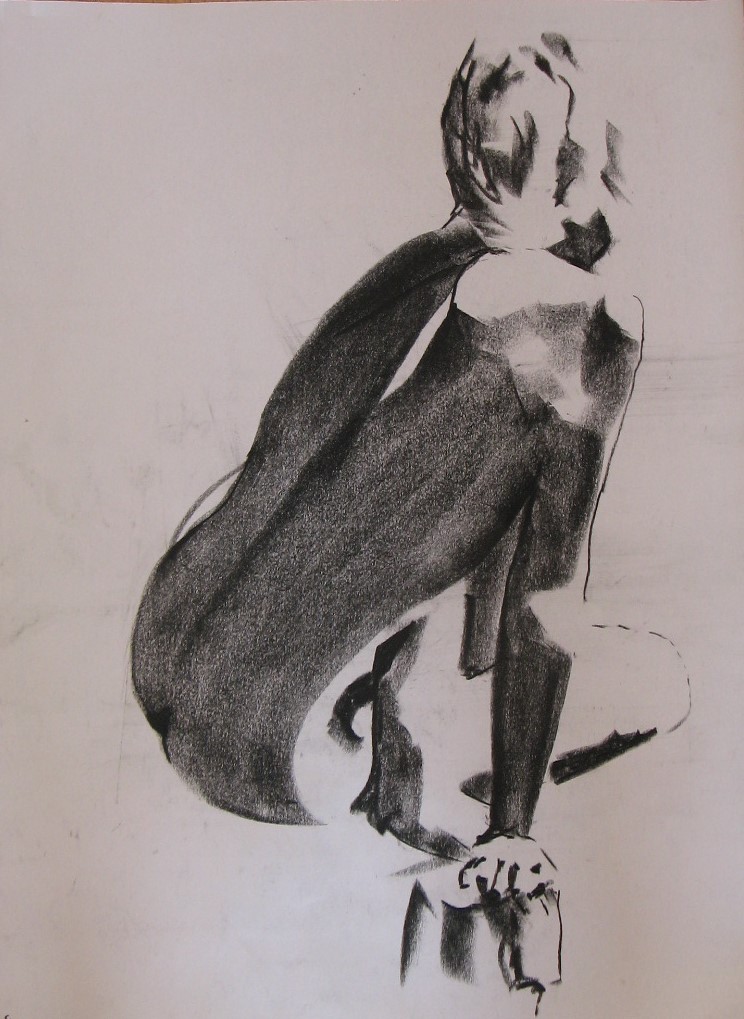
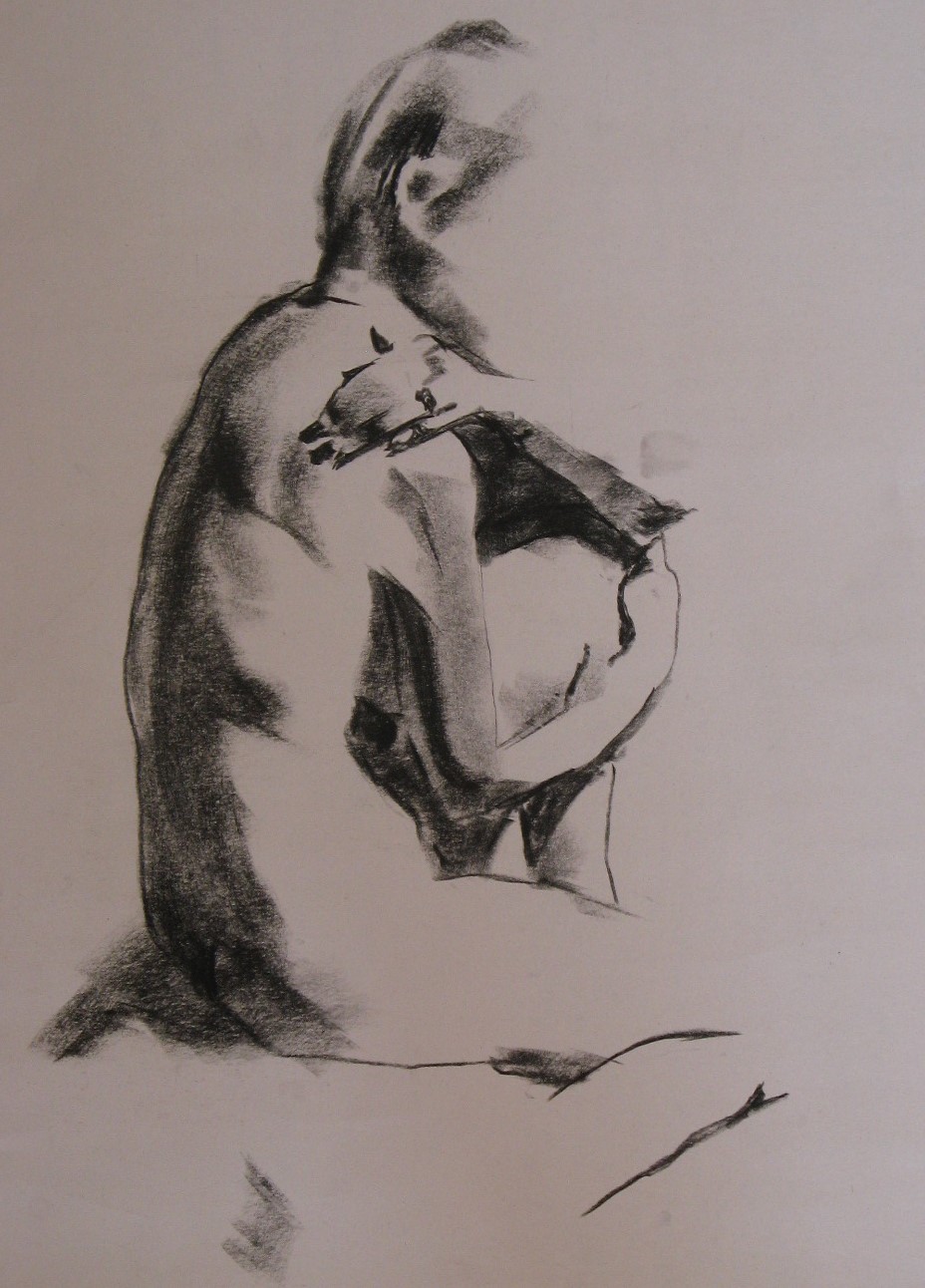
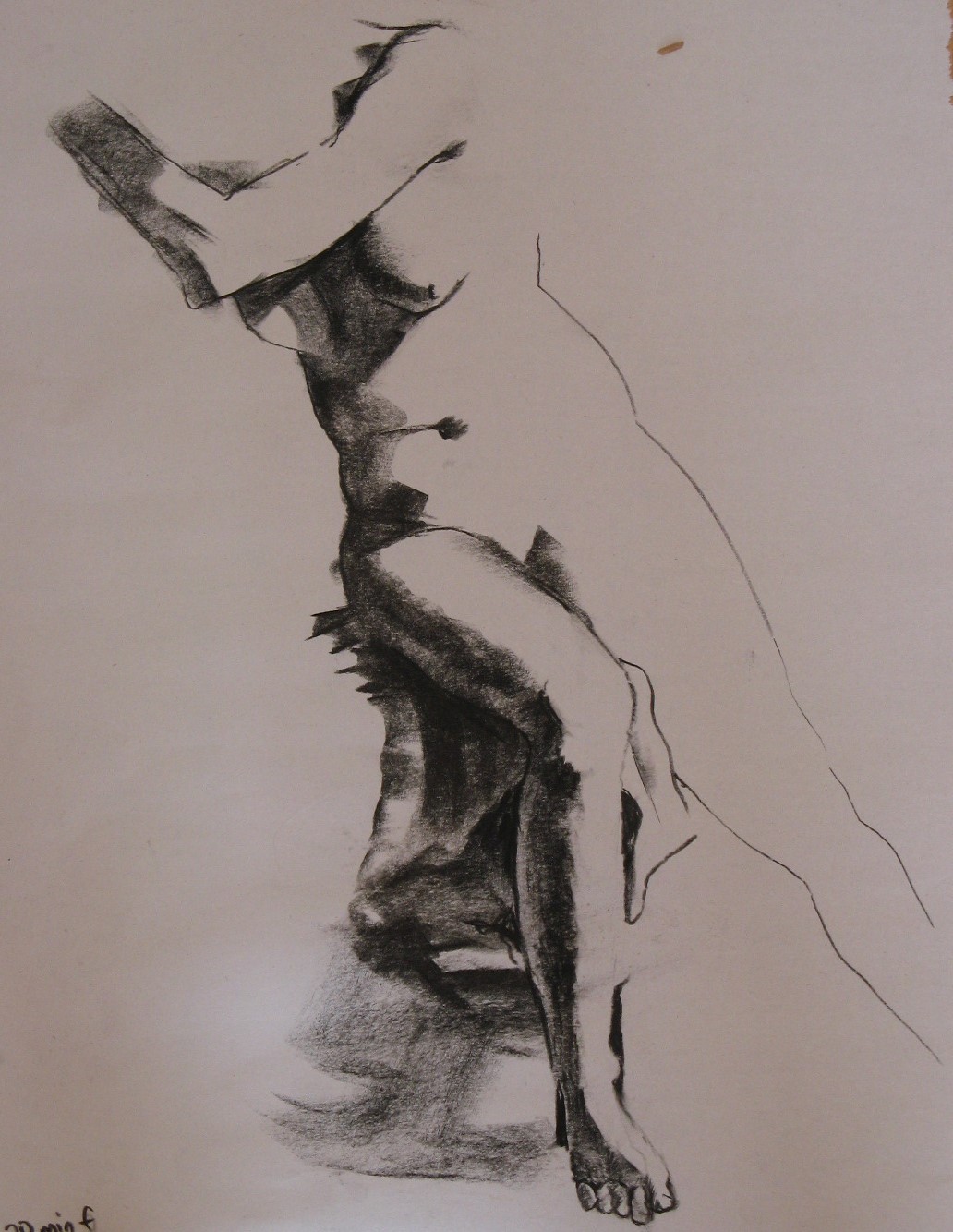
I came in a bit late to drawing today, because I’d realized a work report hadn’t uploaded and yada yada, had to take care of that–shortchanging my spiritual-practice time is not the way I like to start my Monday sabbath. Then when I got to the studio, I realized I was short on paper and needed to fit the remaining short poses onto one sheet. (I could get more at the break.) But maybe it was coming in late, working small, and starting fast that spurred me to draw only the darkest shadows, no subtle shading, no lines–or maybe it was just something dramatic in the light on the first two-minute pose I saw. I grabbed a small piece of soft charcoal and started in. No lines. Mostly black. Gradually, over the course of the session, I loosened up on both self-imposed rules, as they had the desired effect. This was one of the most satisfying mornings of drawing I’ve ever experienced.

05 05 14 7a

05 05 14 7b

05 05 14 7c

05 05 14 10d

05 05 14 10e

05 05 14 20f

05 05 14 20g

05 05 14 20h

About once a year I do a Question Box service, when in lieu of the sermon I answer as many questions as I can from among those people have written down earlier in the service. It being impossible to get to all of them in the space of 20 minutes, I promised this year to take them up gradually in such forums as newsletter columns and blogs. This one is in reference to the benediction our choir sings most weeks,

May the road rise to meet you

May the wind be always at your back

May the sun shine warm upon your face

May the rain fall soft upon your fields

And until we meet again, may God hold you in the palm of his/her hand. (The choir alternates, one week singing “her,” the next singing “his.”)

The questioner asked: “Does God have a gender?” Here’s my response, which I also published in the forthcoming edition of our newsletter.

I love this question! In fact, I’ve given this a lot of thought for years. In a Feminist Theology class at Syracuse, we read pieces arguing that in imagining God as male, men—who had shaped most of Jewish and Christian tradition—were creating God in their own image and then worshiping themselves. In other words, committing idolatry.

I agreed with these theo/alogians (if God might be female, then the area of study might better be called thealogy) but thought they needed to go further. I didn’t believe in an anthropomorphic god at all (as you’ll hear in today’s sermon), and I wrote a paper called something like “Anthropomorphism and Idolatry” arguing that describing the divine exclusively in human images was as idolatrous as describing it exclusively in male images. After all, if God created everything, surely it would be a wild coincidence for us to be the one and only creature who resembles the Creator. It’s self-serving and arrogant to assume that’s true.

So, no, God does not have a gender. As feminist theology points out, does God have genitals? Chromosomes? A beard? Of course the answer must be no. It’s a metaphor, and when we start to take it literally, we end up worshiping maleness, and we’ve seen where that leads: misogyny.

And no, God is not a human being. As I pointed out in my long-ago essay, does God have blood? a brain? two arms, two legs? Of course the answer must be no. When we take this metaphor literally, we end up worshiping humanness, and that leads to our despising the rest of nature and destroying the environment.

This doesn’t mean that these images should be tossed aside. The fact is, we humans think in images and metaphors, especially when it comes to great abstractions such as love, peace, and God. Whatever the holy is—power, goodness, creativity—it is beyond simple understanding and beyond anything to which it might be likened. And yet, metaphors help us express what we mean. When people imagine the holy as something that creates life, they may imagine a sculptor working in clay (as in one of the Genesis stories, and many other religions’ creation stories) or a woman giving birth (as in Babylonian religion and others). Neither makes sense literally, but they’re good metaphors for the power of creation. When the choir sings, “May God hold you in the palm of her [or his] hand,” what they are saying doesn’t make sense literally, but it is a good metaphor for this wish: as you move through a life that is often hazardous, we hope that some of the great forces of the universe will carry you safely through.

Because I think metaphors are a necessary aspect of human thought (if I wasn’t convinced already, one of George Lakoff’s early books, Metaphors We Live By, with Mark Johnson,sealed it), I think the remedy to their limitations is not to shun them but to use a wide variety of them. This helps prevent us from taking any of them literally, or limiting our understanding to just a couple of characteristics of, in this case, God, or as I prefer to say, the holy. Maybe the holy is like water; this is a frequent image for the Tao, flexible and ever-changing and powerful. And/or, maybe it’s like a crucible, in which the unimportant aspects of our lives are burned away. And/or, maybe it’s like a healer, curing the illnesses of the soul, the body, even the planet. And/or, maybe it’s like a flower, growing where we tend it and needing our care to flourish. If we have enough of these different metaphors in the mix, then we can safely throw in some human ones too: male, female, and neither.

What metaphors express what you believe is holy?

Blessings,

Amy


The hotel I stayed at last weekend has a sign assuring customers that they conserve water by drawing on their lake and their “private well” for their landscaping needs. I estimate that given its surface area and the hot, dry location (Sacramento), the lake loses a couple thousand gallons of water to evaporation each day, helped along by the fountain in the middle, so that is not a point in their favor. The ownership of the well doesn’t seem relevant.

I wondered whether the hotel had taken any steps that are actually effective in reducing water use in a drought-stricken region of our drought-prone state. The shower head was not remotely low-flow. There was no card offering me the option to save water by signaling that I didn’t want my sheets and towels laundered every day. (I was only staying one night, so it was moot, but whenever I stay more than one night I take the conserving option.) The sprinklers were going in the pouring rain.

Other Pacific Central District Assembly attendees, if you stayed at the conference hotel, Red Lion will e-mail you asking about your stay. If you care about water conservation, you could make some suggestions. Or if you don’t have the email, there’s this form.


I posted this on the “Sermons, etc.” page, but have received a gratifying number of “Where do I comment?” queries. Comments are the most fun aspect of blogging, and although there is a comments form at the bottom of that page, it’s cumbersome. So here is a re-post.

“How Gods Are Created”
Easter Sunday, April 20, 2014
Given at the Unitarian Universalist Church of Palo Alto, CA

Centering Words

With our centering words each week, we draw on one of the sources of our living tradition. Today’s words come from a late member of this congregation, John Beverley Butcher, a Unitarian Universalist, writer, activist, and Episcopal priest:

Whatever absorbs most of our mental energies reveals our greatest concerns and values. What do we think about most? Is this really our greatest treasure? Might there be something more valuable on which to focus our thinking? (Telling the Untold Stories, 41)

Story                                The Story of Easter (link coming soon)                 Dan Harper

Readings

Our first reading is from How Jesus Became God, by the historian of religion Bart D. Ehrman:

Jesus was a lower-class Jewish preacher from the backwaters of rural Galilee who was condemned for illegal activities and crucified for crimes against the state. Yet not long after his death, his followers were claiming that he was a divine being. Eventually they went further, declaring that he was none other than God, Lord of heaven and earth. And so the question: how did a crucified peasant come to be thought of as the Lord who created all things? How did Jesus become God? (1)

Our second reading is from the novel Small Gods, by Terry Pratchett:

Where do gods come from? Where do they go? . . . . Koomi’s theory was that gods come into being and grow and flourish because they are believed in. Belief itself is the food of the gods. Initially, when mankind lived in small primitive tribes, there were probably millions of gods. Now there tended to be only a few very important ones . . . But any god could join. Any god could start small. Any god could grow in stature as its believers increased. And dwindle as they decreased. (104-5) [Gods] also needed a shape. [They] became what people believed they ought to be. You gave a god its shape, like jelly fills a mold.(223)            


Sermon                        How Gods Are Created           

So Bart Ehrman has just published this book, How Jesus Became God, because he wants to know how, and why, a peasant teacher from Galilee—the cultural equivalent is “from Kentucky”—began to be regarded as God Himself.

Ehrman irritates religious conservatives so much that even before his book was published, they had prepared their rebuttal, How God Became Jesus. But his project isn’t new. Not 20 years ago, Richard Rubinstein wrote When Jesus Became God (my emphasis), which is particularly fascinating for Unitarian Universalists because it’s all about the Arian heresy, the belief of Arius and his followers in the early centuries after Jesus’s death that Jesus was just a man and a follower of the Jewish God, not God Himself. We Unitarians have believed that ever since.

Well, I think the project of these two scholars, and others like Paula Fredriksen, who wrote From Jesus to Christ, is very interesting, but none of them can quite answer the question. See, I think they’ve missed something because they don’t believe Jesus is God.

But Jesus is God.

Jesus is God!

Before you decide you must have come to a different church than you meant to, I’ll prove it to you.

Because of Jesus, people are willing to die. They go off to war and kill other people. They devote their entire lives to the service of the very poorest, without any hope of compensation. They take on impossible tasks of overthrowing oppression. People do terrible things to each other in Jesus’s name, and amazing, noble things. Anyone or anything that has that kind of power in people’s lives has become a god. Jesus isn’t the only one, but he is one.

And it’s very simple, how he got to be a god. You don’t have to write a whole long scholarly book about it. Terry Pratchett explains it perfectly in his wonderful satirical novel: the way someone becomes a god is that people believe he is (or she is, or it is). Gods grow in power as we believe in them and allow them to shape our lives. Their own shape is whatever form we need them to take: like jello in a mold, as Pratchett says (except he says “jelly,” because he’s British). And then this form affects us in turn.

It’s a very old idea, this idea that people create gods and that gods get their power from having people who believe in them. Heretics like Unitarians and Universalists have said it for centuries. Modern novelists like Terry Pratchett, and Neil Gaiman in his marvelous book American Gods, ran with it and looked at what that would actually mean for the people, how it would affect our lives. How the gods we create, and give form and power, shape us in turn.

Now, this god people call Jesus might not be much like the man Jesus. The peasant, radical rabbi and teacher, who overturned the authority of the religious leadership and political leadership, who challenged the wealthy and powerful, who taught love—if that’s what the actual man was like who lived briefly in what we now call Palestine and Israel two thousand years ago, he’s been changed. We change whatever we believe in and give power to with the food of our belief. We see it through the eyes of our own needs, or what we think we need.

So my question for you on this Easter morning is: What gods do you create? This is how to spot them: look for what rules you.

It’s a tender and difficult question, so I’ll go first. I would like to be ruled by love; a passion for justice; the search for truth; harmony with the earth and all that is . . . I want those to be my gods. But I have other gods too. Why else would I feel too busy to play with my daughter because I need to spend just one more hour on a report for work that I’ve already pretty much written? I think I worship a god of Perfection—and I have made it so powerful, it rules me. It overrules some of the gods I wish I worshiped instead.

That’s one of mine. What are some of yours?

Maybe Influence—the desire to have power, oh, power for good, to do good things, sure, but still, a drive for power, to make things go the way you think they should.

For many people, Alcohol and other Drugs are gods—or maybe the real god is something that the drug gives them, a temporary feeling of Well-being or Confidence or Peace.

I look around my culture and see a fervent worship of the god Financial Security. That god started small, I think. It’s easy to get people to worship you when their situation is so insecure that if anything goes wrong this month, they will be evicted from their homes and living on the street. They are bound to pay you a lot of attention, Security, when they are constantly having to choose between taking their children to the doctor or providing them with enough meals for the day. But this god has become so powerful, feeding on our belief, that even those of us who have a virtual lifetime guarantee of plenty to eat, a college education, the health care we need, and a safe place to live, plus luxuries like the choice of exactly what town to live in and a new car now and then, worry constantly that we don’t have enough.

There are gods of Knowledge, Success, Busyness, Popularity, Distraction, Expertise . . . oh, they’re all over the place. When we give them power and form, they shape our lives in turn.

If you want to know what gods you worship, which ones you give power by your belief in them, watch the pattern of your days for what you give your time, your attention, your concern. Those are your gods.

These gods we worship can serve us and the spirit of life well, or they can be destructive. Look at Jesus. Jesus had power in the life of Archbishop Oscar Romero, causing him to lay down his life for the poor of El Salvador and around the world, and Jesus also had power in the life of Fred Phelps, causing him to devote his life to trying to make people miserable on account of their being gay.

So it is for all of our gods. Alcohol may be a god for one person, a pleasant drink for another, a nasty taste for a third. Money may be a simple means to useful ends for one person and, for another, an all-powerful god who is tyrannical and ever-demanding. It’s not the thing itself, but the worship of it that makes it a god: the shaping our lives around it, the fervent belief that it can give us what we long for.

In honor of the man Jesus, who became a god without asking to or wanting to, but who tried to teach people to love each other and love the source of life, may we celebrate Easter in this way: by trying to become aware of what gods we worship. May we give the power of our belief only to those things that we truly wish to rule us, because when we believe in them, they will have power over us. May we make gods only of the things that are worthy of the sacrifices of our time, our abilities, our attention, and our love. May we choose to revere only what is truly holy and receive its blessings with joy.

So may it be.

 (c) 2014 Amy Zucker Morgenstern
An instant classic by William Haefeli in The New Yorker, 2011

The attempt at re-envisioning Mothers’ (or Mother’s or Mothers) Day by calling it Mama’s (or Mamas or Mamas’) Day, by the organization Strong Families and now by the Unitarian Universalist Association, just goes to illustrate how one person’s broadening is another’s narrowing. A good question about any proposal for change is “What problem is this trying to solve?” I get the problems they are trying to address, and agree that they are problems: the exclusion of queer, immigrant, disabled, poor, step-, foster, adoptive, single, and many other mothers from our implicit concept of motherhood. I’m glad we are being urged to celebrate all kind of mothers. What I don’t see is how the term “Mother’s Day” contributes to these problems nor how the term “Mama’s Day” mitigates them. More to the point, like many queer families, we’re actually better served by the term “mother.”

In our family, there are two mothers, although neither of us is called “Mother” (though one day, the munchkin may haul it out to use in a moment of pique–“MOtherrrr!”–give her time).  One of us is called “Mama”–that’s me–and the other is called “Mommy”–that’s my wife.  If you suggested to the munchkin that she has two mamas, she would correct you. She has one. If you suggested that May 11 was going to be Mama’s Day, she’d probably want to know when Mommy’s Day was going to be. While “Mother’s Day” is inclusive in our family, “Mama’s Day” is exclusive.

No big deal, so far; we call it what we call it. But if people made a serious push for renaming the day, I’d push back on the grounds of its excluding every two-mother family in which one, and only one, person is called Mama, which is a lot of us. Right now, my religious tradition is saying “May 11 is Mama’s Day!” and I want them to know: if you’re trying to be inclusive, you are accomplishing the opposite for this Unitarian Universalist household, where the term “Mama’s Day” would be insulting to Mommy and confusing to Mommy’s daughter.

My morning of drawing this week. I was enjoying the newsprint so much that I never moved on to charcoal paper. I like the smoothness and may try out some smooth white paper, like Bristol.

A few of the two-minute gestures:

image

Three seven-minute:

image

image

image

Two ten-minute–the second looks like watercolor to me, a nice effect I now want to try to recreate deliberately:

image

image

Twenty:

image

And 45, still not enough time this time:
wpid-2014-04-14-45-min-g.jpg.jpeg

A brief prayer from The Left Hand of Darkness comes to me often. On the planet Gethen, in the book, it’s from the Handdara; here on Earth, it sounds like something from process theology. I was moved to say it by today’s photo on NASA’s Astronomy Picture of the Day:

“Praise Creation unfinished!”


Enter your e-mail address to receive e-mail notifications of new posts on Sermons in Stones

Links I like