We went south for a few days after Christmas to meet up with friends and hike in the beautiful Santa Ynez Mountains. The route took us down through the Salinas Valley. At one point a patch of sun on the otherwise clouded hills was so striking that I considered stopping to take a picture, or asking Joy to take one out the window as I drove, because I knew I’d want to draw it later. The moment passed, unrecorded except in my mind, and when we got to our destination, I went looking on the internet for a reference photo. I really wanted it to be of these same hills. Nothing quite captured the quiet drama of that illumination–moral: take the photo when it strikes you–but this one was pretty. Thank you, Shutterstock (photo 1055815059).
That’s a trick title, because I have gone to a grand total of two church services in my six months of sabbatical. I’m rather ashamed to admit it, but it’s true. I had a plan to go to the San Francisco services fairly regularly once we were back from our summer travels, a plan that foundered on the rocks of taiko class (10:45 Sunday mornings). But what took me so long to figure out that a good two-thirds of the UU congregations in the country have services that end by 10 a.m. my time? I just got out of the Sunday morning church habit. Which is instructive. Going to services is a habit, like any other; once in the habit, one tends to carry on, and once out of it, one also tends to continue not-going. Something for all of us who tend these wonderful communities to remember.
U2C3 logo, from a window we could see during worship
I did think of it earlier this fall, looked up a few services, and got up in time to go to one, but I had a flu-y thing and couldn’t keep my energy up long enough even for a Zoom hour. Two weeks ago, I finally got my act together again, and was so, so glad I did. I attended the livestreamed service of Jefferson Unitarian Church (Golden, CO) that Sunday; it was great, so I picked a service for last Sunday, but overslept; this morning, I tried to attend one livestreamed service, but the time on the website was incorrect due to a seasonal change, and had to quickly look for another one. Again: there are lots of options in the Central Time Zone! So I ended up at the Unitarian Universalist Church of Corpus Christi, charmingly nicknamed U2C3.
Both today’s service and the one on December 3rd made me regret not going every week. Both were a great fit for my sabbatical spiritual practice of letting go of judgment and letting curiosity take its place. Oh my, does my judging mind have things to say about church services! It’s only natural, since it’s my vocation, and of course I’m making many mental notes about what does and doesn’t work. But its being my vocation is also the reason that curiosity is so much more useful than judgment. Instead of evaluating what works, what doesn’t, what I like, what I don’t, etc. suspending that process (or telling that judging voice to please pipe down during the service, at least) opens me up to ways of doing things that I’m not accustomed to. It makes room for me to appreciate other ways and others’ creativity.
And creativity there was, both of these weeks. Jefferson is one of the many churches using the Soul Matters monthly themes, and the theme was Mystery: right up my street, for a few reasons. One: again, curiosity in place of judgment. I am trying to be more open to the unknown, to what I may yet discover, and judgment tends to make a person go right past Mystery unaware, because she’s comparing everything she encounters to what she already knows. This person, anyway. Two: I’ve been making a lot of art, and spending a lot of time talking with others about the relationship between art and religious leadership (my class in this semester of grad school was The Arts for Leadership), and one of the great things art does for me is take me into that space of unknowing and discovery. Three: I have been thinking a lot about how uncomfortable Unitarian Universalists, not only me, can be with the unknown, and how spiritually limiting that is. If I had to choose a dissertation topic today (which thank goodness, I do not), it would be something like “Using the Arts in a Congregational Setting to Re-Enchant Religion Without Supernaturalism.”*
The Time for All Ages was clearly one of a series in which Unitarian Universalism, a pleasant man in a t-shirt reading UNITARIAN UNIVERSALISM, gave a wrapped gift to the director of religious exploration, who opened it on behalf of the congregation. Both Sarah Billerbeck, their DRE, and the man playing UU, were clearly comfortable being off-script, so their dialogue was pleasantly conversational while also hitting their main points, nor did it matter that I hadn’t heard previous entries in the series. The box was empty, because, well, Mystery. It isn’t something that is handed to us; it’s part of our search, and we don’t know what we will find. Together, they reached the conclusion that because we have the freedom to search, our faith leaves us a lot of room for mystery. When Unitarian Universalism said, “In fact, Mystery is one of the greatest gifts I give you,” I had tears of hope in my eyes. Can it be that our faith is actually particularly suited to acquainting us with mystery? Then Rev. Wendy Williams’s sermon was beautiful, in a thoughtful and heart-felt style, and ended with a suggestion about how to open to mystery that was so like the advice I had just given someone on Ask Isabel that I had to laugh. My advice was about gratitude, something that does come easily to me–and here it was, traveling in the circuitous ways by which the universe delivers wisdom, coming to me from a colleague I deeply respect in order to help me awaken to mystery. Thank you, Wendy and universe.
Today’s service, at the congregation in Corpus Christi, was about the many festivals of lights at this time of year: Diwali, Hanukah, Advent, Kwanzaa, Solstice. These kinds of services are difficult because if they’re presented as actual celebrations of the holidays, they are almost certainly appropriating others’ religious practices, whereas if they do the respectful thing and simply tell us about the practices, they can be very report-y and dry. The folks leading the service were carefully respectful, which allowed that judging mind of mine to relax awhile, and so where it might have piped up with “Uh oh, this could be a report instead of a worship service,” I was able instead to appreciate how the leaders (most of whom weren’t ministers or worship associates, so they were probably quite nervous) crafted a sensory experience of growing light, a whole table full of candles and lamps that must have given off palpable heat as well as a beautiful sight.
And then the band, which had already done a lovely rendition of “Light One Candle” (and oh, how those lyrics resonate this Hanukah, whatever one’s political views about Israel), sang “Glorious,” a Melissa Etheridge song that I had not heard before and that I then sang in my head all the way to my taiko class. That one is going to be heard in a UUCPA service next year, you can bet. “Everyone will hold this light”–and again I was moved to tears, not only by the words but by the way the two singers and the small acoustic band brought such feeling to them. On Muni, no one notices or cares if you get a little weepy.
I’m very grateful to these two congregations and their worship teams. I’m looking forward to next Sunday, and I’m just sorry it took me this long to start going to services.
*A seminary professor of mine, the late David Ray Griffin, wrote a book with this title–Re-Enchantment Without Supernaturalism–and I was so excited to discover that that of course I got a hold of it immediately. It doesn’t take the tack I want to, but the title sums up my hopes.
WordPress informs me that this is my 1000th post on Sermons in Stones! Wow. Thanks for coming along for the ride!
In Judaism, there’s a concept called hiddur mitzvah: the beautification of a mitzvah or commandment. It means that while one can discharge one’s duty to fulfill a commandment in a very plain way, adding beauty to it is praiseworthy. There is a commandment to light the Shabbat candles; Jews could mutter the prayer and light two candles that stayed lit for the minimal amount of time and weren’t blown out, and that would fulfill the responsibility. But hiddur mitzvah encourages us to do more: for example, use beautiful candlesticks, preferably ones that are used for no other purpose; use new candles that burn longer than is required; set the prayer to music; gather with our loved ones and hold hands around the candles as we sing together.
Naturally, as I grew up as a Jewish child who loved everything artsy and craftsy, this concept suited me down to the ground. It meant that there was a rich folk art tradition of decorating everything: calligraphed ketubot (marriage certificates), embroidered tallit (prayer shawls), silver filigree spice boxes used at the close of Shabbat, even illustrations from the Book of Esther on graggers, the noisemakers used to drown out Haman’s name whenever the cantor sings it during the Purim services. I made a tallis for my dad, a ketubah for my parents, and more Hebrew school art projects than I can remember. To this day, I remember the exact color and pattern on the contact paper we used to decorate the pushke (charity box) we made in Hebrew school and then kept on a household shelf and filled with our spare change for the rest of my childhood. (Hiddur mitzvah and the many ritual objects are a gift to Hebrew school teachers. So many crafts opportunities!)
Papercuts emerged as part of this tradition. One is supposed to pray facing east if possible,* but there is absolutely no requirement to hang a little sign on the eastern wall inside one’s home. But it became a tradition not only to create such a sign (called a mizrach, which means “east”), but to make it beautiful with calligraphy or, in the 18th-20th centuries in Western Europe, a papercut. This beautification was more than decorative; it had the power to change a person’s awareness of the very meanings of the mitzvah, the same way setting a prayer to music does much more than make the prayer pretty and easy to remember. Imagine someone opening their prayerbook and situate themselves facing east, and as they look up, their eyes fall on an intricate work of art, perhaps portraying the Old City of Jerusalem, or the Western Wall, or the words of a verse from the Torah. Their prayer is now accompanied by visions of places that their people gathered again and again on every holy day. It is witnessed to by the hands of an artist who dedicated her creativity and many hours of her craft to the faith they share. The art invites them into a world of beauty and contemplation during their time of prayer.
8″x8″ papercut, still in progress
This tradition keeps coming to my mind as I work on the papercut I’m making grieving the destruction of millions of olive trees that Israeli “settlers” and the Israeli army have committed over the years in a bitterly self-destructive, anti-halakhic (halakhah is Jewish religious law) attempt to deprive Palestinians of their livelihood. If I were making a mizrach or ketubah, papercutting is the art form I might use. Instead, I’m making a political, largely secular statement–and it occurs to me that art in general is a kind of hiddur mitzvah.
I will eventually write a post here about how my connection to Israel and my conception of what it means to be Jewish in the world after 1948 have changed in response to crimes like the destruction of Palestinians’ trees. Its approach will be logical and discursive, a statement of facts and feelings, and I imagine it will accomplish the basic task of clarifying and expressing my opinion. That would be the equivalent of the unadorned mitzvah. But making this piece, like hiddur mitzvah, does more than that. A work of art, whether a painting, an operetta, a poem, a dance, whatever it may be, isn’t just a statement. It can create an entire microcosm for the viewer to enter and dwell in awhile. It can take us to new depths of understanding that plain words seldom convey. That’s certainly what it is doing for me as the maker.
*All the ones I’ve seen are mizrachim because I grew up in the western Diaspora. Of course, Jews in Asia pray facing west, Jews in Israel pray facing Jerusalem, and Jews in Jerusalem pray facing the ruins of the ancient Temple. The same holds true for Muslims vis-a-vis Mecca, and as far as I know, for all religions that have a tradition of praying toward a particular revered location.
I am working on a diptych of olive trees in Israel and Palestine. A few minutes after the image came to me, the medium followed: traditional Jewish papercuts, an art form I have loved and admired for a long time, but have never tried. I’m loving it.
According to Wikipedia, papercutting was done throughout the Jewish world, and was especially popular in the 18th and 19th centuries in Europe. But between the fragility of the medium and the destruction of so many Jewish possessions in the Holocaust, only a couple hundred of the pieces from that period still exist. In recent decades, artists have rediscovered and reclaimed papercut art, and one sees it often in sacred art: decorating ketubbot (religious marriage certificates) and mizrachim (signs designating the east, toward which Jews face in prayer), illustrating passages from the Tanakh or Talmud.
This piece is going to express sorrow and bitterness about an inner conflict, within me and within Judaism: the conflict between some of the most beautiful, wise teachings of Judaism and the policies of the modern state of Israel. The beauty of the art form is one ingredient of that bitterness. This half of the diptych, the happy half, is not quite half finished.
That’s the tentative title for what might end up being a painting. I envision this writing scratched in paint or ink so that an under-layer of paint or ink shows through, but some kind of dry medium might also work, or maybe colored pencil over an ink wash–the layers are important. I have tried it in pencil before, when I first got the idea seven years ago. I know it was that long ago because we were living in Oaxaca then. I didn’t have the idea of making a portrait out of scribbled-out, obscured words at that time. I know I have that sketch somewhere and I’m curious what my earlier idea was.
The legible text tells a story. The most important points are here, but it will be longer and go into more detail in the next version. There’s more I want to write, but as this is quite small, the size of my sketchbook, I ran out of paper before I ran out of things to say.
This whole project makes me think a lot about my friend Karen Schiff, who is also an artist (check out her great drawings and writing about art here).
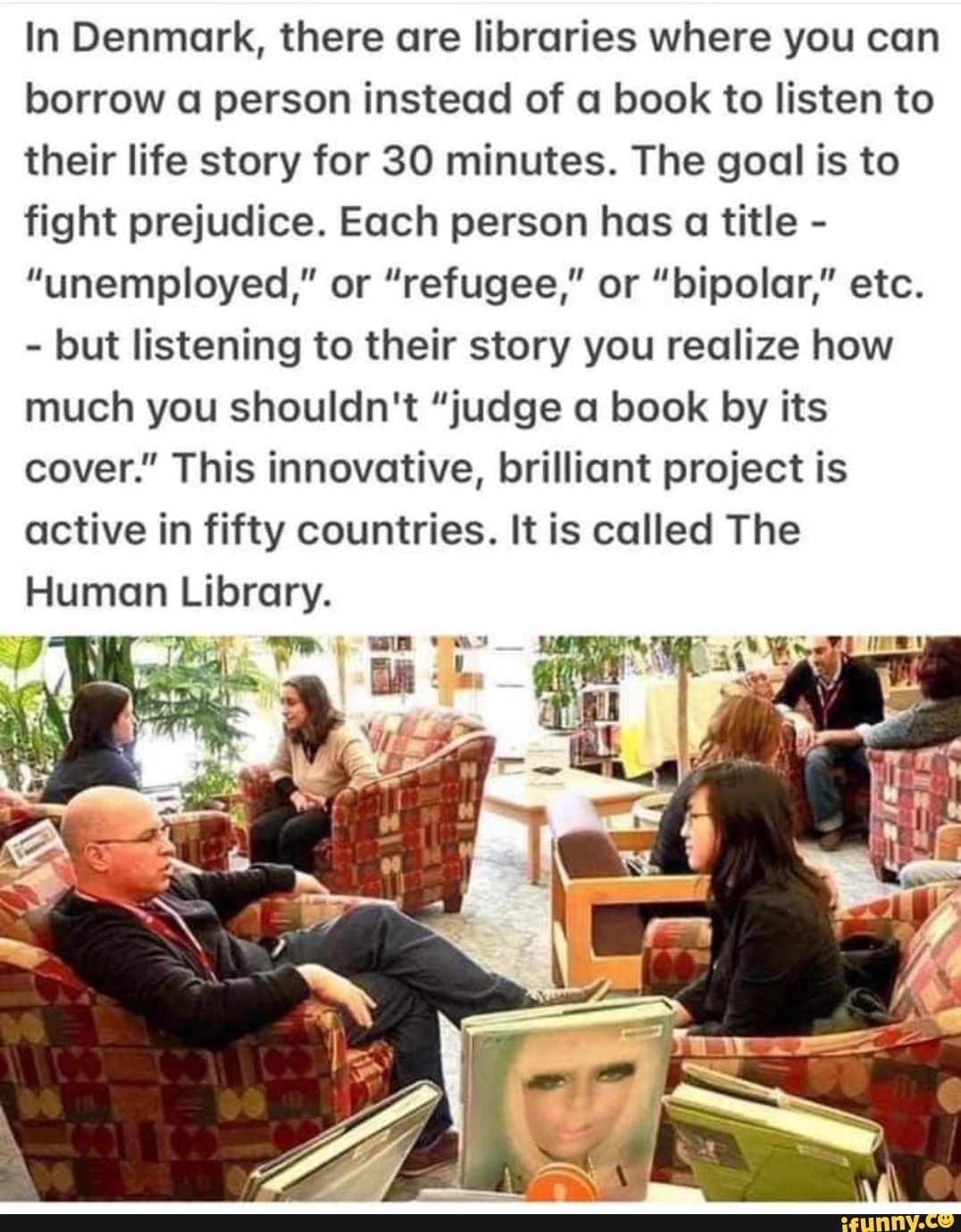
Perhaps you, like me, have seen this come across your social media feed:
Sounds so cool, doesn’t it? Well, the United States is one of those 50 countries, and a depot of the Human Library has been underway for some time here in the SF Bay Area. A friend and colleague in the UK gave me a heads-up that a friend of hers was moving to my area and that we should meet. She rightly predicted that we would really like each other. (All three of us are UUs.) What I didn’t know until we got together for a get-acquainted lunch was that she–the arrival, my new friend–was the new manager of the Human Library depot. I was very excited, and immediately asked how we could bring a Human Library event to UUCPA.
I expect that we’ll do that fairly soon, especially since our minister of religious education is as jazzed about it as I am. In the meantime, I am going to be a Book in the Human Library, this weekend, in San Rafael! It is on Saturday, December 2, 1-5 pm at Marin Ventures. Readers, for whom the Library is completely free, can have a 30-minute conversation with me about two aspects of my identity: being an atheist, and being a pansexual. I should say “or” rather than “and,” since trying to talk about both in the same 30-minute span would be a bit taxing. 😉
I am really looking forward to it, and I hope I have some good conversations. This is one of those activities that I didn’t particularly have on my list of sabbatical plans, but that fits beautifully with them. I have the spaciousness to devote an entire Saturday to something that doesn’t involve my family (something I avoid as much as possible when I’m working and Saturdays are our only family day). I’m having encounters that I imagine will teach me as much as they teach the Readers. And I’m learning firsthand about a ministry (my word, not the Human Library’s) that we at UUCPA can help offer to our community.
For the dates and locations of other Human Library events, follow the organization here.
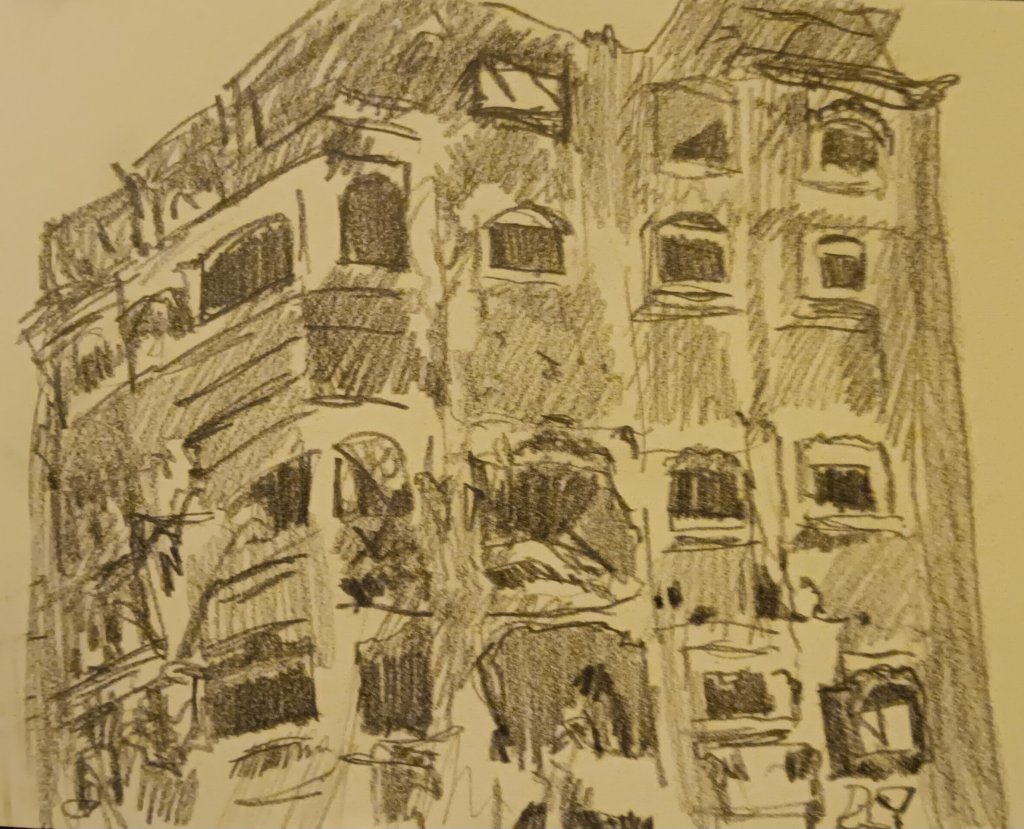
Building in the Jabalia refugee camp after bombing on October 9, 2023. Graphite pencil on paper, approx. 5″x5″. From a photo by Mohammed Abed/AFP via Getty Images
I didn’t realize until after I’d drawn this that the location has a name very similar to a name in our family, the branch that came to the US from Lebanon.
While the world weeps over the bloody religious conflict in the Middle East, the smaller conflicts that concern folks stateside might seem trivial in comparison. However, I believe that if we practice cross-religious dialogue in safer, easier settings like a good friendship, we can learn skills that can transfer to higher-stakes situations. Imagine a world where religion doesn’t divide us . . .
Today’s letter presents an opportunity to start small.
There’s no avoiding it: as soon as I start posting drawings like this and the previous one, some people will evaluate them politically. Am I showing too many images of ___ and not enough of ___? What do I mean by giving attention to ___ instead of ___? Etc.
I can’t say these aren’t political. All I can say is that allowing my heart to spend time with people who have suffered because of this conflict feels like it is the right thing to do. And if anyone is counting beans, they should be aware that I’m not posting everything I’m drawing. Some feel too raw and some are just crappy drawings, but they’re helping my heart stay with the suffering.
With this drawing, I was trying to make every mark a meditation and a reminder to myself that within these white plastic bags are parts of the bodies of people who were recently alive and who died by violence. Every mark a breath, taking in the reality of things we can’t see.






 Sermons in Stones
Recent comments