Since reading excerpts from Mary Trump’s book, Too Much and Never Enough, I have been calling the current occupant of the White House Uncle Vernon. Every time I do, someone wants to know why. So, first, this background from Mary Trump:

“One year, Donald and his first wife, Ivana Trump, gave the young Mary a single gold lamé shoe, its heel filled with hard candy.

“Where had this thing come from?” Mary writes. “Had it been a door prize or a party favour from a luncheon?

“Donald came through the pantry from the kitchen. As he passed me, he asked, ‘What’s that?’

“It’s a present from you.”

Mary Trump also says that in 1977, when she was 12, her Christmas present from Donald and Ivana was a $12 pack of underwear. Her brother got a leather-bound journal, two years out of date. Later, Mary received a Cellophaned gift basket, “an obvious regift” containing olives and a salami but not one evidently removed item, which a cousin said was “probably caviar.”

The Guardian, 7/7/20

Uncle Vernon and Aunt Petunia are Harry Potter’s unwilling and abusive adoptive parents. They never mark Harry’s birthday, and at Christmas they give him “presents” such as a tissue, a toothpick, a 50-pence piece or an old pair of Uncle Vernon’s socks.

Of all the different embodiments of evil in the Harry Potter series, Vernon is the most clownish–always unwittingly so. He is conformist, conventional, habitually cruel, and boring (literally: he’s in the drill business). He has no imagination and disapproves of anyone who does, and he knows no way to deal with opposition except brute force. All of that plus cheapskate Christmas gifts, and we have a tailor-made nickname for the buffoon in the White House.

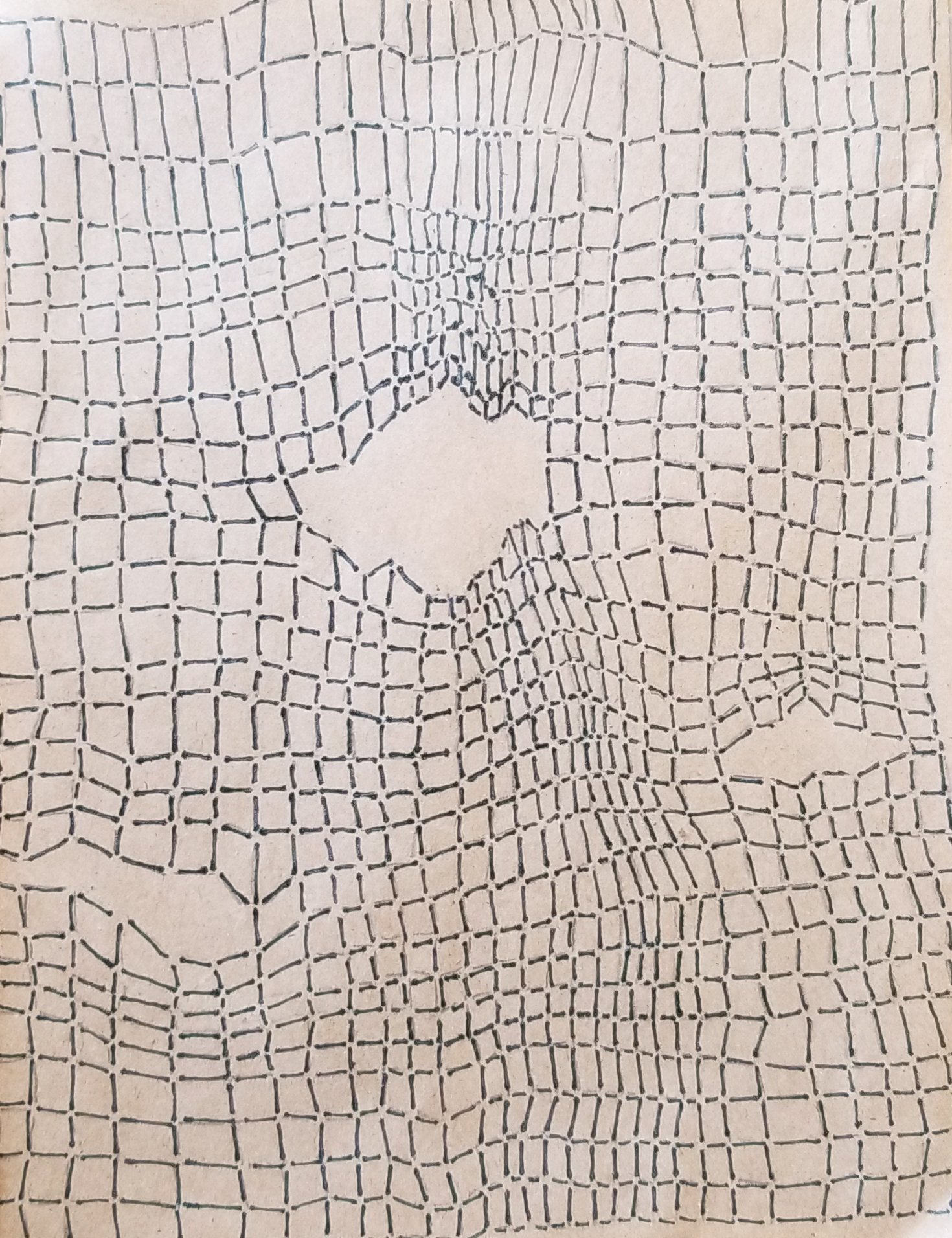
I’ve done numerous variations on these nets, but never with a rupture in the middle. I’ll continue, and probably finish, it tomorrow.

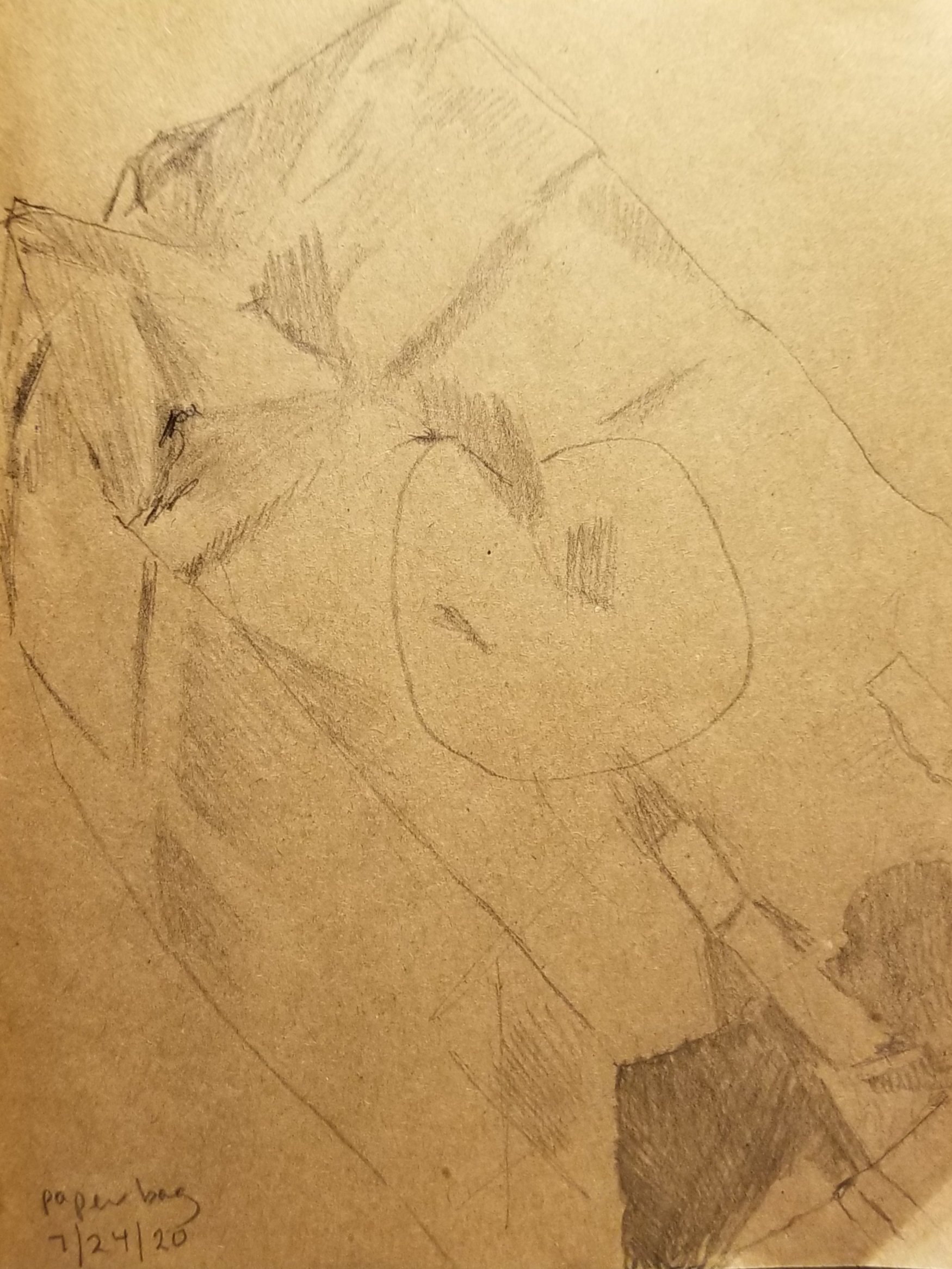
I was flipping through my last bullet journal and saw my hundred-day tracker. “Did I really do art every day for 100 days straight?” I marveled. Pretty much, yep.

Since these mind games seem to be the most effective way to get myself to do the things I really want to do, I’m doing it again. Art every day, if only for ten minutes. Preferably as the first thing I do, during or immediately after breakfast. I hunted around for an interesting shape, and lit on the shadows on this grocery bag.

And it was a very good way to start the day.

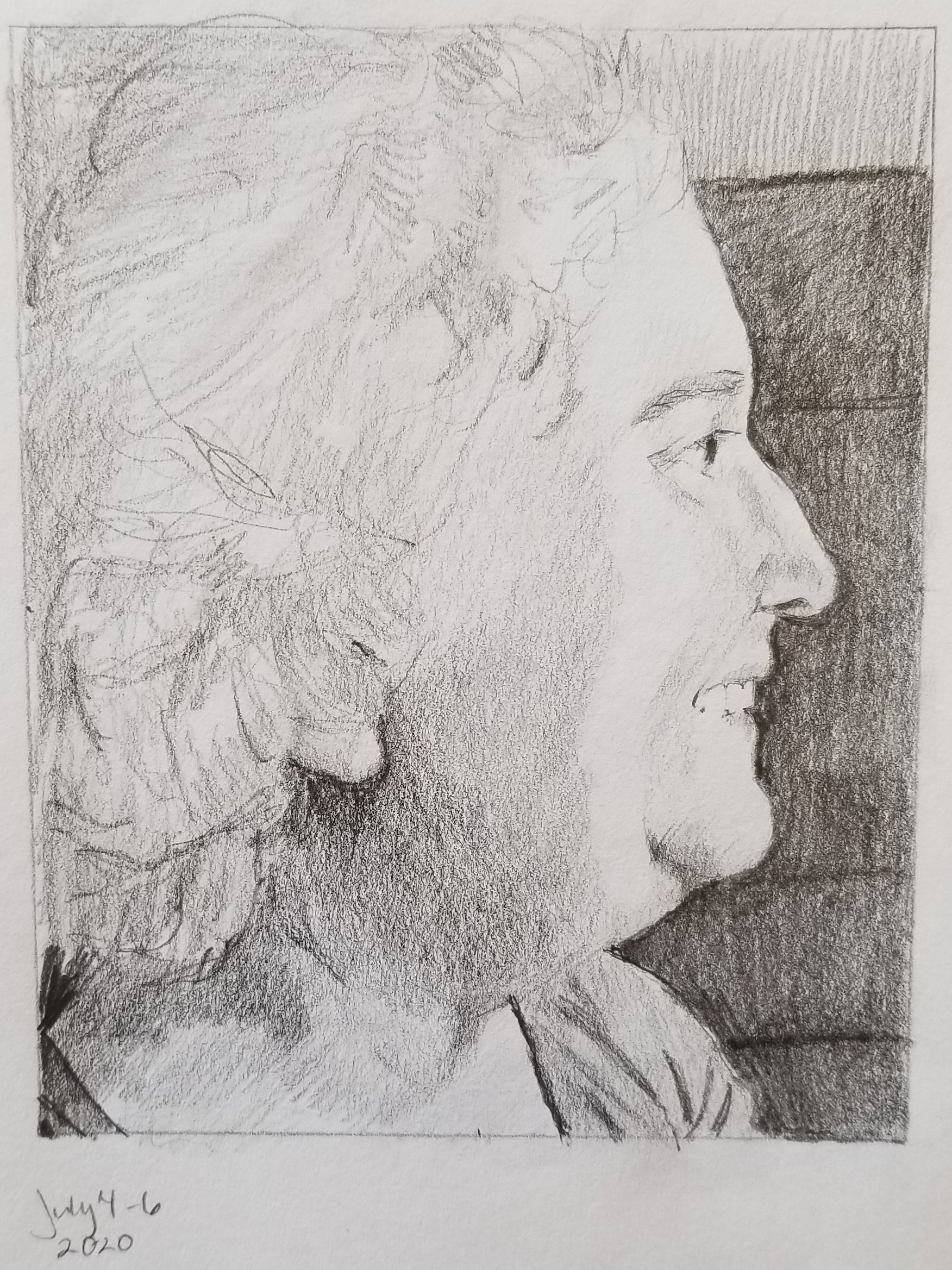
The last week of the drawing class we took from Katie Gilmartin was devoted to portraits. First, another profile (my previous one, of my daughter, is a couple of posts back). I’ve drawn a lot of self-portraits over the years in a high school for the arts and then as an art major, but I’ve never drawn a profile, so I took a lot of pictures of myself in profile and drew this.

Like Katie, I find that I begin to fall in love with whatever I draw. Not the person, but the way they look. Drawing myself was healing that way. I snapped the photo, sighed at the incontrovertible evidence that I have a saggier neck than I might prefer, and then set to drawing, and soon that sag was less a violation of societal standards of beauty, and more a lovely curve with delicate shadows that I just had to capture in graphite.

Then, our assignment for the last week was a standard self-portrait.

I got to something like “finished” an hour before class and just could not bear to erase and re-draw my left (picture’s right) eye, even though it is too close in. But I may yet redraw it, and the nose, which is nicely done but a little narrower than in reality. Or just make another drawing.

In 2000, it seemed as if the whole world was reading the Harry Potter books. That did nothing to make me want to check them out. Truth be told, even though I was in my 30s and ought to have been well past any sense of adolescent nonconformity-for-the-sake-of-conformity, it made me less interested in checking them out. My sister told me, “Really, they’re really good!,” but someone in the grip of unacknowledged adolescent rebelliousness is likely to do the exact opposite of what her older sister recommends. I stayed steadily unintrigued. All those people lined up for the midnight release of the fourth book? Yawn. Even the discovery of a Harry-Potter-themed sermon online by a much-admired colleague and teacher, Ken Sawyer, didn’t draw me in, though I enjoyed the sermon.

Then a church member pressed the audiobooks of the first three books on me–I had a long commute and listened to books on tape all the time–and within the first few minutes, all my resistance crumbled. I loved them. I gulped them down, got a hold of the fourth, gulped it down too. They lived up to all the hype.

Oh, they’re conventional in many ways, and even the best of them has a plot hole you could fly a hippogriff through. And I’m angry with their author, who has torpedoed a deserved reputation as one of this planet’s kindest, most generous people by stubbornly insisting on a bigoted, mean mischaracterization of transgender. But the delights of these books are too many to list, and they keep on delighting me.

When I first discovered them, I sought out people who wanted to talk about them all the time, the way I did, and found them in the Yahoogroup Harry Potter for Grownups. I made good friends there, people I’m still friends with 20 years later, and among the funniest, smartest people in the group, I met the woman I would eventually fall in love with and marry. So Harry Potter changed my life in the most literal way possible. If I had continued to avoid it because it was so annoyingly ubiquitous and adored, Joy and I wouldn’t be married, we wouldn’t have our child . . . it’s scary even to think about it.

It’s rare for anything to live up to its reputation when it’s as widely hailed and appreciated as Harry Potter. But once in a while it does. Listen to my cautionary tale, dear reader. Do not deprive yourself of a greatly hyped cultural phenomenon just because it’s a greatly hyped cultural phenomenon.

The other work that has inspired me to say, “It lives up to all the hype, and more,” is Hamilton. Yes, it won 11 Tonys after being nominated for a record-setting 16 (inspiring this pre-Trump parody by Randy Rainbow). Its composer, Lin-Manuel Miranda, has won Tonys, Emmys, Grammys, the Pulitzer Prize and a MacArthur “genius” Fellowship, well before the age of 40. Its songs have been quoted by countless articles and as the title of a self-serving book by a wingnut who managed to become National Security Advisor and still undermine U.S. national security. It caused millions of middle-class white people to enjoy hip hop; millions of people who would never cross the threshold of an opera house to enjoy an opera; and countless people who don’t love musical theater to be unable to stop singing its tunes. Doctor Who predicts that it will be performed by 900 different casts over time, all of which the Doctor will see. Despite its near-universal popularity . . .

. . . it really is that good.

So, dear reader, don’t believe that the hype is wrong. Once in a while, something comes along that lives up to its stratospheric reputation. Heed my tale of narrowly-averted woe, and if there’s something you’ve been avoiding (despite the recommendations of people you respect) because it’s just too popular, give it a try. I won’t guarantee that you will meet the love of your life, but it might change your life, which is what art is all about.

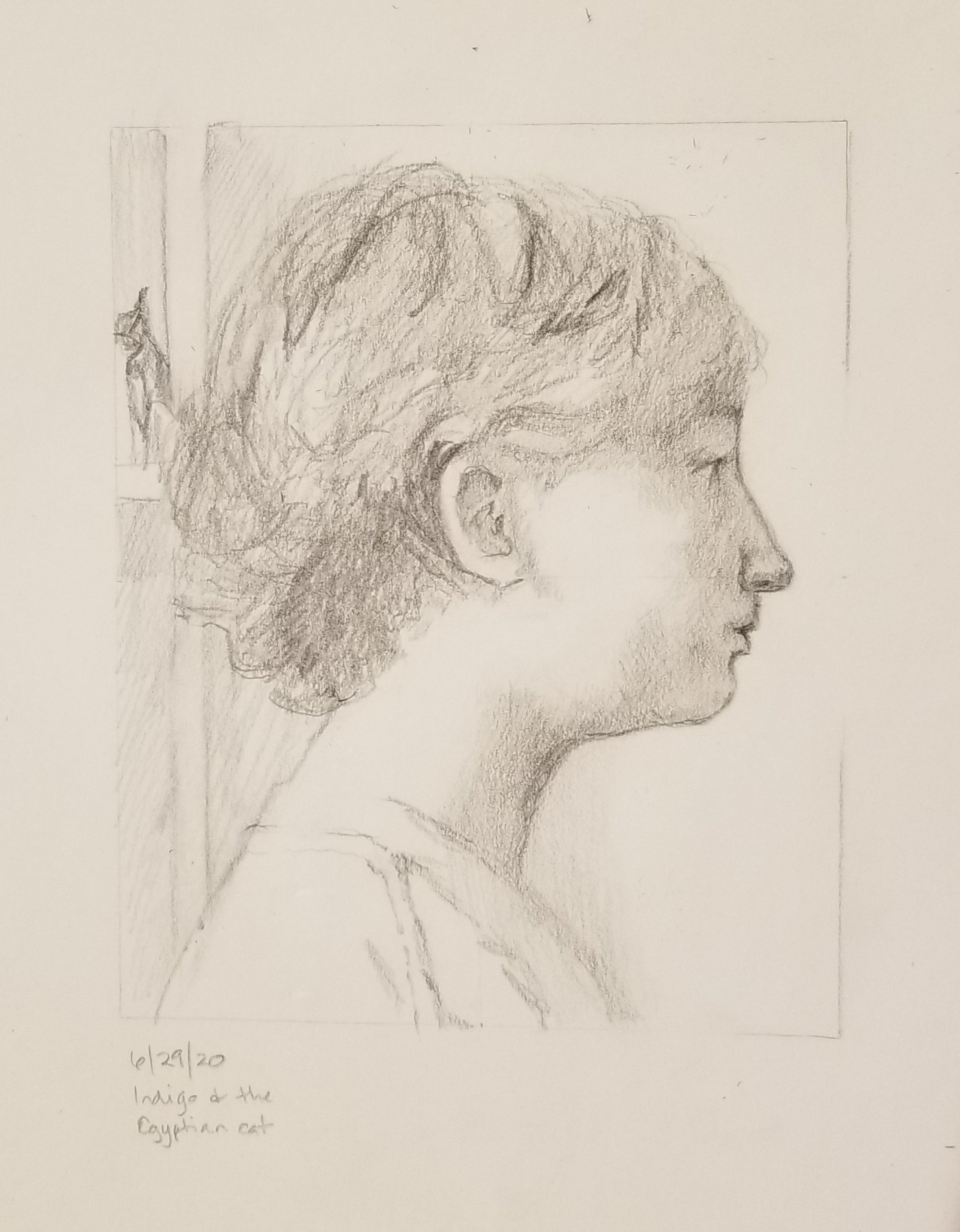
We are doing portraits now in the drawing class we’re taking. I have drawn a lot of portraits in my life, but this is probably the best.

I’m resisting my self-protective habit of listing what doesn’t work well,and taking Katie’s advice to list what does: the ear, the eye, the shape of the shadows that define the cheek. And it looks like her.

I’ve done lots of drawing over the past ten years but have taken only one drawing class in that time. Now, in quarantine, all three of us are taking a class via video conference with Katie Gilmartin, whose printmaking classes we’ve taken before.

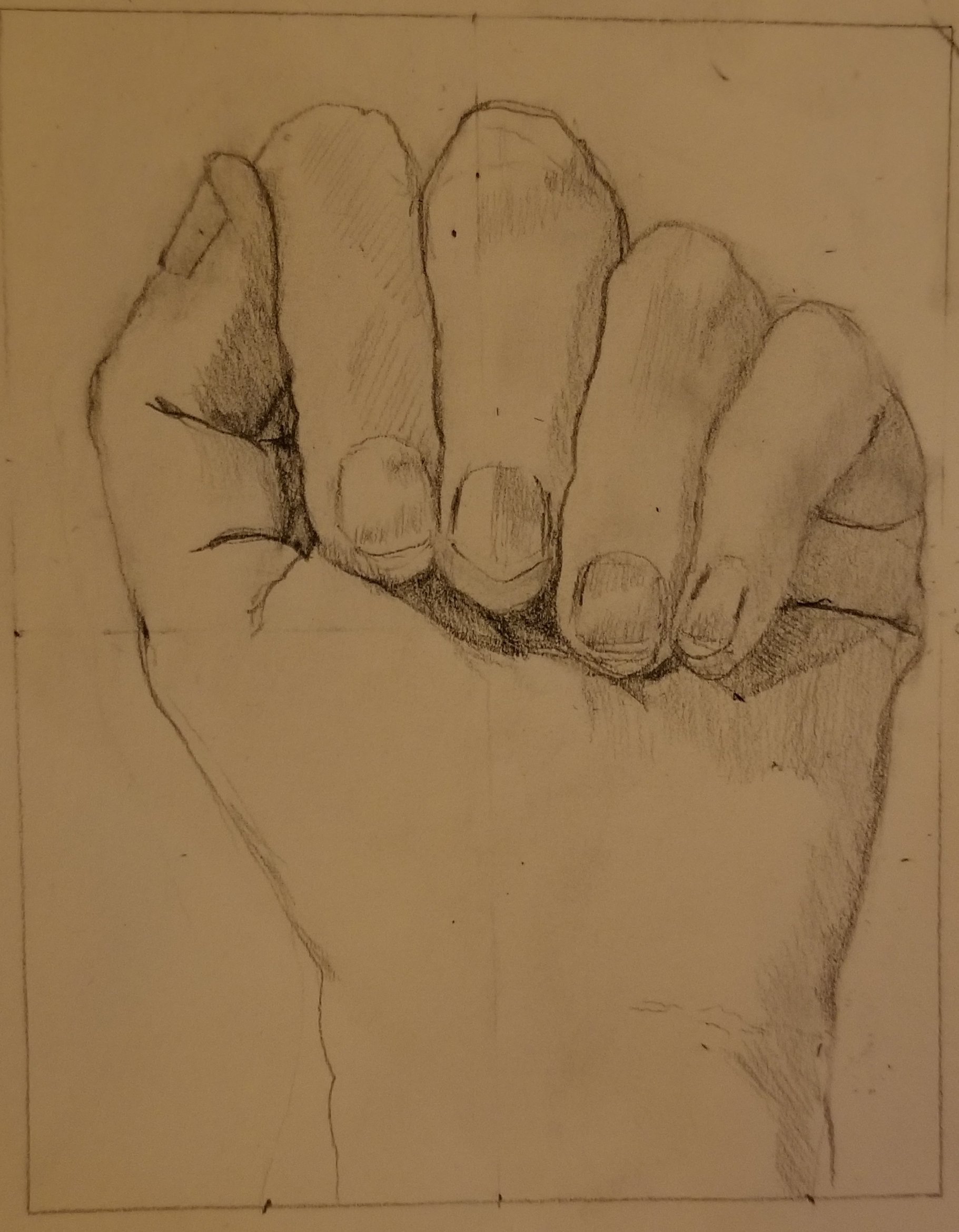
It’s really fun to do together and Katie is a great teacher. Also, this is the best drawing I’ve ever done of my left hand, despite its being a fairly frequent subject, being that it’s always–can I resist the pun? nope–on hand.

Until a week ago–heck, two days ago–I thought people who called for a dissolution of police departments were crazy fantasists. Sure, we should funnel more money into social work, education and other measures that we know actually prevent crime and improve the lives of our people. But defund the police? We do have laws, I thought, and we do need to enforce them.

I’ve changed my mind. Yes, as long as we’re an archist, as distinct from an anarchist, country, we need to empower people to act when laws are broken, but we need to start from scratch. The police of our country have always been pulled two ways: protect the ill-gotten gains of robber barons against the poor who press to receive their due, or protect the people’s rights? Be the legitimized face of white supremacist terrorism, or protect everybody? Act as judge/jury/executioner, or respectfully turn over suspected violators of the law to the courts?

This week they have chosen the evil path over and over, and it’s just one bad week in 250 bad years. Time for a new way.

I retrieved this collage from the pieces-in-progress box, where I had filed it just the other day in the course of going through some piles in our home office. (The Onion, as usual, is sardonically accurate; after two weeks of the coronavirus shutdown, our house task list is noticeably whittled down.) I began it, a few years ago, with some playful, purposeless clipping of an old Thomas guide, which I had bought when I moved here in 2003 and which was rendered redundant within a few years, when I got my first smartphone. Redundant for navigation, but a gem in the collage-materials collection.

As soon as I started playing, the similarities between map features like freeways and anatomical drawings of veins and arteries appeared. Also, I kept noticing places that had a strong emotional tug: hospitals where many of our congregation members have been patients, a cemetery where some have been interred, and, snaking their way down page upon page of the book of maps, the railroad tracks where two have died. And just like that, it became a portrait: of a place, of tender moments from a shared history, and of relationships.

It’s complicated. Many of the moments have been sad, even heartbreaking ones. There’s a tremor of trauma running through this landscape. But joy runs through it too, and sometimes in the same places. Finishing this collage helped me integrate them.

Any ideas for a title about the body, loss, place, lives and deaths, finding one’s way . . . ?

So, drawing with SketchbookX. Luna was surprisingly cooperative.

Enter your e-mail address to receive e-mail notifications of new posts on Sermons in Stones

Links I like