
You are currently browsing the category archive for the ‘uncategorized’ category.
This afternoon will be the sixth in an experiment in community office hours: inspired by colleagues such as Jeremy Nickel, I have been going to local cafes for an hour on Friday afternoons, inviting anyone who wishes to to drop by and talk. I solicited café suggestions from the congregation and chose a variety that weren’t chains and covered the core of the geographical area we serve. I published the list in the newsletter along with a column explaining what I was up to, and I also send a day-of reminder by e-mail, tweet and/or Facebook.
The first week, four people came by, and initial awkwardness quickly turned into a lively five-way conversation. When four o’clock arrived and I excused myself, the other four carried on talking. I walked to my car grinning happily. Nothing makes my day like a decaf nonfat mocha and an animated conversation among people who, for the most part,

Image from http://www.cafeborrone.com
had barely known each other an hour before. Community office hours as small group. Hm.
Other weeks, the number of church folks has varied from zero to three. One person couldn’t come by, but seeing on Facebook that I was in office hours, instant-messaged me. He was the only visitor that week. I was really glad we’d connected, since we were able to talk, via IM,about something important that was on his mind. Community office hours as pastoral care.
During two other sessions, no one visited intentionally, yet each time someone made a connection with me. One was a member of my congregation who often comes to that coffee shop and had no idea that I was going to be there; another was a member of another congregation whom I’ve met before. In both cases we chatted for a while, and the latter conversation was a deep, clearly much-needed pastoral care session. That raised an interesting question I hadn’t thought of before, because if he had come to my office specifically asking for pastoral care, I would have asked whether he’d talked to his own minister. In the café, it didn’t occur to me.
From church folks’ perspective, is this any different than having drop-in time in my office? I can’t be sure, but it seems so. Since my arrival at UUCPA ten years ago, I haven’t held drop-in office hours, but simply invite people to drop by any day I’m at church, while encouraging them to make an appointment ahead of time in case I’m in one of my many meetings. I think people are coming by the café who would not have come to my office (they certainly never have before). I’ve certainly gotten more drop-in visitors in the cafés than I do in my office in a typical week, driven, most likely, by the informality of the setting. It’s not a pastoral visit, right? We’re just having a cup of coffee. It opens up possibilities. I wonder if people will be more likely to invite a friend from outside UUCPA, something that hasn’t happened yet. Community office hours as outreach.
Some colleagues wear a collar to let everyone know that a minister is in the house. Since I’m not doing that, there’s nothing to tell others in the café that the people at our table share a spiritual community, other than the content of our conversation. I wonder whether we will eventually become known as a fixture and people will begin to realize what we’re doing there. Like everything else about this experiment, it’s something I’m just watching as it unfolds.
We are venturing in various ways into serving the wider community, shifting our inward focus on self-identified UUs to a mission-driven outreach to everyone who might need us. Perhaps this will become a small but key part of that shift.
If you’re on the San Francisco Peninsula, come on by, 3-4 any Friday:
1st Friday Café Borrone, 1010 El Camino Real, Menlo Park (next to Kepler’s Books)
2nd Friday Printer’s Café, 320 S. California Avenue, Palo Alto
3rd Friday Dana Street Roasting Company, 744 W. Dana St., Mountain View
4th Friday Café Zoe, 929 Menalto Ave, Menlo Park
5th Friday Palo Alto Café, 2675 Middlefield Rd, Palo Alto
Gordon McKeeman has died. Without our ever meeting, he was a kind of spiritual grandfather to me: a mentor and teacher to many of my mentors and teachers. My conviction that ministry (from the Latin for “service”) is not the private domain of a small number of professionals, but something we all do together, clergy and laity, arose from my own experience, but it was McKeeman who gave it words:
Ministry is
a quality of relationship between and among
human beingsthat beckons forth hidden possibilities;
inviting people into deeper, more constant
more reverent relationship with the world
and with one another;carrying forward a long heritage of hope and
liberation that has dignified and informed
the human venture over many centuries;being present with, to, and for others
in their terrors and torments
in their grief, misery and pain;knowing that those feelings
are our feelings, too;celebrating the triumphs of the human spirit,
the miracles of birth and life,
the wonders of devotion and sacrifice;witnessing to life-enhancing values;
speaking truth to power;speaking for human dignity and equity,
for compassion and aspiration;believing in life in the presence of death;
struggling for human responsibility
against principalities and structures
that ignore humaneness and become
instruments of death.It is all these and much, much more than all of
them, present inthe wordless,
the unspoken,
the ineffable.It is speaking and living the highest we know
and living with the knowledge that it isnever as deep, or as wide
or a high as we wish.Whenever there is a meeting
that summons us to our better selves, whereverour lostness is found,
our fragments are united,
our wounds begin healing,
our spines stiffen and
our muscles grow strong for the task,there is ministry.
Amen, may it be so, and may we know it to be so. Thank you for your ministry, Reverend McKeeman, in all its forms.
I admit it: I am picky about grammar. I use the word “whom” when an object pronoun is called for, even in spoken English. I refuse to pass on graphic memes with bad grammar. My mild-mannered Facebook persona occasionally gives way to someone called the Guerrilla Grammarian who issues a public service announcement about some urgent issue such as the correct English spelling of Gandhi. “Irregardless” sets my teeth on edge and I have a carefully-honed argument about why it’s acceptable to begin a sentence with “Hopefully . . . ” I know why one says “15 items or fewer” and “I’ve gotten less than five hours of sleep every night this week,” and I stick to it. From this position of linguistic purity, I feel I have the authority to make the following declaration: “they” is a perfectly appropriate gender-neutral third-person singular pronoun. It is, in fact, the ideal word to use when we wish to speak of a person, as well as persons, unknown or indeterminate.
You know the problem I’m talking about, right? Sometimes you can’t say, “He fell right off his broomstick with a thud” because you don’t know whether the person falling was Harry or Hermione, in which case you might say, “In the dark of the midnight Quidditch pitch, Ron heard someone fall off their broomstick.” I see nothing wrong with that. I’d like to call it the Rowling rule, because she does it all the time, to the irritation of other grammar-obsessed nitpickers.
What are some alternatives to “they” in this example?
Use “his/her”: “Ron heard someone fall off his/her broomstick.” Problem: do you have to ask? Slashes are the stuff of bureaucratic documents, not fiction. Except, of course, fanfiction. Also, they’re binary and there are more than two sexes and more than two genders.
Use “his or her”: “Ron heard someone fall off his or her broomstick.” Problem: barely less awkward than “his/her.”
Use a new pronoun: “Ron heard someone fall off zir broomstick.” Or do I mean “hir broomstick”? Or “eir broomstick”? Problem: I appreciate the creativity, but there’s a reason that these haven’t caught on and it isn’t (only) transphobia. I don’t even know how to pronounce that last one, and if you can’t pronounce a word you won’t use it.
Use “his”: “Ron heard someone fall off his broomstick.” Problem: We live in the 21st century, in which women and girls are widely acknowledged to be more than half the population. Please.
Use “her”: “Ron heard someone fall off her broomstick.” Problem: Even in the 21st century, this will make most of your readers think you know it’s a female broomstick rider. Sorry.
Alternate between them: “Ron heard someone fall off her broomstick.” A paragraph later: “Ron heard someone else fall off his broomstick.” Problem: This works very well in a nonfiction text with lots of examples, such as a book on parenting. “Your two-year-old may enjoy playing with containers, so give him a stack of plastic or metal bowls.” Next paragraph: “Two-year-olds have unpredictable mood swings, so she may be very independent one minute, clingy the next.” Great solution in this kind of text, but not in most.
Rewrite: “Ron heard someone fall off a broomstick.” Problem: weak; loses the visual impact of A person falling off THE broomstick THE person had been riding.
In contrast, points in favor of “they” are numerous. It seems to be the natural choice; it’s what we tend to say in spoken language in such situations (“Who’s at the door?” “I don’t know–I can’t see them through the peephole”). It is less clunky and binary than “his/her” or “s/he.” The main argument against it–that it is ungrammatical–is very, very weak. “It’s a plural pronoun!” cry overachieving amateur, and uninformed professional, grammarians. Yes, it is. And I know another plural pronoun: “you.” Is it incorrect to use “you” as a singular because “you” is plural? Of course not.
Singular: You’re wearing my shoes!
Plural: You won’t all fit on this elevator!
We have a strong precedent for using one pronoun for both singular and plural. We have a linguistic problem to which this fact is a solution. So let’s use it. I already use “they” (singular) in written as well as spoken English. I think one neologism is warranted, and again, seems to slide off the English-speaking tongue: a singular version of the reflexive pronoun. “You” has “yourself” (singular) and “yourselves” (plural); when we use “they” as a singular pronoun, its reflexive counterpart would be “themself.”
There is a second linguistic problem that “they” can solve: a polite way to refer to agender, transgender, and genderqueer people–anyone for whom “he” and “she” are not sufficient choices. As Karl Fleischman, the father of Sasha Fleischman, an agender teen who was badly burned last week when someone set their skirt on fire, writes, his child prefers “they” as a pronoun. He adds, “English doesn’t have commonly used gender-neutral third-person singular pronouns yet.” However, I would say that it does. It has “they.”
Whether agender and transgender folk will adopt “they” for themselves is up to them. It’s not up to me, and I will use whatever pronoun a person prefers for themself, but I humbly suggest that it has a huge advantage over “ze,” “hir,” or any of the other neologisms that have been tried. Neologisms do take hold sometimes, but when we already have a word that has worn a path in our linguistic landscape–the way “they” has done for many of us–it’s likely to be the best place to build the road.
Joy, the Munchkin and I have been in London for a week. This makes us experts entitled to generate a list. Originated by Joy and compiled by all three of us, here it is:
Things at which the British excel:
Smoked salmon. Specifically, the smoked salmon at the Mall Tavern, conveniently located across the street from the Kensington Unitarians–eating that salmon was a religious experience of its own–but elsewhere too.
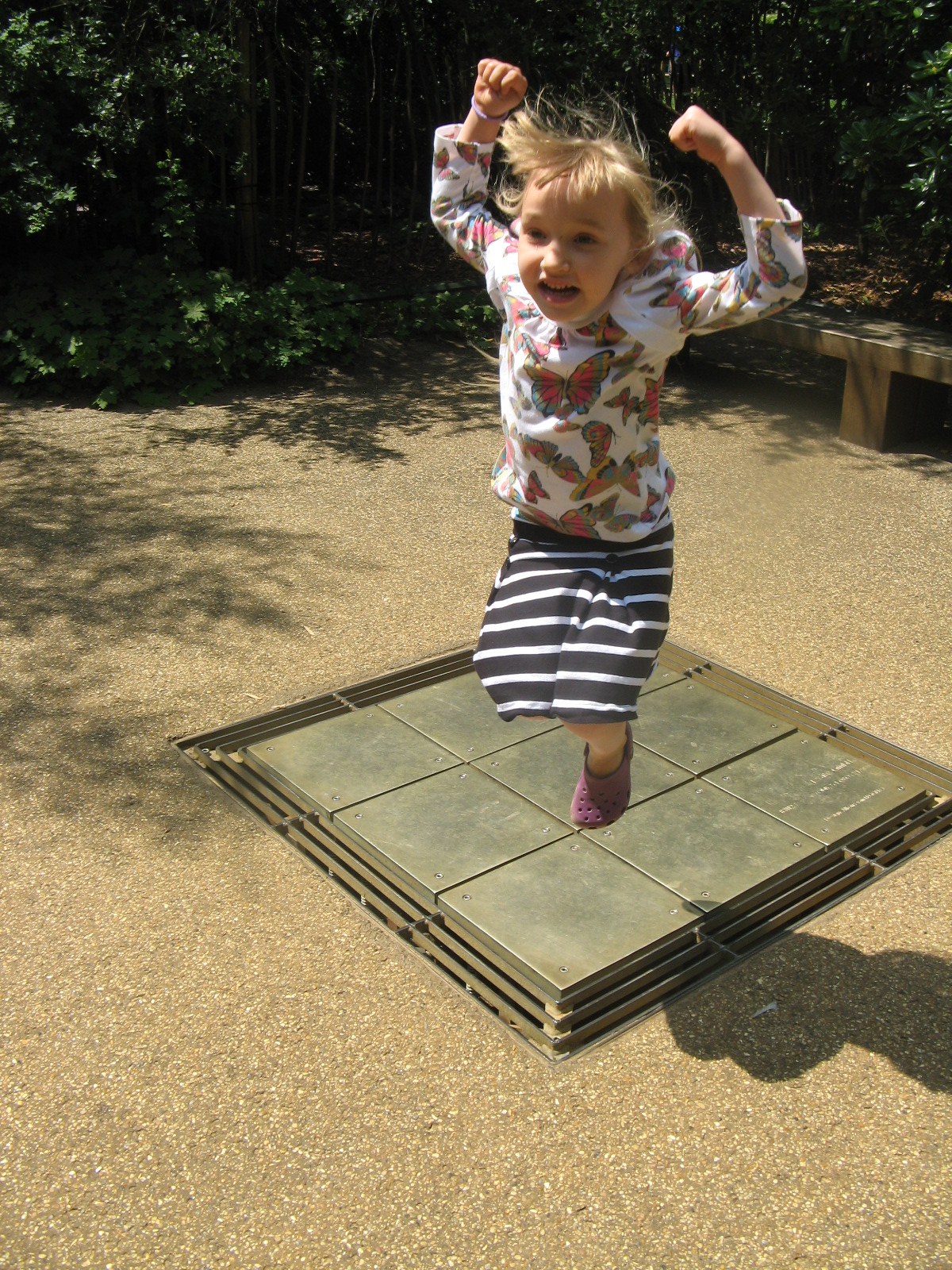
Playing the xylophone the fun way in the Sound Garden of the Diana Memorial Playground (Photo: Joy Morgenstern)
Playgrounds, and we’re not just talking about the astoundingly fantastic Diana Memorial Playground in Kensington Gardens, though it is astoundingly fantastic. There are four or five playgrounds within an easy walk of our flat. It’s not just outdoor space where they grok kids, either. It seems like every museum has highly developed children’s activities (watch and learn, San Francisco).
Coming up with creative pronunciations of non-English words. Yesterday we encountered a name that is pronounced Joe-a-kim, probably spelled Joachim.
Parks and gardens. Joy theorizes that while the men were off expanding and shoring up the Empire, the women had time to garden like mad.
Drinking.
Writing plays. Acting in them too, especially character roles.
 Double-decker buses. Why doesn’t every place have them? This is the way to see a city, as Doggie attests.
Self-deprecation and understatement. I love the ad I’ve been seeing on the buses for a moisturizer. After the tagline comes the hard-selling line, “This moisturizer isn’t the whole answer, but at least it’s a start.” Where I come from, the right moisturizer makes you beautiful, wins you the love of a sexy partner, gets you that dream job, and brings about world peace, so this is refreshing.
Takeaway food. In fact, food in general. We haven’t had a bad meal yet. (Though even one of the best places, where Joy got a delicious roast dinner, boiled the carrots into flavorlessness. Roasted carrots are so yummy that it seemed like a particularly sadly wasted opportunity.)
Ethnic diversity. Of course, most big cities have people from all over, but it’s really striking here. It doesn’t hurt the food situation, either.
Funding museums. Admissions are mostly free.
Sweets. Fortnum and Mason’s toffees are just one shining example (I hope our dentist isn’t reading this).
Tea, the beverage and the meal. Again, why don’t all other countries have a meal that consists of tiny sandwiches, rolls, cakes, and tea? Such a brilliant idea.
Not so much:
Quitting smoking. Man, do Londoners smoke. I thought San Francisco was bad (people smoke there so much more than twenty miles south on the Peninsula, you would think the surgeon general’s warnings didn’t apply to city folk), but London leaves it standing. I am starting to suspect that every twenty-something who comes to London is issued an Oyster card and a pack of cigarettes. And while the restaurants seem to have a smoking ban, people can and do smoke at the tables just outside the doors, which are open for the summer so that the indoor diners can breathe the fumes. England, your food is unfairly maligned, but to have great food you have to remove the tobacco smell.
Not acquiring head injuries while biking. To be fair, maybe they don’t fall off their bikes often. I hope not, because almost none of them wear helmets.
Still and all, well done, Brits. You’re showing us a lovely time.
For all of us who have been following the news of the Boston Marathon bombing and feeling the impact even at thousands of miles’ distance, here is Yehuda Amichai’s great poem “The Diameter of the Bomb”:
The diameter of the bomb was thirty centimeters
and the diameter of its effective range about seven meters,
with four dead and eleven wounded.
And around these, in a larger circle
of pain and time, two hospitals are scattered
and one graveyard. But the young woman
who was buried in the city she came from,
at a distance of more than a hundred kilometers,
enlarges the circle considerably,
and the solitary man mourning her death
at the distant shores of a country far across the sea
includes the entire world in the circle.
And I won’t even mention the crying of orphans
that reaches up to the throne of God and
beyond, making a circle with no end and no God.
I feel very much within the diameter of destruction today.
I wrote yesterday about the loss of creative programming for kids under 10 during General Assembly. Other parents have inquired, and the General Assembly Planning Committee has added details to the Child Care section of their pages:
The theme for childcare this year is, It’s Good to be Green:
Alright kids! Ready, Set, GO GREEN! Taking care of each other and the planet is on everyone’s mind these days and being eco-friendly can be fun! From craft projects made with recycled materials to puzzles and games about our planet, we’ll learn about our environment in a fun, playful and creative way. Our nature theme tents and tunnels will give the feeling of playing in the great outdoors. Exploring our surroundings could lead us to a great scavenger hunt. Divided into teams and following clues, let’s see which team finds the most eco-friendly items hidden throughout the room. From using recycled materials to special projects directed at environmental learning, children will leave the program feeling positive about themselves and becoming eco-friendly.
Sounds much better than “child care from 6 months through age 9.” It’s still not clear what ages get this programming (a member of the committee said in an e-mail it was for 8- and 9-year-olds), and all day in one room doesn’t sound great for anyone over about 4, but it’s more appealing than what was on there before. Thank you! Please extend it to 6- and 7-year-olds if at all possible!
The Fahs Lecture, sadly, appears to have no chance of being restored this year, since the Planning Committee, in what was described as a respectful conversation, said there is no such thing as a guaranteed spot at General Assembly. However, there used to be, and I am one GA regular who thinks that that provided a much richer program than the more recent process of confining most program decision-making to a small group. If anyone thinks that our current method is the best way to meet the wonderfully diverse needs and interests of the thousands of GA attendees, I offer the Fahs Lecture decision as a counter-example.
This morning: As a woman next to me got up and picked up her toddler, he wrapped his arms and legs around her and assured her, “I’ve got you!”
This afternoon: The bus went by a house the bottom step of whose front steps is currently suspended three or four feet above the ground. The steps have caution tape wrapped around them that says “Caution — Wet Paint.”
A congregation member and I were chatting about learning a new language as an adult. He said there’s a proverb in Japan to the effect that what you haven’t learned by forty, you’re not going to learn.
Interestingly, I had been reflecting on what I’ve been doing over the past several years, going back a ways before forty: deliberately taking on the challenge of things that scare me. I didn’t take them on for the sake of the challenge itself, but in pursuit of some other goal, but along the way I had to, in Eleanor Roosevelt’s words, do the thing I thought I could not do. They have built on each other, the knowledge of having done one giving me courage to do the next.
Ending an unhappy marriage (age 35). Necessary and excruciating, like doing an amputation on myself. Like walking through fire because going into and through the pain was the only way to get beyond it. When, three years later, my doula asked me to prepare for childbirth by thinking of a time I found the resources to do something I didn’t think I could do, this is what I thought of.
Giving birth (age 38). Longed-for but also very frightening. I’m still awed that I did it. I love this poem about that amazing power, that another church member shared to start a Committee on Ministry meeting, making me want to shout “Yes!”

first steps, Alexis O’Toole (Creative Commons license)
Speaking Spanish to native speakers (age 41). Learning Spanish in class, which I began to do at about age 40, was not particularly difficult and not at all scary. What I wondered was whether I’d have the courage to try out my novice Spanish when we then lived in Mexico for six months. I knew I’d learn more Spanish, and enjoy myself more, if I dared to speak to people—dared, in short, publicly to do something I wasn’t very good at. To my surprise, I dove right in with few qualms. Was I getting braver? It appeared so.
Drawing (age 41). A fear of drawing had paralyzed me for 25 years. Whatever freedom I apparently felt as a young child, when I said I was going to be an artist, had been shriveled by fear by the time of my first semester of college, when I took a drawing class and procrastinated on every assignment. I was terrified. When I planned my “sabbatical of art” for 2010, I intended mostly to make abstract collages, but I assigned myself one drawing class with the aim of putting some of this fear behind me. Not only did the fear fall away, but I fell in love with drawing. For the first time in my memory, I loved to draw. It is still a little intimidating to face the subject and the blank paper, to feel my inadequacy to convey what I see with a piece of charcoal, but I have been drawing every week ever since, and I always look forward to it.
Writing and preaching (age approximately 40, and ongoing). As drawing became a source of joy instead of dread, I asked myself whether I could shift writing in the same way. I had already been getting bolder in my writing and preaching, and then the revelations of my sabbatical accelerated the process. That’s the subject for a longer post focused just on preaching. For now I’ll just say: I could already write, but my sermon writing has taken on a whole new dimension in recent years for reasons that can be summarized as more guts.
And now, at age 44, I am doing something else: Learning to be a supervisor. I became head of staff—UUCPA’s first in I don’t know how long—when I got back from sabbatical in fall 2010, but I and the church still have a lot to learn. That’s scary to admit, even though I preached about the merits of “beginner’s mind” in my very first sermon as UUCPA’s minister. I really like the model that Susan Beaumont is teaching in the seminar I’m in right now, and it both fits UUCPA well, and draws on and develops gifts that I have. I’m looking forward to bringing it back and, over the next few years, adding performance management to the list of things I once didn’t know how to do, and was afraid I couldn’t do, until I began doing them and loving them.
Sometimes we do learn new things at forty.
I’m in the tight fist of the bad dream I had this morning just before waking. I was in the early stages of a disease that looked certain to kill me soon. Much adult talk and worry, me and doctors, me and other patients, me and Joy. Then, in that way dreams have, it went further and reminded me I have a daughter, and became about the heartbreak of leaving her when she is still a child. It’s hard to shake the image of her face as she realized what was happening, her whole body so still and serious.
I am praying fervently for everyone who is really living those circumstances and can’t wake up from the nightmare.
I haven’t known many postmasters, but I used to chat often with the one in South Strafford, Vermont, where I got my mail. He was ruler of the domain of the post office in the general store–a box of an office and enough mailboxes for half a town of 1000 people–and he was the nicest guy, smart and funny and easygoing. Sometime during my eight years there, the postal service floated the idea of ending weekend delivery altogether, and I asked him what he thought about it. Bad idea, he said. Monday is already a crazy day, with two days’ mail accumulated; the postal service processes mail on Sunday, it just doesn’t deliver it, and you may have noticed that you get more mail on a Monday than any other day of the week. Having to handle three days’ mail on one day would be too much and efficiency would suffer. They should cancel a different day, he said. Wednesday would make more sense than Saturday.
But the post office has taken action, and not taken Vince’s advice. Saturday deliveries will cease starting August 1. I hope it won’t make Vince’s job too difficult.

 Sermons in Stones

Recent comments