
You are currently browsing the category archive for the ‘Oaxaca’ category.
This is a common sight in Oaxaca. A wall with several layers exposed: paint, stucco, brick, stone, adobe. It’s like a telescope that looks into the past. It sees the history of that building, and also the earth of which it was built.
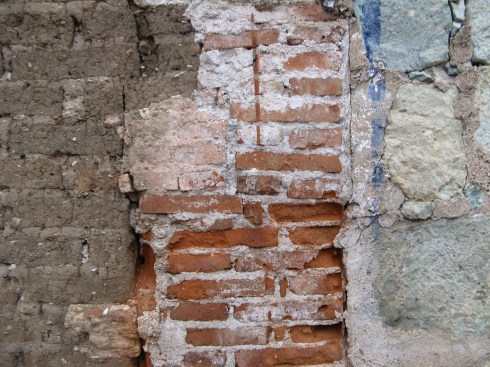
The adobe in particular is fascinating, being made in part of straw that grew during the season when it was built, and pebbles that were made by the earth of that place millions of years before.
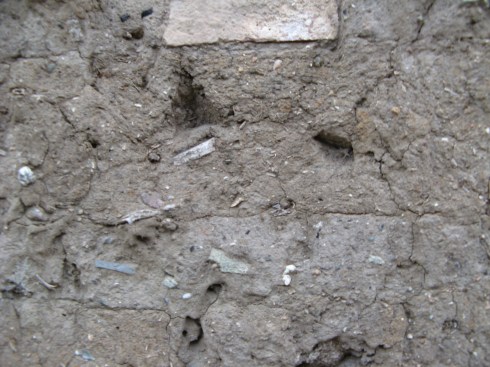
Today we were back in the ceramics studio–we get there about once a week–and I finished the basic shaping of a coil-built bowl that is going to pay homage to these walls. When I’d done that, I had about half an hour to begin carving the outside of the bowl. It will have the textures of brick, mortar, stone, adobe–all these inhabitants of Oaxaca that are never out of sight for more than a block or two.
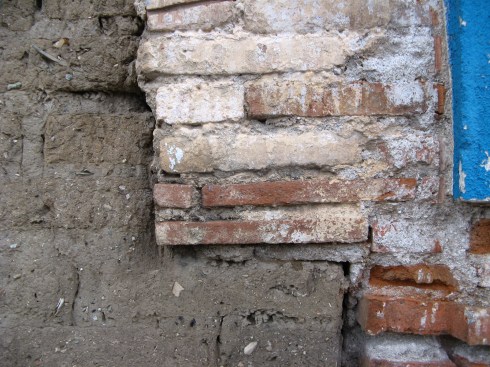
I was so tired during the afternoon that I told Joy and Munchkin to go to the studio without me. I would stay and sleep, I said. But I got a breath of second wind and decided to go along. I was very glad I did. Working on the clay woke me up.
Yesterday we went back to San Martin Tilcajete for its fair of alebrijes. About twenty artists had booths all around its center, and in the middle, people sat at a long table painting alebrijes. Munchkin asked if we could do it and we said no, we wanted to go to San Bartolo before the end of the day and anyway, we were already planning to go to a four-hour alebrijes-painting workshop the next day (today, Sunday). She asked again later. By then, we’d given up on the plan of going to San Bartolo, so we said yes, reluctantly. Ten minutes later I told her it was a fantastic idea. I was painting. The soreness in my shoulder disappeared, Donald Trump vanished from my mind, and it was just me, a paintbrush, and this sea turtle.

Munchkin made a penguin and Joy made a flamingo. Pretty good for our first foray into this art form!

And yes, we are about to go to a four-hour workshop and do it some more. Munchkin also wants to learn how to carve them, but that opportunity is harder to find.
Apparently, the craze for these beautiful little sculptures is causing deforestation of the copal tree. We will have to help plant more.
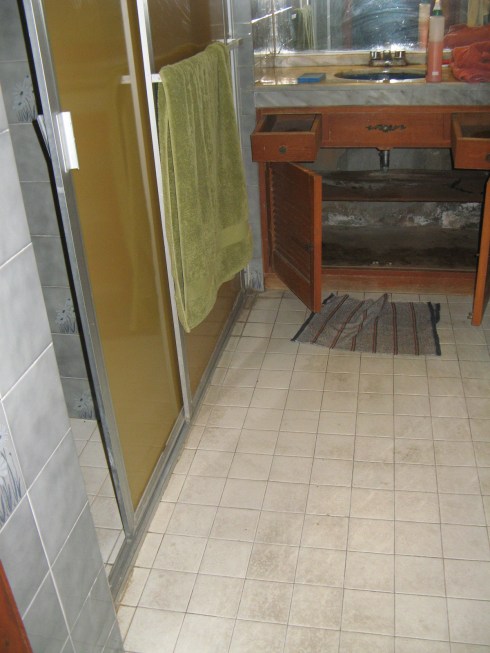
The part-of-a-house we’ve rented is in a really good location in a quiet neighborhood, it has a lot of outdoor space, it has a cistern that guarantees a steady water supply in Oaxaca’s uncertain water system, and the rent is cheap (about $450/month–sorry, San Francisco folks–don’t faint). But it was kind of dismal, to use Munchkin’s word the day we looked at it. She had begun to picture us in the other place we were on the verge of taking, and doesn’t take kindly to these last-minute changes, so she was predisposed to dislike it, but I had to agree. Dirty curtains, drab stained paint, rusty metal, insufficient light, “serviceable” (i.e., ugly) linoleum. Luxurious by Oaxacans’ standards (yes, some houses here have gorgeous tile floors–but plenty of others have dirt), and a perfectly fine place to live, but still . . . a bit dismal, yes.



The long buffet would be better in the kitchen, we thought, and the television would be better hidden in a closet; watching telenovelas (soap operas) would be good Spanish practice, but otherwise the TV serves no function. The plaid sofa and its matching thing, which we call The Thing because “incomprehensible, overlarge combination of coffee table, side table, and armchair” is too long, were probably going to be here to stay.
This was the munchkin’s room. I’ve seen cheap motel rooms that were cheerier.
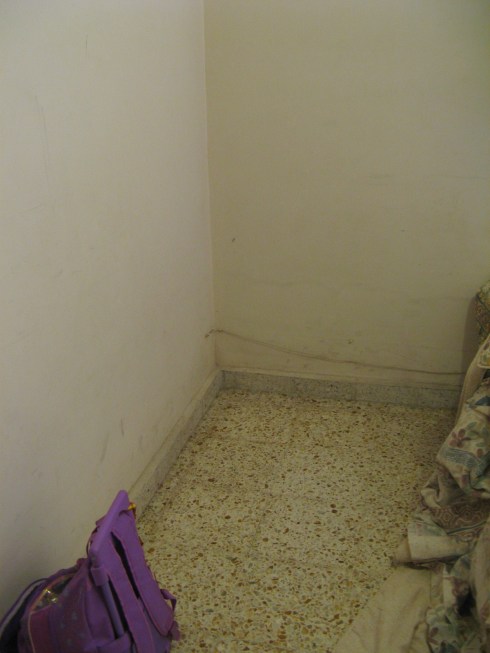
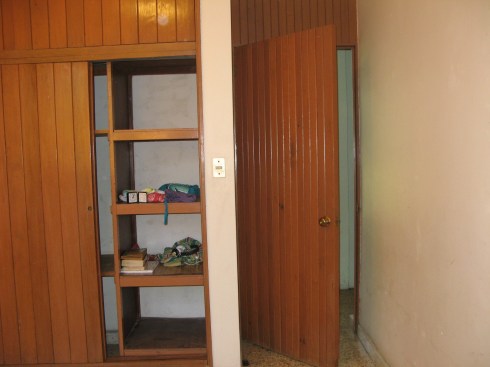
I did not take pictures of the cockroaches, but there were several our first couple of days, some dead, some alive. Shudder.
However, the landlord offered to paint it any colors we chose, which was huge. We told him it was due for fumigation and he got on it. Lightbulbs, lamps, sheets, and curtains are easily acquired, and we hired someone to give it a top-to-bottom cleaning. So the transformation began.
We told Munchkin we’d get her a desk (her first) and a bedside table, and confirmed with the landlord that she could paint one wall with a mural (he is really a very easygoing guy). She picked colors for her room . . .

. . . and soon the desk was ready. It looked even better against a purple wall. (The left wall got plain white to prepare for the mural.)


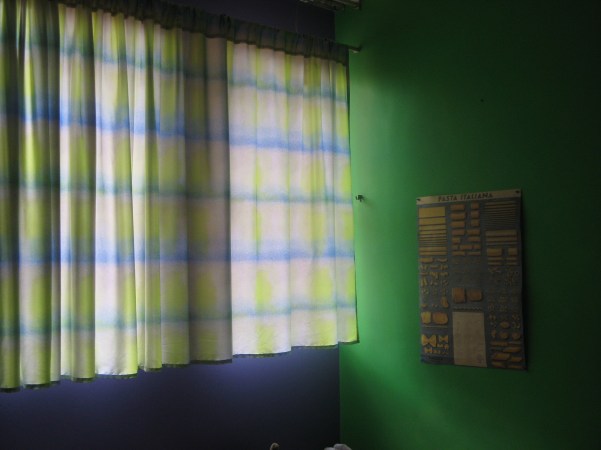
Inexplicably but serendipitously, this pasta poster was on sale at the Museum of Philately. (She liked the curtains that were already there. I don’t, much, but it’s her room.)
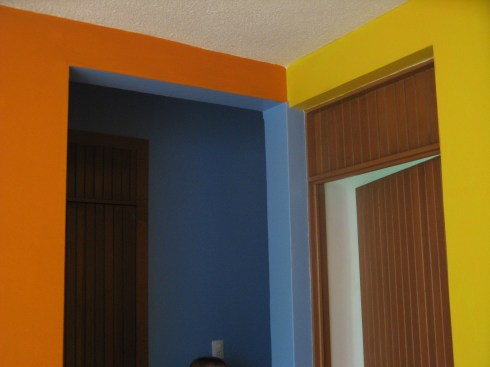
We requested yellow and orange paint for the living room, purple and yellow for my and Joy’s room, and blue for the hallway. This is Mexico–no one blinked. We got these pretty striped curtains for two small windows, and Joy had the great idea of jazzing up the drab ceiling-to-floor curtains in our room with ribbons (we’re going to buy more). The hummingbird alebrije was a birthday present for Joy.


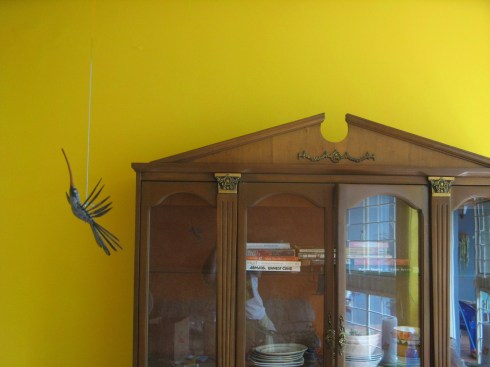
The painter forgot to touch up the rusty spots in the kitchen, so yesterday, Joy did it. And she and Munchkin painted the little shelves we got for art supplies. They, the desk, a big table for doing art on, a smaller table for our room and computer time, and two new chairs cost a total of about $265. (This is sounding like a Better Homes and Gardens article. “She turned a corrugated plastic shed into a nursery for her triplets for only $350!”)


Some tin animals for the walls, a tablecloth, one handwoven rug we’ll be taking home to San Francisco–visible in the background here–

–a few plants, and the crowning touch that I put up yesterday, several strings of papel picado (cut paper), and the de-dismalfication process is complete. It’s quite a cozy, pretty home now.
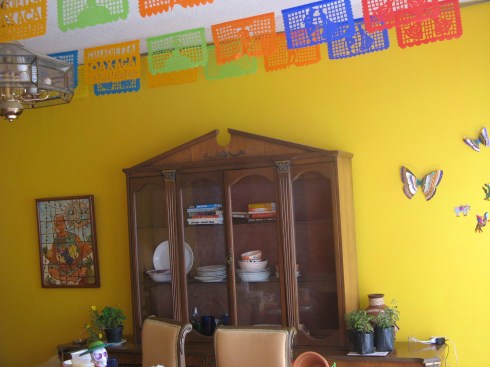
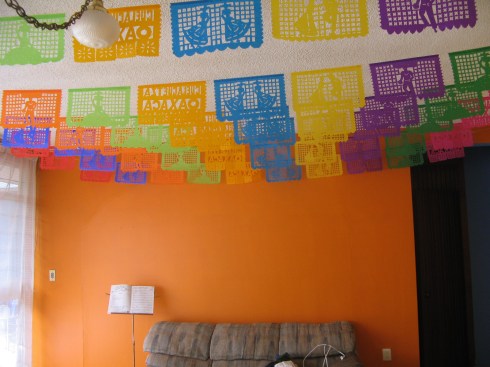
Even the plaid sofa and Thing look rather charming in their new context. Katy, as the munchkin has dubbed our Catrina alebrije, rules over the realm and she approves.

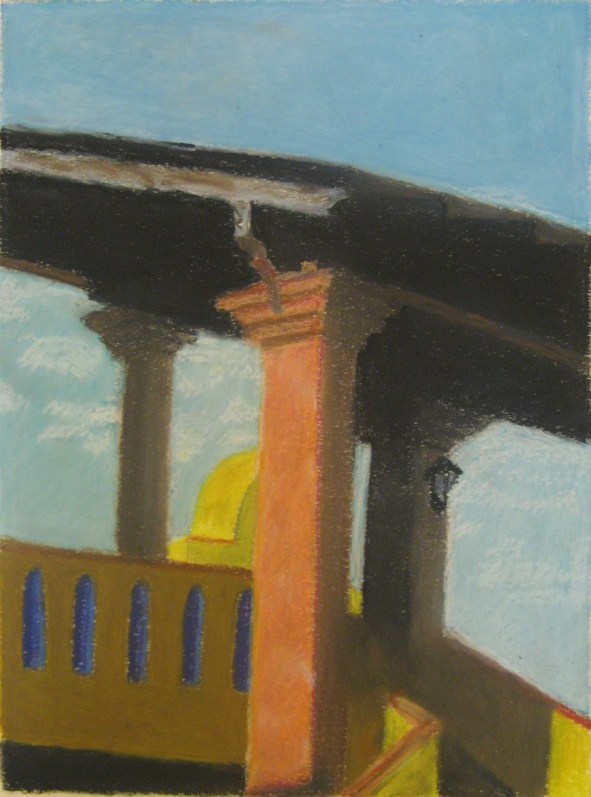
I made a thing! I’m learning how oil pastels work. They seemed like the right medium for this saturated color and light, seen in the Don Cenobio Hotel in the town of Mitla.
We went to the Guelaguetza last night! The festival actually lasts officially for a week and unofficially for several weeks beforehand, since Mexico doesn’t hold a week-long party when a month-long party will do. Oaxaca has the highest percentage and variety of indigenous people of any state in the country, and the Guelaguetza celebrates the many local traditions from all over the state: handcrafts, food, music, dance, religious rituals. So we have been going to parades and artisans’ booths and so on, but the cherry on top is the three-hour performance of traditional dances at the beautiful stadium designed specifically for the festival.
After each group performs, the dancers throw bread, bananas, chocolate, baskets, whisk brooms, etc. into the crowd. Munchkin scored one of the tortillas used for tlayudas. They are the driest, most boring tortillas I’ve ever tasted, and it turns out they grow on you after a while. Maybe I’ll even order a tlayuda now.

The entire crowd sings along when the group from La Mixteca comes on. “Canción Mixteca” is a love song to one’s native land, wherever that might be–wave a hat and join in! “Quisiera llorar, quisiera morir, de sentimiento” (I want to cry, I want to die, of emotion).
Our new friend Sam took us to San Martín Tilcajete, one of the towns famous for alebrijes, figurines (typically animals) that are carved from copal wood and then painted elaborately. His friend Benito Fabian Ortega is one of the artists and his whole family makes them. Six of us piled into a moto taxi–three adults crammed into the back, Munchkin on a lap, and Benito hanging on next to the driver with one hand, holding his toddler daughter on his lap with the other–and went to their workshop/home/gallery. I wasn’t sure if I should photograph their alebrijes, but you can look up the word to see what I mean, and add “Fabian Ortega” to see this family’s amazing artistry.
Here is the munchkin with a menagerie of alebrijes that have been carved, but not yet painted:
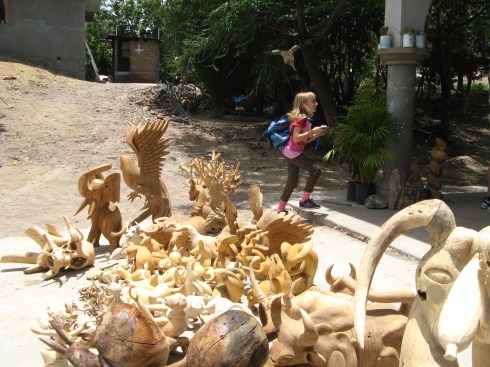
Later, Benito’s nephew brought out a different kind of menagerie and he, Benito’s daughter, and Munchkin played with them. I’ve seen a lot of dragon alebrijes but no dinosaurs so far.


You would think they had enough carving to do for the market, but someone couldn’t resist embellishing this tree. The whole compound was like that, an exaggeration of the Mexican tendency to exert creativity and create beauty, whether it be on boundary walls, floor tiles, or what have you. The Jewish concept of the “adornment of a mitzvah,” which I absorbed as an artistically-inclined Jewish child, is more alive in this country than any other I have visited. In Judaism it means that one does not just do what is required (a mitzvah is a commandment) but does it beautifully. All one must do to fulfill the commandment to begin the Sabbath with candles is stick a couple of candles upright and keep them lit for half an hour, but if at all possible, one uses beautiful candlesticks kept just for that weekly purpose; leftovers would be enough to fulfill the obligation to give to the poor, but Maimonides teaches that one should give them one’s best cooking. That generosity of spirit is everywhere in Oaxaca, as it was in San Miguel de Allende, where we lived in 2010.
One of the brothers saw me pointing my camera and said I had to come up on the roof. I thought he meant I’d get a good angle on the yard, which was where I’d been taking pictures, and I did, but he also wanted me to see the view. I swear Oaxaca has a corner on the world’s greatest clouds.


I noticed this hill off to my right and he said it was called Maria Sanchez. “¿Quien era Maria Sanchez?” I asked. He explained that she was a woman who had died there. According to legend, the large hill was her head, the smaller ones off to the left her breasts, and so on. I would have liked to find out more details–how did she die? why was she immortalized in this way?–but I’d been in Oaxaca for only a week at that point, and “rusty” would be a generous term for the state of my Spanish. (It still is, but it gets easier every day to comprehend what people are saying.)
I summoned enough to tell him that in the town I grew up in, Hamden, Connecticut, there is a hill called the Sleeping Giant. It’s the town’s most prominent geographical feature, which lies within a state park of the same name. Climbing one of the giant’s hips to a WPA-built “castle” at the summit was one of the repeated, always fun adventures of my childhood, which I want to repeat with my own daughter on a visit in the not-too-distant future. The college where my father taught is nestled in its shadow; the town likes to refer to itself as “land of the Sleeping Giant,” and I went to Sleeping Giant Junior High School. The giant, as told by the Quinnipiac Indians, is Hobbomock, who wreaked havoc (apparently with good intentions) when he stamped his foot, and was put into a permanent state of sleep by a more peaceable spirit. Our host seemed unsurprised by the similarity, and in fact when I looked up “sleeping giant” to check a couple of details just now, I discovered that there are similar legends in Kauai and Ontario.
We’ve only been house-hunting in earnest for a few days. We arrived in Oaxaca Monday night, and have been staying in the lovely Al Sol Apartments for most of that time. They are a great short-term place; some people even live here for months, but none of the apartments is big enough for us to do that. We want to have a room dedicated to art–having to clean up after oneself before dinner every night is an impediment to working–and if possible, maybe even another room that is reserved for the many guests we hope to host. With the exchange rate approaching 20 pesos to the dollar, we can probably afford what we want, if it exists.
We have visited half a dozen places to rent. Most have featured either depression-level dinginess (think 40-watt light, the furniture your grandmother bought on sale in 1959, and an 18-inch stove) or a distance of 20+ minutes’ drive from the Centro, the central part of the city. Then, today, we found a really nice apartment, big enough, well within what we can afford, and nicely furnished. We could say yes to it and stop searching.
But this is what’s making it so hard to do: the memory of the house we rented in San Miguel. Oh, it was funky and a bit broken down. There was peeling paint, and our rooftop garden was just a rooftop. The gas pressure was so low that it was hard to use more than one burner at once, and impossible to crank the oven up to consistent baking temperature. But look at that kitchen! Look at the tiles, and the ironwork and the woodwork. We had a courtyard and it was gorgeous. The whole house was a casa tradicional, not something you’d be just as likely to find in Seattle. We’re all holding out for that in our hearts. It makes “good enough” feel not quite good enough.

 Sermons in Stones
Recent comments