
Ah, the UU blogosphere’s a-popping with things I want to respond to at length, too much length for a comments box. Actually, one I want to respond to is a recent post by James Ishmael Ford, whose Monkey Mind blog doesn’t have comments boxes. I’ll get to that one next. Right now I’m meditating on my Palo Alto colleague Dan Harper’s post “Liberty and democracy in liberal religion.” It touches on a topic I think about a lot: the balance (or, equally, the tension) between individual liberty and the demands of community. My candidating sermon for the first church that called me, the Unitarian Universalist Church of Rutland, Vermont, was about this challenge, titled with the words of the Vermont state motto: “Freedom and Unity.”

Dan writes, and I hope he won’t sic Righthaven on me,

[T]he major attraction to Unitarian Universalists for many people in our congregations is that no one can tell them what to believe or do, and this too is enshrined in the bylaws of the UUA, in the claim to a free and responsible search for truth, which is often restated in colloquial terms as “no one can tell me what to believe.” This last attitude is in close emotional alignment with the attitude that the government shouldn’t tell individuals what to what to do with their property.

In close alignment with it, but not at all the same thing. After all, I accept limits on what individuals can do with their property, while insisting on radical liberty to decide what I will believe (I’m pretty sure Dan does too). They are, however, two things we conflate often, and at our peril.

Dan thinks that many of the people who identify as UU theologically but don’t join a UU congregation–there are, by some counts, twice as many of them as actual members of our congregations–stay away because they “find themselves unwilling or unable to submit any of their individual theological liberty to the demands of being part of a democratically organized congregation.” I think this is probably true. Those who do not wish to submit in any way to the strictures of community–I’m thinking of extreme libertarians–will not want to join a congregation, even if they identify themselves as theologically UU.

But I see the congregation as a workshop, as rehearsal space, as practice fields, as a laboratory for the larger democracy, and so I’m focused more on the people who do come to our congregations, and yet who expect that they can pretty much have things the way they want them in that micro-society because of that “free and responsible search” stuff, and of course, that “inherent worth and dignity” stuff. I’m not sure if they are wrongly extrapolating from our freedom of theological belief. It is just as likely that the reason they aren’t very clear on the costs and benefits of different kinds of freedom is that the larger culture has so much trouble accepting a concept such as “Your right to swing your fist ends where my nose begins.” We certainly don’t get “Your right to pour poison onto ‘your’ land ends where ‘your’ land includes an aquifer that lies under others’ land,” or our environmental laws would be very different. We are a much more civil-libertarian than communitarian society.

The distinction between things that are truly no one else’s business and things that do affect others substantially enough for them to deserve a say (namely, via government) is an essential one to make no matter what kind of society one lives in. It’s one with which our democracy, the democracy of the United States, still struggles. After all, it is not easy to agree on the answers to questions such as “Is whom one marries entirely a private choice, or do others get to restrict it?” “Is whether to carry a pregnancy to term entirely a private choice, or do others get to weigh in?” or even “Do I get to say anything I want to at Annual Meeting, or is some of what’s on my mind so destructive that I should bite my tongue?” That’s why we keep debating them. I don’t think we will ever resolve these questions once and for all, but if we accepted that they are not simple, but arise out of the tension between important values, we could approach them with a lot more clarity. Helping people to do that is very much in the job description of pastors, religious educators, and congregations.

Have we UUs given more attention to democratic structures than to theological liberty? I don’t think so. In any case, we definitely haven’t given them enough attention to make up for the confusion that reigns in a nation that is supposedly democratic but in which the prevailing definition of liberty is still license. No wonder people come into our churches saying “I can believe anything I want here!” and thinking it means “I can do anything I want here.” What are we here for if not to help them sort out the difference?

I committed to three practices during Lent: something I wanted to give up, something I wanted to add, and giving to a justice-making organization.

I gave up Facebook. That was not difficult, except once or twice when I really wanted to post a link to some outrageous item. My forays back onto FB in the past few days are marked by greater caution. I look up what friends are doing (I missed that), but I’m not checking every half-hour, and I’m noticing the difference between sharing information and killing time.

I added daily drawing, except that I really didn’t. I drew on one-third to one-half of the days of Lent. A big shift from my usual once-a-week, which has itself been a big shift from my practically-never, but daily got difficult. Watching my resistance was interesting. A lesson: do things like this early in the day. (Maybe instead of posting to my blog, ahem?)

I knew I wanted to give to an anti-slavery/trafficking organization, so I did some research. It’s hard to know which groups are most effective until I am more involved in the issue.  For now, for my donation, I decided on Not For Sale because it focuses on building a grassroots movement and has a particular outreach to faith communities, so I can also see a path for me to get involved. I had heard its president on Forum a few months ago and was impressed; in fact, that program was one of the things that put this issue in the front of my concerns. Also, it is based here in the Bay Area, which makes other kinds of involvement possible. Their home page just flashed that their next global summit will be in Silicon Valley in October, and I’ve signed up.

Jesus said to love our enemies, and I try to live by that, but it’s one of his toughest demands, and I admit that I am happy that Osama bin Laden is dead.  However, I have no desire to dance on the man’s grave.

My friend Jessica Nathanson’s memorial service is being held today, in Minneapolis, at the college where she taught Women’s Studies and ran the Women’s Resource Center. I wish I could be there. It might help me realize that she is gone. It might give me a chance to tell her family how much she will stay with others of us, even distant friends like me.
Jessica and I were fairly close in college, but only irregularly in touch since then. The last time I saw her in person may have been her wedding, over 15 years ago, and I have never met her son, just admired the photos. A few years ago she got breast cancer, and treated it, we thought successfully. It came roaring back, and swept her away on April 5.

What I am remembering about Jess right now: hanging out in our first-year dorm, where we were hallmates. Visiting her in Schenectady in the middle of the long, difficult summer after that year, when I was a counselor at a camp for kids with learning disabilities, and she and her parents rescued me for a weekend at their home. Observing her explorations of paganism and evangelical Christianity with bemusement, but empathy–after all, I was feeling my way towards my adult identity too. Singing with her often during our junior and senior years, Jess on the guitar and teaching me folk songs and others I’d never heard. (When I logged onto my blog this morning, I saw a trackback called “Drops of water turn a mill, singly none,” and remembered with a pang that it was Jess who introduced me to that beautiful anthem. Several years afterwards, I became a UU, found that it was in my new religion’s new hymnal, and felt that I’d come home.) Reconnecting with her when she was a new mom and I was painfully childless, lifted just the same by her joy in her baby boy. Discovering what she had made of her curiosity, sharp intelligence and honesty: a career as a scholarly but down-to-earth feminist, politically sharp and vocal, with a passionate insistence on making room in her and other white feminists’ awareness for the experiences of women of color. Reading her blog, which was courageous and well-written, funny and scrupulously fair.

She was 42, and her son is about 10, and what is hitting me hardest about her death is the thought of his enduring this grief. My daughter’s birth made me feel very strongly that my dying was not an option. The world turns and catches us in the turning, though, without regard to such concerns. I hope Jess and her family reached whatever peace it is possible to reach with the knowledge that she was dying, leaving them, leaving her life far too soon. When we were sitting on her dorm room bed singing those songs, thinking our lives were just beginning, hers had reached its halfway point. I’m glad that she filled those next 21 years with such good work, with so much love.

Jess once wrote vividly about the tenuousness of life and how strange it is to be on the edge of a sorrow, able to go about one’s life while others not far away are enduring inescapable grief. I am feeling that strange mix of loss, fear, guilt, and temporary relief now. As one day, others will feel it upon my death, and perhaps read this and think, “And now she is gone and I remain, until death’s sweep comes closer and brushes me.”

I’m in New Orleans this week, at the other end of a long river from Jessica’s home and the chapel where others will remember her aloud in a few hours. I’ll be looking north this morning, giving thanks for her life, and thinking about what her family, her friends, and the world have lost.

Sad or hopeful?

(Translation: FPS=”first person shooter,” i.e., the kind of video game where you pretend to be killing people. Mod=modification.)

This is pretty much my approach to ethics in a nutshell. When we allow ourselves to be aware of the consequences of our actions, we act differently–that is, better. Two ways to become a better person are therefore: Come closer. Use your imagination. Come closer to the lives that intersect with your own so that you can see how you affect them; if you can’t actually see or hear those other lives, use your imagination. (There’s a psychological and ethical term for the capacity to imagine other lives: empathy.)

This week I met with Almaz Negash, the director of Step Up Silicon Valley, a project whose aim is to halve poverty in our area. I thought people in our congregation might be interested in working with them, and asked her what we would do to become involved. For the first step, she recommended a poverty simulation, a two-hour exercise in which participants are given pretend money and scenarios that place them in the roles of poor members of the community. It looks like Ms. Negash, xkcd cartoonist Randall Munroe and I see things the same way.

Some of the ways I “mod” my own life to become more aware of others’ lives are: read (good fiction is just as effective as non-fiction); listen to the news; ask people about their lives and try to listen to their responses with complete attention; do tonglen meditation. What do you find works for you?

I’m thinking about music a lot as we continue our process to find our new music director. As I wrote before, we had a music stakeholders’ brainstorming session and recorded people’s wishes and peak musical experiences. A lot of my own peak experiences occur during congregational singing, so my bias is toward strengthening that aspect of our music. It’s a bias that was reinforced this week by the singing at our ministers’ chapter retreat. We love to sing together, and we sound great. We were a little tamer than at some previous gatherings–there wasn’t a lot of drumming or dancing–but we leapt into rounds and harmonies as always, and some folks gathered around a guitar and sang late at night. (There was also karaoke, but I got tired and forgot to join it, to my disappointment.)

There are many routes to a vibrantly singing congregation. Here are three:

(1) At St. Gregory of Nyssa, “with no organ, the choir serves as the backbone to support the people in a capella singing.”

The congregation sings, in four-part harmony, during most of the service– opening prayers, hymns and canticles between Scripture readings, the Lord’s Prayer, music when we walk up to the altar, music during communion, and music with the dance. Visitors tell us that they’re struck by how easy it is for first-timers to participate, and how wonderful it is to be part of making such high-quality, beautiful music.

Even for congregations blessed with organs or pianos and excellent musicians to play them, like the one I serve, having a group of singers lead the congregation in singing opens up new possibilities.

(2) A Nick Page workshop will get a congregation singing powerfully, as I know from compelling personal experience: he led a service at the restrained, not to say uptight, Vermont congregation I used to attend, and got us harmonizing, gently drumming on the pews, and singing with big smiles. In covering the workshop he gave on the Saturday, the local paper picked up on something he said, along the lines of “You can be ordinary or amazing, so you might as well be amazing”: their headline was “You might as well be amazing,” and wouldn’t you love that as the lead-in to Sunday’s service?

(3) Worship leaders who know how to teach parts and lead music well make a huge difference. I’m not bad at this, but I’m far from expert, and it takes a lot of preparation. Finding and learning appropriate music can take as much time in a week as preparing my sermon. In other words, it’s ideally the role of a music director, or people and groups trained by the director.

I go back to a few basic assumptions: We’re going to have music in our Sunday services. Some of it will be the congregation singing together. It might as well be amazing.

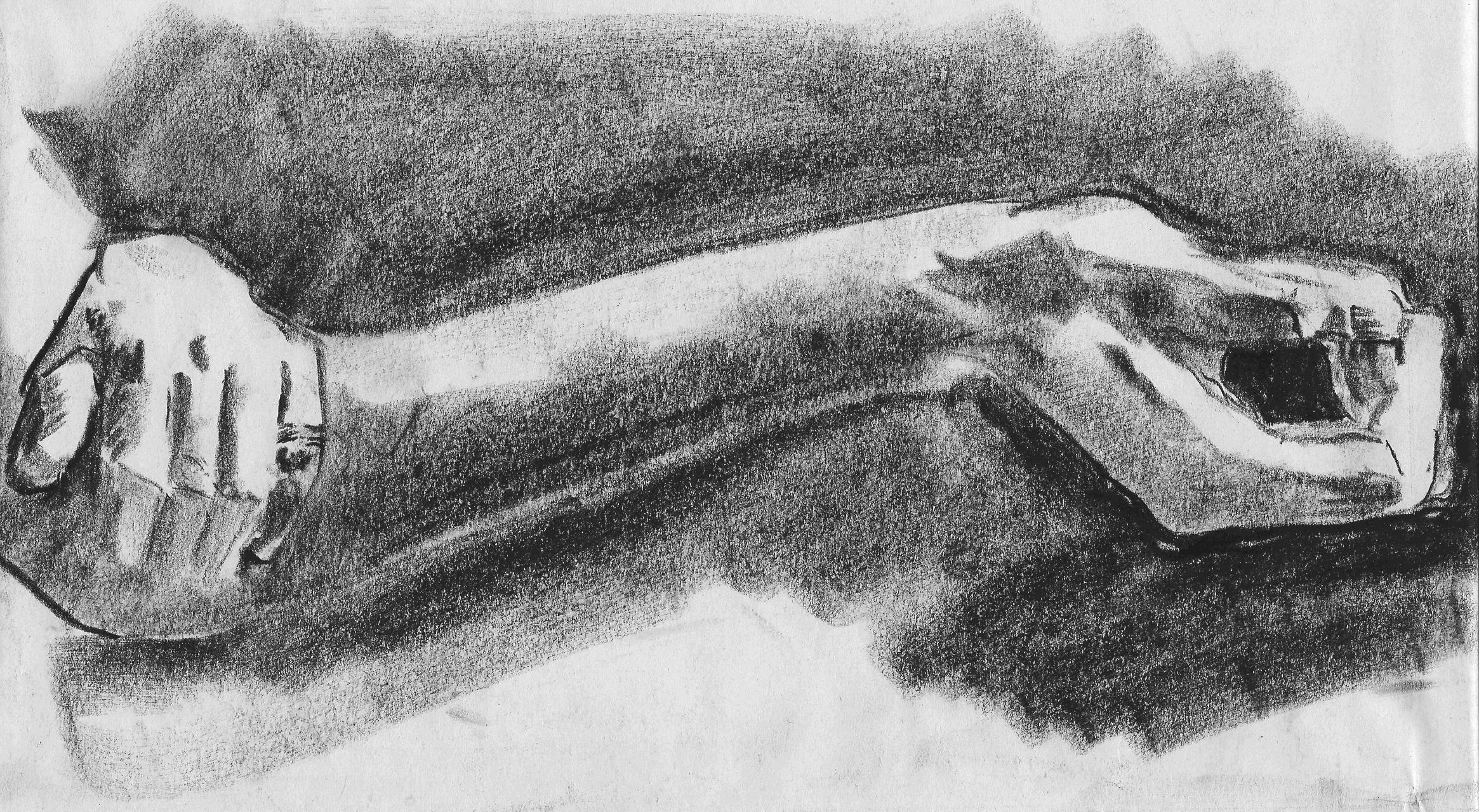
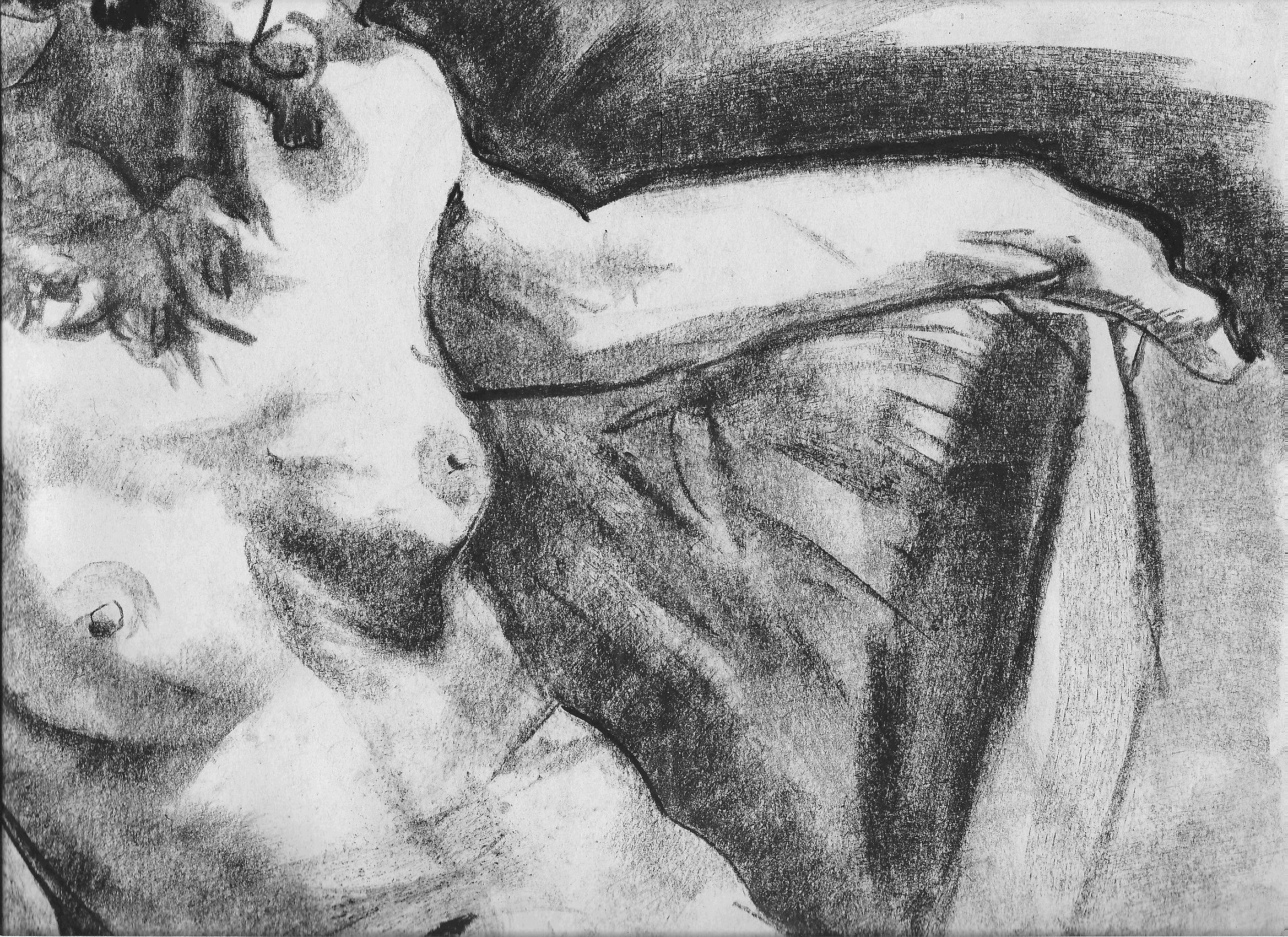
I’m tempted to make this look better-proportioned than it is by splitting it in two and passing it off as two drawings.  I got lost in the detail, as I do with hands, and didn’t realize until afterwards that I’d drawn her right hand so much larger than the left that they look like they’re from two different people.  It’s okay. Good things are happening.

I couldn’t find my pencils as I was leaving for drawing this week, so I only had the box of assorted charcoals the studio has on hand, which doesn’t include any charcoal pencils.  I’m sure I could have borrowed one from someone, but I liked the challenge of doing without one.  I like this drawing because it gets into more fine detail than I’ve ever created without a pencil.

We got a fairly long pose this week, which is rare; the use of the last hour is voted on by the class, and “two poses” almost always wins over “one.” I usually vote for one if I feel like I’m drawing well that week, and this week I did and “one” won and I was very happy to spend 50 minutes on this beautiful pose. My scanner can only take it in in three parts.


……………………….

Why were things clicking this week? No idea. Drawing almost-daily might be helping, or it might have nothing to do with it. I’ve been focusing on light, which is to say, on shadow, and continuing with the close focus (this was the only pose this Monday where I took in most of the body, since I had so much time; on the shorter poses I didn’t attempt it), and those things help.

Our congregation is looking for its next music director, and we had a really interesting music stakeholders’ meeting last week. As we brainstormed wild-eyed dreams and wishes, one that came up was a desire for more variety in our music. Most of our music is classical–including some fresh off the press, thanks to our current music director’s being a highly accomplished composer–or folk.

When brave souls suggest that we use more contemporary music, the names that come up tend to be the Beatles and Bob Dylan. To be fair, Bob is still chugging away, but believe me, we aren’t talking about any of his albums from the ’00s, ’90s, or ’80s. Or probably ’70s. This is understandable, because studies suggest most people seldom listen to any popular music that came out since they were in high school or a little older. I’m an unadventurous music listener, myself, mostly listening to stuff that’s as old as I am or older. (When I was in high school, the airwaves were dominated by Michael Jackson and Madonna, neither of whom inspired me to buy their CDs, or as we still called them then, albums. Feh.) But “Blowin’ in the Wind,” while deservedly classic and even potentially useful in worship, is not contemporary. Heck, it had stopped being contemporary before the escalation of the Vietnam War.

One woman in the meeting talked about a song she knew, a pop or rock song I think it was, that seemed very spiritual to her. I bet most of us can think of some songs just like this, if we listen to any contemporary popular music.

I don’t think newer or more varied music can be counted on to bring hordes of young people to our churches (or African-American or Latino or working-class people, or whatever underrepresented-in-our-congregation population we’re aiming for). What I think is that it is meaningful for people to hear their music, and more diversity in music means this happens for more of our people, just as it’s meaningful for us each to hear our own theology and so our congregations use a range of theological language. So without making any claims of musical messianism, I’d still like to hear your suggestions for music appropriate in Unitarian Universalist worship that:

  1. was written in the last 10 years,
  2. is in some popular genre, and
  3. isn’t already in a UU hymnal.

Dropping a verse or changing pronouns are time-honored ways to adapt music to worship, so don’t be shy about that.  E.g., change “Rainmaker” by Keb’ Mo’ from 3rd person to 2nd and it is suddenly less a love song about a woman than a paean addressed to God, or your congregation, or something.  I can’t use that one, though, since it’s from 1998.

My first nominees are “One Voice” by the Wailin’ Jennys (from the CD 40 Days) and (oh dear, the only new music I seem to listen to is kids’ music) “Extraordinary,” “What a Ride!” and “How Big” by Eric Herman (all from What a Ride!).  Your turn!

In my “43 goals for year 43” I promised myself I’d fly a kite this year. I bought one, ostensibly for the munchkin, almost two years ago; Joy and I were enjoying a lovely couple-alone weekend in Bodega Bay, freed by our dear friend Wendy’s taking our daughter into her home for a couple of days, and of course we mostly talked about Munchkin and bought her a couple of presents. She was really too young for a kite, but I picked out one I thought she’d like–a ladybug–and explained to her what it was. We brought it to the beach on one glorious day several weeks ago, but it was so glorious that there wasn’t enough wind to raise a kite. Yesterday we took a trip to Venice Beach, in Half Moon Bay, and this time the kite flew.

photo by Joy Morgenstern

It was so simple, so unthrilling, really. The munchkin gave it a single smile and then went on with the more exciting business of writing in the sand. Joy said, “Yep, it’s a kite.” I’d deliberately bought a very simple kite, fearing that a two-string trick jobbie would be beyond us. Once it was flying and I’d admired it for a moment, there was nothing to do but tie up the string and read my book or look at the ocean (which meant turning my back on the kite, since of course the wind was coming from the water).

But I kept looking up at it, feeling very moved, and it wasn’t until then that I realized why I had even cared about flying a kite, and why I’d thought of it as a difficult thing to accomplish. It has to do with the kite that hung in the back of my closet through all of my growing up. I have no recollection of ever flying that or any kite in my life. Maybe I did at some point and have forgotten, but what I chiefly remember about kites is frustration. We bought it and tried it at a local park; it didn’t fly; it came back home and sat in the closet for the next umpteen years, a silent reminder of a bit of fun that, literally, didn’t get off the ground. At some point a friend and I made another one of paper and string, but of course that had even less of a chance of working. We probably only had bad luck at that day at the park, but kite-flying stuck in my mind as something tricky and elusive.

It wasn’t a big deal; I haven’t borne a kite-shaped scar on my soul for 35 years; but clearly it was a little piece of unfinished business. Yesterday it was finished, and a small sorrow was replaced with a small, sweet blessing. A lot of my life with my wife and daughter is like that.

Enter your e-mail address to receive e-mail notifications of new posts on Sermons in Stones

Links I like