The resources in the previous post were from Judaism. Here are three prayers of confession and contrition from the heart of the Unitarian Universalist tradition. All three use theistic language and all three lend themselves beautifully to the devotions of a religious naturalist or humanist:

Vivian Pomeroy (1883-1961), from his Hidden Fire:

Oh God, forgive us that often we forgive ourselves so easily and others hardly;
Forgive us that we expect perfection from those to whom we show none;
Forgive us for repelling people by the way we set a good example;
Forgive us the folly of trying to improve a friend;
Forbid that we should use our little idea of goodness as a spear to wound those who are different;
Forbid that we should feel superior to others when we are only more shielded;
And may we encourage the secret struggle of every person.

from Hymns of the Spirit (the “red hymnal,” published 1937), pages 33-34:

Into this house of light we come to seek that which is just and to find that which is good, and here we remember those whose lives are darkened by the greed and wrong of others. We have not purged the commerce of our times of those harsh ways that thwart the hopes and dreams of many. In this house of peace we remember wars and rumors of wars; we have made but feeble effort to understand the peoples of the world and to foster peace among the nations. In this house of joy we remember all sorrowing and troubled folk; we would not ourselves be glad except as we seek the blessings of abundant life in body and spirit for all our fellowmen. Let us here be gathered into a common power of good will which shall issue in lasting peace and larger right. Amen.

Hymns of the Spirit, page 42:

O Thou unseen source of peace and holiness, we come into thy secret place to be filled with thy pure and solemn light. As we come to thee, we remember that we have been drawn aside from the straight and narrow way; that we have not walked lovingly with each other and humbly with thee; that we have feared what is not terrible and wished for what is not holy. In our weakness be thou the quickening power of life. Arise within our hearts as healing, strength and joy. Day by day may we grow in faith, in charity, in the purity by which we may see thee, and in the larger life of love to which thou callest us. Amen.

Next Sunday’s service is a service of contrition and reconciliation. It’s my experience that you can’t have the latter without the former, and yet our Unitarian Universalist tradition dropped even a private prayer of confession from its services long ago. We want to be better people–to reconcile ourselves with those we’ve wronged and re-commit to our ideals–but judging from our liturgy, we would prefer to skip the step of acknowledging what those wrongs are. In a workshop he led in Palo Alto last month, my colleague Mark Morrison-Reed proposed a new UU ritual, that of confession, and both I and most of the attendees thought he was really on to something.

So I’ve encouraged members of my congregation to spend time–not just in the service, but in the days leading up to it–in reflecting, as I’ll be doing, on the occasions over the past year when we have done wrong in our own eyes, and to fast overnight, starting after dinner next Saturday. We’ll break our fast together during the service, after a service that offers private periods of contrition, confession, reconciliation, and recommitment.

I promised I would suggest some aids to the process of contrition, and here are two to start with.

If you’re like me, when you set out to reflect on the ways you’ve done wrong, you tend to think of the things you already know about. You know you’re impatient, that you picked a fight with your brother, and that you ought to call your parents more often. So you reflect on those, and feel sorry for those, and maybe even tell people that you’re sorry, but what about the ways you’ve strayed that you haven’t even noticed? For those, what you need is a list of possible faults that you go down, item by item, so that you notice: oh yeah, I also don’t listen very well or give away much money.

The Jewish tradition, in its wisdom, came up with just such a list long ago. It was so long ago, in fact, that the language is a little obscure. The prayer, the Al-Chayt, lists 44 ways one might have sinned, with a noticeable emphasis on the many ways to do someone wrong through spoken words. I’ve looked at several versions and come up with this one that leaves the question of a deity open, uses the term “wrongs” (I’ve seen “sins” and “mistakes” elsewhere), is in first-person singular, and takes a somewhat-educated guess at what the obscure expressions might mean.

For all of the wrongs I have committed, source of forgiveness, pardon me, forgive me, and make my atonement possible.

For the wrongs I did under duress and those I did willingly,
For the wrongs I did through having a hard heart,
For the wrongs I did without thinking,
For the wrongs I did through things I blurted out with my lips,
For the wrongs I did in public and those I did in private,
For the wrongs I did by abusing sexuality,
For the wrongs I did through harsh speech,
For the wrongs I did with knowledge and deceit,
For the wrongs I did through my thoughts,
For the wrongs I did to friends,
For the wrongs I did through insincere confession,
For the wrongs I did together with a group of others,
For the wrongs I did willfully and those I did unintentionally,
For the wrongs I did by degrading parents and teachers,
For the wrongs I did through the ways I exercised power,
For the wrongs I did through desecrating things that are holy,
For the wrongs I did with foolish speech,
For the wrongs I did with vulgar speech,
For the wrongs I did by listening to my evil inclination rather than my good inclination,
For the wrongs I did against those who know I hurt them, and those that do not know I hurt them,
For the wrongs I did through bribing or flattering others, or accepting bribes or flattery myself–
For all these, source of forgiveness, pardon me, forgive me, and make my atonement possible.

For the wrongs I did through denial and false promises,
For the wrongs I did through hurtful words,
For the wrongs I did through scoffing and being scornful,
For the wrongs I did in business,
For the wrongs I did with food and drink,
For the wrongs I did through exploiting others’ financial needs,
For the wrongs I did by being arrogant,
For the wrongs I did purely with my eyes,
For the wrongs I did through meaningless chatter,
For the wrongs I did through having haughty eyes,
For the wrongs I did by refusing to feel shame–
For all these, source of forgiveness, pardon me, forgive me, and make my atonement possible.

For the wrongs I did in throwing off the yoke of my responsibilities,
For the wrongs I did in the way I judged,
For the wrongs I did through violating a friend’s trust,
For the wrongs I did through the begrudging eye of jealousy,
For the wrongs I did through taking lightly what deserves to be taken seriously,
For the wrongs I did by being stiff-necked,
For the wrongs I did eagerly,
For the wrongs I did through passing along gossip,
For the wrongs I did through vowing in vain,
For the wrongs I did through baseless hatred,
For the wrongs I did through reaching out to take what was not mine,
For the wrongs I did through confusion of the heart–
For all these, source of forgiveness, pardon me, forgive me, and make my atonement possible.

The other Jewish source I recommend is Rabbi Rachel Barenblat’s personal Al-Chet, from her terrific blog Velveteen Rabbi. She grants permission to use it–of course, if you use it elsewhere please credit her.

AL CHET SHECHATATI L’FANECHA…         …על חטא שחטאתי לפניך

I need to speak these words aloud and to know that the universe hears them.
I get caught in old patterns and paradigms; I am stubborn and hard-headed.
In the last year I have missed the mark more than I want to admit.
Forgive me, Source of all being, for the sin I have sinned before you

By allowing my body to be an afterthought too often and too easily;
By not walking, running, leaping, climbing or dancing although I am able;
By eating in my car and at my desk, mindlessly and without blessing;
By not embracing those who needed it, and not allowing myself to be embraced;
By not praising every body’s beauty, with our quirks and imperfections.

By letting my emotions run roughshod over the needs of others;
By poking at sources of hurt like a child worrying a sore tooth;
By revealing my heart before those who neither wanted nor needed to see it;
By hiding love, out of fear of rejection, instead of giving love freely;
By dwelling on what’s internal when the world is desperate for healing.

By indulging in intellectual argument without humility or consideration;
By reading words of vitriol, cultivating hot indignation;
By eschewing intellectual discomfort that might prod me into growing;
By living in anticipation, and letting anxiety rule me;
By accepting defeatist thinking and the comfortable ache of despair.

By not being awake and grateful, despite uncountable blessings;
By not being sufficiently gentle, with my actions or with my language;
By being not pliant and flexible, but obstinate, stark, and unbending;
By not being generous with my time, with my words or with my being;
By not being kind to everyone who crosses my wandering path.

For all of these, eternal Source of forgiveness
Help me know myself to be pardoned
Help me feel in my bones that I’m forgiven
Remind me I’m always already at/one with You.

Homesickness for Mexico comes in waves, and for the past few weeks the tide has been high. As a remedy, I tried to list the things I don’t miss. The list is pretty short.

Making do with a makeshift kitchen. We bought some kitchen goods when we got there, and even brought a couple of items along that we didn’t think we’d be able to find (we may be the only people ever to carry a mushroom brush across an international border for purposes other than import), but it was still a pretty bare-necessity kitchen, which gets old when you love to cook and you’re there for six months.

Small gas tank / water tank. Neither gas nor hot water flowed in great quantities, so that it was hard to get the oven up to baking temperatures, and our gorgeous big bathtub filled to only 4 inches of depth before the hot water ran out.

Lack of good Chinese food. We made our own, but once in a while you just want a real Chinese dumpling made by an real Chinese person. There was good Chinese in Mexico City, but not in San Miguel. We went to dim sum several times in the week before we left for Mexico, and again in the week after our return.

The heat. Even in San Miguel, which is at about 6000′ and has weather not dissimilar to San Francisco’s, it can get pretty hot. May and June would have been more comfortable for me if I’d adjusted to the idea that I should just hunker down and stay inside for a few hours each midday.

Limited reading material. I didn’t come close to running through the English language collection at San Miguel’s impressive biblioteca, but still, I sometimes missed having easy access to books that, in the U.S., would have been no farther away than the main library.

Having a child under stress. There’s no question that living in Mexico was great for the munchkin, and she adjusted admirably to being uprooted from the places, people, and cats she knew for what must have seemed to her 3-year-old’s perceptions to be close to forever. Nevertheless, she showed signs of the strain. After all, as much as she liked school, she had no friends there or anywhere who spoke her language. Looking back, we realize that the high incidence of tantrums during those six months was probably not due purely to her developmental stage.

Being far from friends and family. We got a fair number of visitors from home, but there’s no substitute for seeing your mom every couple of months and your closest friends every week.

I can’t help noticing that most of these are not only trivial, but could be mitigated quite easily. Not to mention that they don’t outweigh the many things I do miss (see any entry from July 2010). I guess I’ll just have to wait for this particular wave of Mexico-missing to recede.

I’ve been on study leave this week, and pursuing projects under three categories:

Reading:  From the Palmer Raids to the Patriot Act: A History of the Fight for Free Speech in America, Christopher Finan, and In Between: Memoirs of an Integration Baby, Mark Morrison-Reed. Maybe a book on strategic planning in congregations too.

Spanish: Remember the old days of language lab? Now you get CDs with your textbook–much better. I keep the CDs in the car and do the exercises while I’m driving, but I’d gotten past the chapters that I’d studied, and didn’t understand the grammar the CD was trying to make me practice. So, I’ve gone back to the textbook to review the subjunctive, discover just how much basic conjugation I’d forgotten, and at last learn the imperative properly. That plus some vocabulary about clothes from the same chapter will help me practice with Munchkin as she’s getting dressed in the mornings. Together we’re going to become bilingual.

Cleanup: Okay, this probably doesn’t count as a study leave project. But it is a wonderful feeling. Joy threatened to throw out any of those old boxes of my stuff that were still in the garage come January 1. I welcomed the challenge, knowing I’d never go through them if I didn’t have a firm deadline. Some of them have made several moves with me, unopened; not surprisingly, most of their contents turn out to be completely unimportant. My spiritual guide as I decide what to keep and what to toss: an elderly man at church who said he had a dozen packed file cabinets in his house and never looked into any of them.

New Year’s resolutions are usually just one more thing to start feeling guilty about, usually by February. I love Woody Guthrie’s list, but it seems a tad ambitious.

So I am going to make just one single, simple resolution: eat three servings of fruits and four servings of vegetables a day. Some days that might mean apple, apple, apple, carrot, carrot, carrot, carrot. Or apple, chocolate, apple, chocolate, apple, chocolate, carrot, chocolate, carrot, chocolate, carrot, chocolate, carrot. Whatever. I’ll have made good on my commitment as long as I fulfill those servings. Ready, set, go.

My Christmas Eve homily from a few hours ago.

Read the rest of this entry »

photo by Emma Pease

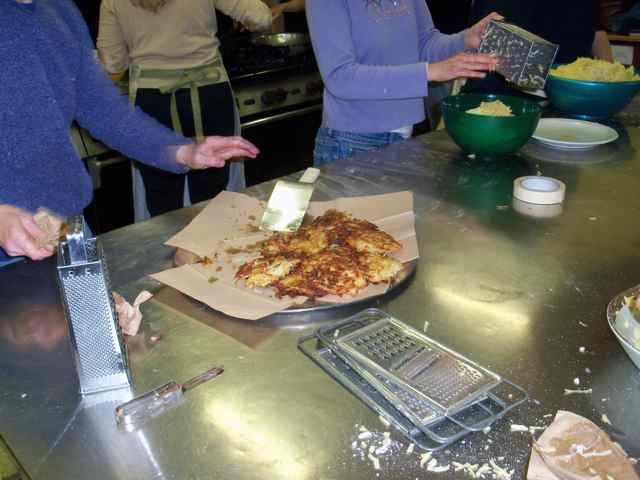
Last night’s midweek service, which was about Hanukah, was preceded by a latke feast, and I invited people to come even earlier than that to join in making the latkes. Over a dozen did, and we had a great time.

I billed the dish as the World’s Best Latkes and then had to come up with an actual recipe, since the way I really cook these would go more like, “Buy twice as many potatoes as you think your family can eat. Peel and grate. Add enough grated onion to make it look right. Add enough egg for it to stick together . . . ” etc. Not very helpful, though my great-grandmother in the Old Country would approve. Attendees and cooks asked for the recipe, so here is what we did last night. The only way to improve on it would be to make sure you always have a dozen fun people to cook with.

I forgot to tell everyone last night that there’s a reason latkes are the quintessential Hanukah dish: you are supposed to eat fried foods as a tip of the hat to that miraculous oil. That’s what we call a handy theological excuse. Now, in addition to the miracles of a small army defeating a large one and the oil’s lasting for an extra seven days, do you suppose there’s a miracle by which the calories from oil in which latkes were cooked disappear?

Or let’s just appreciate this miracle, pointed out by Rabbi Brad Hirschfield:

that people dared to light that tiny bit of oil and trust that somehow things would work out. Perhaps the enduring miracle which Hanukkah celebrates is that there is always more light than we first imagine and that the fuel to create it is really there when we look hard enough and dare to trust its power.

Amen to that, and Happy Hanukah, everyone!

The World’s Best Latkes

A radio story interviewed prospective voters in the GOP Iowa caucuses, coming up in a couple of weeks, to answer the breathless question of who would be the Mike Huckabee of 2012–Rick Santorum? Michele Bachmann? Ron Paul? The reporter did not ask why anyone would want to be the Mike Huckabee of 2012.

Huckabee, of course, did not get his party’s nomination in 2008. Nor are Bachmann or Santorum or Paul likely to get it this year, even if one of them wins in Iowa. Caucuses, even more than most primary processes, favor the extremes, and the GOP has seldom gone with its rightmost option. Yet here is the Iowa caucus, threatening to knock out what passes for a centrist in the Republican party in favor of whoever can please right-wing evangelicals the most.

So I went and looked up just how much of a bellwether Iowa has been for the GOP. It’s not impressive, but it’s not bad.  Asterisks indicate the winner of the nomination.

  • 2008 – Mike Huckabee
  • 2004 – George W. Bush*
  • 2000 – George W. Bush*
  • 1996 – Bob Dole*
  • 1992 – George H. W. Bush*
  • 1988 – Bob Dole
  • 1984 – Ronald Reagan*
  • 1980 – George H. W. Bush
  • 1976 – Gerald Ford*

Six out of the last nine Iowa winners won the nomination. But it doesn’t look even that good when you take out the candidates who ran unopposed: Reagan in 1984, George H. W. Bush in 1992, and George W. Bush in 2004.  That leaves six years of contested caucuses, with only three predicting the eventual winner.

  • 2008 – Mike Huckabee
  • 2000 – George W. Bush*
  • 1996 – Bob Dole*
  • 1988 – Bob Dole
  • 1980 – George H. W. Bush
  • 1976 – Gerald Ford*

I don’t think any Republican candidate should lose sleep over losing in Iowa. What we all might lose sleep over is why the party gives so much power to the extremists who can’t get their favorites to win on the national stage. In 2008, John McCain rose to prominence as an honorable moderate (a reputation he subsequently threw away by embracing every crazy idea, not to mention every crazy VP candidate, that came along–he’s scrapped the rest of his principles since, in his determination to oppose anything supported by the man who defeated him). This year, who of that description has survived even to the first primary?

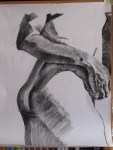
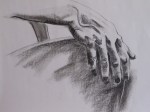
There’s been no one drawing I’m very happy with over the past few weeks, but certain bits make me say, “That’s what I’m trying to do”: in the shadow of a hand, the folds of skin under a breast, the pressure of a finger on a shoulder, the wrinkle of an elbow, the veins of a foot, the fall of a shadow.

We state the short version of the purpose of our congregation in every service: to transform ourselves, each other, and the world. I wrote this much longer version in one feverish journal-writing session about a year ago, and shared it in three consecutive newsletter columns this fall.

Read the rest of this entry »

Enter your e-mail address to receive e-mail notifications of new posts on Sermons in Stones

Links I like