Adrienne Rich has died.  I have used her work in worship (“Transcendental Etude,” excerpted in our hymnal) and preached on it ( “Power“) and quoted it in my statement of why I’m a minister and what my vocation is about (“Natural Resources”):

My heart is moved by all I cannot save:
so much has been destroyed

I have to cast my lot with those
who age after age, perversely,

with no extraordinary power
reconstitute the world.

It sometimes gets printed, incorrectly, in this way:

My heart is moved by all I cannot save,
so much has been destroyed.

I have to cast my lot with those . . . etc.

Breaking the sentence into two sentences that way, and making the first half a complete statement, implies that the rest is somehow separate: that “casting our lot” is what we do in spite of this heartbreak and this destruction. But what the poem says to me, says for me, as it was written, is that it is because so much has been destroyed that I want to be among those who dedicate their lives to tikkun olam, the repair and healing and remaking of the world. That is more powerful and empowering.

As soon as I read of her death, I thought of the poem of Rich’s whose phrases have the most staying power in my mind, “Phantasia for Elvira Shatayev.” I wanted to post it here, but it does not print out correctly on the computer and I don’t want to mangle it, so I hope you will click on the link and read it as she wrote it. (I also recommend reading it aloud.)

The main texts for my sophomore English class in college were the Norton anthology and Rich’s collection The Fact of a Doorframe (1984 edition; the later one omits “Phantasia”). If I recall correctly, it was the only volume by a single poet that was required. Piece after piece in that book was poetry by Emily Dickinson’s definition: it took off the top of my head. It never has fit back on the same way since, and marvelous things drift in and out that would not have taken shape if not for her words. Thank you, Adrienne Rich.

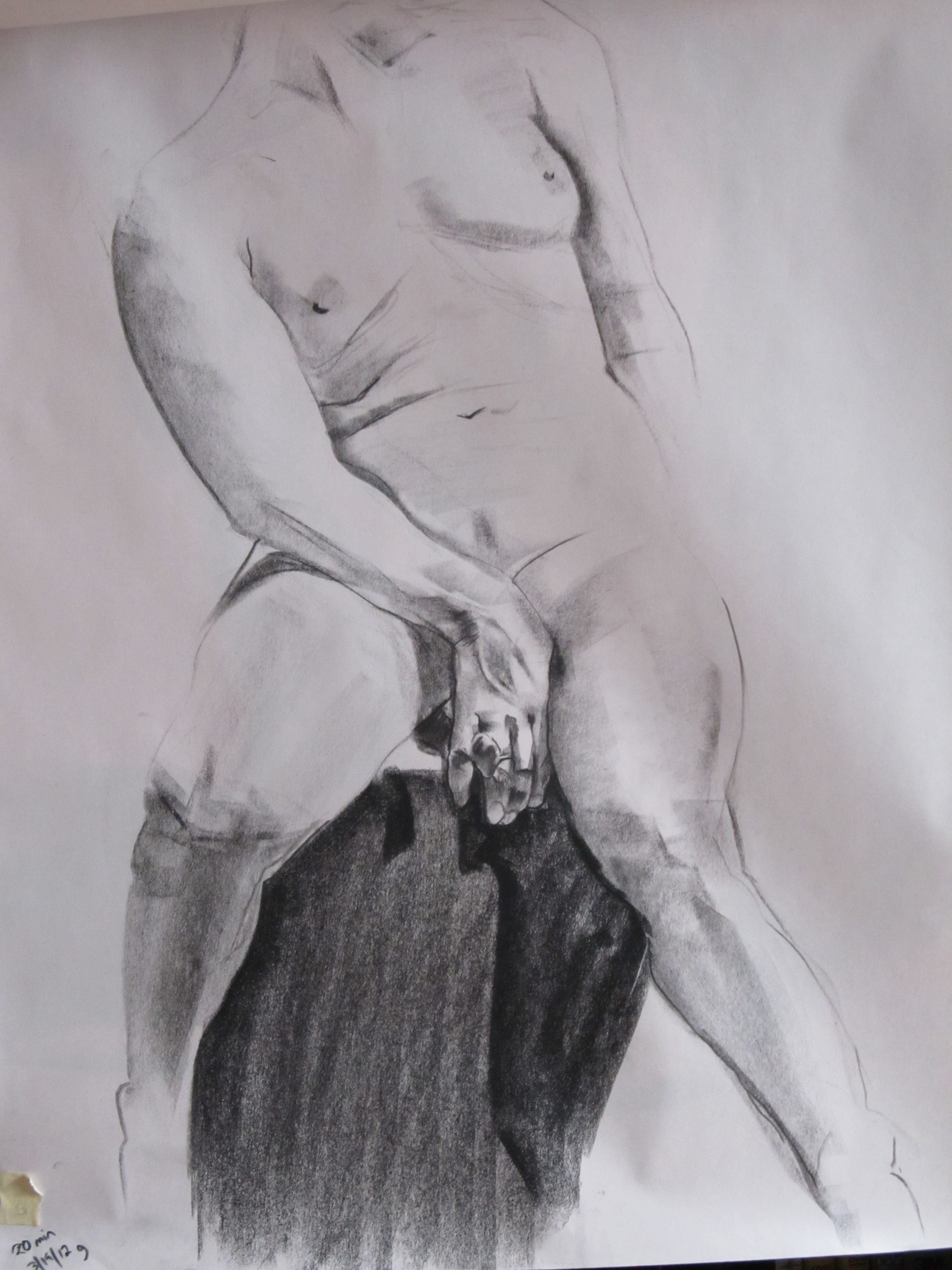
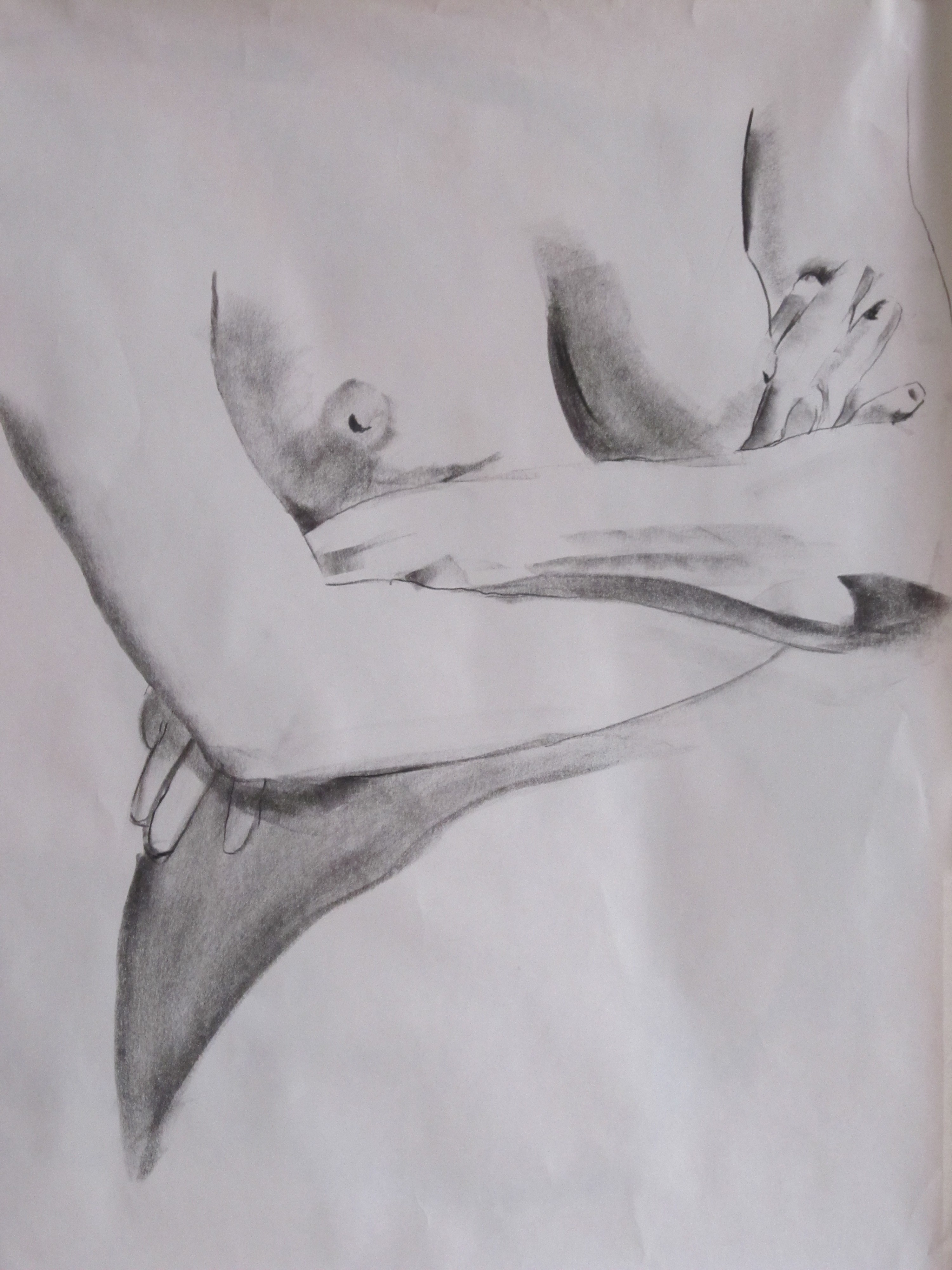
As usual, a mixed bag. Each of these has something about it that was successful. I’m encouraged by this, because I’m feeling stuck–like I keep doing the same things that aren’t working. So it’s good to remember that some things are working even so.

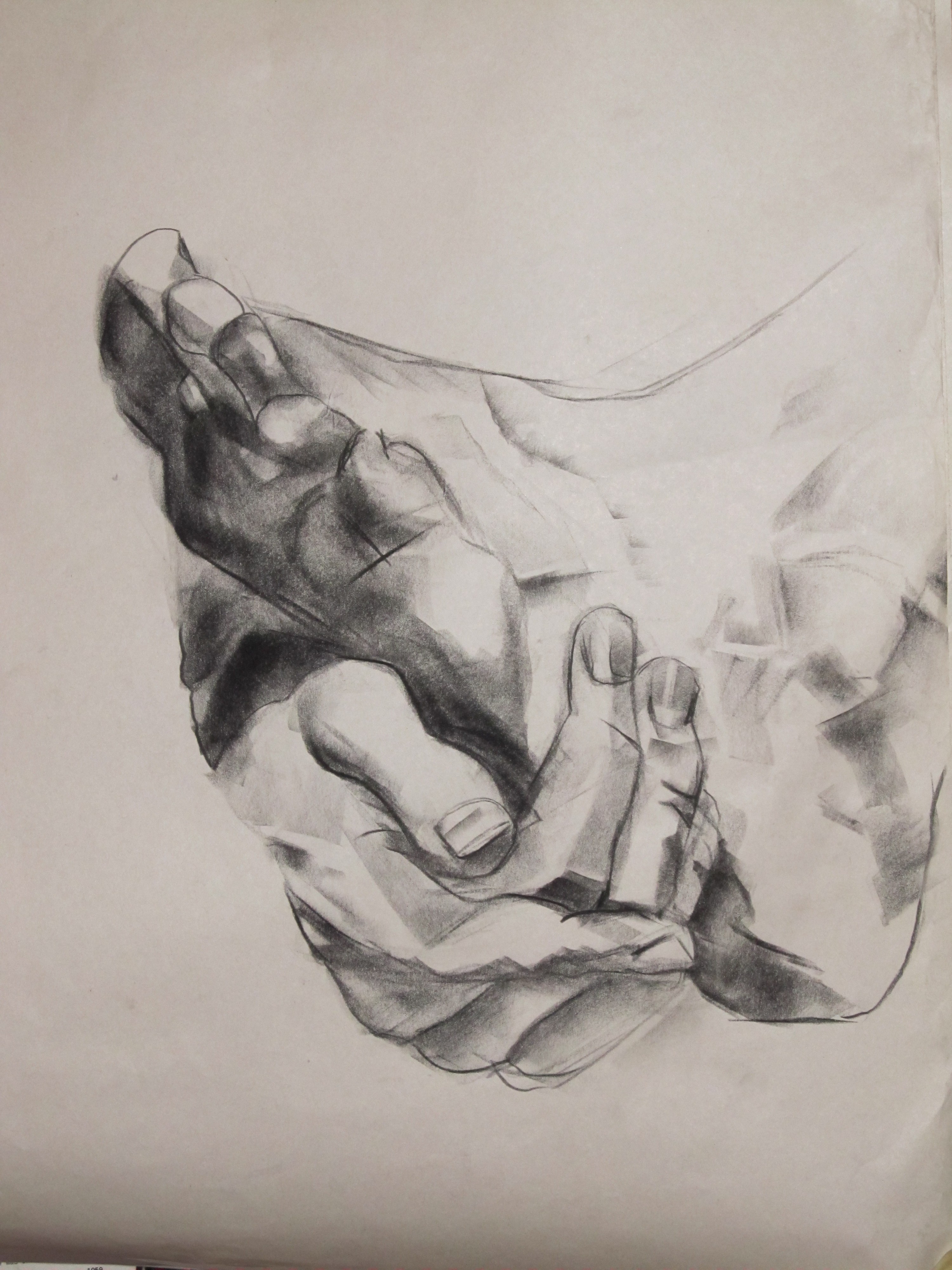
Some hands that are coming along:
 

I loved working on this hand, with its big ring and relaxed position. The finger the ring is on didn’t work right. The two on either side bend but it just looks, I don’t know, mangled. Fingers are almost like eyes: a few lines and shadows are enough to show their true shape; get one wrong by a little bit, and suddenly they are barely recognizable. And hands are almost as expressive as faces. I’ve been trying to sit up close so that even my increasingly myopic eyes can focus on the model’s hands without squinting, because they are still mostly what I want to draw. Although this one, Woman with Mangled Middle Finger, captures the overall expression of the pose too:


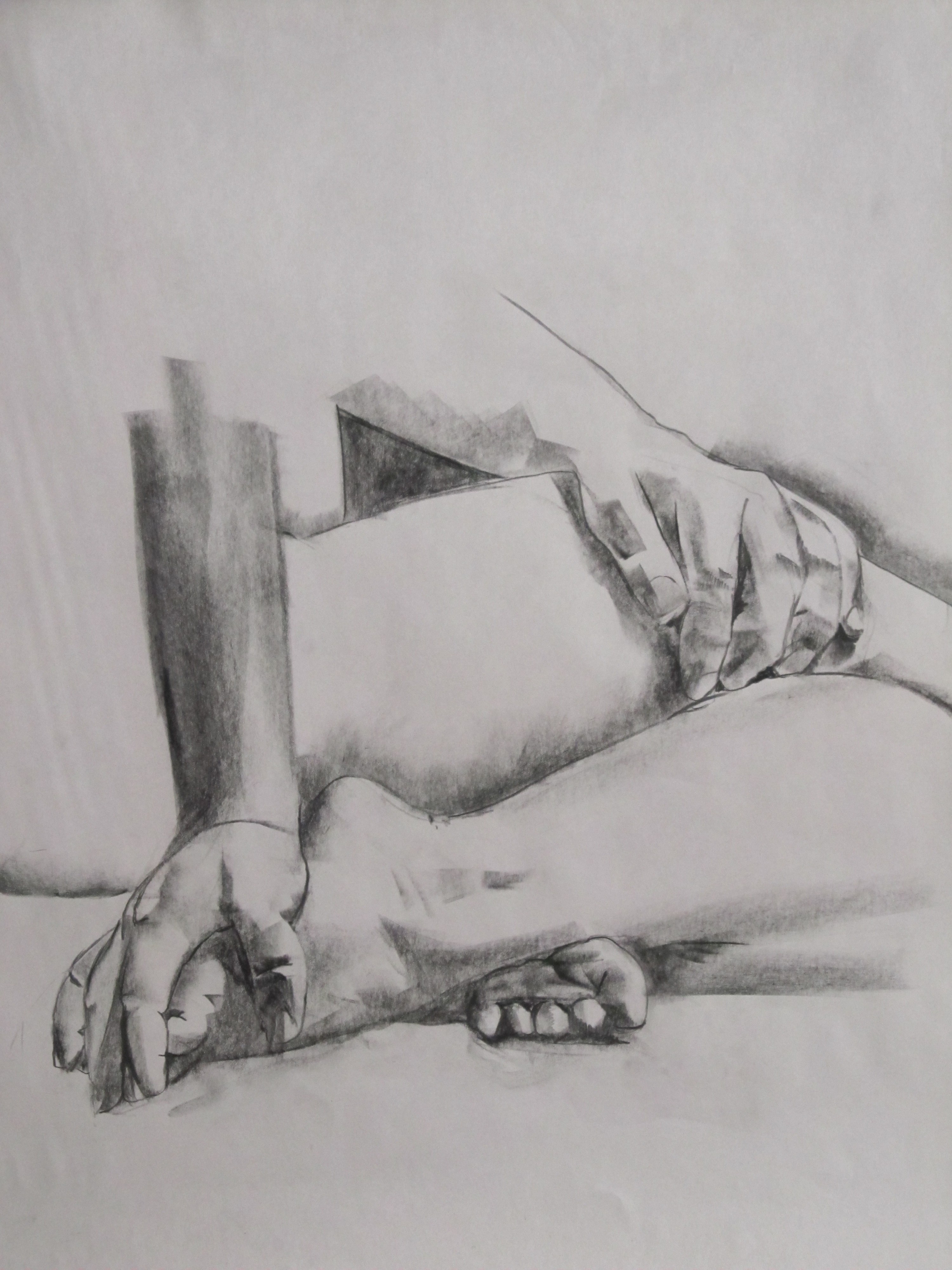
On this one, I knew as I drew the left arm that I was making it too short in order to fit everything on the page. I just couldn’t face starting on a new page at a smaller scale, or abandoning the attempt to get both hands in. Ah well, the focus of the drawing was really the two hands anyway, though I like the whole attitude of her upper body:

Nothing works here but the elbow, which I do like:

My aim in this one was to include both hands. The left one got short shrift and so came out flat. The right one, though, is a lesson to me in how few marks are needed to make the full shapes emerge. It’s quite minimal and yet it works, unlike the more elaborate shading on the forearm.

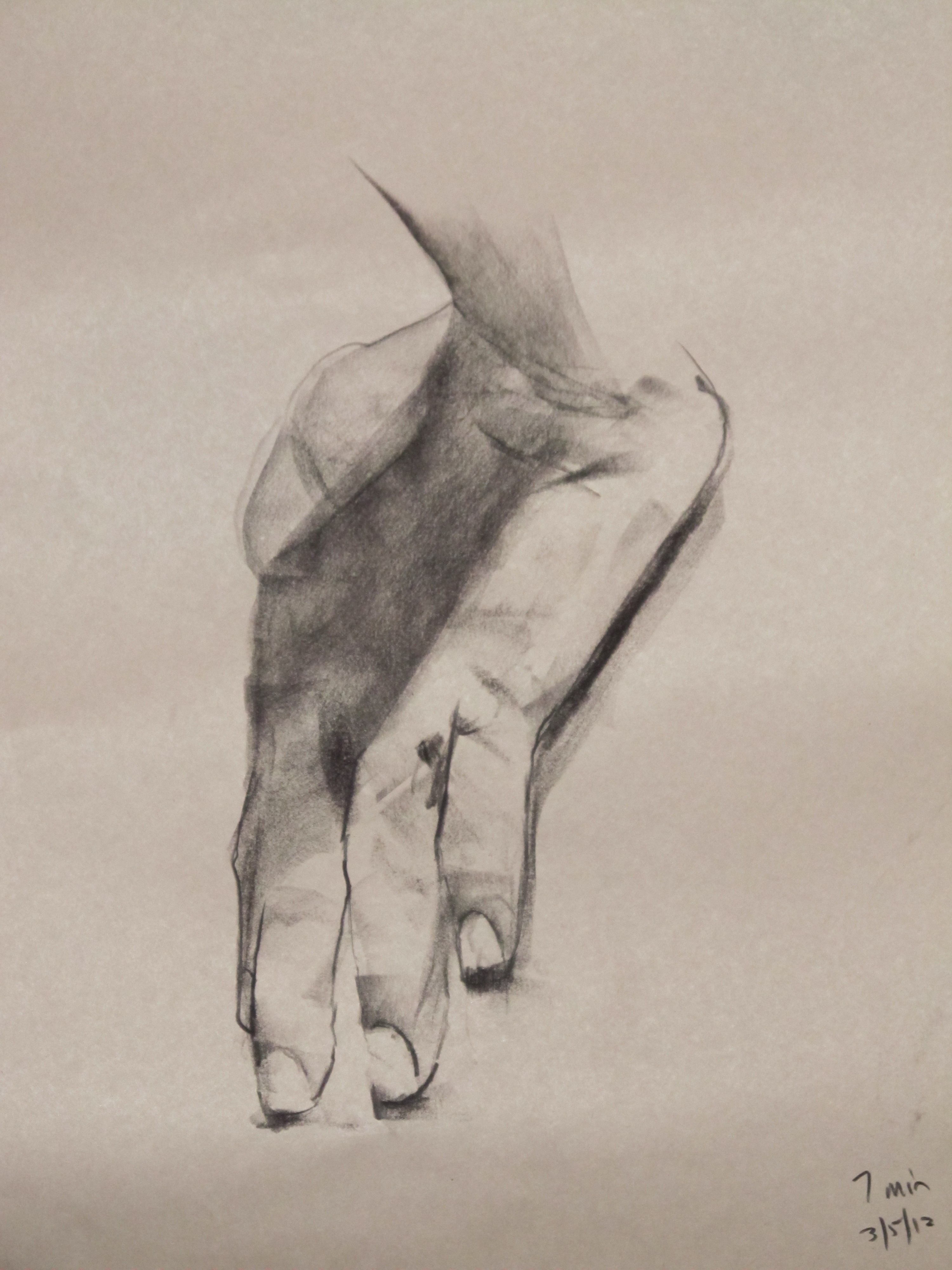
In desperation on a bad day, I really changed the kinds of marks I was making. That often helps, and in this case,  it had interesting results (if a somewhat more dramatic appearance than I really like), and loosened me up so that another good one was possible (the first drawing in this post, above). Maybe I should bring along pastels or pencils so that if nothing is going well, I can ditch the charcoal and try something really different.

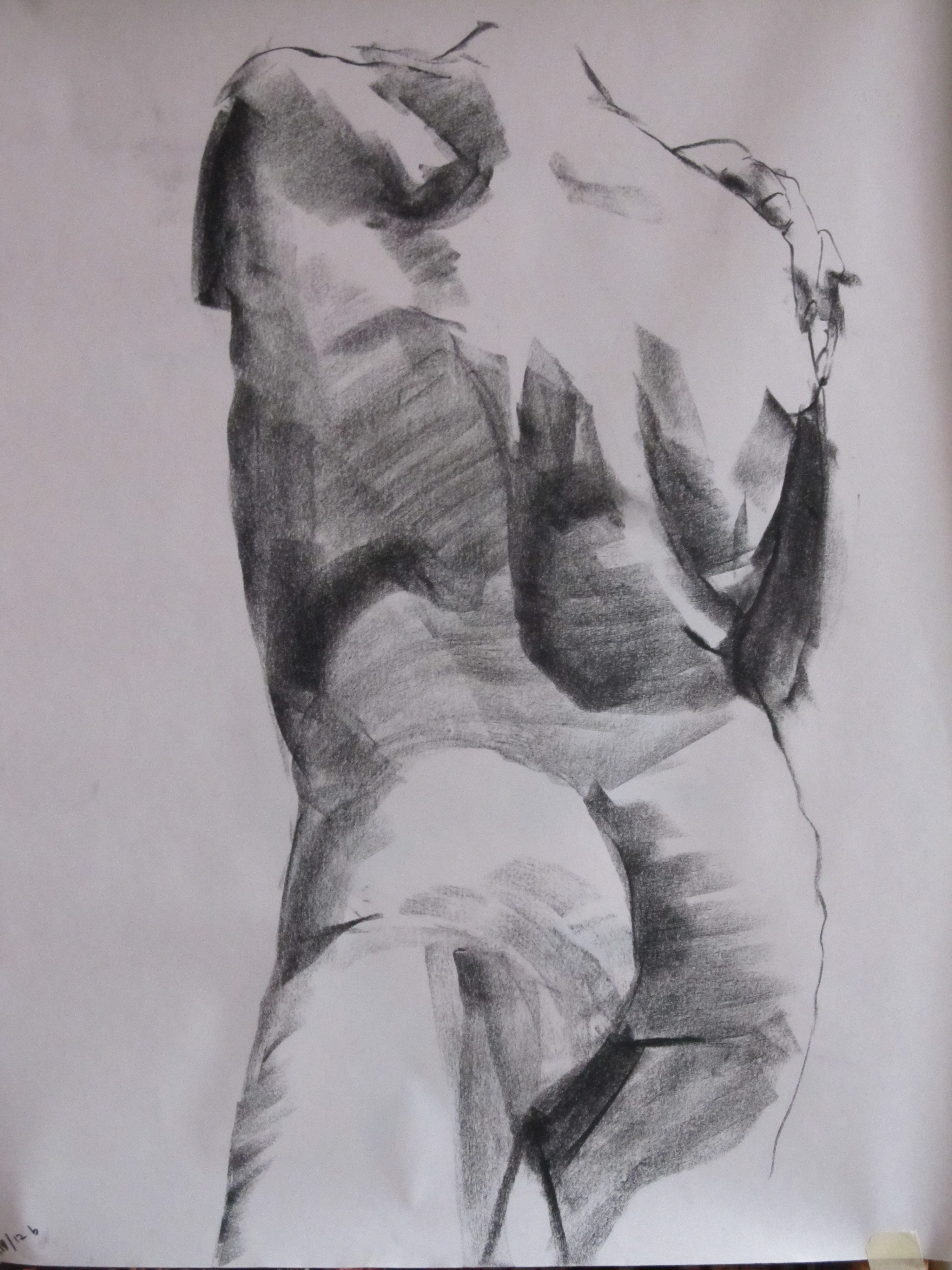
On this one I made myself work fast. It was only a seven-minute pose but I really wanted her whole torso and that nice twist of her neck, so fast was the only option. I tend to fuss too much over details, so speed is a good antidote.

On this one some of the shadows on the back are way too dark and defined, but there is a light on the right shoulder that I was going for and got:

One thing I figured out after yesterday’s session, and after reflecting on what’s been hardest for me these past three sessions, is that I am working too big. Many of these sketches fill an 18×24 paper. I went in that direction in order to get into more detail in places, but it’s gone too far and seems to be making it harder to capture subtleties of light, not easier. Next week I’m going to scale it all back down, and that might be the change that bumps me out of this rut. I should probably cut the paper in half to help myself along.

I haven’t seen nor read The Hunger Games–haven’t seen it because I haven’t read it, and it’s going to be tough to get it from the library until the movie furor dies down, so I don’t expect to do either for awhile. However, I gather it’s about a government that compels young people to fight each other to the death, even if they have no personal animus and might even respect and care for each other.

This does not sound like fiction to me. It sounds like real life. It sounds like war.

Well, that’s why I read scifi: to hold up a mirror to our world and maybe notice something there that hadn’t seemed as clear before. As Ursula LeGuin wrote (in her excellent introduction to the 1976 edition of her even more excellent novel, The Left Hand of Darkness), “Science fiction is not predictive; it is descriptive.” If the Hunger Games trilogy suggests to the teenagers for whom it’s written that their government also threatens to conscript them into a fight they don’t want engage in and can’t win, no wonder it is so popular. I hope it gives them, and the rest of us, some ideas about how to change the situation.

Until the killing of black men, black mothers’ sons
Is as important as the killing of white men, white mothers’ sons

We who believe in freedom cannot rest
We who believe in freedom cannot rest until it comes  (“Ella’s Song,” Sweet Honey in the Rock)

What does it take to get justice in this county if you’re a black man attacked by a white person? When will young black men be free to walk in safety?

Your assault can be captured on videotape as Rodney King’s was. You can be shot 41 times, as Amadou Diallo was. Your killer can document his own stalking of you on a recorded call to 911, as Trayvon Martin’s did. And it still doesn’t seem to be enough to land a conviction, or even a proper investigation, of your attackers.

What will it take?

For a start, it will take millions more of your countryfolk, especially the white ones, demanding justice. That’s why this Sunday is “Wear Your Hoodie to Church Day” at UUCPA.  Everyone is invited to wear a hooded sweatshirt, and we’ll put our group photo out there to show the world that our hearts are broken by the death of Trayvon Martin, that we are watching, that we want the same justice for his family as we would want for our own, and that we will not rest until black Americans are as free as white Americans. (If you don’t have a hoodie, show your support by being in the photo anyway!)

Last night was the last of our midweek contemplative services. They have been very special for me and other participants, but since the attendance has remained small and recruiting leaders has been difficult, it is time to call an end to this phase of the experiment. Maybe we will try them again in the not-too-distant future, in some form, if there is a groundswell asking for them.

The theme last night was “heart to heart,” and we had a ritual of blessing little pewter hearts with something we have gained from coming to these services, and/or that we hope that others will take away with them. We blessed them silently, each of us putting our hand over them, then I gave a heart to each person, and after I spoke their name, we went around the circle speaking the blessing we had each given. So I have a heart in my pocket that holds tenderness and gentleness, compassion, clarity, generosity, humility, space for reflection, and the love and support of friends who show how they feel. All blessings I am very glad to carry in my heart. One more blessing is this congregation, whom I love so much that it’s a good thing that heart is made of pewter or it just might burst.

Edna St. Vincent Millay is speaking for me right now.

I am not resigned to the shutting away of loving hearts in the hard ground.
So it is, and so it will be, for so it has been, time out of mind:
Into the darkness they go, the wise and the lovely.
Crowned with lilies and with laurel they go: but I am not resigned.

Lovers and thinkers, into the earth with you.
Be one with the dull, the indiscriminate dust.
A fragment of what you felt, of what you knew,
A formula, a phrase remains–but the best is lost.

The answers quick and keen, the honest look, the laughter, the love,–
They are gone. They are gone to feed the roses. Elegant and curled
Is the blossom. Fragrant is the blossom. I know. But I do not approve.
More precious was the light in your eyes than all the roses in the world.

Down, down, down into the darkness of the grave
Gently they go, the beautiful, the tender, the kind;
Quietly they go, the intelligent, the witty, the brave.
I know. But I do not approve. And I am not resigned.

I still have to make my final, week-late Black History Month post. Today, though, just drawings. Mostly hands; a few feet. Our church’s lobby serves as a rotating monthly gallery, and I’m seriously contemplating having a show there consisting entirely of drawings of hands, but I’d have to have 8-10 drawings I was happy with. None of these is quite it, though the top left one comes closest. The model with the fabulous hands was there again this morning. I’m going to do justice to those veins eventually.

Black History Month, day 28

I’ve tried to make many of these entries positive, so as not to suggest that African-American history has been nothing but sorrow. The genius of black poets, leaders, artists, composers, dancers, writers, and organizers is the heritage of African-Americans and other Americans–for that matter, of all of humanity.

Still, there are tragic passages of history I have wanted to include. First, they’re part of our history and think we can learn who we are by learning our country’s history, just as we learn it by knowing our family’s story and our own. Second, they also tell us about the tremendous courage, creativity, and perseverance of African-Americans. It gives me hope for the human spirit even as it makes me feel sick at how cruel and ignorant we can be. And third, they counteract the racism, and internalized racism, that says African-Americans must be near the bottom of the social structure because of some fault within themselves or their culture.

One of the phenomena I didn’t know about until a few years ago is the sundown town: a town where black people were prevented by official policy, enforcement by police or unchecked vigilantes, restrictive covenants, and the like from “allowing the sun to set on them”–in other words, they could pass through, spend money, even work (usually as laborers or domestics) there, but not live there. (There have also been towns that were “sundown” to Jews, Chinese, Native Americans, Mexicans, and others. San Jose, California, now home to more people of Vietnamese descent than anywhere outside of Vietnam, used to exclude Asians.) I touched on this a bit early in the month in my entry about the Green Book. The national expert on it is James Loewen, whose book, Sundown Towns, is a fascinating read; you can also read about sundown towns on his website, and look up towns you know.

Surprise: they will mostly be outside the South. He began his research in his home state of Illinois, and eventually confirmed 456 sundown towns there; in Mississippi he has confirmed only a handful. The phenomenon of white Americans creating white-only towns (sometimes by violently expelling the towns’ black residents) took hold around the end of Reconstruction and was most widespread from 1890-1940. It declined, but didn’t end, then; at the time of his research a few years ago, some towns were still effectively closed to certain groups, usually black people. At its peak, Loewen surmises that “probably a majority of all incorporated places kept out African-Americans” (2).

Headline from Appleton, WI, a town whose historian has done some constructive work to acknowledge its past. I guess when your most famous son is Joe McCarthy, you'd be pretty foolish to hide your head in the sand.

Levittown, the famous planned community that began in New York and was also established in three other states, is widely credited with establishing suburbia and the American middle class. It made home ownership available to blue-collar families. Which blue-collar families? White ones. Black people were not allowed to buy houses there. Repeat this pattern all over suburbia and you start to understand why African-Americans have found it so hard to gain a foothold in the middle class.

For the ambitious and history-minded, Loewen provides a guide to determining whether a given town is, or used to be, sundown. If you enjoy researching genealogy or local history, this is a great project, and Loewen will post your results.

Why bother, especially if the town’s status changed two generations ago? Because the reputation lives on, if not among the people who have always been allowed to live there, then among the excluded populations, with the result that they continue to feel excluded. Without ever being told straight out that people like me (Jews) used to be forbidden to live in Darien, CT, I knew it was a town I didn’t want to drive through, much less live in. I would feel very different about it if the town formally acknowledged its history and apologized for the injustices of the past; until it does so, the impression it gives is that it is content to continue to ride the coattails of ancestral anti-Semitism. Likewise, if a town I live in used to exclude African-Americans, I’d want it to explicitly declare that those days were over and all were welcome, so that it didn’t continue to maintain a de facto exclusion by its reputation.

Black History Month, day 27

I love this. Tip of the hat to Esther Bradley-DeTally, on whose blog I saw it, and thanks also for putting me on to Colorlines. com and arc.org (Applied Research Center: Racial Justice through Media, Research and Activism.

from Colorlines.com

Can you feel the power?

I’m printing it out as a poster for my office window.

Black History Month, day 26

A poem from Audre Lorde:

Who Said It Was Simple

There are so many roots to the tree of anger
that sometimes the branches shatter
before they bear.

Sitting in Nedicks
the women rally before they march
discussing the problematic girls
they hire to make them free.
An almost white counterman passes
a waiting brother to serve them first
and the ladies neither notice nor reject
the slighter pleasures of their slavery.
But I who am bound by my mirror
as well as my bed
see causes in color
as well as sex

and sit here wondering
which me will survive
all these liberations.

and from Rita Dove:

The Bistro Styx

She was thinner, with a mannered gauntness
as she paused just inside the double
glass doors to survey the room, silvery cape
billowing dramatically behind her.What’s this,

I thought, lifting a hand until
she nodded and started across the parquet;
that’s when I saw she was dressed all in gray,
from a kittenish cashmere skirt and cowl

down to the graphite signature of her shoes.
“Sorry I’m late,” she panted, though
she wasn’t, sliding into the chair, her cape

tossed off in a shudder of brushed steel.
We kissed. Then I leaned back to peruse
my blighted child, this wary aristocratic mole.

“How’s business?” I asked, and hazarded
a motherly smile to keep from crying out:
Are you content to conduct your life
as a cliché and, what’s worse,

an anachronism, the brooding artist’s demimonde?
Near the rue Princesse they had opened
a gallery cum souvenir shop which featured
fuzzy off-color Monets next to his acrylics, no doubt,

plus bearded African drums and the occasional miniature
gargoyle from Notre Dame the Great Artist had
carved at breakfast with a pocket knife.

“Tourists love us. The Parisians, of course”–
she blushed–” are amused, though not without
a certain admiration . . .”
.                                                      The Chateaubriand

arrived on a bone-white plate, smug and absolute
in its fragrant crust, a black plug steaming
like the heart plucked from the chest of a worthy enemy;
one touch with her fork sent pink juices streaming.

“Admiration for what?” Wine, a bloody
Pinot Noir, brought color to her cheeks. “Why,
the aplomb with which we’ve managed
to support our Art”–meaning he’d convinced

her to pose nude for his appalling canvases,
faintly futuristic landscapes strewn
with carwrecks and bodies being chewed

by rabid cocker spaniels. “I’d like to come by
the studio,” I ventured, “and see the new stuff.”
“Yes, if you wish . . .” A delicate rebuff

before the warning: “He dresses all
in black now.Me, he drapes in blues and carmine–
and even though I think it’s kinda cute,
in company I tend toward more muted shades.”

She paused and had the grace
to drop her eyes. She did look ravishing,
spookily insubstantial, a lipstick ghost on tissue,
or as if one stood on a fifth-floor terrace

peering through a fringe of rain at Paris’
dreaming chimney pots, each sooty issue
wobbling skyward in an ecstatic oracular spiral.

“And he never thinks of food. I wish
I didn’t have to plead with him to eat. . . .” Fruit
and cheese appeared, arrayed on leaf-green dishes.

I stuck with café crème. “This Camembert’s
so ripe,” she joked, “it’s practically grown hair,”
mucking a golden glob complete with parsley sprig
onto a heel of bread. Nothing seemed to fill

her up: She swallowed, sliced into a pear,
speared each tear-shaped lavaliere
and popped the dripping mess into her pretty mouth.
Nowhere the bright tufted fields, weighted

vines and sun poured down out of the south.
“But are you happy?” Fearing, I whispered it
quickly. “What? You know, Mother”–

she bit into the starry rose of a fig–
“one really should try the fruit here.”
I’ve lost her, I thought, and called for the bill.

and from Alice Walker:

I said to Poetry

I said to Poetry: “I’m finished
with you.”
Having to almost die
before some weird light
comes creeping through
is no fun.
“No thank you, Creation,
no muse need apply.
I’m out for good times–
at the very least,
some painless convention.”

Poetry laid back
and played dead
until this morning.
I wasn’t sad or anything,
only restless.

Poetry said: “You remember
the desert, and how glad you were
that you have an eye
to see it with? You remember
that, if ever so slightly?”
I said: “I didn’t hear that.
Besides, it’s five o’clock in the a.m.
I’m not getting up
in the dark
to talk to you.”

Poetry said: “But think about the time
you saw the moon
over that small canyon
that you liked so much better
than the grand one–and how suprised you were
that the moonlight was green
and you still had
one good eye
to see it with

Think of that!”

“I’ll join the church!” I said,
huffily, turning my face to the wall.
“I’ll learn how to pray again!”

“Let me ask you,” said Poetry.
“When you pray, what do you think
you’ll see?”

Poetry had me.

“There’s no paper
in this room,” I said.
“And that new pen I bought
makes a funny noise.”

“Bullshit,” said Poetry.
“Bullshit,” said I.

I really wanted to post “Seeker of Visions” by Lucille Clifton. To my ears its “walking men / wrapped in the color of death” are the world’s accepted leaders and decision makers, the ones who casually sow death with their international wheeling and dealing, and ever since reading it a few days ago, I’ve been thinking about them and what she is saying to us. However, whoever holds her copyright doesn’t like her poetry to be reproduced on the net. I recommend it.

I bet you have a poem by an African-American woman that you’d like others to see. If so, please post it, or give us the title/poet, in the comments!

Enter your e-mail address to receive e-mail notifications of new posts on Sermons in Stones

Links I like