Not long after I became a Unitarian Universalist, I was lurking on a UU chat list when a conversation began about the Trinity. Someone argued that a great deal of Trinitarian Christianity, in the United States, was largely binitarian: lots of emphasis on Jesus and God the Father, almost nothing about the Holy Spirit. This was not only the kind of interesting conversation that made me very happy to have found UUism, and “binitarianism” an accurate description of most of what I heard on Christian radio, but it made something click for me, because I thought, “Geez. The Holy Spirit is the only aspect of God I actually believe in.”
So I am troubled by The Onion’s news brief headlined God Quietly Phasing Holy Ghost Out of Trinity. It was just called to my attention today, but it’s dated 2003, and apparently the Holy Spirit has been out of the picture since Easter of that year.
Oh well. It can be in exile. I still like it, love it in fact, and it’s still the only part of the traditional Trinity that I consider divine. God the Father, if He exists, is not someone to whom I would sing praise. Annie Dillard wrote, “We have not yet encountered any god who is as merciful as a man who flicks a beetle over on its feet,” and while I think that is overly sweeping (there are kind gods out there), it does apply to the God described in the Bible, who frequently neither demonstrates compassion nor asks it of us. Jesus, in contrast, begged us to be loving, and I aspire to follow many of his teachings, but his presence in the Trinity is problematic on account of his being purely human. But the Holy Spirit? A force, invisible but palpable, that moves us to create beauty and goodness? That’s what moves me to deep reverence.
One strand of historical Unitarianism rejected the Trinity because the Biblical evidence of a Holy Spirit was thin. But if, as the old joke has it, Unitarians are those who believe in “at most one god,” then for me the Holy Spirit–elsewhere known as the Ruach HaKodesh, which translates “the Breath/Spirit of the Holy,” or the Shekhinah–is a good candidate.
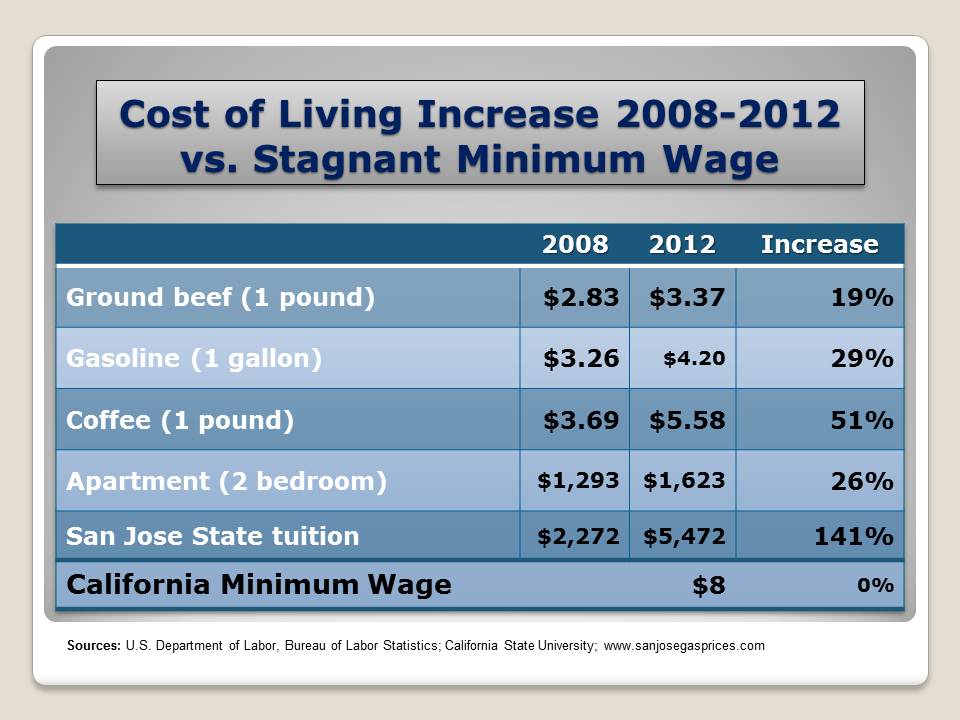
That’s the minimum wage in Santa Clara County, California, where “the self-sufficiency standard for two adults, one preschooler, and one school age child is $77,973.” So if both of those adults both hold down two minimum-age jobs, they can attain self-sufficiency. (Data from the Insight Center for Economic Community Development, via Step Up Silicon Valley.)
Minimum wage stagnates while the cost of living rises
Setting the minimum wage far below the poverty level is one of the biggest pieces of corporate welfare we Americans fund. Instead of businesses paying people a living wage, they pay wages at which a full-time worker–or even two full-time workers–can’t support a family, and the taxpayers step in to fill the gap with welfare programs. Or, more usually, the gap just stays a gap.
Some San Jose State students who were working at a community services center started wondering why so many people who had full-time jobs were still coming into the center for help with food, rent, and other necessities. Once they investigated, the reason became obvious, and they took action. They and a coalition of other organizations in the city–and its county, where my congregation is also located–started to press for an increase in the minimum wage, from the current $8 to $10.
If you’re in Santa Clara County, please send this letter to the San Jose City Council, which will be considering the $10 minimum wage at a meeting next Tuesday. Better yet, sign the letter and go to the meeting. And even better than that, sign the letter, go to the meeting, and send a donation to Raise the Wage San Jose. If you’re elsewhere, you can look up your state or city’s minimum wage–in many places, it’s no higher than the federal minimum wage of $7.25–and multiply it by 2000. What annual income are folks are expected to live on in your area? Do you think it’s feasible?
Even Michele Bachmann underestimated the jingoism of the American right this week, as she came under fire for exercising her option to have Swiss citizenship. Mark Krikorian, who directs an anti-immigration group, wrote in National Review Online: “Dual citizenship isn’t simply a matter of convenience, a way to make travel easier or a sentimental tie to the Auld Sod. It’s a formal declaration of divided allegiance, civic bigamy, if you will.” Reading that, I had one of those moments when another person’s worldview flashed in front of my eyes and I realized how differently we see things. “Allegiance” is just not a word I apply to my relationship with my country, certainly not undivided allegiance.
That allegiance (which is to say, that loyalty, devotion, and fidelity, to use the words that appear in Merriam-Webster’s definition)–that commitment–is shared with the commitment I make to all living things; to humanity as a whole; to the truth, as best as I can perceive it; and to the aims of liberty and justice for all, which is the only phrase in the Pledge of Allegiance that ever moved me. Maybe I am not using the word “country” the same way Krikorian, or the State Department, uses it. The government? The people? The land?
I guess Krikorian’s view is not new to me. A good friend of mine took the attitude that when one’s country is at war, it is irresponsible to do anything but support that war. I was bewildered, but could at least see that he was setting aside a special case. Not all that special, since the US is almost always at war, but still, there was a theoretical space for peacetime dissent there. He is no longer alive, so I can only wonder what he would have made of the idea that being a citizen of two countries at peace with each other is inherently disloyal.
Divided allegiances do mean one may have to make a choice. In fact, if you look at it as broadly as Bachmann’s compatriots on the right are doing, one faces these choices constantly. When my country disregards the well-being of living things, for example, by insisting upon its “right” to pour a dangerous amount of carbon into the atmosphere we all share, do I go with my country or the biosphere? Easy: the biosphere. If my country required me to kill someone I didn’t think had done anyone any harm, would I go with my country or my religious convictions? Easy to say, hard perhaps to carry out: my religion.
I’m not sure what Krikorian imagines a dually-faithful person does at such moments–throw bombs? Being that his country has chosen a Democrat as its leader, he, also, must find that his country does something every day that appalls his principles. What does he do at such times? He’s a columnist and heads a think tank, so I assume he does what a lot of us do: he protests and he argues. What I don’t see is how either of these things threaten the United States. It’s an axiom of my understanding of democracy that they strengthen it. Maybe that is why I tend to think of my relationship with my country not in terms of allegiance, which seems to smother disagreement, but in terms of affection, hope, and responsibility.
I popped into a dim sum place today, all by myself. It was past my lunchtime, I had done the grocery shopping that I needed to do, and I had an hour at most before I had to pick Munchkin up at a birthday party. And I was jonesing for dumplings, as I frequently do, and was in the neighborhood of a very good dim sum palace I’ve been to before. Service is fast–as soon as a cart comes by with something you want, you’re eating. It would be the perfect quick lunch.
Except that it wasn’t, because on my own I can only eat about six dumplings, and that means only two dishes. That somewhat defeats the purpose of small-plate eating, of which dim sum is the cuisine par excellence: to have lots of little dishes and taste a bit of each one. Some foods are just meant to be shared with many friends. Which, now that I think about it, is one of the charms of dim sum.
One of the search terms that was used four times today (presumably by the same person) that led them to my blog was ancient art depicting snake eating a bird. That’s not that odd a thing to put into a search box, but why my blog would pop up beat me. I gave up after 2 seconds’ pondering and tried it myself. The searcher was sent to this entry of mine, and this one, both from two years ago, about our week in Mexico City:
Thoughts on religion, art, books, politics, philosophy, and life in general …. to be eaten by the giant snakes (the counterpart to the giant snake in the … amor, toda para nada” (“House for birds, nest for love, all for nothing”). …. On Monday, we traveled 35 km out of the city to the ancient site of Teotihuacán.
It’s surprising that they clicked on it, considering that it clearly was not what they were looking for, but I guess they were intrigued. I hope they found their ancient art depicting a snake eating a bird somewhere.
Daylight Savings Time is a semi-annual source of bewilderment. If anyone ever understood the point of the thing, they are long deceased. We don’t even need it as a reminder of when to change the batteries in our smoke alarms anymore, because smoke alarms now beep at us when their batteries are dying.
Everyone hates the spring ordeal. Some people suffer genuine adjustment pangs every time. The rest of us just wonder which of our clocks have automatically set themselves and which need our attention. It is especially burdensome on people who actually have a Sunday morning scheduled activity. Someone always comes late to church, or early. A glance at the map above shows that the world can’t even agree on whether or when to observe this outmoded ritual.
What everyone agrees on is that the fall switchover is awesome. So here is my proposal: nix “Spring forward, fall back,” and just turn the clock back an hour every six months. It’s a little freebie, an extra hour of sleep* thrown in just to make life that tiny bit more sweet.
The science-minded among you will point out that by the second occurrence, daylight hours will have altered noticeably, and within a few years, sunset will be at 5 a.m. No worries. I think the minor inconveniences caused by this shift are a small price to pay for extra sleep.**
Thoughts?
————-
*There would be no restriction on the use of the extra hour. You may use yours for playing videogames, snuggling your kids, watching reruns, even washing the dishes if you really want to make this about productivity.
Joy and I had a lovely little mix-up on Valentine’s Day, like “The Gift of the Magi” except with no downside (I always did feel so bad about Jim’s watch): we each surprised the other with a pair of tickets to the April 24 Bruce Springsteen concert.
Laughs and hugs exchanged, and extra tickets sold, we eagerly looked forward to the show, and it did not let us down. Bruce started out strong and ended stronger. I swear, he looked younger and more energetic at the end of the three hours than he did at the start. I was exhausted, and I’m almost 20 years younger than he is. And, I might add, a good 30 years younger than a lot of the people in the crowd. Joy was a little concerned that someone might have a coronary. No one did, at least not in our section. They danced and sang along and looked very happy. I knew we had a great crowd to share the concert with when he sang “Badlands” early on and everyone sang along. Not just on the chorus–on the verses.
On the down side, there was such a bottleneck getting into the arena that the show had to start 45 minutes late. I don’t know how many entrances there are into the arena but it’s about 25% of the necessary ones. A more significant problem was that, as we discovered, the HP Pavilion in San Jose is a rotten place for a rock concert. The sound was so muddy I couldn’t make out half the instruments. I knew there was a violin in that mix, because I could see the violinist playing, but I couldn’t hear her until Bruce introduced the band and each got a moment’s solo. Today when I told a friend I’d been to the show, she said, “I saw him there a couple of years ago!” and within three seconds we had shared the opinion that the sound was abominable. About the best thing that can be said about the arena is that its seats are super-comfortable.
Never mind. Springsteen said the mission of the band was to make us wake up the next morning saying, “What the f— happened to me? I feel different!” and they accomplished it.
Tip of the keyboard to . . . my colleague in Palo Alto, Dan Harper, whose mention of Deep Ecology in a recent post on his blog sent me back to Leopold and prompted my Earth Day topic
. . . and to Prof. Richard R. Niebuhr, who introduced me to A Sand County Almanac in the first place.
I was saying to Joy the other day how much I love the song “Atlantic City,” and she was a little surprised and curious. So in honor of her first and ultimate religion, Brucetarianism, and in memory of Levon Helm, who covered this song and has just died, here are my thoughts on this multifaceted gemstone of a song.
Well they blew up the chicken man in Philly last night
First of all, the first line cracks me up. I only had a vague awareness of this song before I heard it on The Band’s Jericho. That version opens with the tinkling of a mandolin and a deep Arkansan accent–it is miles and miles away, in sound, in culture, in every way, from New Jersey or Philadelphia–but I said immediately, “That’s got to be a Springsteen song.” Who else would blow up the Chicken Man in the first line? Who else would know who the hell the Chicken Man is, or think someone with that nickname belongs in a work of art?
The lyrics continue:
–now they blew up his house too
Down on the boardwalk they’re gettin’ ready for a fight gonna see what them racket boys can do
Now there’s trouble busin’ in from outta state and the D.A. can’t get no relief
Gonna be a rumble out on the promenade and the gamblin’ commission’s hangin’ on by the skin of its teeth
OK, the stage is set. There’s trouble. Who’s telling us all this? Someone who’s going to head right into the middle of it as if it’s a hot date. Here’s the chorus, for the first time:
Well now everything dies baby that’s a fact
But maybe everything that dies someday comes back
Put your makeup on fix your hair up pretty
And meet me tonight in Atlantic City
So right off we know a few things: bad shit is going down. This guy, the narrator, plans to be in the middle of it. He’s trying to make light of it; he’s meeting his girl on the boardwalk. But the boardwalk’s where there’s going to be a fight (to the death, if the chicken man is going to be avenged), and he can’t avoid the truth: “Everything dies, baby, that’s a fact.”
It’s significant that the song is a love song as well as about something grimmer, a Mafia showdown. That’s a rock and roll convention, sure–they’re almost always love songs, whatever else they’re about–but it’s more than that. The interplay between the image of a girl getting ready for a date and the images of violence and death, which will crop up again, sets up the theme of life being a little bit of hope and happiness snatched out of dark despair.
To skip forward to the bridge:
Now our luck may have died and our love may be cold but with you forever I’ll stay
We’re goin’ out where the sand’s turnin’ to gold so put on your stockin’s baby ’cause the night’s getting cold
It’s getting cold out there, baby, in more ways than one.
What death is on his mind? The one that starts off the song (whoever the chicken man is), the ones bound to come in the rumble, the narrator’s own, and something else.
Well I got a job and tried to put my money away
But I got debts that no honest man can pay So I drew what I had from the Central Trust
And I bought us two tickets on that Coast City bus
He tried to live honestly, but he’s getting pulled into a life of crime. The line “I got debts that no honest man can pay” is ambiguous: it could mean “I owe so much money that I can’t earn enough to pay it back,” or it could mean he owes something else, like a favor to a mobster, and there’s no honest way to pay those back. So he’s spending his last lone dollar on getting to his new job, something to do with the mob and this unfolding disaster. The “Central Trust” is a homely little detail: the narrator’s taking his money out of a nice, safe, conventional place, just as he’s abandoning a nice, safe, conventional life. And trust is another one of those things that’s dying–we’re out of the realm of trust and into the riskier realm of gambling, where the narrator’s chances are probably as good as the gambler’s chance of beating the house.
I love what a tight songwriter Springsteen can be–he also slides in a reminder that the love story is still in progress with that “two tickets.”
The chorus again:
And everything dies baby that’s a fact
But maybe everything that dies someday comes back
The second line is so poignant. A rationalization, maybe; a desperate attempt to reassure himself that the situation isn’t as bad as it looks. Someone or something is going to die, but maybe it’s not the end.
Last verse:
Now I been lookin’ for a job but it’s hard to find
Down here it’s just winners and losers and don’t get caught on the wrong side of that line
Well I’m tired of comin’ out on the losin’ end
So honey last night I met this guy and I’m gonna do a little favor for him
Okay, he’s a loser and he’s tired of it. He wants to change his luck. He’s already acknowledged that this bright, cute relationship is actually on the rocks (“our love may be cold”) and he doesn’t have high hopes (“our luck may have died”), but he’s gambling all he’s got on one long shot. The casino logic is drawing him in, with all its empty promises of “the sand’s turnin’ to gold.” What is it he’s going to do? It can’t be anything good. “I’m gonna do a little favor for him”–well, it could just be running numbers, his first foray into crime, but I don’t think so. With that chorus about death, I think someone’s life is at risk: his own, or, that suspicious “little favor,” someone he’s being paid to kill.
If the latter, there’s another layer of meaning to the refrain. “Everything dies, baby” becomes a rationalization; hey, no one’s immortal, so why not put some money back in the bank by speeding someone along? The hope of resurrection begs forgiveness in advance; if “maybe everything that dies someday comes back,” then maybe killing someone isn’t so bad after all . . .
The other things in mortal danger are his innocence and his conscience, or his soul. It’s not “everyone” dies, after all, but “everything.” So his existence as a good guy trying to work hard and do the right thing is about to die, as he sells his soul to the mob, but maybe there’s still hope. Maybe he can “someday come back” from the end of this road he’s on.
And the song ends in future tense: we don’t know what will happen. The big drama is still to come. The rumble and the date haven’t happened yet (the last line is “Meet me tonight in Atlantic City,” repeated several times). We can’t even be sure she’s going to come along. We just know that he’s going and the outcome doesn’t look good. Is there even really going to be a date, what with the rumble and the ominous job he’s going to do? It doesn’t seem likely, and their love has gone cold anyway, but at the end he’s still thinking about love and the simple pleasure of a pretty woman made up for a night with him. He’s running on denial, but it’s getting him through the night.
Springsteen has a genius for painting a portrait in a few strokes so that we can see someone who might otherwise be invisible to us, like the guy working at the carwash or sitting unemployed in his empty house. The narrator of “Atlantic City,” the lowest man in the mob, a new recruit who might not survive his first job–what do I know about people like that? This song invites us to care about him and hope he and his soul survive.









Recent comments