Tim Bartik, who I wish lived near Palo Alto instead of in Michigan so he could be there tomorrow night, has been contributing really interesting and careful comments on The Dispossessed at the UUCPA blog, and his last one, written on February 24, was so helpful in clarifying my own thoughts that I want to post my response here as well.

Forgive the length of this response, but you’ve helped me understand a real key to this novel. I’ve been thinking about your previous comment, which made me realize for the first time the connection between The Dispossessed and Le Guin’s essay (which I cannot recommend highly enough) “The Stalin in the Soul,”  and how I would concisely sum up my scattered thoughts, and before I got back to the internet you did it:

“as long as he or she can find an audience that is willing to pay for that art”

That’s the rub, isn’t it? That’s why our freedom isn’t free. Not only because many great artists never make their art, or many people never get to see it or hear it, because they are busy working in an office or factory; but because many potentially great artists censor themselves for the market. They make what will sell instead of what their art calls them to make. That is an outcome of our economic system. It might be a price worth paying, in the last analysis, but we mustn’t treat it lightly.

Le Guin’s essay describes two novels: a great one that is written and never published in the author’s native land, because it is repressive and censors him in life and death; another great one that is never published in the author’s native land because he never writes it, being too busy writing what will sell to ever get around to his true art. The first author is Yevgeny Zamyatin, author of We, and the second is anyone in the US, including herself. As she says, we’re free “not only to write fuck and shit, and to spell America with a k,” but “to write what we please,” and yet we often don’t. She’s a little hard on her imaginary author, making him concerned with riches and fame. Most artists surrender their freedom just to eat and pay the rent, so their selling out is more understandable.

You are right that Bedap is right–Shevek doesn’t accept it in chapter 6 but he comes to–but I think you are describing the repression on Anarres slightly inaccurately. The bureaucrats can assign Tirin to the Asylum, but they can’t send him there. There are no laws, no police; he can refuse to go. But he goes, under the pressure of his community. The distinction is key, because we also pride ourselves on the fact that no one is going to throw us in jail for expressing ourselves. But do we do it?

If we don’t–and most so-called artists don’t, most of the time–then what is keeping us from doing it? A kind of unfreedom. And if we say, “Well, we’re free really, as long as we find someone to pay us,” we’re being like the Anarresti who “keep their initiative tucked away safe” (chapter 10). We’re refusing our own freedom. And then how free are we? Less free, in a sense, than Zamyatin, who wrote his book at least, even under Stalin.

I’m not saying there’s a better alternative to what we’ve got. I’m not sure whether there is, though I hope so. What I’m saying is that we tend to hide behind our democracy, assuring ourselves that we’re all free, and not acknowledging the walls that our economic system puts up. For every artist I know, I know five other people who would create art if only they didn’t have to earn a living. And don’t ask me how many “artists” I know whose great novels never get out of their heads because they are too busy producing what their publisher tells them can earn them the next advance. I’m sure it’s a lot. Most of them. And let’s not even get started on physics. You create it for the military, or for sale, or you fit it into the ever-narrower realm of “pure research” enabled by the ever-poorer universities. For that matter, I know many ministers who are not pursuing the community ministry they are called to, which would be tremendously beneficial, because they don’t know any way to get paid for their ministry except by congregations.

Last night, when I heard UKLG speak at Berkeley, her interlocutor asked her about her passion for Virgil, since she has such leftist-anarchist politics and he’s a poet of empire. She said she’d thought of lefty excuses for him, which got a laugh, and then she said seriously, “He had to be. If you don’t have copyright, you need a patron, and his patron was the emperor.” Art has to be paid for. (Copyright is just a part of it, something she’s concerned with at the moment since it’s under assault.) One thing she fantasized in The Dispossessed was a society in which artists are supported the same way as anyone else: the only justification they need present for their receiving food and housing and medical care and time is that they are doing the work they need to do, and that they join in the tenthday rotation and do some kleggich like everyone. They don’t need to find a patron; they don’t need to sell their art. They just need to create it. And then, because she is an honest thinker, she identifies what might not work about this: even Odonians start to ask, implicitly about the art, the compositions, the physics maybe, “What is it good for?” (“music isn’t useful,” Bedap points out)–which makes them no different than Dearri, the stupid businessman at Vea’s party. If it doesn’t further their narrow ideas of Odonianism, so they block it. They miss the true Odonianism, of course, which is based on the conviction that if each person follows their calling the society will thrive.

She is very subtle in how she talks about what undermines a revolution. This novel is not Animal Farm. People aren’t shot or driven out of the community by force. Tirin is not SENT to the Asylum; no one can send anyone anywhere, on Anarres. His Stalin is in his soul. But social pressure is often enough to drive someone mad and punish him for his madness. So what’s our equivalent? What imprisons us, who are so free? Isn’t the purpose of Le Guin’s novel to get us to ask that? And she suggests one answer: part of it, a big, big part of it, is money.

Again, disabling comments here so as to consolidate them at the UUCPA blog.  “The Stalin in the Soul” is a very short essay collected in Le Guin’s The Language of the Night and also in a collection called The Future Now.
Two more questions in advance of my class on The Dispossessed next week.

(1) As a teenager on Anarres, Shevek sees a film about Urras, the home planet that’s a lot like ours–multiple countries, all with governments, some of which are capitalist and some communist. The film juxtaposes a famine in the country of Thu where the bodies of starved children are being burned with the wealth and plenty only 700 km away in the nation of A-Io, noting that these exist “side by side” (pp 33-34 in the Avon paperback edition). Do you think  this is a fair criticism? Can it be applied to our world? How would you defend us, or would you make the same criticism?

(2) If you suddenly discovered that Anarres existed and you could move there, would you trade the benefits of living in a society like ours for those of that society? For example, would you give up the various things you own, and the possibility of owning more, in exchange for life in a society where you have almost no private possessions and “no one eats while another starves”?

Cross-posted at the UUCPA blog, and I’ve disabled comments here so that all comments are in one place; please make them over there.

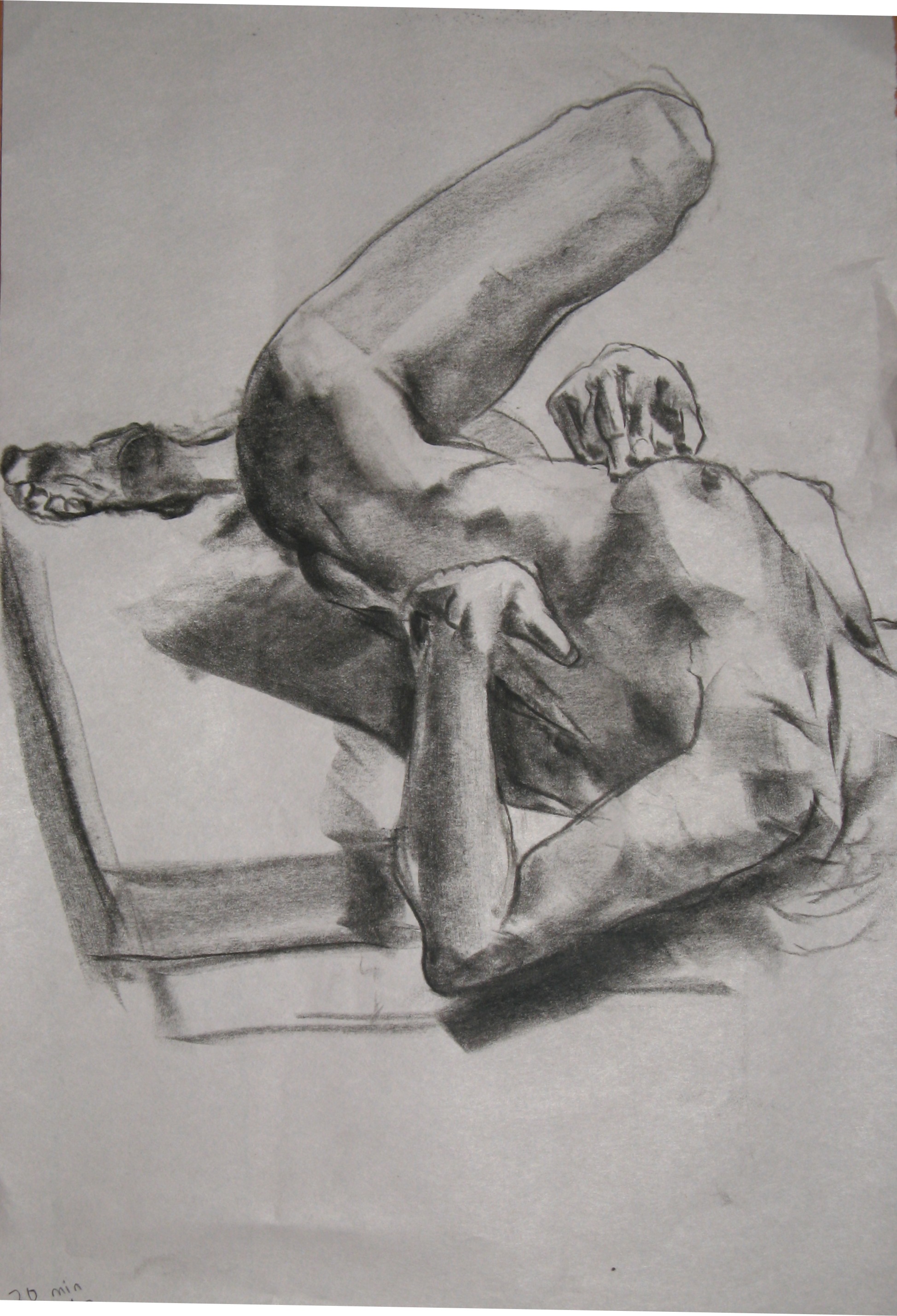
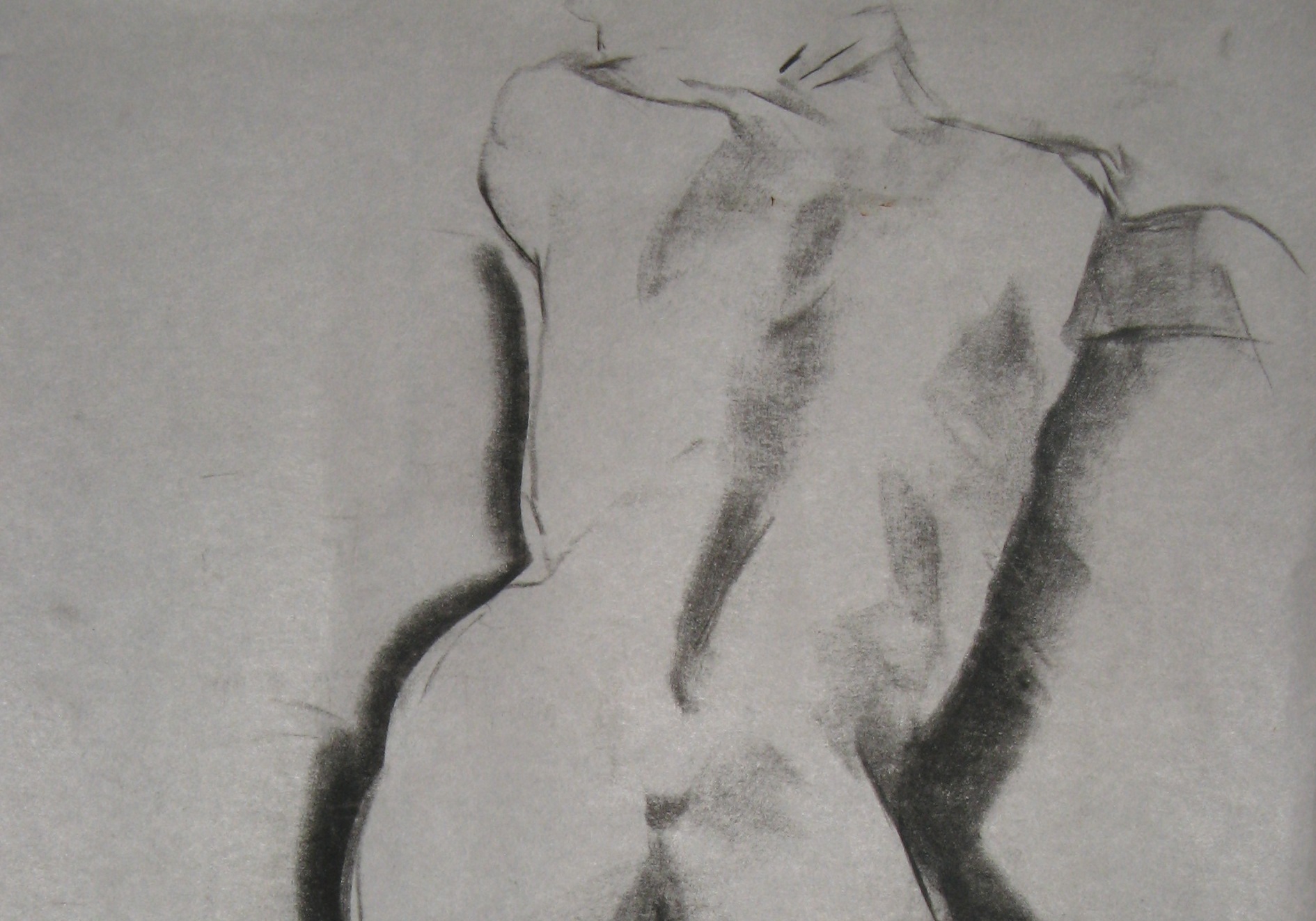
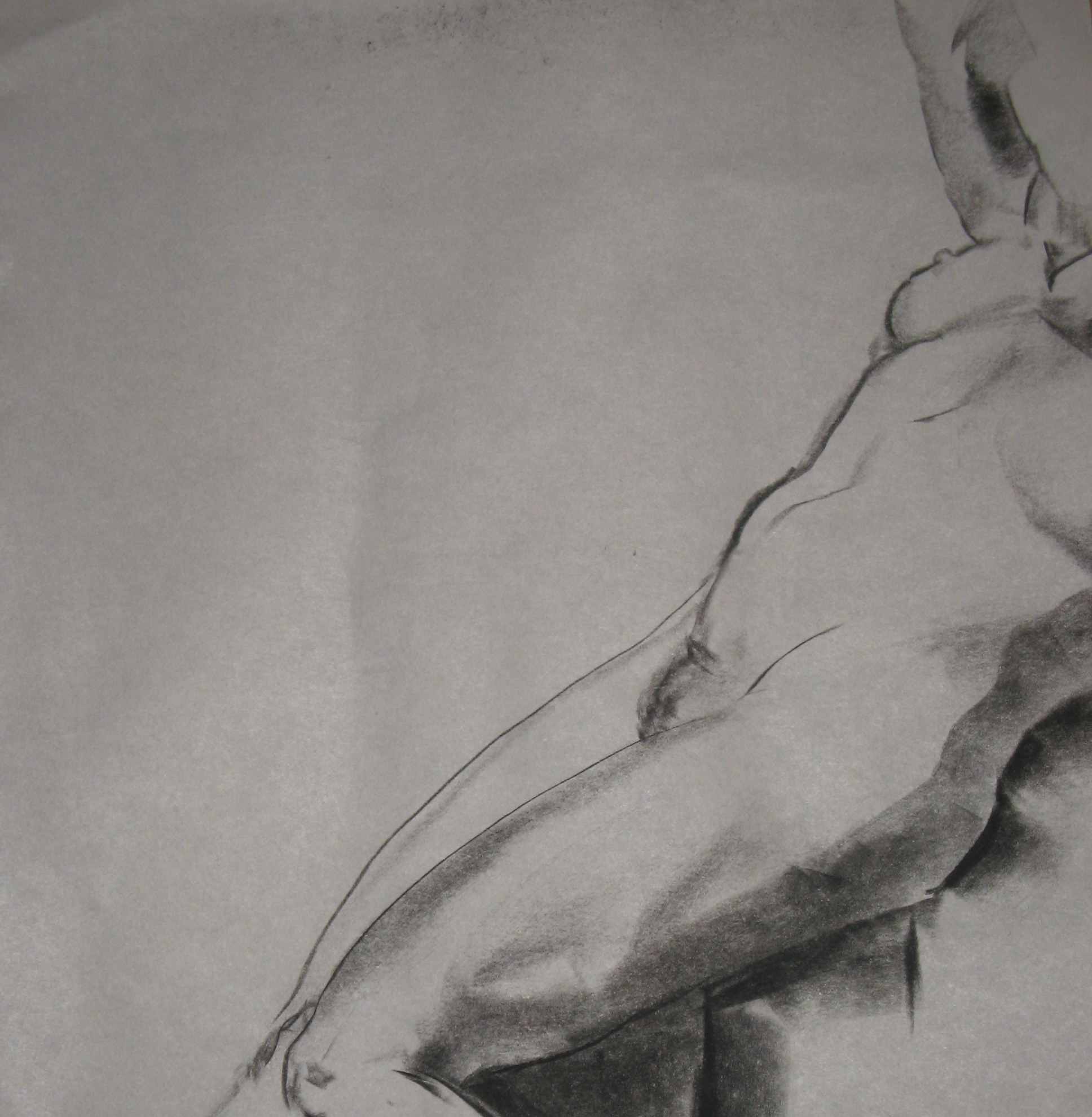
As in previous years, I decided on a spiritual practice for Lent. One recent year, I tried drawing every day, and missed almost as many days as I drew.  So this year I decided to draw, too, but not to aim for every day. Just most days, and something fast. Whatever catches my eye is my subject and I jump in for five or ten minutes; for example, on the first day I drew part of the BART station while I was waiting for a train.

Joy said, “Aren’t you supposed to give something up?” and then answered her own question: “I guess you’re giving up not-drawing.” Yes.

The past two Mondays having been school holidays, I have missed my figure drawing sessions to be with the munchkin, so these little drawings have been nice tidbits to tide me over.

I’m in the tight fist of the bad dream I had this morning just before waking. I was in the early stages of a disease that looked certain to kill me soon. Much adult talk and worry, me and doctors, me and other patients, me and Joy. Then, in that way dreams have, it went further and reminded me I have a daughter, and became about the heartbreak of leaving her when she is still a child. It’s hard to shake the image of her face as she realized what was happening, her whole body so still and serious.

I am praying fervently for everyone who is really living those circumstances and can’t wake up from the nightmare.

I’m facilitating an Adult Religious Education session on the novel The Dispossessed, by Ursula K. LeGuin, on February 28. I know some people will come who haven’t read it, but you’ll get a lot more out of the class if you have, so you might want to get a hold of the book now.

As promised, I’m posting questions about it ahead of time. This first one is more along the lines of a thought experiment and can be carried out whether you’ve read the book or not.

As you go through your day, wonder what it would be like if no one in our society had money or private property–if everything belonged to everyone. (On Anarres, one of the novel’s invented worlds, if you want a new shirt, you walk into a clothing depository and pick one up.)

For example, if you go to a restaurant tonight: If this were Anarres, what would happen when you walked into a restaurant? Who is cooking, how does the food get there? Would there be a restaurant? Etc. This is repeatable wherever you are and whatever you are doing.

How does it feel to imagine this different economy? Freeing, frightening, fragile . . . ?

By the way, Ursula LeGuin will be speaking in Berkeley on Tuesday, February 26. I’ll be there.

Cross-posted at the UUCPA blog. I am closing comments here* so that responses are gathered in one place–click on over to the UUCPA blog to add your comments.

*Except Stacy’s. That got through before I remembered to close comments. 🙂

I haven’t known many postmasters, but I used to chat often with the one in South Strafford, Vermont, where I got my mail. He was ruler of the domain of the post office in the general store–a box of an office and enough mailboxes for half a town of 1000 people–and he was the nicest guy, smart and funny and easygoing. Sometime during my eight years there, the postal service floated the idea of ending weekend delivery altogether, and I asked him what he thought about it. Bad idea, he said. Monday is already a crazy day, with two days’ mail accumulated; the postal service processes mail on Sunday, it just doesn’t deliver it, and you may have noticed that you get more mail on a Monday than any other day of the week. Having to handle three days’ mail on one day would be too much and efficiency would suffer. They should cancel a different day, he said. Wednesday would make more sense than Saturday.

But the post office has taken action, and not taken Vince’s advice. Saturday deliveries will cease starting August 1. I hope it won’t make Vince’s job too difficult.

Today* is a momentous anniversary: 200 years since the publication of Pride and Prejudice. As my friend Deb cleverly remarked, “It is a truth universally acknowledged that some literature is timeless.”

Until a few years ago, I had only read Pride and Prejudice and Emma, so I recently read all the rest of Austen, with that mix of pleasure and dread that one gets from reading a wonderful writer who produced tragically few books.

Pride and Prejudice is packed with passages that strike one as extremely quotable as one is reading, but aren’t really, because the context is essential. This is hilarious, but only if you know the characters (Jane and Elizabeth):

“Will you tell me how long you have loved him?”

“It has been coming on so gradually, that I hardly know when it began. But I believe I must date it from my first seeing his beautiful grounds at Pemberley.”

Yeah. If you’re shocked by the venality, it’s time you read the book. But here’s a quote that will do even if you’ve never read it:

“For what do we live, but to make sport for our neighbours, and laugh at them in our turn?”

I would have loved to know Jane Austen, but I would have hated to get on the wrong side of her.

*Yesterday! Darn! I would’ve mentioned it in the Sunday service!

In preparation for our class on theological unity within Unitarian Universalism scheduled for January 31 at UUCPA, Dan Harper and I are blogging about the topic online. With this post, I am less responding to Dan’s post than tossing my own thoughts into the mix, so I’ll use a new post instead of the comments.

The second question we posed to ourselves is “Do we need more theological unity in Unitarian Universalism?” and to that my answer is “No, we need less.”

What I mean by that is that our fear of diversity and difference among us keeps us from talking about our theology/ies.* And that dialogue is something we need more of. In fact, when I am afraid that Unitarian Universalism is withering and dying, it’s the lack of this dialogue that I suspect is the cause.

People sometimes address our decline in numbers with a call for increased theological unity, asserting that if we are to attract people, we need to know what we all believe and declare it. They usually seem to mean that everyone should rally behind their particular theology. While I agree that what we have to offer sometimes feels weak and half-hearted, what gives us such a tentative air isn’t the lack of a simple, unified statement. It is that we are dancing around the topic instead of digging in. We don’t have to agree about what we believe, but we do have to talk about it. And as long as we are afraid of disagreement, we won’t open our mouths.

Here I am getting into very personal territory. When I think about my own preaching and how it has changed–in my view, improved–over the past few years, I know that the weakness at the core was my fear of voicing my own theology. Too often, I was hedging. And hedging attracts no one. When I speak from my own theological center, not trying to speak for every UU but just for myself, I contribute to the conversation. The conversation, to me, is where we come alive.

By the way, our first question to ourselves was “Is theological unity necessary?” That word, “necessary,” always suggests another question, “necessary for what?” What is our purpose? When we know that, we may know the answer to whether we need unity. I have a lot of different ways of stating our purpose: “To transform ourselves, each other, and the world”; the benediction we say at the end of each service; the vision I once set out here. None of them, in my opinion, requires that we have a unified theology.

*”Unitarian Universalist Theologies” was the name of the core liberal theology course I took in seminary, taught at Andover-Newton Theological School by then-doctoral-student Paul Rasor. His book Faith Without Certainty would probably be very interesting to anyone who wanted to explore these questions beyond next week.

Cross-posted here at UUCPA’s blog. (I have turned off comments on this Sermons in Stones entry so that the conversation will take place there.)

I have so many Sunday afternoon responsibilities that I can’t join the Immigration as a Moral Issue class our Adult Religious Education program is offering starting this Sunday (it’s led by a newly-forming Task Force on Immigration). But I really want to learn more about the subject, so I’m going to read along and, I hope, chat with others who aren’t in the class, or for that matter who are, at the UUCPA blog. Just the first week’s readings were a wake-up. First entry here.

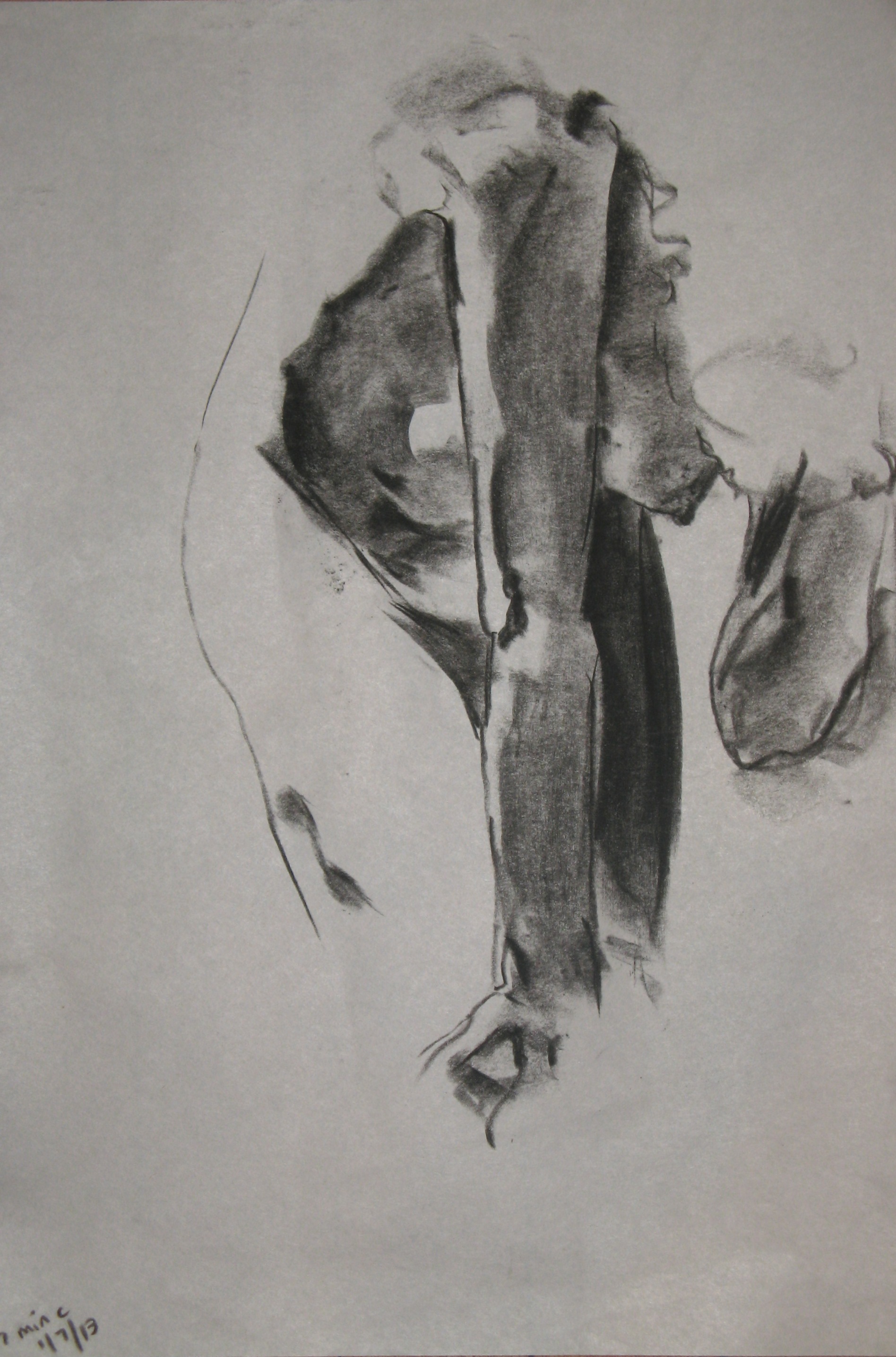
I was so happy to get back to the figure drawing studio yesterday after the month’s break. I was prepared to be stiff, but actually right from the warmup gestures I could tell I was having a good day. I resolved to keep that fast, loose approach going in the longer poses. It worked pretty well for the seven-minutes:

01 07 2013 a 7min detail

01 07 2013 b 7min detail

In fact, the third 7-minute pose yielded my favorite drawing of the morning:

01 07 2013 c 7min

The light on the torso is what I loved most, and what came through. It was less successful on her right arm.

The poses got longer and if I was done and in danger of overworking something, or just dissatisfied, midway through, I flipped over the page and started a second one. So these two five-minute bits emerged from a 10- and 20-minute pose:

01 07 2013 h 5min detail

01 07 2013 f 5min detail

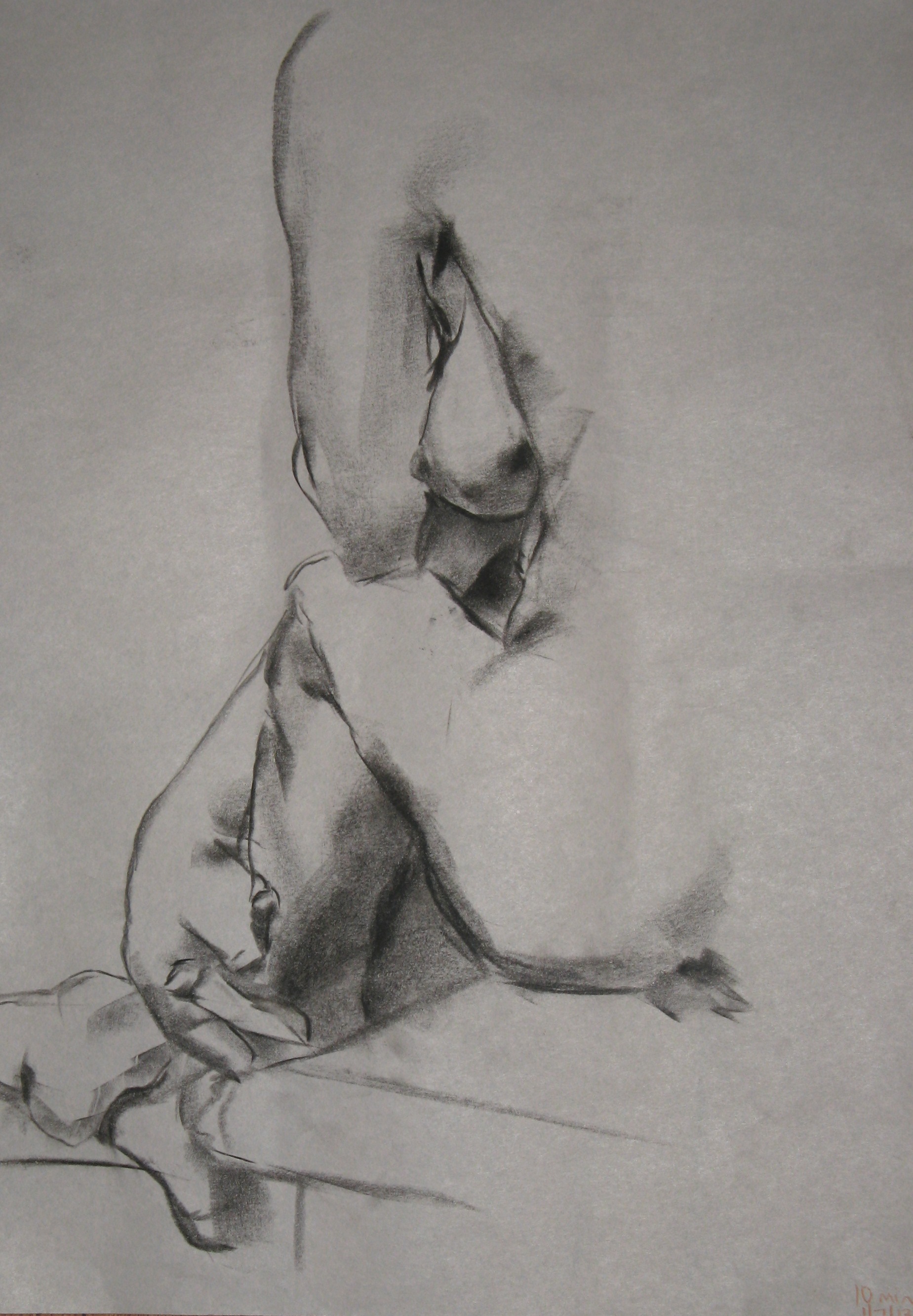
The vast expanses of back and belly, with their subtle shadings, are often beyond me. I put in too many marks or make them too dark, or else I back off entirely and the whole thing ends up flat. Yesterday I was able to evoke something of those slight changes in tone, like in the back on the first drawing, the belly in the second, and the arm here:

01 07 2013 d 10min

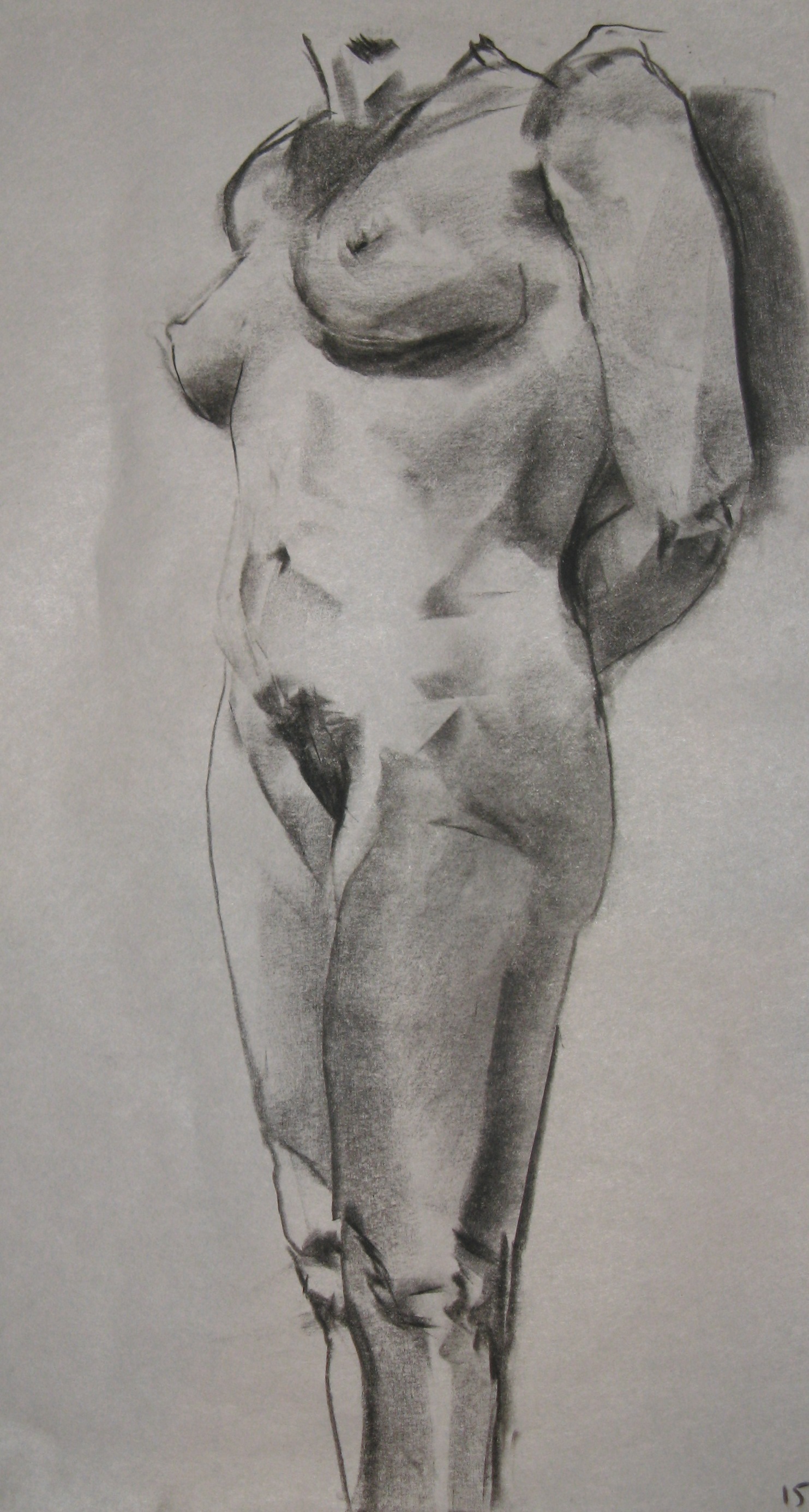
Three slightly longer poses. I was done with this next one after 15 minutes. I got the proportions wrong and made her too stocky–she’s actually very slim–but I wasn’t going to erase and fix it (almost impossible to do much of that on newsprint anyway). I was trying to keep my hand moving and focus on the light. Wherever I can see that light in the drawings, it makes me ecstatic. I never could understand the Impressionist obsession with evoking light, but I get it now. Though frankly, the Dutch masters’ success in this area left nothing to improve on, in my opinion.

01 07 2013 g 15min

In this next one the light ended up a little lurid. Not sure why. But it’s a sign of my erring on the side of boldness and high contrast, and that’s good.

01 07 2013 i 20min

01 07 2013 j 20min

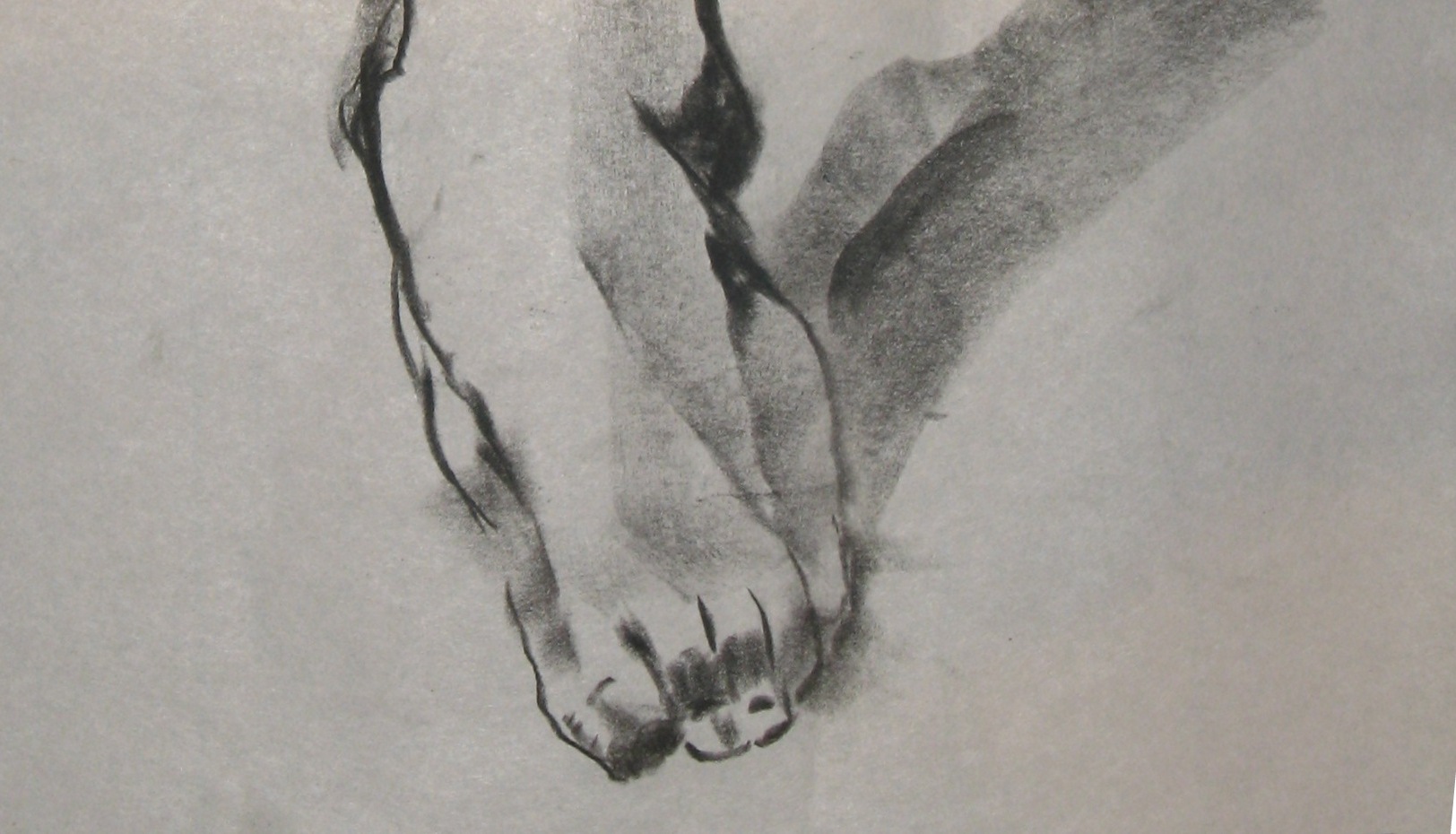
The wrinkles on the bottom of a foot are a puzzle to me. Maybe the next few times the pose makes them visible, I should focus entirely on them and see if I can figure it out. Other than that and whatever happened with the calf, and once again making her torso look wider than it is, I like this last one pretty well. The light works in several places.

Enter your e-mail address to receive e-mail notifications of new posts on Sermons in Stones

Links I like