For all of us who have been following the news of the Boston Marathon bombing and feeling the impact even at thousands of miles’ distance, here is Yehuda Amichai’s great poem “The Diameter of the Bomb”:


The diameter of the bomb was thirty centimeters
and the diameter of its effective range about seven meters,
with four dead and eleven wounded.
And around these, in a larger circle
of pain and time, two hospitals are scattered
and one graveyard. But the young woman
who was buried in the city she came from,
at a distance of more than a hundred kilometers,
enlarges the circle considerably,
and the solitary man mourning her death
at the distant shores of a country far across the sea
includes the entire world in the circle.
And I won’t even mention the crying of orphans
that reaches up to the throne of God and
beyond, making a circle with no end and no God.


I feel very much within the diameter of destruction today.

Reading some more about Emily Dickinson before giving today’s sermon on some of her poetry and its power, I came upon the description of her  “earliest friend,” Benjamin Franklin Newton. He died young, but before he did, he had a great influence on her that she referred to throughout her life. Among other things, he introduced her to Emerson, whose poetry, she wrote in wonder, “has touched the secret Spring.” Hm, I thought. Wonder if he was  a Unitarian. Sure enough, his minister was Edward Everett Hale.

I wrote yesterday about the loss of creative programming for kids under 10 during General Assembly. Other parents have inquired, and the General Assembly Planning Committee has added details to the Child Care section of their pages:

The theme for childcare this year is, It’s Good to be Green:
Alright kids! Ready, Set, GO GREEN! Taking care of each other and the planet is on everyone’s mind these days and being eco-friendly can be fun! From craft projects made with recycled materials to puzzles and games about our planet, we’ll learn about our environment in a fun, playful and creative way. Our nature theme tents and tunnels will give the feeling of playing in the great outdoors. Exploring our surroundings could lead us to a great scavenger hunt. Divided into teams and following clues, let’s see which team finds the most eco-friendly items hidden throughout the room. From using recycled materials to special projects directed at environmental learning, children will leave the program feeling positive about themselves and becoming eco-friendly.

Sounds much better than “child care from 6 months through age 9.” It’s still not clear what ages get this programming (a member of the committee said in an e-mail it was for 8- and 9-year-olds), and all day in one room doesn’t sound great for anyone over about 4, but it’s more appealing than what was on there before. Thank you! Please extend it to 6- and 7-year-olds if at all possible!

The Fahs Lecture, sadly, appears to have no chance of being restored this year, since the Planning Committee, in what was described as a respectful conversation, said there is no such thing as a guaranteed spot at General Assembly. However, there used to be, and I am one GA regular who thinks that that provided a much richer program than the more recent process of confining most program decision-making to a small group. If anyone thinks that our current method is the best way to meet the wonderfully diverse needs and interests of the thousands of GA attendees, I offer the Fahs Lecture decision as a counter-example.

Two developments at this year’s General Assembly make me wonder about our movement’s commitment to children and their teachers and families. The General Assembly Planning Committee, which has had an increasing say over exactly which programs have happened at GA in recent years, has decided not to include the Sophia Lyon Fahs lecture, which usually has an outstanding speaker and attracts hundreds of attendees, nor any program by the Liberal Religious Educators’ Association (LREDA). LREDA submitted the request as usual and were stunned to have it turned down. I have not seen any response from the General Assembly Planning Committee, whose last-published minutes are from 2011. I hope they give a good explanation before thousands of people come to GA wearing “Where’s Sophia?” buttons.

Also, programming for children has been curtailed. In previous years, there was a UU camp for kids 1st grade and up and I heard great things about it. Now it is only for kids entering 5th grade or older. I was thinking that my daughter would be able to go to UU camp next summer at GA, but apparently she will have only the same kind of programming that she had as a toddler. Not appealing.

If there are logistical or funding problems with LREDA’s programs or camp for younger children, I hope the GA Planning  Committee will say so. If LREDA’s proposed speaker wasn’t good and the committee wants them to suggest someone better, I hope they’ll say so. Taking away these programs without explanation or comment tells us that children don’t count. And in ten years, we will be wondering why those teenagers are drifting away.

Correction: I originally wrote that camp kids have to be in fourth grade. I was wrong; they have to have completed fourth grade. That’s five more years before there will be any programming for my child. She can stay home, going to a secular day camp while my wife solo-parents, but I’d hoped she would accompany me to GA now and then and have a great camp experience with other UU kids from around the country.

Ooh was I having fun today. Here are the drawings I like best.

Something I’ve been trying to do is cut down on the range of tones. I can get lost in the jungle of an infinite variety of shades, fussing so much to get each one right that I lose the big picture and the passion. So I’ve been trying to go darker and leave white in places that do have subtle gradations of light and shadow.

2013 04 08 c 7 min2013 04 08 e 10 min detail

On the other hand, when I use a broader range of grays, I can convey more about the light. With the longer poses I have time to do that. The light was so interesting in this one, but the drawing came out kind of messy and indefinite.

2013 04 08 g 20 min

I like the light in this one best, which is probably why it’s my favorite for the day.

           2013 04 08 f 20 min

Faces are so tricky. This one was looking quite a bit like the model until I made just a couple more strokes. Now it doesn’t look like her at all:

2013 04 08 h 30 min

I’ve posted my Easter sermon here on this blog, and also on UUCPA’s blog. It will soon be up at the church website.

In personal news, I did not keep to my Lenten practice of drawing at all. I drew on Monday mornings as usual, and besides that I did only a handful of drawings. I think I should just acknowledge that I’m at my limit for daily practices, between reading my Dickinson poem (today is #220, and next week’s sermon is on the journey so far) and exercising and following the various necessary family routines.

I took a deep breath, took a big step and tossed a dozen or more Mondays’ worth of drawings into the recycling. I like taking photos of them for the record, but I don’t always keep up, and the backlog had become a pile. At some point even a somewhat obsessive-compulsive person has to ask whether the time invested in such a project is worthwhile. I felt a pang as I tossed them into the big blue bin, knowing that there were some lovely bits in there along with a lot of mediocre, brave attempts, but I was resolutely Buddhist and closed the lid.

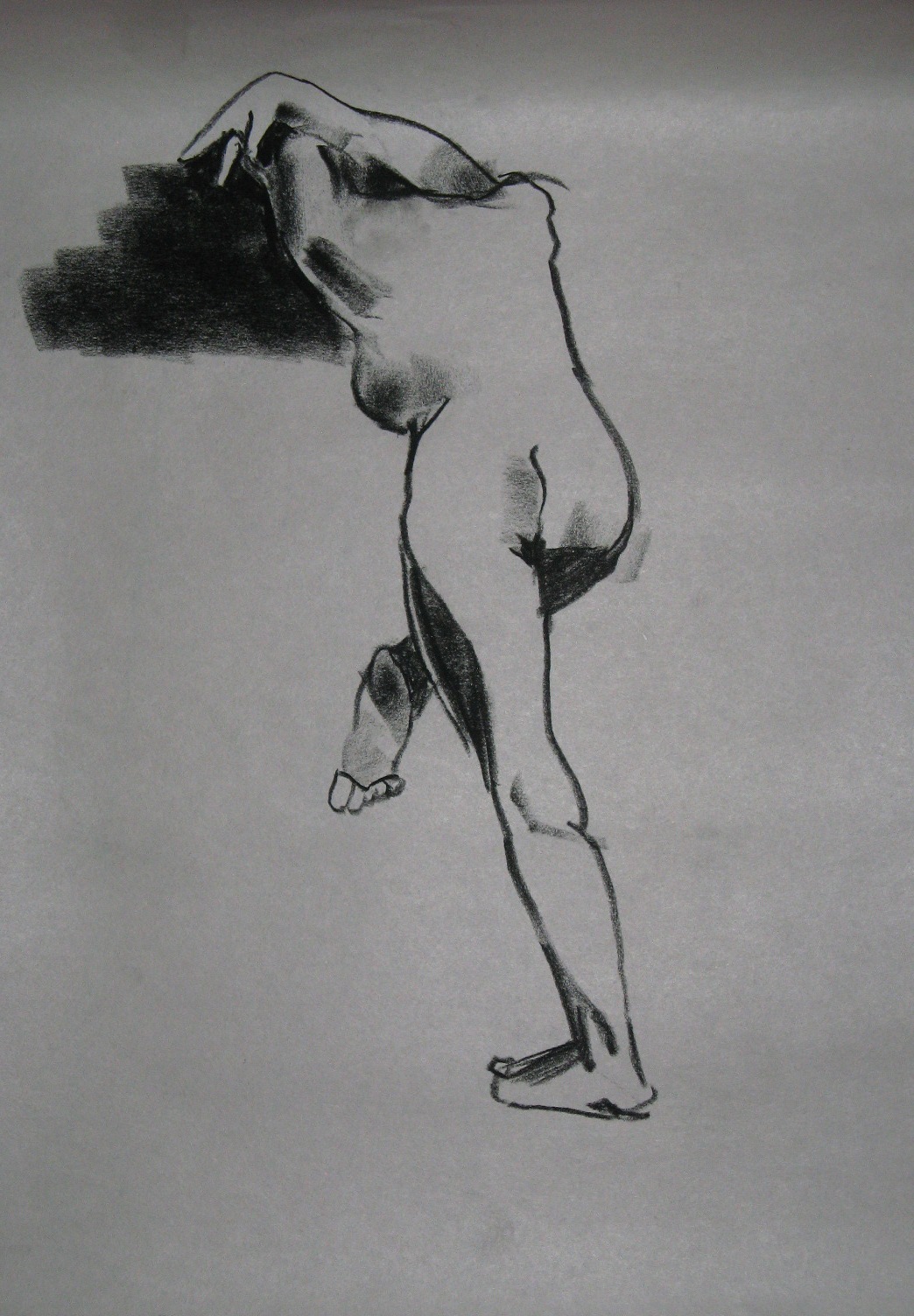
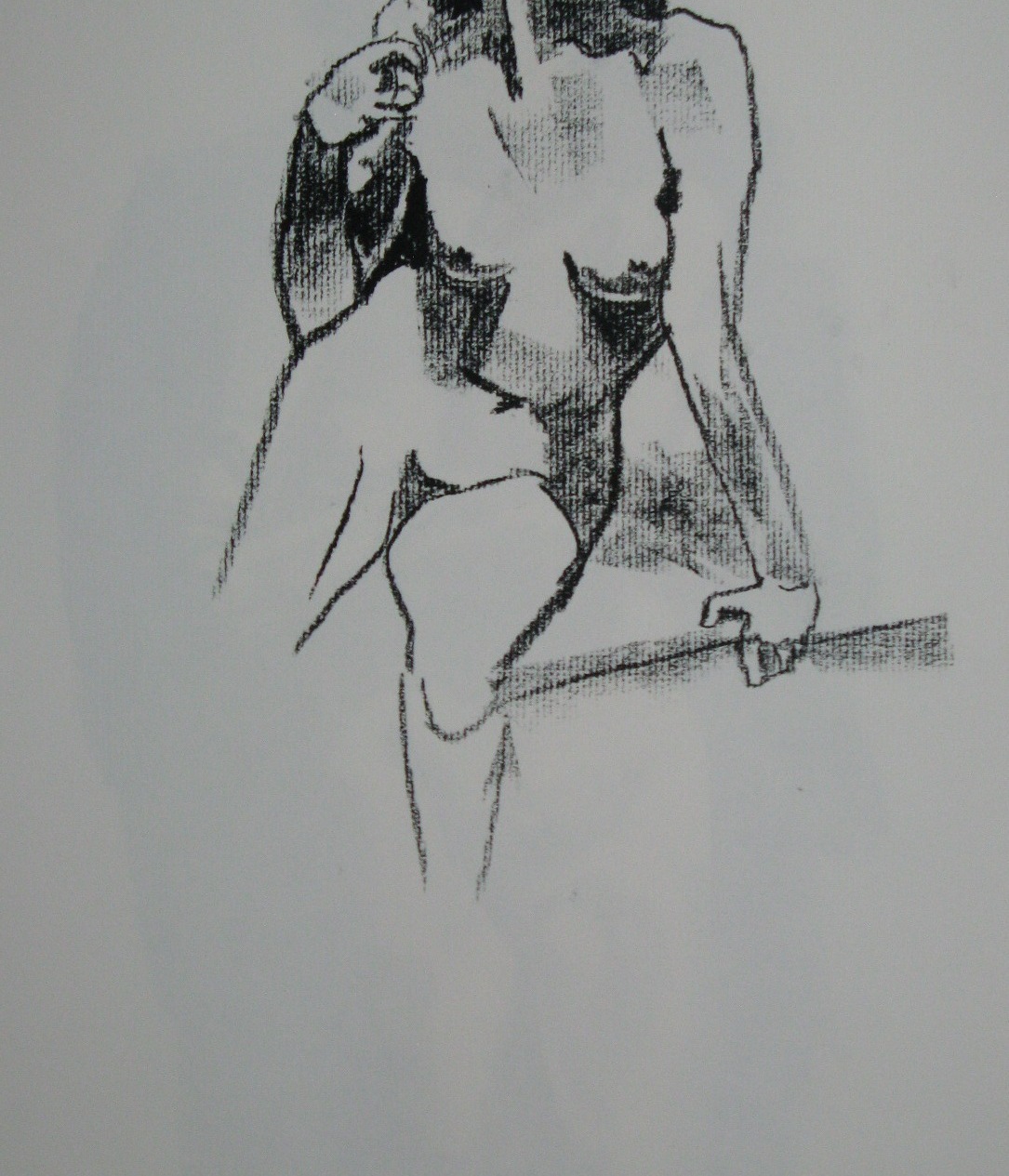
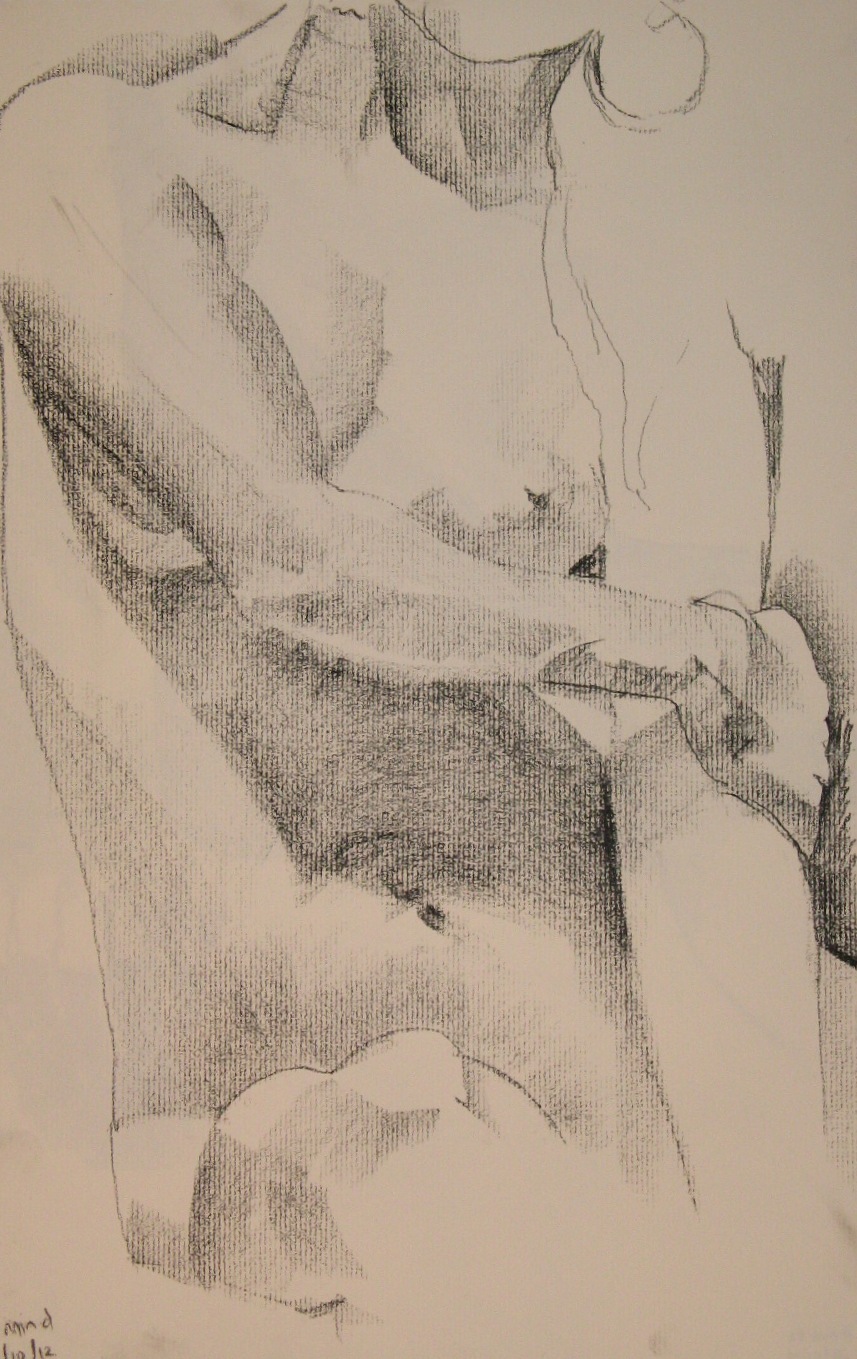
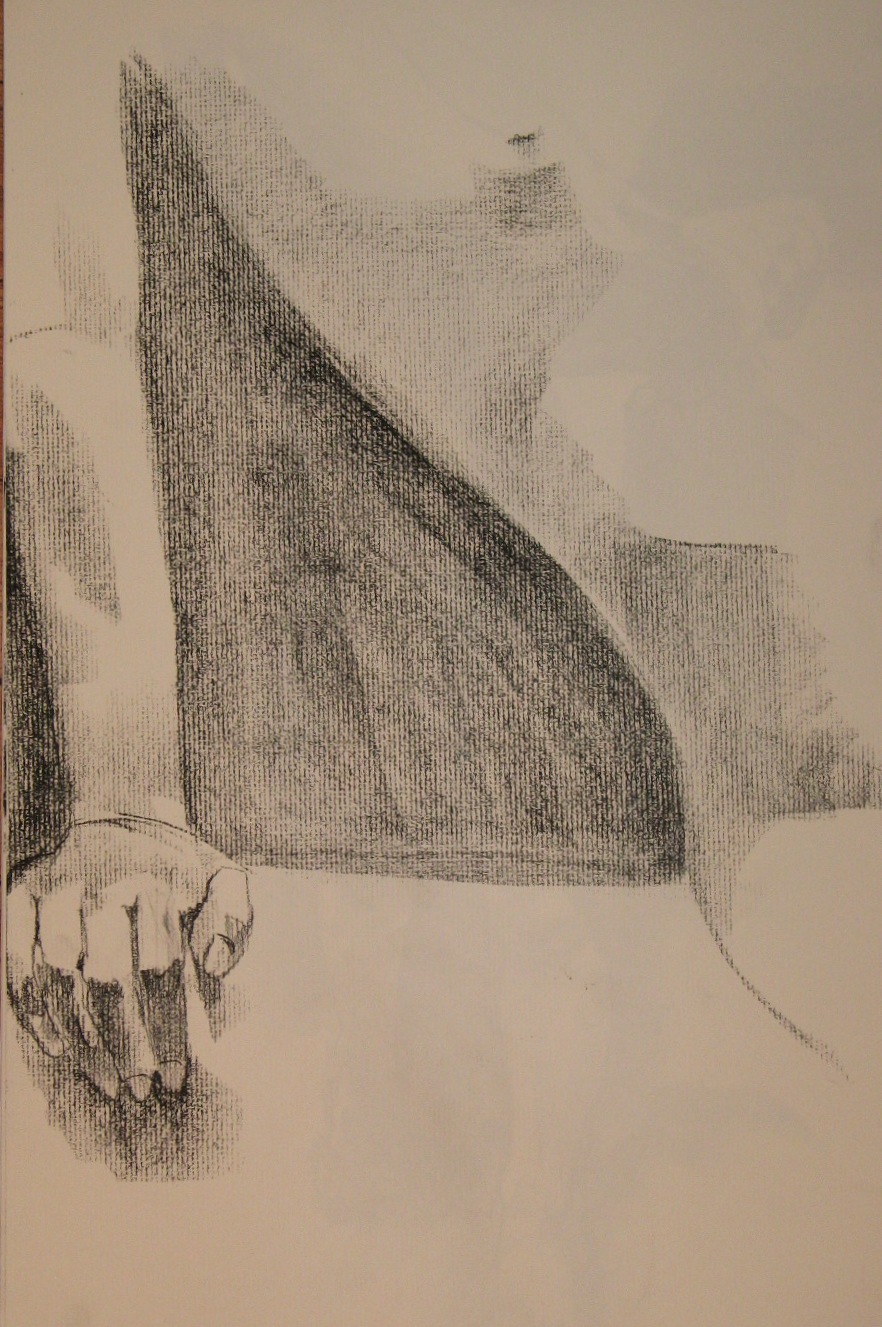
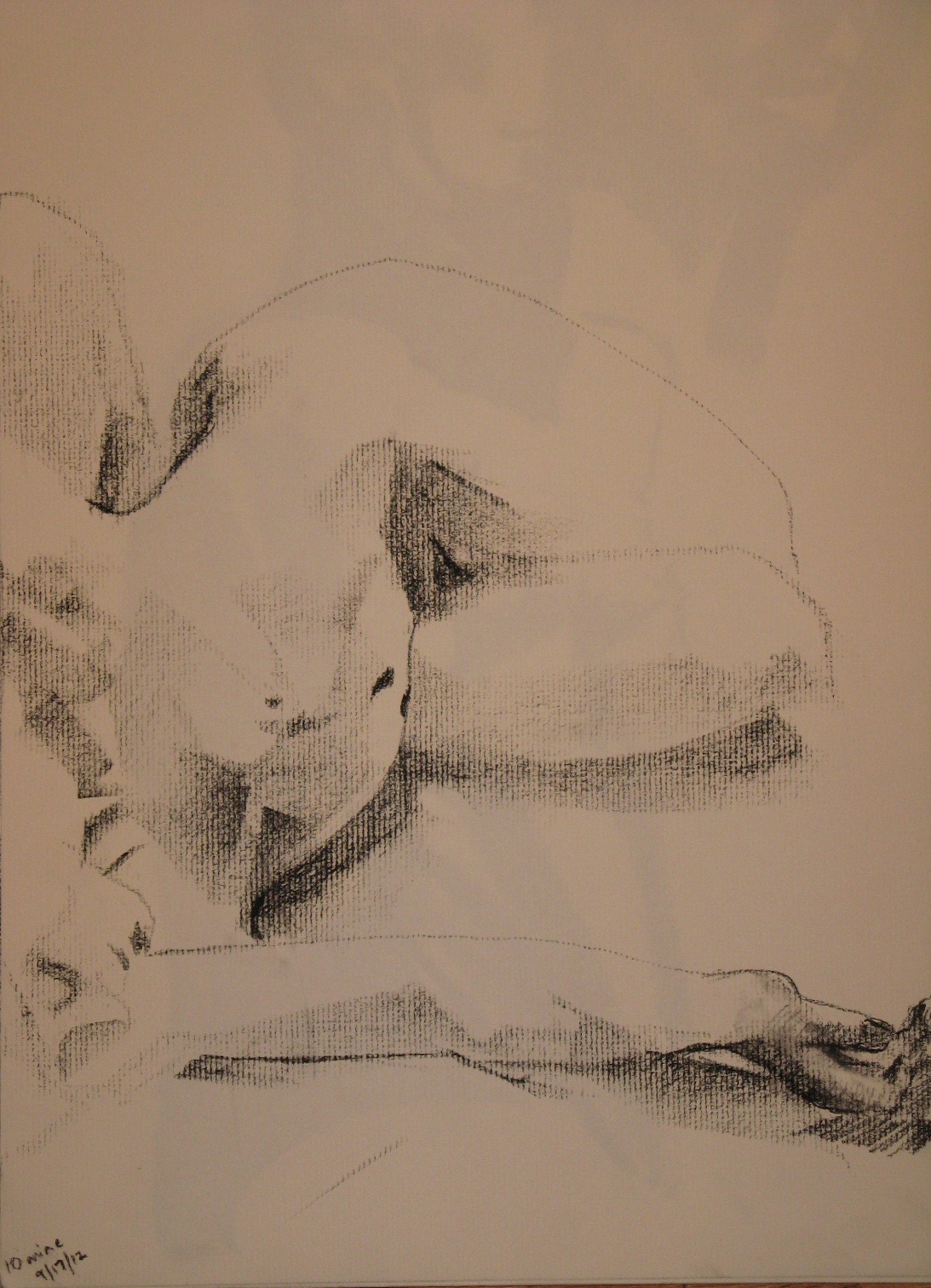
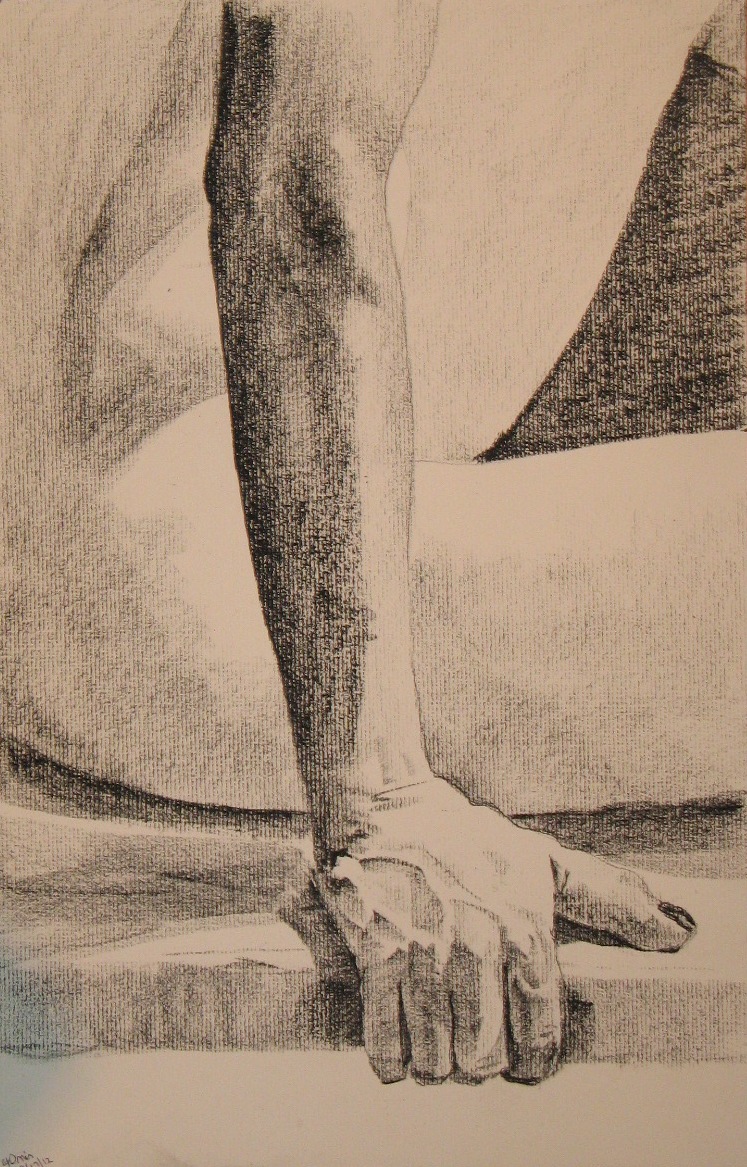
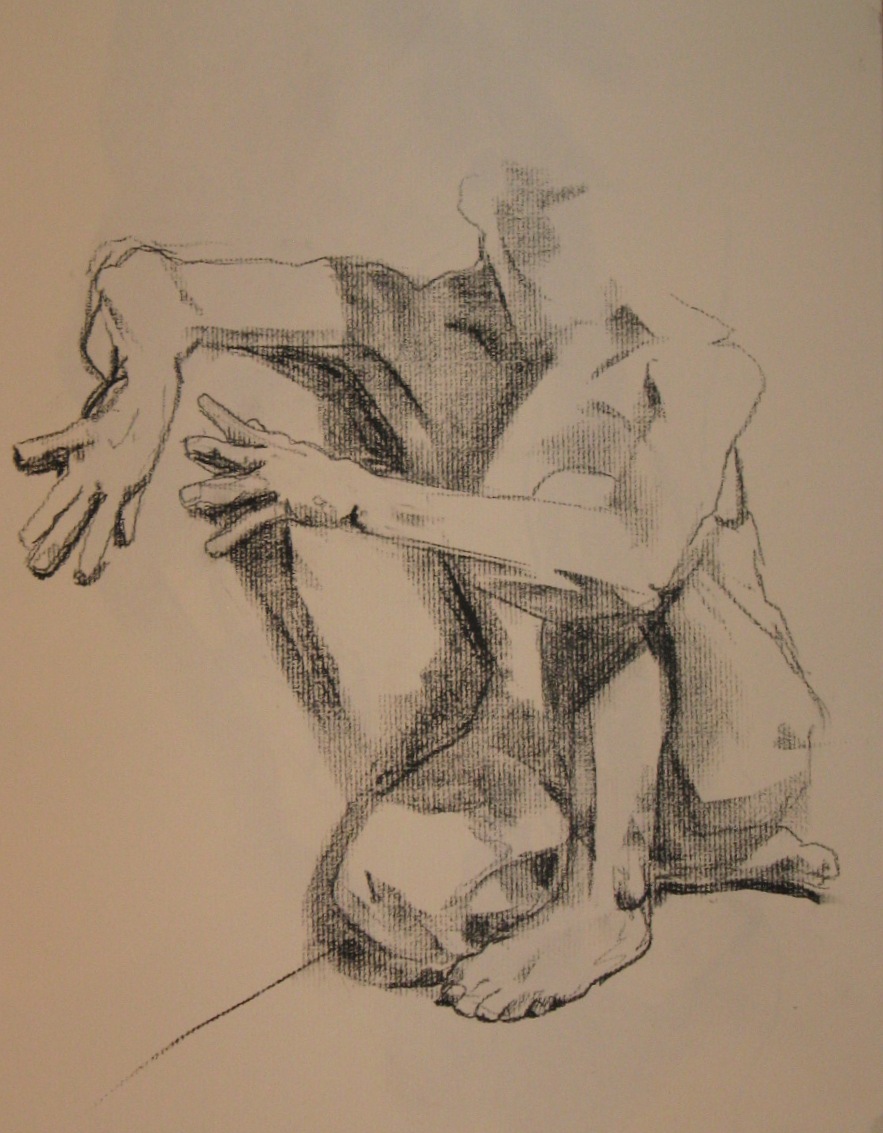
Here is a sampling from those that had been recorded before the big purge, or have been done since then. They range from September to February and the poses range from ten minutes to an hour long. All of them are on charcoal paper, instead of my more usual newsprint. I’m still getting the feel of this paper. It’s even less erasable than newsprint; a mark made on this paper is there for good.

2012 09 10 d 10 min

2012 09 10 e 10 min

09 17 12 d 10min

09 17 12 e 10min

09 17 12 h 40 min

2013 01 28 g 60 min detail

2013 02 04 f 20 min

2013 02 04 h 20 min

This morning: As a woman next to me got up and picked up her toddler, he wrapped his arms and legs around her and assured her, “I’ve got you!”

This afternoon: The bus went by a house the bottom step of whose front steps is currently suspended three or four feet above the ground. The steps have caution tape wrapped around them that says “Caution — Wet Paint.”

A congregation member and I were chatting about learning a new language as an adult. He said there’s a proverb in Japan to the effect that what you haven’t learned by forty, you’re not going to learn.

Interestingly, I had been reflecting on what I’ve been doing over the past several years, going back a ways before forty: deliberately taking on the challenge of things that scare me. I didn’t take them on for the sake of the challenge itself, but in pursuit of some other goal, but along the way I had to, in Eleanor Roosevelt’s words, do the thing I thought I could not do. They have built on each other, the knowledge of having done one giving me courage to do the next.

Ending an unhappy marriage (age 35). Necessary and excruciating, like doing an amputation on myself. Like walking through fire because going into and through the pain was the only way to get beyond it. When, three years later, my doula asked me to prepare for childbirth by thinking of a time I found the resources to do something I didn’t think I could do, this is what I thought of.

Giving birth (age 38). Longed-for but also very frightening. I’m still awed that I did it. I love this poem about that amazing power, that another church member shared to start a Committee on Ministry meeting, making me want to shout “Yes!”

first steps, Alexis O’Toole (Creative Commons license)

Speaking Spanish to native speakers (age 41). Learning Spanish in class, which I began to do at about age 40, was not particularly difficult and not at all scary. What I wondered was whether I’d have the courage to try out my novice Spanish when we then lived in Mexico for six months. I knew I’d learn more Spanish, and enjoy myself more, if I dared to speak to people—dared, in short, publicly to do something I wasn’t very good at. To my surprise, I dove right in with few qualms. Was I getting braver? It appeared so.

Drawing (age 41). A fear of drawing had paralyzed me for 25 years. Whatever freedom I apparently felt as a young child, when I said I was going to be an artist, had been shriveled by fear by the time of my first semester of college, when I took a drawing class and procrastinated on every assignment. I was terrified. When I planned my “sabbatical of art” for 2010, I intended mostly to make abstract collages, but I assigned myself one drawing class with the aim of putting some of this fear behind me. Not only did the fear fall away, but I fell in love with drawing. For the first time in my memory, I loved to draw. It is still a little intimidating to face the subject and the blank paper, to feel my inadequacy to convey what I see with a piece of charcoal, but I have been drawing every week ever since, and I always look forward to it.

Writing and preaching (age approximately 40, and ongoing). As drawing became a source of joy instead of dread, I asked myself whether I could shift writing in the same way. I had already been getting bolder in my writing and preaching, and then the revelations of my sabbatical accelerated the process. That’s the subject for a longer post focused just on preaching. For now I’ll just say: I could already write, but my sermon writing has taken on a whole new dimension in recent years for reasons that can be summarized as more guts.

And now, at age 44, I am doing something else: Learning to be a supervisor. I became head of staff—UUCPA’s first in I don’t know how long—when I got back from sabbatical in fall 2010, but I and the church still have a lot to learn. That’s scary to admit, even though I preached about the merits of “beginner’s mind” in my very first sermon as UUCPA’s minister. I really like the model that Susan Beaumont is teaching in the seminar I’m in right now, and it both fits UUCPA well, and draws on and develops gifts that I have. I’m looking forward to bringing it back and, over the next few years, adding performance management to the list of things I once didn’t know how to do, and was afraid I couldn’t do, until I began doing them and loving them.

Sometimes we do learn new things at forty.
I’ve been putting my thoughts about linked ideas, images, and events in The Dispossessed into what the software, MindMeister, calls a “Mind Map,” here.

Whole sections haven’t been transcribed from my mind to the map, such as the multiple valences of possession, but it’s fun and helpful to get it into this form. What would you add?

Looking forward to class tonight, 7:30 in the UUCPA Fireside Room. Directions here, campus map here.

Cross-posted to the UUCPA blog, which is where comments may be made.

Enter your e-mail address to receive e-mail notifications of new posts on Sermons in Stones

Links I like