Alan Turing at age 16

I’ve been interested in Alan Turing ever since I first encountered his work in Gödel, Escher, Bach, a book I read obsessively in my teenage years, so the moment I heard there would be a movie about him I started lobbying Joy to see it with me (we don’t go to the movies very often). It didn’t hurt that Turing would be played by Benedict Cumberbatch, who is starting to impress me as one of the best actors of my lifetime, and sure enough, we saw The Imitation Game last week and his performance is humane, subtle, and heartbreaking. It does him a disservice to suggest that the role of Turing is an easy jump from his Sherlock Holmes. Sure, they’re both geniuses drawn to socially-useful work yet painfully lacking in social skills (the writers hint that a modern-day diagnosis would place them both on the autistic spectrum), but Cumberbatch, who must have been aware of the trap as he prepared for this role, never mixes them up. His Turing is his own person.

At the time Douglas Hofstadter wrote Gödel. . ., the story of the breaking of the Enigma code was still classified. We now know that Turing was not just a brilliant mathematician, originator of computer science, and pioneer of the concept of artificial intelligence, but also a behind-the-scenes hero of World War II, and it was no doubt the fact that the Bletchley Park codebreakers knocked probable years off the war and saved millions of lives that got Turing pardoned, over the heads of the House of Lords, by Queen Elizabeth. Of course “pardon” is a legal term; what he really deserved was an apology, as he had done nothing wrong: he was just a gay man at a time when his government regarded acts of love between people of the same sex as “gross indecency.” What the rest of the world lost by Turing’s being forced to choose among prison, a mind stunted by chemical castration, or the option he took, suicide, we can only imagine. Or, given the astounding originality of his thought, it would be more accurate to say that we simply can’t imagine it.

That loss, the misery he suffered, and the knowledge that it’s no easier to be gay today in most countries than it was for Turing in 1952, left me feeling shaky as the theater lights went up. So did the information that over 49,000 people (all men, from what I’ve read) were prosecuted in the UK before the “gross indecency” statute was terminated. Turing’s pardon was won because of a petition launched on the internet and his accomplishments, but he’s just one of the victims of this stupid law, and the argument made against the pardon that “these acts were illegal at the time” just adds insult to the injury against them all. Of course they were illegal–but some laws are nothing more than the enshrinement of injustice, and the least we can do, after repealing them, is to apologize to everyone they’ve harmed.

So I was very pleased to learn that Cumberbatch has thrown all of his Oscar-nominee influence into getting an official pardon for everyone convicted under those laws; Stephen Fry has enthusiastically joined him. You can add your name to these more famous ones, as I did, at the petition site.


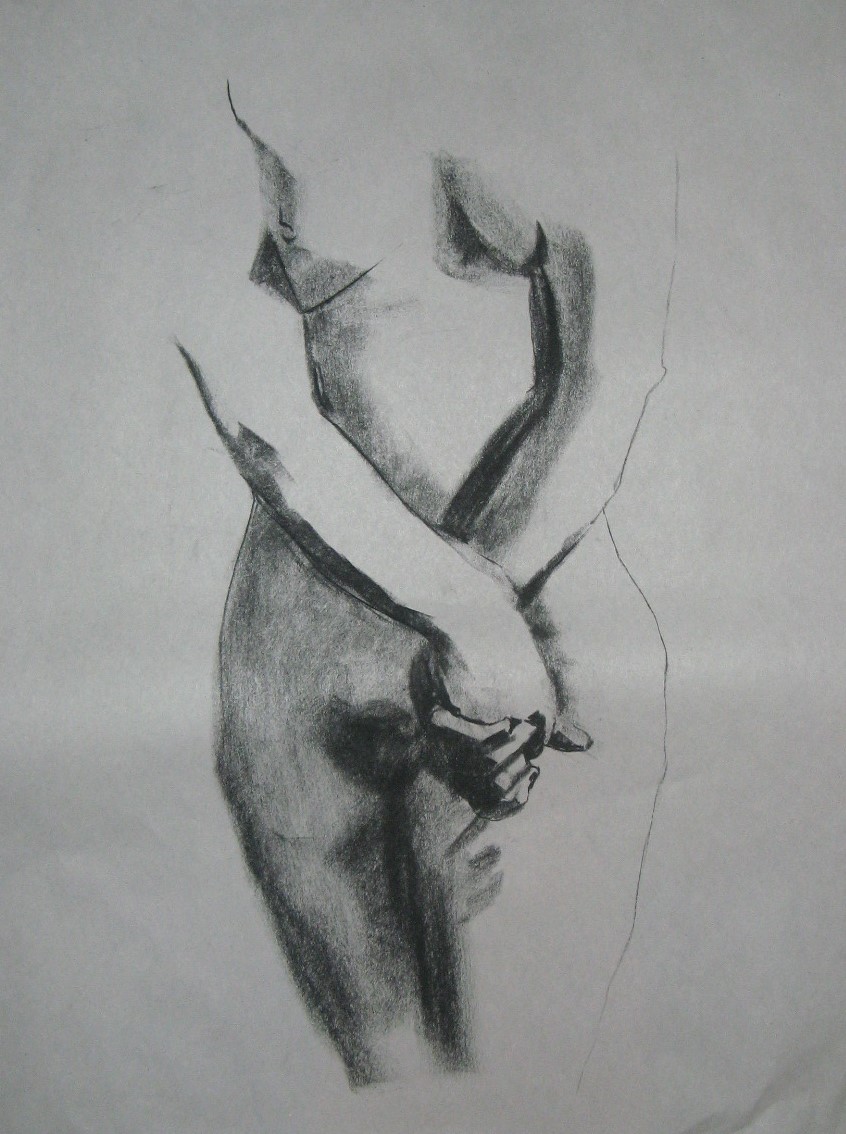
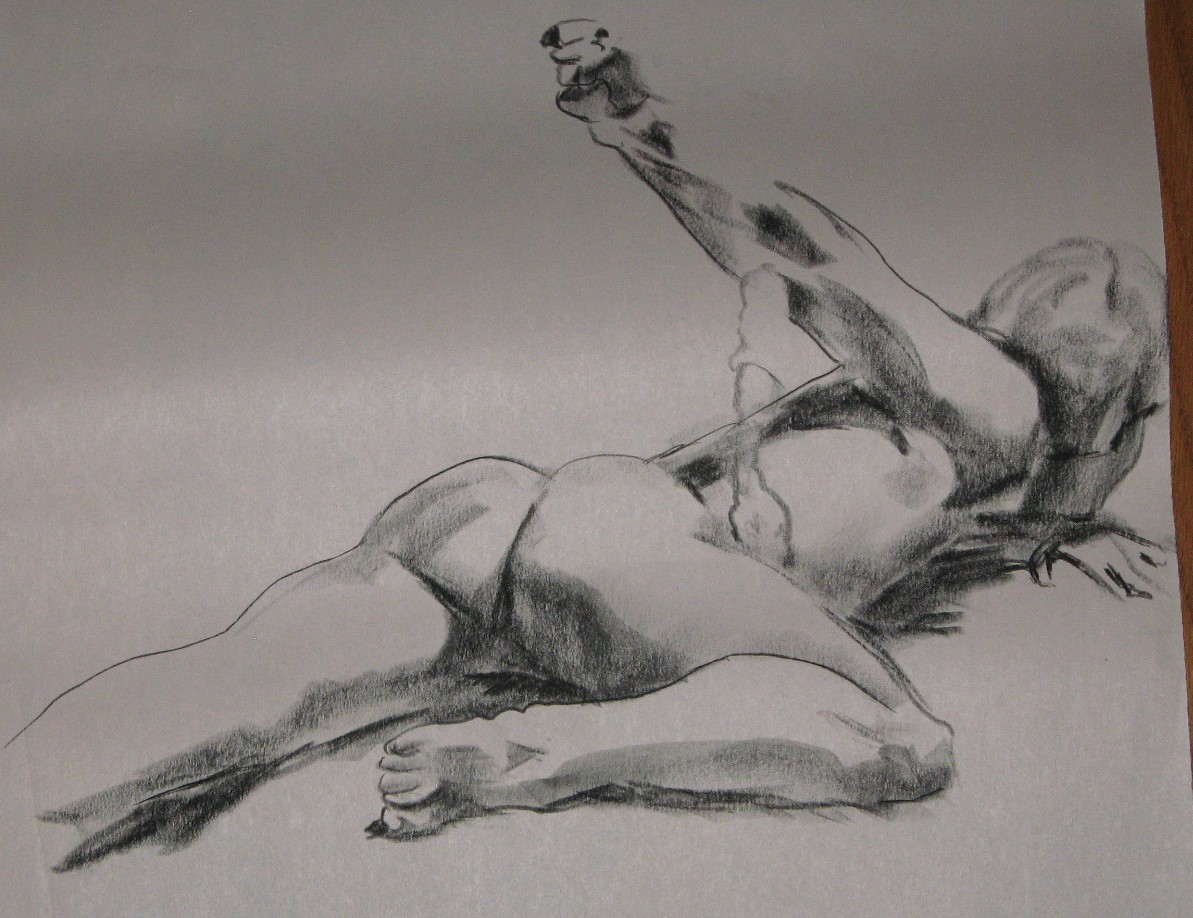
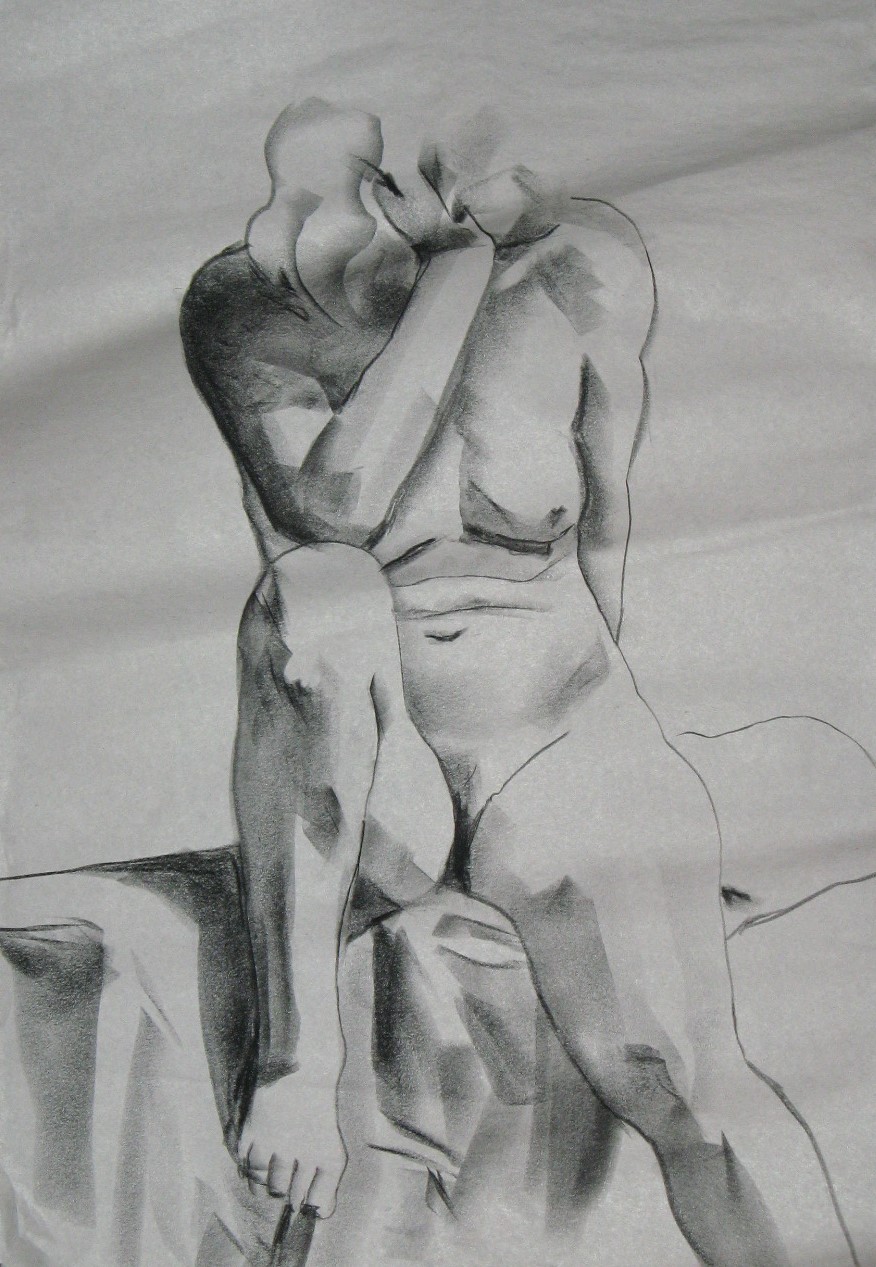
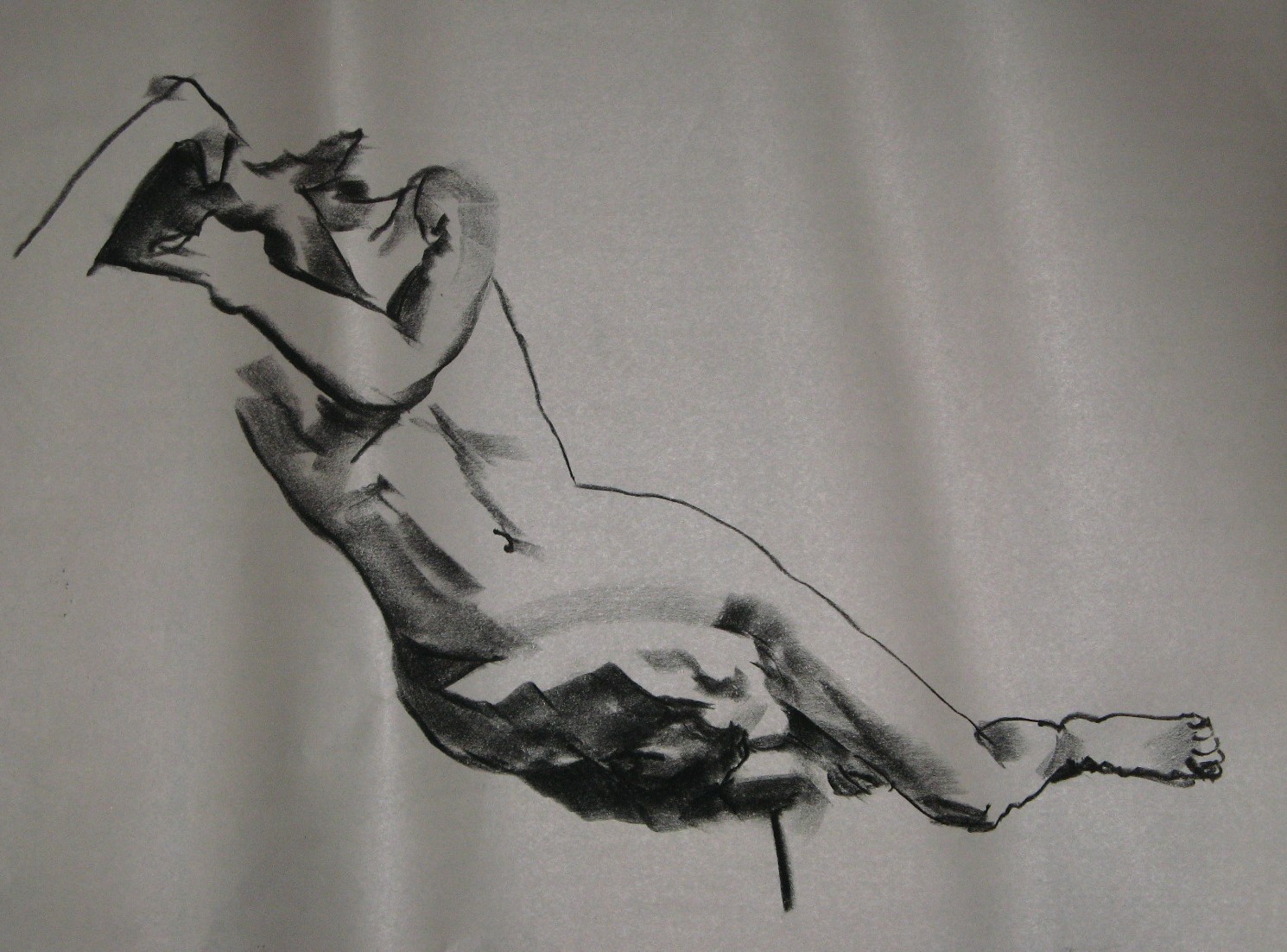
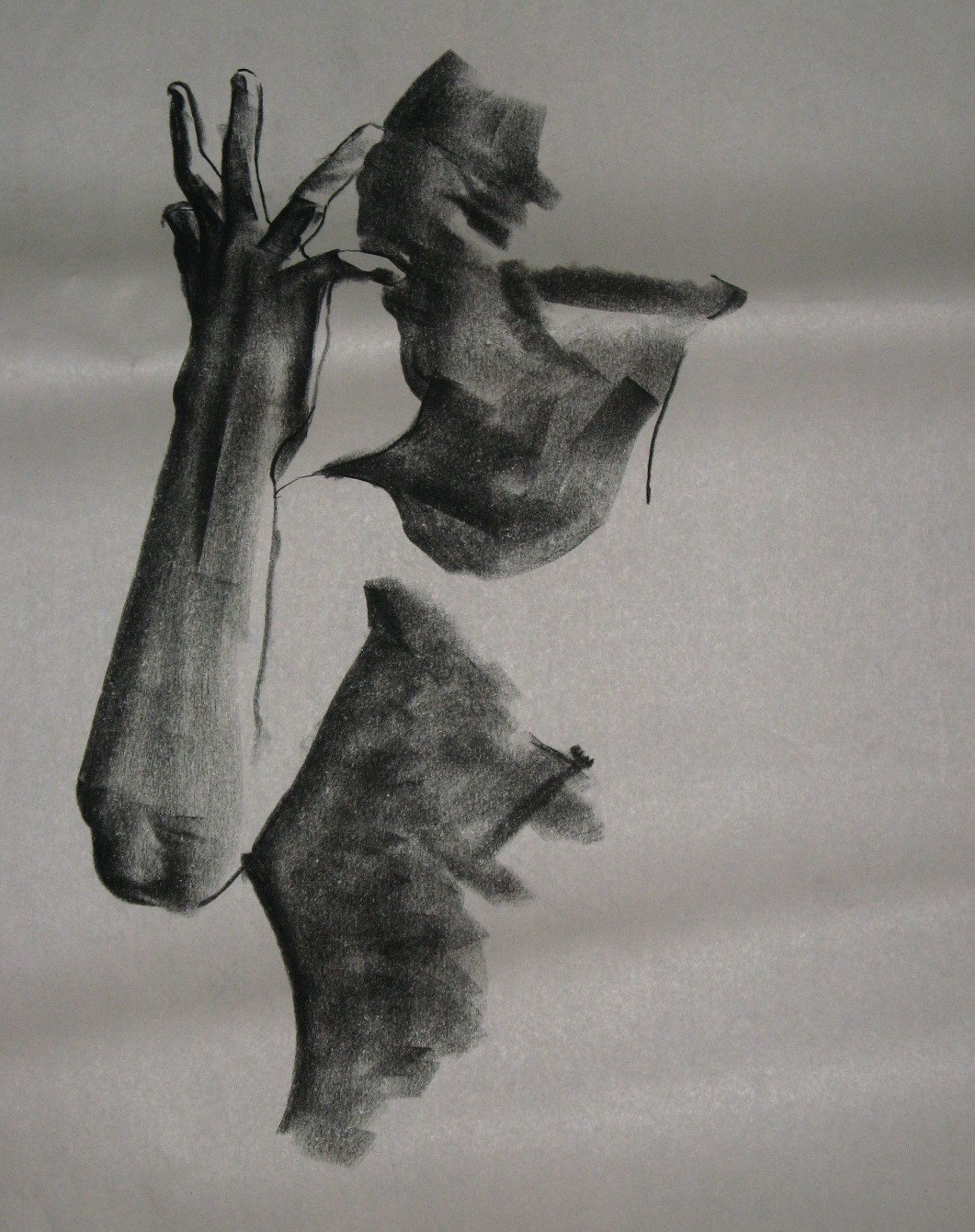
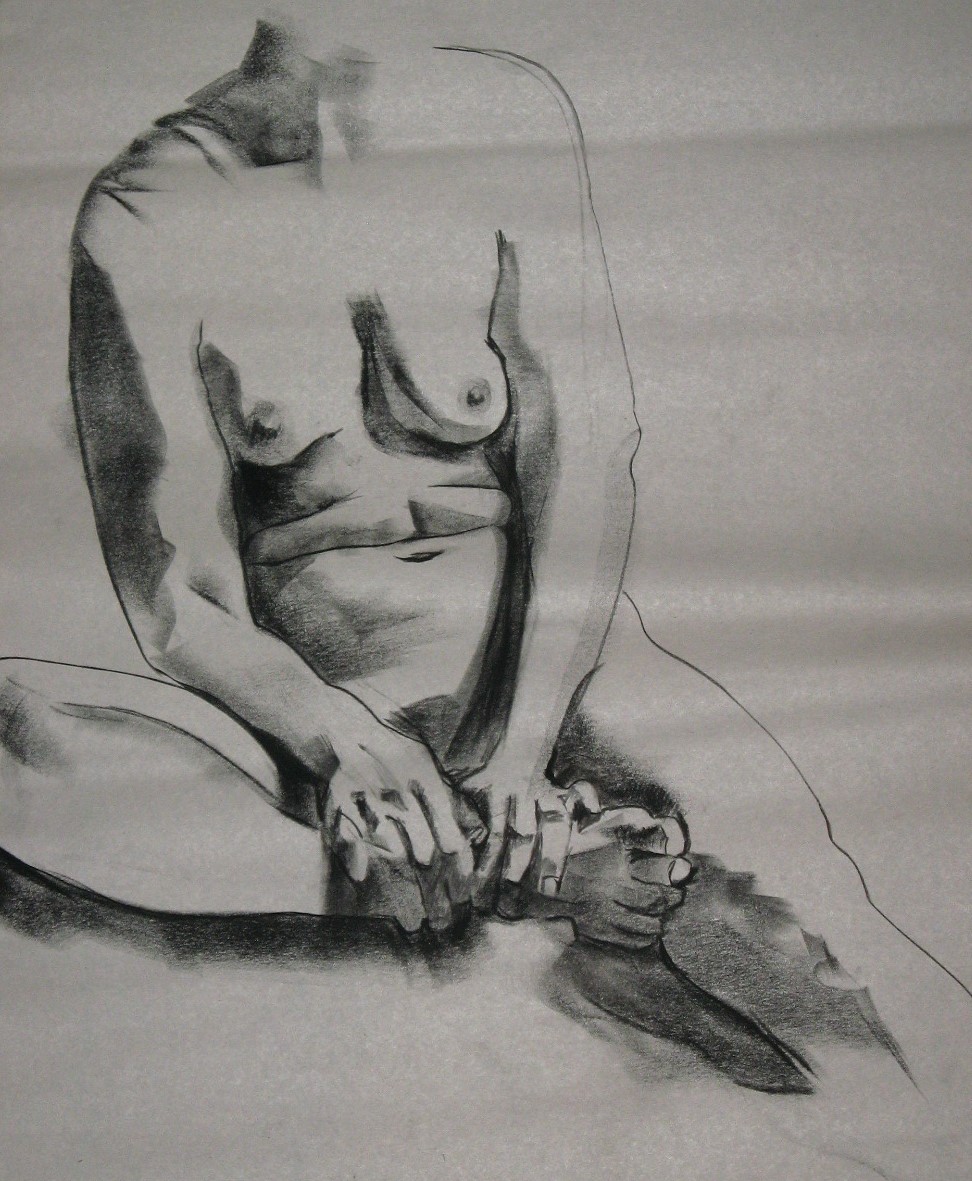
These six, the last from my great sweeping-up of all the accumulated drawings from several months, have something in common. In all of them, I was trying to use mostly the shadows and darkest places, rather than lines, to indicate shape as well as the fall of light. It works well. For example, I think the most successful bit of this one is the shadows defining her right hand.

141201c 7min

This next one too. (Same person, left hand.)

141201d 10min

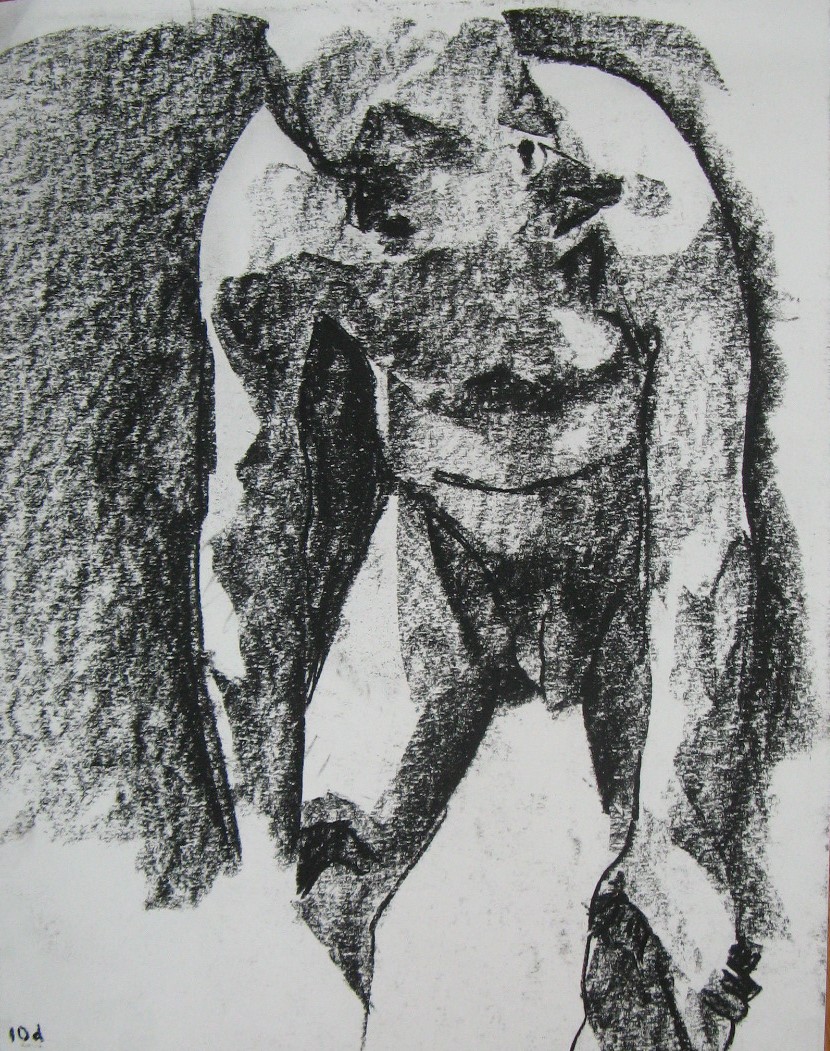
Same day, therefore same person modeling, in this next one. I was just really taken with what was emerging when I looked for the shadows and reduced a lot of grays to black and white.

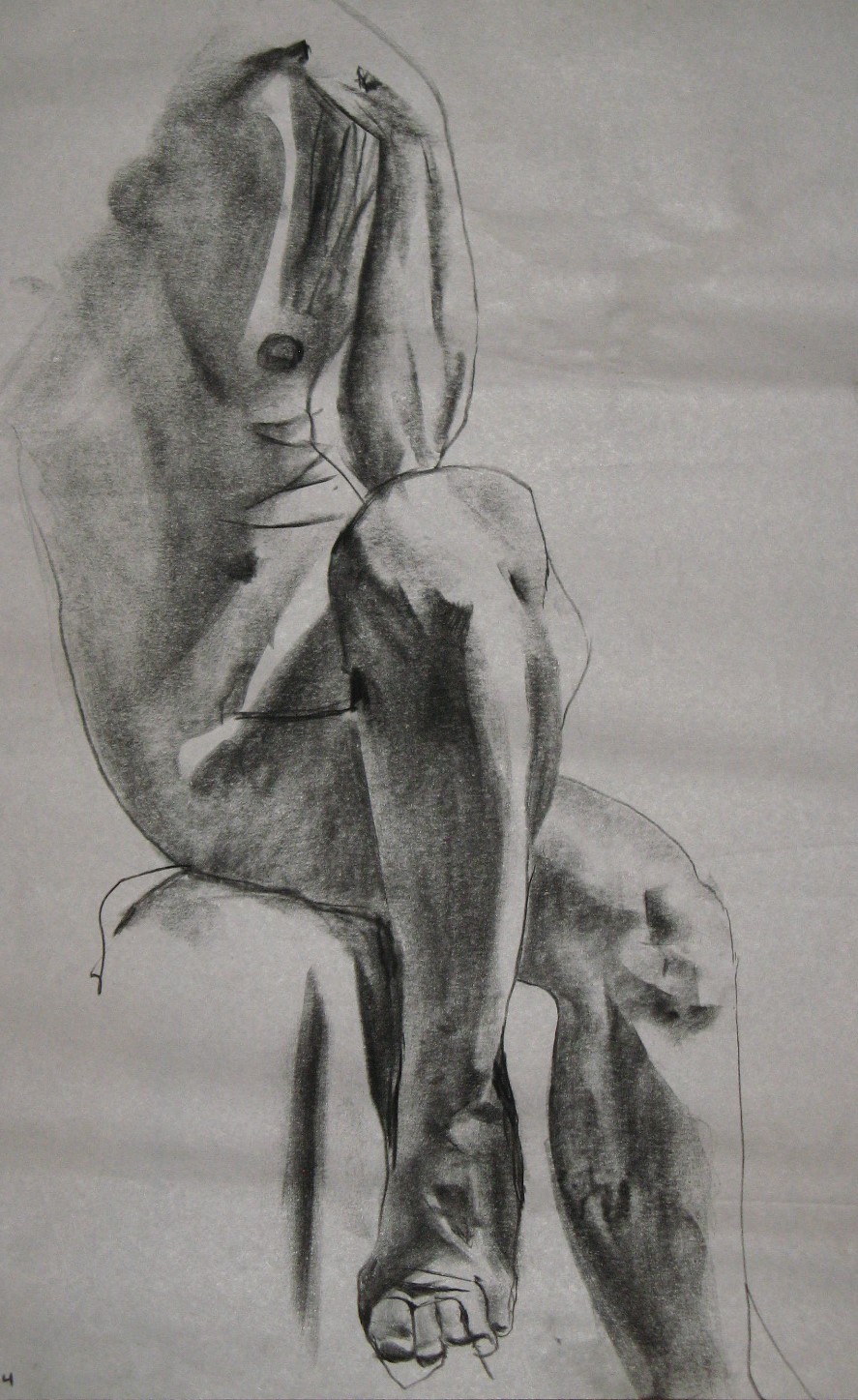
141201e 10minThe last three are also all of one model, and from one day. The approach was quite different than in the above three, but had a similar narrowing of the range of shades. Not too many grays. Black, or white. Lines and the edges of shadows show the contours of muscles more than they do the outlines of the body against the background.

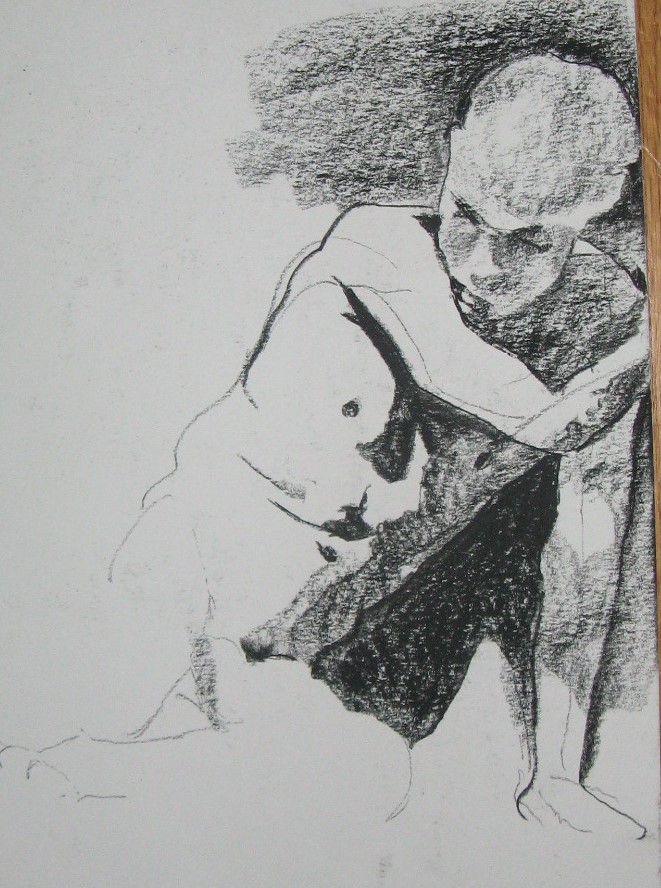
150105c 7minIn this next one, I used hardly any outlines at all. It gives a very different feeling about the relationship of the man and his environment.

150105d 10minAs sketchy as the face is in the last one, it’s still a rather good likeness, which goes to show . . . something. Amazing how little it takes to make a recognizable portrait.

150105f 20minAs I often do when I draw, I feel very moved looking at these drawings, at how vulnerable people are, and how beautiful.

The Rev. Lillian Daniel, who is so often wise and measured, kicked up a duststorm on the internet a few years ago among people who think about spirituality, religion, and the communities that make them possible, when she published a piece on her denominational website that was neither measured nor wise. It was full of dubious statements such as “There is nothing challenging about having deep thoughts all by oneself” and pure nastiness such as “Please stop boring me” (the latter was a headline, so it might not have been her writing).

As my colleague Jeremy Nickel responded at the time, Unitarian Universalist congregations welcome people who describe themselves as “spiritual but not religious” (SBNR). Or we do to the extent that they aren’t put off by defensive and angry ministers.

Unfortunately because of messages like yours, instead of finding that safe space within our congregational walls, they have found them in Yoga and Meditation classes, book clubs, in small group ministry settings in friends homes, in volunteer associations and online in chat rooms and on blogs, and in countless other ways that all turn out not to be your church. And I think at this point, it is becoming pretty obvious why that is.

It is not, as you mockingly suggest, because they find themselves “uniquely fascinating,” but rather because they find us, and our congregations, predictably close-minded and judgmental.

I thought he eloquently said what I wanted to say on the subject, and pretty much hit it out of the park. But the “SBNR people are rabidly individualistic” meme is alive and well, and among people that hold the key to the problem in their hands, as I learned yesterday. I’m in a workshop on preaching and worship for the future church, by Mike Piazza of the Center for Progressive Renewal, formerly pastor of the largest LGBTQ congregation in the world, and it’s terrific, and I am inspired and aided by almost everything he says. He brought up the SBNR briefly, though, and made the same complaint about individualism. The applause made it clear that a lot of UUs agree with him.

I wasn’t clapping, because as irritating as “I can do it all by myself” religion is, I don’t think that it is the main impulse behind “I’m spiritual, but not religious.” My congregation is full of people who describe themselves the same way. Hell, I would describe myself the same way if I didn’t have a lifetime’s experience of religious community’s being a place for my spirit to flourish: a nurturer of spirituality, not its enemy. But that isn’t what many Americans think of when they hear “religion.” They hear–and this information was shared, later, by Rev. Piazza himself–

It’s judgmental.

It’s homophobic.

It’s boring.

People in churches demonize everything outside the churches. (Rev. Daniel walked right into that one.)

It sets itself up as an opponent of science and intellectual thought.

Now, it’s easy enough for me to see why someone would conclude that their spiritual life was not going to be helped along by such an institution. Your average American has very good reason to think that churches are hotbeds of judgment, homophobia, and anti-scientific superstition. And the Barna Group study that yielded the above responses (it’s titled “You Lost Me”) wasn’t even of people who haven’t ever gone to church–it was a study of young people who grew up in Christian churches and left. As for Unitarian Universalism, as Rev. Piazza challenged us, we are none of these things (except sometimes boring) and very few people know we exist. Whose fault is that, and who’s responsible for turning it around?

If people don’t know that there is a religion that affirms the explorations of science; that celebrates our whole lives including our sexuality, regardless of sexual orientation; that is not concerned with defending its own dogma and doctrines; well, it’s mostly because we have hidden our own light under a bushel for all these years. Too many of us, which is why I don’t give in to the temptation to lie about my profession on airplanes, but tell those who ask that I’m a Unitarian Universalist minister. And when they start witnessing to me about their faith, which happens as often as their saying “I’m spiritual but not religious,” I tell them about us: that my congregation welcomes humanists and atheists (including me) as well as theists and Christians, that we encourage people to follow their own spiritual impulses in community, that we see the Bible as a document created by and for humans, that science and our observations of nature are one of the sources of our tradition, and of course, that we unreservedly affirm LGBTQ people (again including me). The very public fight for gay rights is helping to undermine the stereotype, I think–many of us have turned the media framing of “gays versus religion” to “look, here are religions that support gays,” and all those photos in the press of UU ministers, in collars and stoles to make it abundantly clear that they are ministers, officiating at the weddings of same-sex couples, are surely having an impact. Now we also have to let everyone–those outside and those inside our walls–know that we are a home for deep spiritual exploration.

Which is to say, we need to make sure we’re not boring. Time for me to get back to my preaching and worship class.



What all three of these have in common is that the gesture is expressive of what I saw. For example, in the first one, her right arm is totally wrong–I got the proportions off somehow and shortened it painfully. But I can feel the lift of her chin and the pressure her left ankle puts on her clasped hands as she holds it.

141117g 20min

I got lost in the weeds here and spent time on the shadows along his right side and other little fritterings, and I messed up the right knee so that it looks as if his elbow sinks two inches into it (reality is unforgiving–put a line half an inch in the wrong place and your drawing gives off a big neon WRONG sign). But again, the tilt of his head is here, even with nothing drawn in but his ear and chin, and the weight of his hand on his left knee, and the twist of his body.

141124d 10min

I fussed over the beautiful contours of his right upper arm but got them wrong and couldn’t fix it (erasing is a very limited option given the materials and time limit). What makes me happy about it is the gesture, again: his stare downward, his inward turn.

141124h 20min

Gestures and proportions, plus light and overall energy and mood of the situation–I don’t think I’ve ever made a drawing that captures them all to my satisfaction. Maybe that is the next goal to aim for.

It’s said that Bach wrote the Goldberg Variations to help a nobleman with insomnia get to sleep. I can’t imagine a more counterproductive sleep aid. This music makes the heart flutter, the toes flex, the mind fly, the diaphragm speed up until one is breathless, the eyes well with tears of ecstasy, the whole soul come alive and wide awake. If I could bring only ten recordings to the fabled desert island, one would be the Goldberg Variations, and I wouldn’t dare listen to it right before bed.

I know why I chose this one among hundreds of drawings: because of how much it conveys with how little.

141110b 7minThe next one, though? I have no idea why I included it. Limbs as stiff and flat as if they’d been cut out of plywood. The middle finger is about the only thing I like. Give me the finger!

141110f 20minSuch a lovely gesture, and her hands seemed to be opened to the light that filled them like water. Next time, can I remember to just focus on the hands and leave the rest be?

141110g 20minIn this last one, that’s what I did.

141110h 20min

All of these are about light, and take several different approaches to getting light to show up on paper. It is so hard for me to leave parts of the paper blank. I’m looking at this person’s skin, and it’s not white. I want to put shading everywhere. If I force myself to leave the lightest patches completely clear of charcoal, good things tend to happen.141013b 7minI got fussy with the many shades of gray in these next two, but the patches of pure white go a long way toward rescuing me from the cul-de-sac I was creating.

141020 20min

141027a 7min

Make sure to include shadows where body touches floor; they make light visible.

141027d 10min

Sometimes the light makes things invisible: the edge of a cheek, the detail of a bottom lip, are lost because the light falls on them so brightly.

141027h 15min

This cracked me up: Why You Should Never, Ever Get a Tattoo (But Having a Baby is Fine). I particularly like #10:

“You think you’re going to seem so cool walking around with one, but really most of the time you’re going to look sort of ridiculous.” 

Sorry, I couldn’t hear that last one.  I was screaming the phrase, “DON’T EAT THOSE BUGS,” while pulling pieces of sweet potato and banana out of my hair and coat pockets.
 
About “you know it’s going to hurt, right?”: I was scared shitless about how much having a baby was going to hurt. But the thing about childbirth–and you can interpret this as a pro or a con–is there’s no going back, and there’s no stopping. Once I realized I was pregnant, I knew: there’s only one way out of this, and it’s gonna hurt. Ulp. And once labor started, I could cry and yell and raise a ruckus, but all anyone was going to do was give me some more fentanyl and squeeze my hand sympathetically. This is just as well, because if there had been an off switch, the Munchkin would still be inside, and attending second grade would be very complicated.
 
Whereas, if I went and got a tattoo, I know what would happen. I would scream and make the person with the needle stop after about ten minutes, because I could. I’d never have the courage to finish the job and it would look ridiculous, a badge of cowardice and incomplete art. I’d be like Bart Simpson, wearing MOTH on my arm for the rest of my life.

I’ll be joining 1000 Voices for Compassion, which currently stands at the mathematically-pleasing number of 1024 bloggers who will write about compassion on February 20. What do you think compassion is? What does it mean in your life?

The day I did this drawing, I knew it was some kind of breakthrough. It has to do with the cleanness of the edges of the shadows. I get really frustrated with myself when all my marks are mushy. These are not mushy. They’re almost Cubist in appearance in places, as happens when I work so much and so firmly with the long edge of the charcoal. But the shading on the belly is subtle without being wishy-washy. Something really good was happening here.

140908f 20minThree weeks later, with lots of unsatisfying attempts in between, I managed to keep that same firmness. There are places where the edges are soft, maybe too soft, as in the left calf and foot. I’m not sure whether those work, but to the extent they do, it’s because not every mark on the page is like that. Most are more clearly delineated. This is a case of the first longer pose (seven minutes) maintaining some of the spontaneity and energy of the warmup one- and two-minutes.

140929a 7minThere’s usually one spot that grabs my attention, and without taking time to analyze why, I almost always start there. On the next drawing, done the same day as the previous one, it was the dramatic light on the right hand.

140929b 7min

I have brown and sanguine conte crayons in the art box I bring to drawing, but I seldom get them out. This time I wanted some color, and wanted to try the different medium, which has a little more drag than charcoal; it’s stickier, smoother. This next drawing is a bit of a mess, but I like the gesture, and the left hand, which is far from an accurate rendering but conveys the energy of the pose; intense, intent on something inward, but braced for what’s outside.

141006a 7minThis next one is a more tranquil pose from the same day as the previous. Still working on the clarity of all those planes–there are so many on her belly, revealed by, and revealing, of the light. I like the light in this, overall.

141006e 10minOn the next one, three out of four limbs (all but the left leg) are flat and undeveloped, and the neck–feh–but I knew right away that the hands and foot would need my attention. Even with 45 minutes for this pose, that’s not much for me when two hands and a foot are visible, and so clearly what the pose is about for me. They’re all a bit rough, but real to my eyes. I also like the torso.

If you look at shadows you’ll often see a gradation, from darkest at the outside edge of the shadows, to lighter farther in, farther from the light it seems. You see it here, on both breasts and the left arm. I notice that phenomenon often but can’t reproduce it as well as I can see it.

141006g 45min

Enter your e-mail address to receive e-mail notifications of new posts on Sermons in Stones

Links I like