Sometimes when you plan for the Sunday service, you’re not thinking about the impact on Saturday night. I just went to an event at church (Mary Pipher speaking about how to do sustainable, hopeful, joyful citizen activism) and saw the brand new bulletin board–which I’d asked our administrator to create–in a new light. We’re going to fill it with our elevator speeches, so its heading is “Unitarian Universalism, Briefly,” and below that: nothing. Nada. That’s brief, all right.

The service came about because in last year’s “question box” service, someone asked, “Can you give your ‘elevator speech’ about Unitarian Universalism?–please don’t use the word ‘don’t’.” So that will be the bulk of the sermon: concise, positive answers to the question “What is Unitarian Universalism?” or “What do you all believe, anyway?” or the like. Since I was brought up on poetry, of course what popped into my head was “Thirteen Ways of Looking at Unitarian Universalism,” and that’s how many I wrote. We’ll end with many more than a baker’s dozen, though, because everyone present is going to have a chance to write down their elevator speech and take one copy home, and leave another copy on that board. That way, the people who come to the next event at UUCPA won’t think we have nothing to say about ourselves.

The previous posts on this topic can be found here and here.

The third shift in my writing and preaching in the past several years can be summed up simply: more courage. I’m accessing deeper truths in myself and speaking about the things that I see as most important to me. When the writing gets scary–when it’s leading me to question things I’ve taken for granted, or to say things that might be hard to hear, or to feel scary emotions–instead of backing off, I keep going. On my best weeks, I’m giving people the most important things I’ve discovered.

This is not to be confused with self-revelation, which can be a trap for preachers. It’s easy to think that simply by talking about incidents from our own lives, we’re being brave, when sometimes we are just dumping stuff on the congregation that would be better aired to our therapists or best friends. (Sensing the distinction is one topic in the seminary course I outlined but haven’t taught, “Preaching on the Edge.”) You can’t preach well week after week without revealing a great deal about yourself, but it’s not necessarily about anything you’ve done or said. It’s about depth of soul and being willing to dig deep to that treasure and share it with others. For me, courage comes into it because I’m afraid they’ll reject my offering, or sneer “That’s all? That’s what’s in the treasure chest?” or one way or another, find my gifts inadequate. But I think the best sermons come out of that risk, because when I don’t risk it, I’m hiding what is most valuable.

I learned a lesson from Allen Ginsberg back in the mid-90s, though it took a good many years to filter into my preaching. Recordings of fifty of his poems and songs had just been released (Holy Soul Jelly Roll, Rhino), and I went to hear him read. This was an era of nudity. Madonna was breaking barriers by strutting onstage in her lingerie. Yet she never seemed very raw or vulnerable to me; on the contrary, her act felt like an act, the skimpy clothes a kind of emotional armor. Ginsberg was just the opposite. He kept all his clothes on, a 60-something-year-old man standing on a modest stage in thick glasses, a button-up shirt and khaki pants; for the most part his content was PG-rated; despite the ego required to recite one’s poetry to a crowd, he didn’t give the sense of putting himself forward in any way; and for all that, he was utterly naked. He peeled away all pretense and allowed us to see his soul. Watching him, listening to him, I realized a person can share the most intimate thoughts and feelings in a way that says not “Look at me!” but “Here, let me help you take a look inside yourself.”

True vulnerability invites vulnerability from others. That takes courage. I don’t know how others develop it; for me it’s been by doing things that scare me.

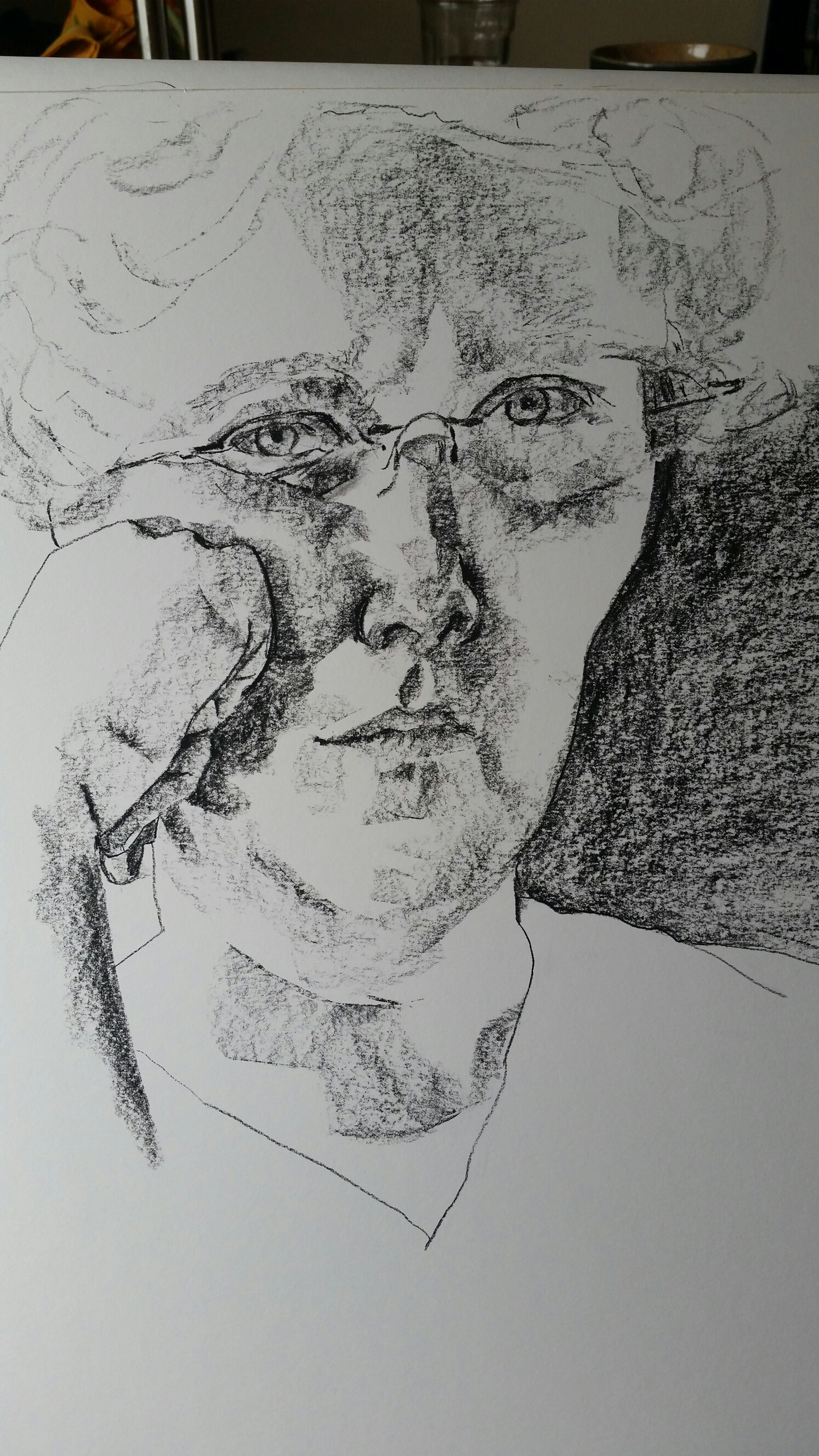
Joy said about the drawing I posted earlier, “All self-portraits have that same expression.” True–it’s the expression of someone concentrating. Just to prove it wasn’t the only option, I did this one just now, working fast and having fun, though my tongue started to feel dry.

image

Robert Arneson actually did this years ago.

I didn’t go to drawing today; it’s rare for all three of us in the family to have a weekday off, and we preserved it as a family day. I did some drawing at home, though, which I seldom do in any sustained way, so I’m pleased.

Usually I have my paper propped up on my knees, but this time it was flat on the table. As a result, what looks pretty correctly proportioned at the angle at which I drew it–

image

–shows all its distortions when propped up perpendicularly:
image

This was also a foray into Bristol vellum-texture paper; I’m looking for something as smooth as the newsprint I’m accustomed to, but of more archival quality. It’s close.

I also spent some time with Munchkin’s Hawthoria succulent, until the attention to detail was driving me squirrelly and I stopped.

image

For the previous post on this topic, click here.

The second shift in my sermon writing and preaching was one of intention and attention. Anything can become a routine, and preaching was often a routine for me–an excruciating, four-in-the-Sunday-morning routine, sure, but still, routine in that I’d lost touch with the reason to preach, the reason people sit and listen to a sermon in the first place. It wasn’t entirely absent; it flared up in my preaching, I’m sure; but in many of my weekly struggles with writing, it had ceased to be central.

Maybe something began to shift back where it needed to be when I began to open every service with an eight-word mission: “to transform ourselves, each other, and the world.” Another thing that brought it back now and then, brought my heart back to what was most important, was others’ great preaching. I would go to a service–typically, someone’s ordination, or the short worship services ministers lead for each other during our retreats–and the preacher’s words would rock my world. I would walk out of the service remembering what my life was about, “This, this!” and know once again, in my bones, that I needed to reorder my priorities to put the people I love most at the center (thank the departed Mary Harrington for her sermon “A Lifetime Isn’t Long Enough”); that I wanted to wake up before my short time was over (thank you, Erik Walker Wikstrom, for a sermon you gave just before your departure from Brewster, MA, in the summer of 2008). These sermons transformed me, personally. This is what I could do for the members of my congregation.

Around the same time, Christine Robinson’s Berry Street Essay, i.e., sermon, spoke to my soul by reminding me that my job was to speak to others’ souls: to allow them to be “touched to the core of [their] being.” She spoke about an experience of holiness she had on a ride at Disneyworld, and I was pressed back against my seat–it felt like 2 g’s–by these words: “The only thing you’ll really have to work with . . . is yourself and what you are willing to share of your own, precious and always threatened spiritual life.” Another wake-up call. Was I sharing of the core of myself, and was I speaking to the core of those gathered on Sundays?

Then I read Kay Northcutt’s book. My congregation, mostly atheists, humanists and naturalistic theists, might be nervous to know the title (Kindling Desire for God: Preaching as Spiritual Direction), but the fact is that whatever they love about my preaching in the past five years owes a great deal to this book. The message I took from it is: whatever your text for the week (and Northcutt, like most Christian preachers, follows a lectionary and has Biblical texts as her reading), prepare for writing by meditating and praying on that text, yes, but even more, meditate and pray on the spiritual needs of your congregation, individually and collectively. What is happening in their lives right now? What is happening in their world? What are they hungry for, frightened of, longing for? These are the “texts” for your study, preacher. Northcutt spends significant sermon-prep time each week contemplating the heart of her congregants’ being, and she says to all preaching ministers, Go and do likewise.

I had forgotten. I had been writing as if my job were to present twenty minutes of coherent and occasionally eloquent argument. Coherence and eloquence are important, but they’re just the craft of writing, and while craft is often underrated, if you’re an artist it’s intended to be the servant of meaning, not the end in itself. In church, the meaning is our lives. A preacher is an artist, meant to create something that is not just well-crafted but beautiful and charged with meaning: something that will touch the core of our being.

I know why I’d forgotten this. It was a convenient amnesia, an avoidance of something that scared me. So what I needed to do, if I were to write and preach in a way that would speak to people’s spirits, was to move through my fear.

Next time: Doing the thing we think we cannot do

My writing and preaching have changed dramatically and for the better in the last several years, and as I find it instructive to read other people’s accounts of changes to their writing, here are three quick posts on how I changed mine. They are not a recommendation to do anything except listen to yourself and go with processes that will bring your work closer into line with what you envision. As to the specifics, they vary so much from writer to writer, preacher to preacher, that blindly adopting someone else’s approach is bound to steer you wrong. Try it out by all means, but don’t expect that every experiment will work for you the same way it worked for others.

Several things happened to me in the space of a year or two that drove the change, two of which had to do with departing from a word-for-word text and preaching from notes. A colleague shared how Mark Bellettini, well known as a riveting preacher, would take all of his thoughts and ideas for a sermon and turn them into about a half-page of notes, which is what he took into the pulpit. Some people can deliver a sermon from a word-for-word text and make it sound spontaneous, but as I couldn’t, I needed to try something else. I had been frustrated with my preaching, feeling that it lacked the immediacy and liveliness of my non-preaching speech, and I resolved aloud to try Mark’s approach.

I don’t know if I would have done it, though, if I hadn’t been thrown into the deep end by accident. I was having printer trouble one Sunday around that time, so I did something I’d done before and e-mailed myself the text to print out at church. When I got to church, I turned on my computer, found the e-mail I’d sent myself an hour earlier, opened the attachment, and sat staring. It was the wrong attachment: the order of service for that morning, not the full service with sermon included. My home was 20 minutes’ drive away; my wife was with me; there was no one at home to send the correct file, the cats being notably unhelpful in this department.

I was at church without a sermon. All those anxiety dreams, in the flesh. After I’d finished gaping at the screen, rereading the same useless document several times, and gasping for breath, only ten minutes remained before the service.

So what else could I do? I asked Chaz, the person who was to ring the bell to start the service, to hold off until I came in–I wouldn’t be long–and I grabbed a notebook and jotted down the points of my sermon. I had time to recall the beginning and end and the basic outline of the points in between, and like Mark Bellettini, I went into the pulpit with nothing else. I felt naked.

No one but Joy and Chaz knew about the mishap, and they said after the first service that the sermon had gone well. For my part, I could have done without the adrenalin rush–to this day the memory makes my heart speed–but there was no question that I spoke differently than usual: less as if I were reading something I had written, more as if I were speaking ideas to which I’d given a great deal of thought. I was excited. It was the beginning of a transformation.

Next time: Remembering why I preach

This year, our Minister of Religious Education, Dan Harper, and I have been talking a lot about the congregation’s ministry to and with teenagers. He and members of our Children and Youth Religious Education Committee will be leading a town hall-style forum on youth ministry in our congregation next week. Since there’s also been a lot of conversation on the topic among people in our district, at the retreat of the district ministers last week I and a couple of colleagues shared models of how youth ministry looks in our congregations. I didn’t have enough time to talk about all of the programs at UUCPA because they are burgeoning.

A core of our youth ministry–and the part I’m most frequently involved in–is the proactive inclusion of teens in the leadership of the congregation. In the past few years, teenagers have been on the Board, Membership & Growth Committee, and Finance Committee, and have taught Children’s Religious Education. They are responsible for the wildly popular, very well-run Children’s Auction every year during the congregation’s auction, our biggest fundraiser. Rising 7th, 8th, and 9th graders can be CITs in our pilot Ecojustice Camp.

This year, two representatives from the “Purple Class,” early teens, made a proposal to the Board for $250 to install an experimental rain barrel on church property. The Board members listened carefully, asked good questions, and voted unanimously to support the project. In fact, none of this leadership development would be possible without the support of our adult leaders, who are enthusiastic about youth taking on leadership and treat them with the respect of any congregational leader, and accommodate the particular scheduling issues of teenagers. For example, our Board terms are three years, so if a teenager doesn’t come onto the Board until their junior year, they will probably not complete the term. The Board and Nominating Committee are fine with that.

One of the most important and visible leadership roles in the congregation is that of the Worship Associates (WAs): they write and deliver a 3-5-minute reflection, confer with the service leader to help choose the readings and music, play important roles during the service (speaking the chalice lighting words, etc.), and if the speaker is a guest, emcee and coordinate the entire service. The Worship Associate’s reflection is frequently the most meaningful part of the service for the rest of the congregation. This year we have ten WAs, three of whom are under 18. This is leadership development for the teens, but face it, it’s to the congregation’s benefit as they hear the insights of the youth leading the service, and to my benefit as the minister responsible for services. I’m always looking out for good Worship Associates, and these people are good. I have my eye on so many articulate, responsible young people for next year’s Worship Associate team that if I invited them all, we wouldn’t have enough adult representation among the WAs.

Youth ministry also, of course, takes the form of groups and classes especially for youth. A Senior High Youth Group, quite independent in its leadership though there are adult advisers, meets every Sunday night. Our Whole Lives (OWL), the sexuality curriculum that we teach at all age levels and make freely available to the wider community, also meets on Sunday evenings for the 7th-9th-grade level; it’s been so popular that we are planning to offer that level every year from now on. (We need more facilitators, so we’re hosting the upcoming training.) On alternate years, we have a Coming of Age group, mostly composed of 8th graders; this is one of those years, so I’ve led three of their Sunday-evening sessions, including the planning session for their ever-popular Sunday service, coming up on May 17. They articulate their own beliefs in a written credo (Do they believe in God? What are their values? What’s most meaningful to them?) The junior-high age kids also have a Sunday morning program–their curriculum is Neighboring Faiths, where they learn about other traditions through visits and interviews–and many attend both. Youth are welcome in Adult Religious Education classes, something I realize we need to make more explicit.

This July, nine teens are going on a service trip to Belize, where they’ll be doing real, needed work rooted in the longtime relationship one of our members (now a parent of a teenager) has there through the non-profit she co-founded, Teachers for a Better Belize. They will paint one primary school, help install solar panels on another, plant an environmentally-friendly demonstration garden at a third, and stock children’s books in the libraries of several schools; they’re currently soliciting book donations and raising the funds to ship the books and buy the supplies, and they successfully petitioned the Action Council and congregation to make this project the recipient of the 10% of our offering that we give to one justice partner each month (again: congregational support for youth ministry). In the process, they’ll learn about the culture of Belize’s poorest region, where most of the people are indigenous (Mayan in this case), like so many of the Latin American residents of our own area. In recent years, other service trips have taken teens to Los Angeles and New Orleans. One of Dan’s and my goals for this aspect of our program is to fund enough scholarships that travel costs are not a barrier to any teenager who wants to go.

One of the needs we perceive is family-based youth programming: church activities that teens and other family members, especially parents, can do together. Teens need space apart from their parents, and we provide that; but they also need to negotiate the changes in their relationships with their parents, and family-based programming helps facilitate that process. We’ve been thinking about what kind of Sunday evening worship we might create, for example, that would engage parents and teens while they are here for the increasing number of Sunday-evening groups. The Adult Religious Education Committee is looking at supporting this direction by offering more of its programs on Sunday evenings–the parents could go to them while the teens are in OWL, Coming of Age, and Senior High Youth Group.

All of this is a matter of saving lives and saving souls–not from Hell, since we’re Universalists, but from the earthly hell of fear, pain, and meaninglessness. Since long before Palo Alto’s woes hit the New York Times, our congregation has grappled with the stresses that our local culture puts on teenagers. They suffer a high level of mental illnesses such as depression and anxiety, worry incessantly about school, lose sight of passion and joy, and not surprisingly, report that the stress levels cause them physical pain, chronic sleep deprivation, and missed periods. How can we, as a faith community, ameliorate these problems and offer a counter-cultural alternative to the high-pressure world of Silicon Valley teenagers? We know that a positive peer group, connections with caring adults in and beyond their families, meaningful opportunities to serve the community, unconditional support for people of all sexual orientations and gender identities, and a religious community where they can search for truth and meaning are all developmental assets that help teenagers thrive. That’s what we’re doing when we do youth ministry.

I know the Town Hall participants and attendees will add more.

It was the kind of exchange of mindless violence that wreaks havoc on those who are innocently going about their lives in war zones of all times and places. In this case, it was in Belfast in 1976. IRA members fired on a British patrol. The British returned fire, killing the IRA driver. His car ran up on a sidewalk where Anne Maguire was shopping with three of her children, killing two of them before their mother’s eyes and injuring the third so badly that he died the next day. Betty Williams saw the accident and ran to help. She’d grown up in Belfast and seen deadly violence up close before, but this incident was the last straw for her. She began collecting signatures and organized a march of women protesting the endless cycle of violence. The 200 or so marchers passed by the house of Mairéad Corrigan, who was the aunt of the three children who were killed, sister of Anne Maguire. Corrigan came out and joined the march, and not long after that, she and Williams had planned another march, this time of 10,000 women to the graves of Joanne, John, and Andrew Maguire. The organization of Protestants and Catholics that they founded, the Community of Peace People (changed from Women for Peace when Ciaran McKeown joined them in leadership), pressed constantly for the battling parties to sit down together, and served loyalists and republicans equally, for example by arranging buses for people of all religions and political persuasions to visit their imprisoned family members. As they mobilized hundreds of thousands of war-exhausted, grieving people in Ireland and England, the fatalities in Northern Ireland fell dramatically. The Peace People’s declaration was signed by over 100,000 people:

We have a simple message to the world from this movement for Peace.

We want to live and love and build a just and peaceful society.

We want for our children, as we want for ourselves, our lives at home, at work, and at play to be lives of joy and Peace.

We recognise that to build such a society demands dedication, hard work, and courage.

We recognise that there are many problems in our society which are a source of conflict and violence.

We recognise that every bullet fired and every exploding bomb make that work more difficult.

We reject the use of the bomb and the bullet and all the techniques of violence.

We dedicate ourselves to working with our neighbours, near and far, day in and day out, to build that peaceful society in which the tragedies we have known are a bad memory and a continuing warning.

Williams and Corrigan were awarded the Nobel Peace Prize that year. Alfred Nobel described the intent of the award quite narrowly–the recipient “shall have done the most or the best work for fraternity between nations, for the abolition or reduction of standing armies and for the holding and promotion of peace congresses”–but the committee recognized the power of a grassroots movement. A peace congress probably wouldn’t have made much difference, but thousands of people demanding peace, over and over, in a grassroots movement all over two lands, most certainly did good work for fraternity–and sorority–between those two nations. Both women continue to agitate for peace to this day.

Today is pi day here in the United States, where we list the date before the month in our date shorthand, thereby enabling geeks to celebrate our geekiness on 3/14 each year. This year it’s extra special: 3/14/15 at 9:26:53 celebrates the first nine decimal places of pi.

It’s only fitting that today’s entry for Women’s History Month celebrate a female mathematician, and until earlier today, I didn’t even know the person I’m writing about was a mathematician. Florence Nightingale is of course more well-known for her pioneering work in nursing; her professionalization of the role (nurses were previously without training), management of hospitals, and attention to sanitary conditions, so transformed medicine that she is known as the founder of modern nursing. She was also a social reformer on issues including education, poverty, prostitution, and (despite her generally low opinion of women) the expansion of women’s professional opportunities. However, hand in hand with these accomplishments goes her work in the field of statistics: she believed that public policy should be based on data, and she had the skill and training in mathematics to present data in vivid and accurate forms.

Paul Lewi calls her “one of the pioneers of modern statistics.”

She . . . insist[ed] that statistics should be used and understood by politicians and officials as a rational means for decision making. To this effect she designed original diagrams which illustrated in a dramatic way the needless sacrifice of human lives and the simple means to prevent it. These diagrams were
published as part of the many reports and proposals that she prepared on various issues including health care, education, child labor, work houses and crime.

Her work in the Crimean War went far beyond her admirable service as “the Lady with the Lamp”; she documented, and presented in then-new and convincing graphic form, the causes of death among the British Army. Eschewing the philosophy that was urged on her of “the dryer the better,” or the bar chart that was then popular but would not have conveyed the comparison between the same months in different years, she devised a complex variation on the pie chart now known as the “Nightingale Rose.”

Nightingale-mortalityT

(An animation of this chart can be viewed here.)

Nightingale went on to use “applied statistics”–a term she coined, according to Lewi–to drive policy changes in public health in India and at home in England. All of this was possible because her talent as a mathematician was recognized and nurtured beginning in her earliest years. So have a piece of pie for pi day, improved pie charts, and a woman who saved thousands of lives or more.

Last Sunday, we ended the service with a ritual bridge crossing. Everyone had this image and question in their order of service–

bridge

–and I urged them to answer the question and keep that image and pledge somewhere they would see them often.

There are a couple of things I’m going to do. One is to partner deliberately with African-American-led organizations, listen to what they want me to do to help bring justice, freedom and equality to their people, and do it. The other is not so much action as the foundation for action, because when I listen to other people’s stories I am drawn into their struggles: to read a dozen books by African-Americans that would teach me something about their experience of the country we share. I decided to make it a baker’s dozen. I’ve drawn up the list now and noticed that it’s heavily tilted toward the voices of women.* So here, for Women’s History Month, are the books by African-American women that I’ll be reading over the next several months:

how I discovered poetry, Marilyn Nelson. I just learned about this book today from sister UU blogger Tina Porter, who wrote, “If I taught American History, I would make this mandatory reading. If I taught religion, I’d make this mandatory reading. If I could still make my daughters read things, I would make this mandatory reading. Because nothing could be more informative about life in America in 2015 than the story of the years 1950 to 1960 in the life of an African American girl whose father is in the military, moving the family north, south, east and west.”

Citizen, Claudia Rankine, whom I heard speaking on the PBS News Hour this afternoon and found electrifying. Must read more!

Beloved, Toni Morrison. I love Morrison, but for many years now, I have been dragging my feet about reading this, her masterpiece. I’ve endured other books about dead children; it’s time to bite the bullet.

Americanah, Chimamanda Ngozi Adichie. Adichie is actually not African-American, but Nigerian, but she spends a lot of her time in the United States and writes about the African-American experience. I wondered if anyone would give me this for Christmas. They didn’t, and the waiting list at the library continues to be long, so I’m just going to buy it for myself.

Dawn, Adulthood Rites, and Imago (Lilith’s Brood: the Xenogenesis Trilogy), Octavia Butler. My wife gave me this trilogy before she was my wife. I dipped a toe in, but couldn’t get into it. We’re going on ten years of marriage and I’ve read and enjoyed lots of other Butler, and sadly, there will be no more, so it’s back to Lilith for me. Honestly, sci fi? alluding to Lilith? How can I not love it?

Salvage the Bones, Jesmyn Ward. I don’t know anything about Ward or this book, other than it’s about Hurricane Katrina and sounds interesting.

The Warmth of Other Suns, Isabel Wilkerson. A history of the Great Migration of African-Americans to the urban north from the rural south.

Your nominations are welcome. What books–poetry, fiction, non-fiction–by African-American writers have been important to you?

*The others, by men: The Intuitionist, Colson Whitehead; The Known World, Edward P. Jones; Blues City: A Walk in Oakland, Ishmael Reed; and Brothers and Keepers, John Edgar Wideman.

Enter your e-mail address to receive e-mail notifications of new posts on Sermons in Stones

Links I like