I took my first foray into National Theatre Live recently, lured like millions by the prospect of seeing Benedict Cumberbatch play Hamlet, and I really enjoyed it. If you want to see interesting theater at $20-plus-handling, I highly recommend looking up what’s being broadcast from the National Theatre to a cinema near you. Not only is there great acting, but when else do you get to watch Shakespeare and eat popcorn? It’s like being a groundling, except with more comfortable seats. My one complaint was that the preliminaries made the actual start time 30 minutes after the time on the ticket. I wished they’d told us whether we had time for a run to the restroom; next time I’ll know.

Specifically re: Hamlet, it had been a long time since I’d read or seen it, and something has changed in me–not in the play, obviously–because I realized that that play is sad. Really heartbreakingly sad. I know that that is what the word “tragedy” means, but reading the play in my callow, callous youth, the sheer waste and misery of it didn’t make such an impression. The play opens with Hamlet already sunk in grief; you never see him as he was before his father’s death, but only get enough intimations of his humor, intelligence, and emotional fervor to feel the decline. It closes not only with eight people freshly dead, five of them young, but with the country handed over to a stranger: something else that never struck me as that tragic before but on this viewing, seemed to be the final evidence of how badly the time is out of joint. Hamlet’s murder of Rosencrantz and Guildenstern also hit me hard–it’s so cruel and unnecessary, and he’s so completely lacking in remorse. Everything about his collapse into isolation is right there in that moment: how he’s unable to see that he is not the only one whose strings are pulled by powers he can’t resist. Cumberbatch makes us believe in a Hamlet with a razor-sharp intelligence who can turn that intelligence to exquisite self-awareness, yet also be blind to the obvious about himself.

Something else I had forgotten, or not fully realized when I last saw a production or read it (15 and 30 years ago, respectively), is how funny the play is. I remembered Hamlet as one of Shakespeare’s most pleasingly sarcastic characters, but he’s funny in other ways too. This production played up his wit and imbued certain lines that can be played pretty straight (e.g., “he will stay till ye come,”.about the dead Polonius) with heavy sarcasm. The Hamlet in this production is a very funny guy, not just in a bitter way (that would get tiresome) but with a real sense that even on the slope to disaster, he’s enjoying himself sometimes. That glimpse into what his personality must have been like before the events of the play adds a bitter twist to our laughter.

I have many questions about the characters, especially Ophelia and Gertrude–my main objections to the direction in this version are in the indeterminate way these two are portrayed. What is making Ophelia completely fall apart–her father’s death, or the collapse of any hope of a relationship with Hamlet, or something else? (This production played down the “She’s no longer a virgin and is therefore doomed” interpretation by removing her Valentine’s Day song about “the maid that out a maid / Never departed more.”) Was there any hope for them to marry in the first place? Polonius and Laertes stress that that was always out of the question due to their difference in station; yet Gertrude says she hoped they would, and she ought to be the final word on court protocol. So which is it? You can direct it to favor either one, or to point up Ophelia’s confusion about which is true, but this production just left me feeling confused, myself.

And Gertrude: After the big scene between her and Hamlet, does she shun Claudius as her son has begged her to do? How does the accusation of murder affect her feelings towards him? Altogether this production did not give us much to go on about Claudius and Gertrude’s relationship–no spark of passion nor mistrust. Another fascinating question–did Gertrude drink the poison knowingly–can be interpreted strongly one way or the other, but this production left it vague and in fact sped right past the critical moment.

Likewise, the dumbshow interaction between Hamlet and Ophelia in Act II, scene 1 was done so fleetingly that I wondered why they put it in at all, and whether it was supposed to be the incident that Ophelia then reported to Polonius, or something else. I know it’s hard to fit Hamlet into three hours, but here and there they needed to slow down.

The set was stunning, but lots of aspects of the production seemed off or aimless. The costumes were a bit bewildering, especially Horatio’s everpresent backpack. Really, what was that supposed to signify? I wanted to say “Dude, we know you’re a student. You can put down the backpack now.” “Dude” would be the right term–he was Hipster Horatio, with elaborate tattoos, big glasses and a little beard. I have no idea who the children in the promotional materials are supposed to be–younger versions of the characters? Laertes was boring; maybe this is Shakespeare’s fault.

But any number of glitches wouldn’t have outweighed the delight of a few marvelous, marvelous performances: Hamlet and Polonius (Jim Norton) being the best, with nice little touches from minor characters such as the first gravedigger and Rosencrantz (Guildenstern didn’t feel as engaged to me, despite having more lines). Ciarán Hinds’s take on Claudius seemed flat at first, but grew on me more and more. It’s one of my favorite characters in Shakespeare, and in his performance, I saw things I hadn’t seen before: that he acts more like a CEO than a king; that a spirit of cover-your-ass rules his life, as we see in his relentless efforts to justify himself to Laertes and anyone else who will listen. Ophelia (Siân Brooke) was terrific before she went mad; I’m not sure how I feel about her portrayal of Ophelia after her father’s death. Maybe this comes down to the fact that I always want to sidle up to Ophelia and say, “Just between us, I promise not to breathe a word–aren’t you the teensiest bit relieved that he’s gone?”  I’m always wanting to see that ambivalence in Ophelia. The rest of us think that Polonius is a buffoon and destructively overbearing; surely his children chafe just a bit?

Anyway, a great night at the “theater.” National Theatre Live keeps showing plays for months after they’re produced, even after their runs on the stage end, so you can still catch this Hamlet and lots of other productions.
Today was a pretty good drawing day overall. I spent a lot of time on portraits and hands, and a lot of things clicked in those areas.wpid-20151026_183739.jpg

wpid-20151026_183427.jpg

The nose, on this next one, shows an effect of light that I see all the time and have never managed to portray. I should keep it so I can keep referring back to it and figure out what I did.

wpid-20151026_183416.jpg

But this next drawing is the one that really made me happy. It is a good likeness, and portrays the things I most wanted to: the lean of the head, the darkness of the eye that was reminiscent of a skull. This, as much as anything, is why I draw: for the rare moments when I look from the person to the paper and see the same thing coming to life under my hand as I’m seeing standing before us on the platform. They’re electric:

wpid-20151026_183453.jpgIt was so satisfying that I was very jazzed to follow it up with a long pose–more time, more time, please!–and we did have a 40-minute pose (we don’t always–usually the longest is 20 minutes). It doesn’t work as well, though, and the face doesn’t look like his. I like the left hand a lot, and the shadows. I just never took the time to step back and see the overall effect, or I would have known that I needed to smooth out some of the dramatic shading (it looks garish on the right arm and left leg) and deal with the background, which is inconsistent and confusing.

wpid-20151026_183837.jpg

The leader of last weekend’s retreat, process philosopher and poet Christina Hutchins, invited us to write poems, prompted by and including a question by Pablo Neruda. She posted a dozen around the room, and as soon as I saw this one I knew it was posed to my soul. It’s been over 30 years since I wrote a poem, and my internal response when she announced the plan was “oh, crap,” but I was pleasantly surprised.

No title has occurred to me yet.

————————————————–

And why do they strike the rock
with so much wasted passion?
                                     –Pablo Neruda

Passion wasted–
Why do I?
     Strike the rock, and strike, and be struck and stuck
When I can rock with passion,
Rock my soul, rock and roll
Right downhill past the waste into the wastes of the wished-for world
Speeding and spinning, singing and sinking
My lips into the sweet
Sweet rolling singing rocking succulence?

The rock yearns to be rolled,
The passion to be spent,
The world to be rocked.

Fear is so subjective. Three men, laughing loudly and jostling each other, walk towards you on a nighttime street–does it make you smile, make you nervous, make you cross to the other side? A kid brings an electronics project to school–do you applaud his initiative and skill or call the police? An armed group gathers in a department-store parking lot–do they make you feel safe or threatened?

because white men can’t
police their imagination
black men are dying

–from Citizen, Claudia Rankine

When the people with the power and weapons are deeply afraid of you, your life is in danger. That’s why so many civilians are dying at the hands of police, isn’t it–because the police find them frightening? Isn’t fear the reason police perceive that there’s a “war on police” even though officer deaths are, thank goodness, steeply down this year?

If we can acknowledge that our perceptions are not always accurate, and start acting on reality rather than on our fears, then we can get closer to our ideal of the land of the free and the home of the brave.

Men armed with semiautomatic weapons in a Target parking lot, Irving, Texas, 2014. Irving is the Dallas suburb in which Ahmed Muhammad was detained yesterday after a teacher was afraid his electronics project was a bomb. Screen shot from KDAF-TV.

Men armed with semiautomatic weapons in a Target parking lot, Irving, Texas, 2014. Irving is the Dallas suburb in which Ahmed Muhammad was detained yesterday after a teacher was afraid his electronics project was a bomb. Screen shot from KDAF-TV.

Almost every time someone asserts “Black Lives Matter,” someone responds “ALL lives matter,” “That’s racist,”  or “Don’t you care about [Syrian refugees, victims of civilian crime, etc.]?”

I have been involved in many justice issues, and none of them has attracted this level of “What about…?” backlash. None has made people jump in with accusations that I am being exclusionary. When I talk about modern slavery, people sometimes say “What about sweatshop labor?” but they understand that I’m not tacitly approving of paid, exploitative labor just because I’m focused on literal slavery. When I talk about our area housing crisis, people may say “We need higher wages,” but they never accuse me of not caring about wages. When I talk about gay rights, people don’t chime in with “But what about the rights of girls in Afghanistan?” or anything of that kind; they are content to engage with the issue of justice for gay people.

I said none of them inspires accusations of exclusion, but actually there is one issue that does. Almost every discussion of animal rights and welfare I have ever been part of has garnered at least one comment along the lines of “Why don’t you worry about the rights of human beings?” People get really upset about the simple assertion that other animals may also deserve freedom from cruelty, and calm responses about caring deeply about both have no effect. Evidence that one works for human rights as well as animal rights has no effect. You have done something offensive, threatening, by even mentioning other animals, by giving a concern for them them any part of your care and time.

I don’t want to leap to conclusions, here, or oversimplify a complex situation. I just want to note how chilling it is to realize that only two issues, in my experience, elicit the passionate conviction that concern for X necessarily excludes concern for Y: a focus on the worth of non-human animals’ lives, and a focus on the worth of black humans’ lives.

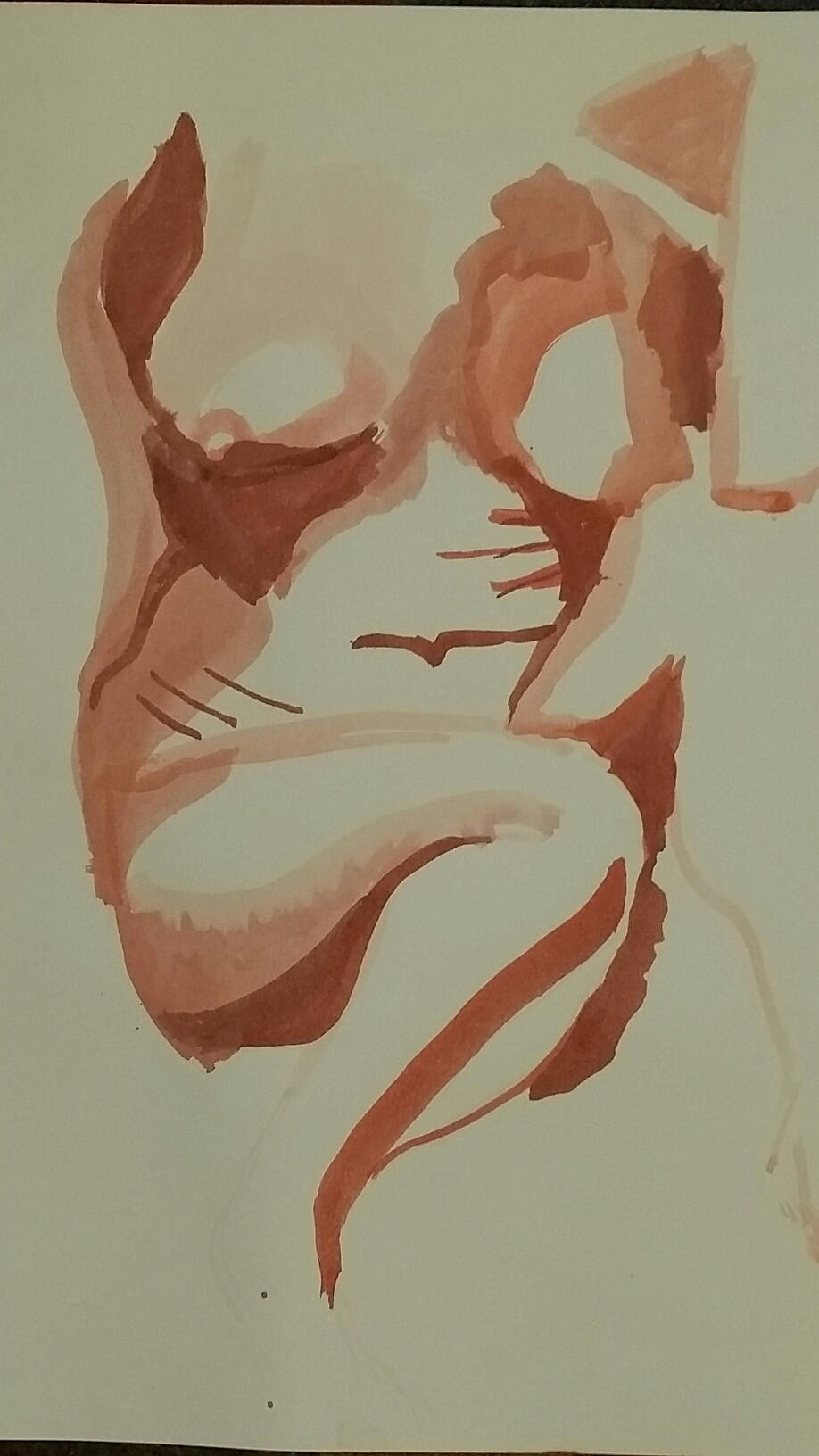
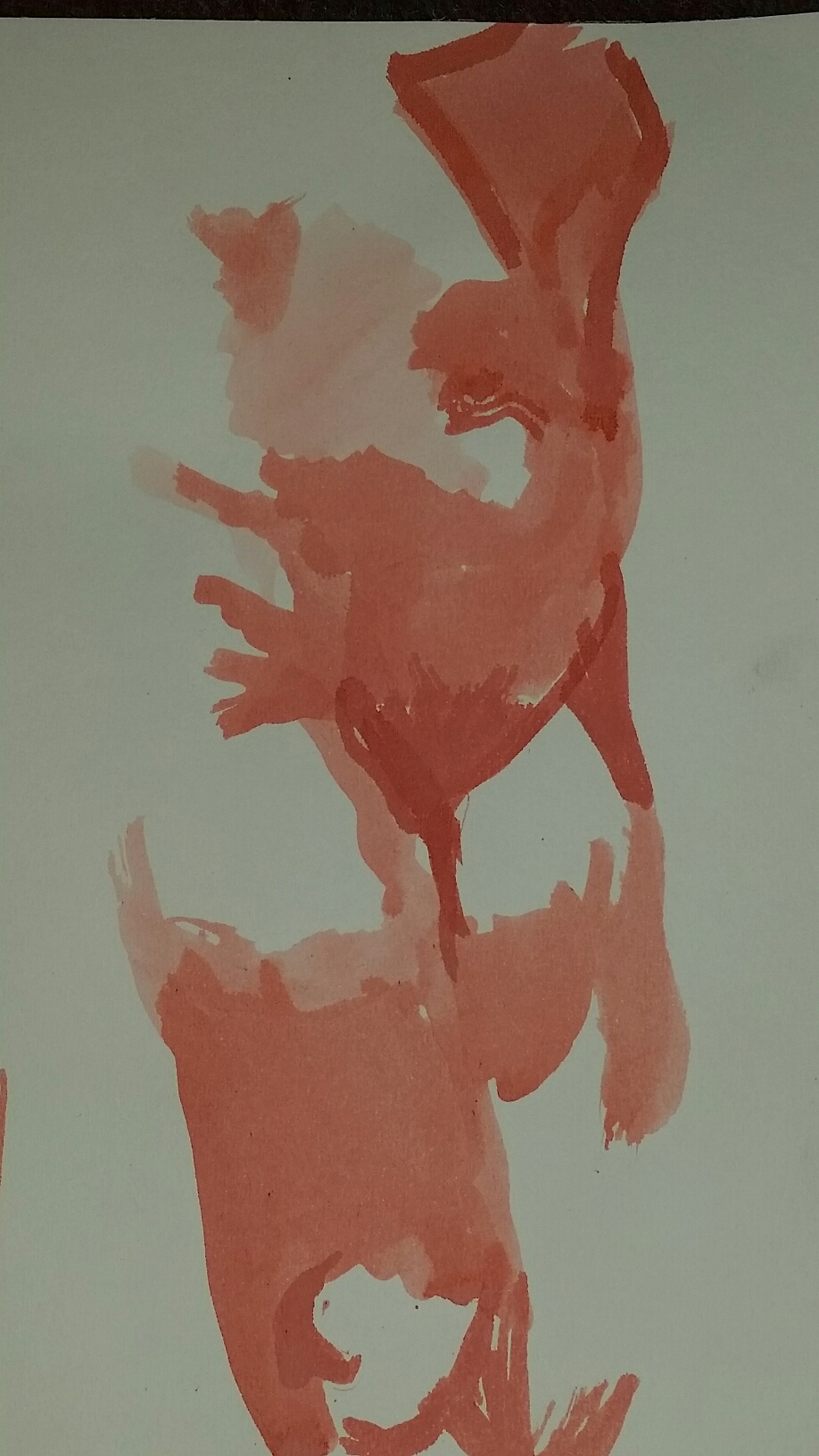
After several years of drawing almost entirely with charcoal, I decided to take the plunge and try two new things: color, and a brush. I have a couple of brushes, but I couldn’t find them this morning, and just grabbed one of my eight-year-old daughter’s, with plastic bristles (Poor child! We must treat her to some proper brushes). I recently bought a few bottles of ink in shades of reddish brown for another project, so I brought those, and also the watercolor tubes I haven’t opened in five years.

image

I brought my box of charcoal just in case, but I didn’t use it. But I was tempted. So tempted, because . . .

image

. . . This was hard! I didn’t know what I was doing. I was figuring out the media as I went: how does ink spread? How do you judge the color when it’s in the dish? How much liquid does the brush hold? What happens if you paint over a place that’s already been painted and dried? I felt like I was back in kindergarten. It was less playful than scary.

image

That fear was a humbling reminder of something I wish were not true of me, but often is: I do not like to do things I’m not good at.

imageHuh? What am I in the studio for, if not to do something I haven’t done before? Am I really playing it that safe most weeks? I hadn’t thought so–each session is certainly challenging and exciting, just trying to draw with the charcoal–but the way I felt today was unmistakable. It was what I feel when I’m doing something new and scary.

image

As a result, it was also the most exciting session in a long time. The drawings are messy but (rather, and) full of novelty. In every one, I was trying something I literally haven’t done in decades, if ever. I even got my playfulness back.

image

image

As Munchkin was looking at the drawings, she said, “I like these. You can tell you were really looking at the light.” I demurred, saying, “Sometimes I was, but mostly I was just making it up as I went along.”

imageShe looked at me and said, “That’s what art is.” My daughter, my teacher.

image

Every Sunday my eight-year-old daughter asks, “Is today a Navigators Day?” She loves church and Children’s Religious Education, but the best Sundays of all are the weeks she puts on her green kerchief and goes to Navigators. She wouldn’t have those if it weren’t for Nathan Harris.

Nathan started coming to our church three years ago when he and his then-seven-year-old daughter, Sage, were new to the area and looking for a community they could call home. They found it at our church, and what they didn’t find ready-made, Nathan helped create. He started a unicycle club, and we soon saw UU Unicyclists all over the parking lots and paths of the church. He learned about Navigators USA, a bias-free, co-ed scouting program, and asked our minister of religious education, Dan Harper, how to go about starting a chapter. It wasn’t long before Chapter 42 was born, and my daughter and a dozen other kids were camping on the church grounds, hiking, learning how to split wood and build a fire, geocaching, cooking, sending up rockets, you name it.

Now Nathan is about to leave the area. He doesn’t want to; he likes his job as a school psychologist in East Palo Alto, the church community, the friends he and his daughter have made. But the rent on their tiny apartment–he calls it “the hotel room”–is rising by 10%, and he can’t find anything else.

When he moves away, someone else will have to co-lead Our Whole Lives (OWL), our sexuality education program for middle schoolers in and beyond our congregation—or maybe we won’t be able to find a replacement. Someone else will have to lead the five-mile hike, if they can keep up with an energetic bunch of 7-10-year-olds. Sage’s friend who looks so much like her that we call them doppelgangers will have to say goodbye to his twin.

This has happened in our church more times than I can count. Someone who is a small-group leader, a teacher, a friend, a mentor, a singer in the choir, a Board member, reluctantly pulls up roots and moves to somewhere with affordable housing. It happens to property owners, though more often to renters; it happens to professionals like Nathan, though more often to those with lower-paying or part-time jobs. They want to stay, and we want them to, but they can’t. Our public policies are forcing them to leave, hitting our community with loss upon loss.

In our church, our big annual fundraiser is an auction of goods, services, and hosted events. An auction makes a great fundraiser. It makes a terrible system for delivering the necessities of life.

Yet that is how we sell and rent housing: to the highest bidder. And the highest bidders around here have such deep pockets that those who manage to offer what the seller is asking have little chance of winning the bid. Think of all the times you’ve heard of a would-be buyer offering considerably more than was asked, yet losing out to someone who could pay cash. And renters: when has your rent gone down, or even simply kept pace with inflation? In the past year, Bay Area average rents have risen over 14%. Those of us who didn’t get a 14% pay raise, such as Nathan: where are they supposed to live?

The answer we’ve given is clear: they’re supposed to go away.

And when they’ve gone, who will be the psychologists in our schools? Who will be the teachers, the police officers, the store managers, much less the gardeners, the cooks, the janitors? Who will create our scouting programs or volunteer in our schools?

With our housing-only-for-the-highest-bidder system, we have made our community increasingly hostile to anyone in the mere 99%. That is not sustainable for our families, our earth (many people burn fossil fuels for 20 or more hours every week driving to work here from their affordable homes in the Central Valley), or the quality of life of our communities.

These market forces aren’t all to the bad, and in many times and places, they have served most people. They aren’t serving us. They are ripping us apart. We need cities to stabilize rents and preserve enough housing that’s affordable to the people who make our communities run—who are our communities.

My daughter was hoping Nathan would teach her to ride a unicycle. She’s got a few more weeks to learn. Then he and Sage are off to Sacramento. I wish them luck. And I wish us luck too. But we’ll have to make our own luck, by summoning the political will to make some changes, now, before the next Nathan and Sage are driven out of our lives.

Note: I wrote this in May, 2015, and submitted it as an op-ed piece to various newspapers in our housing-strapped region. I’m sure many other local communities, from workplace teams to PTAs to altar guilds, experience similar losses and stresses as their members are forced to be transient, but alas, none of the papers chose to run it. So here it is, a bit past the time. Nathan and Sage are now settled in to their new lives in a home they can afford and that has a lot more space; our loss, Sacramento’s gain. Someone else will have to teach Munchkin to ride a unicycle, if they know how.

I was walking around a pond in a development in Louisville, Colorado, yesterday afternoon when I saw a fluffy black and white flag wiggling above the foot-tall grass. Then another appeared. Before I caught a glimpse of the bodies that went with the tails, I knew they had to be skunks.

I hesitated for a moment, thinking of their reputation even though I know it’s exaggerated, but reasoned that even if they noticed me, they wouldn’t be frightened into spraying, with me several yards away and easy escape routes all around. So I watched for several minutes as they moved between partial and complete concealment. I am not sure I have ever seen a living skunk in the wild, and I wouldn’t have expected to see one before dark. As best as I could tell, one was larger than the other and both were nosing along the ground or close to the roots of the grasses.

They disappeared into the high reeds closer to the edge of the pond, and I watched for another three minutes or so but didn’t see them again. I reluctantly headed back to the house, feeling so elated that sighting a rabbit hop ahead of me and across the road a few minutes later seemed ordinary.

I said I would be happy to read a shopping list written by Harper Lee. I might have gotten my wish. This is not a novel: a story. It is an essay trying to become a story and not really succeeding in being a story or an essay.

I’m sure a lot of new writers have manuscripts like this in boxes under their beds, which is where they should stay. You have to write a lot of dreck to learn to write the great stuff, and it’s nothing to be ashamed of–don’t I post my own drawings here, bad as most of them are? You can see a common phenomenon here: a talented, deeply thoughtful novice has some ideas she wants to explore, and by God she’s going to explore them, and story be damned.

I was going to describe what happens to the story after Jean Louise discovers that her boyfriend and, far more crushingly, her father are members of a Citizens’ Council, but I can’t improve on Adam Gopnik’s concise summary in The New Yorker (July 27, 2015: 68): “Shocked, she confronts [Atticus], and starts on a series of static and prosy debates–first with her uncle Jack . . . and then with Atticus himself–about integration, the N.A.A.C.P., the Tenth Amendment, and other fifties-era subjects, all offered mechanically as set pieces, accented with oaths and ‘Honey, use your head!’s to make them sound a little more like dialogue.” Gopnik left out the boyfriend and aunt; she goes a few rounds with them too.

There are interesting ideas in there, even 60 years later, though they’re most interesting to me as a window into that period of our racial struggles–they are social history. But, as I said: not a novel. At this point in her writing life, Lee hasn’t figured out how to embody ideas in plot and character yet. They’re just air.

It’s a joy to see her terrific descriptions of characters and places. You can tell that this writer has a lot of talent. She has a lot to learn about dialogue and pacing, but those who have read To Kill a Mockingbird know that she will quickly learn it, and superlatively. Reading Go Set a Watchman, though, is like skipping along through a meadow of interesting characters and then suddenly finding oneself knee-deep in mud, unable to move. The characters stop talking to each other and start lecturing the reader through each other. The drama of their relationships grinds to a halt as we’re forced to listen in on an improbable family dispute that reads like an op-ed page. The most interesting dramas from the point of view of a Mockingbird reader–the confrontations with Calpurnia and Atticus–don’t make much sense because we don’t know these characters well enough to have a context for the conflict. (As readers of the previous book, we can interpret them as the characters by the same name–but, as I wrote in my previous post, that doesn’t quite work; the backstory is too altered. We don’t know this Cal or this Atticus–but, not to dodge the central issue raised by this book, I’ll write more about him in my next post about this book.)

The best parts of Go Set a Watchman are flashbacks to Jean Louise’s childhood, and you can see the seeds of Mockingbird there, in incidents that didn’t make it into that book, such as the revival and baptism she, Jem and Dill put on in the yard, or her countdown to suicide when as a hopelessly naive twelve-year-old, she is sure she’s been impregnated by an unwanted French kiss. Lee’s astounding ability to convey what’s in the mind of a young girl comes through even in third person, and even with an omniscient narrator, which is used as clunkily here as inexpert writers do tend to use it, the reader popping suddenly into a secondary character’s head and popping out again. By the time she writes To Kill a Mockingbird, just a couple of years later, she is in masterful control of voice and point of view, and those portraits of places and people have become the verbal equivalents of Constable landscapes and Rembrandt faces. Sadly, that book remains her only successful novel.

Go Set a Watchman has been described as a sequel to To Kill a Mockingbird. After all, we see Jean Louise (“Scout”) Finch, her father Atticus, her uncle and aunt Jack and Alexandra, in the town of Maycomb, Alabama. But “sequel” is a misnomer, because a sequel is the continuation of a story. It becomes clear almost right away that the past of the characters in Watchman is not the past told about the characters with the same names in To Kill a Mockingbird. The editor of Watchman, Jonathan Burnham of Harper, qualifies it as “Reading in many ways like a sequel to Harper Lee’s classic novel,” and the many ways in which it is not a sequel have a significant impact on our interpretation of each book (more on that in post 4). The experiences of Scout1 are so different than the experiences of Scout2 that it’s best to read Go Set a Watchman as alternative history.

I’m not talking about minor changes and absences. Watchman can’t refer to every incident, even every important incident, in Mockingbird; that would be silly. And one key character who almost certainly did not exist in the Maycomb of To Kill a Mockingbird, Henry Clinton, remains in Go Set a Watchman because Lee needs him there. That’s not what makes it an alternative history novel.

Rather, I’m looking at three core events of To Kill a Mockingbird, events so central to the story that their omission makes the adult Jean Louise of Watchman a different person than the grown-up Scout who narrates Mockingbird.

First, at one point in Go Set a Watchman she strolls toward her childhood house and “steels herself for Mrs. Henry Lafayette Dubose’s onslaught” (112). In other words, in Watchman, Mrs. Dubose is still alive. I read the passage several times to see if it were perhaps meant as a flashback, and I’m pretty sure it’s not. The idea of putting Mrs. Dubose at the center of one of the most important events of a novel simply hadn’t occurred to Lee yet. And so we have an adult Jean Louise who did not sit with her brother afternoon upon afternoon while he read to an old woman who piled racist abuse on their family as, unbeknownst to the children, she fought to free herself from morphine. The incident with Mrs. Dubose ends Book I of Mockingbird. It is the experience that Atticus hopes will prepare them for an unwinnable fight in the courthouse, and it parallels it. But this Scout never had that experience.

Second, there is no Boo Radley in Watchman. Oh, I know he could well be dead by then, with no Radleys remaining in that house by the time Scout is a woman of 26. But even so, it is hard to imagine that an adult Scout, returning to her hometown and walking down memory lane in her old neighborhood, would not spare a thought for Boo Radley–unless he hadn’t been invented yet in her creator’s mind. Boo is the title character of Mockingbird (a designation he shares, of course, with Tom Robinson, and by extension with black people in general). His story frames the novel; it begins and ends it; it shapes Scout’s entire adult consciousness. How can there be a grown-up Scout who reflects on the summer of the trial without Boo Radley crossing her mind? Answer: this is a different Scout.

And finally, the Jean Louise of Go Set a Watchman is a woman who never saw Tom Robinson unjustly convicted. The story she identifies as pivotal to Atticus–pivotal to her understanding of who her father was and is–is similar enough that we know it’s the seed of Mockingbird, yet crucially changed.

Atticus Finch rarely took a criminal case; he had no taste for criminal law. The only reason he took this one was because he knew his client to be innocent of the charge, and he could not for the life of him let the black boy go to prison because of a half-hearted, court-appointed defense. The boy had come to him by way of Calpurnia, told him his story, and had told him the truth. The truth was ugly.

Atticus took his career in his hands, made good use of a careless indictment, took his stand before a jury, and accomplished what was never before or afterwards done in Maycomb County: he won an acquittal for a colored boy on a rape charge. (109)

Need any reader of To Kill a Mockingbird be reminded how important it is to the story, and to the development of Jem and Scout as characters, that Tom was not acquitted, but was convicted? Here are a few passages in case it’s been a while:

   “Aw, Atticus, let us come back,” pleaded Jem. “Please let us hear the verdict, please sir.”
“The jury might be out and back in a minute, we don’t know–” but we could tell Atticus was relenting. “Well, you’ve heard it all, so you might as well hear the rest. Tell you what, you all can come back when you’ve eaten your supper–eat slowly, now, you won’t miss anything important–and if the jury’s still out, you can wait with us. But I expect it’ll be over before you get back.”
“You think they’ll acquit him that fast?” asked Jem.
Atticus opened his mouth to answer, but shut it and left us. (210)

I shut my eyes. Judge Taylor was polling the jury: “Guilty . . . guilty . . . guilty .. . guilty . . . ” I peeked at Jem: his hands were white from gripping the balcony rail, and his shoulders jerked as if each “guilty” was a separate stab between them. (214)

“Atticus–” said Jem bleakly.
He turned in the doorway. “What, son?”
“How could they do it, how could they?”
“I don’t know, but they did it. They’ve done it before and they did it tonight and they’ll do it again and when they do it–seems that only children weep. Good night.” (215)

Although “things are always better in the morning” (215), that despair soaks into the novel and forms the narrator Scout’s account. Remember the haunting terms in which she recounts the moment of the verdict, linking it to the crisis of the rabid dog that Atticus had to shoot?:

   What happened after that had a dreamlike quality: in a dream I saw the jury return, moving like underwater swimmers, and Judge Taylor’s voice came from far away and was tiny. I saw something only a lawyer’s child could be expected to see, could be expected to watch for, and it was like watching Atticus walk into the street, raise a rifle to his shoulder and pull the trigger, but watching all the time knowing that the gun was empty. (213)

What was devastating was not just the conviction of a man who was obviously innocent, but the realization that it had been inevitable: that it was surprising to no one but themselves. Miss Maudie tells them, “[A]s I waited I thought, Atticus Finch won’t win, he can’t win, but he’s the only man in these parts who can keep a jury out so long in a case like that” (218). They learned from the verdict what every adult already knew: that under the comfortable exterior of Maycomb was the vicious impenetrability of a lynch mob. That disillusionment was what made the “children’s heart break” (282). And the Jean Louise of Watchman never experienced it.

I wish that Go Set a Watchman were a sequel, so that I could spend more time with the woman who emerged from these experiences. But the Jean Louise of Watchman isn’t her. She had a different childhood.

Next post: a novel or an essay?

Enter your e-mail address to receive e-mail notifications of new posts on Sermons in Stones

Links I like