My main sabbatical project is to make art, with a goal of doing so for several hours almost every day. The past few weeks, however, have been mostly “preparing the studio”: packing up our house for the renters, cleaning and repairing and buying and sorting, getting all our traveling ducks in a row (traveling ducks, how cute), and once here in Oaxaca, house-hunting and such. And I was on study leave for four weeks, so was doing a lot of writing and reading. I read Christ for Unitarian Universalists, by Scotty McLennan, which was well-written and interesting; and Promoting Diversity and Social Justice: Educating People from Privileged Groups, by Joan Goodman, whose interesting topic was overshadowed by the prose, which was dire even by dissertation standards (it clearly was written as a dissertation); and a boatload of fiction, including, at last, Octavia Butler’s Xenogenesis trilogy–well, the first book and a half of it so far.

All necessary before the arting could begin. But I knew I would be glum if I didn’t do some art along the way, so I’ve been drawing, doing ceramics, or sketching notes for future pieces, and am now in the rhythm of doing some art every day. I’m almost done with my first piece in clay at Ishuakara (I don’t know how it came by a Japanese name; I keep forgetting to ask), and have another I’m hankering to start. All three of us can work there and have been doing so.

Several nights ago, in the fertile time of half-sleep, I thought of a series of pieces that seem so obvious and in keeping with things I’ve been thinking about for years that I couldn’t believe they had never come to me before. I won’t write about the project here except to say that it’s about the ambiguous nature of decay. I will post photos as I begin to make the pieces. One wrinkle: I am completely ignorant of printmaking and I am pretty sure that this series wants to be prints. An iron for the wrinkle: Oaxaca turns out to be a positive hotbed of printmakers, printmaking teachers, graphic arts collectives, and printmaking history. So I’m going to learn printmaking. While I am occupied with other things I am doing a little research on the different kinds of printmaking (I am telling you, I’m ignorant–I have heard of lithography and etching and monoprint and silkscreening, etc. etc., but since I don’t know how each technique works, I have no clue which one/s is/are best suited to the vision in my head).

Last night, on the way to a dance performance, I picked up a seedpod with such cries of delight that my peri-adolescent daughter treated me to half-disgusted condescension: “You’ve never noticed those before? I have.” Nope, never have, and don’t know what they are–I’ll have to go back and look at the tree–but this morning I drew it, intending this first pass to be very simple and monochromatic, almost schematic. As is always the way with drawing from nature, the process helped me see things about this lovely subject (I was going to say “object,” but it’s a subject) that mere looking hadn’t shown me. Can you see the mistake?: at one point, not yet wise to the necessity of keeping a finger on the podlet I had just drawn, I lost track of where I was and mixed up my figure and ground. Escher would have made something brilliant of that, but I just laughed at myself.

IMG_7052.JPG

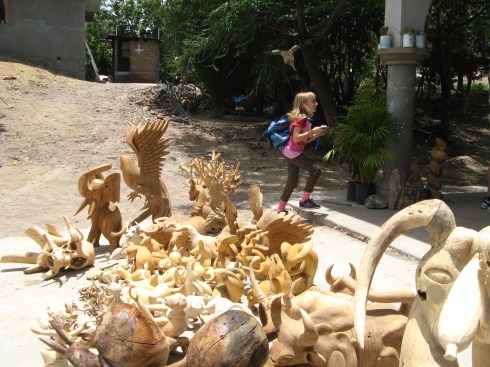
Our new friend Sam took us to San Martín Tilcajete, one of the towns famous for alebrijes, figurines (typically animals) that are carved from copal wood and then painted elaborately. His friend Benito Fabian Ortega is one of the artists and his whole family makes them. Six of us piled into a moto taxi–three adults crammed into the back, Munchkin on a lap, and Benito hanging on next to the driver with one hand, holding his toddler daughter on his lap with the other–and went to their workshop/home/gallery. I wasn’t sure if I should photograph their alebrijes, but you can look up the word to see what I mean, and add “Fabian Ortega” to see this family’s amazing artistry.

Here is the munchkin with a menagerie of alebrijes that have been carved, but not yet painted:

IMG_6967

Later, Benito’s nephew brought out a different kind of menagerie and he, Benito’s daughter, and Munchkin played with them. I’ve seen a lot of dragon alebrijes but no dinosaurs so far.

IMG_6973

IMG_6968.JPG

You would think they had enough carving to do for the market, but someone couldn’t resist embellishing this tree. The whole compound was like that, an exaggeration of the Mexican tendency to exert creativity and create beauty, whether it be on boundary walls, floor tiles, or what have you. The Jewish concept of the “adornment of a mitzvah,” which I absorbed as an artistically-inclined Jewish child, is more alive in this country than any other I have visited. In Judaism it means that one does not just do what is required (a mitzvah is a commandment) but does it beautifully. All one must do to fulfill the commandment to begin the Sabbath with candles is stick a couple of candles upright and keep them lit for half an hour, but if at all possible, one uses beautiful candlesticks kept just for that weekly purpose; leftovers would be enough to fulfill the obligation to give to the poor, but Maimonides teaches that one should give them one’s best cooking. That generosity of spirit is everywhere in Oaxaca, as it was in San Miguel de Allende, where we lived in 2010.

One of the brothers saw me pointing my camera and said I had to come up on the roof. I thought he meant I’d get a good angle on the yard, which was where I’d been taking pictures, and I did, but he also wanted me to see the view. I swear Oaxaca has a corner on the world’s greatest clouds.

IMG_6969IMG_6971

I noticed this hill off to my right and he said it was called Maria Sanchez. “¿Quien era Maria Sanchez?” I asked. He explained that she was a woman who had died there. According to legend, the large hill was her head, the smaller ones off to the left her breasts, and so on. I would have liked to find out more details–how did she die? why was she immortalized in this way?–but I’d been in Oaxaca for only a week at that point, and “rusty” would be a generous term for the state of my Spanish. (It still is, but it gets easier every day to comprehend what people are saying.)

I summoned enough to tell him that in the town I grew up in, Hamden, Connecticut, there is a hill called the Sleeping Giant. It’s the town’s most prominent geographical feature, which lies within a state park of the same name. Climbing one of the giant’s hips to a WPA-built “castle” at the summit was one of the repeated, always fun adventures of my childhood, which I want to repeat with my own daughter on a visit in the not-too-distant future. The college where my father taught is nestled in its shadow; the town likes to refer to itself as “land of the Sleeping Giant,” and I went to Sleeping Giant Junior High School. The giant, as told by the Quinnipiac Indians, is Hobbomock, who wreaked havoc (apparently with good intentions) when he stamped his foot, and was put into a permanent state of sleep by a more peaceable spirit. Our host seemed unsurprised by the similarity, and in fact when I looked up “sleeping giant” to check a couple of details just now, I discovered that there are similar legends in Kauai and Ontario.


I’m sad and worried for the people of the city of Oaxaca. For weeks, the Zócalo (central square) has been full of the tents of protesting teachers and the sellers of food and cheap goods that have seized the moment. Tensions have been high, with various roads out of the city under blockade, and the state police killed nine people last week.

Now the warning is going out: at 10 p.m. (35 minutes from now), the military will sound an alarm to tell everyone to stay in their homes, and shortly after that, they will move into the Zócalo and move the protesters out. If you are a praying person, please pray for a good outcome. If you do something else to help people deal with conflict nonviolently, please put a little more into your efforts in support of Oaxaca.

One of the minor flaws of the San Francisco Bay area is its lack of thunderstorms. It is less thunderstorm-prone than almost any part of the country. I am sure this is good news for our cat, but the human members of the family love thunderstorms and those of us who grew up in the northeast miss them.

Oaxaca is coming to our aid. It rains a lot in June and July here, and the storm is often accompanied by thunder and lightning. We had lots of lovely rumbles all afternoon today, and I got out my oil pastels and drew the view from our window, looking past the curtains to a big frond-y plant and the door across the courtyard. My daughter declares me an expert in the medium, but I, who have a vision in mind, not to mention a familiarity with Cassatt and Degas, conclude that I really want to learn how to use pastels. It was a lot of fun, but the results don’t even merit the term “novice.” Maybe the next attempt will be just of the plant. It is what really caught my attention.

We’ve only been house-hunting in earnest for a few days. We arrived in Oaxaca Monday night, and have been staying in the lovely Al Sol Apartments for most of that time. They are a great short-term place; some people even live here for months, but none of the apartments is big enough for us to do that. We want to have a room dedicated to art–having to clean up after oneself before dinner every night is an impediment to working–and if possible, maybe even another room that is reserved for the many guests we hope to host. With the exchange rate approaching 20 pesos to the dollar, we can probably afford what we want, if it exists.

We have visited half a dozen places to rent. Most have featured either depression-level dinginess (think 40-watt light, the furniture your grandmother bought on sale in 1959, and an 18-inch stove) or a distance of 20+ minutes’ drive from the Centro, the central part of the city. Then, today, we found a really nice apartment, big enough, well within what we can afford, and nicely furnished. We could say yes to it and stop searching.

But this is what’s making it so hard to do:  the memory of the house we rented in San Miguel.  Oh, it was funky and a bit broken down. There was peeling paint, and our rooftop garden was just a rooftop. The gas pressure was so low that it was hard to use more than one burner at once, and impossible to crank the oven up to consistent baking temperature. But look at that kitchen! Look at the tiles, and the ironwork and the woodwork. We had a courtyard and it was gorgeous. The whole house was a casa tradicional, not something you’d be just as likely to find in Seattle. We’re all holding out for that in our hearts. It makes “good enough” feel not quite good enough.


Between study leave and sabbatical, I will not be back at my church until January 2, 2017. I will miss the people there. And I am very busy right now purging belongings, cleaning and organizing, making arrangements, and doing everything it takes to turn our house over to renters and begin a six-month sojourn in Oaxaca, Mexico, in about a week. Just the same, I feel a spaciousness in my life that is best symbolized by this screenshot.

inbox screenshot

My period had come for Prayer—
No other Art—would do—

image

My Tactics missed a rudiment—
Creator—Was it you?

image

God grows above—so those who pray
Horizons—must ascend—
And so I stepped upon the North
To see this Curious Friend—

image

His House was not—no sign had He—
By Chimney—nor by Door
Could I infer his Residence—
Vast Prairies of Air

Unbroken by a Settler—
Were all that I could see—
Infinitude—Had’st Thou no Face
That I might look on Thee?

image

The Silence condescended—

image

Creation stopped—for Me—

image

But awed beyond my errand—
I worshipped—did not “pray”—

image

The light on my daughter’s face, and the face, were so beautiful that I said “I wish I could draw you,” and to my surprise she volunteered to hold still for 10-15 minutes.

image

It’s not a bad impression. It has that faraway look she has when she’s thinking. Naturally, it’s not as beautiful as the original.

A member of my congregation has translated the benediction we say each Sunday into Spanish (the English version is at that link). He’s an excellent linguist, fluent in German and English as well as his native Spanish, accomplished in French also, and with a poet’s ear for language. This coming Sunday some of us will say our benediction in Spanish, some in English, and some both, at the close of our Flower Communion service:


Vete en paz al mundo

Mantén tu valentía

Sostén lo bueno con firmeza

No pagues maldad con maldad

Fortalece a los frágiles de corazón

Apoya a los débiles

Auxilia a los que sufren

Goza de la belleza

Expresa amor con palabra y acción

Honra a todos los seres.


Thank you, G.!

I dwell among words, talking fast (it’s the northeastern, Jewish heritage) and trying to listen well. I forget to make time for silence, especially when in the company of others; the rush of words flows by so fast. This afternoon I had a visitor to my office with whom I had more time for silence.

She is Deaf, and since I only know half a dozen signs in ASL and she neither speaks nor reads lips, we conversed by writing. This meant that for long stretches, as she wrote on a notepad, I set aside language and received the things that usually recede to the background. One hand rested on the page, the other wrote, and I imagined drawing them and trying to convey all that they had done and written over the decades. Her hands looked browned by sunlight, like her face, suggesting days outdoors and places traveled. Her jeans were worn to softness and I wondered if they were as comfortable as they looked. Her hair was gray–what color had it been before? And where was that girlhood spent–what memories did she carry? What did it feel like to brush that straight, smooth hair each morning, to look out from those eyes?

She wrote several sentences, pausing to consider and even erase. I had time to consider all of this before she finished and handed me the pad to read and respond. It felt like a gift: to be dipped into a quiet pool and permitted to float there for a while before the flow of words resumed.

Enter your e-mail address to receive e-mail notifications of new posts on Sermons in Stones

Links I like