This one has a sweet 🙂 association for me: when we go to Bass Lake for our church’s family camp weekend, as often as not my daughter and I have the cabin called Sugar Pine.
I kept my marks light in anticipation of adding color, but it took a long time just to draw it with the graphite, so that was enough. I think for tomorrow’s drawing, in lieu of the next tree I will add the color to this one. It is the most gorgeous light gray-green, and the colors in the photo make it look even more like a sea anemone than it does here.
According to the Audobon guide, “Unlike most pines, this species often produces new shoots or sprouts from cut stumps.” The less typical variety, var. chihuahuana, is the one native to California. I think that must be the one pictured here, because it has three needles in each bundle, whereas the variety found in Mexico has five.
This time the name is not a slur. The range of this species does coincide with a lot of Apache territory; hence the common name. Its scientific name is Pinus engelmannii.
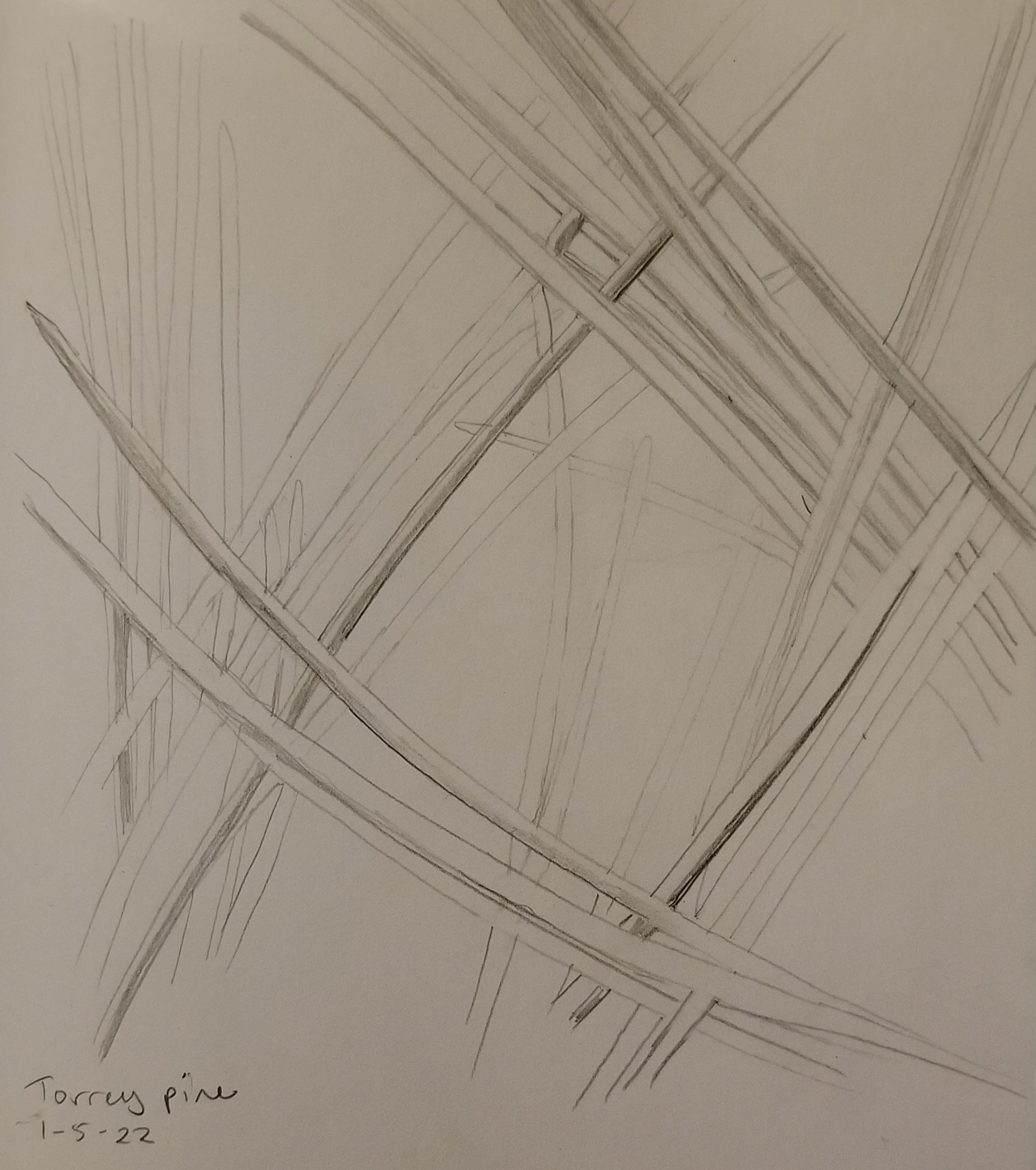
Torrey pine needles are very long–typically 8 to 13 inches–and they are frequently used in woven baskets. With that in mind, as I looked for a large close-up photo of the needles, this one by Susan Beauchemin (second photo in that blog entry) caught my attention because of the subtle weaving in and out of some of the needles as they grow towards one another from different bunches. I used one portion of that photo as my model.
Torrey pines are native only to California, and are critically endangered, with just a few thousand wild trees, almost all in San Diego.
“The odor of crushed twigs defies exact description,” the Audobon guide says. “The scent has been likened not only to lemons and vanilla, but also to violets, pineapples, and apples.” I sympathize with those who have tried to identify the equivalent scents, as I imagine it is a task comparable to trying to identify the shades of whitish-green that appear in the closeup photos of these needles. The brain is so accustomed to interpreting what the eye sees that it’s hard even to know what color I’m looking at. And then to convey the blur behind the few needles that are in focus . . . Well. I’ll have many opportunities to practice.
P. jeffreyi is a native species here in California, though the person it is named for, Scottish naturalist John Jeffrey, brought many of the plants he found here back to Scotland, where I hope they are not invasive.
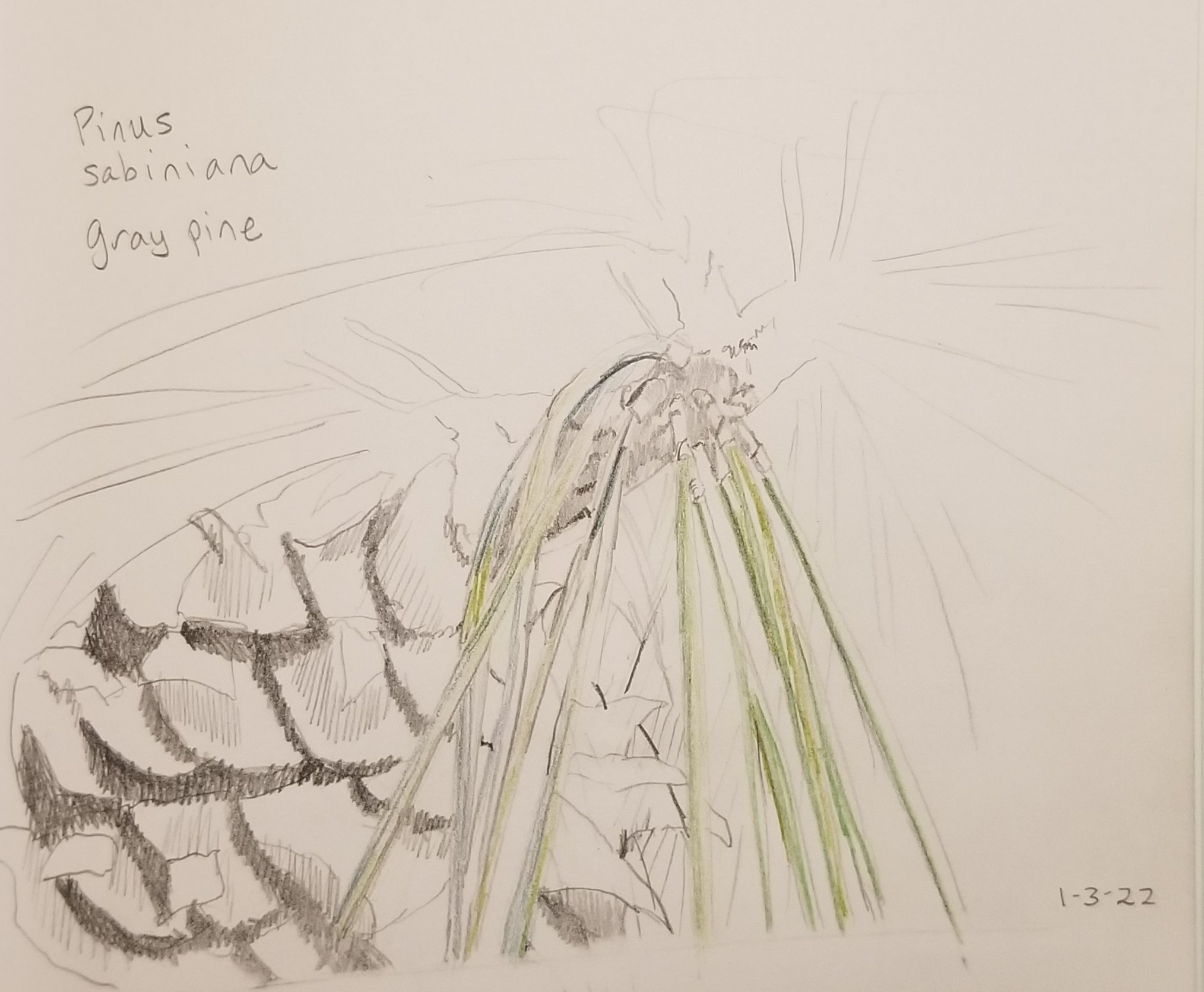
Today’s needles are those of Pinus sabiniana. The Audobon guide calls it “digger pine,” but when I looked it up online in search of a larger photo to work from, the common names that kept coming up were foothill pine, towani pine, or most often, gray pine. I thought the clue to the change was in the Audobon guide itself, which noted that “digger pine” came from the name given (by Europeans, one can infer) to the many Indian tribes of the west as a whole. Hm, sounds pejorative, and sure enough, the Jepson Manual of 1993 advises against it (see how much I’m learning? I knew next to nothing about California plants before this week, and now I am tossing around terms like “the Jepson Manual”). My Audobon guide was published in 1980: progress.
It seems fitting, therefore, to add here its common name in various Californian languages–which, contra those who lumped the tribes into one, are greatly varied. People of the Ohlone language group, the region in which I live, call it xirren or hireeni. Others known to Leanne Hinton (author of Flutes of fire :essays on California Indian languages. Berkeley, CA: Heyday Books) are tujhalo (Achumawi), axyúsip (Karuk), sakky (Southern Sierra Miwok), gapga (Klamath), sakky (Chimariko), tunah (Mono), náyo (Wappo), c’ala’i (Yana), tuwa (Patwin) and, the one that has made its way into wider use, towáni (Maidu). Some of these languages are critically endangered or extinct, and with them, the lore embedded in these names. The nuts of pinus sabiniana are particularly good to eat, and several Californian languages have words specifically for the nut, and in one case different words for the ripe and unripe version.
On a lighter linguistic note, when I was a child, I thought “penis” was spelled “pinus,” so that seeing the scientific name of pine species still gives my inner six-year-old a giggle.
Unlike the previous two trees, the gray pine is native to California.
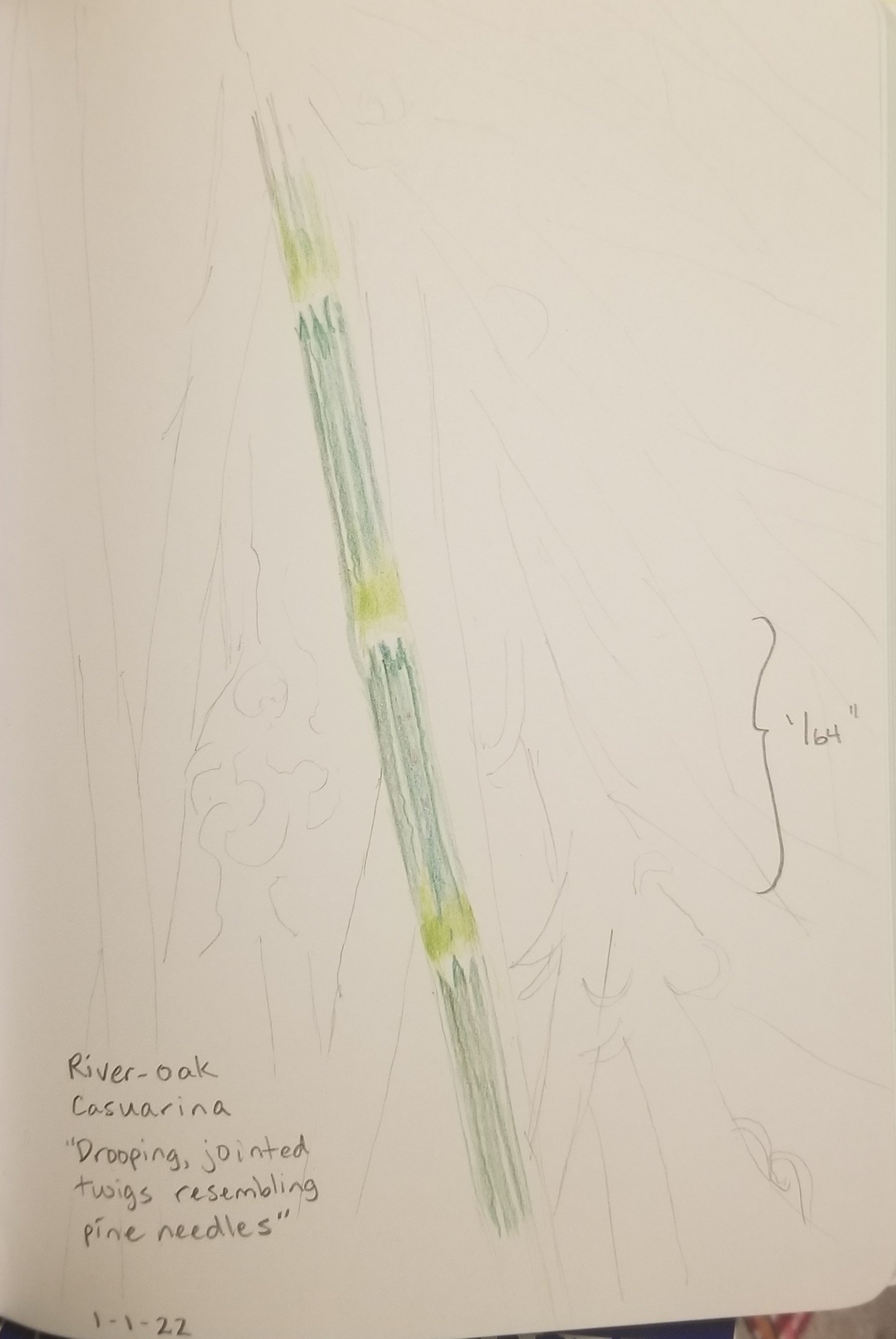
Introduced in the US, invasive in Australia, and a real pain to draw the way I tried it. I really wanted to get the tangle of needles and their contrast against the dark shadows, but whoo is that tough with pencil on white paper. For similar trees over the next few days, I may try a scratchboard, white on black. My daughter gave me some a year or two ago and I enjoyed doing some other botanical drawing on it.
I don’t usually do New Year’s resolutions, but I’ve thought of two that would improve my life that I think I can actually carry through for an entire year.
One is to draw a leaf every day of the year. In this I was inspired by my friend Janet, who drew her way through a field guide to butterflies and posted the drawing each day. I like the field-guide approach because it skips right over the choosing. Whatever leaf is next in Audobon’s guide to trees of the western United States, I draw.
The other is to take a tech sabbath, just as Casper ter Kuile describes in his book The Power of Ritual–relevant excerpt here. Phone and computer away on Friday evening, not to be taken back out until Saturday night. I will permit myself exceptions for being on call or on family outings for which I ought to have my phone, but only to use it for necessary calls or texts (you know, the “Where are you? I thought we were meeting at Mission & Hayes at 2” type).
What about you? Do you use New Year’s for resolutions, as a rule? Have you had any particularly successful or unsuccessful ones?






Recent comments