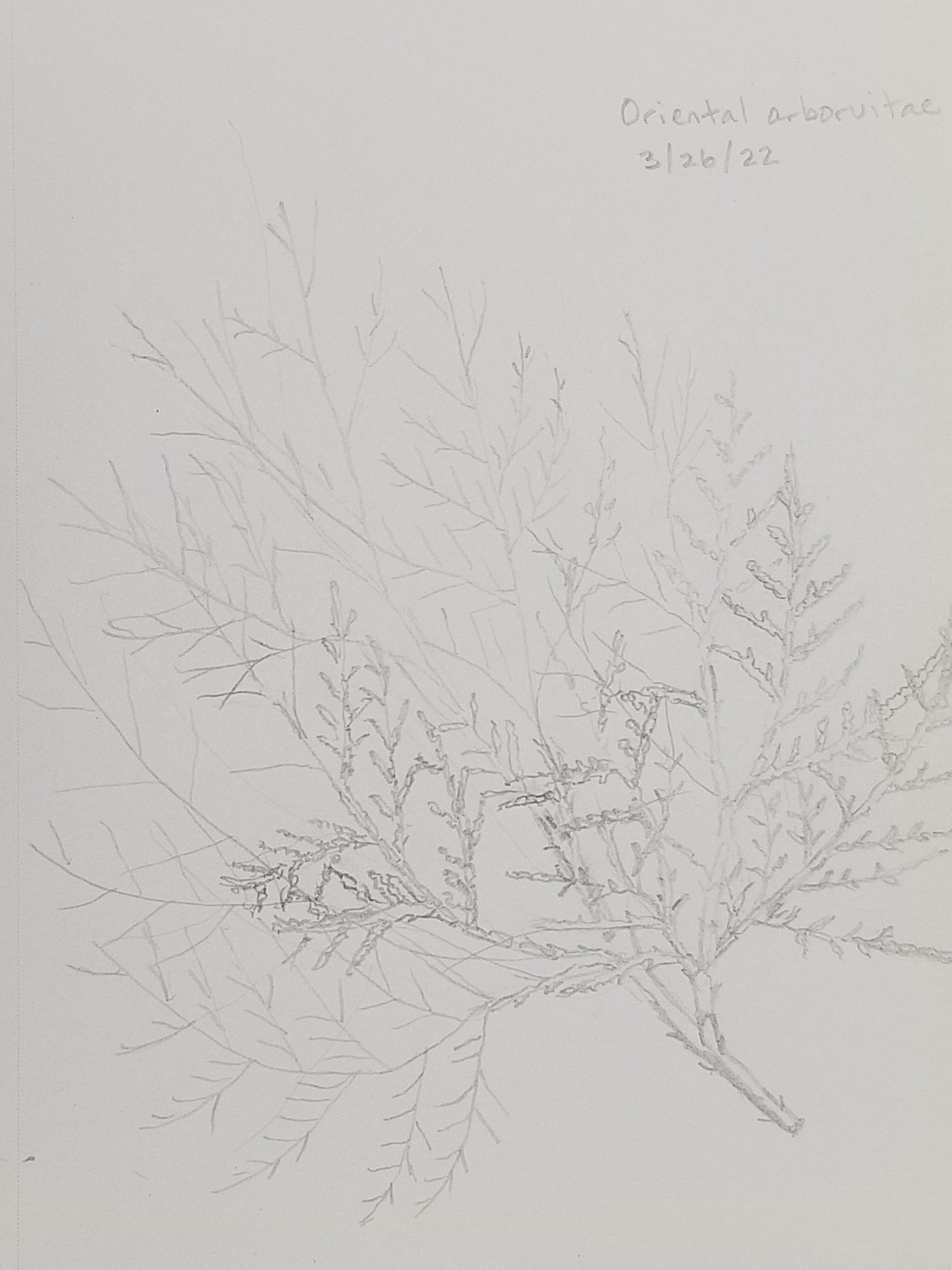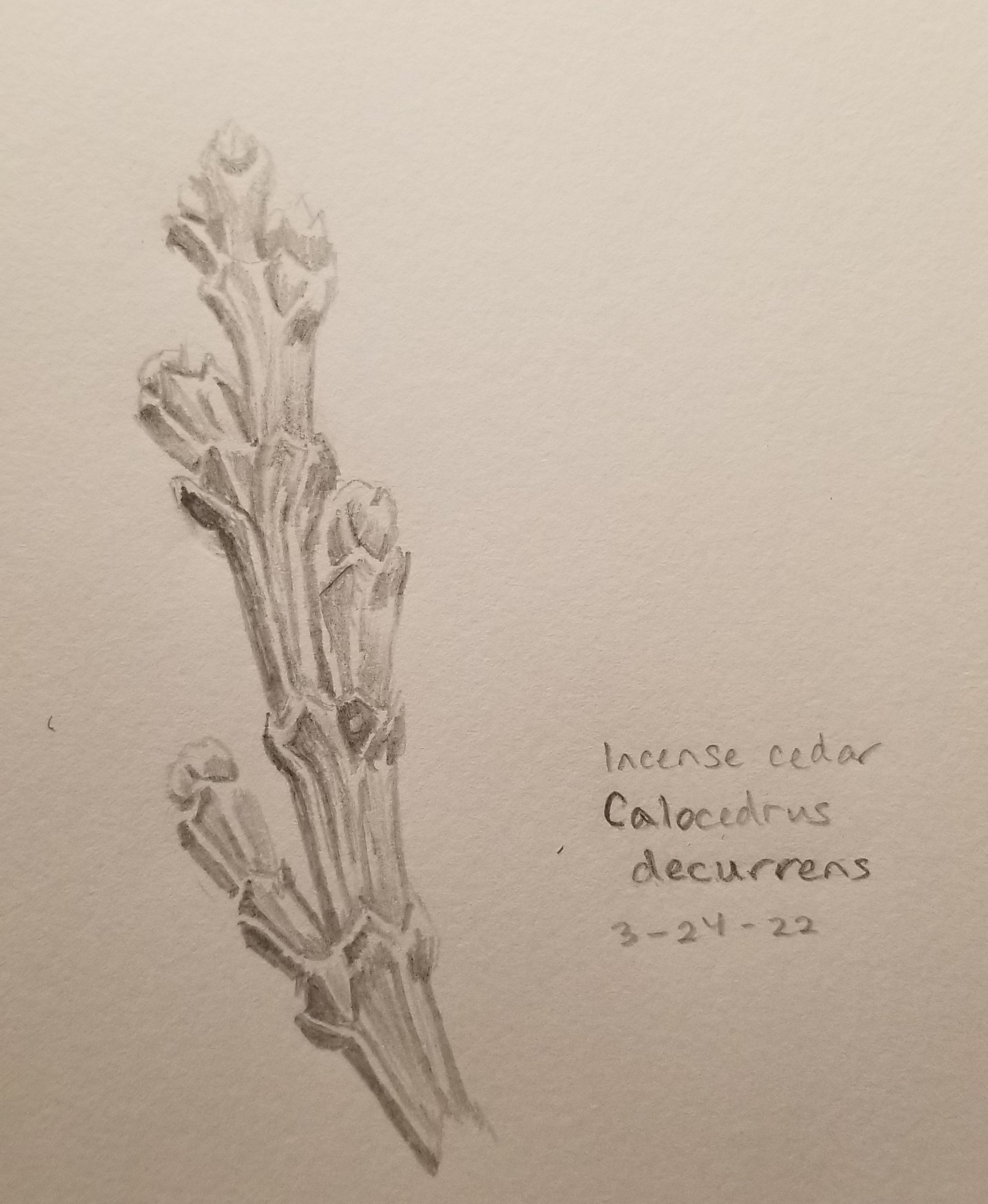
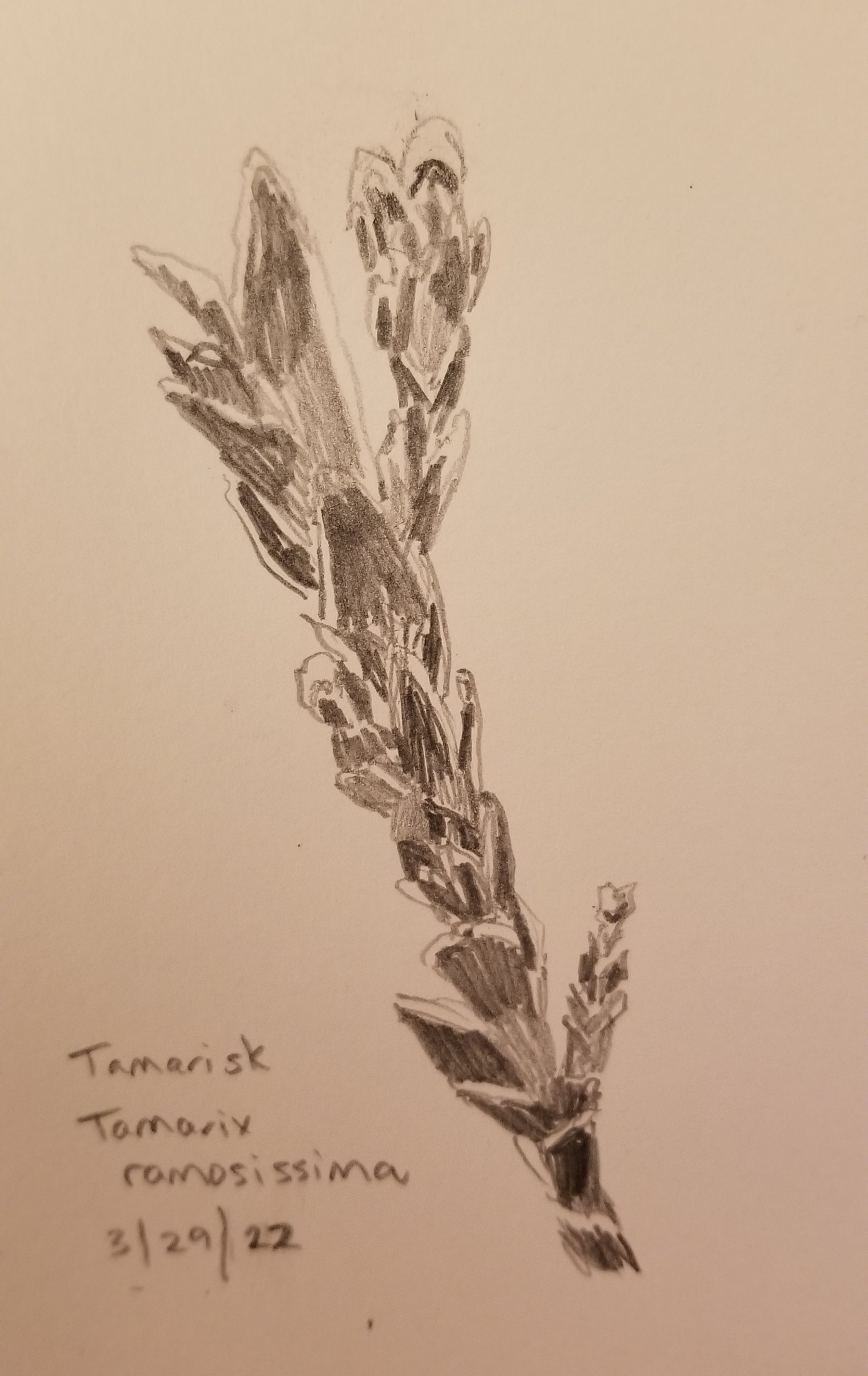

Scientific name Platycladus orientalis. The branch is so beautiful, I longed to draw every detail. That lasted for, well, you can see. A few twiglets.
I need to copy works of some of the great draftspeople to learn better how to combine detail and a more impressionistic approach. It’s so mysterious to me.
This is yesterday’s drawing, because last night was so packed with packing and work deadlines. We are on the road. Oriental arborvitae kept me happy as we waited for a delayed flight, and tonight I’ll be in another state and draw the next one.


These leaves take my breath away.
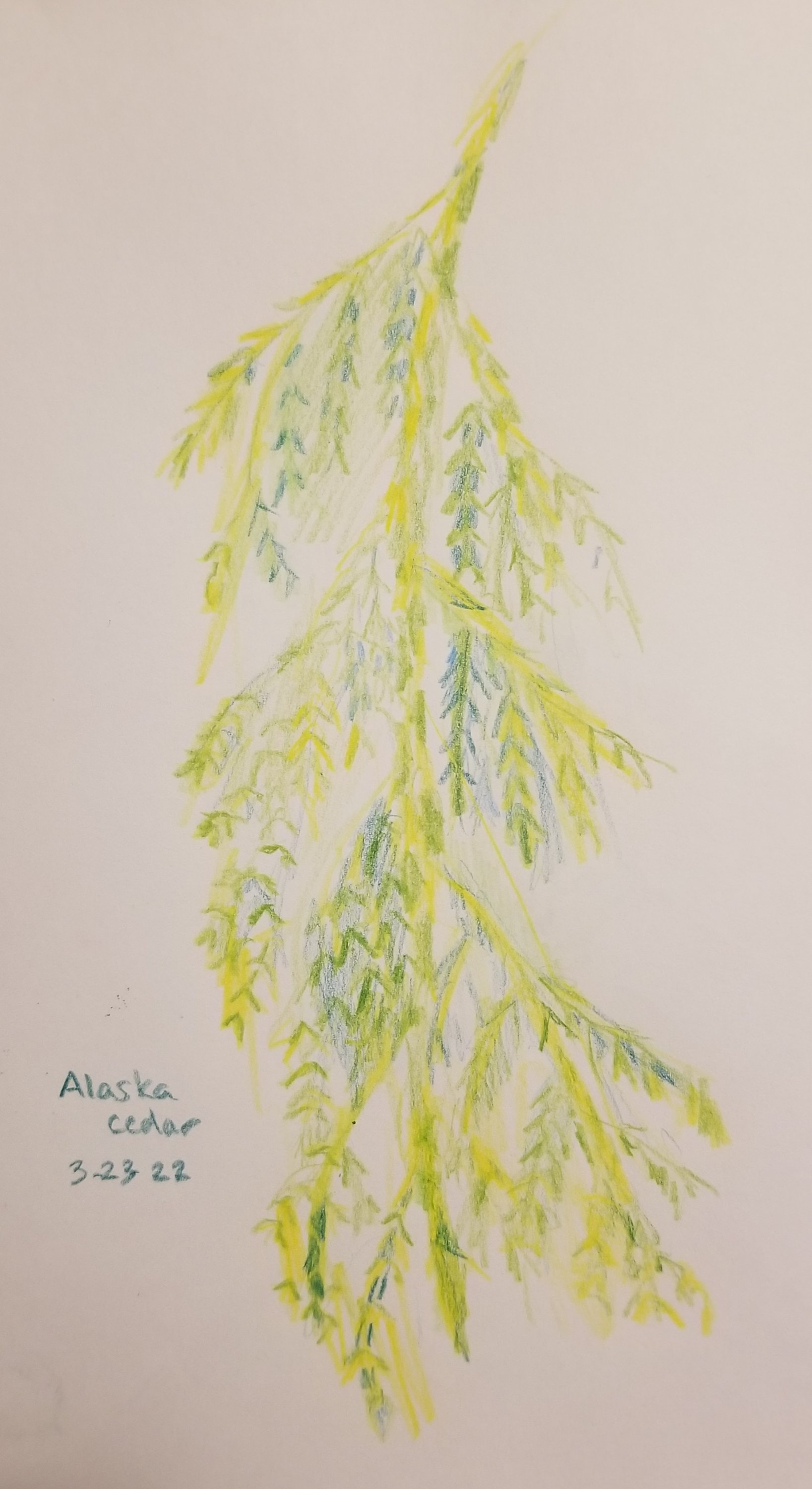
And I am at the back page of the sketchbook my daughter gave me a year or two ago. The last entry: a weeping branch of Chamaecyparis nootkatensis.


. . . which isn’t a cedar. At least, it’s not of the genus Cedrus. Quite a few conifers not in that genus get called cedars anyway, and this is one of them. It is a member of the genus Chamaecyparis, making it a cypress, though there too, the common name of “cypress” and the family, Cupressaceae, do not consistently correspond to each other. Maybe frequent commenter ERP will work through the tangle of what is and is not a cypress or a member of Cupressaceae.
In any case, for a tree to belong to this genus, Chamaecyparis, it must have scale-like leaves in adulthood, which means that here on my 55th tree, I have at last moved on from needles! This drawing feels like a schematic; I was just learning how these little scales fit together. What’s the pattern, and how does it change when a new twig (twiglet?) branches off? It’s fun to learn it. I will get a lot more familiar with them over the next few weeks, because there are 23 other trees with scale-like leaves here in western North America.
The leaves, that is, the scales, of the Port-Orford-cedar are tiny: about 1/16″ each.

Common name: Sugi, or Japanese cedar.
I love the overall pattern of these needles en masse: the way the twigs bend in waves and curls. I struggle to portray big-picture patterns like that, so I tried using broad strokes, literally. And at a distance I think it approximates the movement of this tree. Here’s the reference photo–which I couldn’t look at at exactly the same time that I was drawing. Having to switch back and forth also helped/compelled me to draw the shape and pattern of the whole rather than zeroing in on details.

It’s Saturday night. This is all a hardworking minister can do.

I enjoyed spending several days on this (and I think I blanked out entirely yesterday!) but it’s good to declare it done–something that’s often hard for me.
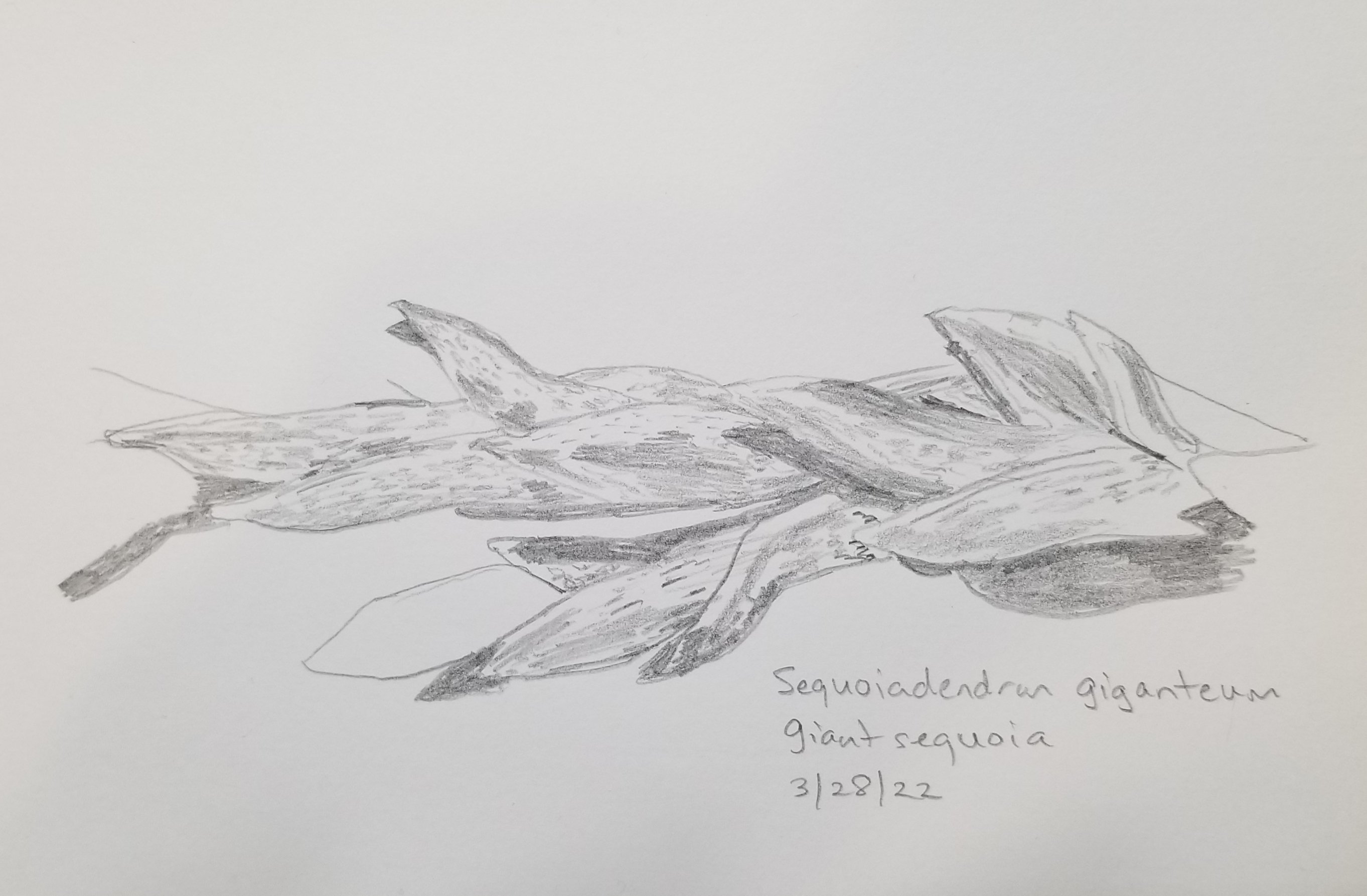
Presenting a very small, young, short-lived part of a tree that grows to be very tall and old, a Coast Redwood.


My daughter said, “Why is it so pink?” I responded that pink was part of the actual background color, and that I was exaggerating that but would be mottling it (as I have now done, above). I said I was trying to show how there was a glow around the needles. She affirmed that there’s a glow, but thought that with a pink background, the glow seemed to come from nowhere. Damn it, she was right. When I started this, the background, which is partly bright white light, seemed way too difficult, but that now seems untrue, and yes, if the background doesn’t show that light, where does the glow come from?
I think I am resolving it by making the upper section of the background considerably lighter than the lower. We’ll see. I should consult her earlier next time.
Next day: you can’t erase colored pencil, but you can lighten it. I’ve done that and added a few more leaves. They are all different. I’m loving meeting each one.


Recent comments