I have not been keeping to my posting schedule! So I will post the last three drawings now.

I fell asleep at 9:30 last night. Lovely. So I didn’t draw, and have made up for it with two trees today.

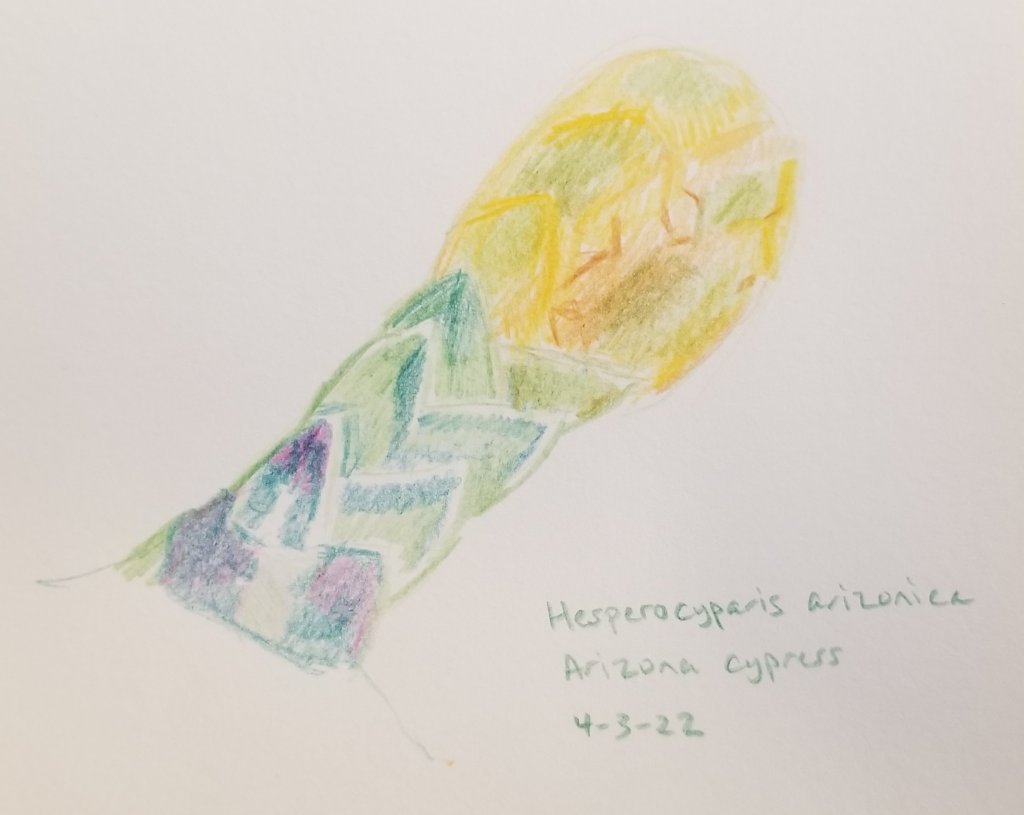
Baker cypress–sigh. I’m getting a little tired of these cypresses. No, they aren’t all alike, but still. I’m ready for something completely different.

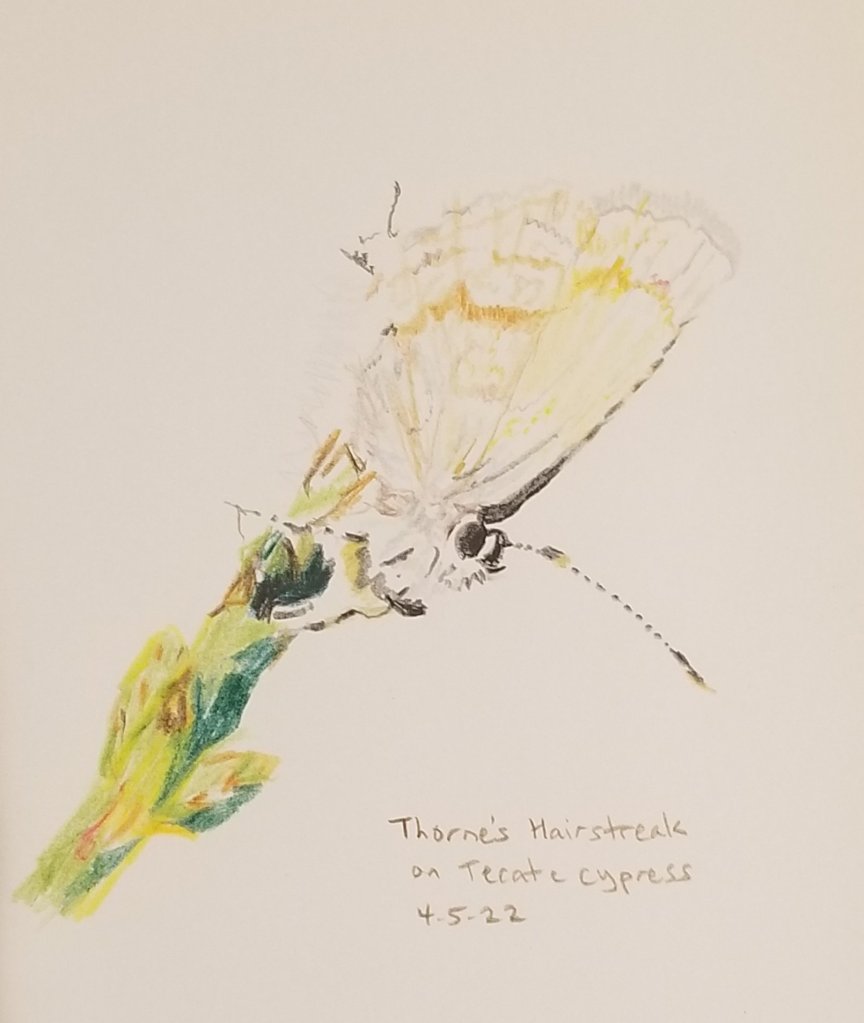
But the Tecate cypress! Its range is limited almost entirely to San Diego County, and it is the only home of the Thorne’s Hairstreak butterfly. Between that and the fact that my inspiration for this yearlong project was my friend Janet’s year of butterflies, of course I had to draw the two species together. They are intertwined–the larvae of the butterfly, which lays her eggs on the cypress, look very much like the tree’s leaves–and both endangered.

I hope they both make it.

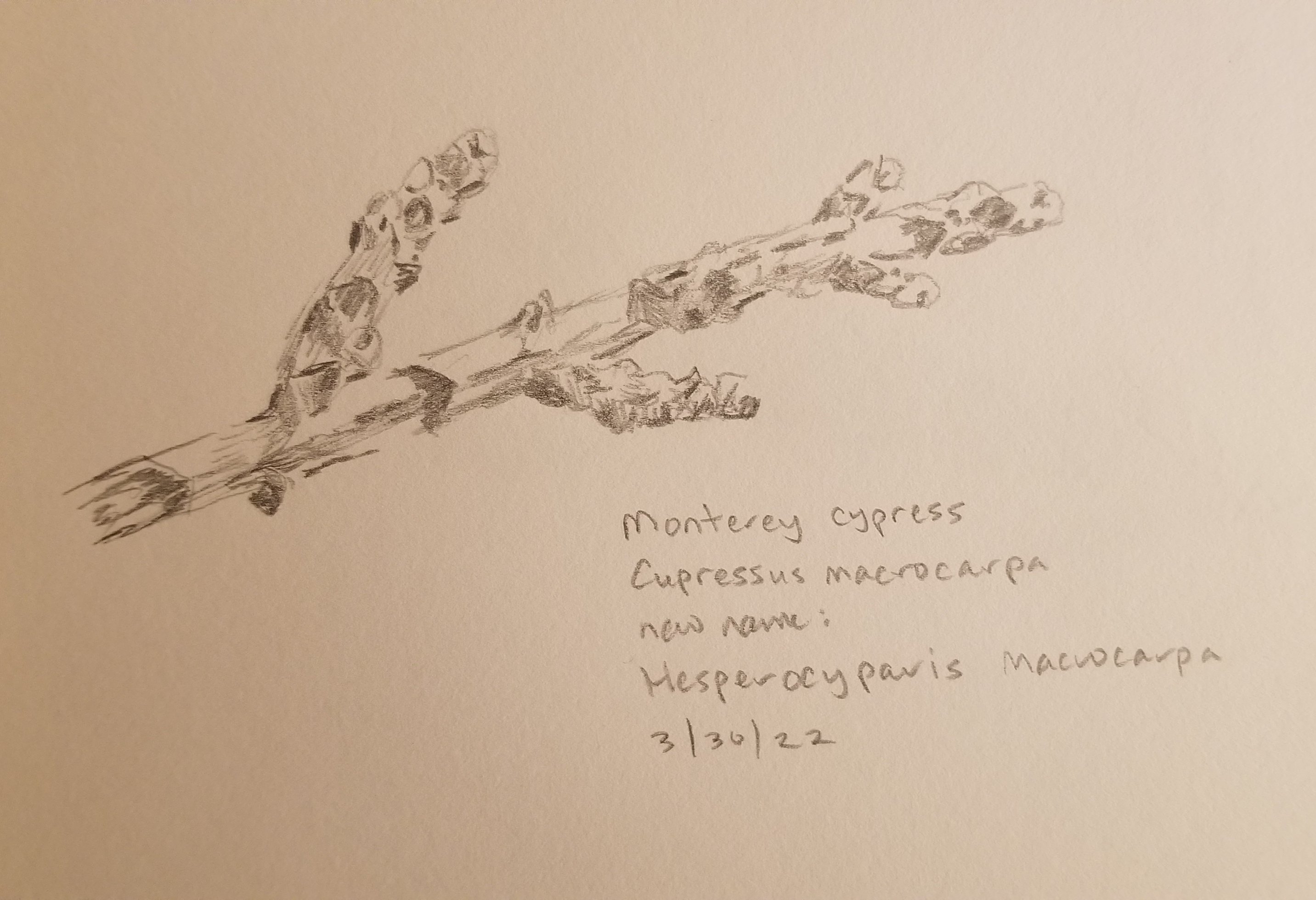
With an early-rising morning of travel behind me and a big service ahead of me, I’m too tired to do more than make a quick sketch and note that like yesterday’s tree, the Mac Nab or Shasta cypress is endemic to California, which means it is found only here.

Glad to meet you, neighbor.

This Californian, found mostly on the Monterey Peninsula in only two natural stands, is threatened due to the encroachment of invasive non-natives, and habitat destruction–the latter mostly carried out by humans clearing land for new houses, recreation spaces, and businesses. One problem is that where we humans build, we suppress fire, and Gowen (a.k.a. California) cypress needs fire every so often in order to reproduce.

I think I have the right tamarisk here, Tamarix ramosissima (working back to Latin from Spanish, I can guess what that means: many, many branches!). Before leaving on vacation, I jotted down the next several trees by their common names, and noted next to tamarisk that it is deciduous. Another way it deviates from most of the trees I’ve drawn so far is that it is not a conifer. But the field guide categorizes them first by leaf type, and T. ramosissima has the scale-like leaves typical of cypresses and cedars (one of its common names is salt cedar, so called because it has a high tolerance of salty water, and also exudes quite a lot of salt).

It is also invasive, which is not all that unusual, but this tamarisk is particularly successful at it. That ability to thrive in water and soil too salt-laden for many trees, and a similar tolerance for poor soil, help it to crowd out many species that are native to the west’s riparian habitats, such as cottonwood and willow.

It was widely planted in the south and west because of its hardiness, and because it has long spires of beautiful pink flowers.

Photo by Jerzy Opioła. CC BY-SA 3.0

Pretty, no? But not only have we planted it, we keep stressing out the native trees with the ways we manipulate rivers and lower their flow. Tamarisk takes over, which leaves many of the fauna in the lurch, because they can’t eat it, the way they depend upon doing with the shrubs and trees along the rivers and oases.

So there is a huge push to eradicate tamarisk from our region. Does its unwanted status make it less of a pleasure to draw and discover? I can’t say it does. But I do hope the native species displaced by it can make a comeback.

The leaves I drew yesterday were so shiny that I didn’t want to stop with a line drawing, but went back and added the shadows, shades and sheen. So here is the Western red cedar again.

Enter your e-mail address to receive e-mail notifications of new posts on Sermons in Stones

Links I like