
You are currently browsing the category archive for the ‘Unitarian Universalism’ category.
I looked up at the clock tower that rises above this district and discovered it said Bromo-Seltzer. Hence the name Bromo Arts District.
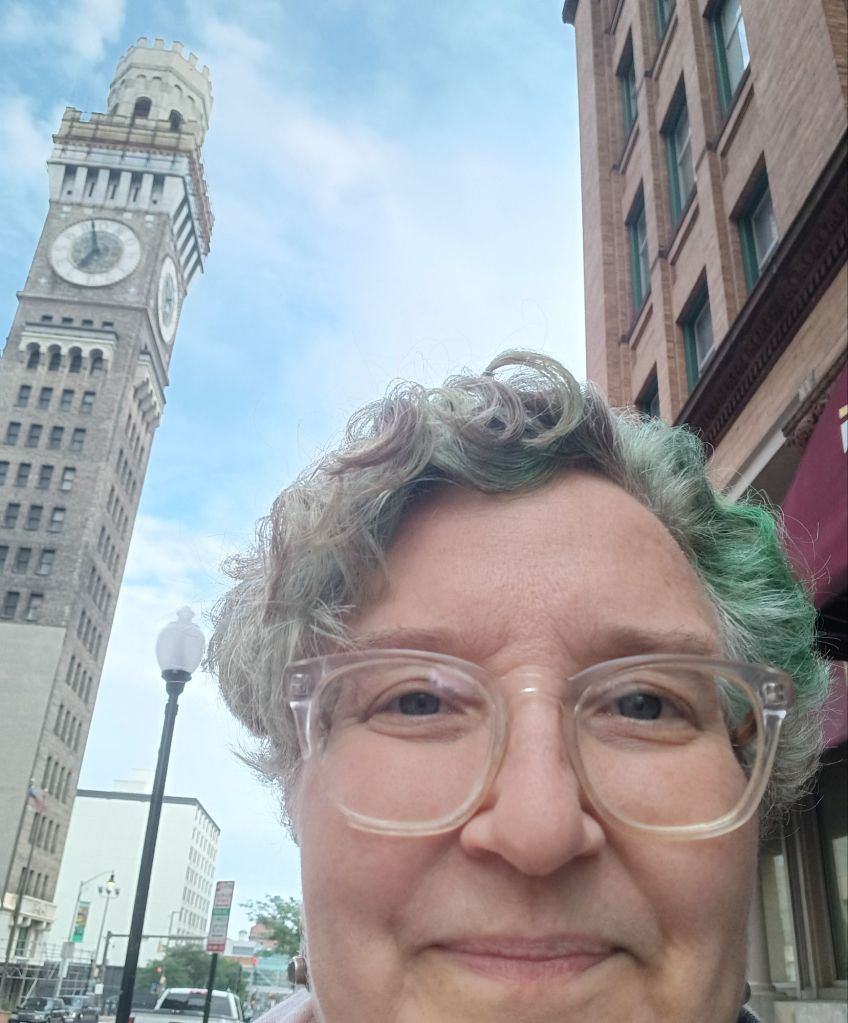
It also seems to be the Erstwhile Banks District. My hotel and several other nearby buildings are old banks, with the stately architecture of 19th century capitalism: no first-floor windows, Corinthian columns, high and sculpted ceilings, the bank’s name carved above the entrance like Ozymandias’. Oh, and the art is about money and wanted bank robbers.


In the convention center hotel–not the one I’m staying in–I saw this poster of a writer I love. Makes sense, as Poe is one of Baltimore’s most famous children, but it turned out it was marking the door to the Poe Room. Can you imagine: a meeting in the Poe Room?! I’d be afraid the door would be bricked up and we’d never escape.

The Calloway Room looks like much more fun.

As far as I can tell, there is no John Waters room. Regrettable.
I helped staff Harvard Divinity School’s booth for a couple of hours. About half of the people who swung by were interested in seminary, and half wanted to say “Stay strong, Harvard!” Amen. I think Harvard learned from Columbia’s experience what Columbia should have known: the only reward for giving a shakedown artist what he wants is to be shaken down more.
After dinner with West Chester, PA’s minister, Dan Schatz–he’s my bestie from seminary, and with our birthdays a week apart in June, whenever we’re both at GA we have a birthday dinner in between–we came outside to light rain and bright sun. The building we’d just exited blocked our sight of any rainbow, but we walked around it and there it was!

People congratulate me wherever I go, and it takes a few minutes of conversation to discover whether I’m being congratulated for 25 years in ministry (the ministers have a service celebrating 25- and 50-year anniversaries, so people know), my retirement from FT work, my completion of a long ministry in Palo Alto, or Indigo’s graduation and college plans. This is how lucky I am.
I sang in the choir for the Service of the Living Tradition (celebrating milestones for religious professionals), something I’ve done only once before. It was an utter joy, and also I now have an india.arie earworm.
I have taken almost no selfies despite running into a zillion dear friends and colleagues. I rush over and hug, but it doesn’t occur to me to snap a picture. Sorry, y’all. I hope you know I love you.

You cannot open more than one lateral file drawer at a time, of course. So I can’t take a picture of the three drawers of this four-drawer lateral file that are empty. But I’m sure you believe me.
In case I failed to post it here before, June 30 is my last day at UUCPA. I promised myself I’d have the lateral file, which was quite full, cleared out before leaving for our General Assembly (and the ministers’ conference that precedes it), which I do on Monday. The first three drawers took a couple of months, but I’m on a roll and confident that I’ll clear out the last one tomorrow. That will be awesome, even though the bummer of file cabinets is that the office looks the same whether they are full or empty. I don’t care. I will know they’re empty, and that a dreaded task got easier and easier until I was done with it.
I have accumulated a lot of paper in 22 years. I should plant several trees in compensation. Between meetings today, I took boxload after boxload to the recycling dumpster, feeling lighter each time. And I did a few rounds of distributing Stuff from my office to its former and future homes, such as the office-supplies cabinet in the main office, the kitchen, and the art-supplies shelves. Lighter! Lighter! By the way, no one at UUCPA need ever buy file folders, hanging files, index cards, three-ring binders, or paper clips again. I’m not sure anyone, anywhere need ever buy paper clips again, since I have never bought any and yet I never run short at either home or work, but that’s a mystery I don’t need to solve.
We’ll have lots of both members and guests at the service on Sunday, so my goal is to have the files cleared out and the office looking tidy by the end of tomorrow, Friday. (It was tidy before the last few whirlwind weeks of clearing stuff out. Things get so messy as they’re being reorganized.) I am dearly fond of my beautiful, orderly office–in the last several months, I’ve repeatedly thought of an old Onion headline, “Nine-month Fetus Finally Has Womb Just the Way He Likes It”–and I want it to look good, even if very few people pop in. A few will, for sure, because they are giving new homes to a bunch of my books, which are waiting for them in boxes and bags along one wall.
The desk is almost empty or, in the case of some supplies and files that our interim minister will need, neatly organized. The surface of the desk, though, not so much. So that’s tomorrow’s task, after drawer number four, and between some more key meetings.
That’s a trick title, because I have gone to a grand total of two church services in my six months of sabbatical. I’m rather ashamed to admit it, but it’s true. I had a plan to go to the San Francisco services fairly regularly once we were back from our summer travels, a plan that foundered on the rocks of taiko class (10:45 Sunday mornings). But what took me so long to figure out that a good two-thirds of the UU congregations in the country have services that end by 10 a.m. my time? I just got out of the Sunday morning church habit. Which is instructive. Going to services is a habit, like any other; once in the habit, one tends to carry on, and once out of it, one also tends to continue not-going. Something for all of us who tend these wonderful communities to remember.

I did think of it earlier this fall, looked up a few services, and got up in time to go to one, but I had a flu-y thing and couldn’t keep my energy up long enough even for a Zoom hour. Two weeks ago, I finally got my act together again, and was so, so glad I did. I attended the livestreamed service of Jefferson Unitarian Church (Golden, CO) that Sunday; it was great, so I picked a service for last Sunday, but overslept; this morning, I tried to attend one livestreamed service, but the time on the website was incorrect due to a seasonal change, and had to quickly look for another one. Again: there are lots of options in the Central Time Zone! So I ended up at the Unitarian Universalist Church of Corpus Christi, charmingly nicknamed U2C3.
Both today’s service and the one on December 3rd made me regret not going every week. Both were a great fit for my sabbatical spiritual practice of letting go of judgment and letting curiosity take its place. Oh my, does my judging mind have things to say about church services! It’s only natural, since it’s my vocation, and of course I’m making many mental notes about what does and doesn’t work. But its being my vocation is also the reason that curiosity is so much more useful than judgment. Instead of evaluating what works, what doesn’t, what I like, what I don’t, etc. suspending that process (or telling that judging voice to please pipe down during the service, at least) opens me up to ways of doing things that I’m not accustomed to. It makes room for me to appreciate other ways and others’ creativity.
And creativity there was, both of these weeks. Jefferson is one of the many churches using the Soul Matters monthly themes, and the theme was Mystery: right up my street, for a few reasons. One: again, curiosity in place of judgment. I am trying to be more open to the unknown, to what I may yet discover, and judgment tends to make a person go right past Mystery unaware, because she’s comparing everything she encounters to what she already knows. This person, anyway. Two: I’ve been making a lot of art, and spending a lot of time talking with others about the relationship between art and religious leadership (my class in this semester of grad school was The Arts for Leadership), and one of the great things art does for me is take me into that space of unknowing and discovery. Three: I have been thinking a lot about how uncomfortable Unitarian Universalists, not only me, can be with the unknown, and how spiritually limiting that is. If I had to choose a dissertation topic today (which thank goodness, I do not), it would be something like “Using the Arts in a Congregational Setting to Re-Enchant Religion Without Supernaturalism.”*
The Time for All Ages was clearly one of a series in which Unitarian Universalism, a pleasant man in a t-shirt reading UNITARIAN UNIVERSALISM, gave a wrapped gift to the director of religious exploration, who opened it on behalf of the congregation. Both Sarah Billerbeck, their DRE, and the man playing UU, were clearly comfortable being off-script, so their dialogue was pleasantly conversational while also hitting their main points, nor did it matter that I hadn’t heard previous entries in the series. The box was empty, because, well, Mystery. It isn’t something that is handed to us; it’s part of our search, and we don’t know what we will find. Together, they reached the conclusion that because we have the freedom to search, our faith leaves us a lot of room for mystery. When Unitarian Universalism said, “In fact, Mystery is one of the greatest gifts I give you,” I had tears of hope in my eyes. Can it be that our faith is actually particularly suited to acquainting us with mystery? Then Rev. Wendy Williams’s sermon was beautiful, in a thoughtful and heart-felt style, and ended with a suggestion about how to open to mystery that was so like the advice I had just given someone on Ask Isabel that I had to laugh. My advice was about gratitude, something that does come easily to me–and here it was, traveling in the circuitous ways by which the universe delivers wisdom, coming to me from a colleague I deeply respect in order to help me awaken to mystery. Thank you, Wendy and universe.
Today’s service, at the congregation in Corpus Christi, was about the many festivals of lights at this time of year: Diwali, Hanukah, Advent, Kwanzaa, Solstice. These kinds of services are difficult because if they’re presented as actual celebrations of the holidays, they are almost certainly appropriating others’ religious practices, whereas if they do the respectful thing and simply tell us about the practices, they can be very report-y and dry. The folks leading the service were carefully respectful, which allowed that judging mind of mine to relax awhile, and so where it might have piped up with “Uh oh, this could be a report instead of a worship service,” I was able instead to appreciate how the leaders (most of whom weren’t ministers or worship associates, so they were probably quite nervous) crafted a sensory experience of growing light, a whole table full of candles and lamps that must have given off palpable heat as well as a beautiful sight.
And then the band, which had already done a lovely rendition of “Light One Candle” (and oh, how those lyrics resonate this Hanukah, whatever one’s political views about Israel), sang “Glorious,” a Melissa Etheridge song that I had not heard before and that I then sang in my head all the way to my taiko class. That one is going to be heard in a UUCPA service next year, you can bet. “Everyone will hold this light”–and again I was moved to tears, not only by the words but by the way the two singers and the small acoustic band brought such feeling to them. On Muni, no one notices or cares if you get a little weepy.
I’m very grateful to these two congregations and their worship teams. I’m looking forward to next Sunday, and I’m just sorry it took me this long to start going to services.
*A seminary professor of mine, the late David Ray Griffin, wrote a book with this title–Re-Enchantment Without Supernaturalism–and I was so excited to discover that that of course I got a hold of it immediately. It doesn’t take the tack I want to, but the title sums up my hopes.
As a congregational minister who has been creating worship online and/or outdoors for two years, and will soon, I hope, be resuming indoor services, I read with interest a recent New York Times opinion piece by Tish Harrison Warren, a priest of the conservative Anglican Church in North America. She ends with the reminder, “A chief thing that the church has to offer the world now is to remind us all how to be human creatures, with all the embodiment and physical limits that implies.” However, the rest of the article did not offer much to those human creatures whose physical limits keep them from getting to the church building.
Warren argues that being in one another’s physical presence is irreplaceable, and with that I wholeheartedly agree. However, she takes that as a reason not to offer any other way to gather. The heart of her complaint is that “offering church online implicitly makes embodiment elective,” which suggests that the only form of human embodiment worth the name is the kind that can attend church in person. Need it be said that that is not the case? Whether we are capable of getting out of bed, traveling with manageable pain, and being in a public space for an hour is not a matter of “consumer preference, like whether or not you buy hardwood floors.” It’s something that some of the congregants with whom I serve simply can’t do, no matter how much they may wish to.
In fact, for us at the Unitarian Universalist Church of Palo Alto, one of the boons of these hard, isolating two years has been that we reached people in this situation whom we had previously excluded despite our best intentions. It has opened my eyes to the ways in which our outreach to members with disabilities was simply inadequate. For many years, we have offered rides to anyone who needs one, but some people didn’t take us up on it, saying that they couldn’t predict until Sunday morning whether they would be up for leaving their apartments. I would assure them that that was fine, that the person offering them a ride understood and could change plans on short notice, yet few people accepted this arrangement, and I thought we had done all we could. Once we began offering online services, I realized that this was the “more” that we could do, because some–not a lot, but a few–people attended that way who had not left home for church services in some years. (We also have attendees from far away, which is a lovely new development, but that raises different issues and I’ll set them aside for now.)
Warren offers, as a solution, visits to homebound members, bringing them the worship experience where they are:
A small team of “lay eucharistic ministers” at our former church volunteered to go to the home of anyone who could not make it to church and wanted a visit. They would meet one-on-one with people, caring for them, reciting a short liturgy together, serving communion and catching up.
That’s a great thing to do. We visit folks, of course; we also have a pastoral singing group that goes to people’s homes. We could, and should, do much more of that. But I can’t see myself departing from the church on Sunday afternoon, personally renewed by our experience of corporate worship, and then visiting someone to whom I have effectively said, “Never mind corporate worship. A personal visit is enough.” Many of the members of my congregation may feel–as hundreds have since March 2020–that while attending via the internet is second best, it is far, far better than missing out entirely.
Homebound folks may feel less inclined to attend online church when most other people are there in person. On the other hand, they may feel more eager to turn on their computers: “Everything’s happening at church! I want to be a part of it.”
Perhaps my and Warren’s different liturgical traditions create different circumstances. If the most important element of one’s worship is the eucharist, perhaps a visit centered on communion is enough to make the congregant feel that they have partaken of worship. However, our Unitarian Universalist worship revolves around making music together, the spoken word, silence, and the living knowledge that one is moving along the path in the company of dozens or hundreds of people. Naturally, one can bring some elements of even this worship to a one-on-one visit. When I spent a couple of days in the hospital years ago, it meant a great deal to me when someone visited me, lit an electric version of our ceremonial chalice (hospitals, like other places where pure oxygen flows, forbid open flames), and shared a reading from our hymnal. I absolutely felt ministered to, and as if I had been to worship. However, as a substitute for corporate worship every week of my life, it would be thin gruel.
Furthermore, those few who are endangered by close contact and thus unable to attend corporate worship in person are often reluctant to admit visitors for the same reason. What about, for example, a member who has a very weak immune system and must curtail visits to their home? I’ve had wonderful conversations with such members of my community via phone or Zoom. Due to their health risks, they may never come to in-person services. So if we cease our online services, they will cease to have a service to go to, period.
It may be that once COVID fades, internet worship no longer attracts more than a handful of people. But we have yet to find out. I hope we’ll find out by offering it (alongside indoor and, probably, outdoor services), and seeing who still attends, not by yanking the plug.
So we will most certainly offer both. It’s not about embodiment being elective. It’s about some people simply not having bodies that can get to the building easily, or at all.
If, as Warren fears and as probably is the case, some people who are capable of attending in person opt to attend online rather than engage with the complexities of physical presence, we’ll deal with that when it arises, compassionately and without judgment. And I’ll be glad that while they are hesitating about whether to attend in person or just stay away from everything to do with church, we will be offering them a third option.
Edited to add: Five minutes after I posted this, I happened to get a phone call from an elderly woman in my congregation who attended almost every Sunday before COVID, and has done so online since. She said that as much as she misses gathering in-person, she may keep attending via the internet. (We already have in-person, outdoor services, thanks to our climate.) The 20-minute drive is just too much for her sometimes. I rest my case.

Earlier in this third week of devastation throughout the state, a member of UUCPA emailed us the news that a fire was burning near Yosemite, just a few miles east of Bass Lake. Bass Lake is the site of Skylake Yosemite camp, where the congregation holds a “getaway weekend” each summer. This year’s was cancelled due to COVID-19. Now the camp itself, not to mention Yosemite and its nearby communities, are approached by a wildfire that has grown very quickly.
The man who sent the email included a photo from Caltopo, to which I guess he must subscribe. I hope they won’t object to my showing it here:

I shared it on Facebook, with a few words about all the loss and sorrow we are holding. Then, a while later, I checked my Facebook page, saw this image in tiny, thumbnail format, and had three thoughts in quick succession: “What is that?” / “It’s beautiful” / “Ohhh. The Creek Fire map.”
I knew right then that I needed to draw it, to spend time with, if not make sense of, the swirl of feelings it evoked. The above are three very small drawings, each 2 x 1.5 or 2 x 1.75 inches, in colored pencil, done earlier today.
Day 49 of #100days of making art
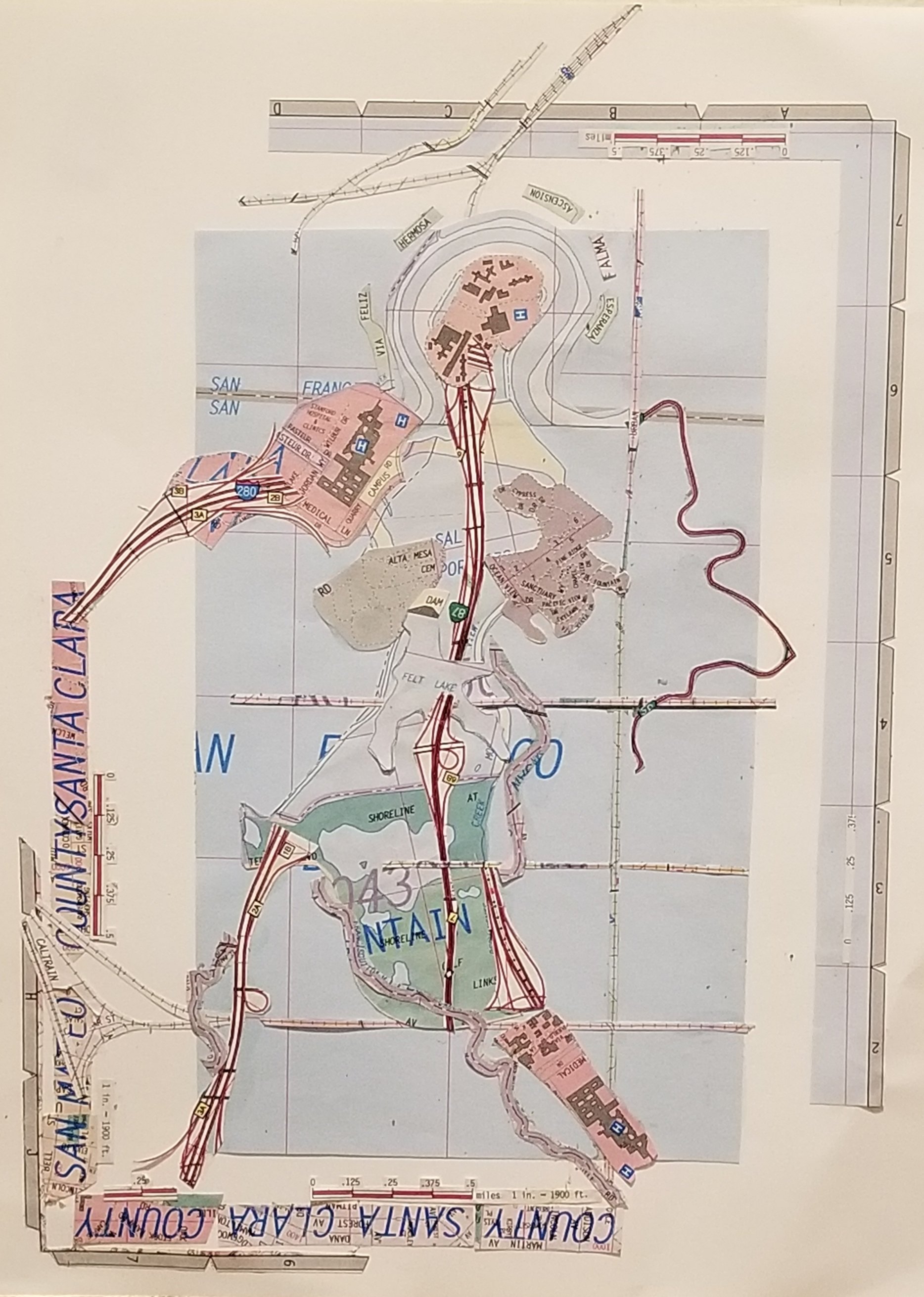
I retrieved this collage from the pieces-in-progress box, where I had filed it just the other day in the course of going through some piles in our home office. (The Onion, as usual, is sardonically accurate; after two weeks of the coronavirus shutdown, our house task list is noticeably whittled down.) I began it, a few years ago, with some playful, purposeless clipping of an old Thomas guide, which I had bought when I moved here in 2003 and which was rendered redundant within a few years, when I got my first smartphone. Redundant for navigation, but a gem in the collage-materials collection.
As soon as I started playing, the similarities between map features like freeways and anatomical drawings of veins and arteries appeared. Also, I kept noticing places that had a strong emotional tug: hospitals where many of our congregation members have been patients, a cemetery where some have been interred, and, snaking their way down page upon page of the book of maps, the railroad tracks where two have died. And just like that, it became a portrait: of a place, of tender moments from a shared history, and of relationships.
It’s complicated. Many of the moments have been sad, even heartbreaking ones. There’s a tremor of trauma running through this landscape. But joy runs through it too, and sometimes in the same places. Finishing this collage helped me integrate them.
Any ideas for a title about the body, loss, place, lives and deaths, finding one’s way . . . ?
I had a kaleidoscope pattern in my office window that I’d made during one of the sessions of Exploring Mind, Hands, Spirit and Heart through Art I lead monthly. Dan Harper, our Associate Minister for Religious Education, asked if I’d like to make some more to be coloring pages for kids to do during services. So that’s what I’ve been happily doing with a lot of my art time for the past few weeks. Here are four in various stages of completion.

I love this art form, which I discovered when my daughter did some in school last year. I immediately introduced it in our monthly class at church, Exploring Mind, Hands, Spirit and Heart Through Art, and then offered it as a spiritual practice at a ministers’ retreat this week.
The mix of a found- and (for lack of a better antonym) created-art approach helps me get rolling. Words on a page suggest associations, and then the associations stimulate original ideas.
Here are two I made at the retreat.
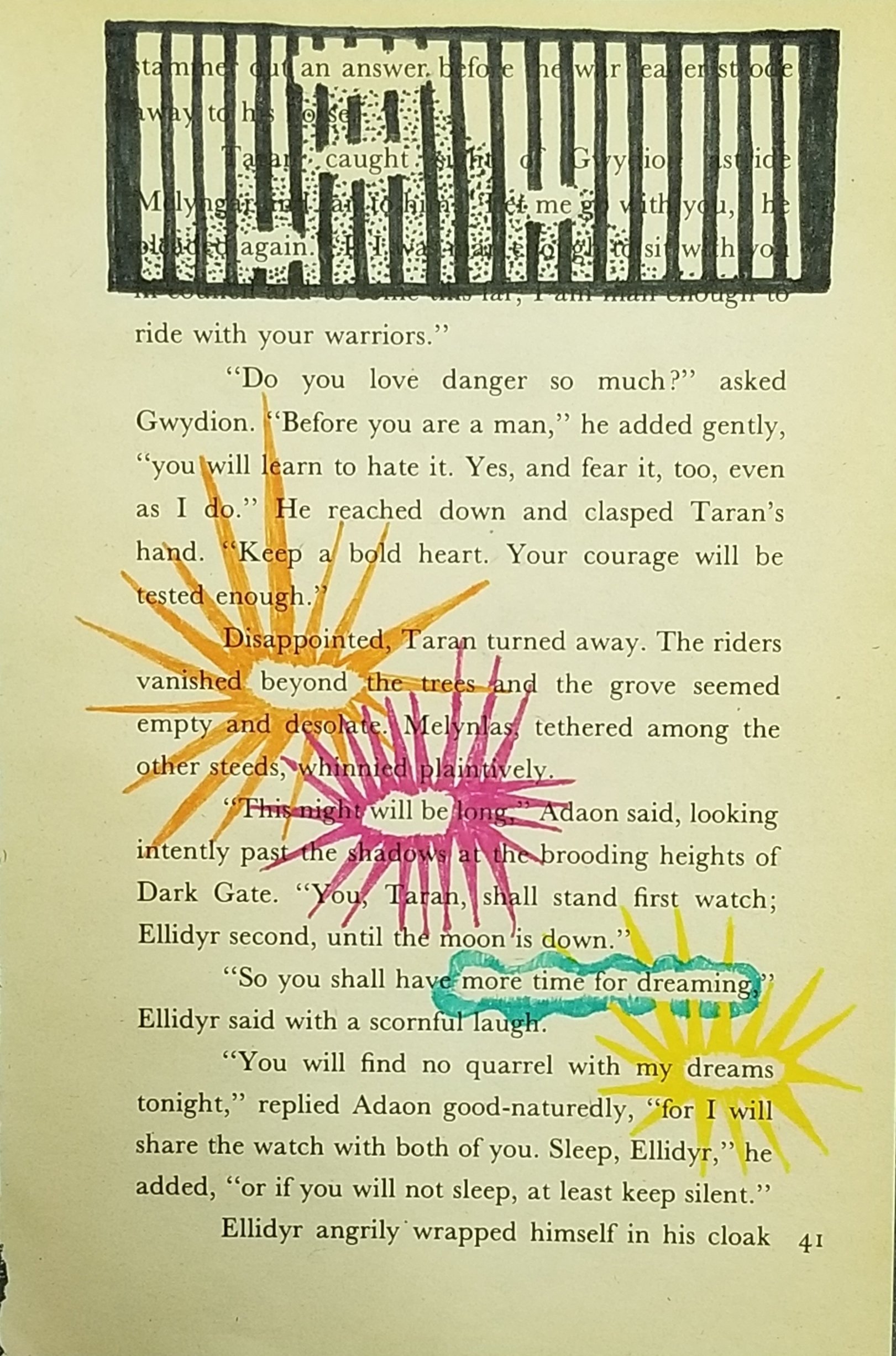
Beyond, more time for dreaming
For the first one, the words “an answer” and “caught” caught my eye first. I’d been pondering mystery and my own “irritable reaching after fact and reason” against which Keats counseled. Sometimes an answer prevents me from dwelling in the “uncertainties, mysteries, doubts” from which wisdom might emerge. So right away I knew I wanted to draw the bars of a cell across the part about the answer. I also wanted the piece to suggest a happier alternative, and while the words I found seem obvious now, it took some searching and thinking to figure out which ones to use, and how. When my eye lit on “beyond,” I had that second half.
The second piece ended up being about creativity itself. “A passage opened to her fingers.”
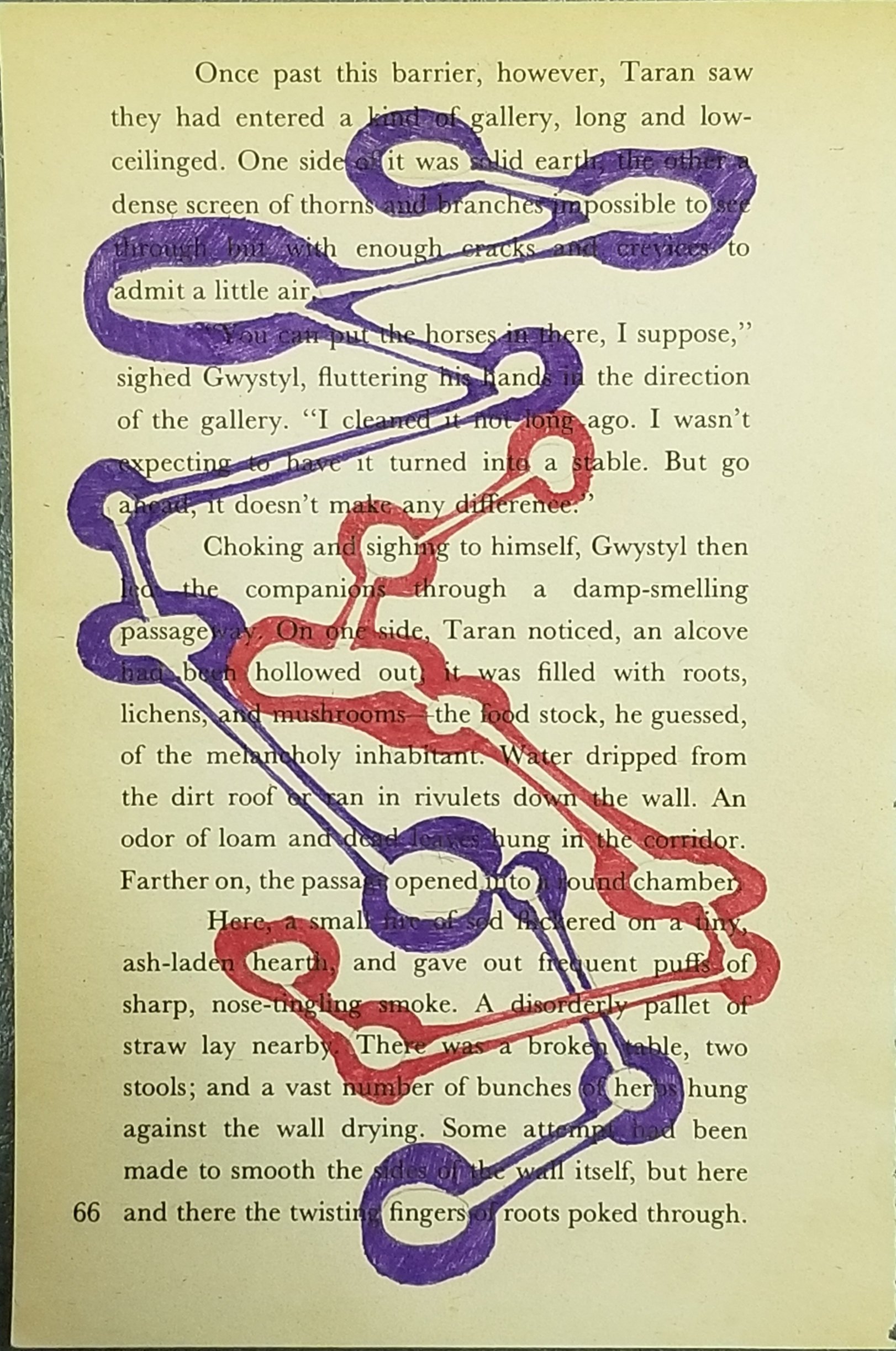
A sigh hollowed out the chamber of The heart
Our unwitting, but I trust not unwilling, collaborator was Lloyd Alexander, since my copy of The Black Cauldron, from his Chronicles of Prydain, was in several pieces. I hated the cover anyway, which was the poster from the forgotten, and, judging from the drawing, lamentable, Disney version. I’m going to look for the edition with the cover I remember and loved in my childhood, and buy Taran Wanderer while I’m at it: my favorite of the series, which we don’t yet have. (My sister loved them too, and our set was hers, so I’ve acquired my own set piecemeal in adulthood.)
Look at that. I started out writing about art, and ended up writing about books. That tells you why I love this kind of art.
I’d like to share the ones colleagues made as well, but I only asked their permission to put them out on a table at the retreat, not online.
Try one yourself! If you don’t have a falling-apart book or can’t bear to write on one, a photocopy works. To see lots more examples, the best search term is “blackout poetry.”
Sometimes, being a minister means working with some prickly people. They’re among the congregational leaders or visitors or–particularly tenderly–among the people I visit when they’re sick or sad. Not long ago, I was on my way to meeting with a member of the congregation when I passed under a stand of sweet gum trees (I think that’s what they are), whose seeds I love whenever I see them, and have never dared to draw. I went on to the meeting, and in our conversation, the person was both prickly and, to me, very beautiful: honest, caring, vulnerable. When I left, I picked up one of the fallen seeds, and I drew it that evening. In my private thoughts, it has this person’s name.

I keep trying to write long pieces about this and feeling like others have said the same thing better. So I will just put it in two sentences.
I am thrilled that the UUA Board has committed significant money to Black Lives of UU (BLUU); identified white supremacy as one of the biggest challenges facing us, and the dearth of leadership by people of color in high positions in the UUA itself as one of the expressions of that challenge; and chosen a three-person, all-people-of-color team for the acting presidency. This direction not only seems wise, prudent, and moral, but it gives me a surge of hope for the future of our faith.

 Sermons in Stones
Recent comments