You are currently browsing the category archive for the ‘art’ category.
Sabbatical Activity No. Umpty-Ump is, of course, making art. I’ve been doing art almost every day, which is a major accomplishment.
A lot of what I’ve been working on is nothing I want to show yet: more explorations of the Tower of Babel and several themes that cluster around it. I’m working on one right now that uses the names of God in several dozen languages, and I think I’m likely to keep exploring that direction for a few pages of the sketchbook.
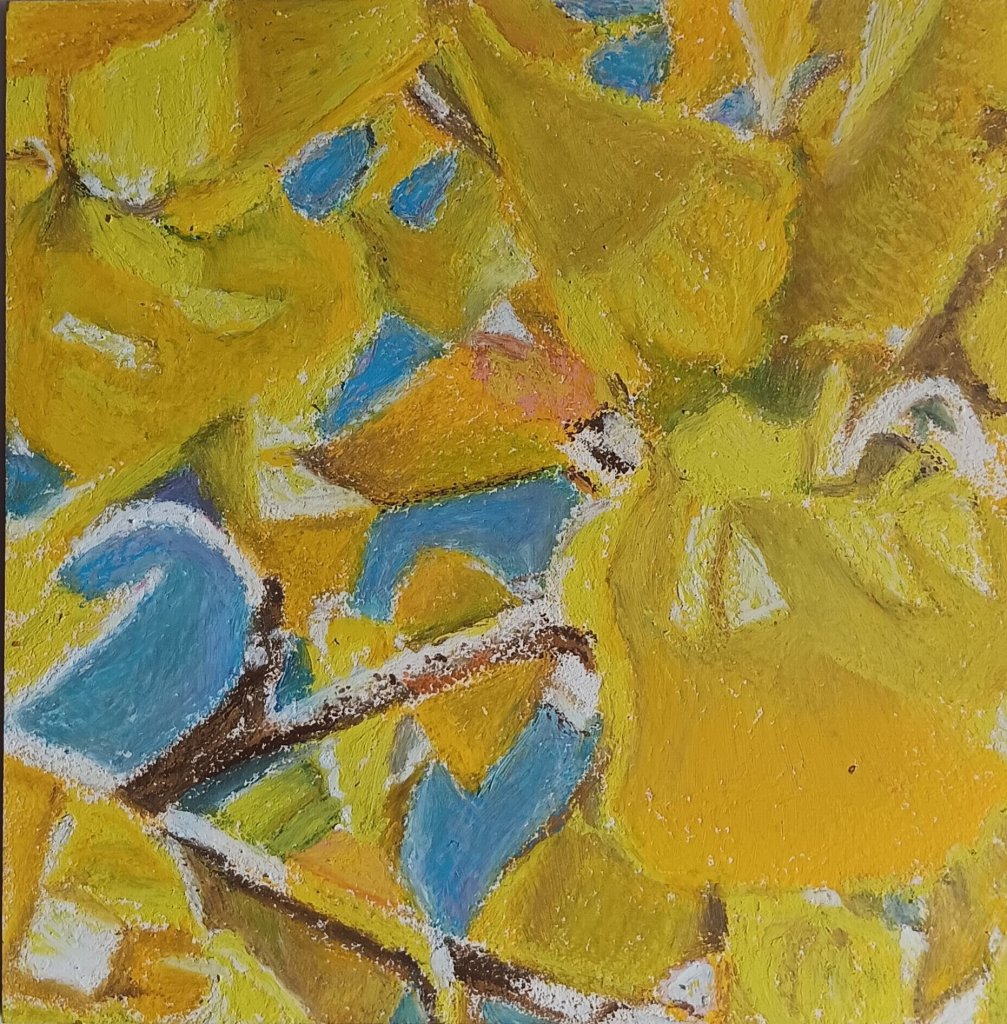
I’m annoyed at myself right now because I’ve had the below piece ready to submit to the Tiny Show (at Studio Gallery, early November to late December) for weeks, and was holding off only until I finished another piece that fit the dimensions, thinking I’d send them at the same time. But I finished that piece and didn’t like it–I don’t think I can make it work at this scale–and so I finally photographed this, frame and all, and submitted it.

Except that the deadline was not the 25th, like I had in my head, but the 20th. How old was I when I learned that I could not trust the dates I held in my head? About 12. Oh well. My chances of its being accepted were slim anyway; they didn’t want the ginkgo piece, citing too much similarity to other things they had already accepted for the show, and to my eye, anyway, the two pieces have a lot in common. But I really like them both, and that makes me happy.
I would like to show my art, but as every artist knows, it’s a whole other job to submit it, and takes a lot of time and effort that I’d rather put into half a dozen other things, including making art. I will renew my lapsed membership in a local art network and keep an eye out for opportunities, though. I love Elizabeth Gilbert’s practice of responding to rejections by immediately sending the piece right back out (just read about this in Big Magic, which I read for class), but for that you need to have a list of potential galleries.
I also have an idea for a mural in my neighborhood, on a wall that really wants something. I feel like I shouldn’t describe it here because the theme is directly related to the business in the building, and I haven’t talked to the owner yet. That’s the biggest “if” to actually making it happen; both the owner of the business and the owner of the building have to want it (I’m pretty sure they aren’t the same person). Once I’ve sketched a few ideas to my more-or-less satisfaction, I’ll take them and some other paintings that show what I can do, and go talk to the business owner.
So, back to drawing.
I hope you’ll check out my new column, Ask Isabel: Advice for the Spiritually Perplexed or Vexed
To receive it via email each Tuesday, subscribe for free!
Water is endlessly fascinating to paint as well as to watch.
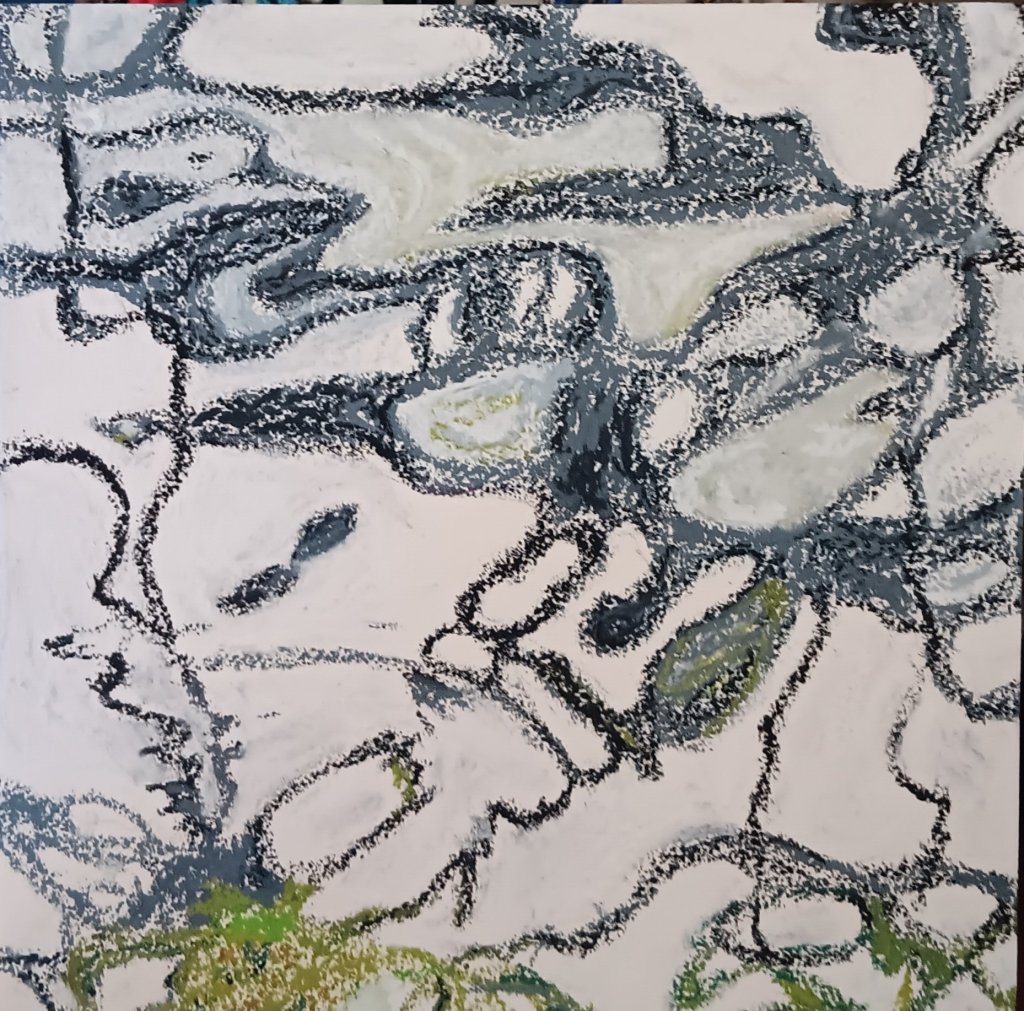
I think this is done.
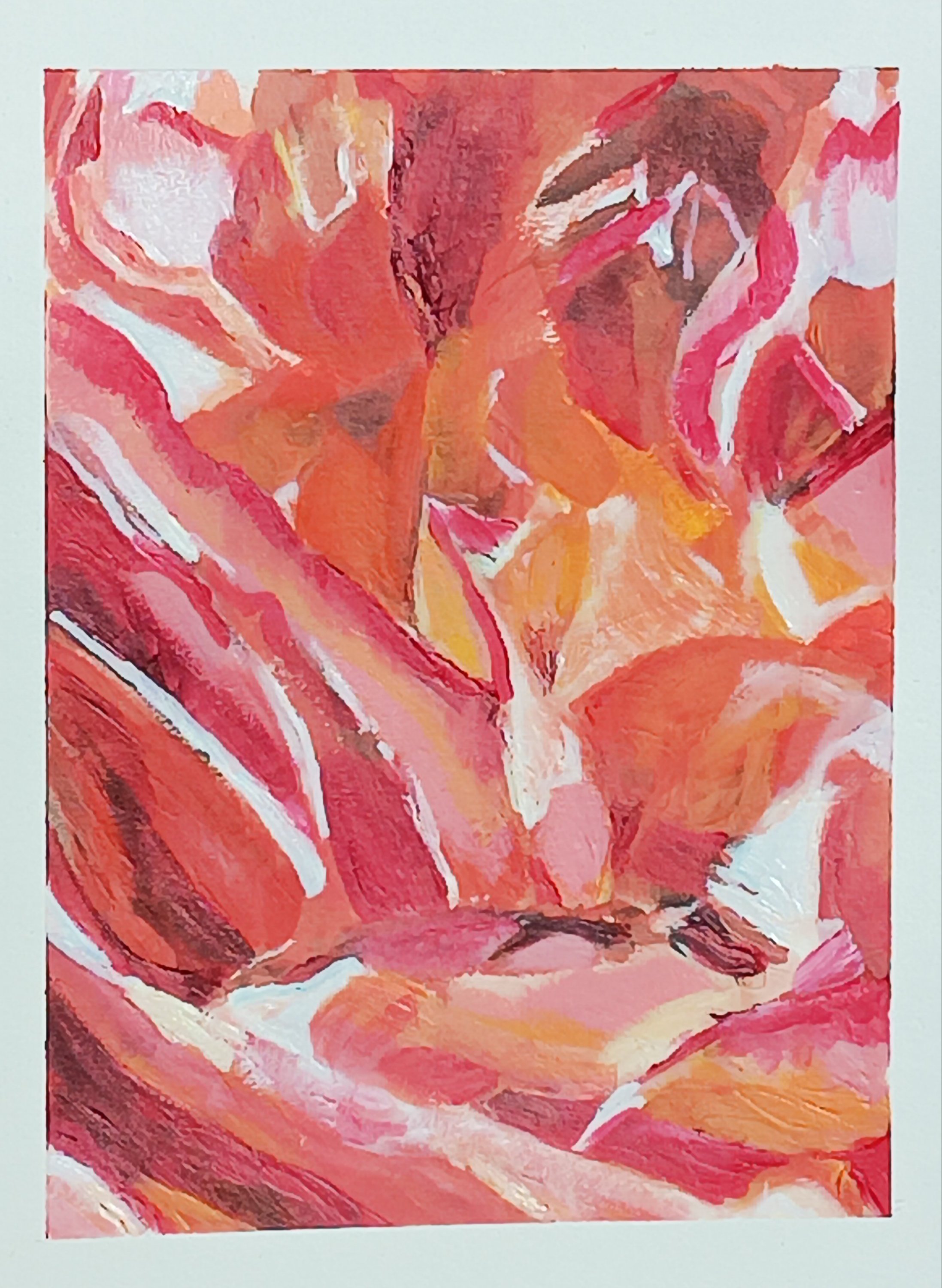
I have finished this painting, or rather, I’ve stopped working on it. It’s not totally unsatisfying, but I couldn’t get the precision either of line or of color with acrylic paint. Joy and I went to the Kehinde Wiley exhibit at the De Young today, and aside from the beauty and gut-punching power of his art, I was also looking at the oil paintings and saying “How does he DO that?” His lines are razor-clean and his shading looks both impossible to do without a brush and also like no brush hairs can ever have touched that surface.
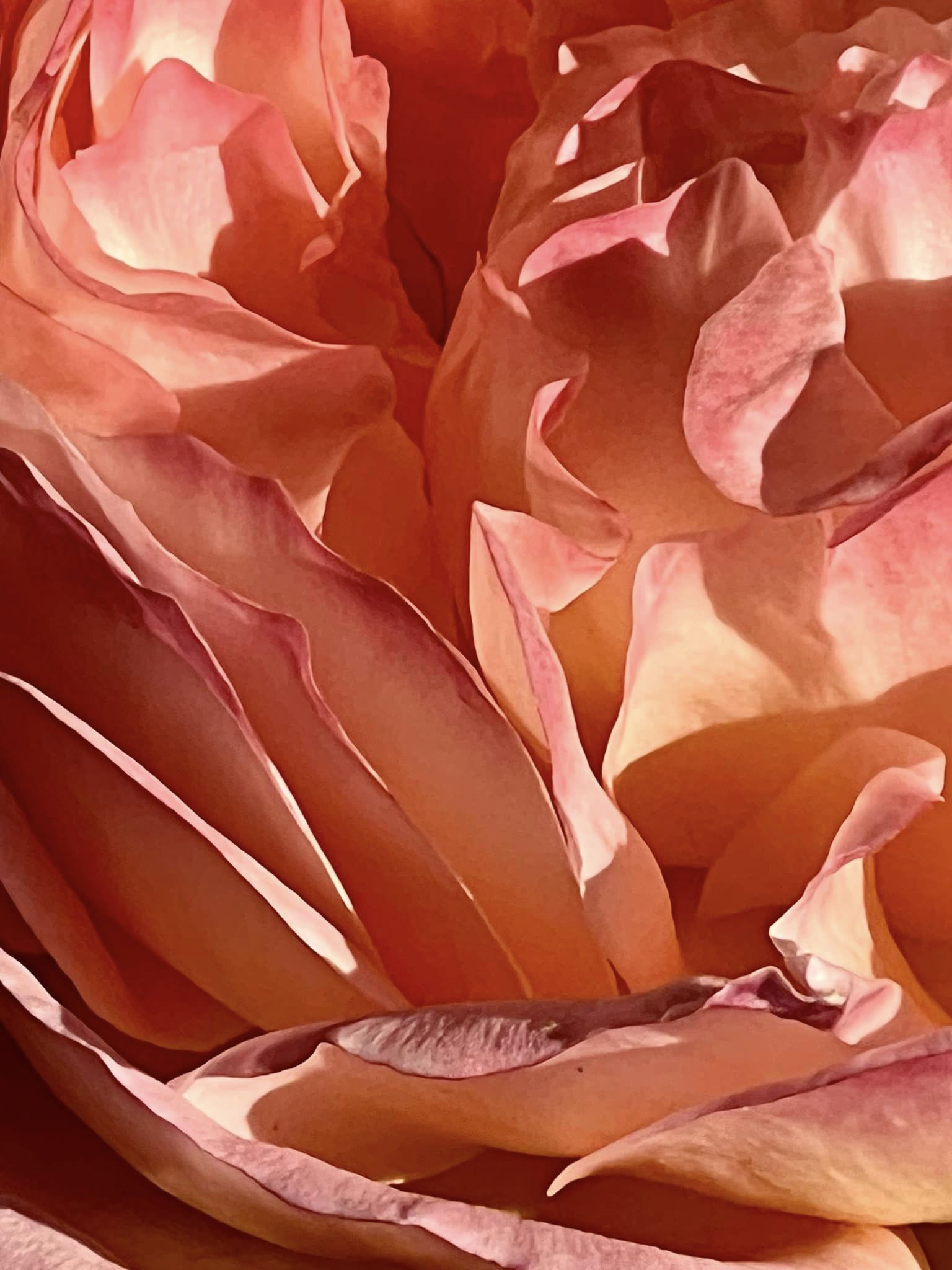
I will learn more about painting, I’m sure, and develop more control over the brush. For now, I loved working with oil pastels so much that I’m going to make another painting of the roses, same size, with that medium.

Oil pastel on paper, 10.5″ x 7″
It’s a heart-thumping kind of game: I pulled off the tape that was holding this in place, put away the pastels and other materials, signed it, and propped it up, all while averting my eyes. Then I left the room and came back in, glancing over at it from the doorway, as if I had never seen it up close. I wanted to see if the magic had worked, and to a pleasing extent, it had. Scrawls, strokes and dabs of oily sticks on paper were transmuted into light on water.
Just as some ink paintings are called drawings, making this felt like painting even though it was done with a dry medium without brushes. I think I’ll paint the same scene tomorrow.
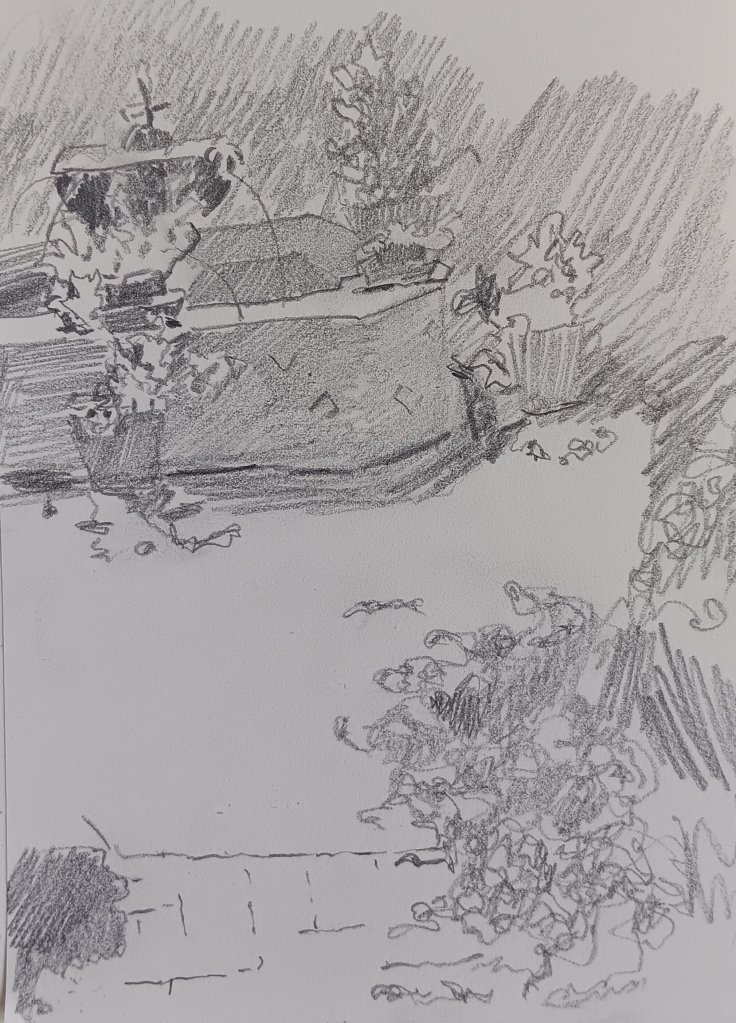
Looking at art in museums, and also making a drawing of a building in SketchbookX, where I can’t make very precise marks, I noticed how little it takes to show light and shadow. So when we say by this patio at Palacio Viana, Córdoba, I tried to put in just enough to show the light.
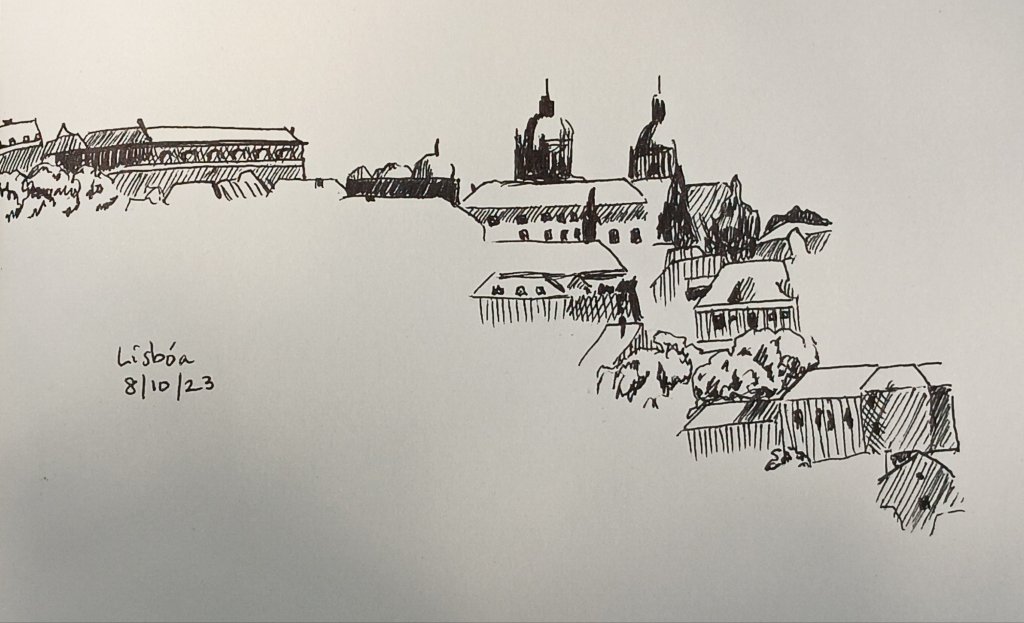
I am now sitting in the park Miradoura de Sāo Pedro de Alcántara, in Lisbóa, looking out to the castle and hillsides of buildings. For music, there’s a breeze, the clink of coffee cups behind me, and a man with an acoustic guitar and a beautiful, unadorned voice playing bossa nova. I might get out my sketchbook and draw the light on the buildings, or I might just keep reading and making notes on How to Be an Artist, by Jerry Saltz, for my grad school course (The Arts as Leadership) that starts next month. It’s all good. More than good.
Edited to add this, the view from here, since I did do some drawing.
It’s amazing how you can walk into a room full of 17th century Dutch paintings, take a quick glance around as you move through, and know immediately when your eye falls on a painting by Vermeer. I could spend the rest of my life trying to do what he does with light, but I figure the only way to begin to learn it is to draw it. This is “The Astronomer,” the only one of Vermeer’s that is currently in residence here at the Louvre (“The Lacemaker” is out on loan).

I was in this wing in search of Rembrandt, and found the roomful a couple of rooms along from Vermeer. This self-portrait (below) is from 1660. There are a few here from 25 years earlier. I love how honestly he shows the changes time and experience have wrought on his face, though through my own limitations, I took about 25 years off again.
The first try was way too small, and when I went closer to see some details that I hadn’t been able to see from the seat on the other side of the room, I hadn’t left myself room to have a prayer of including them. So I started again at twice the size (still a thumbnail of a detail; the painting is about 3×4′). As with Vermeer: the light, the light, though with Vermeer I always have the impression of light’s falling on the subject, whereas with Rembrandt self-portraits, I usually have more of a feeling that he is emerging, partway only, out of a palpable darkness.
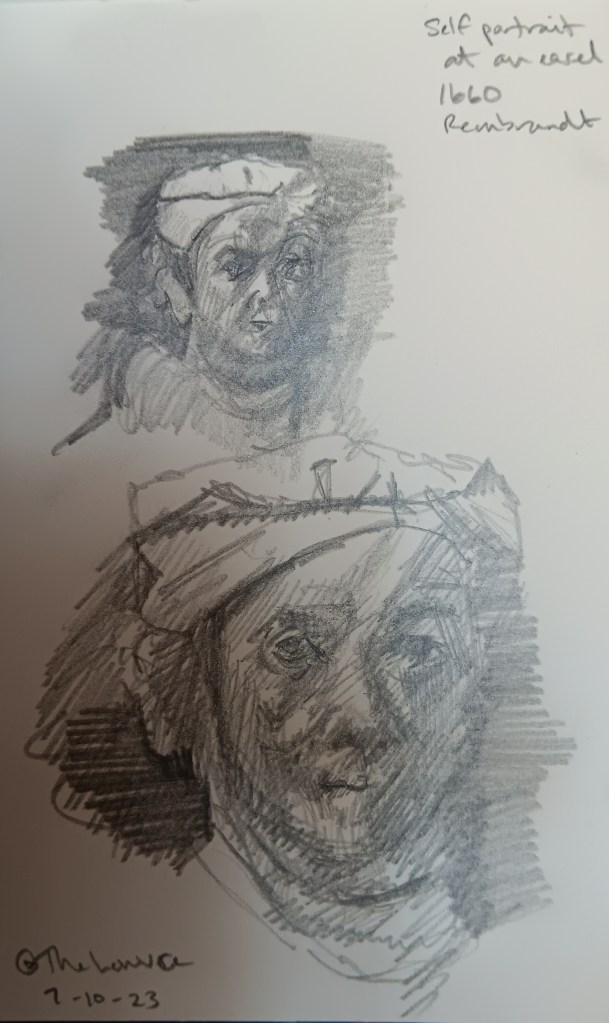
Both graphite pencil on 4″×6″ sketchbook paper.

Munchkin and I are at the Louvre. I communed with one of Michelangelo’s “Captives” while she went in search of more recent European sculpture.
I was lukewarm about returning to the Louvre, and came mostly to accompany M, but this time spent drawing made it more than worth the price of admission, and the wait.
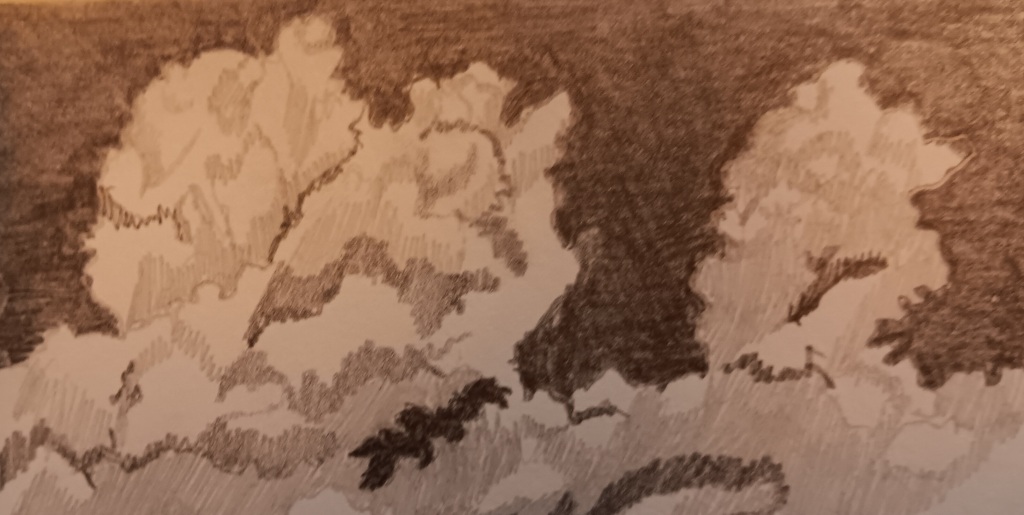
Two more drawings in my 4×6 sketchbook. Clouds in Geneva, making me wish that I had colored pencils with me.
And something inspired by Paul Klee, who was unafraid to incorporate signs such as arrows, numerals and letters, even stick figures if they served the vision. I would normally be cowed out of using arrows by the inner critic who sneers, “Kind of a shortcut, isn’t it? Don’t you have a way to show motion befitting an artist, or are you just a jumped-up road sign painter?” I tried to be more polite to my inner critic than he was being to me, kindly suggesting that it sounded like he had a bad headache and might want to go lie down. But I couldn’t resist pointing out to him that the great Paul Klee used arrows, and he was no sign painter. He went away grumbling.
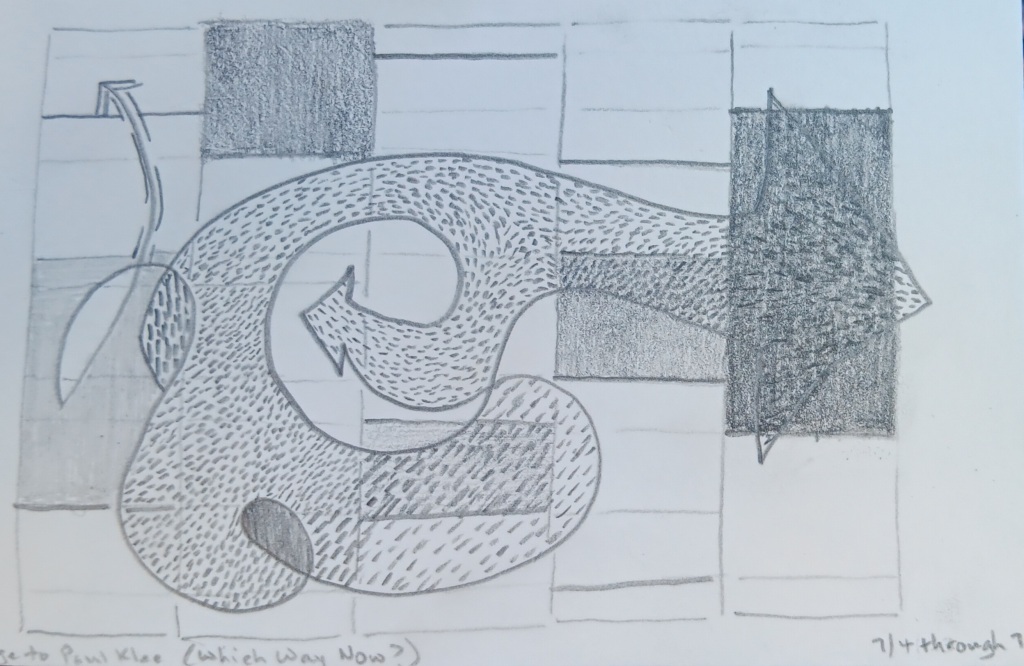
Both are graphite pencil on paper.
With time in the Zurich Hauptbanhof before our train to Geneva, we found a store (Flying Tiger,based in Copenhagen) that was like Daiso in the breadth and randomness of its merchandise, many items of which also had Daiso-like little quotes, but in disappointingly flawless English. Also, the packaging was quite uniform, as if everything were manufactured in one place instead of a dozen. There were snacks, including several types of marshmallows, making marshmallows about 50% of the foods on offer (maybe they are as popular in Zurich as Pocky are in SF?). There were kitchen gadgets. There were model traffic lights that really blinked. There were 2023-24 planners in French and German, making Munchkin slightly regret that she already bought her planner. There was a notebook that she opted not to buy despite the built-in calculator on the front cover (of course she doesn’t need a calculator, but she thought that was so cute), and a gel pen that I convinced her to get because she is constantly borrowing mine. I struck it lucky with my sketchbook search, finding one that is a bit heavier than the ideal, being hardcover, but irresistible at six Swiss francs. (I had looked in the museum stores in Zurich and Bern and would have had to pay 30 CHF for one with fewer pages. Yeesh.) (Another small source of annoyance in Switzerland: it isn’t in the EU–something I did not know until I arrived there, though it stands to reason–and so broke the streak of needing nothing but euros all summer. Everyone charges everything, so it made little difference. However, I’m glad to be back in the Eurozone and able to spend cash on small purchases again. I know “the convenience of tourists” was low on the list of concerns in the formation of the EU, but I sure do love the single currency.)
—–
Rereading: Gilead, Marilynne Robinson
Finished: Oil and Marble
Continuing: Understanding the Fundamentals of Music
A couple of sights recently made me want to try to create something like their luminosity. One was a circular reflection of light on a painted white wall, and the other was a painting I saw when Joy and I visited the museum Ca’ Pesaro yesterday. I thought I would remember the artist’s name, but I have already forgotten it and will have to do some research. I was so taken with how a simple use of line could create such a powerful sense of light and dark. An apt topic for the solstice.
I brought a very small sketchbook with me on this trip, and so these are very small drawings, each about 2″ x 3″. Graphite pencil. I hope the focus is adequate; I photographed them on a moving train (hello, Slovenia!).


 Sermons in Stones
Recent comments