You are currently browsing the category archive for the ‘drawings’ category.
There’s no avoiding it: as soon as I start posting drawings like this and the previous one, some people will evaluate them politically. Am I showing too many images of ___ and not enough of ___? What do I mean by giving attention to ___ instead of ___? Etc.
I can’t say these aren’t political. All I can say is that allowing my heart to spend time with people who have suffered because of this conflict feels like it is the right thing to do. And if anyone is counting beans, they should be aware that I’m not posting everything I’m drawing. Some feel too raw and some are just crappy drawings, but they’re helping my heart stay with the suffering.

With this drawing, I was trying to make every mark a meditation and a reminder to myself that within these white plastic bags are parts of the bodies of people who were recently alive and who died by violence. Every mark a breath, taking in the reality of things we can’t see.
Content warning: image of a grief-stricken child
This is as done as it’s going to get–I think I’m better off starting from scratch if I want to improve it. But the making of it has been painful and beneficial. I am trying, over and over, to embrace my art as a spiritual practice and only secondarily concern myself with the physical artifact that results.
The subject is a child whose name I don’t know, who came to this Gaza hospital a couple of weeks ago when the refugee camp that is her home was bombed. Next to her gaze, and the so-adult expressiveness of her hands, it’s the little details of normal life that wring my heart (as normal as life in a refugee camp can be said to be). Someone helped pull that Minnie Mouse shirt over her head. Someone pulled her hair into a ponytail with that white elastic. Is that person’s blood on her shirt now? Is that person alive? Is she alive?–an ambulance just outside the hospital has been bombed since, and the lack of fuel is turning Al-Shifa into a “mass grave,” although a rumor that a group of Israeli doctors actually called for the hospital to be bombed seems to be sheer invention. (I found reports about it, but searching for the “Israeli news site” they claim to be citing, and the name of the group they claim is doing this, turns up nothing. “The truth is the first casualty of war”; read with care.) 11/7/23, ETA: I saw the same story with full citations here, thanks to Jewish Voice for Peace. At this writing, over 90 doctors have signed the letter. Utterly sickening.
I will never know her story. I just know that I hope neither I nor anyone I love ever has to look upon whatever horror her eyes are seeing.

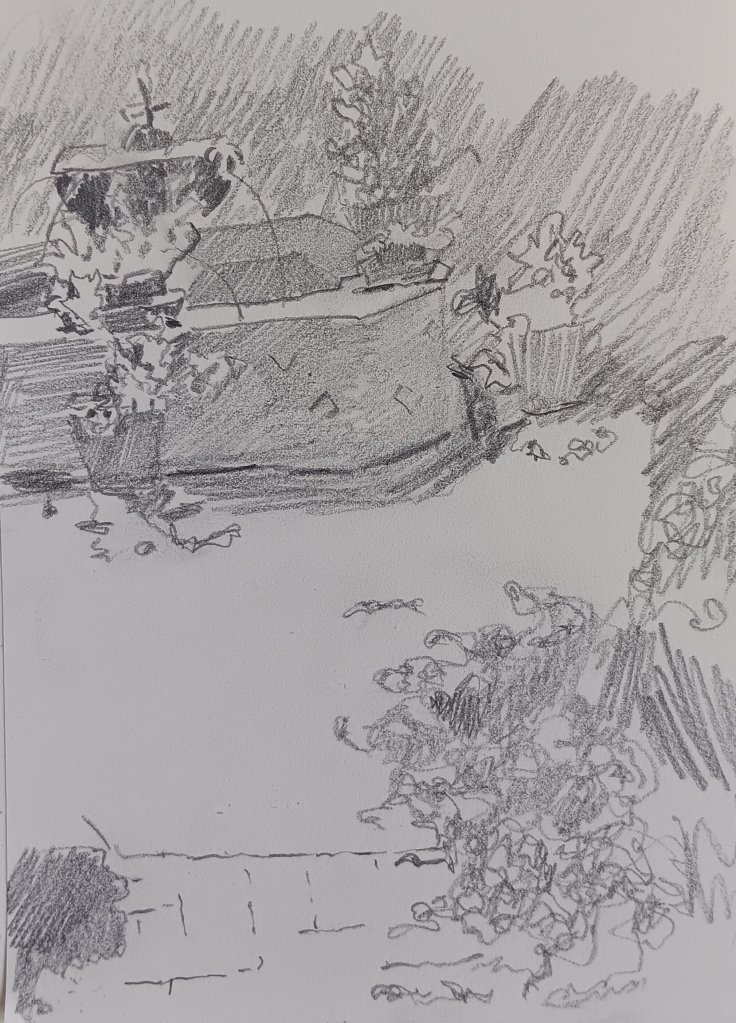
Looking at art in museums, and also making a drawing of a building in SketchbookX, where I can’t make very precise marks, I noticed how little it takes to show light and shadow. So when we say by this patio at Palacio Viana, Córdoba, I tried to put in just enough to show the light.
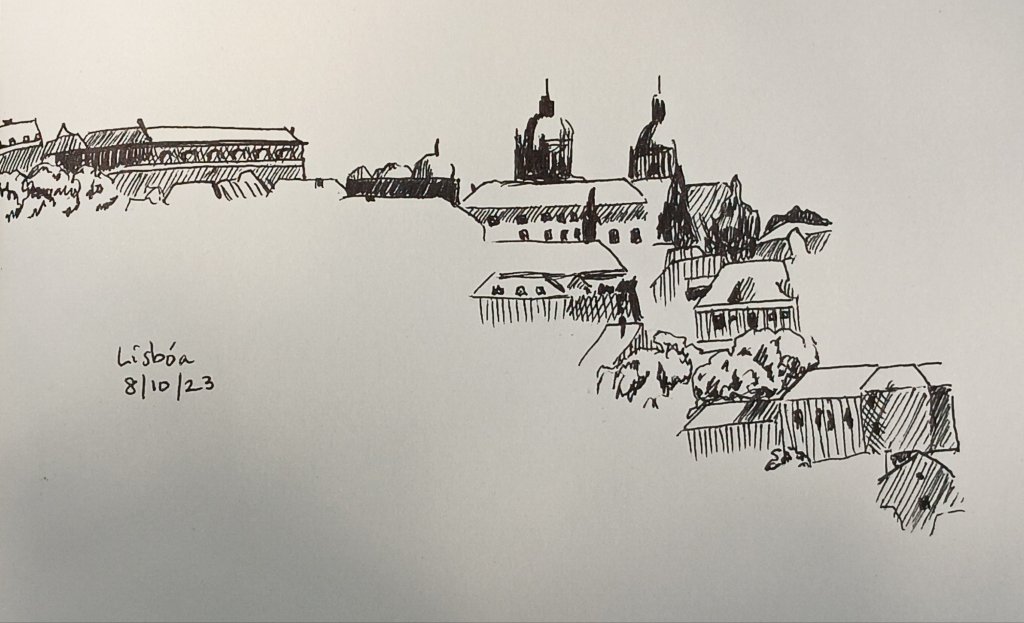
I am now sitting in the park Miradoura de Sāo Pedro de Alcántara, in Lisbóa, looking out to the castle and hillsides of buildings. For music, there’s a breeze, the clink of coffee cups behind me, and a man with an acoustic guitar and a beautiful, unadorned voice playing bossa nova. I might get out my sketchbook and draw the light on the buildings, or I might just keep reading and making notes on How to Be an Artist, by Jerry Saltz, for my grad school course (The Arts as Leadership) that starts next month. It’s all good. More than good.
Edited to add this, the view from here, since I did do some drawing.
It’s amazing how you can walk into a room full of 17th century Dutch paintings, take a quick glance around as you move through, and know immediately when your eye falls on a painting by Vermeer. I could spend the rest of my life trying to do what he does with light, but I figure the only way to begin to learn it is to draw it. This is “The Astronomer,” the only one of Vermeer’s that is currently in residence here at the Louvre (“The Lacemaker” is out on loan).

I was in this wing in search of Rembrandt, and found the roomful a couple of rooms along from Vermeer. This self-portrait (below) is from 1660. There are a few here from 25 years earlier. I love how honestly he shows the changes time and experience have wrought on his face, though through my own limitations, I took about 25 years off again.
The first try was way too small, and when I went closer to see some details that I hadn’t been able to see from the seat on the other side of the room, I hadn’t left myself room to have a prayer of including them. So I started again at twice the size (still a thumbnail of a detail; the painting is about 3×4′). As with Vermeer: the light, the light, though with Vermeer I always have the impression of light’s falling on the subject, whereas with Rembrandt self-portraits, I usually have more of a feeling that he is emerging, partway only, out of a palpable darkness.
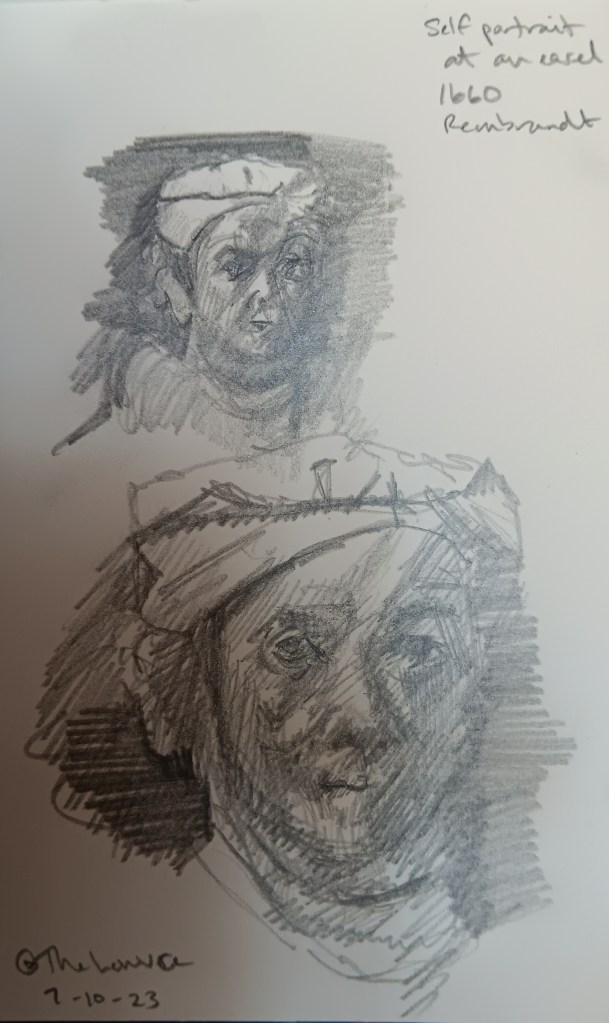
Both graphite pencil on 4″×6″ sketchbook paper.

Munchkin and I are at the Louvre. I communed with one of Michelangelo’s “Captives” while she went in search of more recent European sculpture.
I was lukewarm about returning to the Louvre, and came mostly to accompany M, but this time spent drawing made it more than worth the price of admission, and the wait.
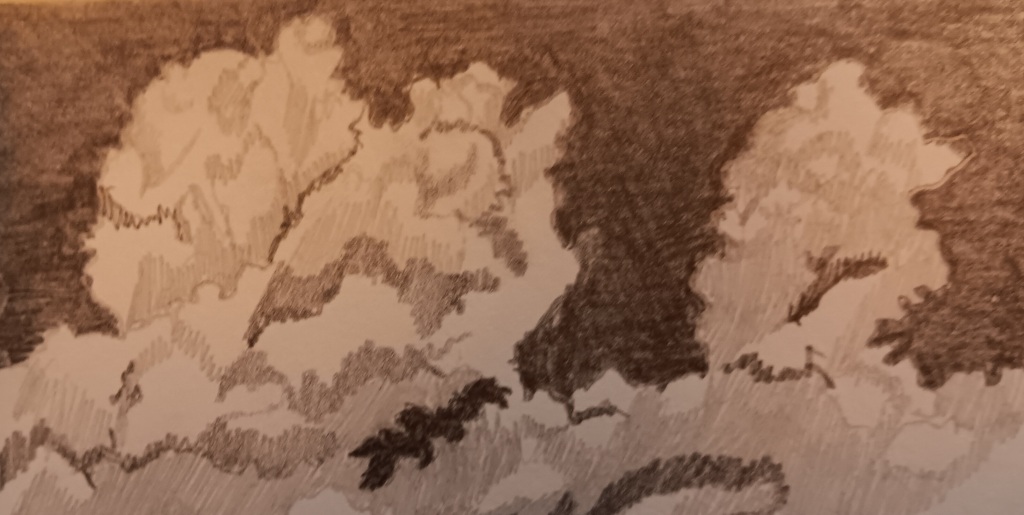
Two more drawings in my 4×6 sketchbook. Clouds in Geneva, making me wish that I had colored pencils with me.
And something inspired by Paul Klee, who was unafraid to incorporate signs such as arrows, numerals and letters, even stick figures if they served the vision. I would normally be cowed out of using arrows by the inner critic who sneers, “Kind of a shortcut, isn’t it? Don’t you have a way to show motion befitting an artist, or are you just a jumped-up road sign painter?” I tried to be more polite to my inner critic than he was being to me, kindly suggesting that it sounded like he had a bad headache and might want to go lie down. But I couldn’t resist pointing out to him that the great Paul Klee used arrows, and he was no sign painter. He went away grumbling.
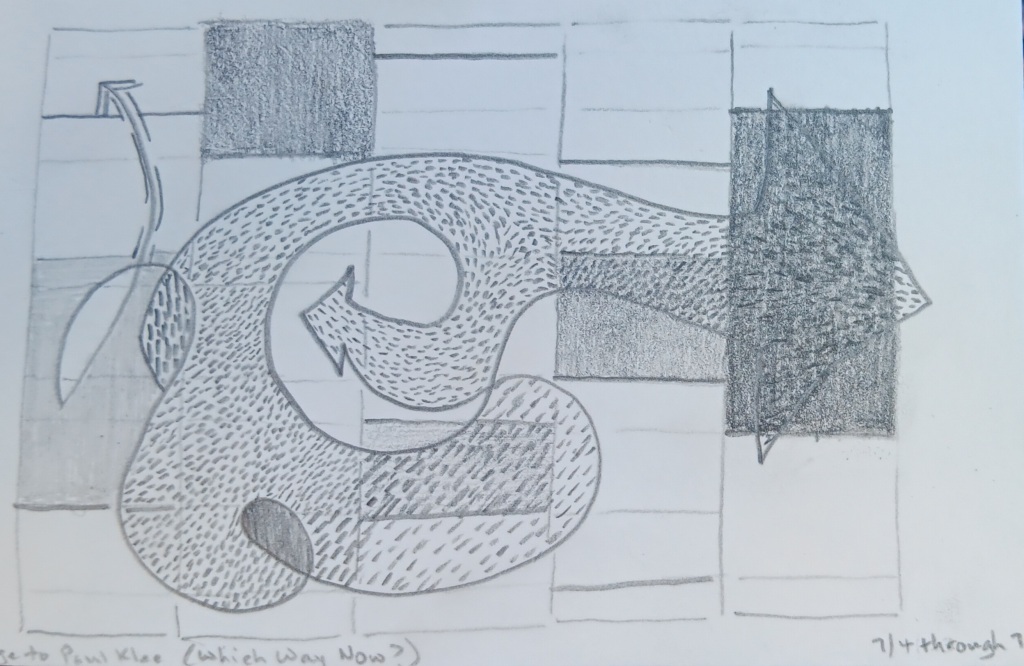
Both are graphite pencil on paper.
With time in the Zurich Hauptbanhof before our train to Geneva, we found a store (Flying Tiger,based in Copenhagen) that was like Daiso in the breadth and randomness of its merchandise, many items of which also had Daiso-like little quotes, but in disappointingly flawless English. Also, the packaging was quite uniform, as if everything were manufactured in one place instead of a dozen. There were snacks, including several types of marshmallows, making marshmallows about 50% of the foods on offer (maybe they are as popular in Zurich as Pocky are in SF?). There were kitchen gadgets. There were model traffic lights that really blinked. There were 2023-24 planners in French and German, making Munchkin slightly regret that she already bought her planner. There was a notebook that she opted not to buy despite the built-in calculator on the front cover (of course she doesn’t need a calculator, but she thought that was so cute), and a gel pen that I convinced her to get because she is constantly borrowing mine. I struck it lucky with my sketchbook search, finding one that is a bit heavier than the ideal, being hardcover, but irresistible at six Swiss francs. (I had looked in the museum stores in Zurich and Bern and would have had to pay 30 CHF for one with fewer pages. Yeesh.) (Another small source of annoyance in Switzerland: it isn’t in the EU–something I did not know until I arrived there, though it stands to reason–and so broke the streak of needing nothing but euros all summer. Everyone charges everything, so it made little difference. However, I’m glad to be back in the Eurozone and able to spend cash on small purchases again. I know “the convenience of tourists” was low on the list of concerns in the formation of the EU, but I sure do love the single currency.)
—–
Rereading: Gilead, Marilynne Robinson
Finished: Oil and Marble
Continuing: Understanding the Fundamentals of Music
A couple of sights recently made me want to try to create something like their luminosity. One was a circular reflection of light on a painted white wall, and the other was a painting I saw when Joy and I visited the museum Ca’ Pesaro yesterday. I thought I would remember the artist’s name, but I have already forgotten it and will have to do some research. I was so taken with how a simple use of line could create such a powerful sense of light and dark. An apt topic for the solstice.
I brought a very small sketchbook with me on this trip, and so these are very small drawings, each about 2″ x 3″. Graphite pencil. I hope the focus is adequate; I photographed them on a moving train (hello, Slovenia!).
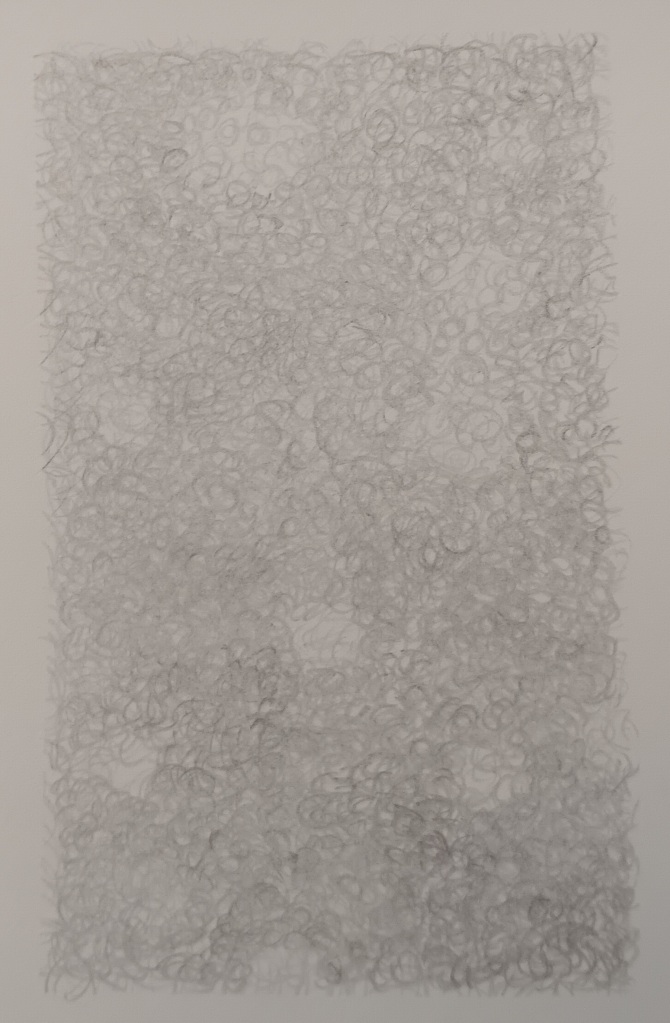
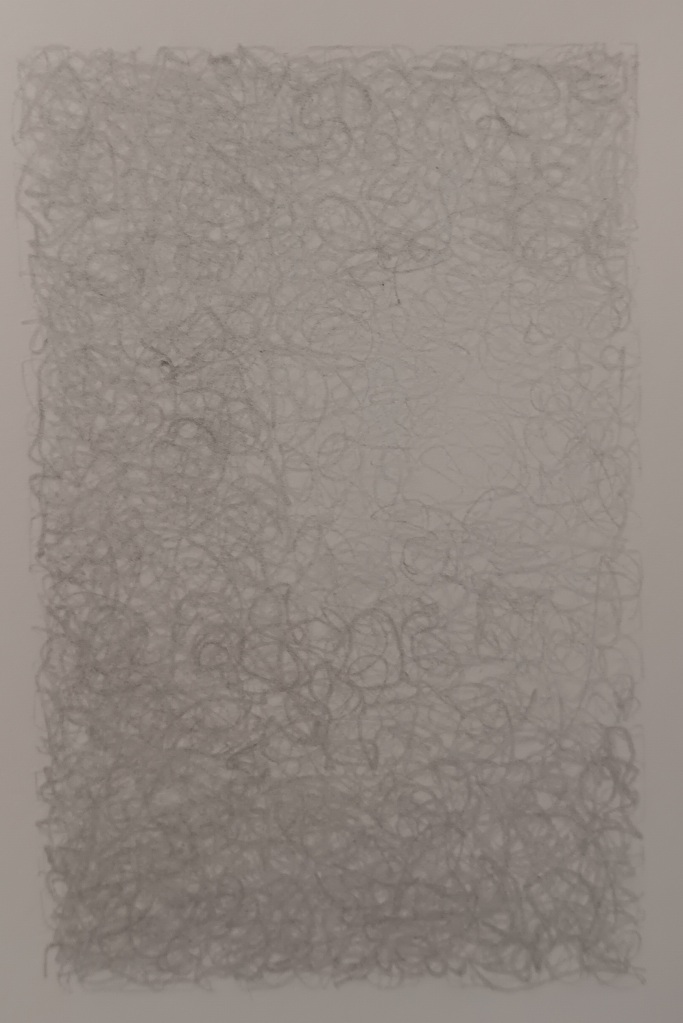


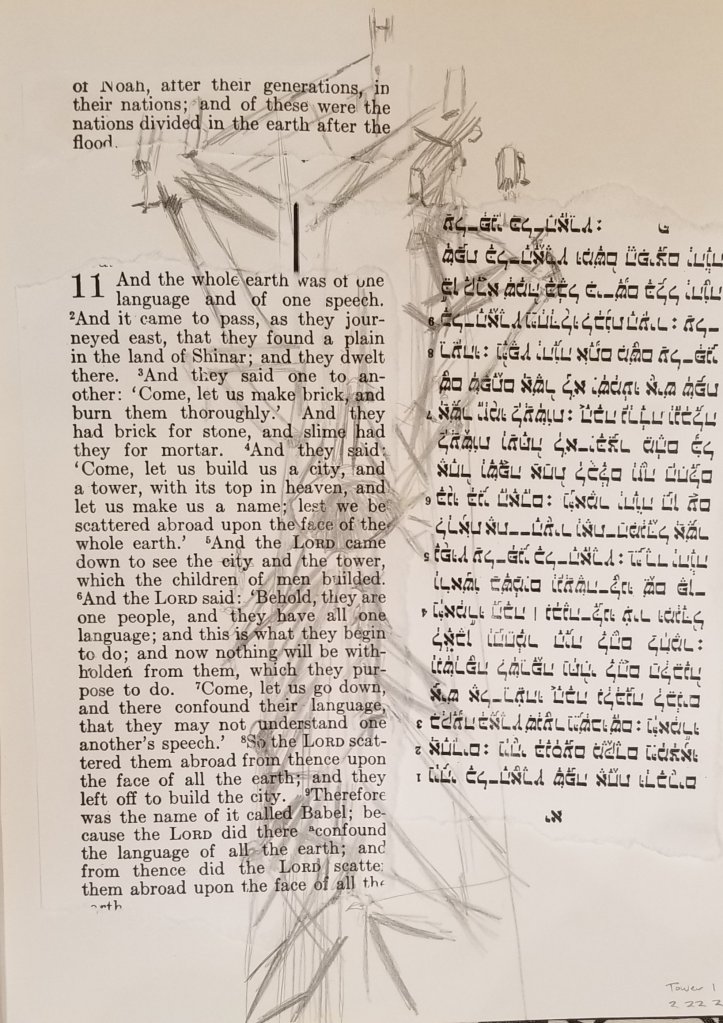
I’ve been intrigued by the Tower of Babel for a long time, so I’ve decided to really dig into it via art (and maybe writing) by making it my Lent project. Every day, an exploration of some aspect or interpretation or tangent of this very brief (nine verses, Genesis 11:1-9), enigmatic story. Here’s the first.


 Sermons in Stones
Recent comments