You are currently browsing the monthly archive for July 2023.
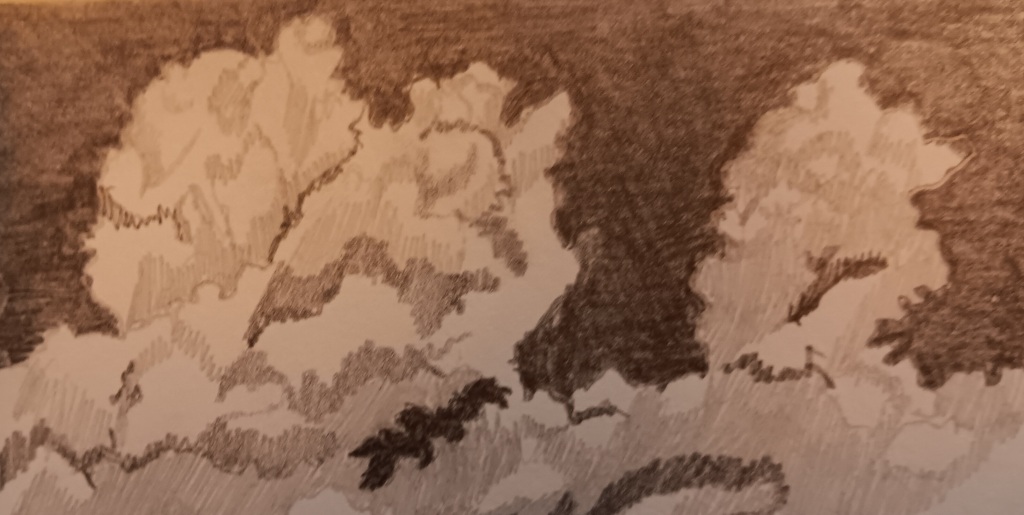
Two more drawings in my 4×6 sketchbook. Clouds in Geneva, making me wish that I had colored pencils with me.
And something inspired by Paul Klee, who was unafraid to incorporate signs such as arrows, numerals and letters, even stick figures if they served the vision. I would normally be cowed out of using arrows by the inner critic who sneers, “Kind of a shortcut, isn’t it? Don’t you have a way to show motion befitting an artist, or are you just a jumped-up road sign painter?” I tried to be more polite to my inner critic than he was being to me, kindly suggesting that it sounded like he had a bad headache and might want to go lie down. But I couldn’t resist pointing out to him that the great Paul Klee used arrows, and he was no sign painter. He went away grumbling.
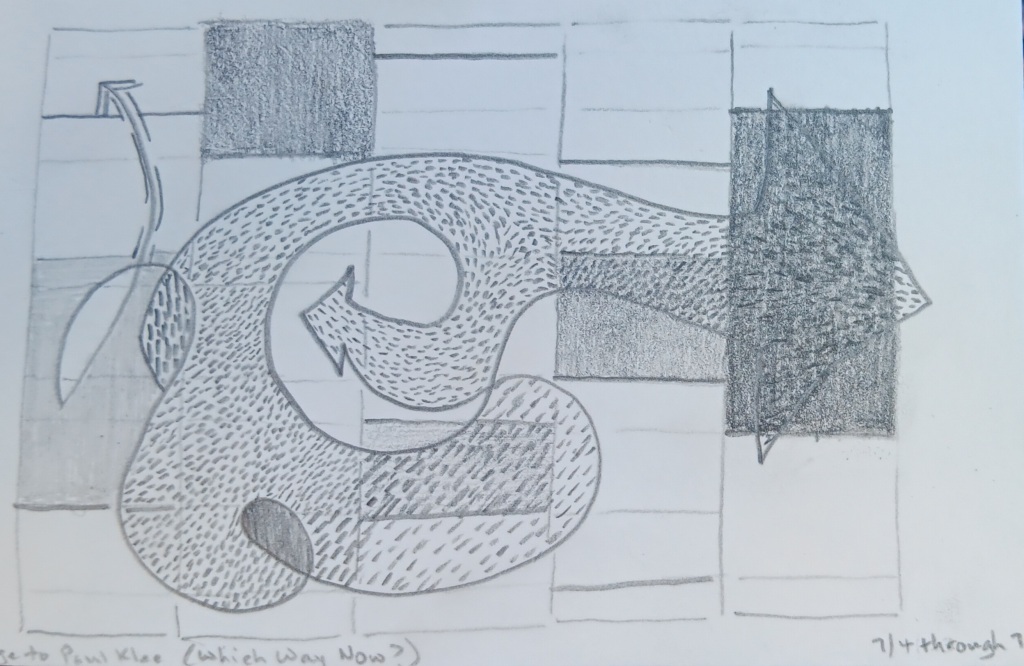
Both are graphite pencil on paper.
With time in the Zurich Hauptbanhof before our train to Geneva, we found a store (Flying Tiger,based in Copenhagen) that was like Daiso in the breadth and randomness of its merchandise, many items of which also had Daiso-like little quotes, but in disappointingly flawless English. Also, the packaging was quite uniform, as if everything were manufactured in one place instead of a dozen. There were snacks, including several types of marshmallows, making marshmallows about 50% of the foods on offer (maybe they are as popular in Zurich as Pocky are in SF?). There were kitchen gadgets. There were model traffic lights that really blinked. There were 2023-24 planners in French and German, making Munchkin slightly regret that she already bought her planner. There was a notebook that she opted not to buy despite the built-in calculator on the front cover (of course she doesn’t need a calculator, but she thought that was so cute), and a gel pen that I convinced her to get because she is constantly borrowing mine. I struck it lucky with my sketchbook search, finding one that is a bit heavier than the ideal, being hardcover, but irresistible at six Swiss francs. (I had looked in the museum stores in Zurich and Bern and would have had to pay 30 CHF for one with fewer pages. Yeesh.) (Another small source of annoyance in Switzerland: it isn’t in the EU–something I did not know until I arrived there, though it stands to reason–and so broke the streak of needing nothing but euros all summer. Everyone charges everything, so it made little difference. However, I’m glad to be back in the Eurozone and able to spend cash on small purchases again. I know “the convenience of tourists” was low on the list of concerns in the formation of the EU, but I sure do love the single currency.)
—–
Rereading: Gilead, Marilynne Robinson
Finished: Oil and Marble
Continuing: Understanding the Fundamentals of Music
I started writing this during my outing three days ago, on Tuesday, so I’m going to stick with the present tense, as if it were all written on that day.
——
I’m on a side quest of my own today. No one else has a powerful hankering to go to the Zentrum Paul Klee, so I’m on a train to Bern by myself and relishing this pure introversion time.
I figure it like this: if I’m going to Bern, I’m going to see its famous clock, the Zytglogge; if I’m going to see the Zytglogge, I’m going to get there by noon to watch it perform to the utmost. So I left the house at 9, which allowed time to pick up breakfast essentials in the Zurich Hauptbanhof (main station): cherries, coffee, and a mystery roll that later turned out to contain chocolate and some kind of custard.

The train trip included such delightful sights as a field of sunflowers (not pictured). Seeing half an acre of them all together, facing exactly the same direction, is very affecting. Now I am curious: since they obviously don’t turn 360 degrees, but turn back at some point to begin again, at what point in the day do they do that? Do they follow the sun until it is out of sight, and then turn back to where it will next appear, to wait out the darkness there? How quickly do they re-orient themselves? There are videos online of sunflowers in fields, but I haven’t yet found one that answers these essential questions.
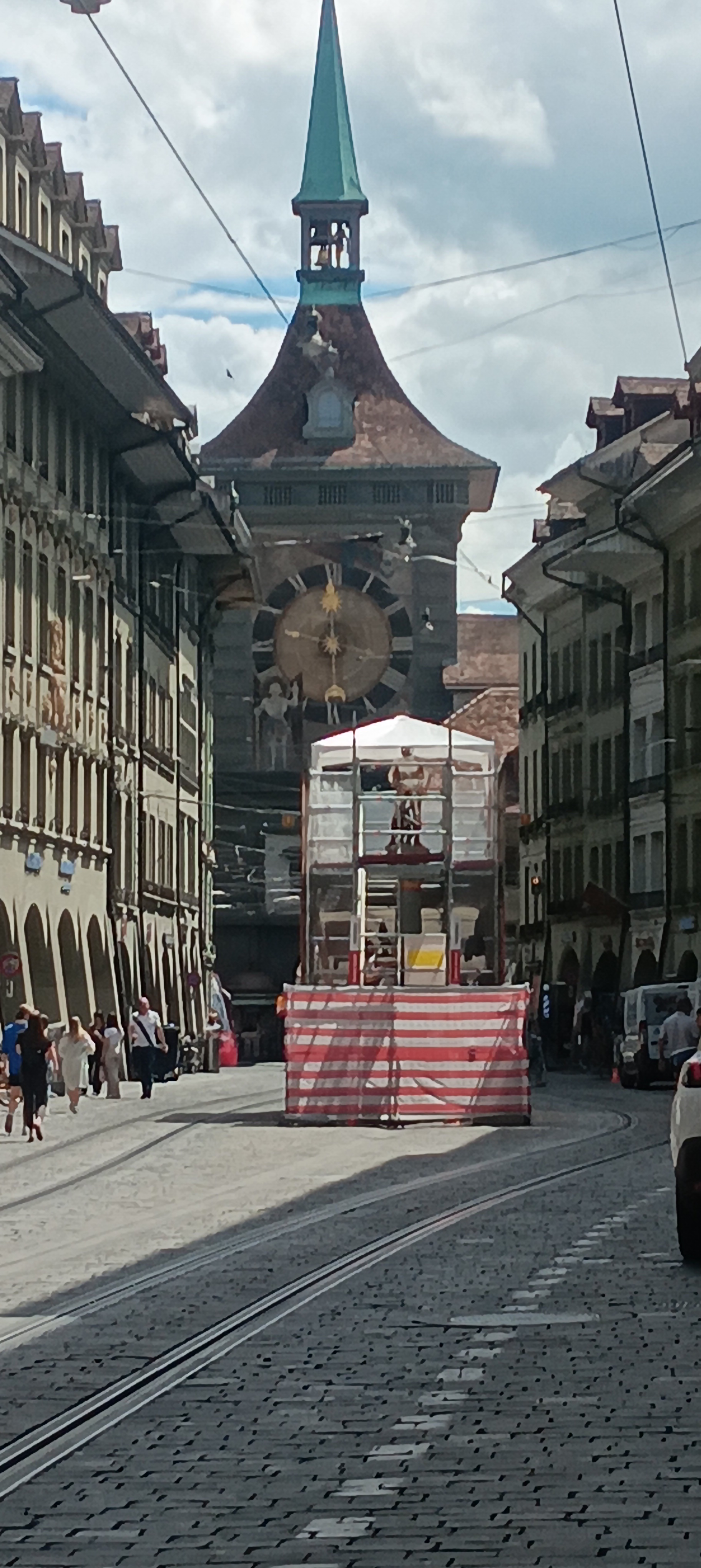
So with this tracker of planetary time freshly in mind, I arrived in Bern with time to get my bearings and walk to the Zytglogge before noon. The side I saw first was the neglected side, but lovely in its own right.
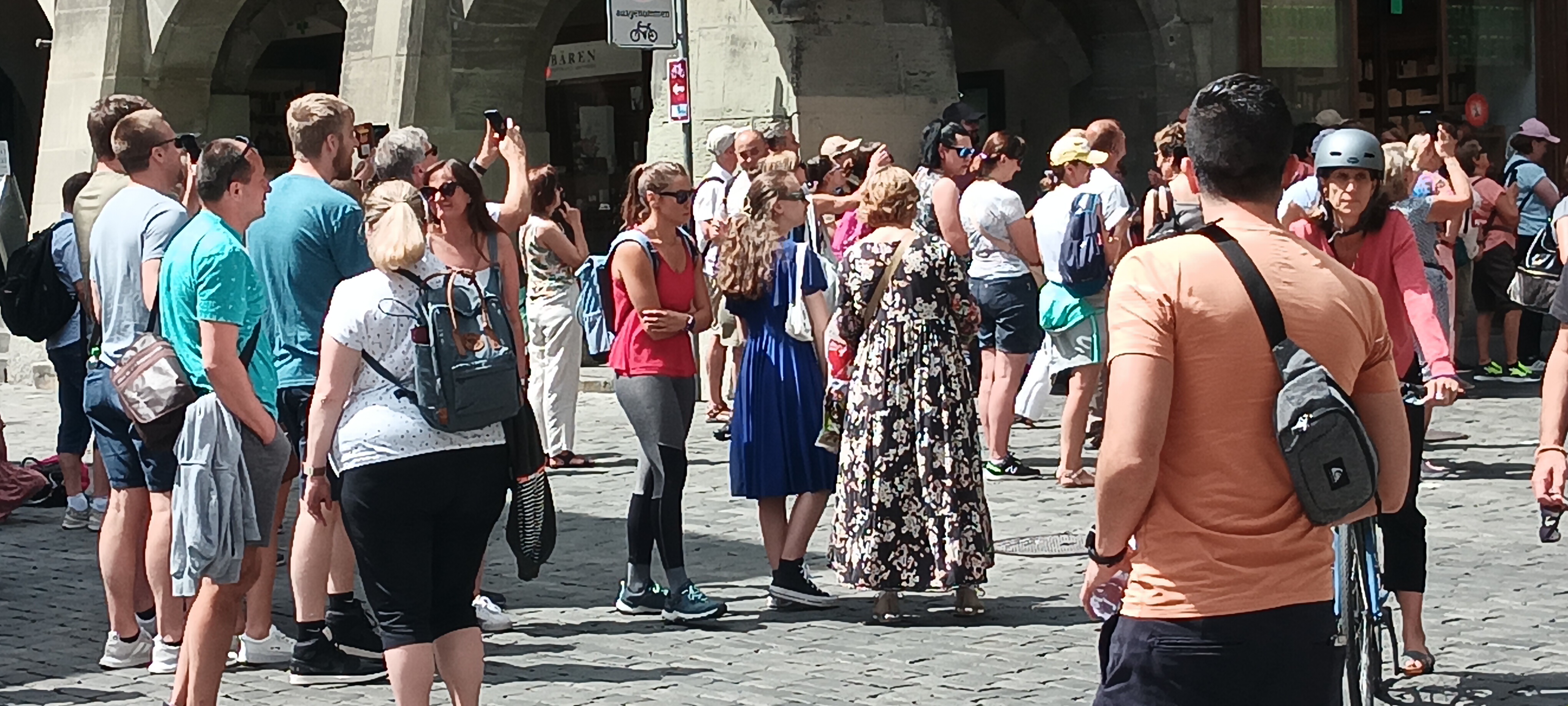
Having gone through the tunnel made by the clock building to the other side, I joined the growing crowd of tourists, most of whom stood in the street for the best view. I am sure the locals know not to try to drive through that block when it’s approaching 12, the way San Franciscans know to avoid driving through the center city on the last Friday of the month, when Critical Mass is amassed. I found a spot where I could lean against a pillar and be out of the crowd (anti-pickpocket measures) and still see the moving figures.
The Fool gave the three-minute warning. Then the man with the hammer struck the twelve chimes directly upon the bell, as the figures below waved their staves. We watched silently, albeit with many clicks of digital shutters. I felt a tender kinship with all these gathered people, each of us moving toward the same end.
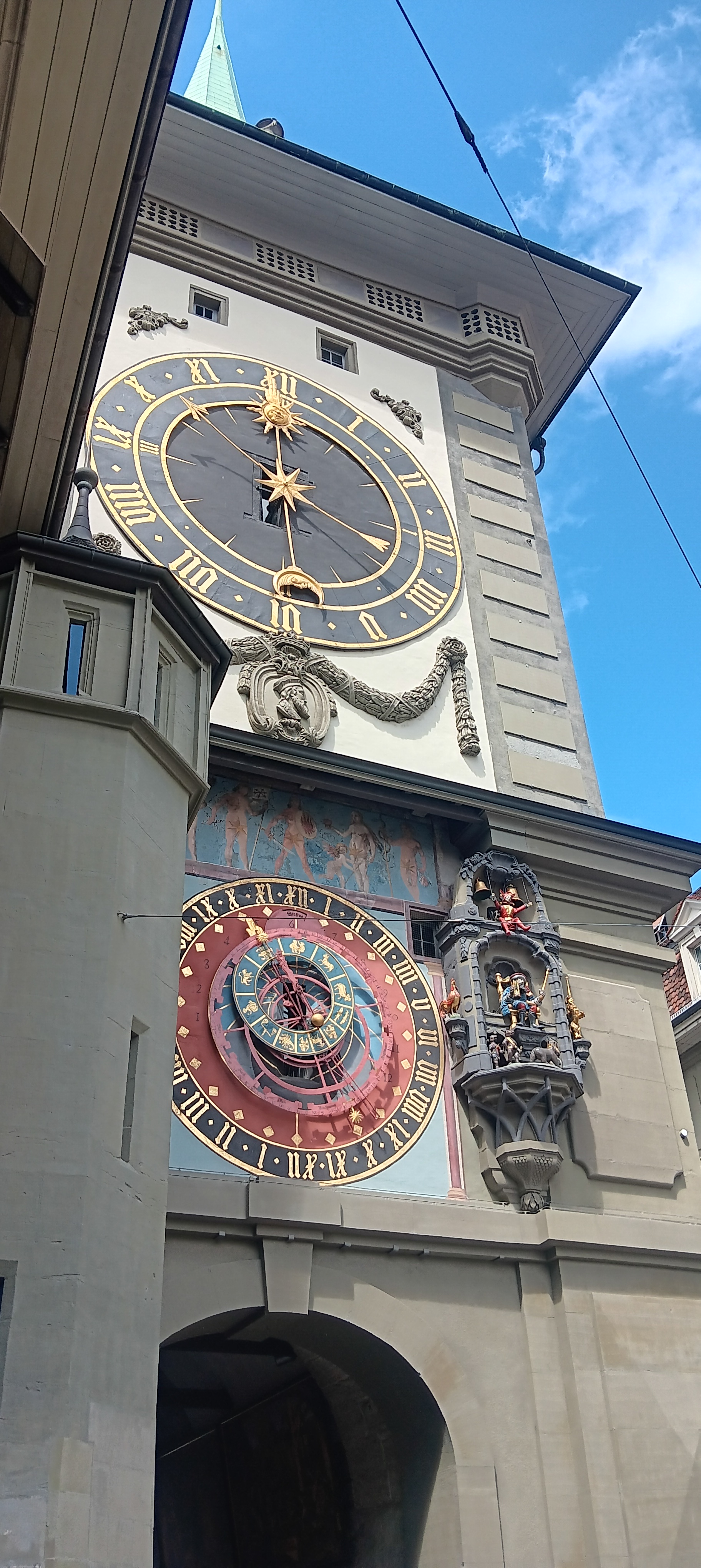
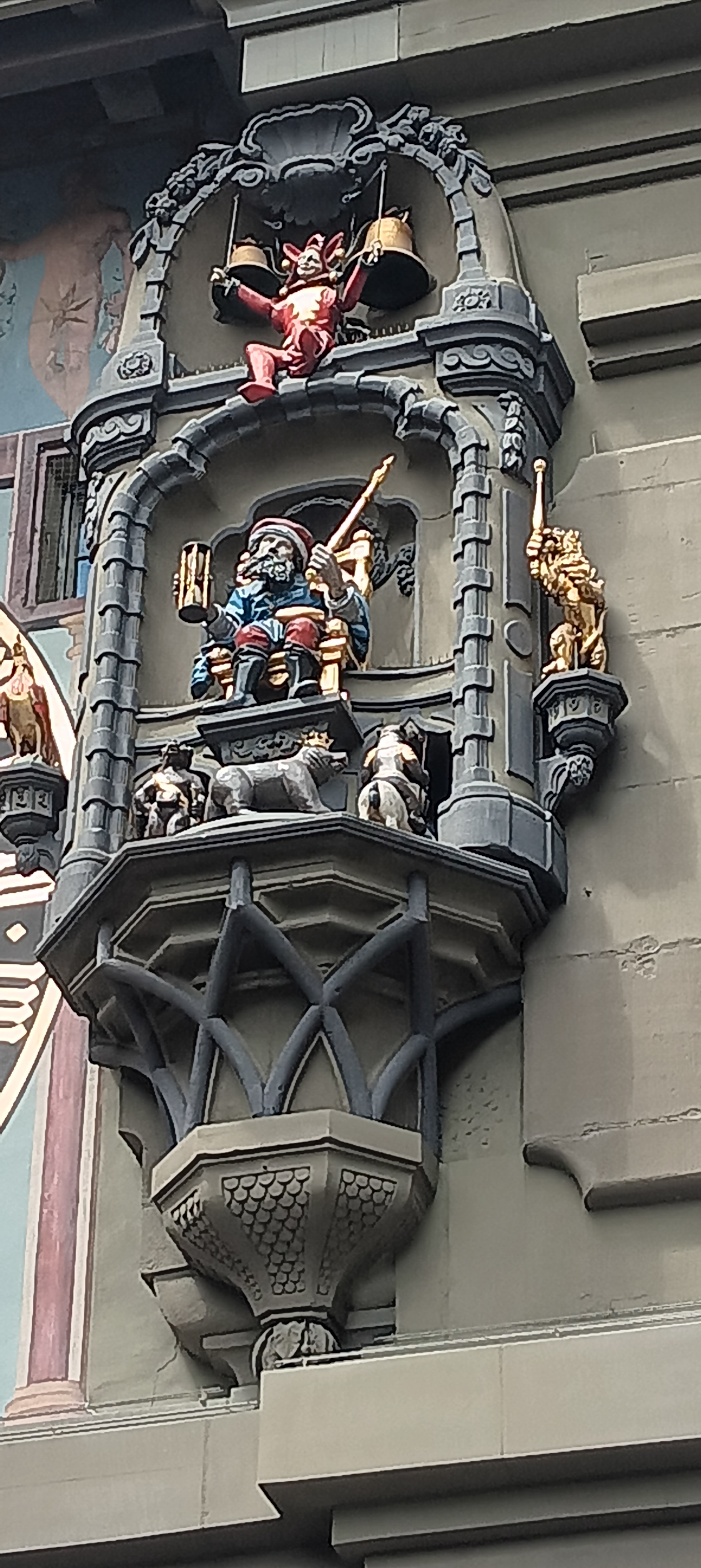
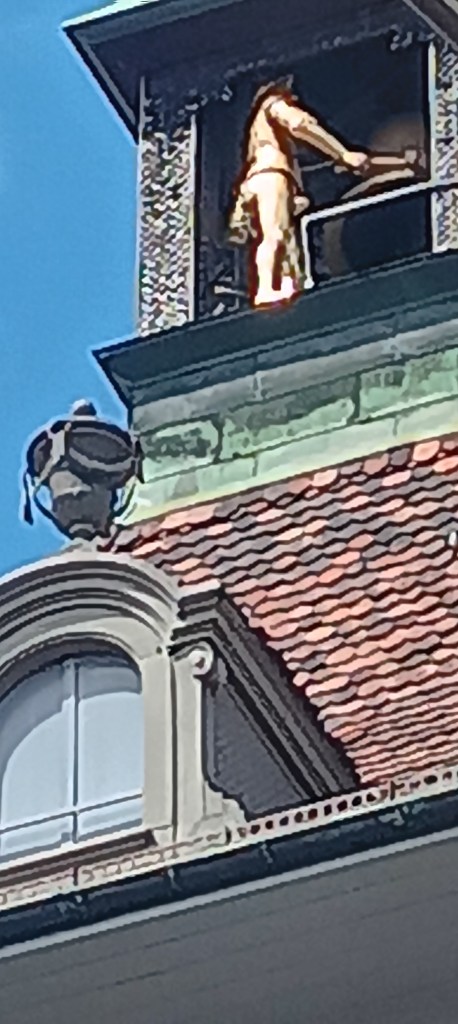
It was in some ways a comical, even paradoxical way to spend our time: to come all this way, use hours or a day of our wild and precious lives, to watch the chiming of a clock. On the one hand, I thought the Fool might be laughing at us: “Go, live! You don’t have that much time.” On the other hand, and again thinking of Mary Oliver’s “The Summer Day,” “what else should I have done?” To be with other mortals, contemplating mortality, or time, or whatever they’re going to have for lunch, and enjoying the work of great craftspeople who went before us and contemplated the same things, seemed very fitting.
For my part, I wasn’t thinking about what I’d have for lunch, only where. Indian food is almost always my choice when I’m on my own, so I just needed to find an Indian restaurant, and I did, passing this interesting object en route.
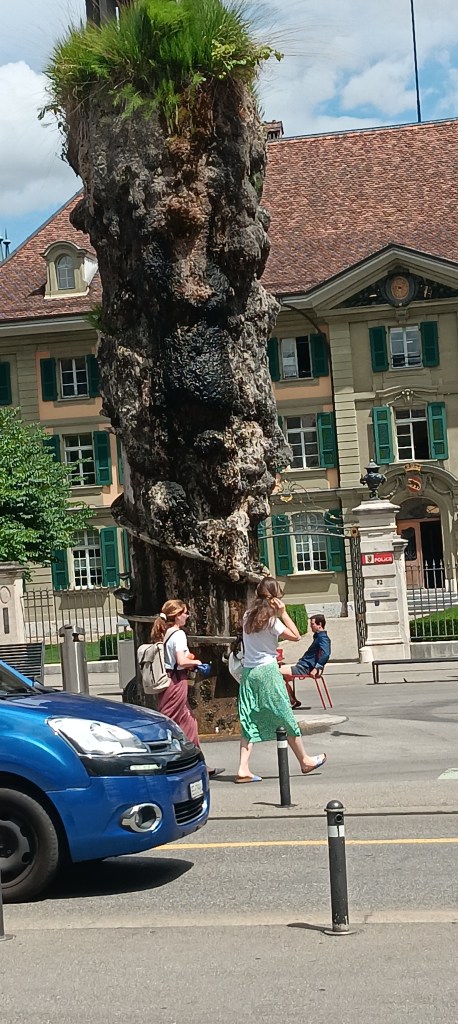
My exhaustive (i.e., five-minute) internet search doesn’t turn up an explanation of what it is, so I’ll have to ask Mike and Sue. They used to live in Bern. (ETA it is the Meret Oppenheim Fountain. Thanks, M & S!)
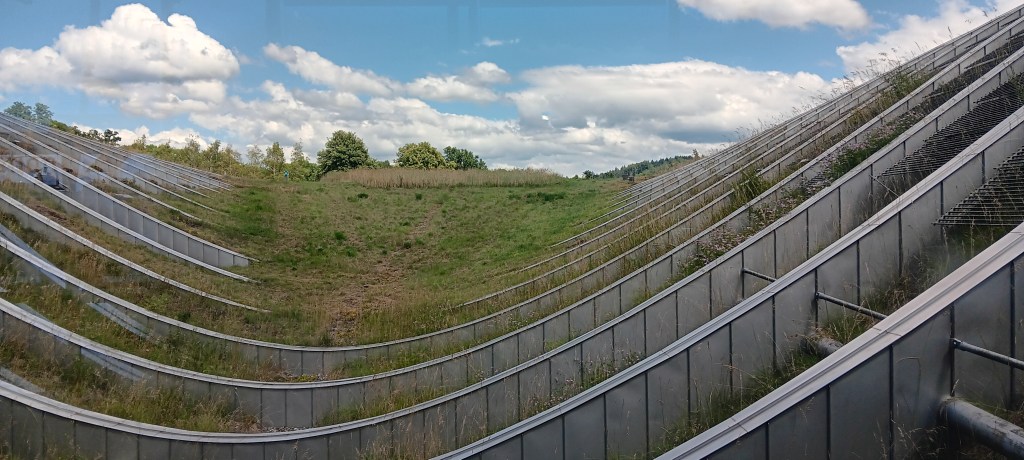
Then I boarded the bus for the Klee museum, whose design is pretty cool. The current main exhibit here is called “Alles Wächst,” “Everything Grows,” delving into Klee’s fascination with the patterns of growth and change in the natural world and how he explored them in his art, both the earlier, more representational pieces, and the abstractions for which he is better known. I like seeing how the former turn gradually into the latter.
Having loved Klee’s paintings for a long time, I was both moved and chuffed to learn that like me, he collected lots of items that show these patterns, such as shells, stones, leaves, and nests, and that like me, he was fascinated by the scientific exploration of nature as well as the artistic. Notebook pages the curator displayed demonstrated how his mind and pencil moved among diagrams, mathematical analyses, drawings, notes, and abstractions; you can buy a facsimile of the notebook, and if I knew German I might have.

I’ve gotten into the habit of spending a long time with one piece, as persuasively recommended by Dr. Jennifer Roberts in this essay. I have never yet devoted her three hours to a piece–I think my longest stretch has been an hour and a half–but it’s become a frequent practice, and it is always deeply rewarding. Last week, writing about “Main Prise / Caught Hand” by Alberto Giacometti, I wanted so much to draw it that I realized that of course that was a part of how I come to understand what a piece has to say to me, and that will no doubt become part of the practice. I did draw “Main Prise,” and of the many Klee works that took my breath away, this was the one I sat down with, and drew and wrote about. I neglected to jot down the original title, which would have been in German, but the English translation was “Illuminated Leaf.”
Now I am inspired, as well, to make a drawing in homage to Klee, but it’s not ready to share yet. I’m going to hit Publish on this and resume drawing, because time is short.
More later. For now, I’m just posting this picture from outside the Montmartre apartment we’ll be staying in for the next two weeks.

Everything is very French, and we are very happy.
This child has always climbed everything she could. It should have come as no surprise when she wanted to join a climbing gym last year.
After an afternoon of taking in art at the Zurich Kunsthaus, she was literally ready to climb the walls. This one was outside a very expensive-looking gated estate with sculpture of its own sprinkled around the property. We didn’t know that when she began climbing. Luckily no one seemed to mind, or notice.


Seriously, though, we both really enjoyed the Kunsthaus. But wait, you may be asking, how did we get to Zurich? Via a long train ride from Salzburg on Thursday. It was a four-country trip, passing through Germany, then Austria again, and even Liechtenstein (don’t blink or you’ll miss it) before we entered Switzerland and began to travel along the south shores of some long, beautiful lakes, the last of which was Lake Zurich. Borders are strange.
So here we are in Winterthur, a charming small city a little northeast of Zurich. Our friend Mike is exactly like we expected him to be, except more terrific. It has been just great hanging out with him and getting to know his wife Susan, who is also terrific. Munchkin chatters away in German with them, with the result that to my admittedly ignorant ear, her German sounds about five times as good as it was a week ago.
Today Susan, their adorable dogs, Joy, and I took the train to a small town they like, while Mike and Munchkin biked there. We all met up at a cafe and explored the village. One of the great things about Europe is the age of things. At least one building in this town was over 900 years old. This barn is probably older than our nation:

The town was surrounded by fields of wildflowers that would make an Impressionist rush to set up an easel. My camera and I being no Monet, I just documented the warm welcome we got from these siblings of California poppies.

Then Mike and the dogs left for a volunteer gig (they are both trained as therapy dogs, and he and the enormous Saint Bernard frequently visit a psychiatric clinic), while the other three of us went on to the second destination of the day. I did not realize until we bought our train tickets that when Sue and Mike spoke of our taking in a waterfall, they weren’t talking about a walk in the woods leading to a sweet little waterfall, but the Rheinfall.

I am going to disloyally avow that it is more my kind of waterfall than Niagara Falls. Niagara is spectacular, and I have enjoyed it enough to go back three or four times. But the Rhine, rather than falling over a cliff in one great cascade, rushes down over the rocks just like the many mountain streams I’ve loved do, except that it’s frickin’ huge. The spot is set up well as a tourist site, with the path leading to several encounters that are closer and closer to the falls, until you’re on a platform right out over the torrent.

Photos can’t convey the stunning sound, but videos come close.

 Sermons in Stones
Recent comments