
You are currently browsing the daily archive for July 7, 2023.
I started writing this during my outing three days ago, on Tuesday, so I’m going to stick with the present tense, as if it were all written on that day.
——
I’m on a side quest of my own today. No one else has a powerful hankering to go to the Zentrum Paul Klee, so I’m on a train to Bern by myself and relishing this pure introversion time.
I figure it like this: if I’m going to Bern, I’m going to see its famous clock, the Zytglogge; if I’m going to see the Zytglogge, I’m going to get there by noon to watch it perform to the utmost. So I left the house at 9, which allowed time to pick up breakfast essentials in the Zurich Hauptbanhof (main station): cherries, coffee, and a mystery roll that later turned out to contain chocolate and some kind of custard.

The train trip included such delightful sights as a field of sunflowers (not pictured). Seeing half an acre of them all together, facing exactly the same direction, is very affecting. Now I am curious: since they obviously don’t turn 360 degrees, but turn back at some point to begin again, at what point in the day do they do that? Do they follow the sun until it is out of sight, and then turn back to where it will next appear, to wait out the darkness there? How quickly do they re-orient themselves? There are videos online of sunflowers in fields, but I haven’t yet found one that answers these essential questions.
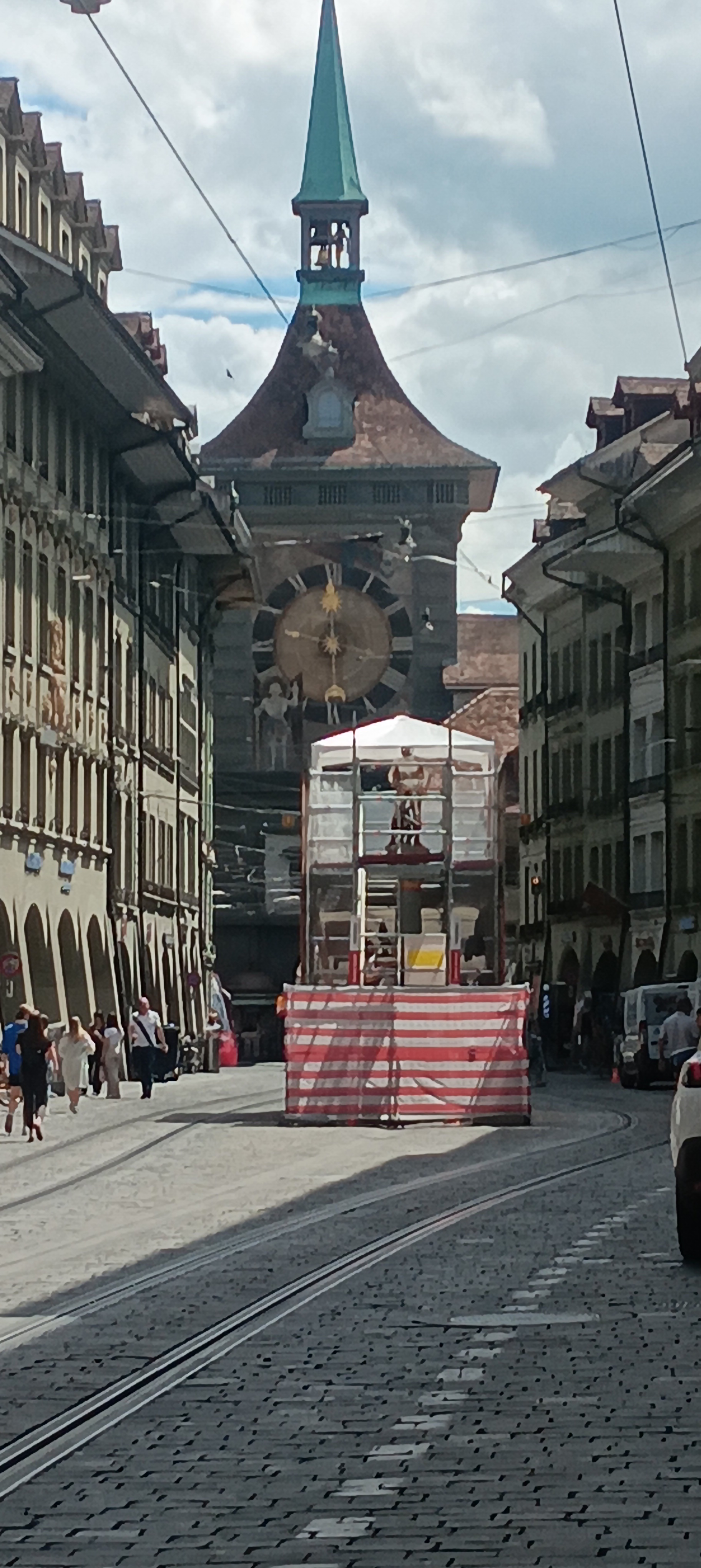
So with this tracker of planetary time freshly in mind, I arrived in Bern with time to get my bearings and walk to the Zytglogge before noon. The side I saw first was the neglected side, but lovely in its own right.
Having gone through the tunnel made by the clock building to the other side, I joined the growing crowd of tourists, most of whom stood in the street for the best view. I am sure the locals know not to try to drive through that block when it’s approaching 12, the way San Franciscans know to avoid driving through the center city on the last Friday of the month, when Critical Mass is amassed. I found a spot where I could lean against a pillar and be out of the crowd (anti-pickpocket measures) and still see the moving figures.
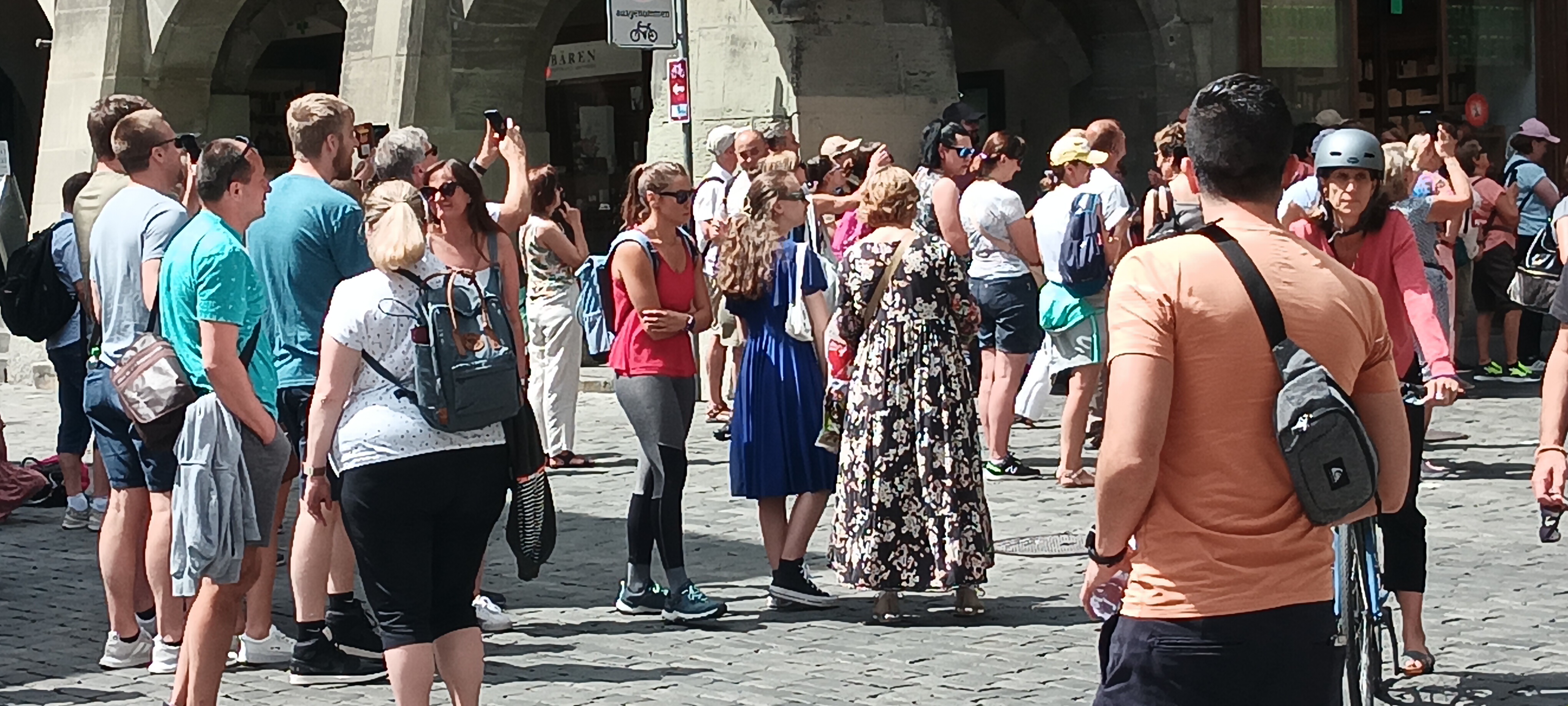
The Fool gave the three-minute warning. Then the man with the hammer struck the twelve chimes directly upon the bell, as the figures below waved their staves. We watched silently, albeit with many clicks of digital shutters. I felt a tender kinship with all these gathered people, each of us moving toward the same end.
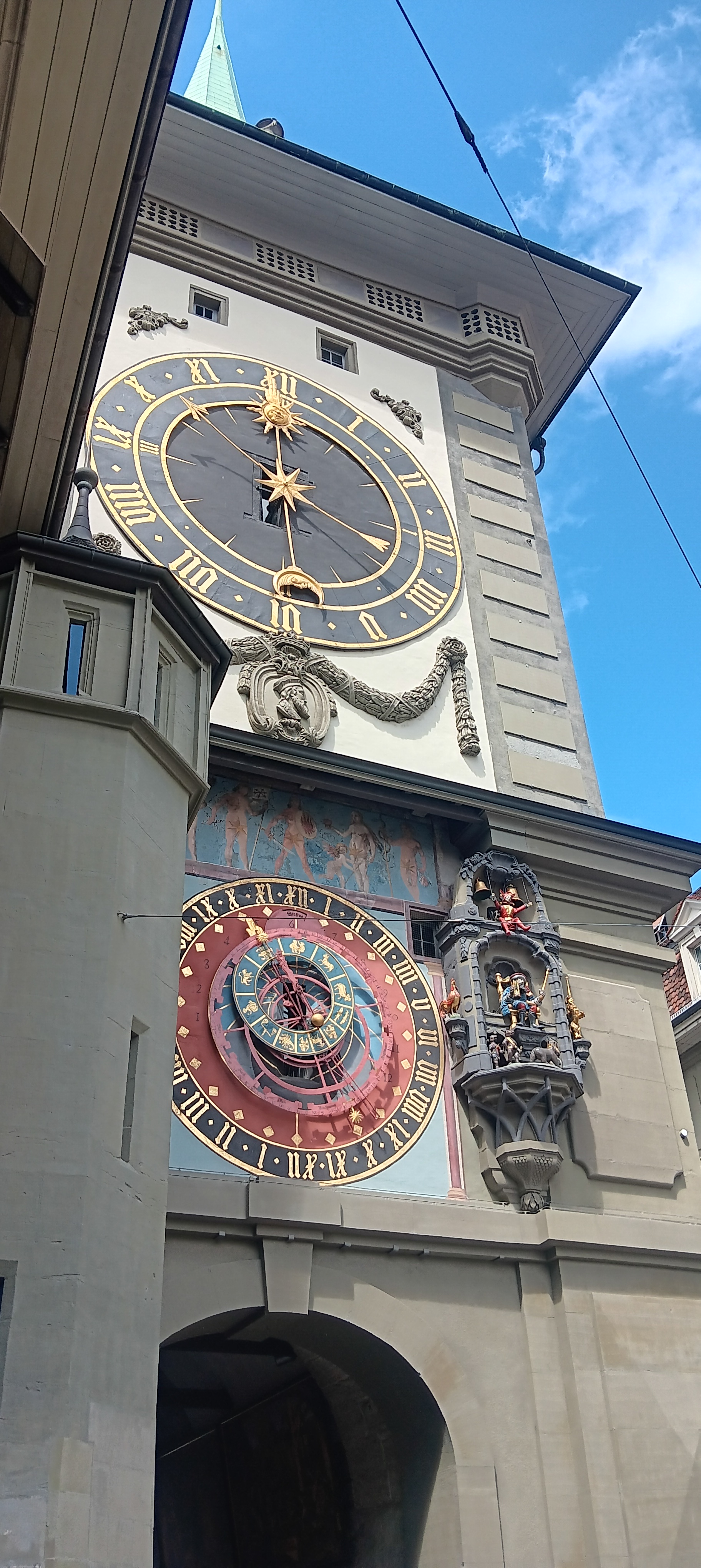
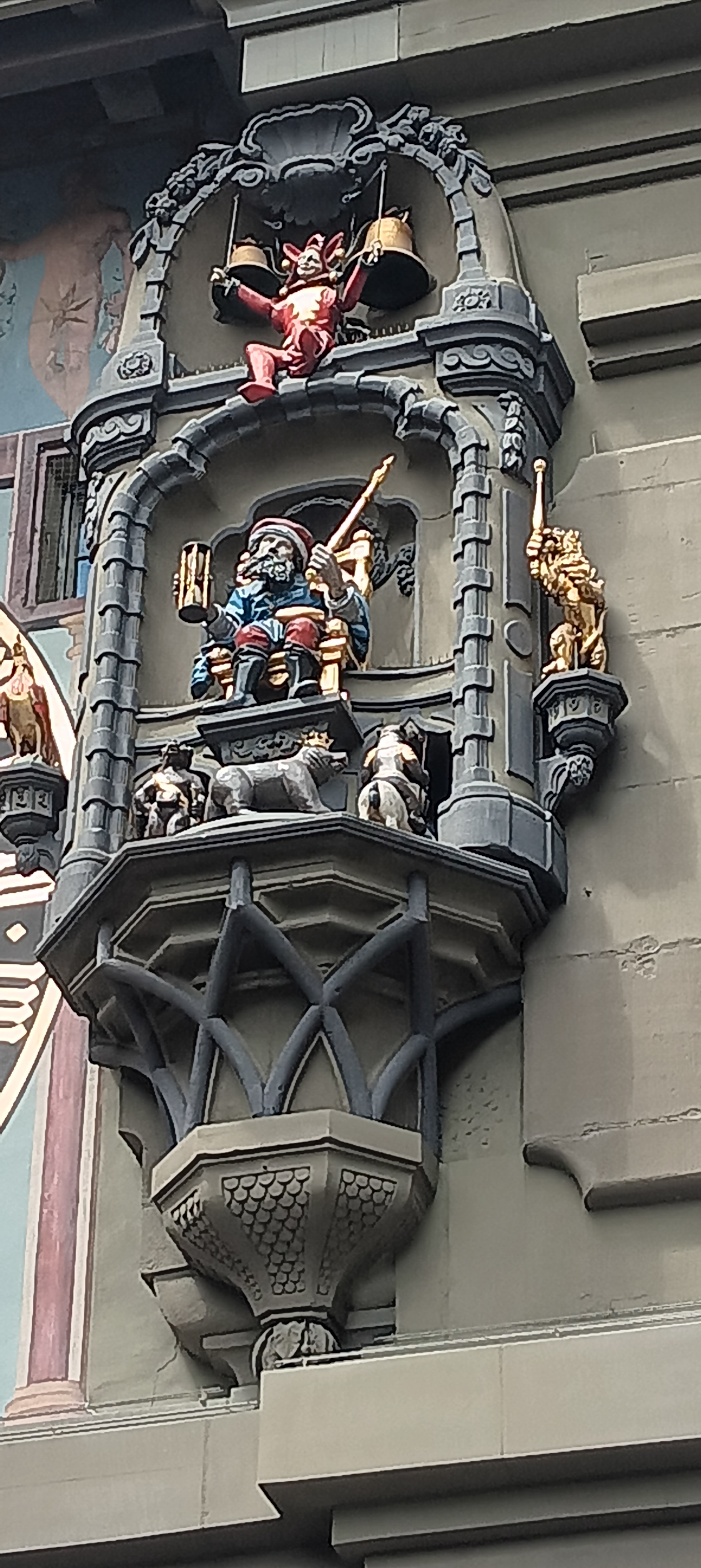
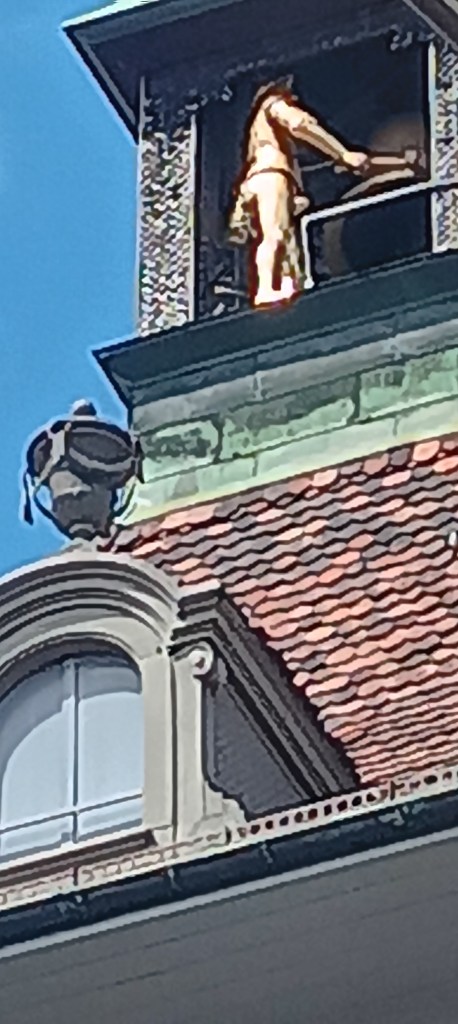
It was in some ways a comical, even paradoxical way to spend our time: to come all this way, use hours or a day of our wild and precious lives, to watch the chiming of a clock. On the one hand, I thought the Fool might be laughing at us: “Go, live! You don’t have that much time.” On the other hand, and again thinking of Mary Oliver’s “The Summer Day,” “what else should I have done?” To be with other mortals, contemplating mortality, or time, or whatever they’re going to have for lunch, and enjoying the work of great craftspeople who went before us and contemplated the same things, seemed very fitting.
For my part, I wasn’t thinking about what I’d have for lunch, only where. Indian food is almost always my choice when I’m on my own, so I just needed to find an Indian restaurant, and I did, passing this interesting object en route.
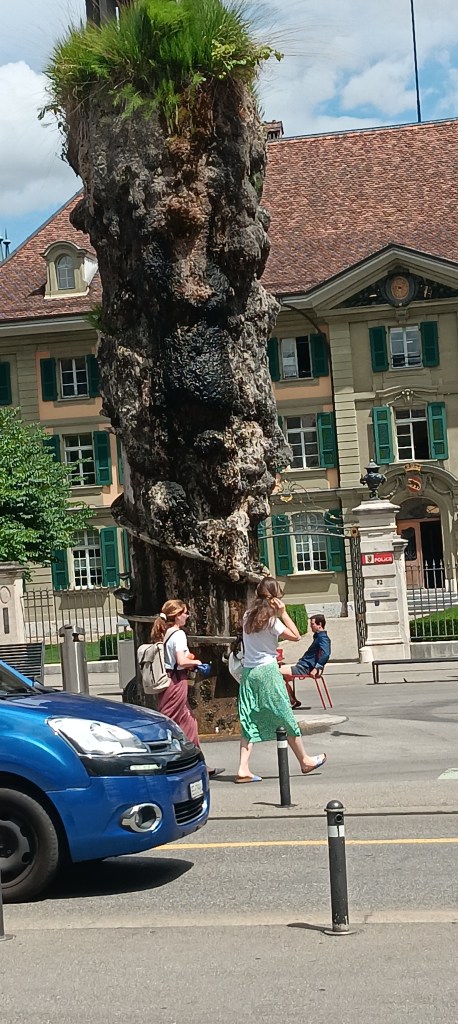
My exhaustive (i.e., five-minute) internet search doesn’t turn up an explanation of what it is, so I’ll have to ask Mike and Sue. They used to live in Bern. (ETA it is the Meret Oppenheim Fountain. Thanks, M & S!)
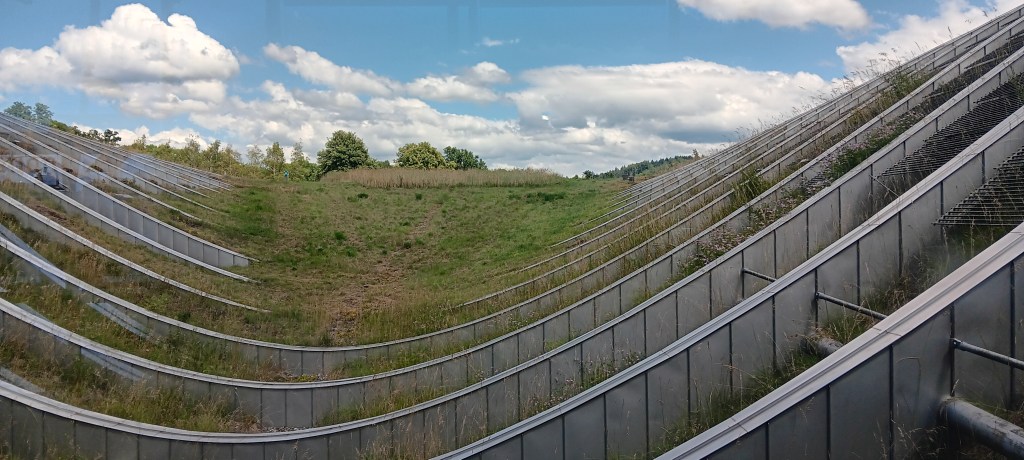
Then I boarded the bus for the Klee museum, whose design is pretty cool. The current main exhibit here is called “Alles Wächst,” “Everything Grows,” delving into Klee’s fascination with the patterns of growth and change in the natural world and how he explored them in his art, both the earlier, more representational pieces, and the abstractions for which he is better known. I like seeing how the former turn gradually into the latter.
Having loved Klee’s paintings for a long time, I was both moved and chuffed to learn that like me, he collected lots of items that show these patterns, such as shells, stones, leaves, and nests, and that like me, he was fascinated by the scientific exploration of nature as well as the artistic. Notebook pages the curator displayed demonstrated how his mind and pencil moved among diagrams, mathematical analyses, drawings, notes, and abstractions; you can buy a facsimile of the notebook, and if I knew German I might have.

I’ve gotten into the habit of spending a long time with one piece, as persuasively recommended by Dr. Jennifer Roberts in this essay. I have never yet devoted her three hours to a piece–I think my longest stretch has been an hour and a half–but it’s become a frequent practice, and it is always deeply rewarding. Last week, writing about “Main Prise / Caught Hand” by Alberto Giacometti, I wanted so much to draw it that I realized that of course that was a part of how I come to understand what a piece has to say to me, and that will no doubt become part of the practice. I did draw “Main Prise,” and of the many Klee works that took my breath away, this was the one I sat down with, and drew and wrote about. I neglected to jot down the original title, which would have been in German, but the English translation was “Illuminated Leaf.”
Now I am inspired, as well, to make a drawing in homage to Klee, but it’s not ready to share yet. I’m going to hit Publish on this and resume drawing, because time is short.


Recent comments