
You are currently browsing the monthly archive for July 2023.
When we started taking public transit again on the downslope of the pandemic, I swore I would always wear a mask on transit. Close quarters, lots of people coming and going, usually inadequate ventilation–and look, I hadn’t gotten a cold the whole time I was masked for COVID, and I liked it. However, this summer I have forgotten a lot, or in the case of the Paris Metro, put my mask on and then taken it off because it was so, so hot. So . . . I have a cold. Meh.
And of course, since we’re in Madrid for only four days, I hate to miss anything, and yet, I also want to enjoy myself, and forcing myself to go out and do stuff when I’m sick is just not fun. Today is a case in point. The plan was to go to Reina Sofia, the modern offshoot of the Prado, but I slept until 11 a.m. and still couldn’t imagine going anywhere, especially since we had reservations for dinner and flamenco tonight and it would take all the energy I have. So I stayed in the apartment, grateful for the time to rest and recover, trying not to feel like I “should” be seeing this city while I had the chance.
In general, when a tourist, I don’t like to put myself under the pressure of must do this, must do that. Even under ideal circumstances, you can’t get to everything you’d like to see without running yourself ragged. Add a minor illness and it’s goodnight, Irene. But there are two things I really want to see in Madrid. One is the Prado, and tomorrow we have nothing else planned but that. The other is Guernica. That seed may have been planted early. Growing up, I lived near New Haven, and my family went into New York fairly often for art, great restaurants, and so on. The Museum of Modern Art had a huge retrospective of Picasso when I was about 12, probably specifically because they were going to have to return Guernica to Spain. The bombing of the city was ordered by Franco’s forces, and Picasso’s impassioned response was commissioned by the Republic. Picasso did not want a Spain ruled by Franco to have his masterpiece, and he gave it into MoMA’s keeping under the conditions that once Franco was dead, it would return to Spain permanently. So when my family and I went to MoMA to see the exhibit, my dad said, “You have to see Guernica while it’s still here.” And I did. That was 43 years ago, so I want to see it in person again.
Fortunately, we have some time Wednesday before we take the train to Córdoba, and I’m going to go to Reina Sofía then. There is a sculpture courtyard and some other pieces I’d like to see there, but if all I manage is Guernica, I will be content with that.
In Paris, something that wasn’t quite a “must-do,” but up there for me, was the basilica at St.-Denis. If you, like me, have taken art history classes, you have probably learned about St.-Denis and how it took all the elements of Gothic architecture and put them together. In other words, if there is a “first Gothic church,” that’s the one, so if you love Gothic architecture, which I do, it’s on the short list. And it was a short Metro ride from our apartment. I went there on my own, with a sense of religious and artistic pilgrimage.
I was listening to Gilead, with its narrator–a humble, troubled Christian pastor–exploring ideas of blessing, grace, and mystery. I thought having that in my ears as I sat in the church would be lovely. And I was also reading a lot on a Facebook group called “god has the worst fan base,” whose posts (reposts from some of God’s most insufferable fans) reminded me of just how many really destructive beliefs are out there. So when I gazed upon the basilica’s famous tympanum (the half-circle over the front door), which portrays the Last Judgment, instead of shrugging it off as a bit of medieval theology, I was thinking of all those people who really, truly believe that we are all going to be judged, and mostly found deserving of hell. I’m sorry they drowned out the much kinder, wiser Christianity of the fictional pastor John Ames and his creator, Marilynne Robinson, but they did.
I snapped a photo of one small portion of the carving, a tableau of demons and damned, and have been drawing it ever since.
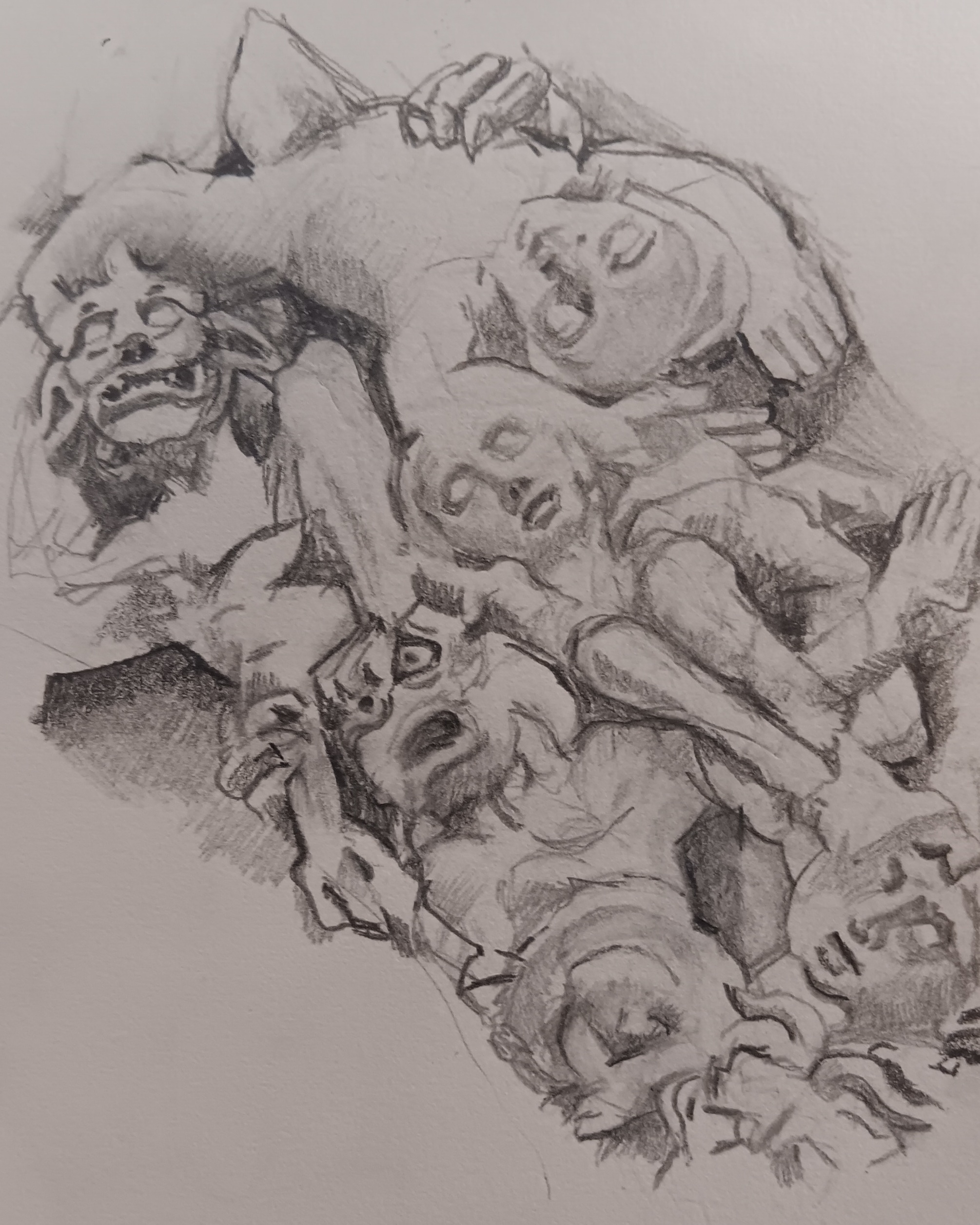
I left feeling shaken. I don’t usually fret much about the theology embodied in the churches I visit. They are aesthetic objects, and I enjoy them for their beautiful elements and shake my head over their less beautiful ones. But I couldn’t look at the tympanum of St.-Denis without thinking about all the people who have passed under it during the past nine centuries. Generation after generation of people living in constant terror of the pit of eternal torment that was about to open up under their feet. People whose loved ones died of plague or infection, rapidly and unshriven, and who were told by their religion that those beloveds were in hell. And how many still live under that weight today. I can still appreciate the art–I even like the demons, who are a lot more expressive and interesting than the placid humans in their clutches–but it’s haunting.
Anyway, I finally finished the drawing yesterday, so there it is. I left off working on the demon that you can see just barely outlined on the bottom, because I had miscalculated and not given it enough room. I think I’ll draw it separately, when I recover from this cold.
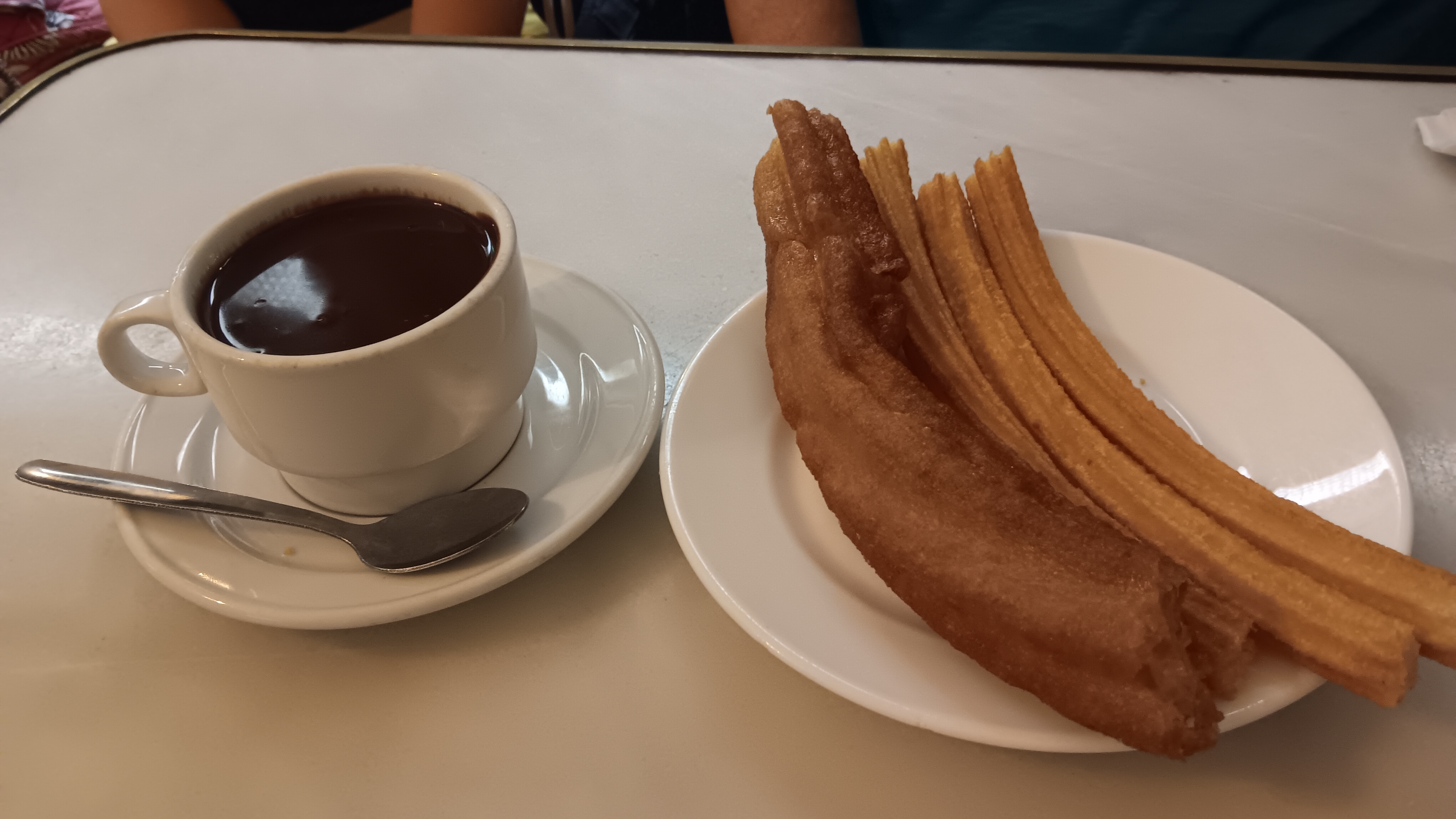
Also yesterday, we went to another one of those things that many people say one must do in Spain: churros and chocolate. Of course, something can’t really be obligatory unless you want it to be. And when it comes to dipping churros in rich, thickened but not too sweet liquid chocolate, we did want it to be.
We have just returned from our evening at Corral de Moreria. The problem with dinner theater, cabaret, and all such combination events is often that only one element is really excellent. You’ve got great music and the food is meh, or vice versa. But Joy read that at this place, the food, music and dancing are all extraordinary, and she was not steered wrong. Everything was wonderful, and I was glad I had made it my only activity of the day.
Now it’s back to horizontal mode, listening to a podcast, hoping to sleep so that my poor, cough-sore diaphragm can get some rest, and so that I can enjoy a nice, slow day at the Prado tomorrow. I wonder if they have benches where I can just curl up for a little nap if I need it . . . ?
Por fin, estamos en un país donde hablo el idioma. At last we are in a country in which I speak the language!
Only a fool would complain about traveling in Italy, Slovenia, Austria, Switzerland, and France, and I’m not complaining. But oh, what a relief to understand what people are saying and know that I can make myself understood! The woman who let us into the apartment rattled away en español, and I followed almost everything she said. I could ask for what I wanted in the little joint where we got lunch, though after reminding myself for three weeks to say “Merci,” not the “Gracias” that comes automatically to my lips, I’m having to un-remind myself.
We arrived in Barcelona five hours ago, and we will be here for less than 48 hours. All the trains from Arles to Madrid pass through Barcelona with a stopover of several hours, so we decided we couldn’t come to this marvelous city and just sit in the train station. Certainly not when Munchkin has never seen the city of Gaudí. She knows his architecture enough to know she wants to see it in person.
So we have tickets for a visit to Sagrada Familia tomorrow afternoon. (Park Guell would be even better, if it weren’t going to be 85°F.) Right now, Joy and Munchkin are visiting a couple of other Gaudí buildings. Tomorrow morning, we might visit the beach, or explore the Gothic Quarter, and tomorrow evening, we’re having dinner with a friend. Enough to have a taste of this city without trying to cram in more than can be enjoyably seen in two days.
I’m sad to learn that Sinéad O’Connor (Shuhada’ Sadaqat) has died. She was just a little older than I am.
I was at the 1992 “Bobfest” (officially the 30th Anniversary Concert Celebration, for Bob Dylan) in Madison Square Garden, when she got up to sing “I Believe in You,” but was booed mercilessly by the crowd. She had torn up a photo of the pope on live television some time earlier, singing “War” by Bob Marley and citing child abuse. So she was controversial, but I was disgusted by the people booing. They seemed to lean gleefully into a sense of having been personally insulted by her, as if they were all devout Catholics and the pope were their spiritual father. It is wildly unlikely that many of them were more than nominally Catholic.
Kris Kristofferson came and put an arm around her and tried to help her carry on, but she ditched the song she had planned, sang a few lines of “War” again, and stalked offstage. It was a shame, because “I Believe in You” would have made a great response. It’s about sticking to your beliefs despite persecution and doubt, and its statement of faith is obviously Christian to anyone who knows Dylan’s history. But she was very young. Imagine being booed by even a small minority of the crowd at a packed Garden.
Ever since the stories about the abuse by the Catholic Church, including the extensive cover-up by the pope in question (John Paul II), I’ve thought a whole lot of people owed O’Connor an apology. If she ever got one, it didn’t get nearly the publicity that their condemnations of her had.
As for her singing, I wasn’t attentive enough to be a particular fan. I liked what I knew of her music, but never bought any albums. The one recording of hers that I owned was her rendition of “You Do Something to Me” on Red Hot + Blue, a compilation of Cole Porter covers by contemporary artists, made as an AIDS benefit. I love Cole Porter. I listened to that CD a lot (still do), and a few of the tracks are real standouts for me, none more than hers. That song has been recorded by some of the greatest–Ella Fitzgerald, Frank Sinatra–and O’Connor made it all new. If you’ve never heard it, give yourself a treat.
I’m not sure what “rest in peace” even means, but I don’t think she found a lot of peace in life, so I hope she is at peace at last.
I pointed to a Barbie poster in the Paris Metro.
Me: I really want to go see this when we get home. Does either of you want to come along?
Munchkin: You’re joking, right?
Joy: Um . . . why?
Me: Greta Gerwig is a serious director, you know. It’s not going to be a toy tie-in. It’s probably a parody, or some kind of serious take. And I bet it’ll be really funny.
Joy: Even so. Have fun.
I will. And . . . it turns out I don’t have to wait ’til we’re back in the U.S., because the movie is shown in English with local-language subtitles! (I had feared it would be dubbed.) But I am going to hang in there until we’re in Spain, so that the subtitles will be an educational experience. I’m always trying to improve my Spanish, whereas my French is a relic I can’t be bothered to brush off, except for necessary interactions.
Edited to add: I have found a Barcelona movie theater that’s showing it in English; confirmed that the subtitles are in Castellano, i.e., Spanish, not Catalán (you never know); figured out transportation from/to the place we’re staying; and bought a ticket for Thursday night! Score!
—
This week in Provence is the one time in our two-month trip that we have a car. We figured we’d want to go to small towns and other places a ways out from Arles, so we rented a car–that is, I did, as I’m the only driver. I had hopes for a little Fiat or Citroen, and ended up with a larger car than I needed, but one thing about it is very European: it’s a stick shift. I was taken aback when I got in the car, and for a split second wondered if I’d still know how to drive one after many years of an automatic, but of course I do. It’s like riding a bicycle. Not in terms of environmental impact, however; I bow to the munchkin in that regard, since she is biking everywhere. Anyway, I’m enjoying driving, and especially in beautiful and unfamiliar places, and especially shifting gears.
—
Lest I have given the impression with recent posts that all the reading I’m doing is Serious, I have also been reading Commissario Guido Brunetti mysteries, by Donna Leon. They were recommended to me long ago, and I tried one then, but couldn’t get into it. Maybe I should have started with the first one. In any case, the apartment building we stayed in in Paris had a public shelf of books for the taking, and one was an English-language edition of one of them (not the first), so I decided to give them another go, and took the first one out of the library using Hoopla, which is how I’ve been doing most of my reading all summer. I could not put it down. Likewise the second, third, and the one from the building, which turns out to be the fourteenth. They are so good, and she has written so many! Yum.
In a perfect illustration of how impossible it is to characterize reading as leisure or work, I have also resumed the Wayfarers series by Becky Chambers. I had read The Long Way to a Small, Angry Planet and A Closed and Common Orbit. Via the library / Hoopla / my cellphone, I just read Record of a Spaceborn Few, and am now reading the fourth and final book, The Galaxy, and the Ground Within. They are undoubtedly fun to read. They are also powerfully thought-provoking. Spaceborn Few, in particular, has one storyline that really resonates–the character has a job that’s a lot like a minister’s, and her difficulty being seen always in that role is one that will have most clergy nodding in rueful recognition. But all of them have a genius for creating worlds, species, relationships, and situations that shine a revealing light on our own. I’m so glad she is prolific, comparatively young, and still writing up a storm.
—
So, in sabbatical reading:
Finished rereading Gilead, started rereading Lila, both by Marilynne Robinson.
As noted above, read Record of a Spaceborn Few and have started The Galaxy, and the Ground Within.
I had planned to read The Angel’s Game, by Carlos Ruiz Zafón, before going to Barcelona, its setting. However, my hold request hasn’t come through yet, and it’s probably just as well. Two books at a time are sufficient.
I have become a flat-out café mocha addict over the past couple of years, and when we were preparing to travel in the continent of cafes, I went so far as to bring my thermos so as to avoid littering Europe with any more disposable cups than necessary. I planned to try mochas in every locale and make a serious comparison. Who would deliver the best mocha? Italy, originator of the cappuccino and the espresso? Switzerland, world chocolate king? I looked forward to finding out, one delicious coffee drink at a time.
The winner of the contest is . . . no one. Mochas are very seldom on offer in any cafe in any of the places we’ve been. In Venice, I found one cafe with caffe mocha on the menu (Ten Thousand Coffee, if you happen to be headed that way) and so I went there twice. But most of the time, when the coffee craving hit, I was far from there, and so I started ordering caffe latte, which I have come to like if I add enough sugar, though it is no substitute for that coffee-chocolate combo.
The no-mocha trend continued through Slovenia, Austria and Switzerland. During my afternoon at the Zentrum Paul Klee in Bern, on a stretch break from drawing and writing, I meandered to the cafe at the far end of the museum, and lo and behold, they had mochas on the menu. Murphy’s Law; I had had a lovely Indian lunch, including chai, and I was not the slightest bit hungry or thirsty, so even though it was a wrench to walk away from the opportunity, I declined to choke down a mocha I didn’t want.
Coffee shops are different here in other ways. Coffee is usually available in just one size, and that size is very small. No matter what kind of coffee I’ve ordered (au lait / latte, café creme, macchiato), it has been strong enough to, as my father would say, “put hair on your chest.” “Flat whites” are a widespread phenomenon, but as I haven’t been able to discover a discernable difference between them and cafe lattes, I haven’t tried them. I’ve learned to say “decaf” in three languages and mostly gotten it when I asked, but it is almost never listed; nor are non-dairy milks. Every café has hot chocolate. They just don’t mix it with the coffee.
My thermos is too tall for the machines, and it would defeat the purpose to have someone make me a drink in a paper cup and pour it into my thermos, then toss the cup, so I mostly don’t carry it around with me. However, in Paris, where we shopped extensively since we were in one apartment for two weeks, I bought cocoa and instant coffee and reverted to my home practice of making ye olde cheap-a$$ instant (I started doing that during the pandemic, keeping a jarful of homemade dry mocha mix in the cupboard: just add hot milk). A couple of times, I filled my thermos halfway with the chocolate part, then ordered a small coffee from the boulangerie on the corner, along with a roll. Even though it was au lait, even though it was mixed with another eight ounces of oatmilk that I had put in at the apartment, that sucker was strong.
We are now in Arles, in Provence, and yesterday was the big marché day. It’s close to 2 km long and has two double-sided aisles, one of dry goods and one of foods, but we were most of the way along before I discovered a coffee stand, off to one side in the town square. As I waited in line, watching people leave the counter with their tiny glasses in hand–no more than 6 oz in a glass, and of course smaller for an espresso–I decided that this was the moment to make my move. I ordered a café au lait and a chocolat chaud and took them away with me to the bench where Joy watched, bemused, as I poured a bit of the first into the second. Every time I drank a few sips of the resulting mix, I added more coffee to it, until I had one cup of a perfectly mixed, not-too-sweet mocha.
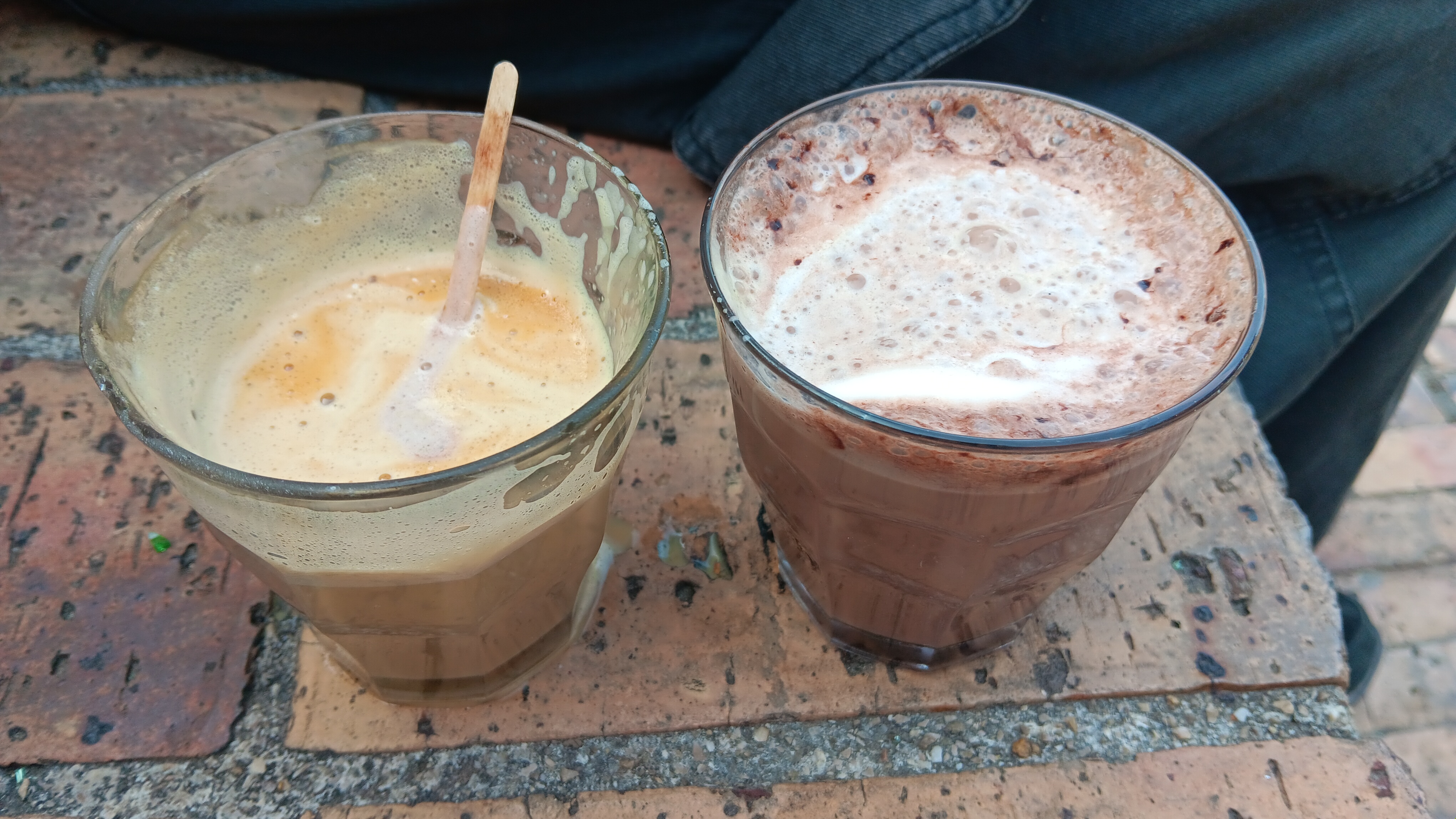
Chocolate! Coffee! Someone could make a mint marketing this combination in Europe.
So, Provence. It’s beautiful. Arles is the town where Van Gogh lived for just a couple of years, incredibly productive ones; he made something like one painting a day on average, even though he had a breakdown and spent time in two different hospitals. One was in St.-Rémy, which, Joy identified later, was why the name of town was so familiar to us, sadly. It is now unbelievably posh. We enjoyed walking its streets just the same–the beauty of these buildings is unaffected by the riches or poverty of their temporary tenants.
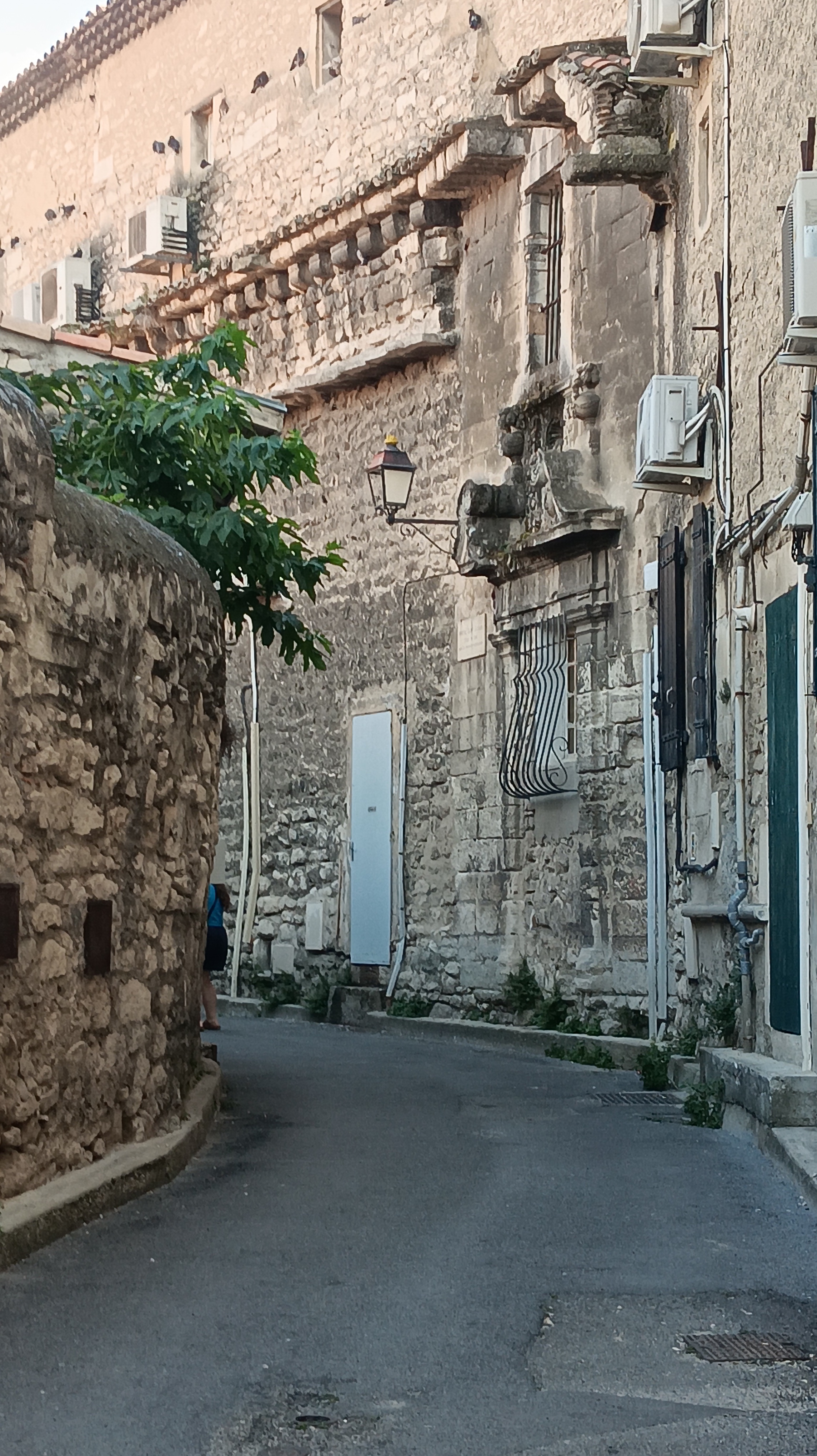

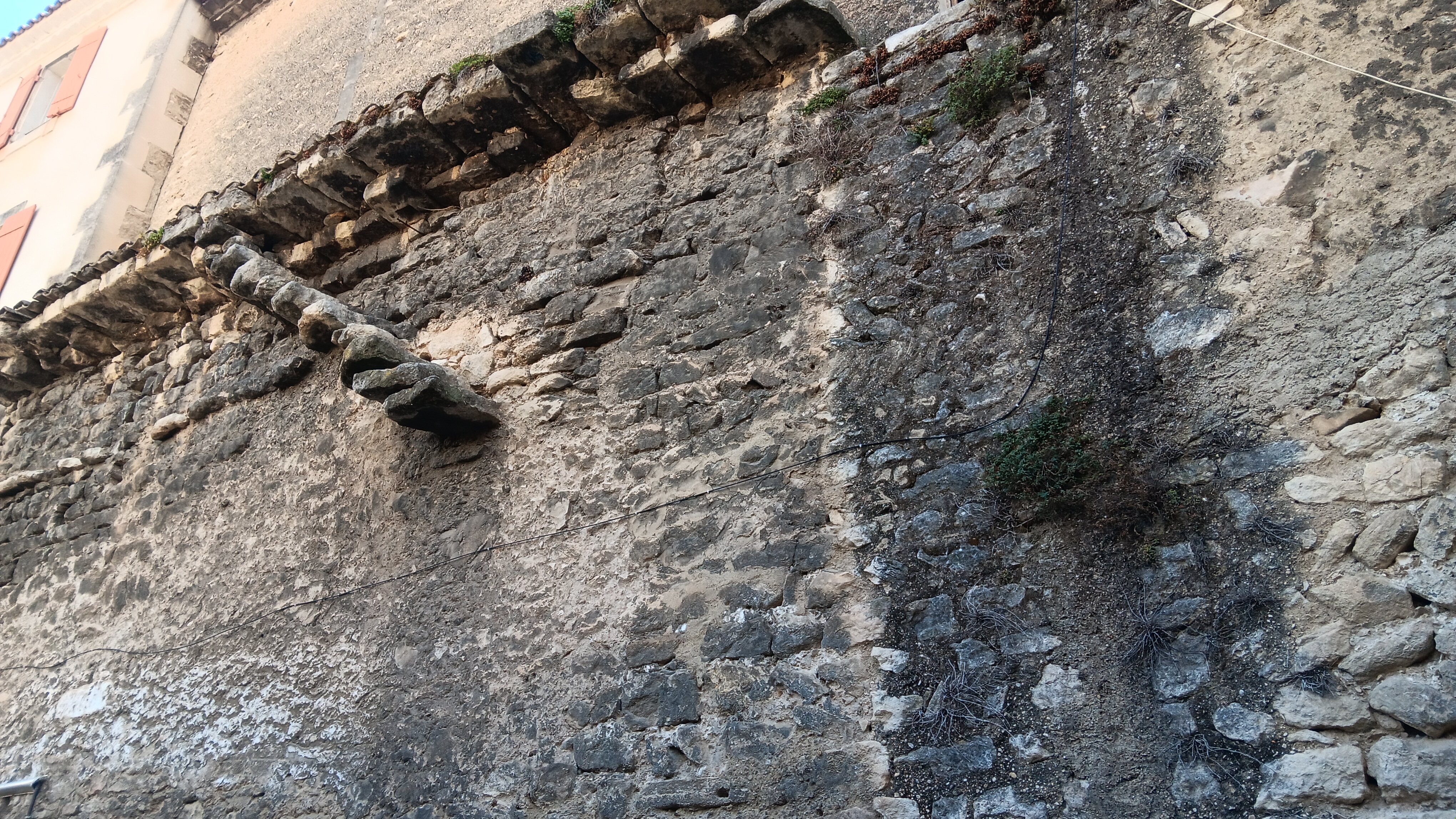
St.-Rémy was–is–on the Via Domitia, a road the Roman government built in their new province in order to connect their already-existing ones in Italy and Spain. The Roman city of that time and place, Glanum, is an archaelogical site that didn’t appear to be open to visitors, except for the spectacular Mausoleum and Triumphal Arch, collectively known as Les Antiques, just off the road outside St.-Rémy.


I saw a lot of Roman ruins when I was 12 and my family spent several weeks in Israel. A lot. My sister hit her limit one day and referred to whatever 1st-century site we were seeing as “A pile of rocks,” so it instantly went into the family joke collection: “What are we doing today?” “Going to see another pile of rocks.” I thought that I might still have Roman-ruins fatigue all these decades later, because I looked at the things to see around Arles and sighed internally. Amphitheaters, yeah, aqueducts, yeah yeah, arches, yawn. Well, you know what? It is still hella cool to put a hand on these stones and consider that someone built these things two thousand years ago.
We had passed a sign to the aqueduct on the drive between Arles and St.-Rémy, so on the way back, we followed the signs. We were almost past where it must be, and were saying, “We couldn’t miss an aqueduct, could we?” when we drove right through it.
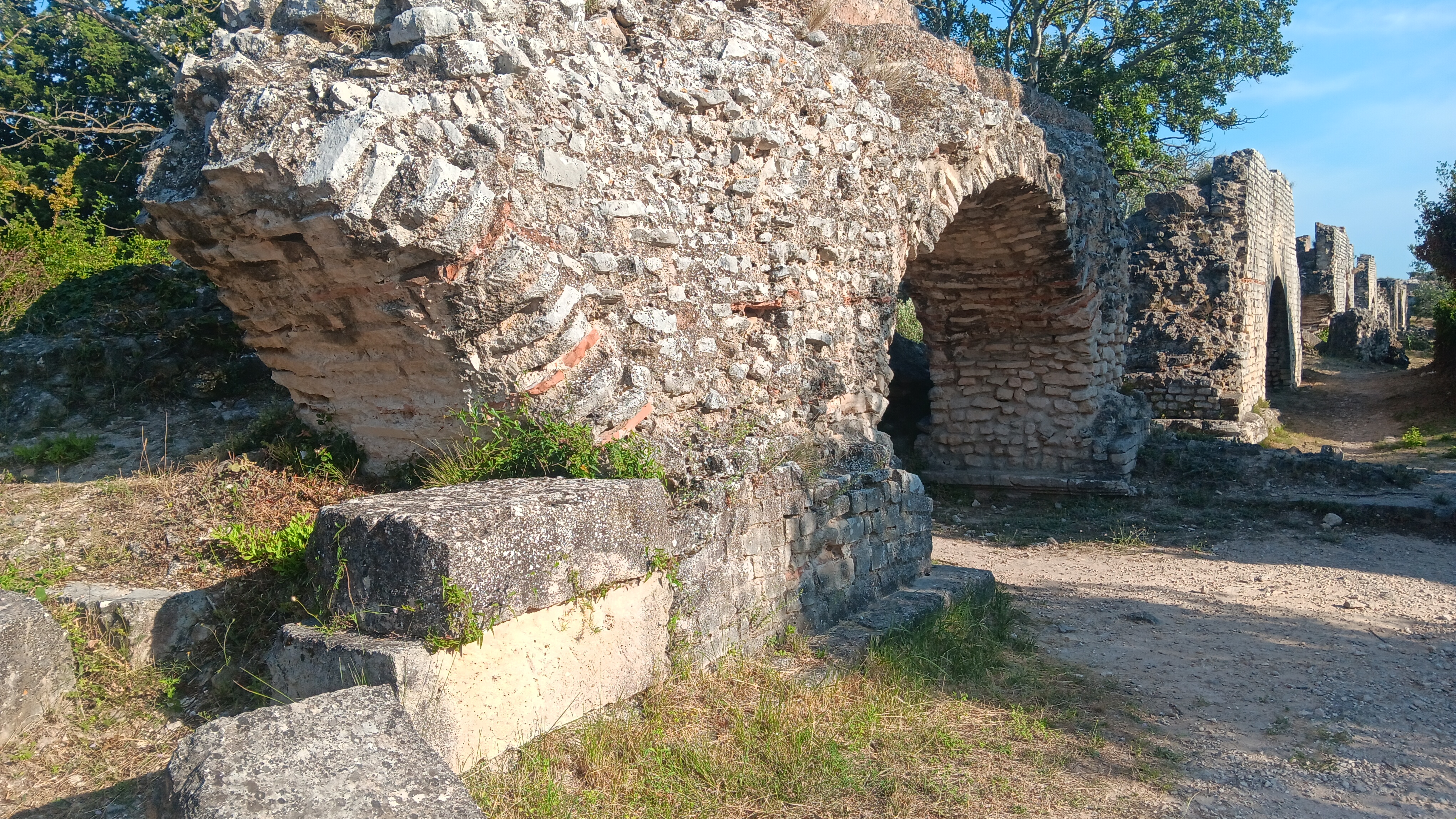
We pulled over immediately and hopped out to walk along the remains of the aqueduct. It’s so old that the graffiti is my parents’ age. That was the oldest dated graffiti we saw; I’m sure it’s not the oldest there.


I realized a few days ago that I have never really understood aqueducts. Were the arches themselves conduits for water, i.e, did the water run under the arches? And if so, what good did that do? Joy thought that there were pipes running longways through the structures, and that the arches were just a strong, efficient support for very long pipes. The photo on the right confirms her hypothesis. The tops have broken off, so what was a pipe looks like an open channel, but when they were in operation, the tops were enclosed. Of course you wouldn’t want to build a solid wall for miles and miles unless you actually wanted to wall something in or out; but the structure had to be strong; the arched structures were the solution.
Before our conversation, though, I looked up the question online. One of the top hits was Britannica, which did not answer my question, but did give an object lesson in the persistence of bias.
“Although the Romans are considered the greatest aqueduct builders of the ancient world, qanāt systems were in use in ancient Persia, India, Egypt, and other Middle Eastern countries hundreds of years earlier.”
britannica.com/technology/aqueduct-engineering
Who is it who considers the Romans the greatest? Does the author mean that they consider the Roman system the greatest, and if so, why not assert it and back it up with facts? That passive voice is a way to make an assertion while claiming not to be making one.
I never learned about any of those prior aqueduct systems, only the Roman, i.e., the European ones. The British have more of an excuse for bias, since those ruins populate their land–it’s only natural for them to think “Rome” when they see aqueducts. But encyclopedia authors should deal in information, not opinion, especially unexamined opinion.
Something useful in that article: the big, visible aqueducts were only a small percentage of the entire water transportation system. Amazing.

You climbed how many flights of stairs today? What’d you do, walk up the Eiffel Tower?
Why, yes we did.

That’s 674 steps from the ground to the second floor, from which point those who want to go to the summit must take the elevator, so we did. The view was gorgeous. If not for just a trace of haze and the curvature of the earth, we could have seen San Francisco.

Surely there are action movies in which people actually climb the Eiffel Tower . . .
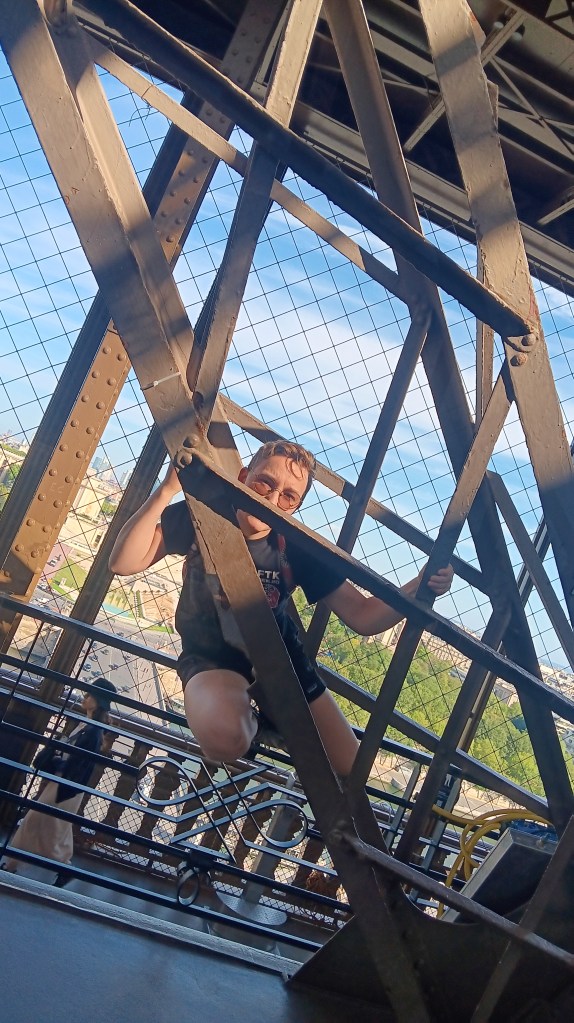
. . . but the powers that be frown on it, and insisted that we take the stairs. Between the ground and the first floor, there was a pep-talk poster on each flight, often with a little Tower trivia thrown in.
“You’re doing great!”
“Uh oh, you’re slowing down–slower than the elevator (which goes 2 m/s!)”
“Your face is getting red, like the Eiffel Tower when it was being built.”
“Keep hydrated! Did you know the elevator has a hydraulic mechanism?”
Corny, yet cheering. Above the first floor, there were no more posters, as if to say that they weren’t going to treat us like kids anymore; this was serious business, and it was time to just put our heads down and climb.

I went up the Eiffel Tower when I was a little older than my daughter is now (I don’t remember whether by stairs or elevator). How strange and wonderful to think of the changes in my life since then.
We looked out at the Jardin du Luxembourg, where Joy was (“I’m waving at you–can’t you see me?” she texted), and we talked a lot about Munchkin’s plans and dreams, and then we walked down 674 steps and took a bus to the Jardin.
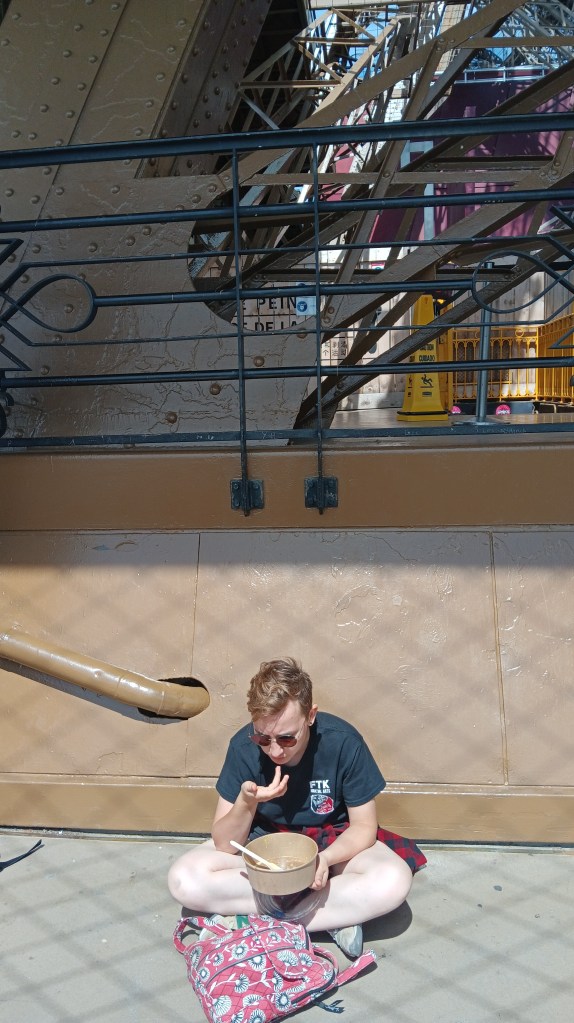
Some people thought the tower was hideous when it was first built, and looked forward to its being torn down after the expo for which it was designed. I have always thought it was beautiful, both far off and up close, and it looked even more beautiful after we had been among and atop its web of struts. Lots of things in this world don’t live up to the hype about them, but as my daughter declared, this one totally does.
Living in a tree has been a fantasy of mine for a long time. Right up front, I should say that it’s the kind of fantasy I never seriously thought I’d enjoy making real. I don’t like roughing it. I like my creature comforts: a shower at least once every couple-three days, hot water to shower in, freedom from biting insects, water without Giardia in it, light to read by late into the night. I don’t even enjoy camping; sleeping in a tent is fun, but cooking over a fire is such a drag. I am a living illustration of this Modern Man classic, though I greatly prefer a nice cottage B&B to the Hilton.
But when I had time on my hands in my work-study job at the university art library, I used to pull the book Handmade Houses: A Guide to the Woodbutcher’s Art off the shelf and pore over the photos with a kind of envying admiration. I wished I knew how to build like that, but mostly I just wanted to be in those houses, where the trees dappled the light, and tidbits from beautiful old buildings made up the walls and windows. (You can see many of the photographs if you put “Barry Shapiro” photographs houses into a search engine.)
And a couple of years later, I discovered the book The Starship and the Canoe, by Kenneth Brower, which has remained one of my favorite books. I loved accompanying the author 95 feet up a Douglas fir to the treehouse that George Dyson built and occupied for three years. As with the houses in Handmade Houses, Dyson incorporated the branches into his architecture. It was a living structure.
Again, I would tire of living in such a place very quickly. Cooking over a wood stove, using a latrine, gathering my own water in buckets?–I already knew I was too bourgeois at heart to do any of those things for more than a few days. And yet I was, and still am, drawn to simple living, at least in small doses. A big part of it is proximity to nature and the peeling-away of the layers of stuff with which I have surrounded myself.
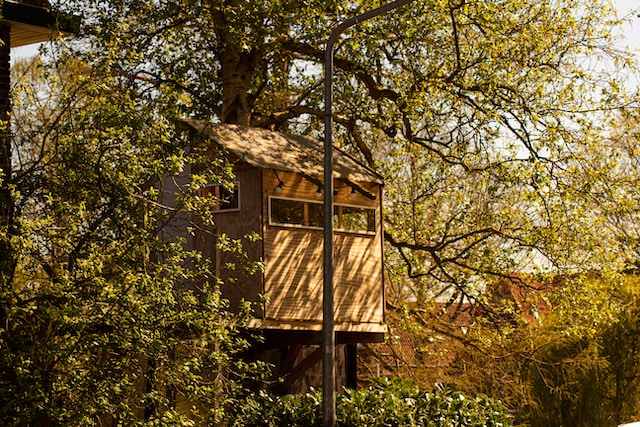
So I am thrilled to have found a treehouse to stay in for two days in September (I choose not to say where). It is just the right balance of comfort and simplicity. It has minimal kitchen facilities, like running water; that’s fine, I’ll pack in my food and keep it simple. It will be chilly at night, but it has walls, windows, a roof and a floor, and I’ll bring warm blankets. I’m grateful that there’s a toilet, bed, and chair. It isn’t far from more technologically equipped houses, but it’s isolated enough for privacy. Wifi is out of the question. I’ll read, draw, think, listen to the birds, watch for wild critters, and just be: my own, unstructured retreat.
We have two weeks in which to relish Paris, and have been relishing away. Munchkin would like to go to college in French–not just in a French-speaking country, and certainly not just for a semester–so she has been exploring universities, first in Geneva, now here, and next week, in Lyon. Joy and I have no such burden and can’t really be of any assistance other than, you know, bringing her to Europe, so we just do our thing while she pokes around universities (campus tours are not done here) and chats with students.
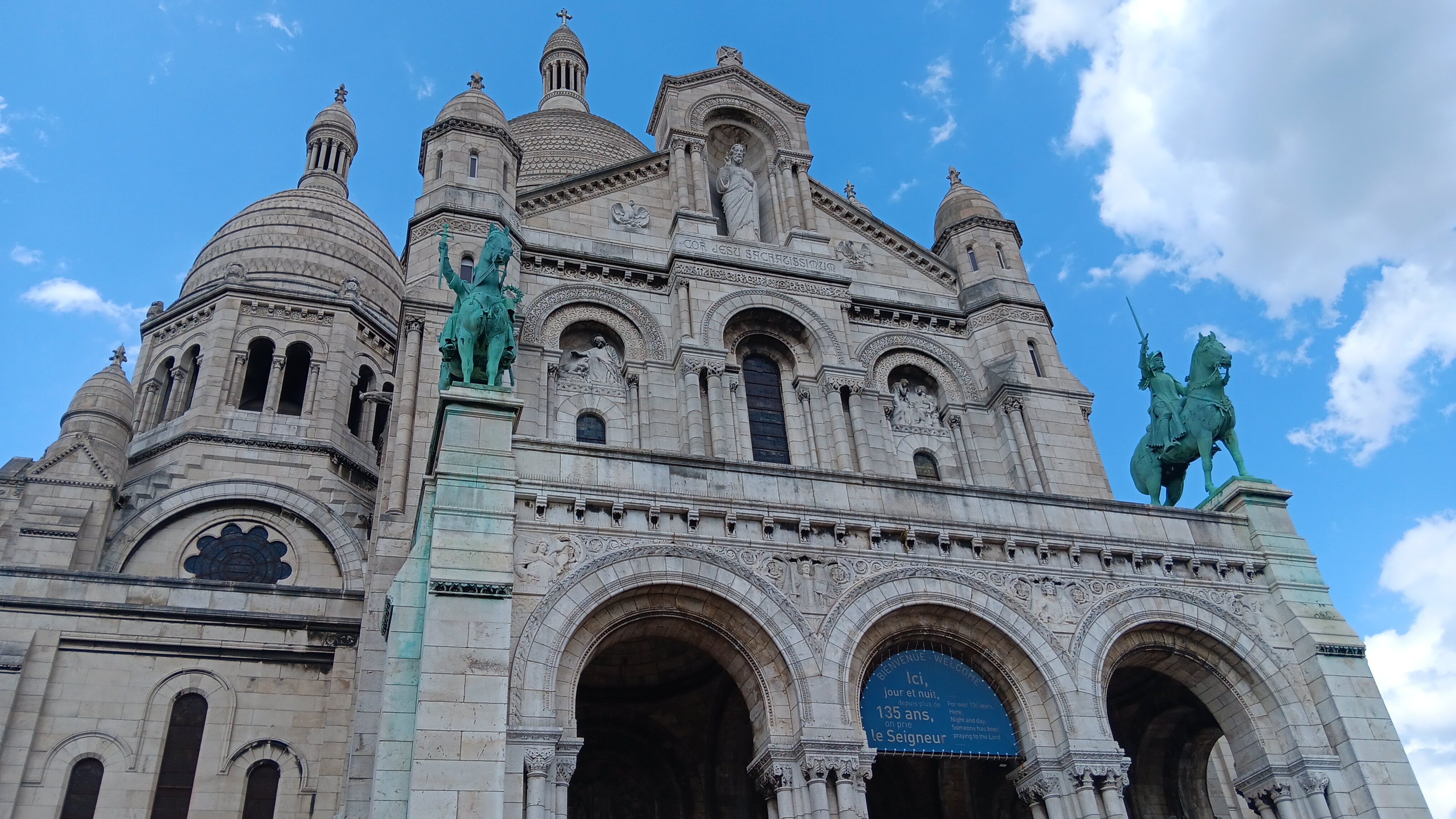
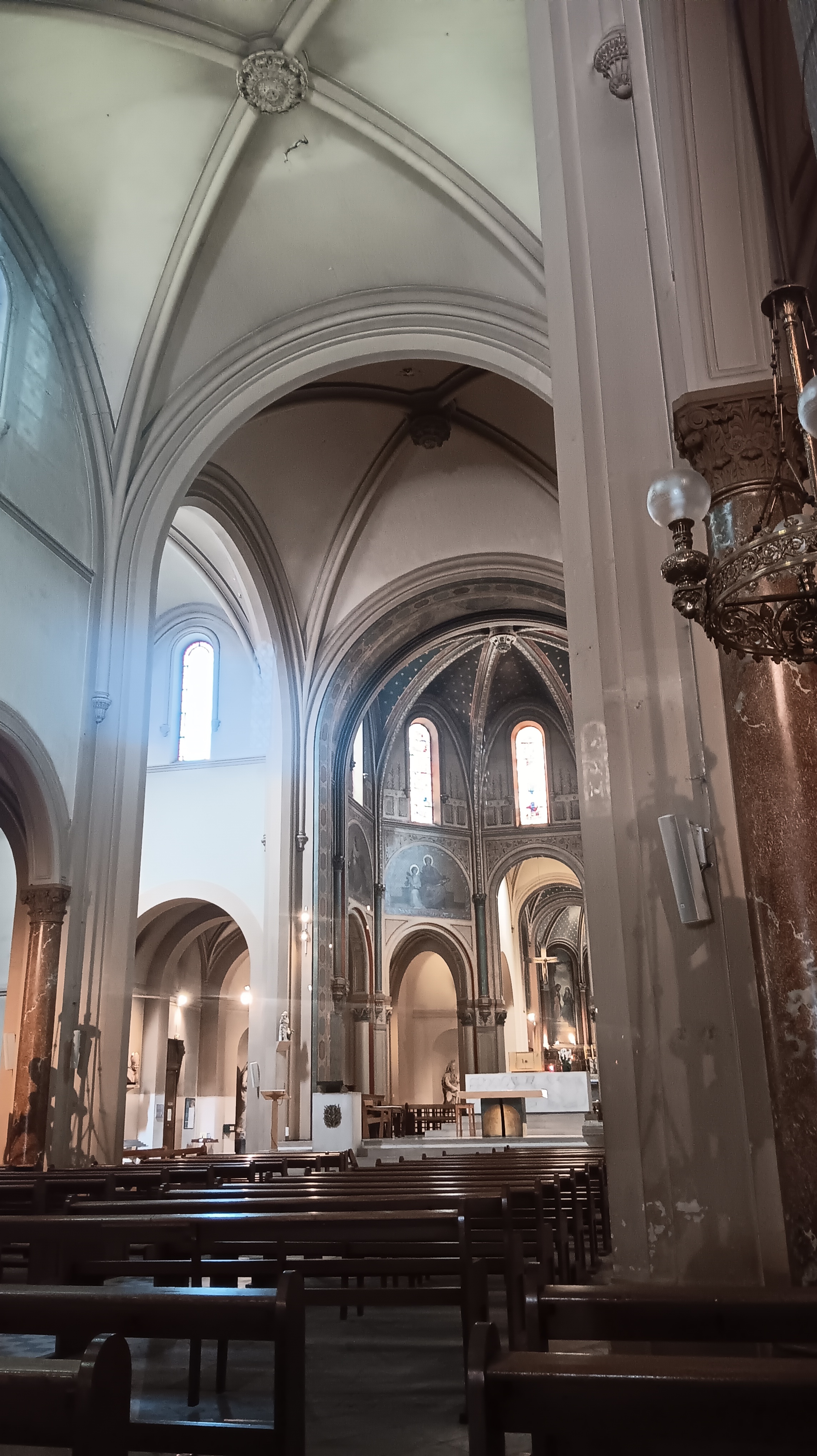
We are staying close to Montmartre, and on my own one one of our first days, I toiled up the stairs to Sacre-Coeur. One could write a thesis on the interweaving of military and religious imagery in the Christian West, and I’m sure many have, although I won’t. But these two guys are what caught my attention when I got to the church. I didn’t go in, not feeling up to standing in line, but I pop into other churches now and then and have been struck by the idea that Parisians don’t know how to do a small church, just as they don’t seem to know how to cook a bad meal. For example, this is a neighborhood church, Eglise Notre-Dame de Clingancourt.
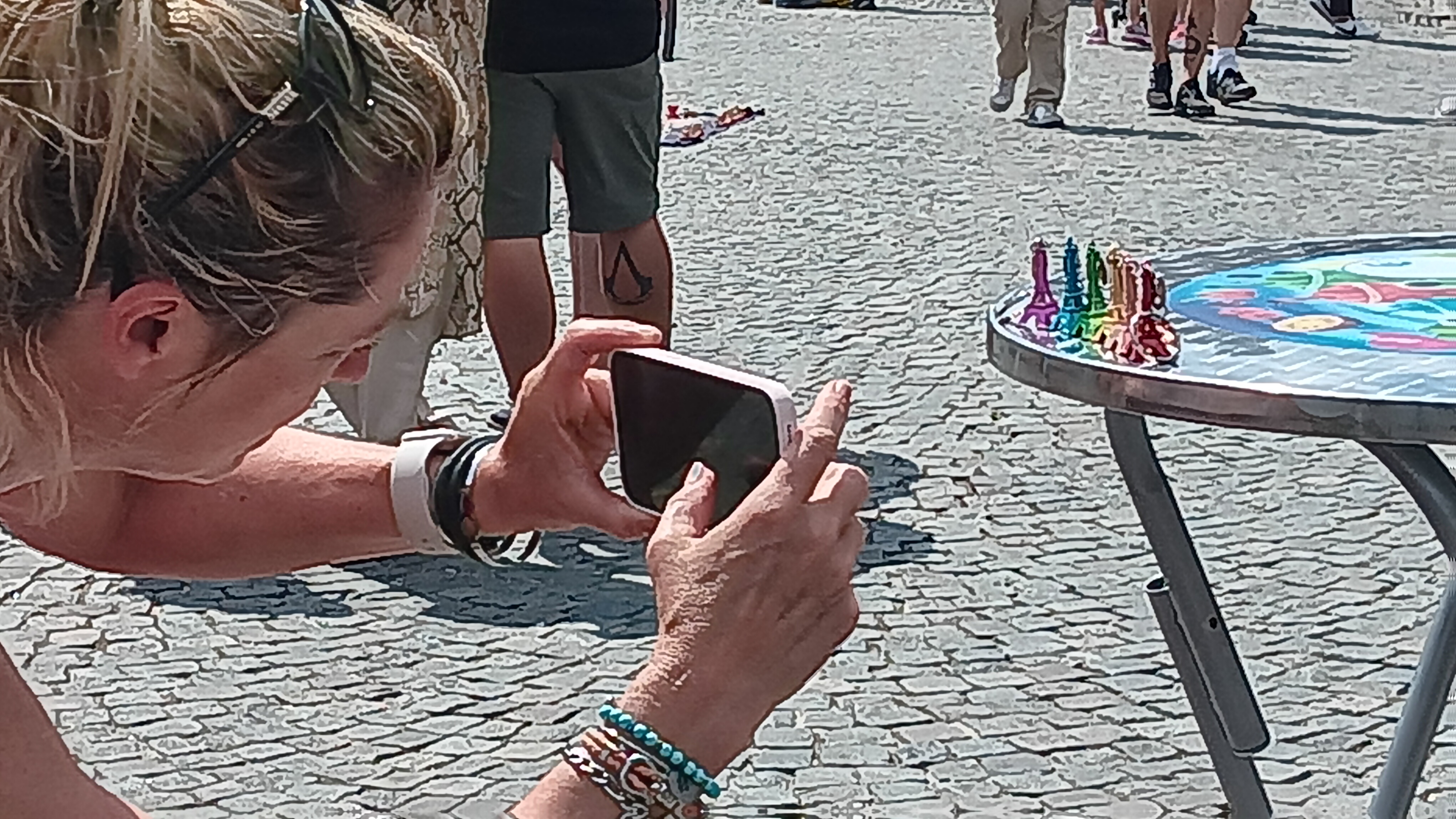
Joy has been on a quest for a small tacky item of Eiffel Tower memorabilia to bring home. I admired this woman’s efforts in that direction: a rainbow of tiny Eiffels, which she had set up to photograph with a backdrop of Sacre-Coeur.
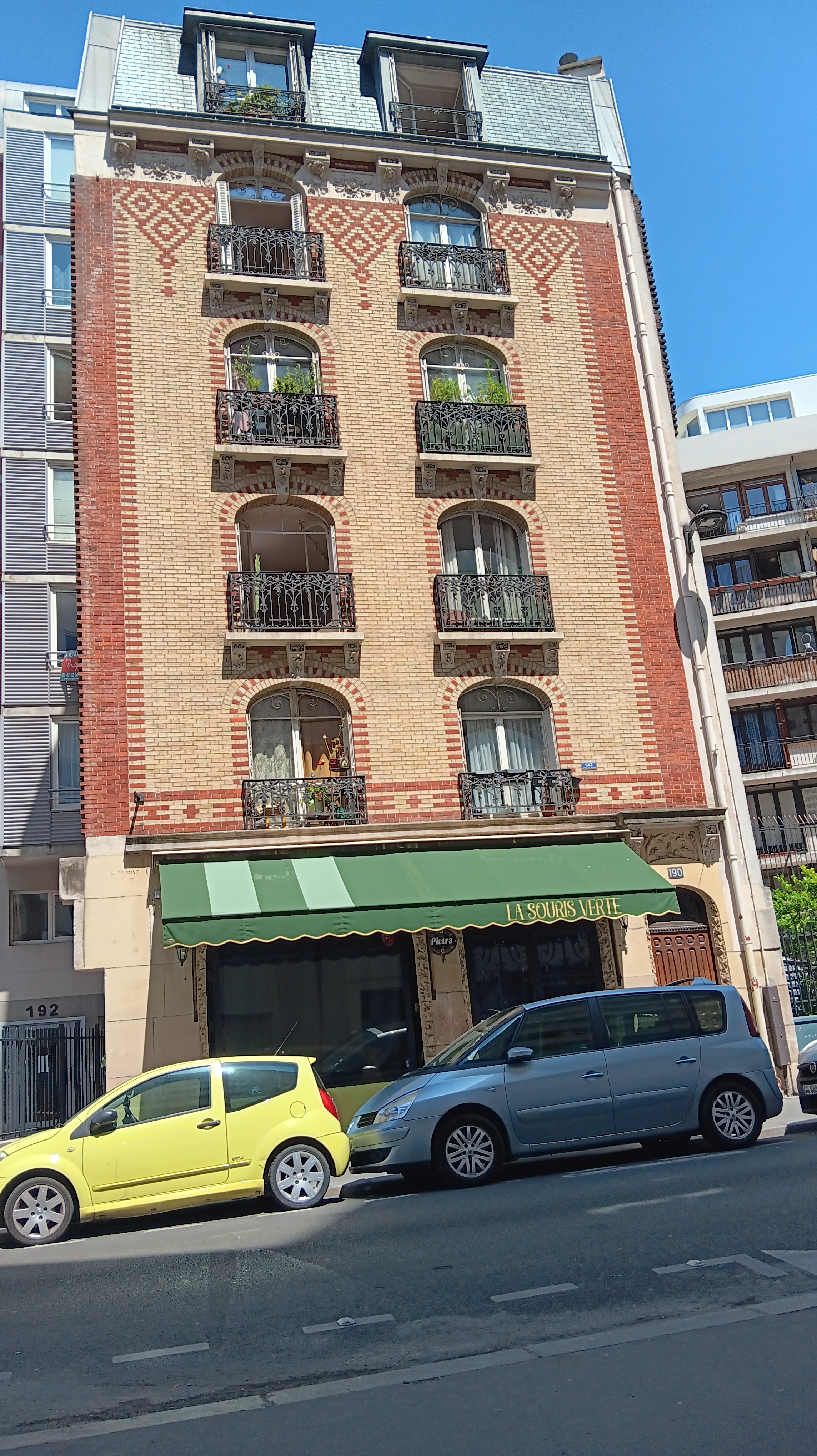
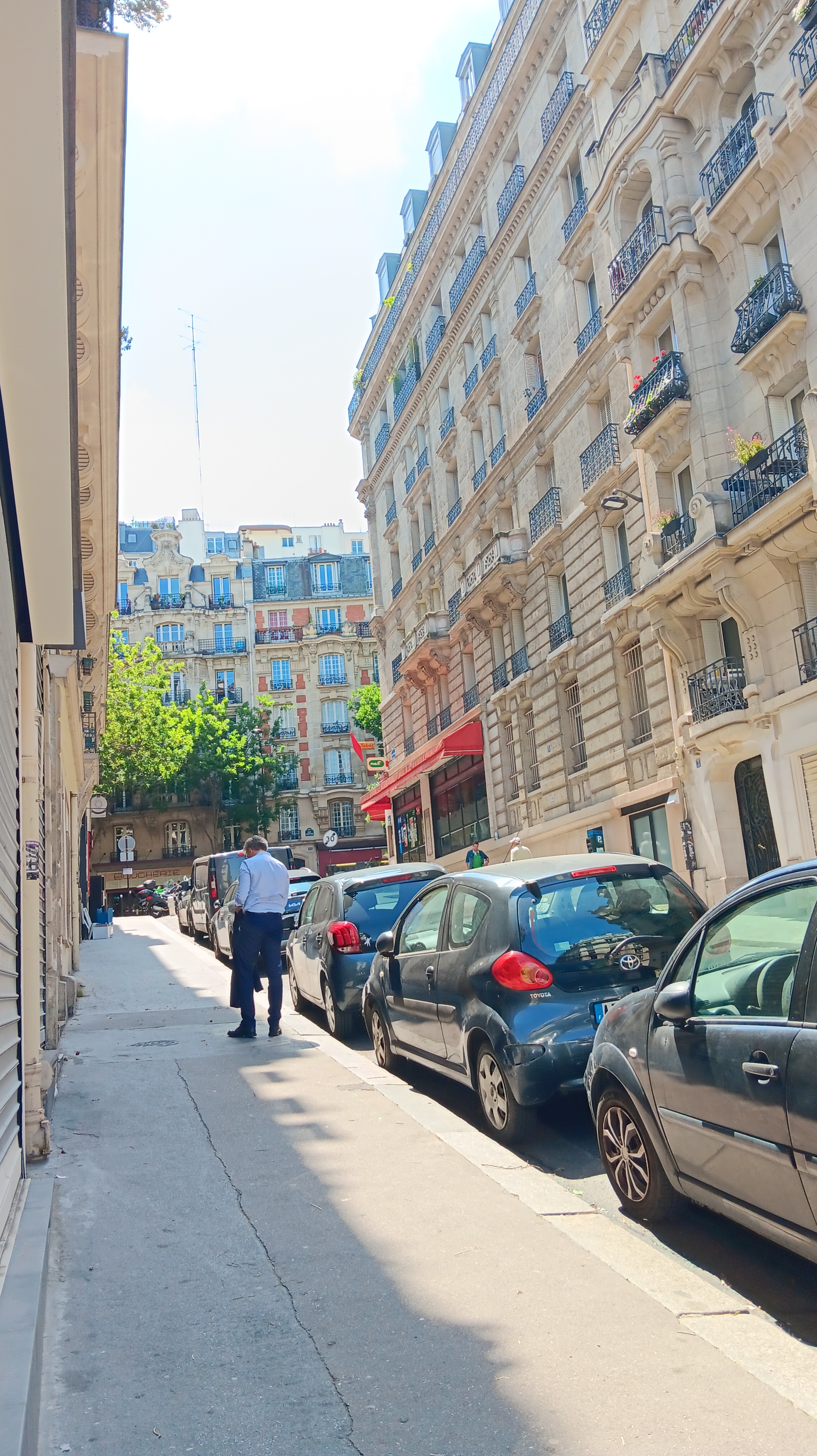
Then I just meandered back home, enjoying the luxury of downhill. I just love the architecture of your basic apartment building here.
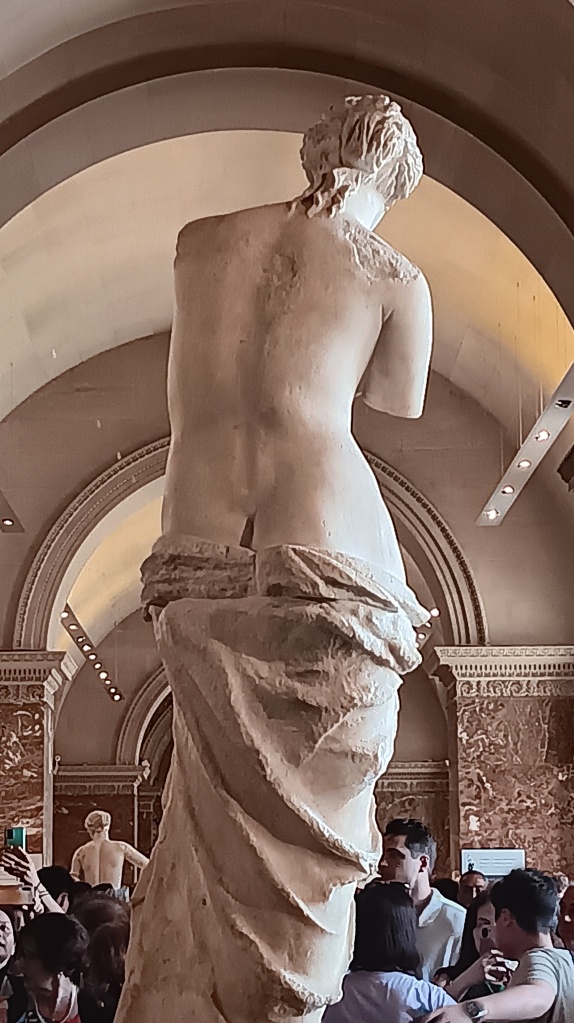
Munchkin and I had a plan of getting to the Louvre early (since online tickets were already sold out for the dates we wanted. Friends, buy those online tickets weeks or months in advance). We failed. We arrived shortly after 9 and were told the wait would be three hours, but decided to stick it out because, eh, we could read in line. As it turned out, the wait was under two hours, and as I posted a few days ago, was totally worth it.
I don’t usually take photos of artworks, since if I want to see them again later, they are likely to be in a book or online, or in the case of the most famous, on postcards, all of which are better representations than I’m going to get with my camera. But the Venus de Milo is always shown from the front, and she is so stunning from the back that I snapped this in case I want to draw it later.
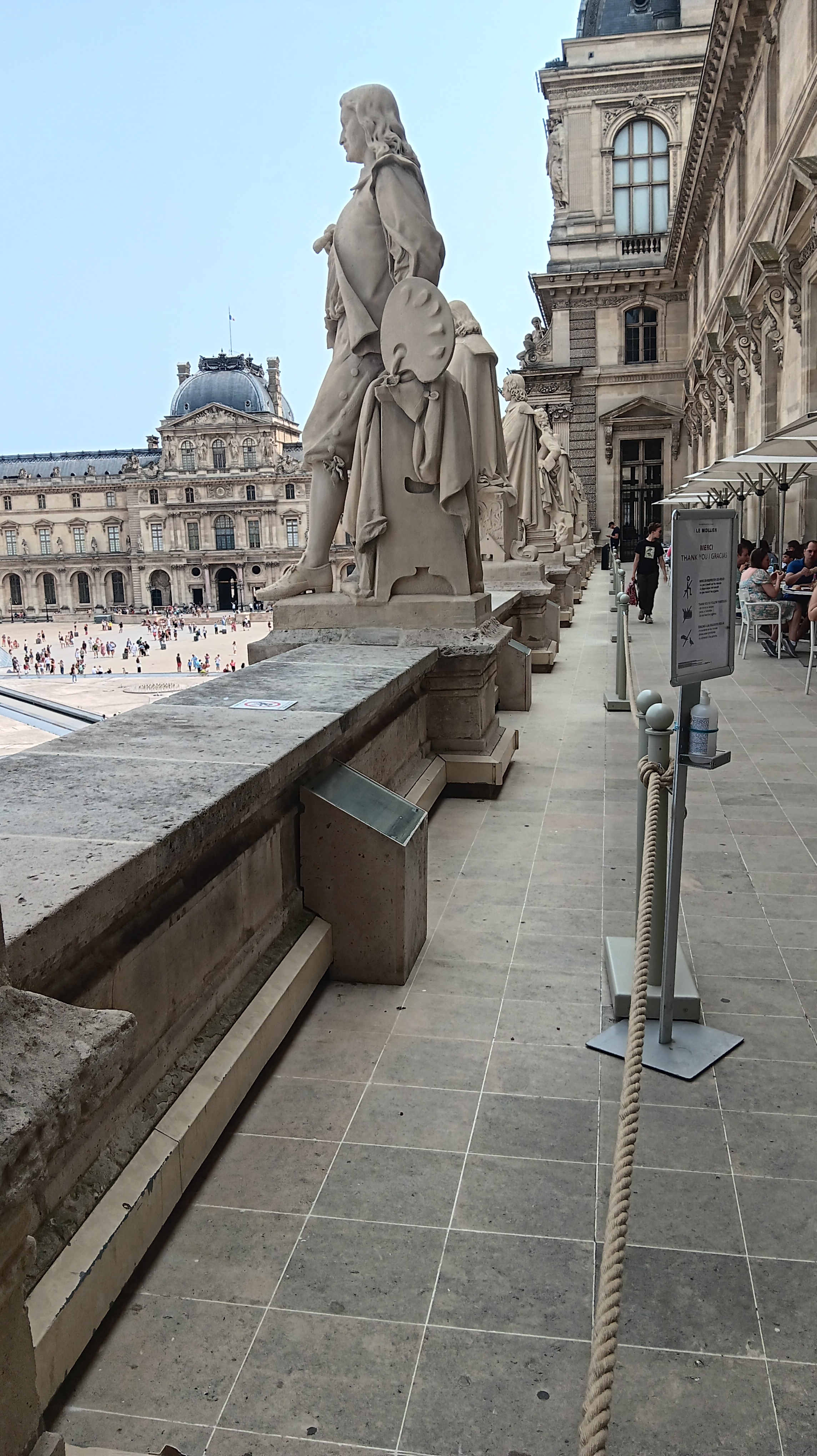
A really nice thing about this cafe in the Louvre is that you can take your food to tables alongside the statues that line the roof. However, we opted to eat indoors for our usual reason: the lovely outdoors is made much less lovely by the omnipresent cigarette smoke. People smoke a lot more in all the places we’ve been this summer than in San Francisco. It seems like a ticking time bomb for these countries’ marvelous single-payer healthcare systems as well as for the individual smokers. My more selfish concern is that it smells awful. Of course, with all the doors and windows open, it’s not possible to get away even though smoking indoors is forbidden. We had the most exquisite dinner the other evening at a restaurant near where we’re staying, in the 18th arrondissement, and the smoke coming in from the people dining just outside got so strong that as soon as the child finished, she excused herself and went home. I stuck it out because I was absolutely determined to have dessert, but the creme brulee would have tasted a lot better if not accompanied by tobacco.
Another return visit for me and Joy earlier this week: the Rodin museum.
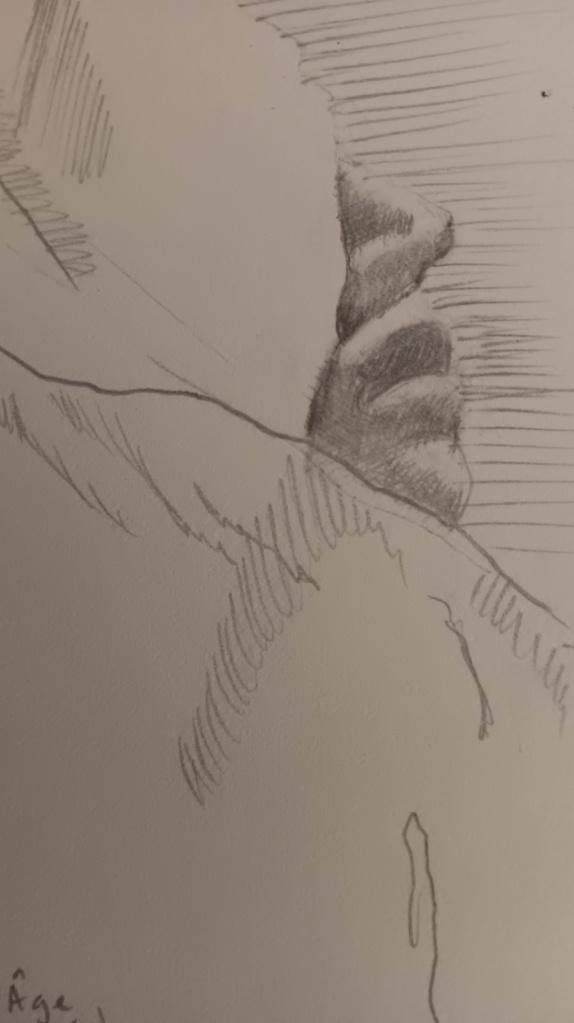
Age of Bronze, Draped
Munchkin spent the whole time in the atelier, making art alongside French kindergarteners, and then left to go to the Curie Museum. Then the three of us joined up for a tour of the Saint-Geneviève library, one of the libraries of the Sorbonne. The man offered to lead the tour in English, but we declined. Joy and I could follow a lot of it with our decades-dusty French, and Munchkin translated the key points for us afterwards. No photos of users allowed, only of the architecture, which is gorgeous.
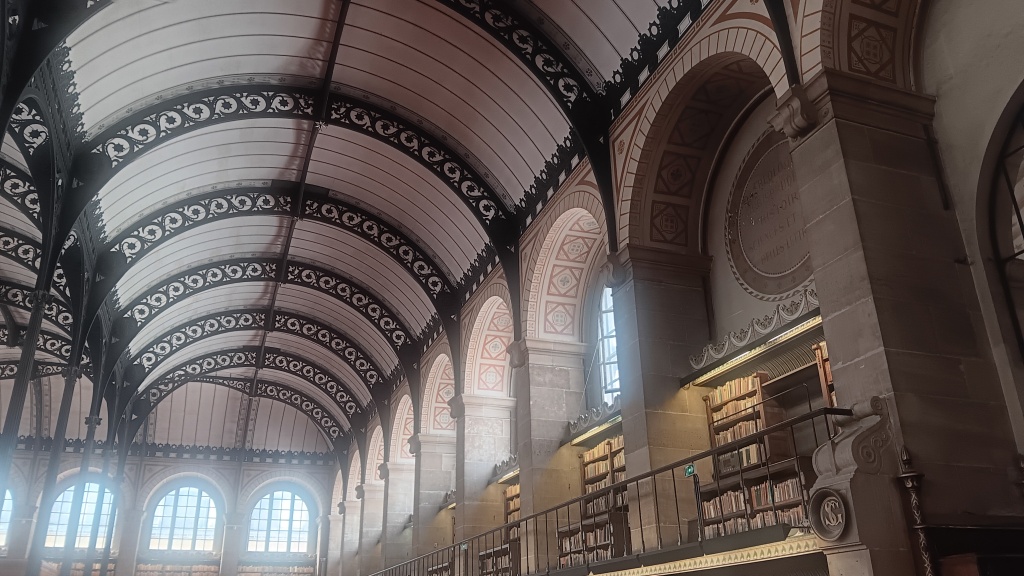
Then, yesterday, Munchkin went on a long bike ride all over the city, and Joy and I got on a bus and went to Giverny, the home of Claude Monet, where, as his painting career became more successful, he put his money into creating some of the most beautiful gardens I have ever seen.
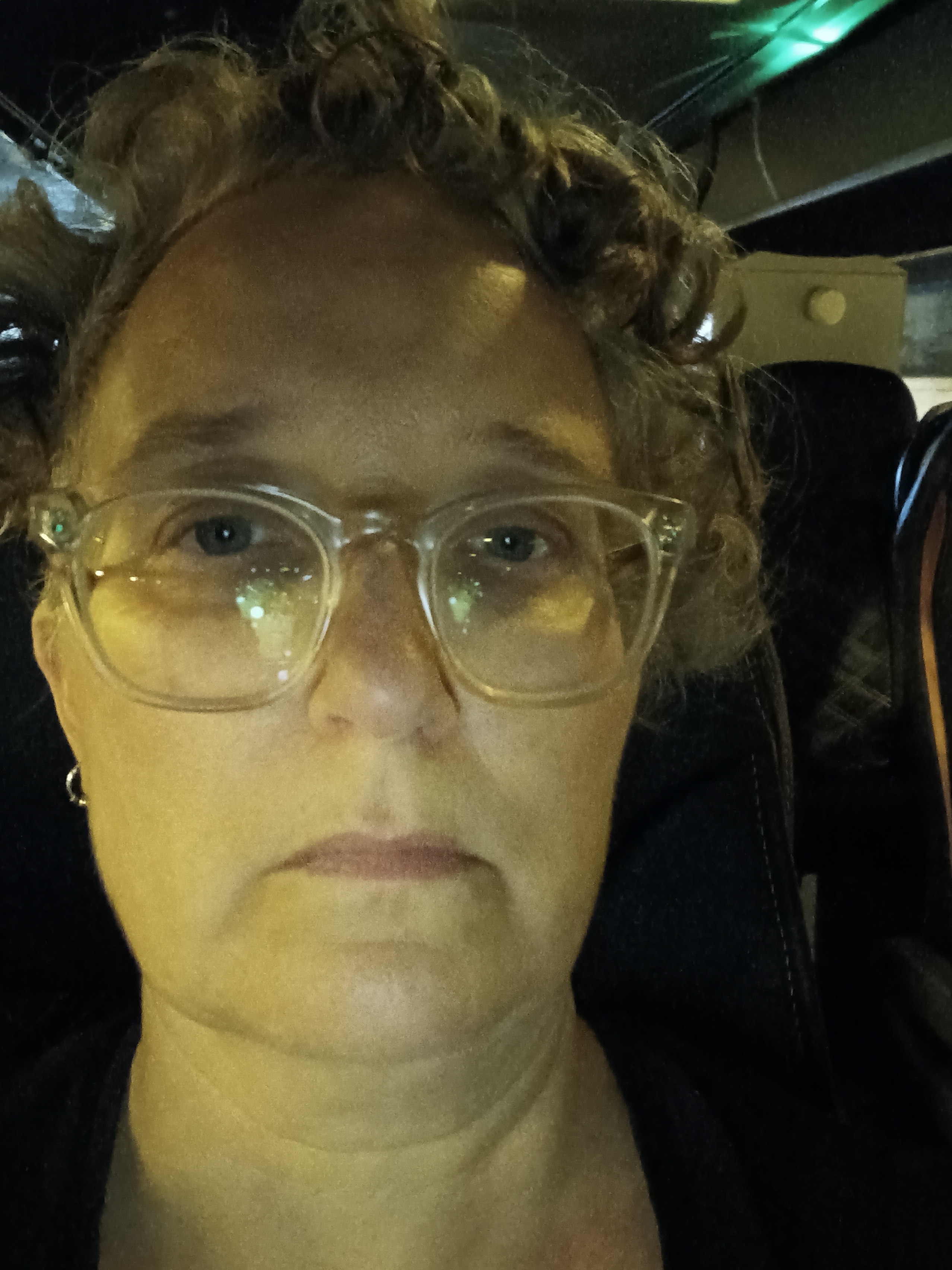
Buses are not my favorite way to travel. I felt clammy and was sure I was turning a little green, so I snapped this selfie. I do look green, although that might be the lights. Fortunately, buses also make me sleepy, so I slept most of the way both ways.
The gardeners of Giverny (Monet and his staff in his time, and now eight gardeners employed year-round) have such an amazing sense not only of color, but of texture. Also–more thunbergia envy–apparently there is such a thing as pink thunbergia, and a couple of them are growing next to the house, with a profusion of flowers in hues ranging from almost-white to magenta. I didn’t take their photo, just this sweetie’s, which from the foliage might be some kind of zinnia.

When we got back from Giverny, we met up with the munchkin and did something we can’t do in the United States: went to a jazz club, all three of us. And it turns out that she loves to dance, just as I do. We danced together, but I couldn’t keep going all evening, the way she could. The munchkin just carried on. There’s such a great feeling there–people of all ages, people dancing in couples or alone or in groups, same-sex couples both romantic and non-, expert dancers and those like me who just get up and move. The crowd was a lot younger than I expected, which makes me hopeful for the future of jazz.

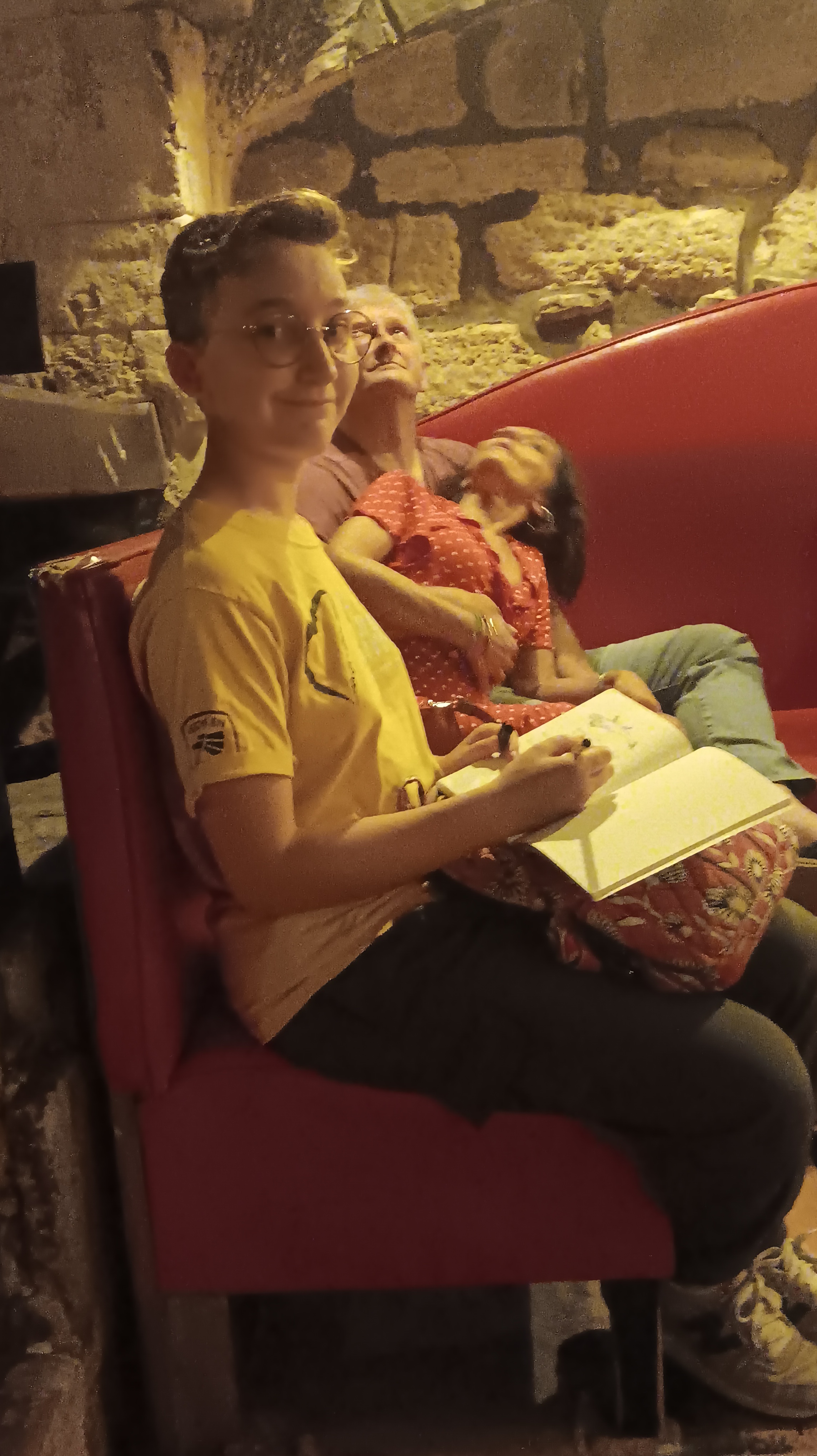
Now it is Bastille Day. I had originally proposed going to Chartres today, because Friday is the day you can walk the labyrinth there. But Joy flatly refused, having learned that there are actually fun things to do during the day on Bastille Day. We have no interest in the military flyover or parade, and you couldn’t get me to the Champs de Mars on its most crowded day of the year, but supposedly there are fun doings at the fire station down the block, as at most of them around the city.
At 4:30 Munchkin and I are going to the Catacombs, a fascinating relic of a brief period of Paris history. The weather has cooled off a bit, but going underground for a couple of hours of the afternoon is still an attractive prospect. I remind myself, grimly, that this might be the coolest summer of the rest of my life . . .
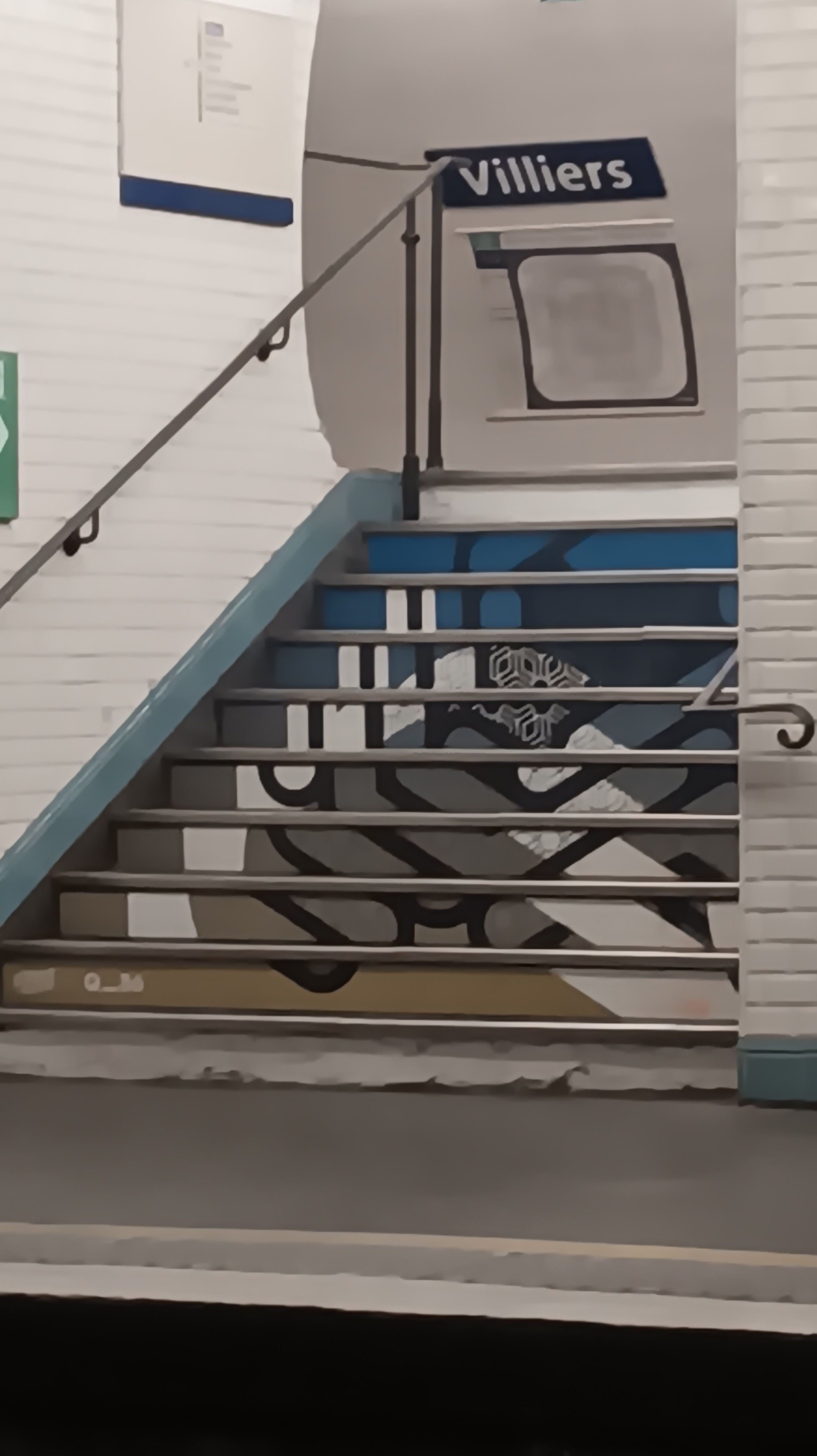
Other details that have made me smile in Paris: the sound of a pigeon landing just outside the half-open shutters in our room and cooing there as I watched it through the slats. Murals like the one on this stairway in a Metro station. The kind neighbor who passed us the key since our host was out of town when we arrived, and how animatedly she chatted with Munchkin. The gentleman who lives elsewhere in the building who said, not “Bonjour,” but “Je vous souhaite un bon jour,” as he nodded in an equally courtly way and went out. The way bakery workers spin a paper bag between their two hands to close the top with two little twists. The attention given to beauty in so many buildings, street signs, even the Metro corridors.
I find myself thinking, “If I were young and still deciding where I would live, like Munchkin, I would be pretty interested in spending a few years in Paris.” Then, considering why I don’t do that now, and why I didn’t do it when I was her age, I realize: because I don’t have the language. And I am so glad for her that she has opened the doors of the Spanish-, French-, and probably Italian- and German-speaking worlds for herself.
It’s amazing how you can walk into a room full of 17th century Dutch paintings, take a quick glance around as you move through, and know immediately when your eye falls on a painting by Vermeer. I could spend the rest of my life trying to do what he does with light, but I figure the only way to begin to learn it is to draw it. This is “The Astronomer,” the only one of Vermeer’s that is currently in residence here at the Louvre (“The Lacemaker” is out on loan).

I was in this wing in search of Rembrandt, and found the roomful a couple of rooms along from Vermeer. This self-portrait (below) is from 1660. There are a few here from 25 years earlier. I love how honestly he shows the changes time and experience have wrought on his face, though through my own limitations, I took about 25 years off again.
The first try was way too small, and when I went closer to see some details that I hadn’t been able to see from the seat on the other side of the room, I hadn’t left myself room to have a prayer of including them. So I started again at twice the size (still a thumbnail of a detail; the painting is about 3×4′). As with Vermeer: the light, the light, though with Vermeer I always have the impression of light’s falling on the subject, whereas with Rembrandt self-portraits, I usually have more of a feeling that he is emerging, partway only, out of a palpable darkness.
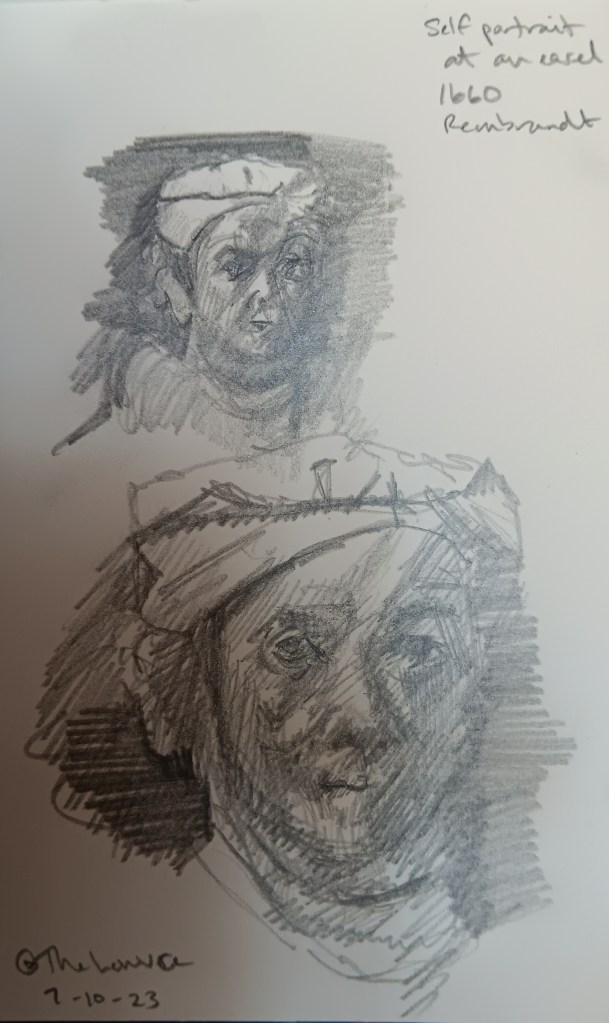
Both graphite pencil on 4″×6″ sketchbook paper.

Munchkin and I are at the Louvre. I communed with one of Michelangelo’s “Captives” while she went in search of more recent European sculpture.
I was lukewarm about returning to the Louvre, and came mostly to accompany M, but this time spent drawing made it more than worth the price of admission, and the wait.

 Sermons in Stones
Recent comments