
You are currently browsing the monthly archive for March 2022.
. . . which isn’t a cedar. At least, it’s not of the genus Cedrus. Quite a few conifers not in that genus get called cedars anyway, and this is one of them. It is a member of the genus Chamaecyparis, making it a cypress, though there too, the common name of “cypress” and the family, Cupressaceae, do not consistently correspond to each other. Maybe frequent commenter ERP will work through the tangle of what is and is not a cypress or a member of Cupressaceae.
In any case, for a tree to belong to this genus, Chamaecyparis, it must have scale-like leaves in adulthood, which means that here on my 55th tree, I have at last moved on from needles! This drawing feels like a schematic; I was just learning how these little scales fit together. What’s the pattern, and how does it change when a new twig (twiglet?) branches off? It’s fun to learn it. I will get a lot more familiar with them over the next few weeks, because there are 23 other trees with scale-like leaves here in western North America.
The leaves, that is, the scales, of the Port-Orford-cedar are tiny: about 1/16″ each.


Common name: Sugi, or Japanese cedar.
I love the overall pattern of these needles en masse: the way the twigs bend in waves and curls. I struggle to portray big-picture patterns like that, so I tried using broad strokes, literally. And at a distance I think it approximates the movement of this tree. Here’s the reference photo–which I couldn’t look at at exactly the same time that I was drawing. Having to switch back and forth also helped/compelled me to draw the shape and pattern of the whole rather than zeroing in on details.

It’s Saturday night. This is all a hardworking minister can do.

I enjoyed spending several days on this (and I think I blanked out entirely yesterday!) but it’s good to declare it done–something that’s often hard for me.
Presenting a very small, young, short-lived part of a tree that grows to be very tall and old, a Coast Redwood.
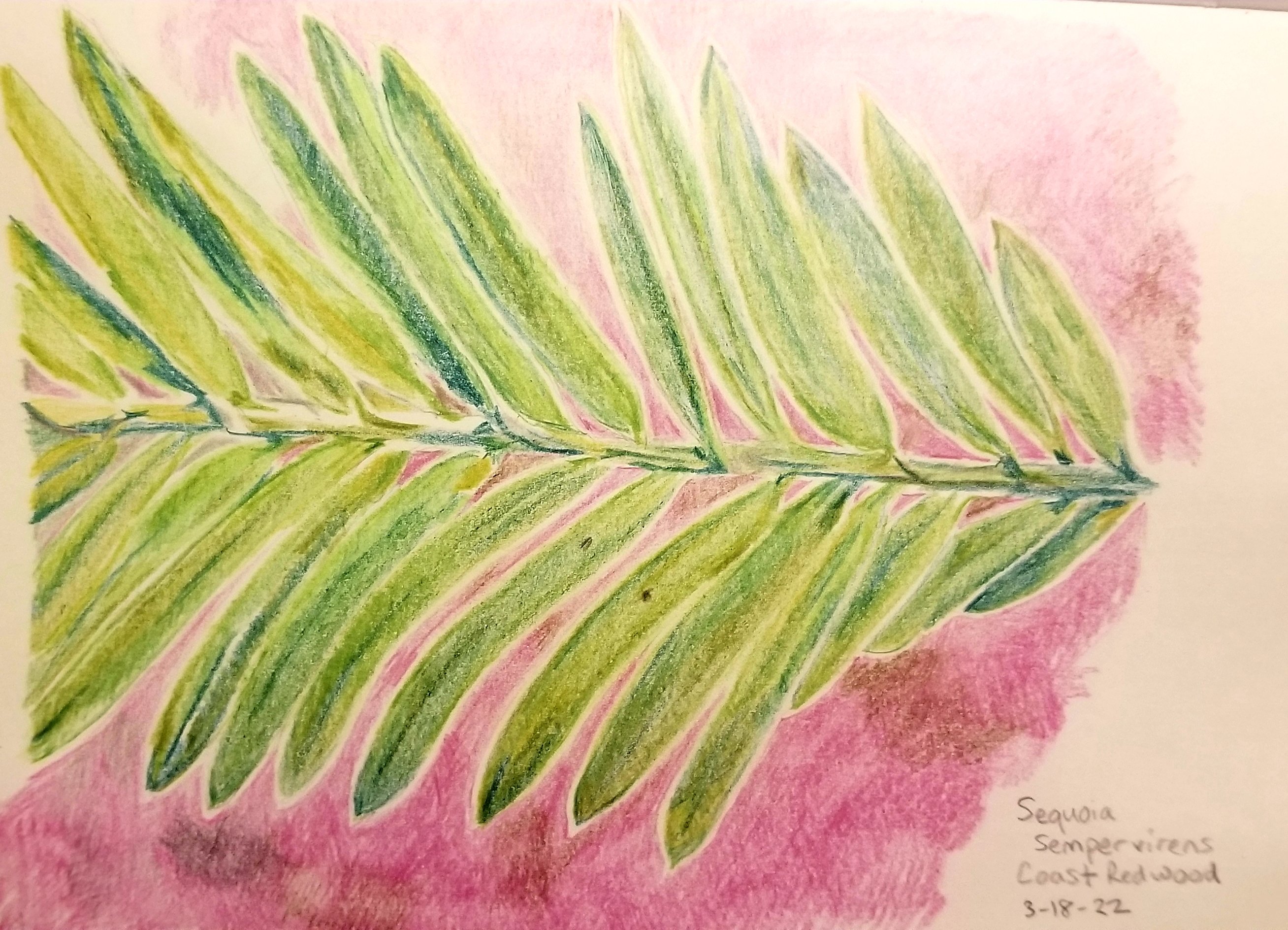
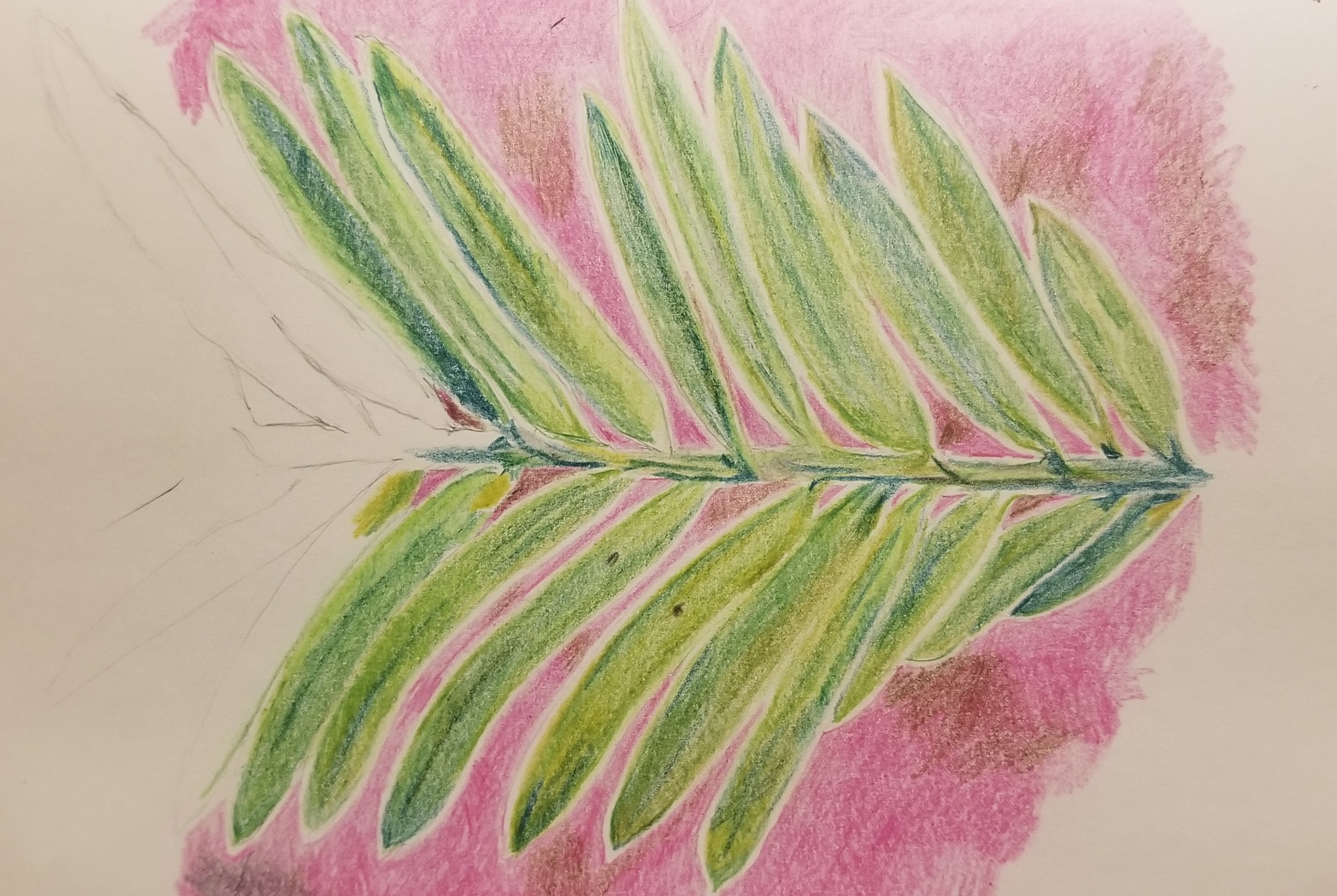
My daughter said, “Why is it so pink?” I responded that pink was part of the actual background color, and that I was exaggerating that but would be mottling it (as I have now done, above). I said I was trying to show how there was a glow around the needles. She affirmed that there’s a glow, but thought that with a pink background, the glow seemed to come from nowhere. Damn it, she was right. When I started this, the background, which is partly bright white light, seemed way too difficult, but that now seems untrue, and yes, if the background doesn’t show that light, where does the glow come from?
I think I am resolving it by making the upper section of the background considerably lighter than the lower. We’ll see. I should consult her earlier next time.
Next day: you can’t erase colored pencil, but you can lighten it. I’ve done that and added a few more leaves. They are all different. I’m loving meeting each one.

Coming along. Maybe I will finish it tomorrow. Cryptomeria, the next tree in the field guide, is tugging at my sleeve, but I’m really relishing this time with a beloved tree. I’m very happy with the way the glow is showing.

I’m very, very close to writing the Dewey Decimal number on all the books in my office. Before anyone gets worried about incipient OCD (cue my wife saying: “Incipient?”), hear me out.
There are about 10% of my books that I never know how to categorize. My office shelves have sections: worship resources like meditation collections. Scriptures of various religions. Philosophy. Religious education, preaching, fundraising, and other practical arts of ministry; fine. But then pastoral care shades into spiritual memoirs, books on healing through writing and art, others on aging, etc. And do books about our spiritual relationships with money go with fundraising or spiritual something-or-other?

And which books are history, which philosophy, which theology . . . ? I often find myself holding a book, trying to decide what shelf to put it on, and wondering what Dewey would have to say about it. (That’s Melvil Dewey, creator of Dewey Decimal Classification [DDC]. Not John Dewey, who maybe goes with Philosophy or maybe Humanism or maybe Unitarian Universalist History . . . )
Usually, I go with my gut. I figure, wherever I classify it in my own mind, that’s where I’ll look for it. That worked for a while, but it’s gotten harder as my library has grown. Plus, some of my most interesting books seem to cross categories.
Someone has already done all this work: Dewey and those who have further refined his categories over the years. So I’m leaning toward hitching a ride on their labors by putting books where the DDC would. Generally, this number is listed on the same page as the publication information. But to actually categorize them all means not only looking at those (at least for that non-obvious 10% or so), but remembering them. Making little piles, maybe, of the 210s and 220s and so on. And how will I remember which pile is which as I sit on my office floor, surrounded by books?
You see where this is headed. If I’m going to make a lot of little piles, it’s just as easy–and a lot clearer–to simply put the DDC number onto a label and stick it where I’ll see it, such as, oh, say, the spine of the book. Then, putting them all in order, and keeping them in order, will be easy and not depend on my memory at all.
The only catch is, when it’s all done, I will have an office that looks like a library, and people might look at me strangely. I don’t suppose that’s much of a change.

.JPG)
Many nights, I am tempted to skip that day’s drawing, but I’ve stuck to it every time. Usually, even if I don’t sit down to it until 10 p.m., the process gives me energy and I’m glad to be drawing. But last night, I really wanted a break from both drawing and piano practice, gave it some serious consideration, and decided a day off was a good idea.
Today, I played piano and I drew, but this drawing is going to take a couple more days. It feels special to have gotten to it in the field guide: Sequoia sempervirens, our beloved coast redwood. And the reference photo I found conveys that quality of light that comes through the branches, and maybe explains it too: each needle, it turns out, is outlined by a glow where it thins to nothing. That’s what I want to get across in my drawing, so it will be a slow, careful process. Today I mostly just outlined the leaves.

See you tomorrow, Sequoia sempervirens.
Trying out an ink pen again . . .


 Sermons in Stones
Recent comments