
You are currently browsing the tag archive for the ‘writing’ tag.
I posted this on a social media site earlier today, but various important people such as my daughter don’t have access to it there. One of my most faithful readers and frequent commenters here was, alas, the person I’m writing about, and the fact that there will be no amusing or bemusing comment from him is another dull blow in my gut:
My father died yesterday morning at the age of 86. He had been declining sharply, and my sister E. and I were flying to Tucson this week–she is there now, I’m arriving tomorrow. But both of us too late to see him one more time.

I drift in a kind of numb disbelief, punctuated by waves of sadness. I know the feelings will keep coming and I’ll cry and laugh and write and draw about them.
Dad was funny, smart, curious, with a knack for defusing conflict with a bit of self-deprecating humor. He read voraciously and delved into whatever caught his interest, so that in recent years when we talked, he’d have something to tell me about his studies in ancient Greek or the paintings of Joan Mitchell. He really found his calling when he became an English professor, since he was a natural-born scholar and also a ham who loved to have the opportunity to hold forth on the stage of the classroom. He was very politically aware and liberal–not an activist except for the occasional bout of making phone calls for his Congresswoman, but he was proud that E. and I were. He was a poet, and later in life, took up abstract painting with abandon. He loved to travel, cook, and eat (“I love food,” he used to pronounce now and then).

Some of my sweetest memories of my father are gardening with him when I was very little, baking bread and learning how to shape the loaves, studying Pirkei Avot together when I was older and we were both devotedly Jewish, reading a book he had recommended or occasionally one he hadn’t (“Are you reading Sal Fisher at Girl Scout Camp AGAIN? The whole great world of literature all around you, and you’re reading Sal Fisher at Girl Scout Camp,” he said in mock-despair). Going to Mets games, especially one memorably cold Opening Day, when they made us just about cry by going into extra innings. “Do you want to stay?” he asked, clearly at least half-hoping I’d say no, but I said “We have to!” and he seemed pleased; fortunately, Gary Carter, in his first game as a Met, saved our freezing fingers and toes and became an instant hero by hitting a walk-off homer in the tenth. Traveling: to Israel for a whole summer when I was 12, to London and Paris when I was in high school, or just to someplace like the tiny Mohegan museum in Uncasville, an hour away from home. Countless plays–he did not actually know all of Shakespeare’s plays by heart, the way I thought he did (and matter-of-factly told friends) when I was little, but he loved the Bard, he loved theater, and he and Mom went to just about everything New Haven’s Long Wharf, Yale Rep and Yale Drama School had to offer, often bringing us along and requiring that if it was Shakespeare, we read the prose summary of the plot first so we’d know what was going on. The declaiming from Shakespeare at the dinner table, followed by a pop quiz: “What’s that from?” Eyerolling child: “I don’t know. Hamlet?” “Tsk. RICHARD THE SECOND!,” he’d say, clearly affronted that he had managed to raise children who were so ignorant, and overjoyed to have the excuse to jump up, grab the play off the shelf (he had two or three editions of the complete plays), and read us the whole passage. Day trips to Boston (Faneuil Hall, then a game at Fenway) and New York City (the Metropolitan or MOMA, then dinner at Tout Va Bien).
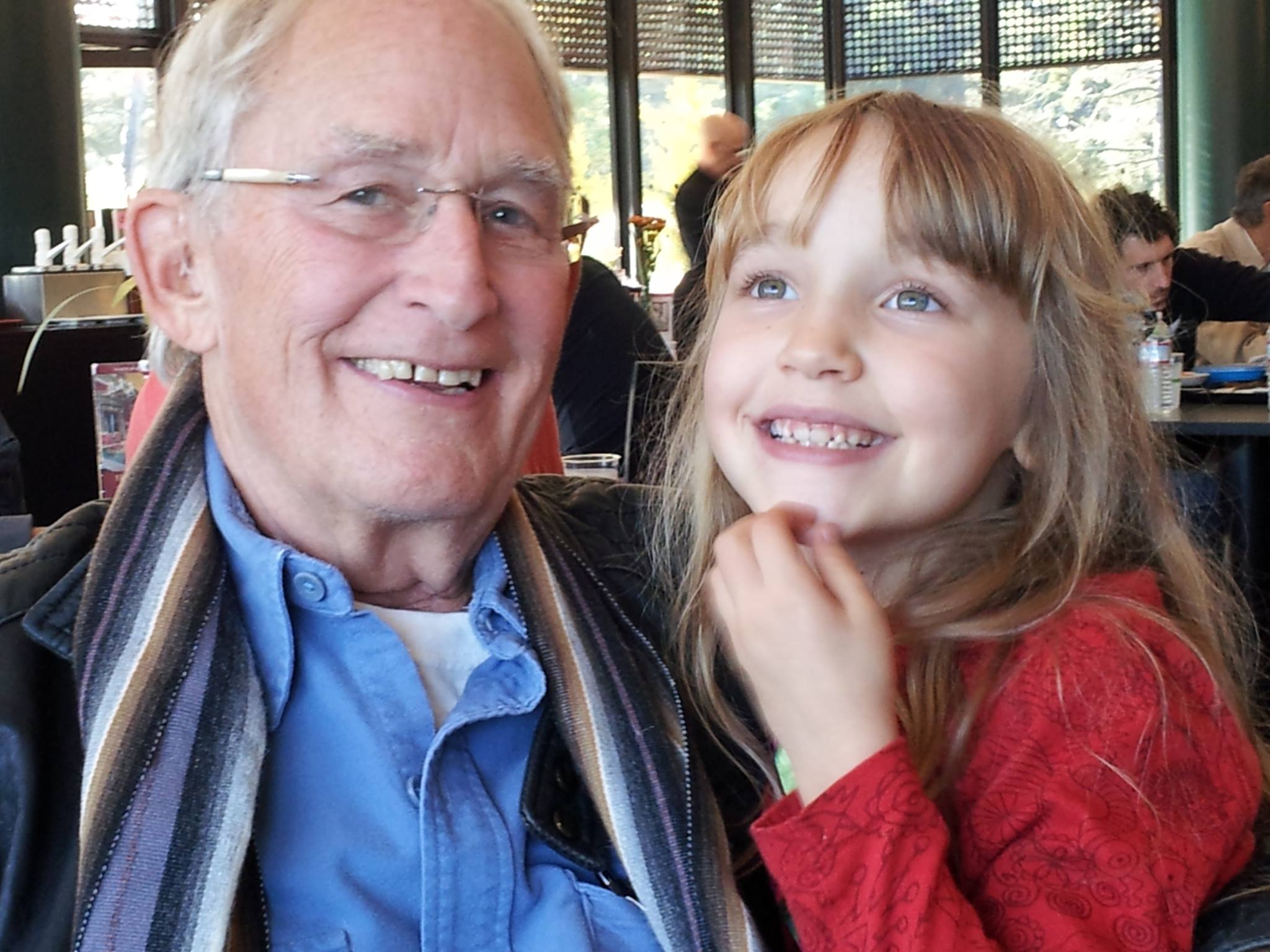
The grand adventure we shared at the start of the Blizzard of ’78, when he walked through the driving snow to get me at school and walk me home. His fiercely comforting me when I called to tell him that my ex-husband had died by suicide: “Now don’t you DARE blame yourself!” He and Joy’s dad, Marty, at our wedding, spontaneously rising at the end of our first dance so that Dad could dance with me and Marty with Joy. Holding Munchkin on his lap to read to her, and later, delighting in the poetry she wrote. His sitting in an armchair in the living room, reading, and occasionally saying “Listen to this” and reading something aloud to whoever was around. And the sound of his voice when he answered the phone–“Amy!”–as if nothing in the world could make him happier.
I love you, Dad. I’ll miss you forever.
The previous posts on this topic can be found here and here.
The third shift in my writing and preaching in the past several years can be summed up simply: more courage. I’m accessing deeper truths in myself and speaking about the things that I see as most important to me. When the writing gets scary–when it’s leading me to question things I’ve taken for granted, or to say things that might be hard to hear, or to feel scary emotions–instead of backing off, I keep going. On my best weeks, I’m giving people the most important things I’ve discovered.
This is not to be confused with self-revelation, which can be a trap for preachers. It’s easy to think that simply by talking about incidents from our own lives, we’re being brave, when sometimes we are just dumping stuff on the congregation that would be better aired to our therapists or best friends. (Sensing the distinction is one topic in the seminary course I outlined but haven’t taught, “Preaching on the Edge.”) You can’t preach well week after week without revealing a great deal about yourself, but it’s not necessarily about anything you’ve done or said. It’s about depth of soul and being willing to dig deep to that treasure and share it with others. For me, courage comes into it because I’m afraid they’ll reject my offering, or sneer “That’s all? That’s what’s in the treasure chest?” or one way or another, find my gifts inadequate. But I think the best sermons come out of that risk, because when I don’t risk it, I’m hiding what is most valuable.
I learned a lesson from Allen Ginsberg back in the mid-90s, though it took a good many years to filter into my preaching. Recordings of fifty of his poems and songs had just been released (Holy Soul Jelly Roll, Rhino), and I went to hear him read. This was an era of nudity. Madonna was breaking barriers by strutting onstage in her lingerie. Yet she never seemed very raw or vulnerable to me; on the contrary, her act felt like an act, the skimpy clothes a kind of emotional armor. Ginsberg was just the opposite. He kept all his clothes on, a 60-something-year-old man standing on a modest stage in thick glasses, a button-up shirt and khaki pants; for the most part his content was PG-rated; despite the ego required to recite one’s poetry to a crowd, he didn’t give the sense of putting himself forward in any way; and for all that, he was utterly naked. He peeled away all pretense and allowed us to see his soul. Watching him, listening to him, I realized a person can share the most intimate thoughts and feelings in a way that says not “Look at me!” but “Here, let me help you take a look inside yourself.”
True vulnerability invites vulnerability from others. That takes courage. I don’t know how others develop it; for me it’s been by doing things that scare me.
For the previous post on this topic, click here.
The second shift in my sermon writing and preaching was one of intention and attention. Anything can become a routine, and preaching was often a routine for me–an excruciating, four-in-the-Sunday-morning routine, sure, but still, routine in that I’d lost touch with the reason to preach, the reason people sit and listen to a sermon in the first place. It wasn’t entirely absent; it flared up in my preaching, I’m sure; but in many of my weekly struggles with writing, it had ceased to be central.
Maybe something began to shift back where it needed to be when I began to open every service with an eight-word mission: “to transform ourselves, each other, and the world.” Another thing that brought it back now and then, brought my heart back to what was most important, was others’ great preaching. I would go to a service–typically, someone’s ordination, or the short worship services ministers lead for each other during our retreats–and the preacher’s words would rock my world. I would walk out of the service remembering what my life was about, “This, this!” and know once again, in my bones, that I needed to reorder my priorities to put the people I love most at the center (thank the departed Mary Harrington for her sermon “A Lifetime Isn’t Long Enough”); that I wanted to wake up before my short time was over (thank you, Erik Walker Wikstrom, for a sermon you gave just before your departure from Brewster, MA, in the summer of 2008). These sermons transformed me, personally. This is what I could do for the members of my congregation.
Around the same time, Christine Robinson’s Berry Street Essay, i.e., sermon, spoke to my soul by reminding me that my job was to speak to others’ souls: to allow them to be “touched to the core of [their] being.” She spoke about an experience of holiness she had on a ride at Disneyworld, and I was pressed back against my seat–it felt like 2 g’s–by these words: “The only thing you’ll really have to work with . . . is yourself and what you are willing to share of your own, precious and always threatened spiritual life.” Another wake-up call. Was I sharing of the core of myself, and was I speaking to the core of those gathered on Sundays?
Then I read Kay Northcutt’s book. My congregation, mostly atheists, humanists and naturalistic theists, might be nervous to know the title (Kindling Desire for God: Preaching as Spiritual Direction), but the fact is that whatever they love about my preaching in the past five years owes a great deal to this book. The message I took from it is: whatever your text for the week (and Northcutt, like most Christian preachers, follows a lectionary and has Biblical texts as her reading), prepare for writing by meditating and praying on that text, yes, but even more, meditate and pray on the spiritual needs of your congregation, individually and collectively. What is happening in their lives right now? What is happening in their world? What are they hungry for, frightened of, longing for? These are the “texts” for your study, preacher. Northcutt spends significant sermon-prep time each week contemplating the heart of her congregants’ being, and she says to all preaching ministers, Go and do likewise.
I had forgotten. I had been writing as if my job were to present twenty minutes of coherent and occasionally eloquent argument. Coherence and eloquence are important, but they’re just the craft of writing, and while craft is often underrated, if you’re an artist it’s intended to be the servant of meaning, not the end in itself. In church, the meaning is our lives. A preacher is an artist, meant to create something that is not just well-crafted but beautiful and charged with meaning: something that will touch the core of our being.
I know why I’d forgotten this. It was a convenient amnesia, an avoidance of something that scared me. So what I needed to do, if I were to write and preach in a way that would speak to people’s spirits, was to move through my fear.

 Sermons in Stones
Recent comments