I have never had a guest poster here and don’t plan to start (too much administrative overhead), but I was so taken with this sermon that I asked Sharon if I could post it, and she graciously said yes. I love it because it speaks not only to the preparation for ministry, and the ongoing work of ministry, but to all that people are and do. I would wish for each congregation to be a “place that calls us back unrelentingly to who we are, lays us bare, and demands of us that we use our gifts to bless the world in the spirit of love.” I would wish that our families be such places; that our friendships be such places; that we each have such places at the center of our lives. And I’m happy to hear that for one person at least, Starr King School for the Ministry has been one such place.

To read more by/about Sharon, check out her blog, Ministry in Steel-Toed Shoes.

“Training to Be a Jedi”

http://news.bbc.co.uk/2/hi/entertainment/1375156.stm

photo credit unknown (BBC)

photo by Kevin Berne

My weekend was full of cultchah. After multiple attempts, I got hold of episodes 4-6 of the BBC Pride and Prejudice (the one starring Colin Firth and Jennifer Ehle) and enjoyed it over popcorn yesterday in a blessedly empty house. Well. Wow. A very faithful production, and yet so startlingly relevant and fresh that I kept pausing the DVD to check the book. “Did she really write that?”–“Yep, she did”–hit “play” again. Actually, I think it is less despite its adherence to Austen than because of it that the production works so well. Is there a better novelist in the English language? I hadn’t read the book since high school, and re-read it in preparation for watching the screen version, laughing and shaking my head in wonder all the way. It’s a classic in the best sense of the word.

It does occur to me, though, how vital it is to teach this book to 10th graders as a bit of an anthropological expedition. They just can’t understand the characters without knowing some basic facts about the culture. That a gentlewoman of the time had no acceptable way to “earn a living” except to have money from her father, brother, or husband. If you don’t get this, you’ll think the Bennet girls are just gold-diggers. That a woman who “lived in sin” would never be able to marry a gentleman (i.e., have access to a steady income), nor would her sisters. If you don’t get this, you will think the family is overreacting to Lydia’s running off with Wickham. (Lydia is so stupendously stupid that she doesn’t even know Wickham has been forced to marry her–and yet she’s believable. Austen knows how to situate her people at the absolute edge between character and caricature without tipping them over it. Good acting by Julie Sawalha, too.) These cultural differences are a reason to read the book in high school, not a reason to avoid it, but I’m not sure that even as a bright, literature-loving teenager, I fully understood that reading even fairly recent English literature is all about entering into a culture very different from one’s own.

We watched a lot of movies in high school English class; I suspected it was the teacher’s attempt to stave off burnout, since she’d show us movies of books we weren’t even reading, such as Billy Budd and The Heiress (movie version of Washington Square ). To judge from her comments, maybe her real motivation was to ogle Terence Stamp and Montgomery Clift–or maybe she was just trying to keep us interested. I’m not blaming her. Hell, Colin Firth was a major reason that I hunted down this version, and not just because the man is a superb actor. And as I said, I re-read the book in order to do justice to the movie, so Ms. N. might have had the right approach. Though I’ve never followed up American Lit by reading Billy Budd or Washington Square . . .

Earlier in the weekend we saw another period drama / comedy of manners, from a different period, when we caught the second-to-last performance of the new musical Tales of the City, based on Armistead Maupin’s books about 1970s San Francisco. I am not much of a musical lover, but Joy is, and we had heard raves from a couple of people we know well, so off we went, and it was really fun.

Contrary to what I usually say, my problem with musicals is not that they’re unrealistic. I don’t require the arts to be literal-minded; a friend once explained her dislike of the Marx Brothers (whom I love) by complaining about how unrealistic it was that Harpo always just happened to have the perfect prop in his impossibly spacious pockets, and I realized that what she found most improbable, I found most funny. And as Joy says, sure, people don’t burst into singing and dancing in real life, but wouldn’t it be great if they did? No, what I don’t like about musicals is how actor-y the actors are. So many don’t seem to be able to just sing, dance, speak; they have to add a little fillip of “Look at me, I’m Singing! I’m Dancing! I’m Acting!” that ruins the moment. (Preachers are prone to the same problem, undermining their own words with a layer of self-consciousness. I can be listening to a great sermon and then lose my concentration entirely because the minister has slid from speaking into Speaking. The voice takes on just the tiniest, most innocent kind of falseness, and that falseness detracts from the truth in the words. And believe me, I’ve used that voice myself, mea culpa.) The Tales of the City cast avoided this trap on the whole–though the one who slipped most often was the star of the show, the only actor I’d actually heard of, and who’s won a gazillion Tonys and such: Judy Kaye, who played Mrs. Madrigal. She was excellent overall, though.

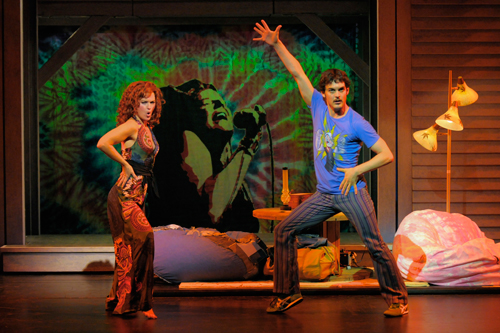
I liked it. Fun music, great set, some of Maupin’s funniest lines, spot-on casting (Joy didn’t think this was true in every case, but we agreed that Wesley Taylor, pictured above, was the perfect Michael Tolliver), and yes, as one would hope for a musical set in the 1970s, a scene on roller skates–sadly brief. We wondered whether it will be tried anywhere else, and if it will travel well if so. The books are popular outside San Francisco, so maybe it will be a hit.


The first two hours of today’s session can most charitably be called a warmup. In the last 45 minutes I finally produced a couple of things I don’t mind looking at a second time. The miracle is that I enjoyed the whole three hours, regardless of what was emerging on the paper.

Maybe it’s all warmups. Potter M. C. Richards said: “All the arts we practice are apprenticeship. The big art is our life.”

Yesterday, day two of the Abolition Academy, the implicit theme of the day seemed to be messiness. There is a lot we can know about the supply chain from slaveholder to consumer–apparel corporations, for example, can identify every subcontractor and source all the way back to the cotton field much more easily than they often claim–but there are still complications in ensuring that no one in the chain is trafficked or enslaved.

For example, one of the requirements is monitoring: monitoring one’s suppliers, contractors and subcontractors, to make sure they are not committing any of the abuses that point to forced labor. (Examples: holding workers’ passports so that they can’t leave; requiring overtime; beating people who don’t make their quota.) Well, there are third-party monitoring organizations. But even they sometimes hesitate to make unannounced inspections, because they want to have a relationship of mutual trust with the subcontractors. (Hey, we can’t even get unannounced inspections in this country. But that’s because we specifically rewrote safety laws so that corporations could conceal problems before an inspection. Would you like E. coli with that hamburger?) The whole system is a work in progress.

For this and other reasons, instead of the shorthand “slave-free,” Not For Sale recommends the term “zero tolerance.” Even the most diligent company, conducting third-party unannounced inspections, can’t guarantee that abuses of workers’ rights won’t occur. The commitment we ask of them is that they keep a sharp eye out for these abuses, and when they find them, take effective action. That’s zero tolerance for forced labor. Monday’s facilitator compared it to a university having a zero tolerance for racism. They aren’t guaranteeing that no one on the campus will ever do anything racist–that’s not possible. Instead, they are promising to pay attention and to act on such incidents.

This is wisdom for congregations, which can be paralyzed by the impossibility of guaranteeing perfection. Being a Welcoming Congregation (UU lingo for proactively welcoming and supporting LGBTQ people) doesn’t mean promising that no one at church will ever utter a homophobic word; it means speaking up if anyone does. Being a multicultural, antiracist congregation doesn’t mean you always get diversity right, but that the congregation is stretching, listening to what its people of color have to say, and being willing to change. Standing for justice doesn’t mean you’ll never do something hypocritical like treat a church employee badly–on the contrary, it means you’ll diligently watch for just such moments and correct course when they happen. The aim is not perfection. We are human and messy, and so the aim is to be honest and keep on moving forward.

The troublesome verse, Matthew 5:48, “Be ye therefore perfect, even as your Father which is in heaven is perfect,” has come in for a called-for re-interpretation in recent years. The Aramaic word that’s usually translated “perfect” evokes, not the absoluteness that “perfect” has in English, but a strong sense of integrity, maturity, completeness: a fruit come to ripeness, a person grown to adulthood, a body whole and healthy. In a world where, as last year’s Trafficking in Persons Report says, “it is impossible to get dressed, drive to work, talk on the phone, or eat a meal without touching products tainted by forced labor,” it’s important this movement is calling us, not to perfection, but to integrity.

– – –

A woman in the class recommended this primer, 18 minutes long, by the author of Disposable People and founder of Free the Slaves, Kevin Bales. If you don’t have time to read his book, check out this excellent talk.

– – –

ETA that Boy in the Bands, my colleague the Rev. Scott Wells, just posted about one of the worst cases of child labor in the world today, the girls pressed into being soldiers and sex slaves of the Lord’s Resistance Army in Uganda. Here’s his post, and here’s the link to help fund the film on the subject being made by a friend of his. Thanks, Scott!

Yesterday, day one of the Abolition Academy (the week’s theme: the supply chain), was pretty fact-filled and unemotional, overall. Even the movie we watched about the trafficking and forced labor of children in the Ivory Coast’s cocoa plantations, The Dark Side of Chocolate, went very light on the heart-wrenching details; from what I know of the abuses against these children, they could have shown us much worse, but they were very restrained. One exchange in the movie, however, brought tears from me that wouldn’t stop.

Children are lured or simply kidnapped from the surrounding countries–Mali, Burkina Faso, Niger, Nigeria–and taken to the plantations, from which most never return, much less send home the money they were promised they’d earn. The filmmakers follow a bus that takes Malian children to the village closest to the country’s border with the Ivory Coast. Once there, they’re taken by motorcycle taxi over the border to an Ivory Coast village, from where they’re distributed to whoever buys them around the country.

Once on the Ivory Coast side, the director went up to a little boy who was sitting alone and crying, and asked him why he was crying. “I’m looking for Ali,” the boy said.

“Who’s Ali?”

“Ali. The man driving the bus. The bus over there,” the boy said, crying and gesturing toward the village square as if the bus had disappeared from there. My heart broke to see this child who wanted only to go back to the bus, who didn’t even realize that he was now in another village, in another country.

An essay of mine, titled “Beyond Either/Or,” appears in a book just published by Skinner House Press and edited by Susan A. Gore and Keith Kron, Coming Out in Faith: Voices of LGBTQ Unitarian Universalists. It’s a beautiful little volume, with diverse and fascinating voices represented in the fifteen essays, and I highly recommend it.

In my essay, something happened along the twisting path of editing and revising. The published version appears to be, not my final draft altered by the usual edits that every author must grin and bear (and often benefit from!), but a reversion to an earlier draft that was still floating around in someone’s hard drive, as earlier drafts do. It’s a shame, since I found the editors’ comments on my later draft extremely insightful and I knew they were improving my piece. The final version, however, didn’t incorporate these (though I’ve heard from readers that it’s good as is). Here, as best as I can recreate it, is the final version that I believe all three of us intended to appear in print.

Beyond Either/Or

I didn’t blog all last week because we were on a family road trip to Southern California, so daytime was for driving and/or activities like hanging out with my mom or touring Legoland, and nighttime was for much-needed unscheduled time with the family, and sleep. It was great. The first day took us down Route 5 through the Central Valley, which contains about 1% of the country’s agricultural land but produces 8% of its agriculture. The politics of water, a major issue in California, is in your face, with various pleas to make water cheaper and reminders that cheap food depends on it. “Food grows where water flows,” the signs say. “Congress-created dust bowl”–they mean Democratic Congress-created, since the signs list the culprits as Pelosi, Boxer, and the local Congressman, Jim Costa. My primary impression whenever I pass through this land, however, is bewilderment that anything edible grows here at all. It’s practically a desert–not a dust bowl, but very dry land. Rerouting water here in the amounts needed to raise things like fruit trees, lettuce, and cattle is a major problem–as anyone in the Sacramento Delta can tell you. It seems that there just isn’t enough water to green this valley and still have salmon in the rivers and water in the pipes of cities with populations in the millions.

My first impression is not quite right, though. Actually, the desert, like the abundance of food growing in it, has largely been created by humans. The valley used to be a mix of grassland, woodlands, and marshland, with lots of rivers. We turned the grassland into fields, cut down the forests, drained the marshes, and diverted the rivers to irrigate the farms and provide water for 30 million people around Los Angeles, as well as the smaller but significant population centers of the Bay Area, Sacramento, and the lower Valley itself. Now we are trying to grow food in what has indeed become a desert.

On a related political issue, I hid from the heat in the air conditioning of the car, and whenever I had to emerge for gas and food, the heat of the air was like a hammer pounding me into the ground. I can’t imagine going out there day after day to plant or pick, unless I had no other options. Maybe Mexicans feel otherwise, being more accustomed to a hot climate, but there’s only so much adjusting a human body can do; farm workers die of the heat there every year. One thing’s for sure, it’s the kind of job that should be very generously compensated, if we compensate based on the value of the work done and the strength needed to accomplish it. Obviously we don’t. Another hidden cost of our cheap food.

We drove by fields (lettuce and strawberries), orchards (almonds was our guess), enormous feedlots where a lot of the country’s beef cattle live out the last one-third to one-quarter of their lives (beef-eating friends tell me the taste is about what you’d expect compared to grass-fed cattle, but obviously most consumers of beef are fine with it). The water policies of the past several decades have given rise to entire communities, a history and a home, a whole way of life for many thousands of people, that are now threatened by changes in policy; yet the old policies don’t seem to be sustainable. No wonder the people are angry. What is a fair approach to solving the dilemma we’ve created?

Drawing sessions resumed Monday. It was so good to be back. This was my best of the morning.

A vibrant young adult group at the Unitarian Universalist Congregation of Atlanta has launched a national outreach. I really like their self-description as an “incubator group,” a model they recommend for all young adult groups: focusing on building community before adding programming; vigilant about avoiding the cliquishness that repels newcomers; accepting of the ebbs and flows of attendance, ideas, and leadership; and regarding its mission as helping its folks get comfortable with the congregation. They go into detail about “incubator groups” here. It’s a model that applies very well to all kinds of small groups in congregations.

It looks like the 2030s group in Atlanta has decided to be an incubator group for Unitarian Universalism as a whole. Love it!

ETA: In a blog entry made today on the 2030s National site, Tim Atkins advises against using “Young Adult” as the name of one’s group. Like him, I’m used to YA meaning 18-35-year-olds, because that’s what it means in UU parlance, but even in UU circles it is confusing. It’s been my observation that our teenagers refer to themselves as young adults (for the same reason Tim observes: that’s their section in the library/bookstore), and presumably 18-35-year-olds also continue to associate the term with people much younger. So please read “20s and 30s” for “young adult” above.

I’m now on study leave and one of my projects is a week-long intensive course in modern slavery at Not For Sale’s Abolition Academy, conveniently held across from the Panhandle of Golden Gate Park. (If you’re interested, but aren’t close to the SF Bay Area, they also offer shorter “Backyard Academy” sessions all around the country.) I first learned about this organization when their president spoke on a radio show earlier this year, then I did more research when I was looking for an anti-slavery organization to support, as I chronicled in May, and along the way got interested in learning more from them.

I know a few things about slavery today, the first being that it’s alive and kicking: actual cases of people being locked up, forced to work, deprived of their wages, and even inheriting their servitude from their parents. Another is that it is far from a remnant; more people are enslaved right now on Earth than there were in the entire African slave trade of the 16th through 19th centuries. Tens of thousands are enslaved in the US or pass through here each year–obviously it’s illegal, but enforcement and prosecution are rare. A large component is sex slavery (the Iowa Family Leader kicked up a little dust yesterday by coming up with an outrageous euphemism for a child who was the property of the man who had produced him by raping his mother, who was also his property: “raised by his mother and father in a two-parent household”). I also know that apart from a few well-publicized cases, like the Thai workers locked in a sweatshop in Los Angeles several years back, there isn’t much awareness of the problem even among people who are attuned to social problems.

I’ve been pretty ignorant about it myself, which is why I want to learn more. The course I’ll be taking later this month is on the supply chain, following the connection from slaveholder to consumer and empowering companies and consumers to break it. A couple of reasons I like Not For Sale (NFS) is that they also train people in investigating slavery in their neighborhoods, and they do outreach to the faith community (possible future courses to take, if this one is good). I hope we Unitarian Universalists will act on our pride in our abolitionist forebears by leading the movement to (as NFS puts it) “re-abolish slavery.” I’ve already committed to preaching on 21st century slavery and abolition on August 14, so now I’ll have much more knowledge to bring to the pulpit.

Enter your e-mail address to receive e-mail notifications of new posts on Sermons in Stones

Links I like