A colleague comes out about her other life, in grand style.

You definitely want to see this.

I love that Dawn pursues a passion outside ministry, which can be so consuming. I love that she shared it so exuberantly with her congregation, I love that they got the connection with their own beauty and power, and I love that she got the media to come and cover this service! “Liv Fearless” is right!

Tomorrow I go to Bass Lake, and will no doubt do many of the same things I did last year, except the munchkin will be with me. Yay! Sadly, Joy has too much work to take off two days right now, so–this part is not sad–it’s four days of Mama-Munchkin time.

I like making tie-dye more than wearing it, so last year I refrained, but this year we will have to pick up some white socks and size 4T t-shirts on the way so that Munchkin can go tie-dye wild and then wear her creations. I’m going to lead a sample Chalice Circle session. Maybe we’ll join in the talent show–Munchkin has excellent comic timing on her one, favorite joke, and I could even teach her a second one.

September 11 was our Water Communion, our Ingathering Sunday, as it was for many Unitarian Universalist congregations: a joyous occasion. It was also, of course, a day of mourning and remembrance. Below is my homily that morning, along with the readings that preceded it. The Water Communion and its attendant readings and blessings followed.

Read the rest of this entry »

The Gleaners. Millet created a scandal by portraying a conventional Biblical theme of Ruth in the fields as a picture of actual poverty

I’m busy uploading a course for the Church of the Larger Fellowship (CLF) that starts Wednesday. Darcey Laine and I taught a version of it several years ago when we were colleagues in Palo Alto, and now we’re teaching it online.

It’s interesting to revisit this with my new awareness of modern slavery. The Bible’s view of slavery is complex, to put it mildly. I have been looking for the source of a quote I remember from somewhere, of an American slave saying of the church services he had to attend on the plantation, “I don’t know why they need all those pages for the Bible, when it only has one verse, ‘Slaves, obey thy masters.'”

I’m looking forward to some good discussions with thoughtful people about work and sabbath, wealth and inheritance, fair lending, what responsibilities we have to others, what a just economic system would look like . . . (If you’re interested, you can register here–no need to be a member of the CLF or a UU.)

I’m listening to the dedication of the national 9/11 memorial as I go over this morning’s service yet again. Family members of those who died have been reading the names for over an hour, in alphabetical order, the waterfalls making a soft music behind them. They are still only on G.

An article of faith:

Though all the winds of doctrine were let loose to play upon the earth, so Truth be in the field, we do ingloriously, by licensing and prohibiting, to misdoubt her strength. Let her and Falsehood grapple: who ever knew Truth put to the worse in a free and open encounter?

Please note that John Milton, who wrote these words in his Areopagitica, was not on any side of the debate about Israel, Palestine, and the occupied territories, because he died in 1674. I say this because I’m about to step out on the thin ice of that conflict and I don’t want old JM to be accused of taking sides.

Here’s my Miltonian suggestion to anyone who thinks a presentation on the Middle East (or anything else) is one-sided: put on a presentation giving your point of view. Let truth grapple with falsehood. Have some faith that it will prevail.

Recently I’ve heard of two cases of people seeking to shut down an artistic event that expressed views of the Israeli/Palestinian conflict that they found disturbing. One was unsuccessful: the Will Geer Theatricum Botanicum, in Topanga, California, whose bottom-bruising benches I have had the privilege to sit on, came in for a lot of heat for showing a play that puts a spotlight on Israel behaving badly, but the production went forward.

Theatricum Opens a Controversy — and a New Space — With Rachel Corrie

The blame for Israel’s PR problem with the death of Rachel Corrie lies primarily with Israel’s killing of Rachel Corrie, but of course the play is political–it’s absurd to say it’s just “a portrait of a young woman,” as director Susan Angelo tries to spin it. However, it is just as absurd to accuse it of being a “decontextualized and one-sided portrayal,” as the Jewish Federation of Greater Los Angeles protests. It’s a play about a controversial issue. Should Arthur Miller have shown McCarthy’s POV (or Judge Hathorne’s) as part of The Crucible? Should anyone stage Richard III without giving equal weight to the opinion that Richard was an innocent man demonized by Tudor propagandists? My church is about to host an exhibit of art about how awful the war in Afghanistan is; should we give equal space and time to art supporting the war? Should the Jewish Federation itself have made sure the Palestinian point of view was fully represented in the play it helped fund about an Israeli soldier, New Eyes?

The second case is more upsetting because those arguing “you must show both sides or none at all” have successfully shut down the event, and because the people they’re shutting down are children living in unthinkable conditions.

Oakland Museum Shuts Down Palestinian Children’s Art Exhibit

The exhibit was to show the art of children living in Gaza. Not surprisingly, it portrays destruction being wrought on their home by Israel and its allies, because that’s what these children live with. A group calling itself “Pro-Israel Bay Bloggers” complains, “This exhibit is without context and balance.” Well, if you want to provide a fuller context and more balance, stage another show. Solicit the art of Israeli children, if you want to show how this conflict affects them. I would like to know.

But don’t suppress what you see as falsehood because you think the truth can’t stand up for itself. If you think the truth isn’t being told completely enough, then don’t subtract from the account; add to it.

I’m sorry, this is not a balanced blog entry. It would be nice to show one case of pressure from the people who want to suppress criticism of Israel, and another from those who want to suppress criticism of the Palestinian Authority. Both my examples are of the former because this is the way all of the cases I’ve heard about have leaned. For that matter, I almost never hear this argument–“You have to present both sides”–in the context of any other political debate. But I hear it a lot when it comes to the issue of Israel and Palestine.

Of course both (or rather, all) sides should be out there to be heard, and they are out there to be heard. That’s why I’d like to hear what the children of Gaza have to say, rather than their voices, their experiences, being drowned out by people who have more power and money, which, as Bob Dylan reminds us, doesn’t talk, it screams. (I may still get the chance; the Middle East Children’s Alliance, which had been partnering with the Museum of Children’s Art, is looking for another Bay Area venue.)

I don’t quite have Milton’s faith that the truth will never be “put to the worse,” but I do agree that “licensing and prohibiting” opinions does more harm than good. The founders of our country, who knew their Milton (and also their John Peter Zenger), thought the same, which is why they considered freedom of speech and the press essential to self-government. We might reach the wrong conclusion (we often do), but the only antidote is more information, more opinions, more assertions of the truth as each person sees it. We each need to filter out the truth from competing claims. The goal is to choose the view upheld by reason and conscience, not by whoever shouts the loudest.

When asked what objections she had to the institution of marriage, Gloria Steinem is said to have replied, “None. I just don’t want to live in an institution.”

In church parlance, I’m an institutionalist, meaning I believe it’s important to sustain the structures that make it possible to do the real work of the church. But that doesn’t mean the church has to be An Institution. A church becomes An Institution when it focuses so intently on its buildings, its long-established programs, etc., that it thinks those are the real work of the church. It forgets for long stretches at a time the purpose for which all those institutional structures were created.

One of the buzzwords I hear in my travels around the UU Growth Lab and blogosphere is “missional.” Some of the most interesting, passionate, grounded Unitarian Universalists I know want us to be a more “missional church.” I’m constitutionally suspicious of buzzwords, and one of the things I do when I’m trying to get under a buzzword to any truth that may lie beneath is to ask, “What questions guide a person who is [buzzword]?” In other words, if you’re doing church in a missional way, what question or questions guide your decisions?

It seems to me that the central question one asks in a missional church is: what does our religion call us to do in the world?

And then you answer by going and doing it. From there it follows that the task of the church is to inspire and equip people to carry out the mission. Institution-building is a key part of the process, but only as a means to realizing the mission. I must be a missional church person, because this is the question I want to be asking and answering daily.

Here’s one (non-UU) minister’s statement of what his church will look like when it’s made the missional shift.

Now, in the interest of full disclosure I want to say that the shift he describes here didn’t work. Why it didn’t is of more interest to church-planters; for people like me who serve a church that’s been around for 60-plus years, the challenge is not to “start it the way you dream it” but to make a change that will stick. That is a complex question (more on it soon), but the answer starts with the question I posed above: ask what our religion calls us to do in the world. Keep asking. Do it. Do it some more. Ask “Was that really it?” Repeat. Deepen.

To see one way UUs can put the missional question at the center of a ministry, read about Ron Robinson’s ministry in (to! with!) Turley, Oklahoma.

Starting on October 1, I’ll be part of a group committed to doing the practices in the book 100 Ways to Keep Your Soul Alive, by Frederic Brussat. The book’s back cover describes it insipidly (“a care package for the soul”), but the brief readings and accompanying practices belie that glibness. We’ll do one per day.

If you want to join in, look for the Facebook group “100 Ways to Save Your Life.” For some reason having to do with maintaining the privacy of people’s posts, it’s a closed group, but if the moderator has set it up the way he intended to, you’ll be able to request entry.

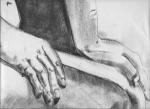
From today’s session. Many frustrations and excitements trying to draw hands, mostly, and in one pose, feet. Each is like a whole body itself.

Too big to scan in one piece, from last Monday:


Today’s model had captivating hands:

Enter your e-mail address to receive e-mail notifications of new posts on Sermons in Stones

Links I like