
The munchkin and I traveled to Washington, D.C., for four days this week, to visit a sick friend in Baltimore. We stayed with other friends in Washington. I was hoping for a day wandering on the Mall, but we had only one afternoon for it due to rain. As it turned out, that was nothing. We got out of the region with 48 hours to spare before yesterday’s big storm hit.
So, Wednesday we went on the carousel, popped into the natural history museum for the living butterfly exhibit and a look at a lot of skeletons, and “climbed on things.” The Mall is full of low walls and fountains that were clearly designed with a four-year-old in mind. As far as Munchkin was concerned, we could have spent all day at the US Navy Memorial fountain on Pennsylvania Avenue. This was our compromise, since I wasn’t about to fly 3,000 miles to go to playgrounds, which probably would have been her first choice.
An unexpected, interesting-only-to-Mama treat awaited us on the way back from the Navy Memorial, though. Walking up toward the metro on 7th Street, we passed a sign reading
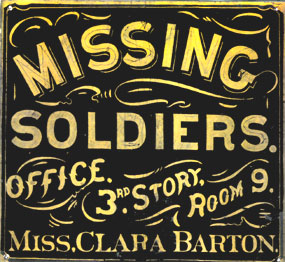
Unitarian Universalists collect famous Unitarian Universalists, and Clara Barton was a Universalist all her life. I did not know about this chapter in her career, which immediately predated the involvement in the American Red Cross for which she is most famous. Apparently she had done a great deal of work to identify Union soldiers in Andersonville Prison, and as the war ended, President Lincoln asked her to head up a Missing Soldiers Office in Washington. The site, the 9th floor of what is now 437 1/2 7th Street, NW, is held by the federal government as a potential museum.
I let out a little exclamation when I saw the sign, and of course, stopped to read about it, which led to one of those interesting conversations with the munchkin in which I try to explain the unexplainable and unthinkable. The wearing of identification tags wasn’t common practice yet during the Civil War, and tens, maybe hundreds of thousands of dead soldiers were buried, unidentified, on the battlefields where they died. Apparently Barton’s office handled over 63,000 letters in three years. The same source, the General Services Administration website, says she was able to provide information to the families of 21,000 men. I wonder if it was ever good news.









 Sermons in Stones
Preventing child abuse
October 17, 2011 in religious education, social commentary | Leave a comment
A BBC story reports that the US has the worst rate of death from child abuse or neglect of any industrialized nation, with 1,770 kids killed in 2009. (A recent Congressional hearing estimates that the real numbers are even higher.)
So how do these other nations differ from us? By and large, they have lower poverty rates, lower crime and imprisonment rates, universal health care, better family-leave and child-care policies, better pre-school options, and much better networks of help for families with children.
Another thing we learn when we compare ourselves to the countries that are doing much better is that they have markedly lower rates of teen pregnancy. Very young people with unplanned children, unstable relationships, a curtailed education and therefore low earning potential, and lots of contempt from their community* are at an elevated risk of killing their kids. This paper compares measures of US teens’ sexual health (rates of pregnancy, abortion, STDs, HIV) with the teens of Germany, France and the Netherlands–you must click, just to see how much higher our teen pregnancy rate is than these countries’–and concludes that we would do well to adopt their approach of “Rights, Respect, Responsibility” regarding teenage sexuality.
That sounds a lot like the sexuality education program we offer at church, Our Whole Lives. OWL was developed by the Unitarian Universalist Association and the United Church of Christ, but you don’t have to be UU or UCC, or religious in any way, to enroll your kid, and–speaking for my own congregation–we won’t pressure you to join our church or ask you to donate money. It’s part of our ministry to the community. (It’s also not only for teens; there are developmentally-appropriate versions for K-2, 4-6, and adults of various ages, too.)
I know we save lives through this program when we teach young people that it’s okay to be gay, that it’s not okay for your partner to mistreat you or for you to mistreat your partner, and that sex is supposed to be safe (as well as fun, loving, and pleasurable), but I hadn’t thought about the impact on the next generation. I have no doubt that if every teenager in the US received a comparable education, we’d see a huge drop in those child death numbers within ten years.
—————–
*A babysitter of ours, then 17, said that she got lots of dirty looks when she and Munchkin were out alone, such as on their happy trips to the playground. Apparently we had all too many neighbors who (a) had never heard of babysitters, (b) disapproved of teen moms, even one who was taking excellent care of the child, and (c) thought they ought to express that disapproval. Did they imagine that that was somehow helpful?
Share this: