Black History Month, day 7

Project Implicit is a Harvard-based project studying the differences between the attitudes we think we hold and those we really do hold. The Implicit Association Test (IAT), developed by the researchers, claims to “[demonstrate] the conscious-unconscious divergences much more convincingly than has been possible with previous methods.” If you’re interested in the workings of your own mind, it’s fascinating.

I believe some of the barriers to racial equality are subtle racism, fear, guilt, and shame, all of which keep us from candid conversation. Certainly many of the white liberal and progressive people I know are afraid to talk about race, because they fear that they will be perceived to be, or discovered to be, racist. Knowing ourselves more fully can help us move through these barriers and toward a more honest conversation with others.

One question that interests the research team is whether people’s stated views on race match up with their unconscious attitudes, revealed through the IAT. To find out something about whether you prefer white or black people, or to take another test–others include one’s views on age, weapons, and various ethnicities–click here. And congratulations on taking the Delphic advice to know thyself.

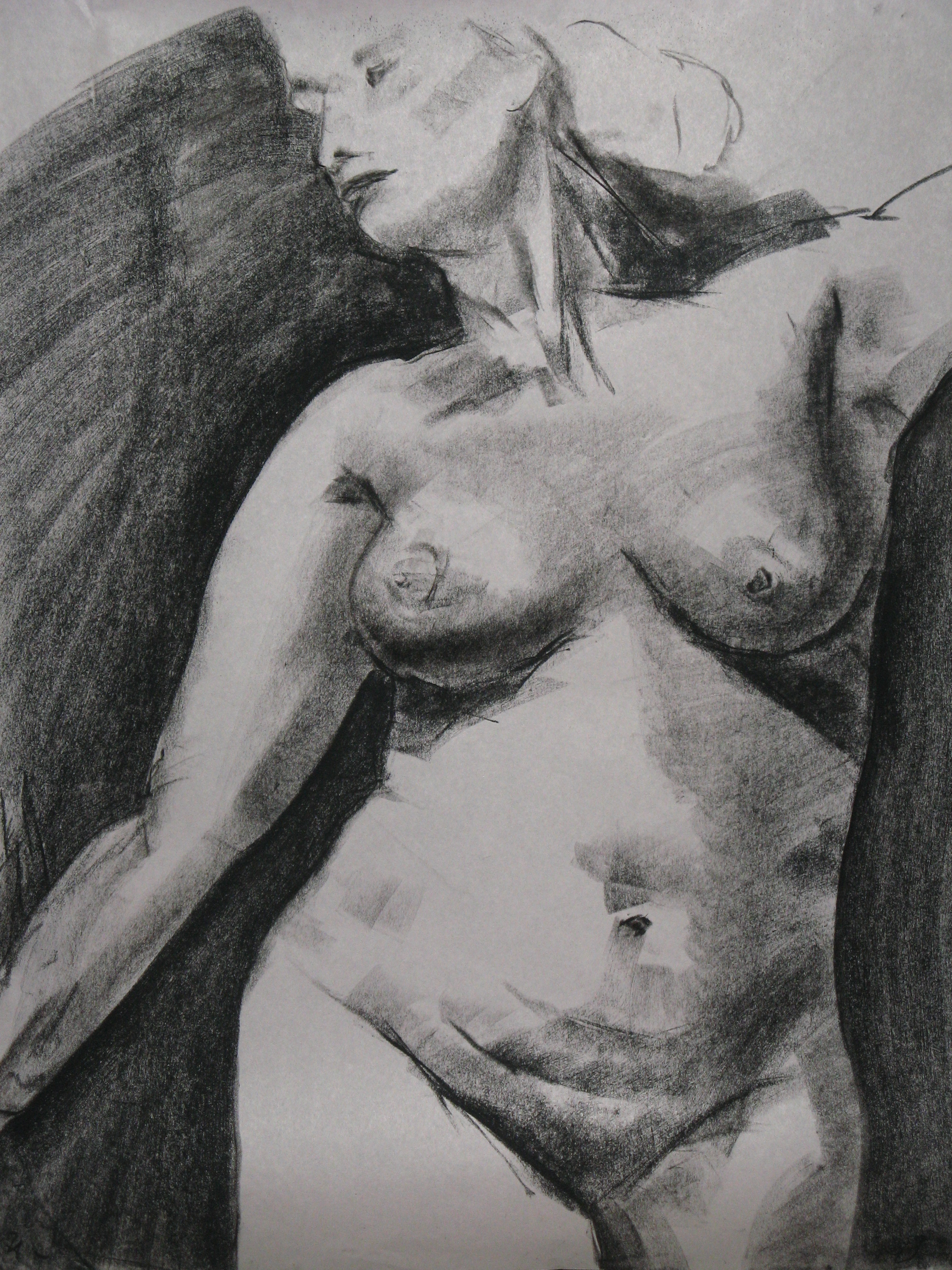
. . . when the only reason to keep photos of the drawings seems to be so that when I look back on several months of work, I’ll remember that there are bad days. At least, that’s what I thought looking over my drawings last night. But because I was having a hard time, I tried to change things up. I drew this really dark, for example. I tend to go too light, exacerbated when the model has really light skin, and on a bad day I go lighter because I’m feeling tentative. I don’t want to commit to anything I put on paper. For the same reason, I draw more slowly when I’m thinking everything I’m doing stinks. So I forced myself to use only the darkest charcoal and work fast and with minimum pauses on this one, and it helped loosen me up.

I even ventured into territory I’ve mostly stayed out of and started drawing her face. The head is too small in proportion to the body, but each on its own is not bad. I stared at that right thigh, trying to find a change in tone in it, and whatever was there was too subtle for me. Leaving it blank makes it look flat.

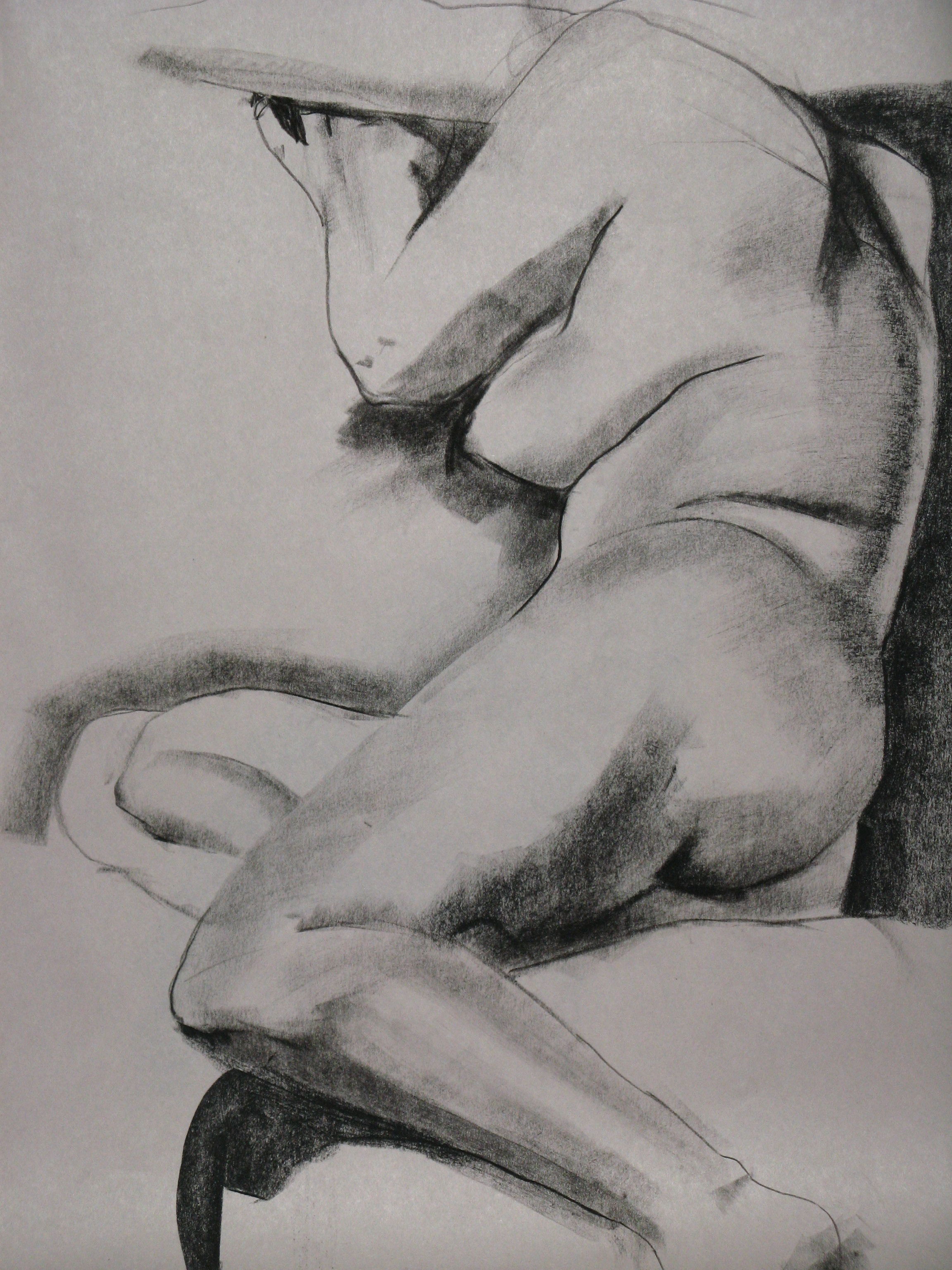
The drawing I was happiest with was this one. I sweated over that first-finger knuckle. Just about gave up on its looking like anything except a glaring white circle on a dark expanse, but when I walked away and came back to look at the drawing, there it was, looking almost real. So was the vein in the arm, which I’d given up as a failure. Drawing is like magic.

An interesting problem raised by this last one: how to show the different textures of skin and cloth. I just left the cloth more or less blank–it wasn’t what interested me this time–but I’ll have to go back to it sometime. I remember having an exercise like that back in Drawing 101, a class in which I struggled mightily–no, that makes it sound like I worked really hard and wrestled with my demons, when actually what I did was mostly avoid drawing and hide from my demons. We were supposed to draw different textures, so I drew a skirt hanger with four skirts on it; one was corduroy, I recall, and one thin cotton. Maybe that would be just the thing to try again.

I wasn’t going to show the lousy ones, but that’s not fair. Here are a couple I wanted to scrunch into a ball and throw away. Stiff, tentative . . . yep, there are days like that. I had fun just the same. Also, one of the CDs played was The Ghost of Tom Joad, a Springsteen album I don’t remember hearing before. A good day after all.

Black History Month, day 6

Zumbi was a great military and political leader of African descent, known as Zumbi dos Palmares because of his legendary leadership of the quilombo (settlement of free Africans) by that name in colonized Brazil during the 17th century.

Antônio Parreiras - Zumbi - 1927

Zumbi, by Antônio Parreiras (public domain in the US)

His story–and the story of Palmares–is told in an excellent movie, Quilombo, directed by Carlos Diegues with music by another great Afro-Brazilian, Gilberto Gil. If that version of the history is accurate, Zumbi represented the rebellion side of the perennial debate among people rising up against oppressive circumstances: continue rebelling and hold out for fuller freedom, or accept a compromise from the enemy? Zumbi successfully challenged the more conciliatory Ganga Zumba for leadership of Palmares. Palmares finally fell to the Portuguese in 1694 and Zumbi was captured and summarily executed the next year. Brazil eventually gained its independence, of course, 127 years later.

One legacy of the quilombos is the martial art U. S.  Americans of descent other than African or Brazilian may know: capoeira. According to the website Aruandê Capoeira,

Created by slaves brought to Brazil from Africa, during the colonial period, Capoeira is a martial art that grew from survival. People were brought from Angola, Congo and Mozambique, and with them, they brought their cultural traditions.

They hid their martial art and traditions into a form of dance. The African people developed capoeira not only to resist oppression, but also for the survival of their culture and the lifting of their spirits. After slavery, they continued to play capoeira.

Brazil’s Black Awareness Day (“Dia da Consciência Negra”) is celebrated on November 20 in Zumbi’s honor; his birthday is unknown but that was the day he died.

Here is Gilberto Gil singing the title song of Quilombo, accompanied by a slide show of this piece of black history.

Black History Month, day 5

A letter from a man named Jourdon Anderson, emancipated from slavery, to his former master, in 1865, has gone viral over the past few days. If you haven’t seen it yet, enjoy it, and if you have, enjoy it again:

Dayton, Ohio,

August 7, 1865

To My Old Master, Colonel P.H. Anderson, Big Spring, Tennessee

Sir: I got your letter, and was glad to find that you had not forgotten Jourdon, and that you wanted me to come back and live with you again, promising to do better for me than anybody else can. I have often felt uneasy about you. I thought the Yankees would have hung you long before this, for harboring Rebs they found at your house. I suppose they never heard about your going to Colonel Martin’s to kill the Union soldier that was left by his company in their stable. Although you shot at me twice before I left you, I did not want to hear of your being hurt, and am glad you are still living. It would do me good to go back to the dear old home again, and see Miss Mary and Miss Martha and Allen, Esther, Green, and Lee. Give my love to them all, and tell them I hope we will meet in the better world, if not in this. I would have gone back to see you all when I was working in the Nashville Hospital, but one of the neighbors told me that Henry intended to shoot me if he ever got a chance.

I want to know particularly what the good chance is you propose to give me. I am doing tolerably well here. I get twenty-five dollars a month, with victuals and clothing; have a comfortable home for Mandy,—the folks call her Mrs. Anderson,—and the children—Milly, Jane, and Grundy—go to school and are learning well. The teacher says Grundy has a head for a preacher. They go to Sunday school, and Mandy and me attend church regularly. We are kindly treated. Sometimes we overhear others saying, “Them colored people were slaves” down in Tennessee. The children feel hurt when they hear such remarks; but I tell them it was no disgrace in Tennessee to belong to Colonel Anderson. Many darkeys would have been proud, as I used to be, to call you master. Now if you will write and say what wages you will give me, I will be better able to decide whether it would be to my advantage to move back again.

As to my freedom, which you say I can have, there is nothing to be gained on that score, as I got my free papers in 1864 from the Provost-Marshal-General of the Department of Nashville. Mandy says she would be afraid to go back without some proof that you were disposed to treat us justly and kindly; and we have concluded to test your sincerity by asking you to send us our wages for the time we served you. This will make us forget and forgive old scores, and rely on your justice and friendship in the future. I served you faithfully for thirty-two years, and Mandy twenty years. At twenty-five dollars a month for me, and two dollars a week for Mandy, our earnings would amount to eleven thousand six hundred and eighty dollars. Add to this the interest for the time our wages have been kept back, and deduct what you paid for our clothing, and three doctor’s visits to me, and pulling a tooth for Mandy, and the balance will show what we are in justice entitled to. Please send the money by Adams’s Express, in care of V. Winters, Esq., Dayton, Ohio. If you fail to pay us for faithful labors in the past, we can have little faith in your promises in the future. We trust the good Maker has opened your eyes to the wrongs which you and your fathers have done to me and my fathers, in making us toil for you for generations without recompense. Here I draw my wages every Saturday night; but in Tennessee there was never any pay-day for the negroes any more than for the horses and cows. Surely there will be a day of reckoning for those who defraud the laborer of his hire.

In answering this letter, please state if there would be any safety for my Milly and Jane, who are now grown up, and both good-looking girls. You know how it was with poor Matilda and Catherine. I would rather stay here and starve—and die, if it come to that—than have my girls brought to shame by the violence and wickedness of their young masters. You will also please state if there has been any schools opened for the colored children in your neighborhood. The great desire of my life now is to give my children an education, and have them form virtuous habits.

Say howdy to George Carter, and thank him for taking the pistol from you when you were shooting at me.

From your old servant,

Jourdon Anderson.

Naturally, the question immediately arose whether this letter was genuine, as well it should considering the frauds that circulate the ‘net. As established by links from the wonderful website Letters of Note, there was definitely a person named Jourdon Anderson in the stated time and place, and the letter was printed in the newspaper at the time, with a preface explaining that it Mr. Anderson dictated it, as illiterate people do when they want to correspond with someone far away. (In Mexico City there is a plaza known for its many typists set up at small tables, to whom people bring their letters to be read, and to whom they dictate the responses, for a fee. Its use has declined in recent years, though I don’t know whether that’s because more people can read and write, the service has shifted to internet cafes, or almost everyone has access to a phone.) That doesn’t resolve the question of whether the letter was actually composed, or the language made more sophisticated, by the person who wrote it down, as some commenters have pointed out.

And so we move effortlessly from racism to classism: the assumption that someone illiterate and uneducated could not use language that is so clever and ironic. What percentage of the world’s population over history has never learned to read and write, both within literate societies and within oral ones? Is it so unimaginable that many of them have used the spoken word with style and subtlety, despite (or even because of) not using written language? I find it unimaginable that they would not, not just because of obvious examples such as (the disputed) Homer, but because developing the necessary into an art is what people do. Look at the gorgeous baskets and pottery people made thousands of years ago, not content to create something functional but making them works of the highest skill and art. Mr. Anderson was an artist with language, and I’m glad his letter has survived for us to read.


Nothing to do with Black History Month–just three more drawings from last Monday and my ongoing adventure of trying to draw hands.


(image in the public domain)

Black History Month, day 4

Tomorrow our service will include centering words from Frances Ellen Watkins Harper, an African-American, Unitarian poet, essayist, lecturer and activist. She worked on the Underground Railroad and wrote and lectured about abolition, then, after the Civil War, lectured widely through the south to educate and inspire former slaves, as well as promoting Reconstruction. She was also very involved in women’s rights and temperance work. Just looking at her picture makes me wish I could sit in a meeting house and hear what she has to say.

Harper was also a popular novelist and poet. Her poetry is conventional for its day, which is to say it is not to my taste. Nineteenth-century popular poetry was very sentimental. But she used that sentimental format to portray the humanity of slaves: a mother’s heart breaking as she loses her child at auction, the thrilling story of an escape from slavery, etc., supplemented the rational arguments she made on the lecture circuit with the emotional appeal that might open some ears.

This, too, is a conventional lyric with a moral, but I like it:

“The Careless Word”

‘Twas but a word, a careless word,
As thistle-down it seemed as light,
It paused a moment on the air,
Then onward winged its flight.

Another lip caught up the word,
And breathed it with a haughty sneer;
It gathered weight as on it sped,
That careless word, in its career.

Then Rumor caught the flying word,
And busy Gossip gave it weight,
Until that little word became
A vehicle of angry hate.

And then that word was winged with fire,
Its mission was a thing of pain,
For soon it fell like lava-drops
Upon a wildly-tortured brain.

And then another page of life
With burning, scalding tears was blurr’d,
A load of care was heavier made,
It added weight that careless word.

That careless word, O how it scorched
A fainting, bleeding, quivering heart!
‘Twas like a hungry fire that searched
Through every tender, vital part.

How wildly throbbed that aching heart!
Deep agony its fountains stirred!
It calmed–but bitter ashes marked
The pathway of that careless word.

Black History Month, day 3

Another obstacle in the “Jim Crow obstacle course” was driving to the polls. The exhibit said that rumors would circulate on election day that black drivers would all be stopped; they were plausible enough, since harassment by the police and vigilantes was common. It also featured this chilling photo, from Life, showing a Clinton, Tennessee mob harassing black drivers. I believe the photo dates from when twelve black students in Clinton integrated the high school. I always wonder who the people in these pictures are and if they are proud, or ashamed, to show them to their grandchildren now. What must it be like to have one of your cruellest moments recorded in Life Magazine?

I also learned about the Green Book, the guide to where to find gas, lodging, food, and restrooms if you were traveling through places restricted by race–which included plenty of northern sundown towns, not just the Jim Crow South. Of course one would need something like this, but I never thought about all the things people did to accommodate a humiliating and potentially dangerous situation. Mark Knopfler wrote this song about a traveling band of gospel singers–clearly, the issue spoke to him decades later, as it does to me.

The lines “We’re a long way from home, just let’s pay the man and go” are such a concise expression of the weariness of living under daily discrimination.

Black History Month, day 2

Bayard Rustin, born 100 years ago next month, was the most important civil rights leader you might never have heard of.  He organized the 1963 March on Washington–the largest protest, at that date, in US history–and in the dozen years that he was a close adviser to Martin Luther King, Jr., he had a seismic influence on the nonviolent philosophy King would come to articulate so well. His frankness about being gay got him in trouble with the law (homosexuality was illegal almost everywhere), met with dismay  from colleagues who were nervous about their fragile cause being damaged by association with “sex perversion,” and is possibly the reason his name has largely faded from the stories of the civil rights movement. Certainly, being a powerful speaker, he would have been more of a public face of the movement than the behind-the-scenes organizing genius he was, if only he and the movement had not feared that giving prominence to a known gay man would jeopardize it. His legacy is coming into its own at last, however, in time for, and partly thanks to, his centennial.


Rustin (center) before a 1964 demonstration. Photo by New York World-Telegram and the Sun staff photographer.

In Nashville in 1942, Rustin sat down in the front of a bus and refused to move. He was beaten by four cops and taken to the station, where he “discussed pacifism and the philosophy of nonviolence with the assistant district attorney, Benjamin West . . . [and was] allowed to leave without being charged or arrested.” (Curriculum Guide to Brother Outsider) A great Quaker tradition! Five years later, he and 15 other activists took a Journey of Reconciliation by bus  through Virginia, North Carolina, Tennessee, and Kentucky “to test the 1946 Supreme Court decision in Morgan v. Virginia, which ruled that segregation is unconstitutional on interstate buses.” The outcome of their being greeted by a mob in Chapel Hill, North Carolina, was that a Chapel Hill judge found them guilty of violation of the state’s laws, indulging in a rant about the “Jews from New York” bringing “[their] n*****s with [them] to upset the customs of the South” as he delivered the sentence. What was being tested was not just the Supreme Court’s decision of the year before, but whether states would abide by federal laws protecting citizens, or insist that each state was a law unto itself.

The similarity of Rosa Parks’s action 13 years after Rustin sat in the whites-only section of a Nashville bus, and the similarities between the Journey of Reconciliation and the Freedom Rides that followed it by 14 years, were not coincidences. The later activists deliberately modeled their protests on those of Rustin and company. When Rosa Parks was arrested, Rustin was there to advise the Montgomery Improvement Association in the subsequent boycott.

At the time he began getting advice about the boycott from Rustin, Martin Luther King, Jr., owned a gun and was accepting an armed guard around his home, and had not yet fully committed to keeping the movement nonviolent. Through conversations with Rustin and another Fellowship of Reconciliation activist, Glenn Smiley, King learned about Gandhi’s teachings and the power of nonviolent resistance. What direction would the civil rights movement have taken if he had not accepted the influence of Rustin’s deeply educated pacifism?

Celebrating Black History Month with a related post each day of February.

The state office building has a “Jim Crow voting obstacle course” in its atrium for Black History Month. Each station explains one of the obstacles, and the choice it poses. You could skip the obstacle; for example, if you skip the “literacy test,” the good news is you’re spared humiliation. The bad news is you don’t get to vote.

The exhibit has polls set up where you can take the literacy test used in Alabama in 1965. There are 68 questions. It was up to the sheriff which questions to ask, and how many. That way, he could ask some people “What branch of government does the US Supreme Court belong to: executive, legislative, or judiciary?” and others, well, all 68. White voters usually didn’t have to take the test anyway, since a grandfather clause provided that anyone descended from a pre-1867 voter was exempt from new voting restrictions.

I said to the woman standing at the next poll, “This is a great exhibit.”

“Awesome,” she said, with feeling.

I took the test and got 49 right: 72%, a passing grade, I guess, since I’m white.  Try it and post how you do!

I love this model and wish he worked in the studio more often, especially now that I’m drawing lots of hands and feet. His are wonderfully veiny. Still, something that figure drawing has taught me is that there is no such thing as an uninteresting or un-beautiful human body, so I’ll enjoy all the other models too, until he comes around again.

I’d left the house in a hurry, chivvying the child, and forgotten my drawing stuff, so I only had the studio’s charcoal: no pencils, and I could only find very dark and very light charcoal. This has happened before and makes for an interesting challenge: to use the edge and corners of the charcoal for fine lines, and develop a light touch with very soft, dark charcoal. The latter in particular is tough for me, and I got better at it today.
(Click on images to enlarge)

Enter your e-mail address to receive e-mail notifications of new posts on Sermons in Stones

Links I like