Gordon McKeeman has died. Without our ever meeting, he was a kind of spiritual grandfather to me: a mentor and teacher to many of my mentors and teachers. My conviction that ministry (from the Latin for “service”) is not the private domain of a small number of professionals, but something we all do together, clergy and laity, arose from my own experience, but it was McKeeman who gave it words:

Ministry is

a quality of relationship between and among
human beings

that beckons forth hidden possibilities;

inviting people into deeper, more constant
more reverent relationship with the world
and with one another;

carrying forward a long heritage of hope and
liberation that has dignified and informed
the human venture over many centuries;

being present with, to, and for others
in their terrors and torments
in their grief, misery and pain;

knowing that those feelings
are our feelings, too;

celebrating the triumphs of the human spirit,
the miracles of birth and life,
the wonders of devotion and sacrifice;

witnessing to life-enhancing values;
speaking truth to power;

speaking for human dignity and equity,
for compassion and aspiration;

believing in life in the presence of death;
struggling for human responsibility
against principalities and structures
that ignore humaneness and become
instruments of death.

It is all these and much, much more than all of
them, present in

the wordless,
the unspoken,
the ineffable.

It is speaking and living the highest we know
and living with the knowledge that it is

never as deep, or as wide
or a high as we wish.

Whenever there is a meeting
that summons us to our better selves, wherever

our lostness is found,
our fragments are united,
our wounds begin healing,
our spines stiffen and
our muscles grow strong for the task,

there is ministry.

Amen, may it be so, and may we know it to be so. Thank you for your ministry, Reverend McKeeman, in all its forms.

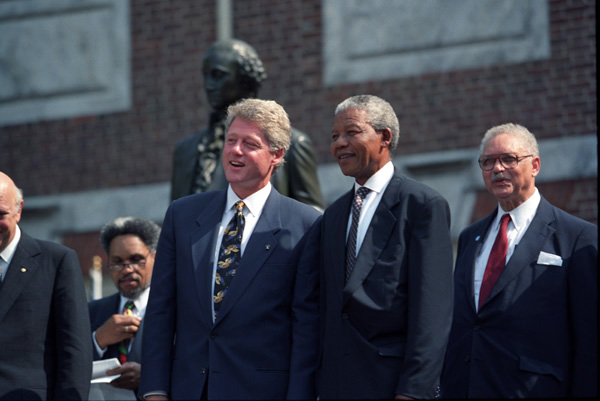
Mandela at Independence Hall, Philadelphia, to receive the Liberty Medal, July 4, 1993

Nelson Mandela was a hero of mine ever since I first heard of him, in the 1980s when I was a teenager growing into political activism. Ending apartheid was just a dream. Sure, we suggested concrete steps, such as divestment, but I for one didn’t think I’d see it end in my lifetime. I thought Mandela would die in prison, his main achievement martyrdom. We’d sing “Free Nelson Mandela” without any real hope that it could happen.

And then it did, and the African National Congress actually took power, and prisoner Mandela was president of South Africa. Of South Africa! And he was a wise, progressive leader who brought tremendous healing to a country that had seemed certain to die of self-inflicted wounds.

Like Martin Luther King, Jr., Mandela is usually mentioned in the context of racial justice, but like him, he was also passionately concerned about economic justice. Having defeated apartheid, he turned to an even larger foe: poverty. One would think that almost 20 years of revolutionary activism, 27 years in prison, and five years as the head of state would entitle him to an honorable retirement, but Mandela never stopped taking on new challenges. In 2005, he went to London before a G8 trade meeting and reminded the leaders and the gathered crowd that the G8 had pledged several years earlier to cut world poverty in half. “Do not look the other way,” he said to them; “Do not hesitate. Recognise that the world is hungry for action, not words. Act with courage and vision.” (Full text)

The statement that poverty is not natural, but a human creation, is so simple and so radical. I hope one day we will look back on his words about poverty and perceive their truth as easily as we now perceive that apartheid was wrong.

Like slavery and apartheid, poverty is not natural. It is man-made and it can be overcome and eradicated by the actions of human beings.

And overcoming poverty is not a gesture of charity. It is an act of justice. It is the protection of a fundamental human right, the right to dignity and a decent life.

While poverty persists, there is no true freedom. . . .

Sometimes it falls upon a generation to be great. You can be that great generation. Let your greatness blossom.

Not everyone is born to a life as large as Nelson Mandela’s, but those last three sentences are going up beside my desk to remind me not to live small when it comes to making justice.

I admit it: I am picky about grammar. I use the word “whom” when an object pronoun is called for, even in spoken English. I refuse to pass on graphic memes with bad grammar. My mild-mannered Facebook persona occasionally gives way to someone called the Guerrilla Grammarian who issues a public service announcement about some urgent issue such as the correct English spelling of Gandhi. “Irregardless” sets my teeth on edge and I have a carefully-honed argument about why it’s acceptable to begin a sentence with “Hopefully . . . ” I know why one says “15 items or fewer” and “I’ve gotten less than five hours of sleep every night this week,” and I stick to it. From this position of linguistic purity, I feel I have the authority to make the following declaration: “they” is a perfectly appropriate gender-neutral third-person singular pronoun. It is, in fact, the ideal word to use when we wish to speak of a person, as well as persons, unknown or indeterminate.

You know the problem I’m talking about, right? Sometimes you can’t say, “He fell right off his broomstick with a thud” because you don’t know whether the person falling was Harry or Hermione, in which case you might say, “In the dark of the midnight Quidditch pitch, Ron heard someone fall off their broomstick.” I see nothing wrong with that. I’d like to call it the Rowling rule, because she does it all the time, to the irritation of other grammar-obsessed nitpickers.

What are some alternatives to “they” in this example?

Use “his/her”: “Ron heard someone fall off his/her broomstick.” Problem: do you have to ask? Slashes are the stuff of bureaucratic documents, not fiction. Except, of course, fanfiction. Also, they’re binary and there are more than two sexes and more than two genders.

Use “his or her”: “Ron heard someone fall off his or her broomstick.” Problem: barely less awkward than “his/her.”

Use a new pronoun: “Ron heard someone fall off zir broomstick.” Or do I mean “hir broomstick”? Or “eir broomstick”? Problem: I appreciate the creativity, but there’s a reason that these haven’t caught on and it isn’t (only) transphobia. I don’t even know how to pronounce that last one, and if you can’t pronounce a word you won’t use it.

Use “his”: “Ron heard someone fall off his broomstick.” Problem: We live in the 21st century, in which women and girls are widely acknowledged to be more than half the population. Please.

Use “her”: “Ron heard someone fall off her broomstick.” Problem: Even in the 21st century, this will make most of your readers think you know it’s a female broomstick rider. Sorry.

Alternate between them: “Ron heard someone fall off her broomstick.” A paragraph later: “Ron heard someone else fall off his broomstick.” Problem: This works very well in a nonfiction text with lots of examples, such as a book on parenting. “Your two-year-old may enjoy playing with containers, so give him a stack of plastic or metal bowls.” Next paragraph: “Two-year-olds have unpredictable mood swings, so she may be very independent one minute, clingy the next.” Great solution in this kind of text, but not in most.

Rewrite: “Ron heard someone fall off a broomstick.” Problem: weak; loses the visual impact of A person falling off THE broomstick THE person had been riding.

In contrast, points in favor of “they” are numerous. It seems to be the natural choice; it’s what we tend to say in spoken language in such situations (“Who’s at the door?” “I don’t know–I can’t see them through the peephole”). It is less clunky and binary than “his/her” or “s/he.” The main argument against it–that it is ungrammatical–is very, very weak. “It’s a plural pronoun!” cry overachieving amateur, and uninformed professional, grammarians. Yes, it is. And I know another plural pronoun: “you.” Is it incorrect to use “you” as a singular because “you” is plural? Of course not.

Singular: You’re wearing my shoes!

Plural: You won’t all fit on this elevator!

We have a strong precedent for using one pronoun for both singular and plural. We have a linguistic problem to which this fact is a solution. So let’s use it. I already use “they” (singular) in written as well as spoken English. I think one neologism is warranted, and again, seems to slide off the English-speaking tongue: a singular version of the reflexive pronoun. “You” has “yourself” (singular) and “yourselves” (plural); when we use “they” as a singular pronoun, its reflexive counterpart would be “themself.”

There is a second linguistic problem that “they” can solve: a polite way to refer to agender, transgender, and genderqueer people–anyone for whom “he” and “she” are not sufficient choices. As Karl Fleischman, the father of Sasha Fleischman, an agender teen who was badly burned last week when someone set their skirt on fire, writes, his child prefers “they” as a pronoun. He adds, “English doesn’t have commonly used gender-neutral third-person singular pronouns yet.” However, I would say that it does. It has “they.”

Whether agender and transgender folk will adopt “they” for themselves is up to them. It’s not up to me, and I will use whatever pronoun a person prefers for themself, but I humbly suggest that it has a huge advantage over “ze,” “hir,” or any of the other neologisms that have been tried. Neologisms do take hold sometimes, but when we already have a word that has worn a path in our linguistic landscape–the way “they” has done for many of us–it’s likely to be the best place to build the road.
Inspired by an exchange on the UU Growth Lab

We Unitarian Universalists sometimes assume that people in other religions are “more comfortable with hypocrisy” or  “comfortable pretending to believe things they don’t believe.” That must be true of some people, but I don’t think that it is a fair or true way to explain why many people remain in religious communities where they don’t believe in the whole package. I stayed involved in Judaism for years after developing serious doubts, and I can articulate several reasons why.

The rituals were beautiful and still meaningful to me in many ways. Some of the meanings were about a vision of God or human destiny that I didn’t believe anymore, but many others were still consonant with my beliefs. Also, the rituals and practices were very wrapped up in family life. I hadn’t lighted the Shabbas candles with my family for all those years only because I believed that God commanded us to rest; I had done it as part of a treasured family gathering, a time of togetherness and mutual blessing. Absenting myself from that would have been removing myself from a special meal at week’s end lit by the glow of candlelight, the beginning of a day we committed to spend together and with gathered friends, instead of scattered all over town on various errands and activities. Dropping the practices that had lost much of their meaning was not as simple as “don’t go to services anymore” or “eat whatever you like.”

Photographer unknown; if it's you, please tell me, and let me know if I may use it and credit you.

The things that I still did believe in, and the values that my religion helped me to practice, were so important to me that I was not willing to give them up just because there were also elements of the religion that appalled me. I knew of no other community that would support these values and beliefs–not yet. I certainly knew of no other community that would support these values and beliefs in the context of a culture that I had known from birth, that is shared by my ancestors, and that goes back thousands of years, and I still don’t. (I finally decided that I would have to do without that. It was a sad, painful choice.)

So there I was, going to synagogue, participating in many aspects of Jewish life. I was not pretending. All the people closest to me knew about my struggles with my faith. Some knew sooner than others, and of course the people sitting in the next row at shul might not have known at all, and might have assumed that because I was singing along with the service, I believed what they believed. That bothered me, but it’s not as if every person in a synagogue believes exactly the same thing even at the best of times. I’m sure some of them had similar internal struggles to mine.

I eventually left, but I don’t think that I am truer to myself than others who shared my doubts but chose to remain. People may stay for a lifetime in a religion that is not a perfect fit, because it’s the best fit. We don’t get to create religions from scratch, not if we want things like 5,000-year-old roots; we choose from a limited list of options. I’m really no different today than anyone who chooses an imperfect religion (or job or place to live or marriage or . . . ). Unitarian Universalism suits me very well, but not perfectly. Just the same, I’m staying here. Does that make me insincere? Of course not.

There are good reasons for people to stay in a religion with which they have profound disagreements. If that’s strange to us, perhaps instead of assuming that they are faking it, we could approach them with curiosity and compassion and inquire about what they seek and what they have found.

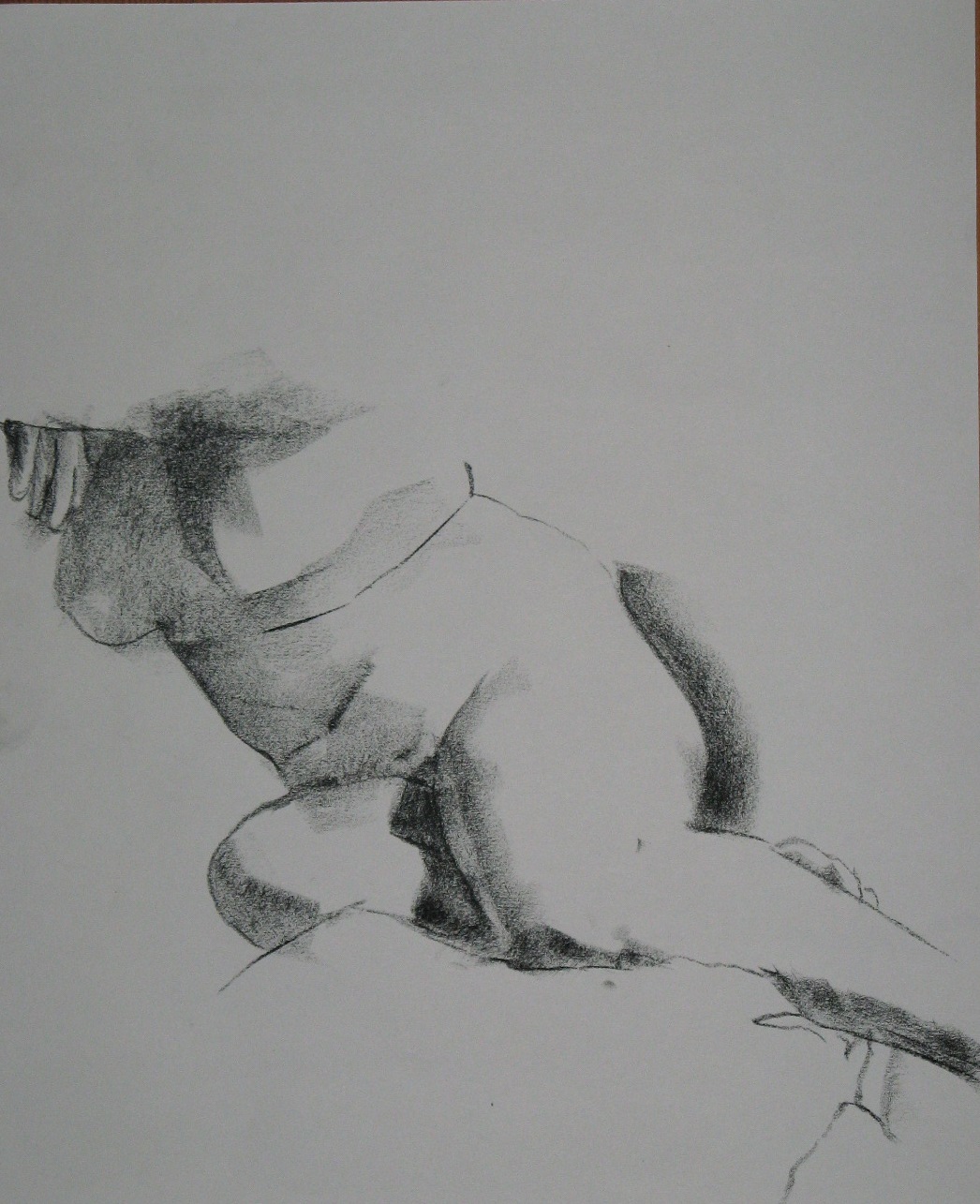
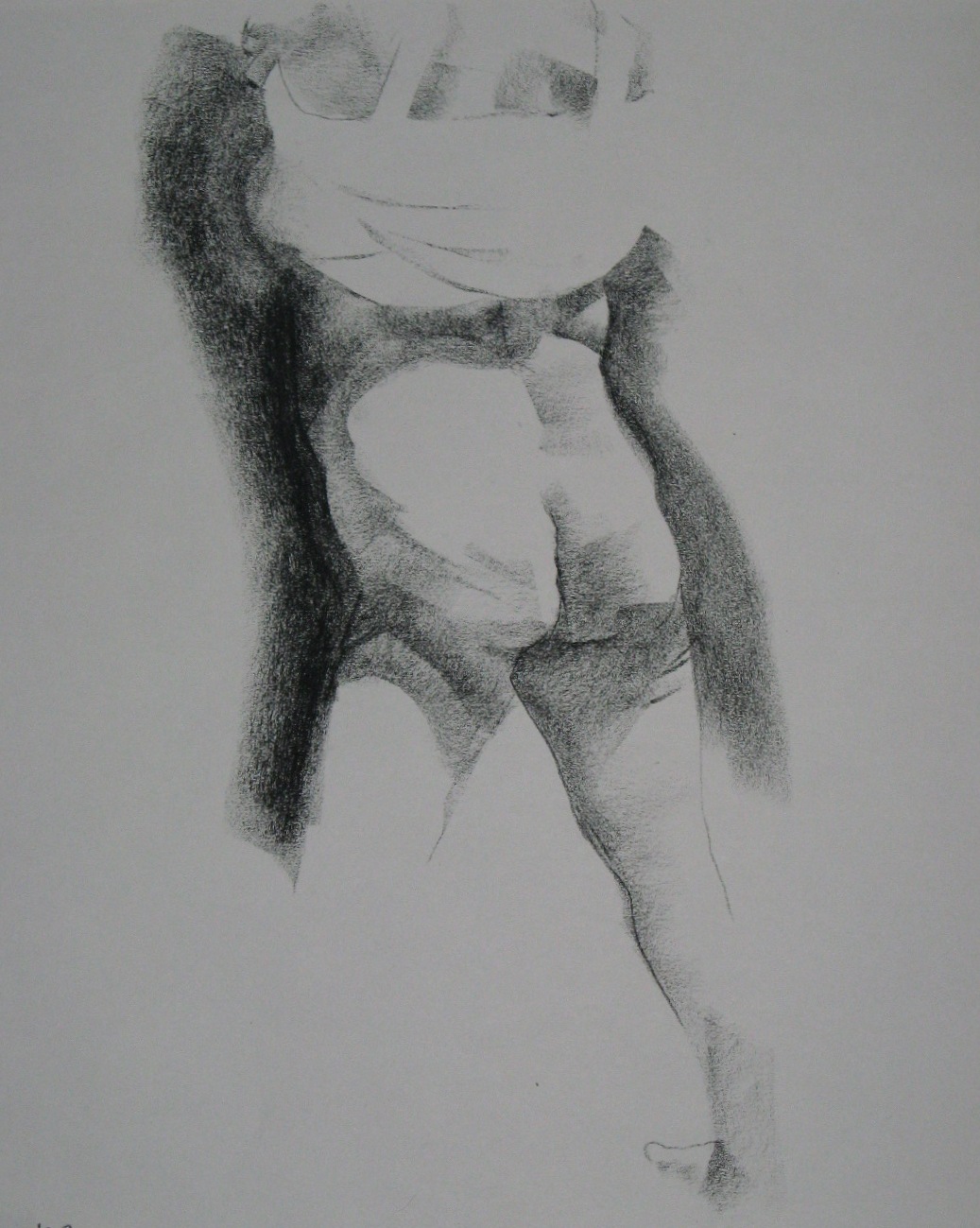
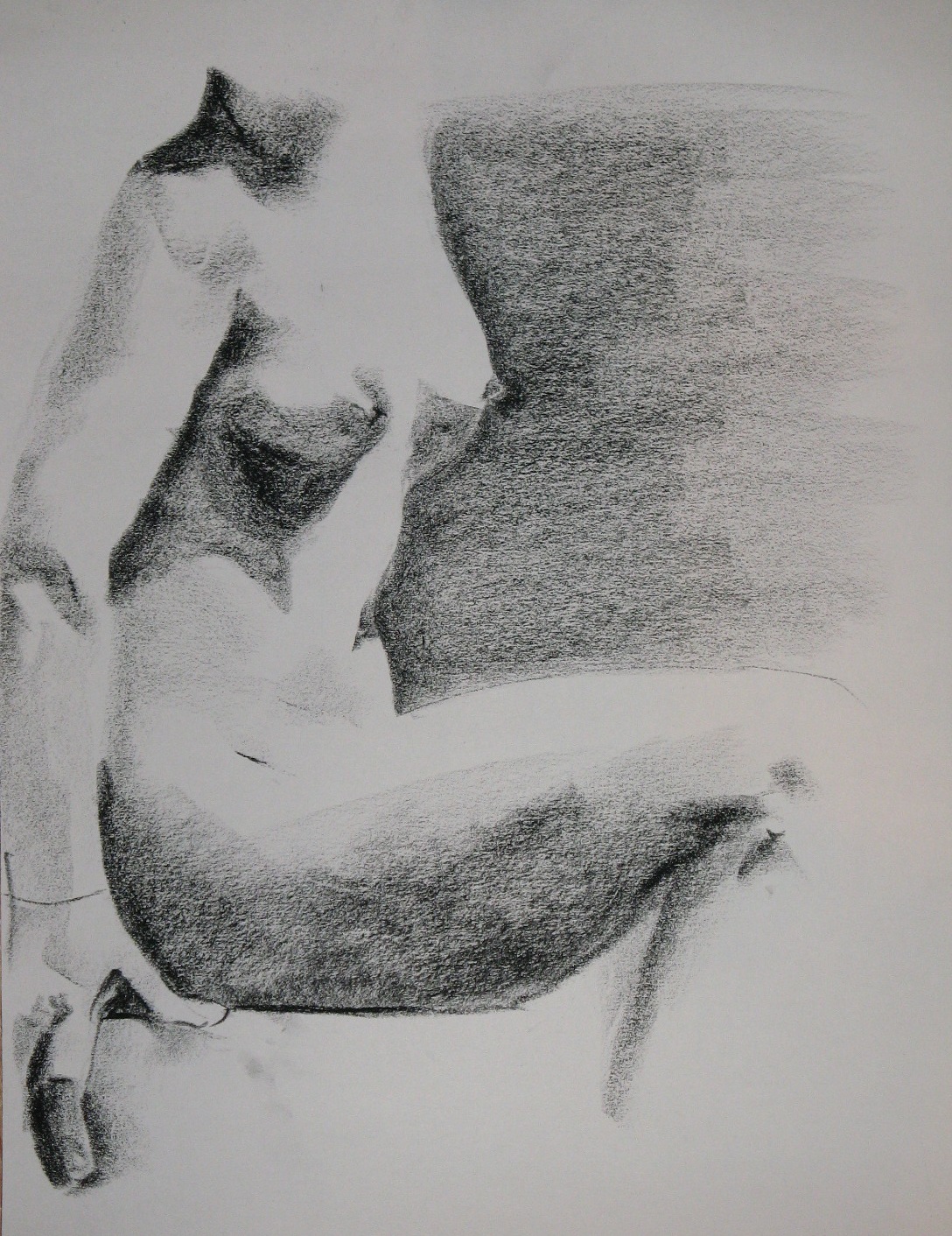
As part of my study leave last week, I did an extra session at the figure drawing studio, so today’s session was the third in eight days. The cumulative effect was very positive–unless it is a coincidence that last Wednesday was better than last Monday and today was better than last Wednesday. I don’t think so. I think I powered through to a better place, because today was full of “aha”s. I was working small and with a fair amount of detail, but I mostly kept the gestural quality that I like instead of going all stiff, and I know how I did it. The first “aha” was with this one. Sometime during this seven minutes, I realized that the life was in the parts that had no lines, but were just drawn in with shadows:

10 14 2013 7 min c

So I set out to draw almost nothing but the shadows, and this was the result:

10 14 2013 10 min d

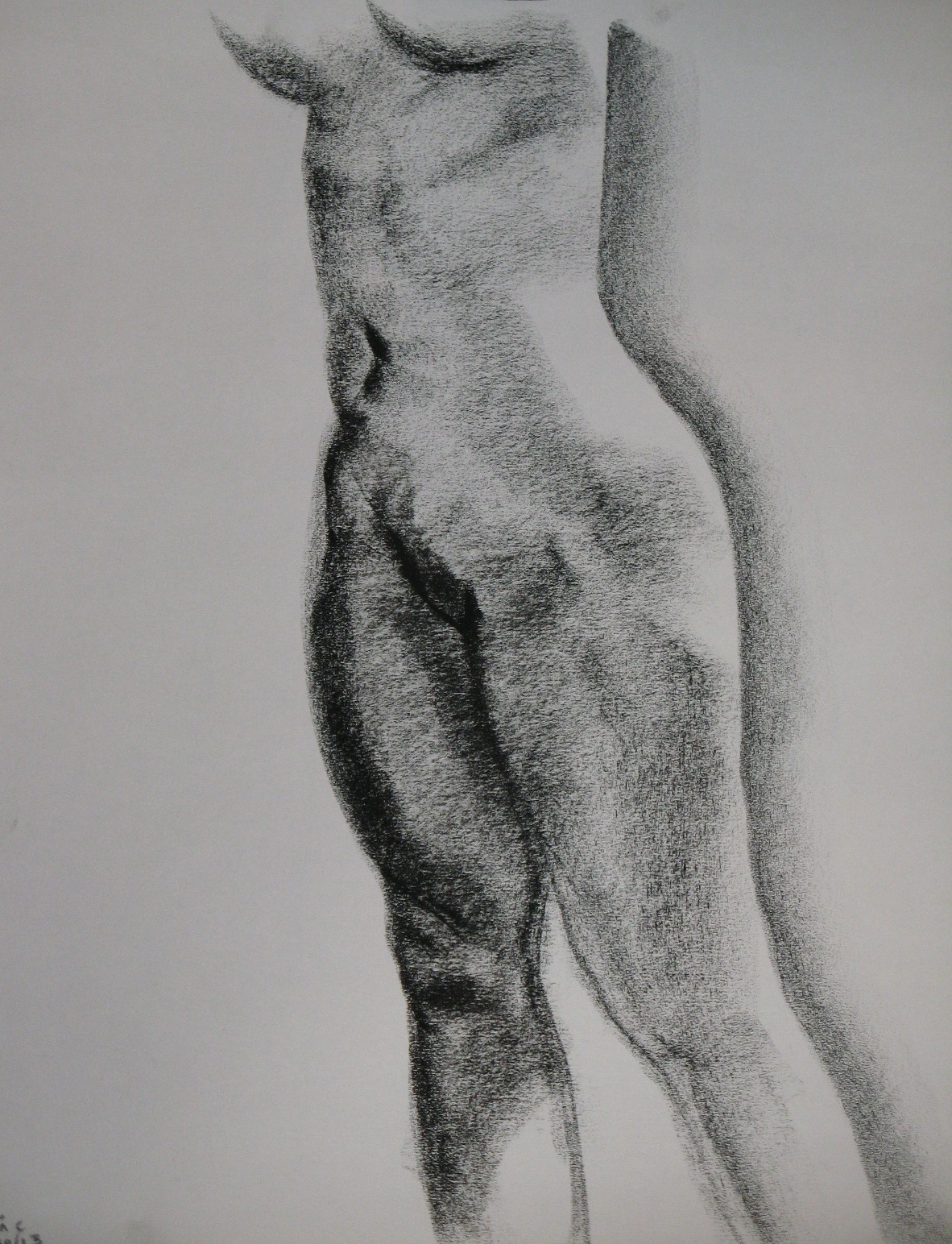
AHA! Definitely getting somewhere! I did the same for this gorgeous pose:

10 14 2013 10 min e

The above is my favorite of the day. I wanted to stay with that pose for the rest of the session, but alas, it was only ten minutes.

We had a forty-minute pose, and I am happy with both the face and the body in the drawing that resulted, but d’oh! they are out of proportion to each other. It’s really hard not to go too large on a section that I do last and give lots of attention:

10 14 2013 40 min g

I needed a few more minutes on the legs, too. But I used the time to tackle the hair, something I usually ignore, and it’s not bad.

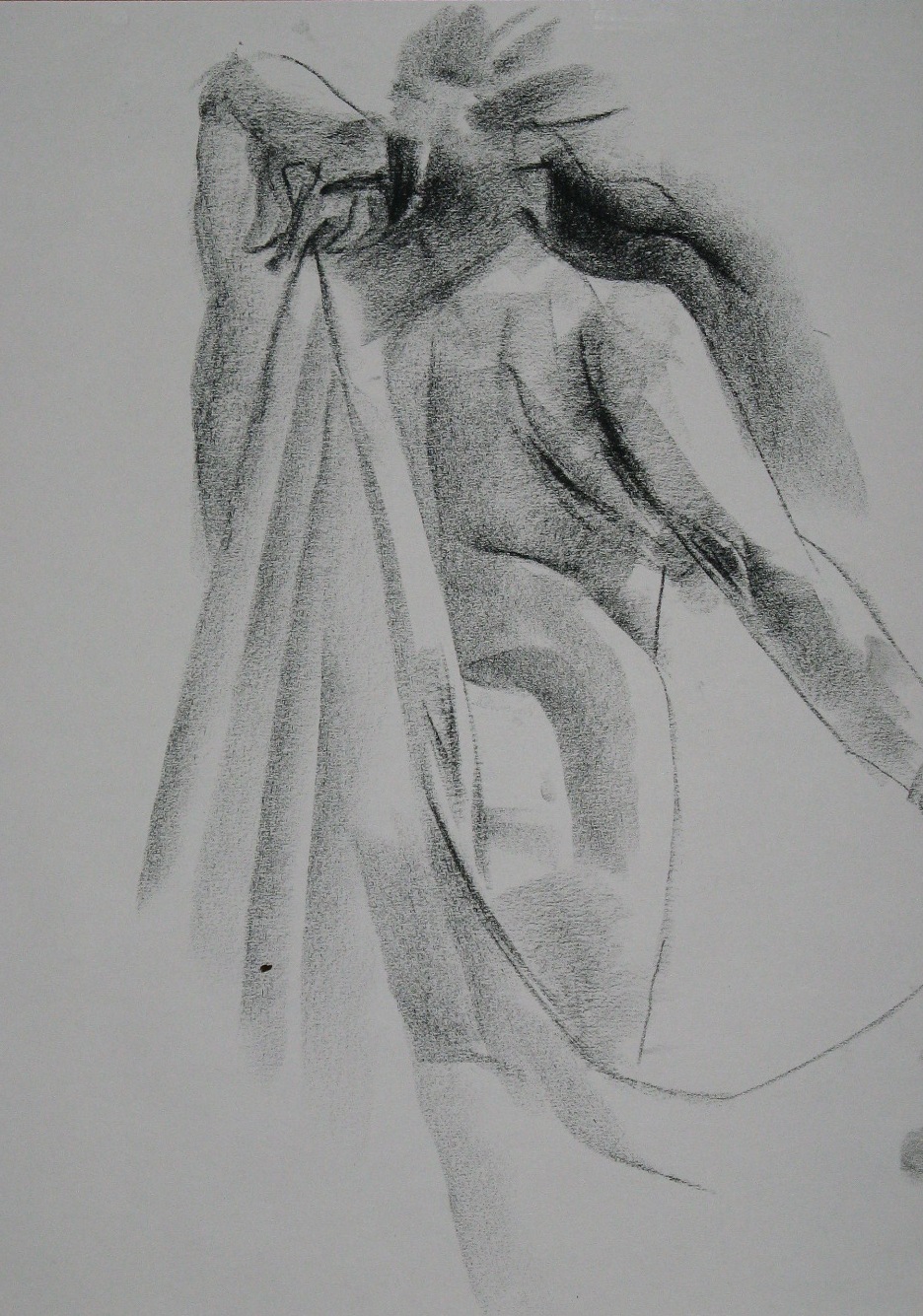
Here are the first two of the day. Not bad, but pre-breakthrough. The fabric on the first one works pretty well even though (because?) I gave it only the most cursory attention.

10 14 2013 7 min a

10 14 2013 7 min b

I never note scale on these drawings, and I ought to for my own purposes down the line (I toss most of the drawings, so I only have digital versions and will never remember the original dimensions). These are on 11 x 14 paper; I went to that smaller format deliberately because the larger paper was “making it harder to capture subtleties of light, not easier.” If I can remember what I’ve done today, it may work well to go back to a larger sheet. I’m not even sure what was going on there–just that I am now at the point that I have to use little tiny pieces of charcoal in order to work in the space I’ve allotted myself, and that’s getting old. This was also the first day that I didn’t use newsprint at all, and I didn’t freeze up, so I’m going to keep on doing everything but the warmup gestures on the good paper and see where that leads.

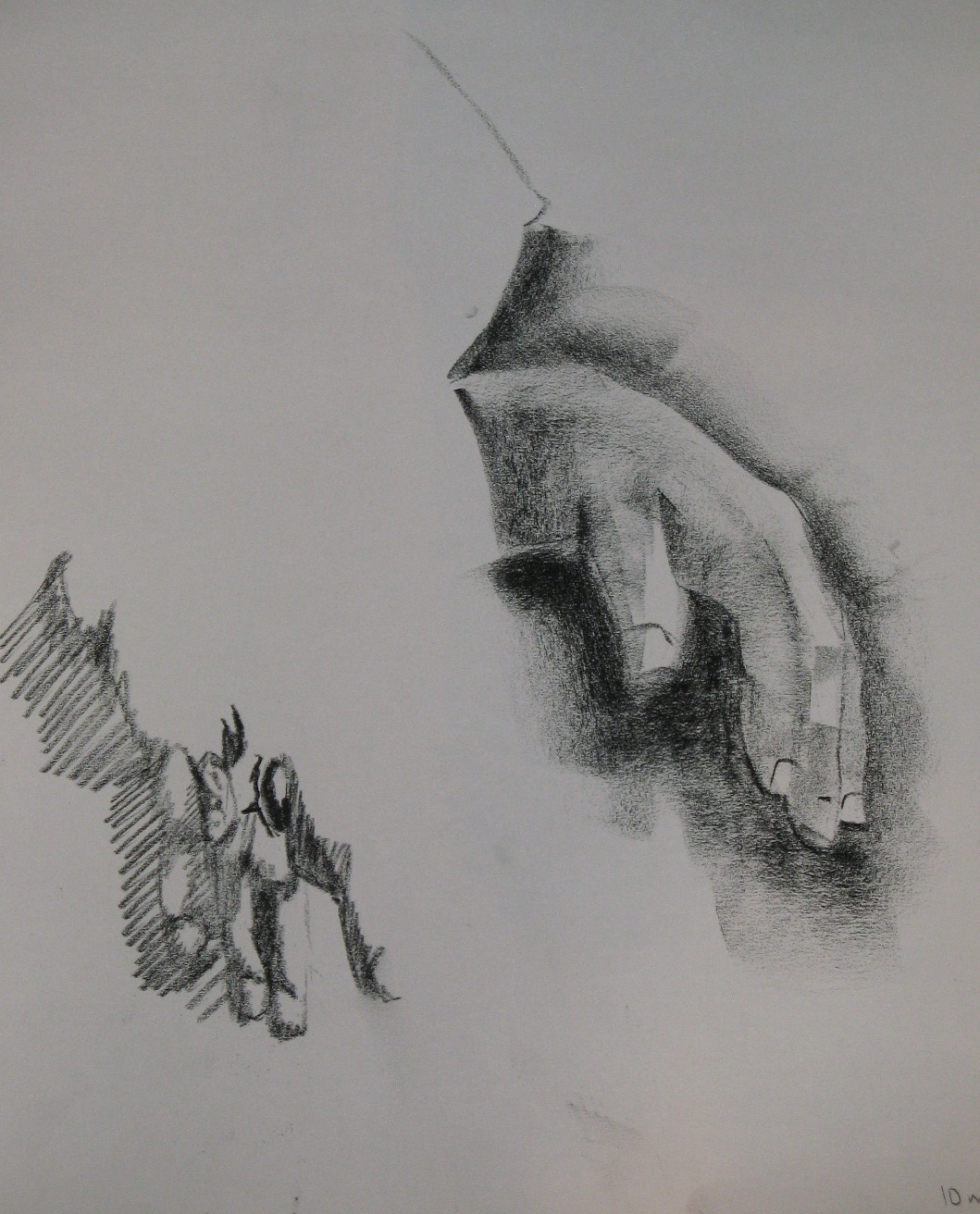
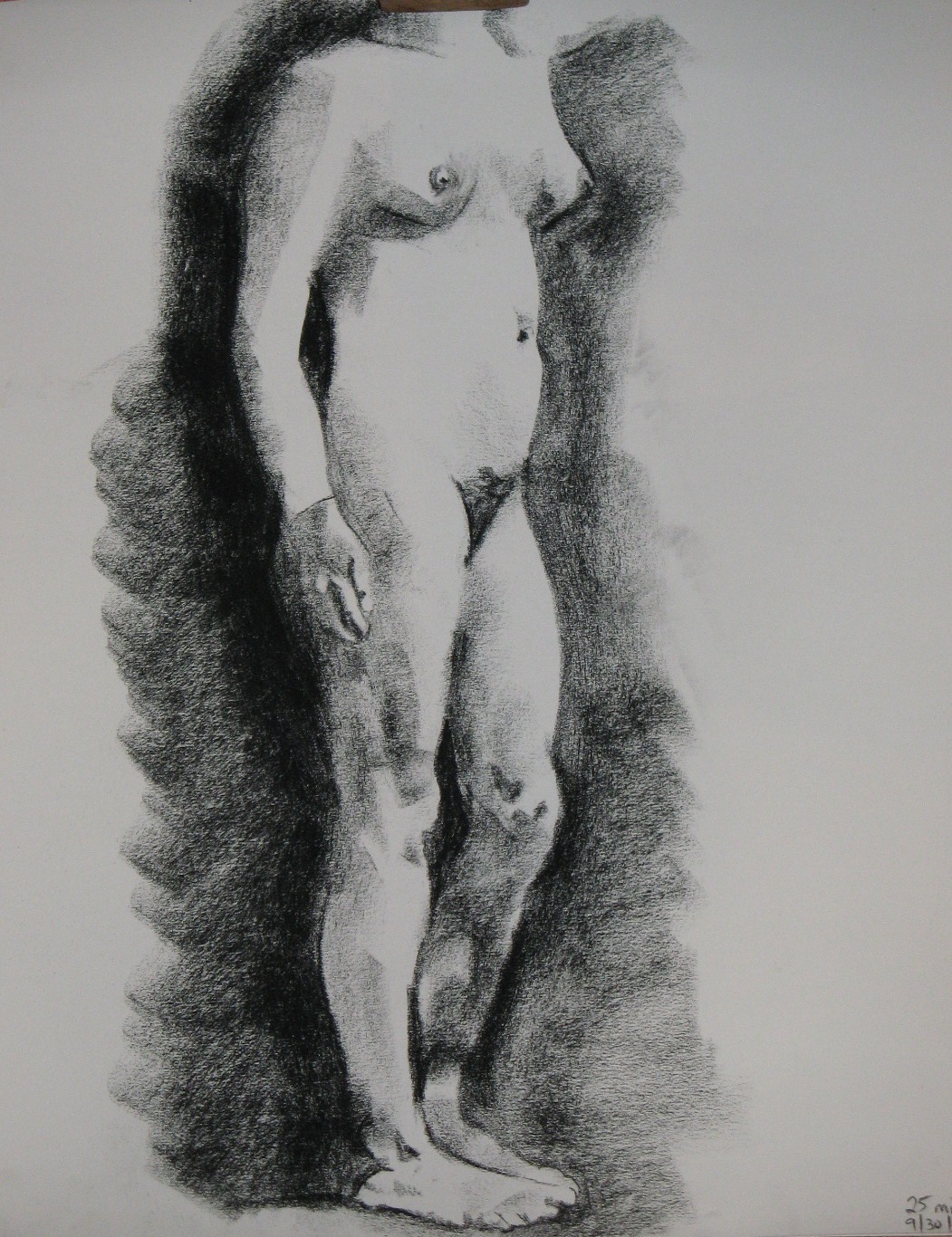
Some I like, at least bits of them (nice light / hand / knee!), some I don’t (so stiff!), one I threw out without wanting even to look at it anymore, much less photograph it. But I haven’t posted any drawings in ages, and I am going to dispense with commentary and just get them up here.

9 30 13 7min a

9 30 13 7min c

9 30 13 10min d

9 30 13 10min e

9 30 13 10min f

9 30 13 10min g

9 30 13 20min h

9 30 13 25min i

I’m posting audio of my sermons as often as possible from now on. I’m hoping these will be on the UUCPA website or blog soon, but until then this is a simple way to get them out there. I welcome your responses regarding format as well as content. How do you like to get your audio? Is this format providing that?

“Free and Responsible,” given at the Unitarian Universalist Church of Palo Alto, August 25, 2013

I’m just about to start a photo-a-day challenge. Among other things, the organizer, Michelle Favreault, predicts it will “allow you to expand ways of integrating visual arts into your ministry.” Even before I signed up for it, it had recently occurred to me that I could build an entire worship service around Annie Leibovitz’s photograph Susan Sontag, Petra, Jordan.

This photo is one of dozens on the postcard rack that lives in our house. We have many more postcards than display slots, so most are hidden behind others, emerging at different times. When we got back to our house after a month’s absence, this one was visible and turned toward the sofa, from which I have been contemplating it. I recommend backing away enough that your experience of it is something like mine when I look at a 4″x4″ square image from a distance of a few feet.

I won’t write the whole sermon today; I’m a bit preoccupied with the one I’m giving on Sunday. But my thoughts, to give them in the vague and chaotic form they take before they’re pulpit-ready, include:

  • it’s a vivid example of negative space, compelling the eye to travel between the foreground and the background. Which one is the subject? Or is neither one the subject?
  • at least three elements balance here: the very small human figure, the very tall buildings of Petra (built by people), the massive rocks (built by no one) that dominate the foreground.
  • it suggests a relationship among the natural world, human-made artifacts, and humans.
  • furthermore, one of the most memorable points about human beings and Petra is: there aren’t any there. The people who created it are long gone, and we’re not sure who they were. The only living person in the photo is a mere silhouette.
  • the overall shape of the glimpse of Petra is evocative of a standing person.
  • the three elements occupy different time scales. In the scale of Petra, Sontag’s life is a blink of an eye (she will in fact be dead ten years after this photo is taken); in the scale of the living rock into which Petra is cut, the buildings and the civilization that carved them are no more than that; and what is the lifespan of the rock, in galactic terms? Nothing more than a blink either. I’m thinking “Ozymandias” would be an appropriate verbal text to go with the visual “text” in this service.
  • the building seen in the photo is called the Treasury, evoking questions of where and what treasure is. The fact that it was probably not a treasury at all, but a mausoleum, only deepens the questions of what we claim has value, what really has value, and what any of it means in the face of impermanence. Knowing that no one and nothing lasts forever, how would we answer the question: what is most precious?

That’s enough. If I actually develop the sermon, I’ll give a heads-up here.

The Chariot, from the Phantomwise Tarot © 2004-2013 Erin Morgenstern

I have just read The Night Circus, by Erin Morgenstern (no relation). Very few books have created a place that I longed to be able to go to in real life. I have wished Hogwarts were real, and that I could slip through the ivy-covered door into the Secret Garden; and now, oh how I wish the Cirque des Rêves were really touring around the world, bringing its exquisite magic to us. I would be a Rêveur, one of the people who follows it around, a beauty groupie. I would knit a Rêveur’s crimson scarf for me, and one for Joy, and we would go into the Cloud Maze tent, and the Ice Garden, and the Hall of Mirrors, and see the illusionist work impossibilities, and take in the intricacies of the clock, and wander through tents where everything is made of paper and covered in words. I don’t know if the Munchkin would need to come along (though she would enjoy Widget and Poppet’s acrobatic kittens). She already seems to live in a magical world.

But then, according to the author, we all do.

“Is magic not enough to live for?” Widget asks.

“Magic,” the man in the grey suit repeats, turning the word into a laugh. “This is not magic. This is the way the world is, only very few people take the time to stop and note it. Look around you,” he says, waving a hand at the surrounding tables. “Not a one of them even has an inkling of the things that are possible in this world, and what’s worse is that none of them would listen if you attempted to enlighten them. They want to believe that magic is nothing but clever deception, because to think it real would keep them up at night, afraid of their own existence.”

Or as Stan Shunpike, conductor of the Knight Bus, says when Harry Potter asks him why the Muggles don’t hear the bus,

“Them!” [said Stan contemptuously.] “Don’ listen properly, do they? Don’ look properly either. Never notice nuffink, they don’.”

“But,” Widget says, “some people can be enlightened.”

Jordinn Nelson Long, at Raising Faith, has posed some questions of interest to her and other seminarians, such as who ministers to ministers, if it’s true that on becoming a minister, one loses one’s church. My answers are in this guest post. Thanks for the invitation, Jordinn!

Enter your e-mail address to receive e-mail notifications of new posts on Sermons in Stones

Links I like