
The needles at the very end of a twig resemble a sea anemone.
Finding the sacred everywhere. Thoughts on religion, art, books, politics, philosophy, and life in general from a Unitarian Universalist minister.
The needles at the very end of a twig resemble a sea anemone.
I was so tired that I fell right into bed, planning to post this in the morning. But morning was busy and I forgot all day. So here is yesterday’s tree, immediately before I draw today’s.
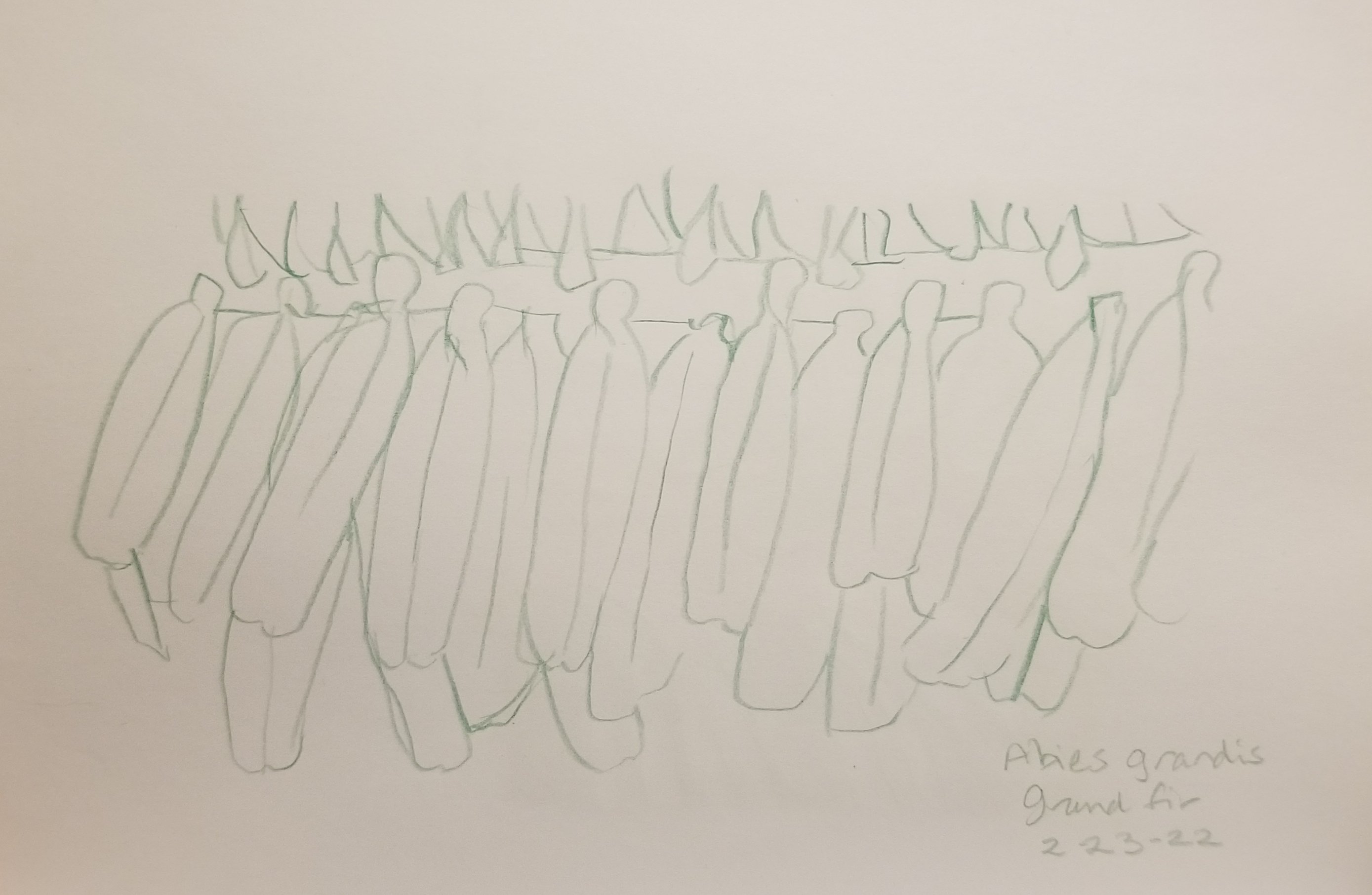
Something I find endlessly fascinating about nature is the way things are patterned but never quite completely regular. What I loved about these needles, in addition to the little twist at the base of each one, was their pattern of alternating short and long, and the zigzag rhythm formed by their placement on the twig. But once I looked closely enough to draw them, the irregularities in the pattern became evident. Drawing them as a schematic seemed like a way to highlight both the pattern and the deviation from it.
I’ve learned that the white streaks on many conifer needles are, on close examination, actually close clusters of little white dots or patches. So what are they? Collectively, they’re called stomatal bloom. Each is the wax that lines a stoma, or opening in the surface of the leaf. Stomata allow the exchange of gases between the interior of the leaf and the air outside; in other words, they are how a tree breathes, excretes, and conducts photosynthesis. They are completely fascinating and also beautiful. I’ve come across this particular photo in a few different places on the web, so I am not the only one who finds it arresting:

The leaf pictured above is from Tradescantia zebrina, a.k.a. Wandering Jew, a somewhat problematic common name that some people, I was amused to discover, have proposed replacing with Wandering Dude. Wandering Dudes are common houseplants and not trees. So back to my wax-lined, whitish stomata.
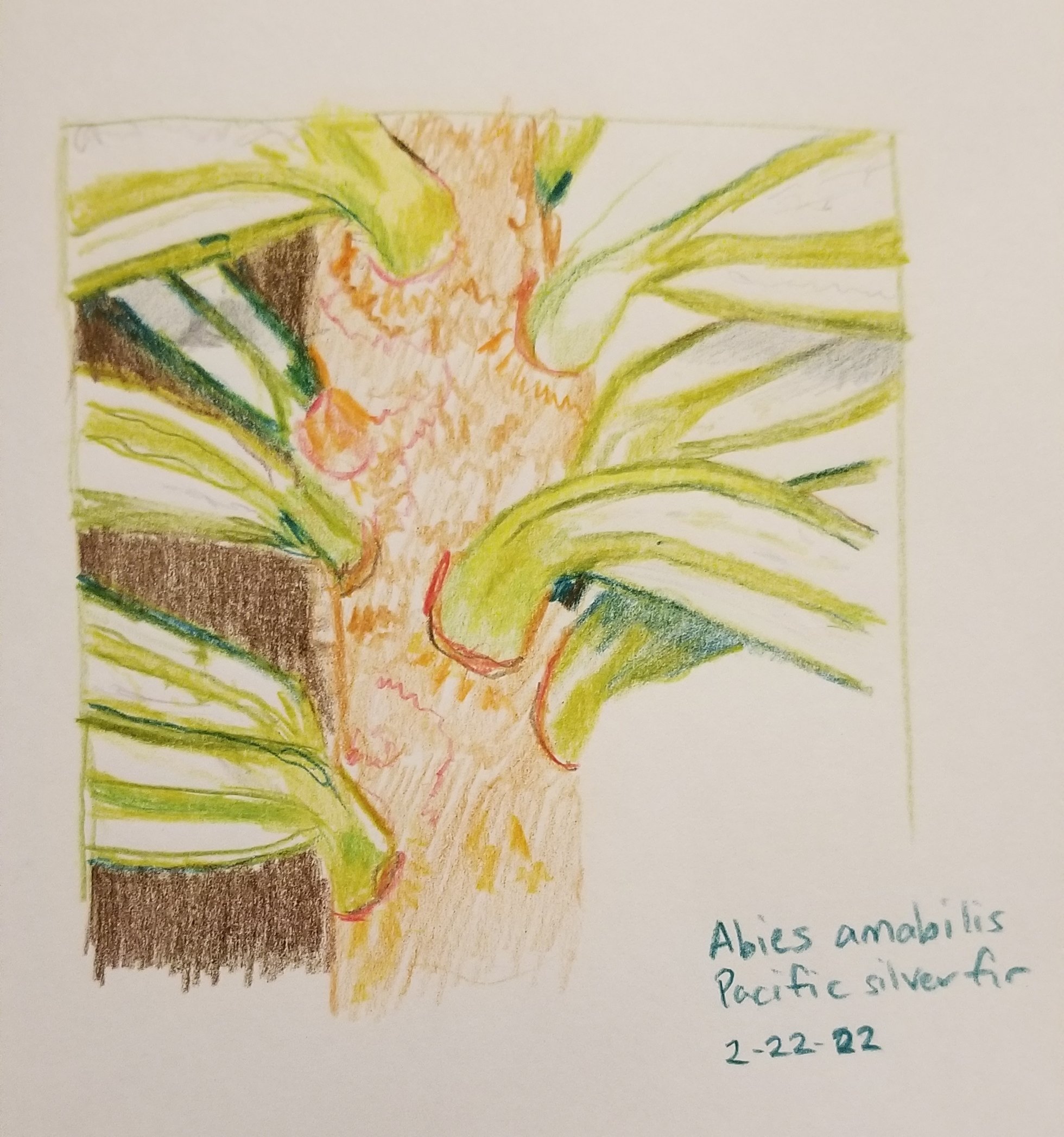
Many of the needles I’ve been drawing have stomatal bloom, resulting in streaks or stripes whose number reveals the pattern of stomata on the tree in question, and therefore making a handy way for would-be tree identifiers to tell various conifers apart. I have already developed a keener eye for the many species of these trees and the differences among them, due to this project, but I can’t remember which ones are which. Today’s might be easier to identify, because the underside of the leaf has such a broad swath of stomatal bloom that it has been dubbed the Pacific silver fir. Unfortunately, its natural range begins in the very northwest corner of California and heads north from there, so I’m not likely to see it on a walk around Palo Alto, but I’ll keep my eye out for the silvery undersides that might indictate Abies amabilis far from their mountain home.
And now I know what subalpine means: in the foothills or lower slopes of mountains, below the treeline. Which seems to imply that alpine trees grow above the treeline. This dendrology stuff is complicated.
Anyway, tree research can wait. This took a long time because each needle was outlined or shadowed by another. It was hard not to keep moving along from one to the next until I had drawn the whole twig and its hundreds of leaves. I just had to stop in the middle.


A.k.a. “Christmas tree.” The needles are closely packed and mostly grow upwards. Another one whose leaves are liveliest en masse, but I can’t always draw a whole twig’s worth.
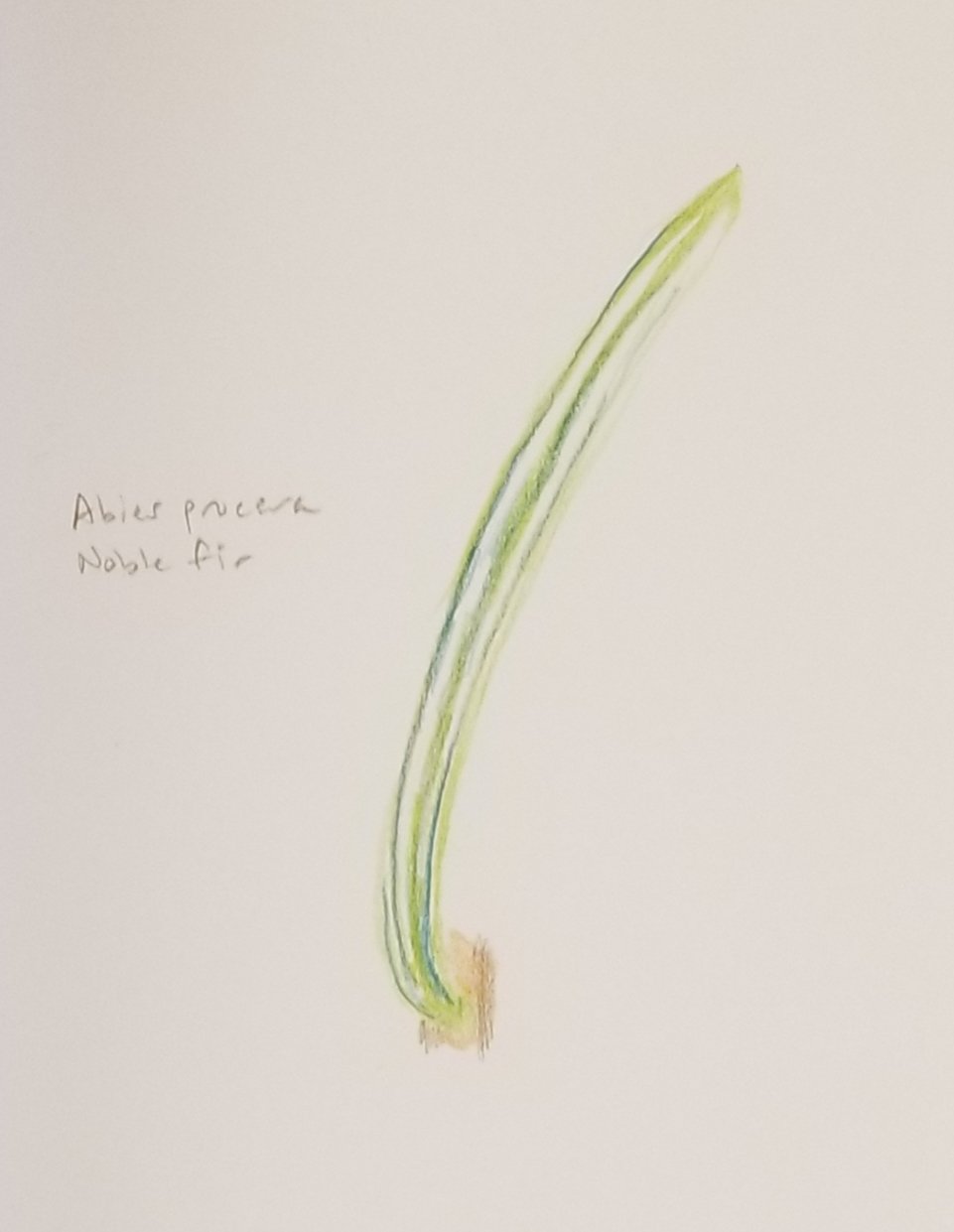
Will you look at this California red fir?
I just about wept looking at it: for the beauty of those curving needles, as graceful as dancers; from the desire to spend lots of time with them and try to put some of that beauty on paper; and from exhaustion. I don’t know why I should be so tired at 8:30 pm, but I am, and tomorrow is an early-rising morning despite its being Saturday. I just can’t spend an hour drawing.
So I tried to make it simple. Maybe I will come back to these needles one day. And I’ll keep an eye out for the well-named Abies magnifica in the wild. It’s not so common here by the coast, but it grows abundantly in Yosemite and all along the western slopes of the Sierras, the guide tells me.

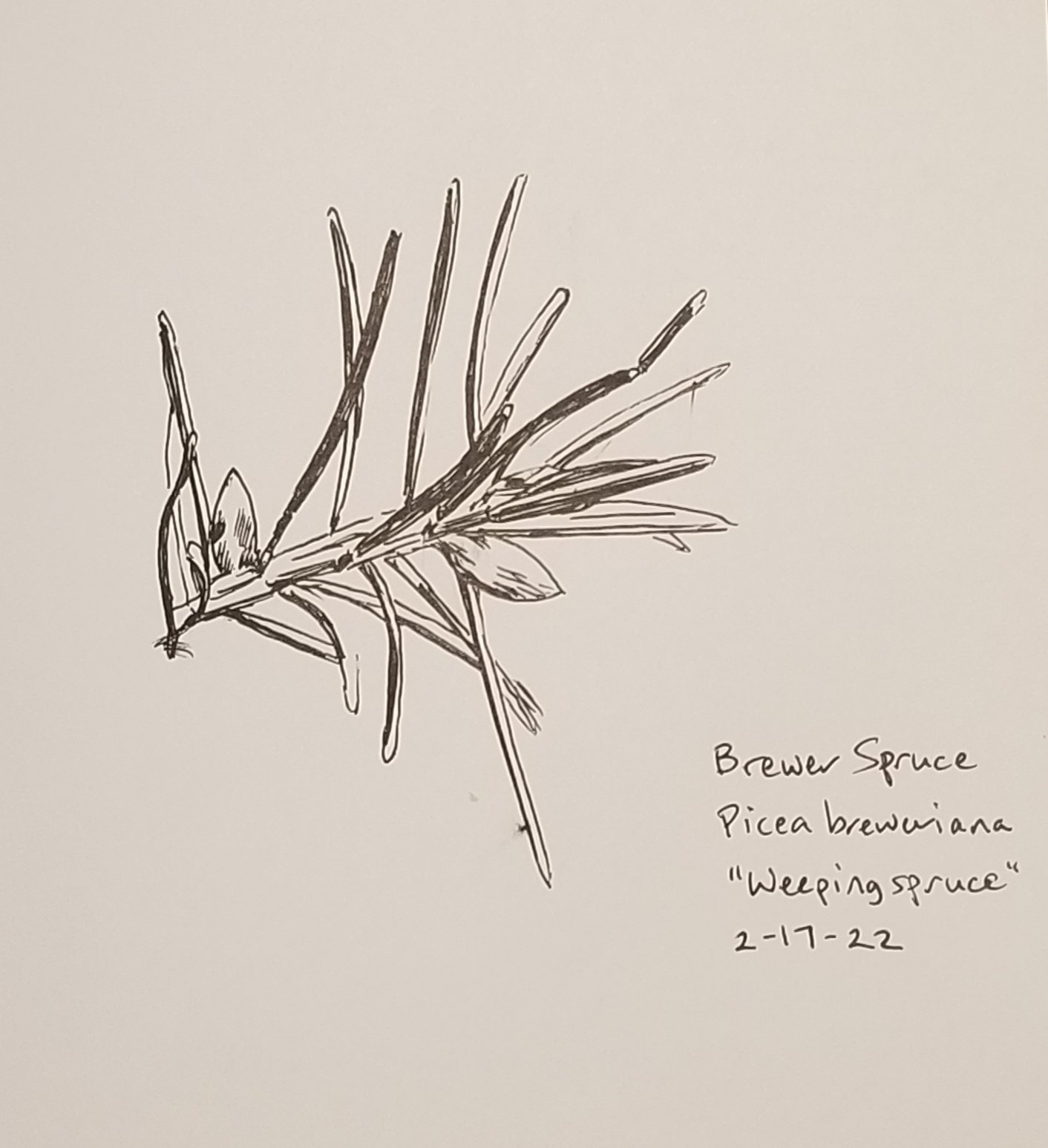
Native but rare. The “weeping spruce” grows near the treeline in the Siskiyou Mountains, and the droop of its branches protects them from breaking under the heavy snows of these high elevations (3300-7500′).
As the name suggests, this species is not native to California or anywhere in the United States. It is commonly cultivated here, but doesn’t live nearly as long as it does in Europe, where it can live to be 300 years old. These trees thrive at higher altitudes, and one variety that grows in the Alps was used by Stradivarius.
Also, it was really fun to draw. I didn’t sit down to it until after 9:30, and I was dragging. Then I didn’t want to stop. But that is so often the way.

Trying to draw fast but not messily. One out of two . . .


Recent comments