Lake Bled! A gem set in the Julian Alps, with a smaller gem of an island within it (Slovenia’s only island) topped by a small church. Munchkin dreamed of swimming to the island. Maybe we would also take a boat and rent bikes to circle the lake, and we would certainly swim at the beach, while Joy had her Kindle along and would enjoy a day of rest.

It was a 45-minute bus ride from Ljublana, a trip that lengthened considerably because when we walked over to the bus station, the 11 am bus we had planned on was sold out, as was the next. With an extra hour on our hands, we got a predictably mediocre bus-station-adjacent snack (though my crepes were quite good), then got aboard for what turned out to be a 75-minute ride, because the bus took city streets and made several stops along the way. We finally arrived at Bled; walked down to the lake, which was as gorgeous as advertised; got another snack because that’s how I roll, Munchkin chafing at the bit; paid the €10 apiece for me and Munchkin to enter the desired beach; popped back out to the ticket office to get a locker key (€3); put our things in the locker; and, as we spread our towel on the luscious grass by the swimming area, felt the first sprinklings of rain.

A few minutes later, we saw the first lightning.
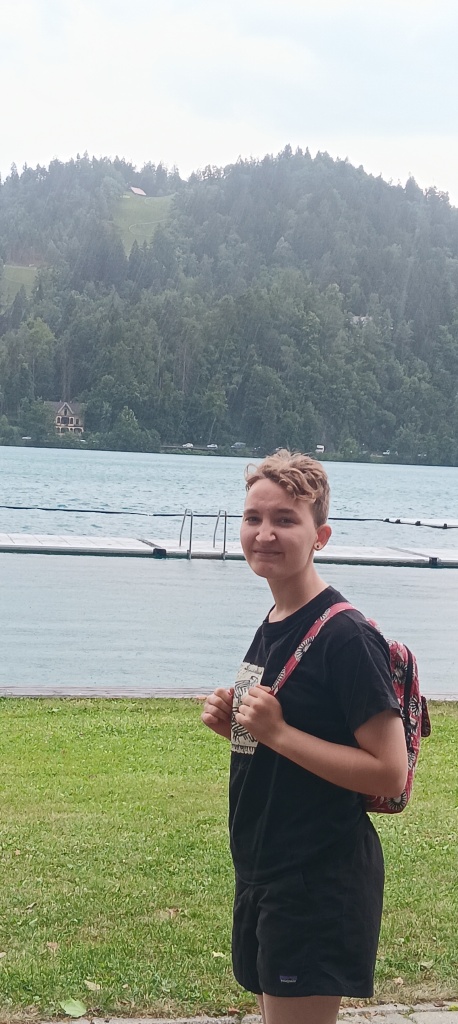
We have opinions about this development.

It became clear that waiting it out might mean a very long wait. So we moved on to the biking plan. Biking in the rain, while not the most comfortable activity, was at least not life-threatening. Who knows, maybe the rain would even have stopped by the time we’d circled the lake, and we’d get to the island after all.

The bounce had pretty well gone from my bungee by the time M and I went back up the small hill to the information office, which lo and behold, doubled as an outdoor-equipment rental company, including bicycles. It was pouring. Absolutely pelting down. I wasn’t excited about a bike ride in these conditions, but damn it, we had left R & K’s apartment more than three hours earlier. We had invested a lot in this trip and we weren’t going to just get on a bus and go back to Ljublana. Nor did I want to spend the afternoon sitting in a cafe, reading and drawing, however pleasant those activities normally are. The cheerful and helpful young woman at the bike office empathized, got us set up with bikes, helmets, locks, and a backpack (“It’s better to get ours wet than yours,” she said, storing my backpack and its paper contents in their back office), and encouraged us to wait in the office for a lull in the storm.
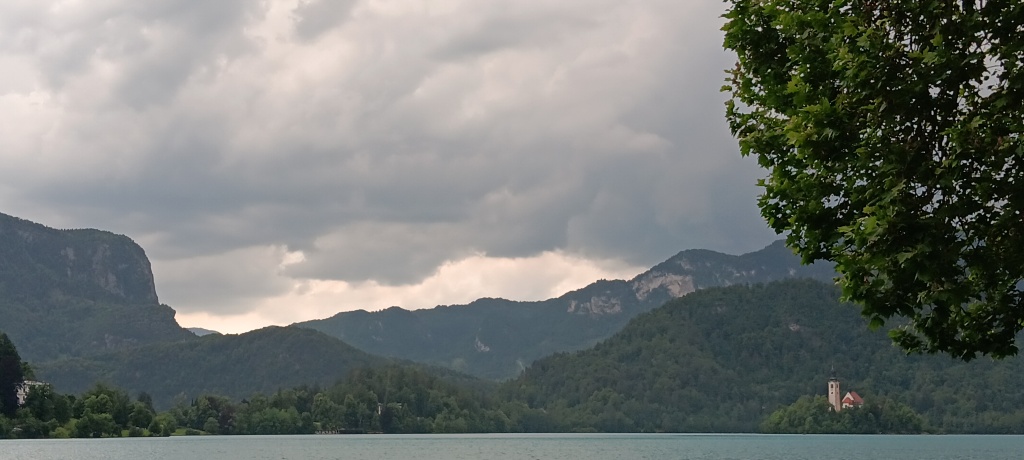
Postcard-quality Lake Bled, minus clear blue sky.
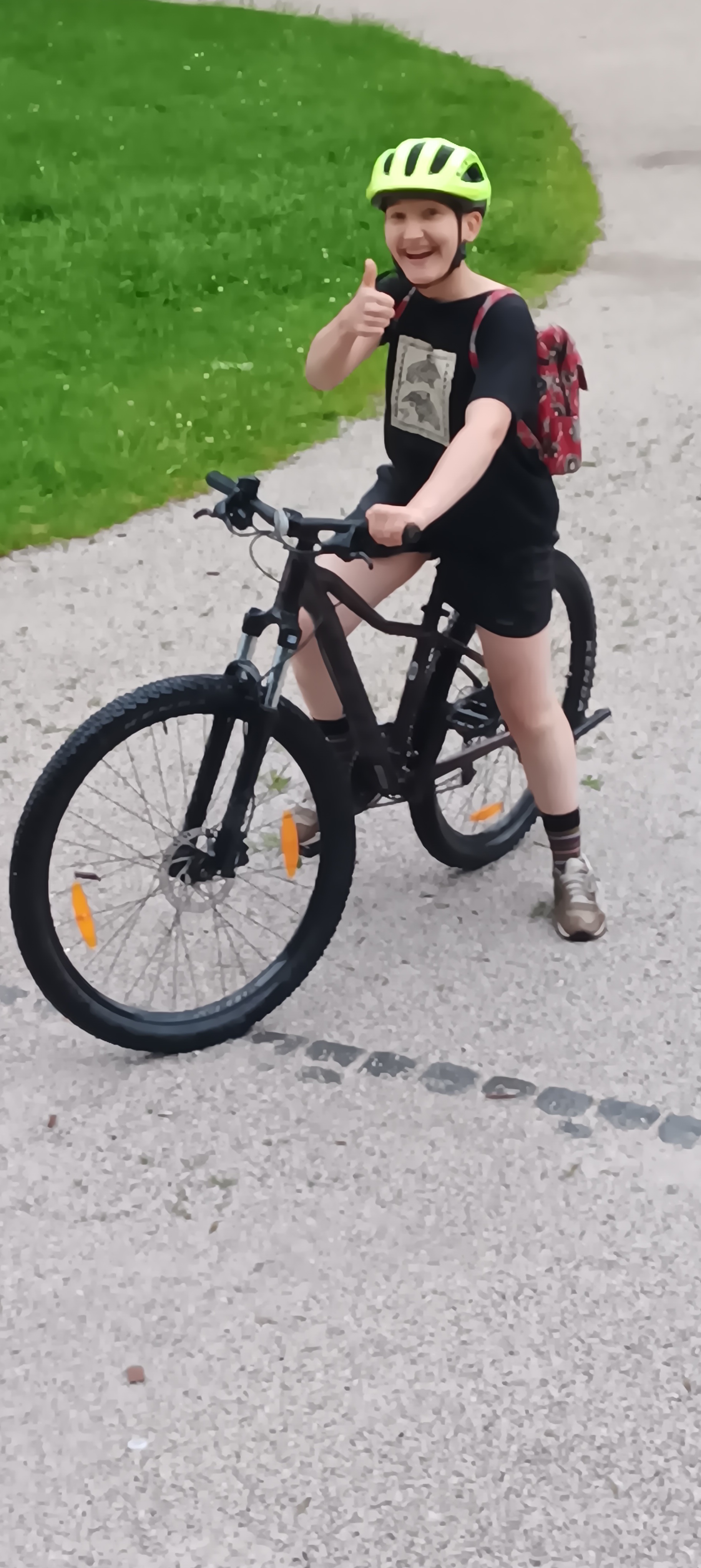
Hail the returning explorer!

A lull wasn’t really in the cards, but when things went from “utter deluge” to “steady hard rain,” we got on the bikes. And within a few minutes, the heavy clouds in my heart dispersed completely. After all, there’s a release in the fact that once you’re totally soaked, you can’t get any wetter. The lake, mountains and island were still beautiful, and although the temperature plummeted (not a bad thing in itself after the heat wave), as long as we were moving, we were pretty warm. Going through the puddles was fun. I don’t bike often, but I’m always so happy when I do, as it’s the closest experience I have, or am ever likely to have, to flying. It would have been fun to bike around the lake together under any circumstances; the tribulation turned a pleasant outing into a grand adventure.

Joy’s entire plan for the day was to sit around reading, so she was relatively unaffected by the weather. We never did get to swim, as the rain didn’t slow until we were eating dinner and about to get on the bus back to Ljublana. M and I were cold as we sat down to dinner, but we wrapped ourselves in towels, changed into what dry clothing items we had with us, drank lots of hot tea, and stoked the inner furnaces with a classic Slovenian dinner: soup (mushroom for me and Joy, pumpkin for M), venison goulash for M, who had never tried venison before (“Bambi,” Joy observed), struklji with porcini for me, and klobasa with a side of mashed potatoes with onions for Joy.

One other little gift of the downpour: back at the beginning of the adventure, as we trooped along the edge of the lake en route to the bike rental, dispirited, M let out a little cry: “Ducklings!”

We stopped to watch the three or four little fuzzballs around their mom (?–I tend to assume that brown ducks are female, though I know that that is not always the case). This is how we discovered that when it rains, mama ducks make their bodies into a shelter for their ducklings. I’m guessing that the little ones need help keeping warm, and maybe also that down doesn’t repel water as well as feathers, though I suppose the latter is not the case, because of course ducklings swim alongside their parents without getting saturated and weighed down. In any case, this is what they do. Within a few seconds, the fuzzballs had disappeared under her wings and you wouldn’t have known, walking past, that you were seeing anything other than an adult duck, slightly puffed-up perhaps, hunkered down and waiting out the rain on the bank of the lake. Once we knew to watch for it, we could spot other mama ducks whose wings had that pooched-out look that signaled the presence of ducklings beneath.

As for our first duck family, we stayed watching them for a while, and at one point the babies ventured out and looked around before ducking (heh) back under the tent of mom.

Between the ducklings, a swan we also saw, the unalterable peace of the setting, and the bike ride, it was a beautiful day at Lake Bled after all.
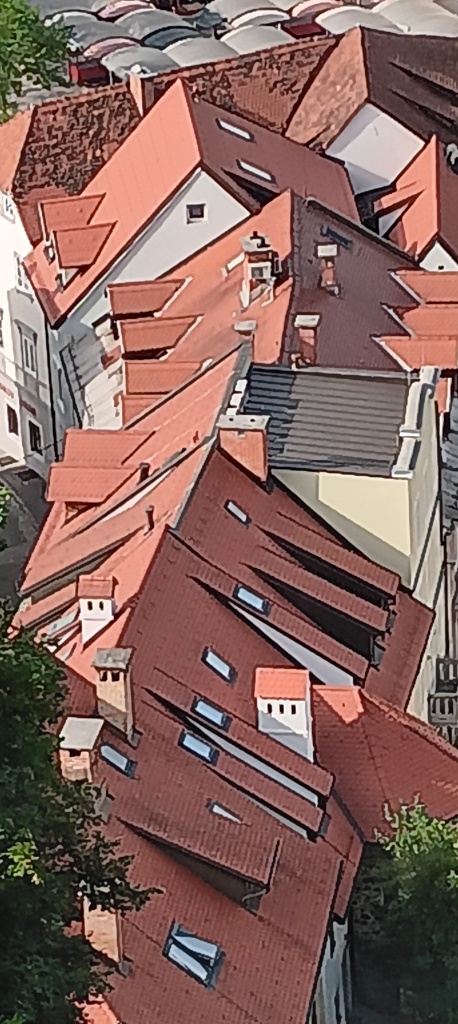
Clue 1: a bird’s-eye view. Okay, looks pretty European. That doesn’t narrow it down much.
Clue 2: There’s a funicular to the high place from which the previous photo was taken. Ring a bell?
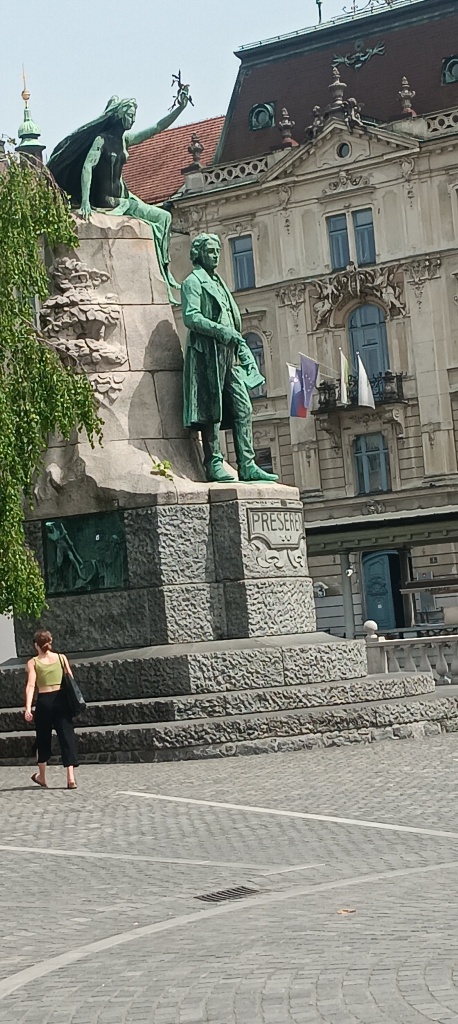
Clue 3: A monument to a poet. Now that’s not something you see in too many places.
Clue 4. If you can see this and still not guess, you’re like me: you know nothing at all about this city.

And the answer is: Ljubljana, Slovenia, a city I had never heard of until we started planning this trip. The sum total of what I knew about Slovenia, in fact, was that it was in central Europe, was not Slovakia, and was the home country of Melania Trump. A friend of Joy’s has recently moved here, and from him and others we heard good things about the country. Our first stop today, as R. showed us the center city, was the Dragon Bridge, one of whose dragons you see here.

Joy, Munchkin and I took the funicular up to Ljubljana Castle late this afternoon, not just to see the almost millennium-old castle, though it is interesting and offers a great view of the city; the restored archers’ tower also houses an exquisite restaurant, Strelec (https://www.restavracija-strelec.si/). Joy’s co-workers knew we were coming to Ljubljana, and for a retirement present, gave us a gift card for a meal there, and what a meal. A seven-course tasting menu, with a couple of “greetings” to start and a third dessert to finish, so that we have just returned from what was effectively a ten-course meal. Everything was a work of art: beautiful visually as well as in taste, smell, and texture.

To round out the senses, our ears were treated to a concert of traditional Slovenian music, since that was the big event elsewhere in the castle. It was hilarious. The band was good, but so incongruous. This food was classical chamber music and in the courtyard below, it was oom-pah, oom-pah, all the way. Truly the icing on the cake for probably the best meal any of us has ever had.

A couple of sights recently made me want to try to create something like their luminosity. One was a circular reflection of light on a painted white wall, and the other was a painting I saw when Joy and I visited the museum Ca’ Pesaro yesterday. I thought I would remember the artist’s name, but I have already forgotten it and will have to do some research. I was so taken with how a simple use of line could create such a powerful sense of light and dark. An apt topic for the solstice.

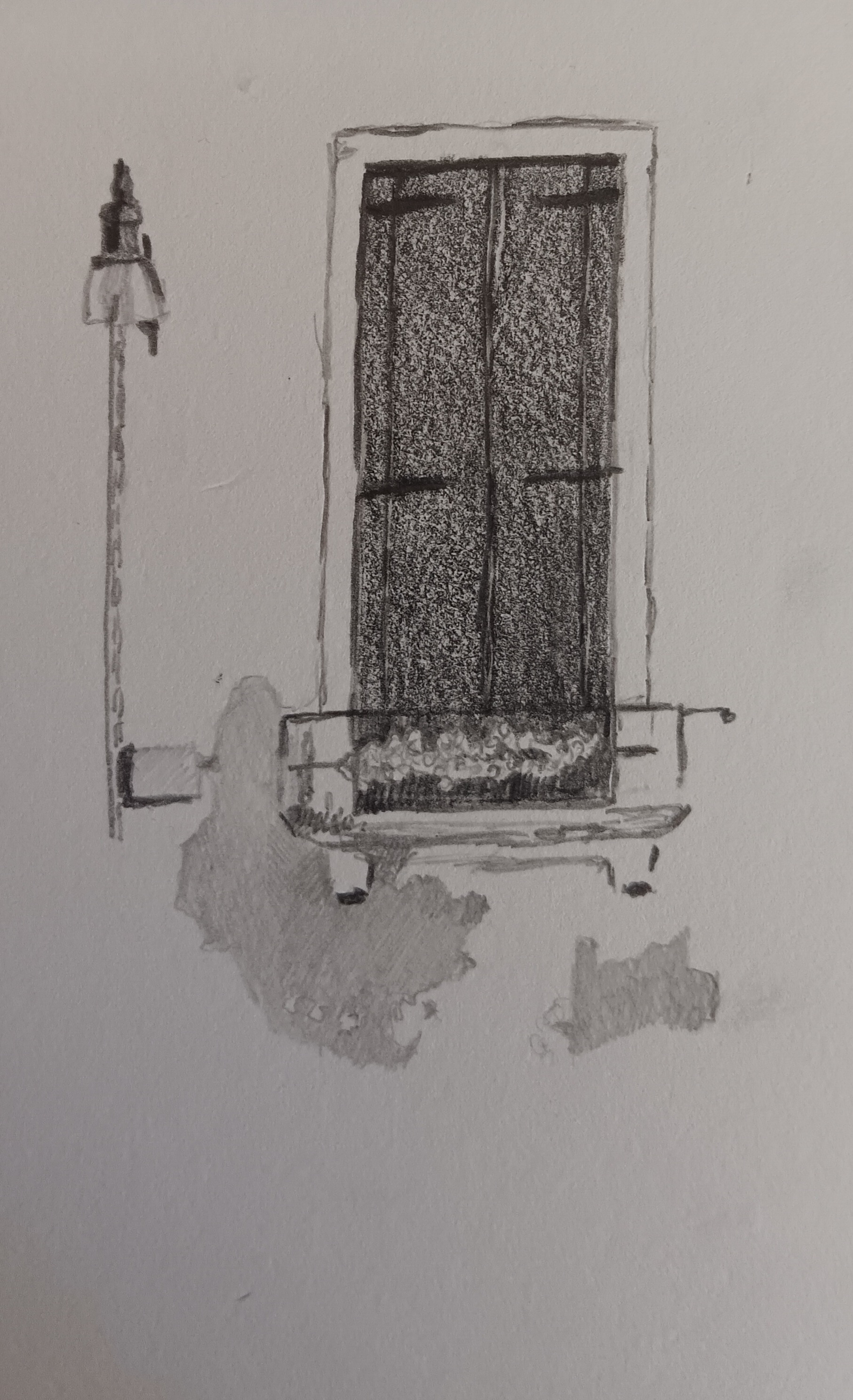
I brought a very small sketchbook with me on this trip, and so these are very small drawings, each about 2″ x 3″. Graphite pencil. I hope the focus is adequate; I photographed them on a moving train (hello, Slovenia!).

I’m in Venice with my daughter, and Joy got her passport and arrives tonight. Munchkin asked what I want for my birthday, which is today, and what else could I possibly want? Another day like yesterday? I am beyond blessed to have life, my family, work that sustains me, and time to enjoy this beautiful world. On top of that, I get to be in this city, created by artists–and I don’t mean Titian and Canaletto, but the masons, architects, road-builders who surrounded themselves and the generations to come with beauty. I will add a thank you to forward-thinking politicians and the people who elect them, because I saw workers repairing some infrastructure under the street yesterday, and they had pulled up the stones whole and were saving them to replace. It would probably be cheaper to replace them with asphalt (or else why did we do it, in the US?), but instead, the skill to lay stone has been passed on, and the expense has been taken on, in order to keep this city one of beautiful stone streets.

Yesterday, each of us went out when she woke up, though it was well before 8 am and it took a long time for either of us to find a place that would sell us food. (Text from me to M: “I am leaving in search of food and perhaps daughter.” Response from M: “Lmk if u find food and the daughter will probably appear.”) Even though this carving was too far away for good resolution, I had to take a picture. St. Mark is the patron of this city and his symbol is a winged lion, so images of lions are everywhere.

Later, on a street so narrow that I could put my bent arms out and touch either side with my elbows, I saw a ruder version. At least, the doorbell looked like a stuck-out tongue to me at first. On getting closer, I decided it was more like a lion sucking a pacifier.

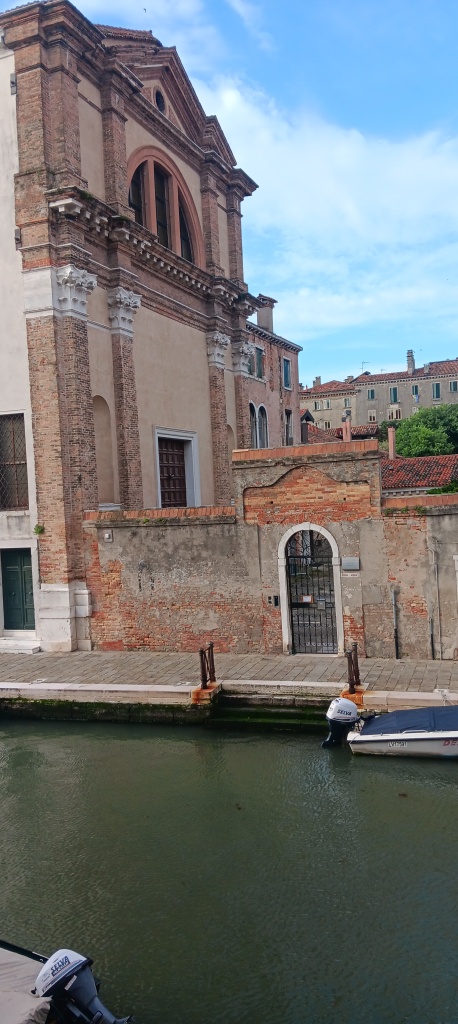
I eventually found a cafe that was open, got a latte and two croissants, and texted the munchkin. While I sipped and waited for her, I drew a window on the other side of the canal:

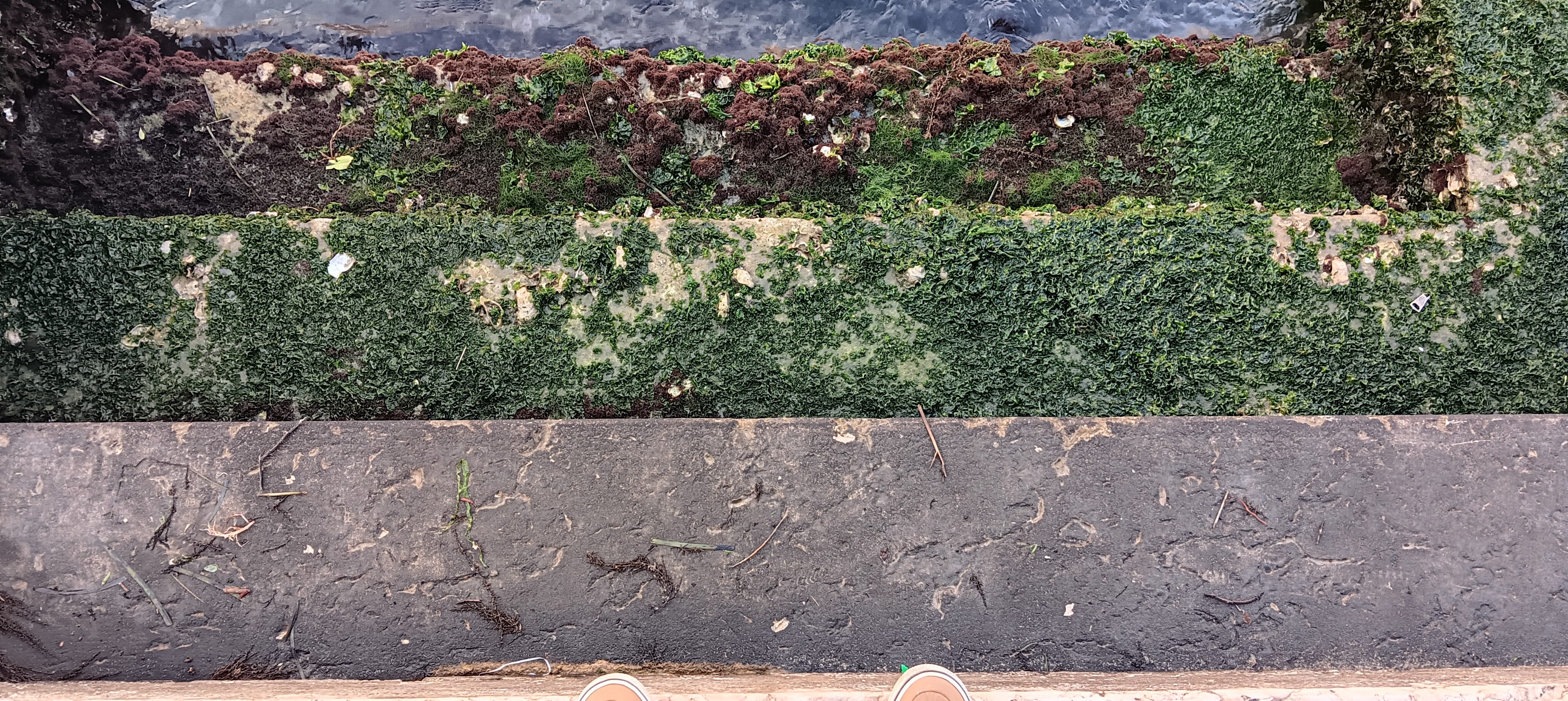
It was low tide when I left the apartment, as you can see from this photo of the steps down to the canal.

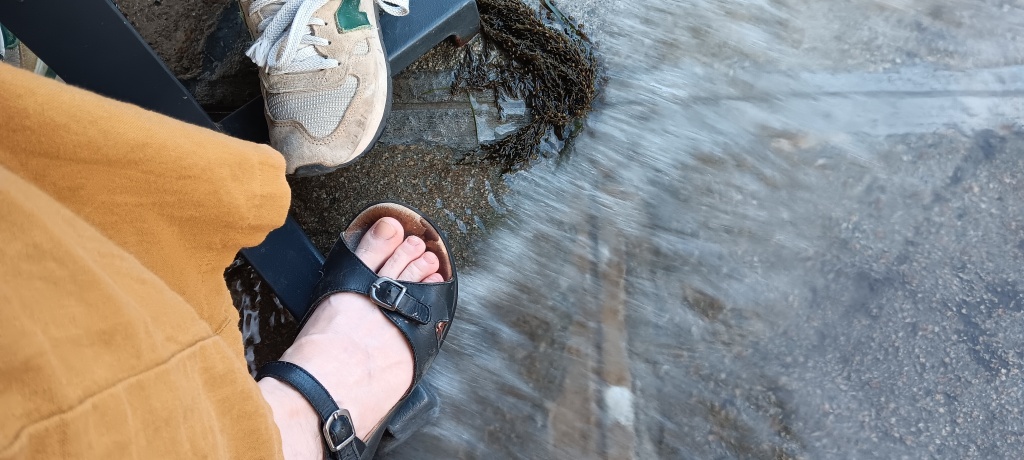
Later, when we ate outdoors, the tide was almost at its height and lapping around our feet.

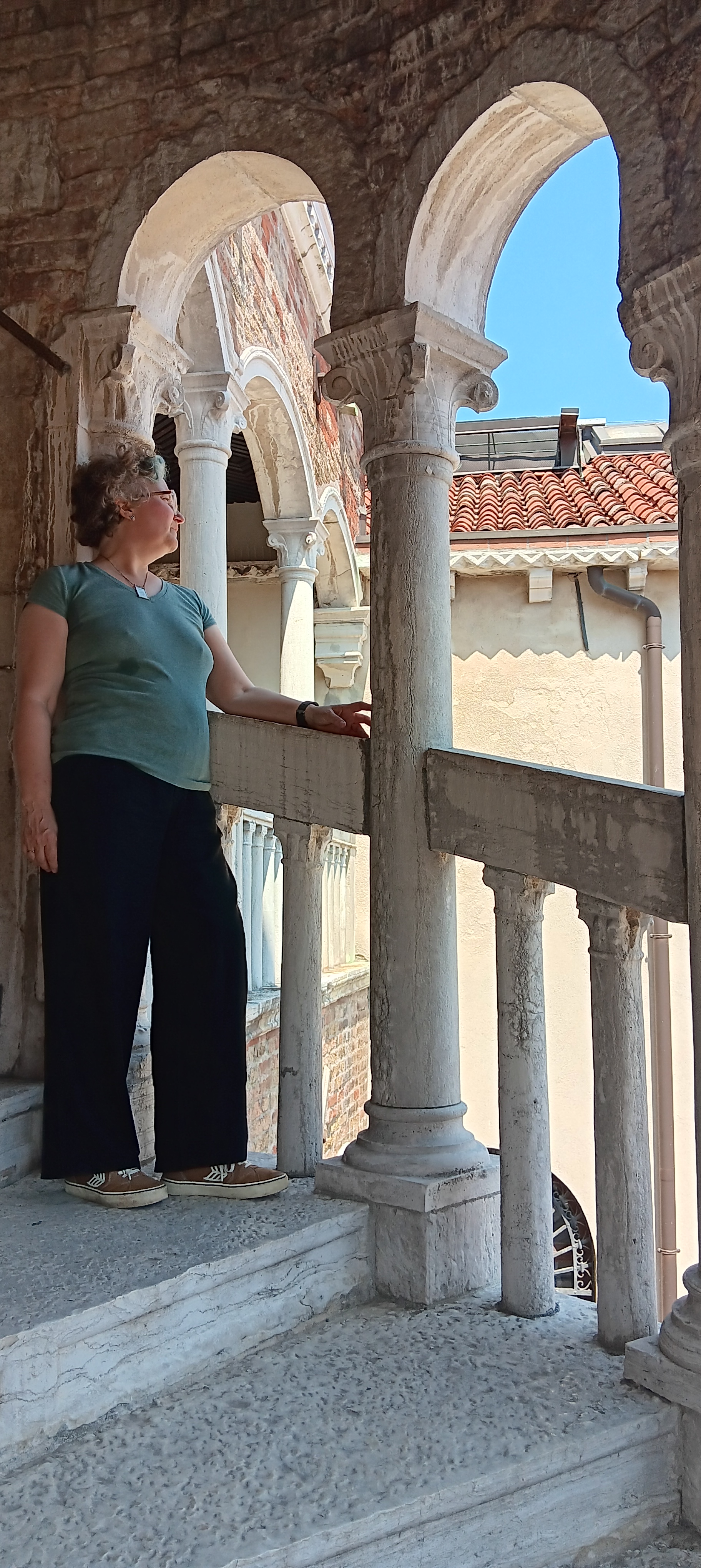
The main activity of the day, between meals, was our walk to, and up, the Scala Contarini del Bovalo. Bovalo means “snail” (though the more usual word is the one I know, since it’s the same in Italian as in Spanish: caracol) and it became the nickname of the Contarini family after they built this loggia and spiral staircase. That can’t have pleased them, because apparently they chose their building spot–at a rather out-of-the-way cul-de-sac–so that they and their ill-gotten gains would go unnoticed. So said a tour guide we listened in on. Or rather, Munchkin listened in. I caught the 20% of words that were identical with Spanish, and so got some of what she was saying, but Munchkin’s Italian (honed on reading The Lightning Thief, the first of Rick Riordan’s Percy Jackson books, in translation) is getting better with each day here, and she translated to me afterwards.

We had a struggle turning our tickets into admission, as I had bought them online and thought having them in my email would be sufficient. Good plan, except I was having trouble accessing email, and so after a long, fast, sweaty walk, we feared we wouldn’t get in. Italian bureaucracy worked against us; I could show them the email but not the attachment, and they had to have the QR code to admit us. But Italian kindness worked in our favor: they did considerable digging to find our reservation on the who-knows-which website on which I made it, and finally entered their wifi password so that I could access the attachment afterwards, being the souls of patience the whole time.

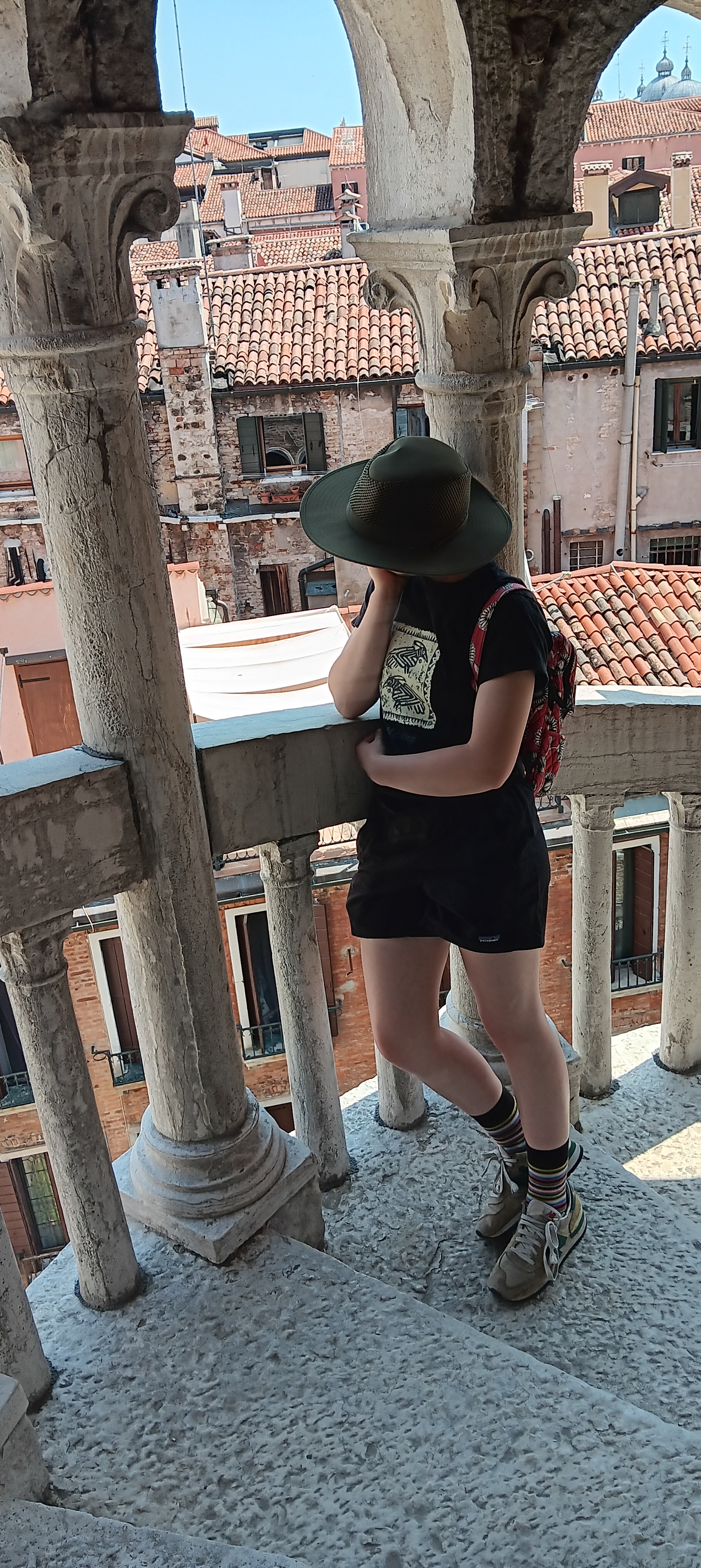
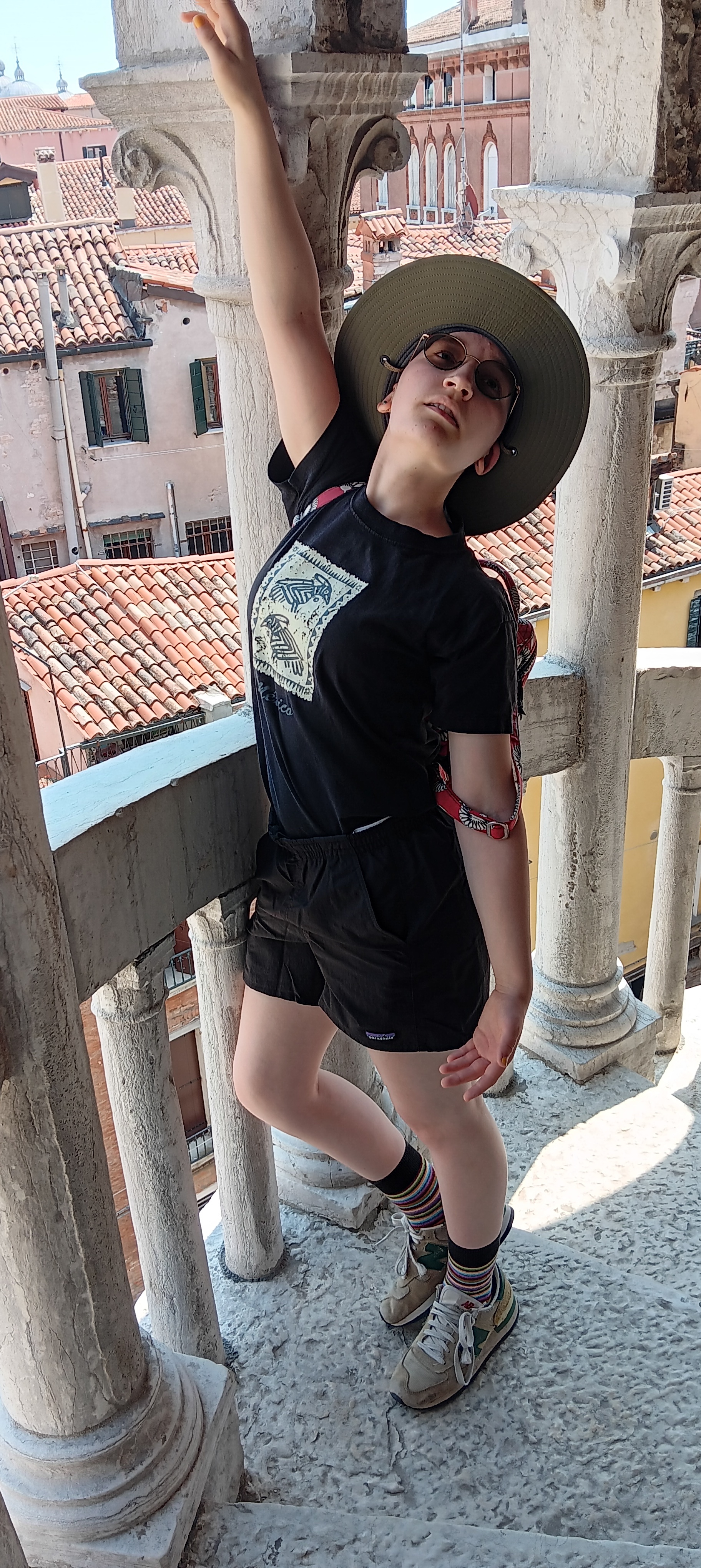
Once admitted to the spiral staircase, we photographed each other looking pensively into the distance.

Having her face entirely concealed by her hat was apparently more pensive than M was asking for, so I asked her to give me some more poses and got this. Now that’s the kind of drama that made Orson Welles choose this as a setting for his Othello.

We had intended to continue to a park with calisthenics equipment, being that M is missing her three-times-a-week gym routine, but my leg was beginning to twinge, I was hungry and tired, and it was a mile back to the apartment, so we parted ways. She went on to her park, and I made my way back through the tourist-crowded central streets, stopping to refresh myself with the first gelato of the trip. “After Eight,” a.k.a. mint with very large, dark-chocolate chips. Exquisite.

I have had increasing sciatica flare-ups over the past several months, and I asked my doctor for a steroid injection before I left, scared that I would end up sitting in our lodgings all summer while J and M explored. The injection was astoundingly successful, but not quite 100%. It’s okay. The twinge, which was a daily event pre-steroids, didn’t start until I had walked 11,000 steps yesterday, and even with another 7,000 on the day, it didn’t get any worse. I’ll call that a win. Credit modern medicine, or else the gelato.

So, this is 55. The leg is still a little grumpy, but I’m about to head out in search of a canalside mocha, to be enjoyed while reading Mansfield Park. I don’t have to contend with any real-life Mrs. Norrises to speak of. Life is good.

We are in Venice! Minus Joy, because she is still waiting for her passport. Public service announcement: If you need a new passport, imagine how long each stage would normally take and double it. This part of the State Department is so understaffed, or whatever, that it’s not even possible to get an appointment in a passport office anywhere in the United States right now. So Joy is in New York, at least, enjoying the opportunity to be there and see friends.

The Munchkin and I arrived late last night. There’s so much we could do and see here. We’re right by or in the old Jewish ghetto, which, if not the first such place in the world, was the one that gave us the term ghetto for a neighborhood to which people are confined. Nowadays the methods by which we keep people in their place are a bit more subtle, which enables the people outside the ghetto to tell themselves that if anyone is still stuck there, it’s their own fault. So we could go to the Museo Hebraico. We’ll go to San Marco and all its accoutrements, of course, but in the hopes that Joy will join us within a few days, I want to hold off on going to Murano, the island of glassblowers. We’ve seen a bunch of posters for the Biennale, and I’d like to go into some of those exhibits. The moment I was awake this morning, Munchkin (who had already been out and about) asked if I wanted to climb a spiral staircase to a great view, and I said yes, but the first available tickets are tomorrow at 11:30, so we’re going to go then: La Scala Contarini del Bovolo, a late 15th-century palazzo. Apparently, it was made famous to the rest of the world when it featured prominently in Orson Welles’s movie of Othello.

The main attraction of Venice, though—the reason it was top on my list of places to go this summer—is just the city itself. I wanted to wander the winding streets and cross canals and soak up the centuries-old architecture. In our two hours of meandering and getting some food, I was confirmed in my conviction that I could be very happy here without going to a single “historical attraction.”

For example: This was the view out my bedroom window this morning.

The building in the distance on the right has a Pride flag hanging out the window, third window from the right.

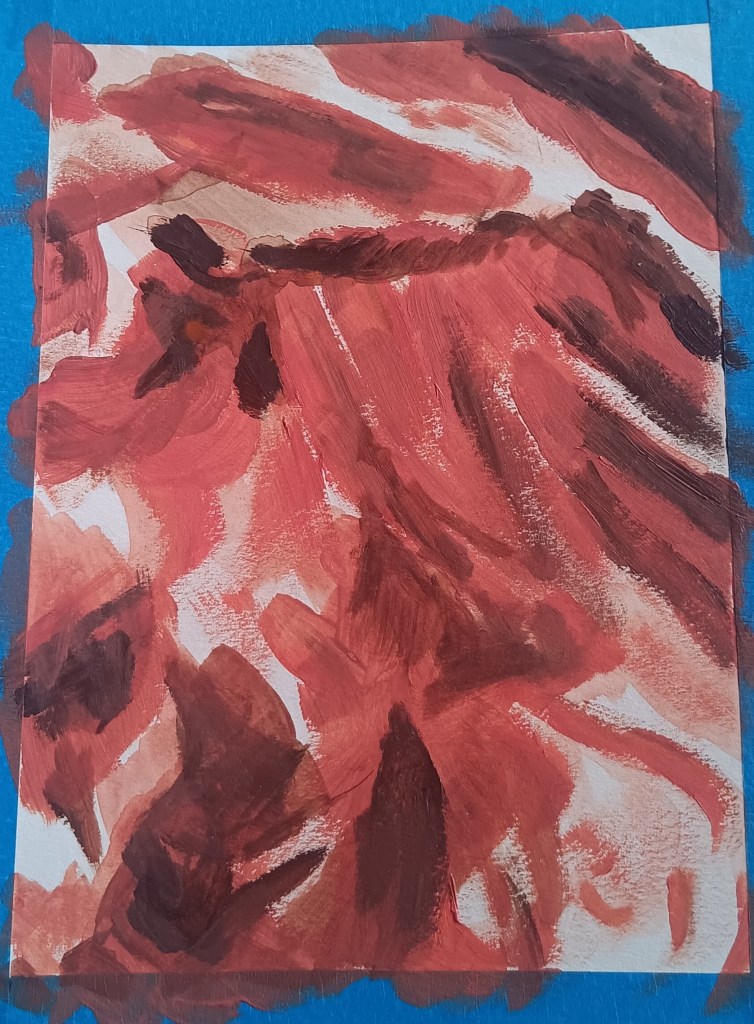
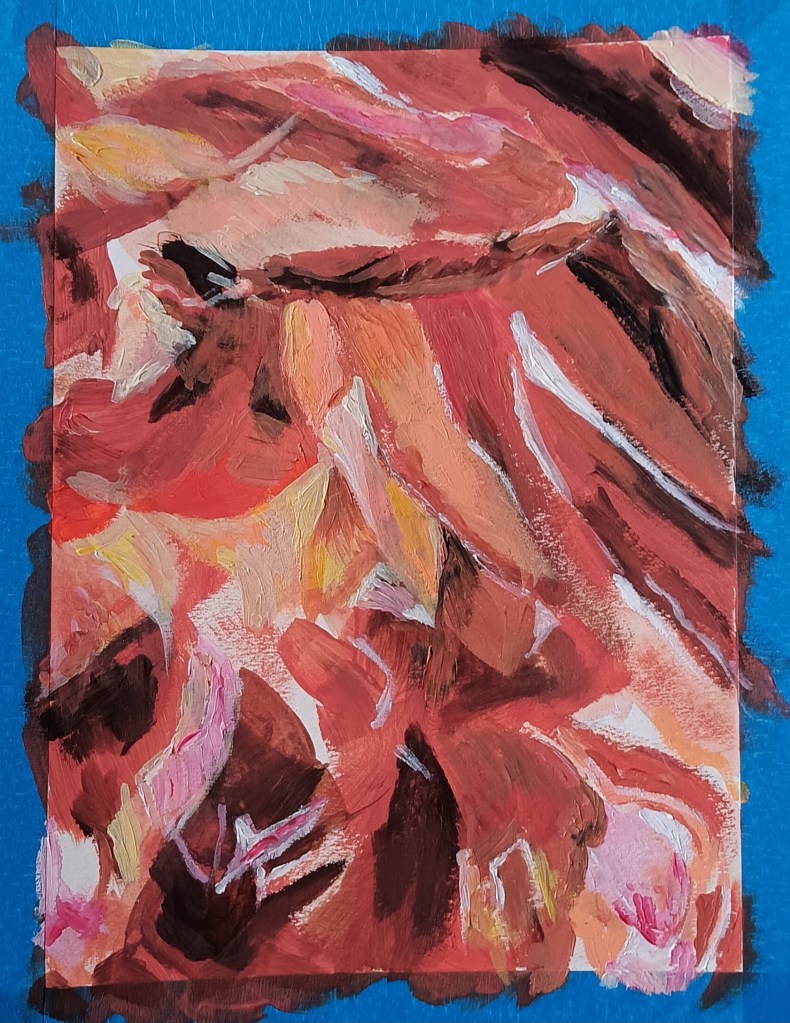
The moment I saw this picture, taken by my friend Nancy Palmer Jones, I said “I want to paint that!” Nancy said, “Go for it!” I want to document the stages, because it’s so heartening to remind myself how the painting went from blank to visual gobbledygook to “hey, that looks like something” to “that’s it!” So I’m putting the original photo at the end of this post, to show the painting getting closer to the model.

The painting is acrylic on paper, about 8×10″. I haven’t taken a painting class since high school, so for even the most basic questions, such as “Should I work from dark to light or light to dark or what?” I have to ask friends or Professor Internet. Professor Internet gave me a fairly consistent answer, but then I forgot what it was, and once I’m painting, I am too impatient and impulsive* to interrupt and go look again. So the first stage turned out to be me laying down blocks of color, mostly midrange, with some darks put in and the paper left blank for the lights. Here it is:

Today I was even more flummoxed about what to do next, feeling a bit like I was just coloring. I did not want to color. But my drawing instincts took over and I found myself doing what I would do with a pencil or charcoal, except with a brush. After today’s hour or so of my getting more specific with the lines, shapes, and colors, the piece kinda sorta looks like the petals of a rose:

I might not get back to it before leaving on our long trip, a week from today. I’ll bring a sketchbook and some pencils, of course, plus a few markers and colored pencils. Painting and other projects will resume when we’re home.

The original:

*Autocorrect tried to change this to “intuitive. ” Aw, thanks, Autocorrect!

I learned as a child in an observant Jewish family that the most important holidays in Judaism are:

  • Shabbat, celebrated every week;
  • the High Holy Days: Rosh Hashanah and Yom Kippur, which are ten days apart in the fall;
  • and the three agricultural festivals: Passover, Sukkot, and Shavuot.

Ah, Shavuot. Least-known and most boring of the major holidays. Far outstripped by its trivial younger siblings, Purim and, of course, Hanukah (as are most of the others). I always liked Shavuot, as a kid–I liked all of the holidays–but it caused me a little trouble. Like the other five of the above Big Six, and unlike Hanukah or Purim, it requires strict observance: in my family, no writing, travel except by one’s own power, or spending money. And you go to shul during the day. Mix those facts with people’s ignorance of its existence, and you get this exchange:

Student: I’ll won’t be here on Wednesday and Thursday. It’s a Jewish holiday.

Teacher: Another one?!

To be fair to the schools, I think this exchange took place only in my head, or between me and friends. The teachers were very professional and respectful of our civil rights. And I was a good student and kept up with my work despite the two-day embargo on writing. Oh, that’s another thing that makes Shavuot an odd one out. Unlike its triplets, Passover and Sukkot, which are a week long each*, it only gets two days (in fact, I started this on the first day of Shavuot, Sunday’s busyness intervened, and now I’m posting just in time for the end of the holiday). What the heck?

All right, so what is Shavuot? It celebrates the receiving of the Torah from God at Mt. Sinai. By tradition, this took place seven weeks and one day after the Israelites’ escape from Egypt. By way of celebration, one eats milchig, dairy–in the United States, blintzes are traditional, as is cheesecake for those who like that sort of thing (I do not)–and in the services, the central scripture is the book of Ruth. It’s a story of harvest, and also of refugees, so it’s a lovely fit.

Some questions I either never asked, or don’t remember the answers to:

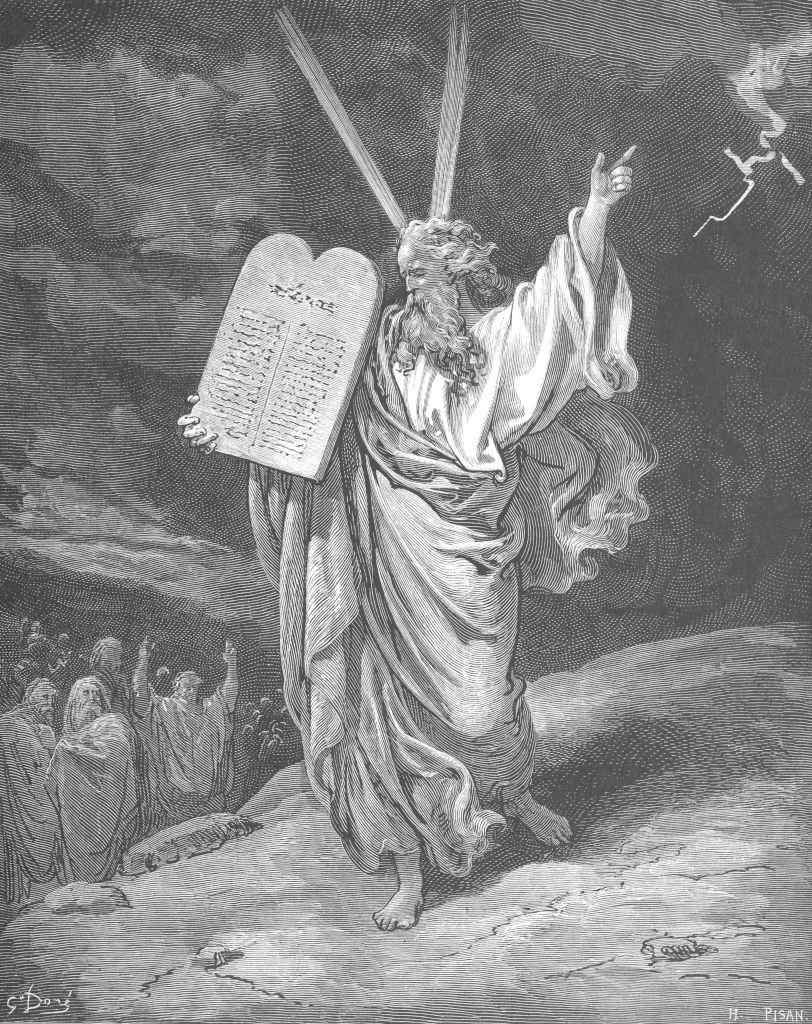
Gustave Doré, who understood the verse about the “horns of light” emanating from Moses’ head. Michelangelo, on the other hand, thought they were literally horns and portrayed Moses that way, greatly increasing life’s difficulty for generations of Jews whose anti-Semitic neighbors thought they had horns, like popular images of Satan. Gorgeous sculpture, though.
  • Tradition says Moses was up on Sinai for 40 days. But the people received the Torah 50 days after leaving slavery. So did the people take ten days to get to Sinai, and then receive the law after 40 more? Or did they take 50 days to get to Sinai, and didn’t actually receive the law until day 90? Ten days seems like a pretty quick trip; I don’t know precisely where they fled from, but Google Maps tells me it’s a walk of 3 1/2 days from Cairo to Mt. Sinai. Make it an entire people, including very old people, sick people, and small children, and maybe bringing some goats and such, and ten days seems unlikely. But if it took them 50 days to get there, first of all, that’s a really long time for a short distance, and second, it makes 50 days a strange interval to choose between Passover and Shavuot, since day 50 wasn’t when they got the Torah, but when they started waiting impatiently for Moses’s trip up and down the mountain to be completed. I could probably find out a lot more just by reading these chapters of Exodus, but I think I’ll just raise the question and let someone else research the answer.
  • “The receiving of the Torah” is very confusing because, well, by the time Shavuot comes around, we’ve been reading the Torah, the Five Books of Moses, from the beginning since fall, and it has been mostly history. Did God give Moses the story of the Garden of Eden? I realize as I write this that what our teachers meant by “God gave us the Torah” was “God gave us the law,” which is a smallish part of the Five Books. The rest of the Torah is the story leading up to, and following, the revelation at Sinai.
  • Also, there’s that whole Moses bringing down the two tablets thing. I had this vague sense that Moses brought down the Ten Commandments and that was it. Again on reflection, it’s clear that the images of Moses bearing the tablets are a visual metaphor for his bearing the entire Law in his mind.
  • Why dairy, anyway? There are various theories, none very convincing. I always kind of figured it was just to give dairy a boost. Usually, holiday meals are fleishig, meat meals, I suppose because meat is expensive and appropriate for special occasions. Ours almost always featured chicken or, at Hanukah, brisket. Since observant Jews can have either one of these items or dairy desserts (you can’t eat milk for some hours after eating meat, nor meat for at least half an hour after eating dairy), this means you never do end up having cheesecake for dessert, nor cheese blintzes as an appetizer. So Shavuot is their moment. Or maybe, as in the joke about the Pope and the Wonder account, there was some lobbying from the dairy producers of the Jewish world.
  • I still don’t know why only two days, instead of a week.
  • And the biggest question, which I know I did ask as a child, but if I got a satisfactory answer, I have no memory of it: since this is the anniversary of receiving the Torah, why isn’t it the day to celebrate the same? Shavuot is celebrated in Sivan (June-ish; the Jewish calendar is lunar and so it doesn’t always line up with the Gregorian calendar). Why is Simchat Torah, the day of Rejoicing in the Torah (and one of my favorite holidays in my devout days), attached to Sukkot way back in Tishrei (October-ish), instead of to Shavuot?

So it turns out that little Shavuot packs a lot of questions. Whether you have any answers to them or not, if you celebrate Shavuot, I hope it has been a happy one and that you enjoyed every bite of your milchig meal.

*Though only the beginning and end of the week have strict rules. The days in between, Chol Hamoed, are pretty much like any weekday, except that in the case of Passover, of course, bread and grains are still off the menu.

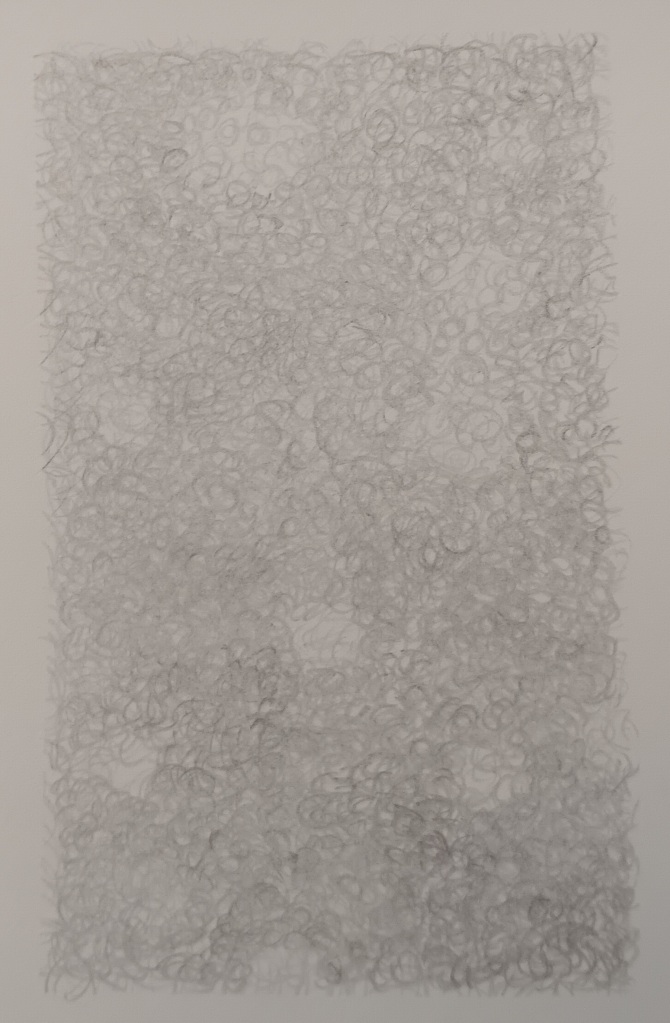
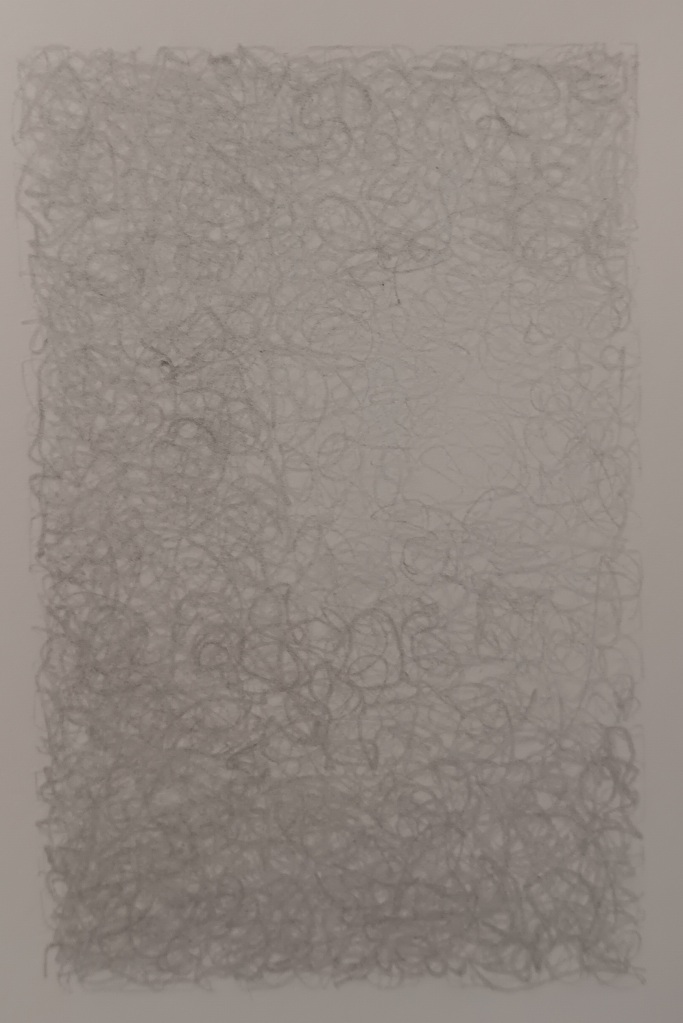
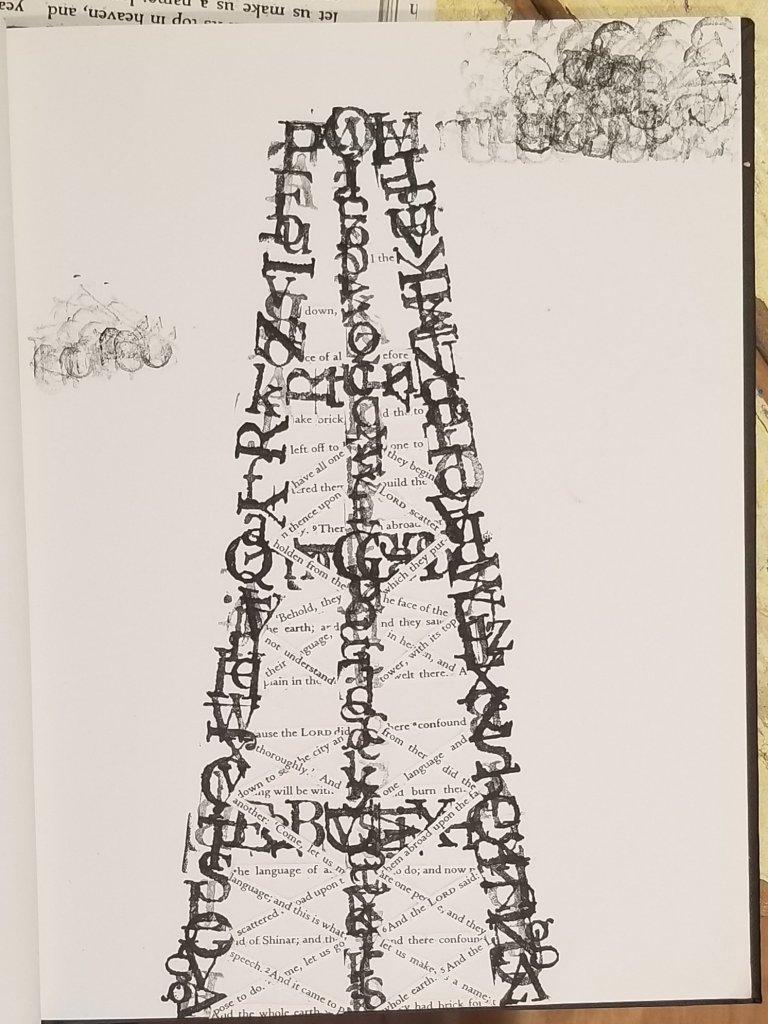
Rubber-stamp ink on paper

Enter your e-mail address to receive e-mail notifications of new posts on Sermons in Stones

Links I like