On Monday, we traveled 35 km out of the city to the ancient site of Teotihuacán. There are very few trees at Teotihuacán and precious little shade, and the thing to do is get up at 5, get there by 8 and beat the heat, but while there must be some families capable of such a thing, we’re not one of them.
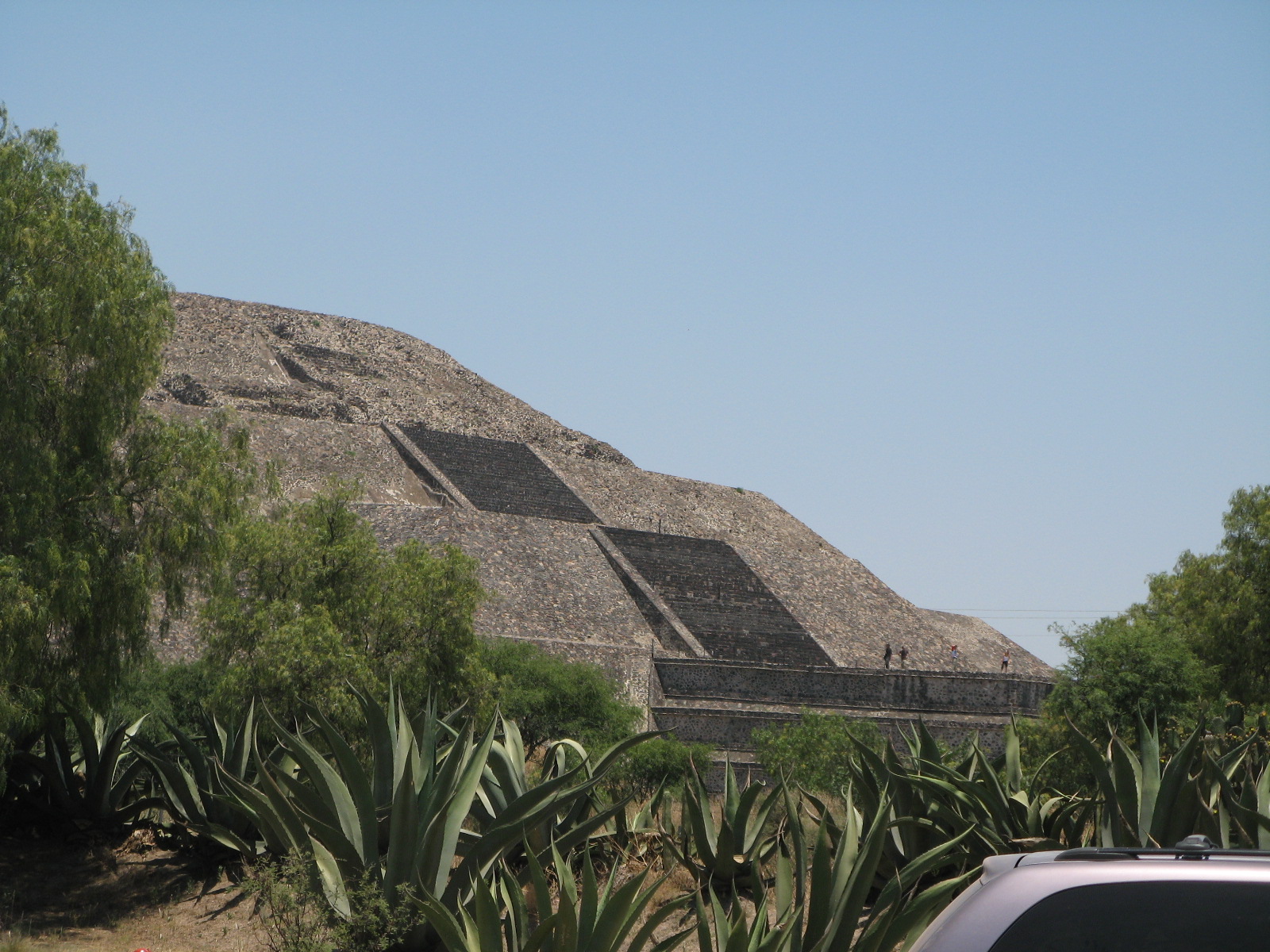
Pyramid of the Moon

No one is quite sure who lived there–the city was already in ruins when the Aztecs came along, and their guess about who had built it was passed along for centuries until archaeologists cast doubt on it–and the purposes of the temples, assuming the pyramids were temples, are also a matter of educated guesswork. The larger of the two enormous pyramids is still called the Pyramid of the Sun, but the information plaque next to it theorized that it was actually a temple to the god of water.  If the weather here in the 5th century was similar to today’s, a preoccupation with either would be understandable: the sun because you can’t get away from it, water because you wish you had some.
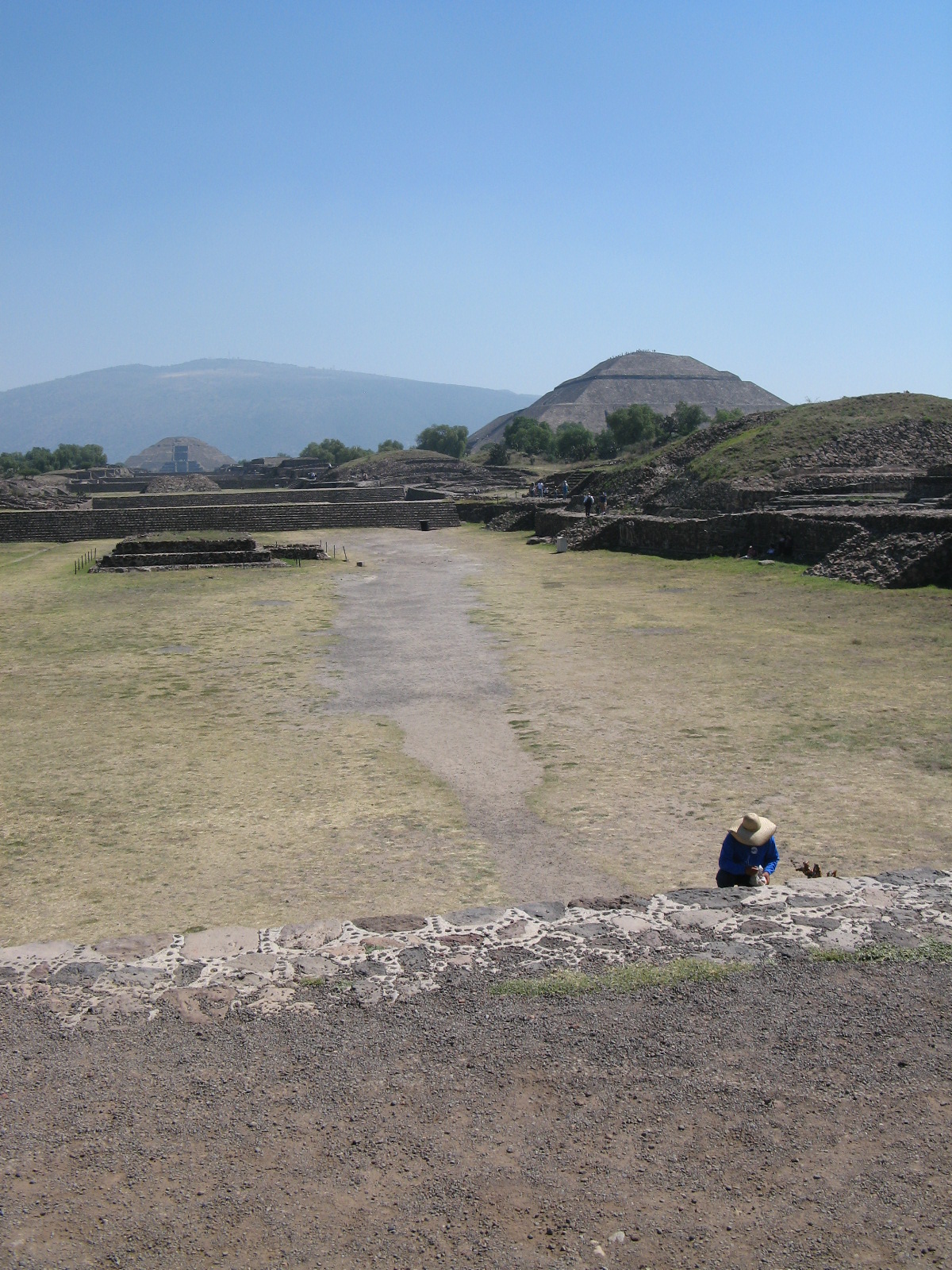
It is strange how a city can become a ruin. Not how it got that way, I mean (though that’s a mystery too–why was the city abandoned? Invasion? An internal uprising?), but how hard it is for us to see past the “ancient ruin” status and picture it like our own cities, filled with all the noise and activity of life. The wide-open spaces of Teotihuacan seemed like they’d always been that way. Even walking among the acres of former homes, even seeing remnants of the paintings that once covered many of the walls, it was hard for me to imagine people walking around there, cooking their dinners, leaning against a wall for a chat with a neighbor, trotting up the steps.
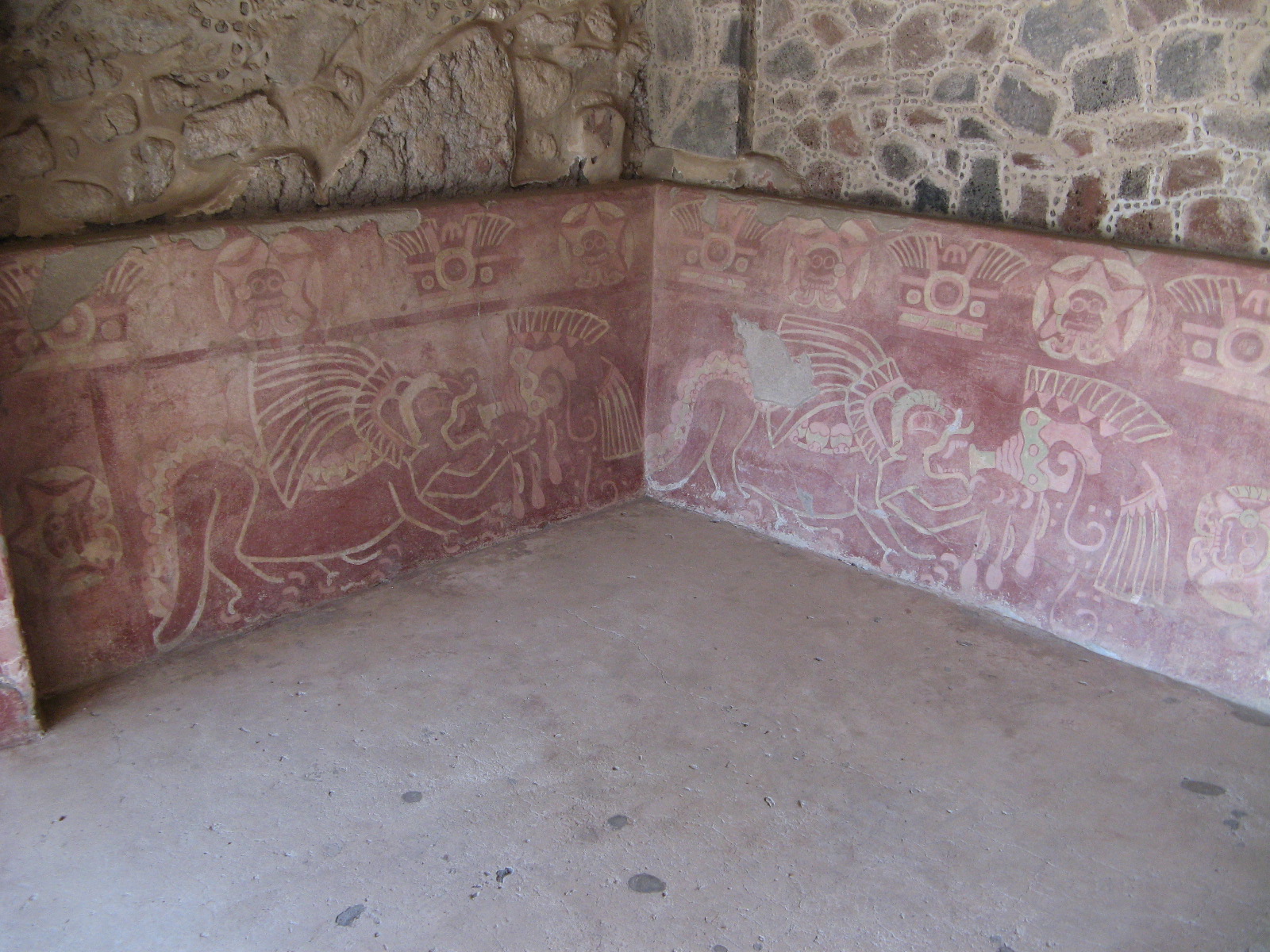
It wasn’t until I got to Templo Mayor, a few days later, that I could really stand within a long-ruined building and imagine it busy with people. For one illuminated moment, I really understood that they were there, in that place, just five hundred years ago, and that they weren’t thinking, “What a fabulous temple–it’ll make an impressive ruin one day.” They weren’t picturing their brilliantly-colored murals faded to fragments. They just swept the floors, got the ritual objects out of the closet, put their worship clothes on, and started the service. I could almost see the crowd strolling along the wall of sculpted skulls. Maybe it was easier to picture Templo Mayor as a living place than Teotihuacán because it is smack dab in the middle of a huge city; or because it has a roof overhead and so it feels like rooms instead of ruins; or even because it was used so much more recently, not by ancients whose name for themselves we don’t even know, but by the practically-modern Aztecs.

Templo Mayor (Aztec temple in Mexico City)

Maybe people in Mexico are better than I am at recognizing their continuity with the past.  They certainly honor it more, despite being a thoroughly modern nation.  For example, they’re less likely than we are to knock down old stuff to bring in the new, instead incorporating the old into the new. (I just learned that when Wal-mart built a store near Teotihuacán, workers were ordered to hide the artifacts they dug up–those who blew the whistle got fired. I’m feeling worse and worse about that stroller.)  In San Miguel they are forever pulling up cobblestones to do work on the streets, and when the new pipe is laid, they put the cobblestones back.  Modern Mexico also has a very different relationship with its indigenous roots than we have with ours, not surprisingly for a country where almost everyone is mestizo (mixed, i.e., partly native), but those are musings for another post.

The munchkin often talks about “zooseums,” and I mistakenly thought that it was simply her word for “museum,” so early in our time in San Miguel I told her about a “zooseum” (gallery, actually) I’d been in that I thought she’d like. We all went there and she looked around at the colorful art and said, in a voice that was made somehow more heartbreaking by its simplicity and lack of drama, “I thought we were going to see animals.” My maternal guilt-meter went off the scale. I’d deprived my child of her beloved Coyote Point for six months, plus I’d misled her into thinking she was about to see otters! Joy and I both rushed to tell her that there’s a great zoo in Mexico City and we’d go there soon.

So Sunday we took the long-awaited trip to the zoo in Chapultepec Park. The munchkin did enjoy the zoo very much, but I think in the end the highlight of her day was not the polar bear or hippo or even the terrifyingly agile snakes she adored, but the Spider-Man (-Men, I should say) who hung out in a booth along one of the park pathways and shook her hand. Here they are, only asking 10 pesos each for the photo, with a lesson in the proper hand position for web-spinning thrown in for free.

I’m ambivalent about zoos, to put it mildly. No matter how nice the enclosures (and this one’s are very good), they’re still cages, and the only kind of zoo I could feel 100% happy about would be populated entirely by animals who couldn’t survive elsewhere. (In fact, most of Coyote Point’s animals, and all of their mammals, were found injured and would die if released to the wild.) But it is still amazing to see them so close. And the Chapultepec Park zoo costs . . . zero. Yep, absolutely nothing. Incredible.

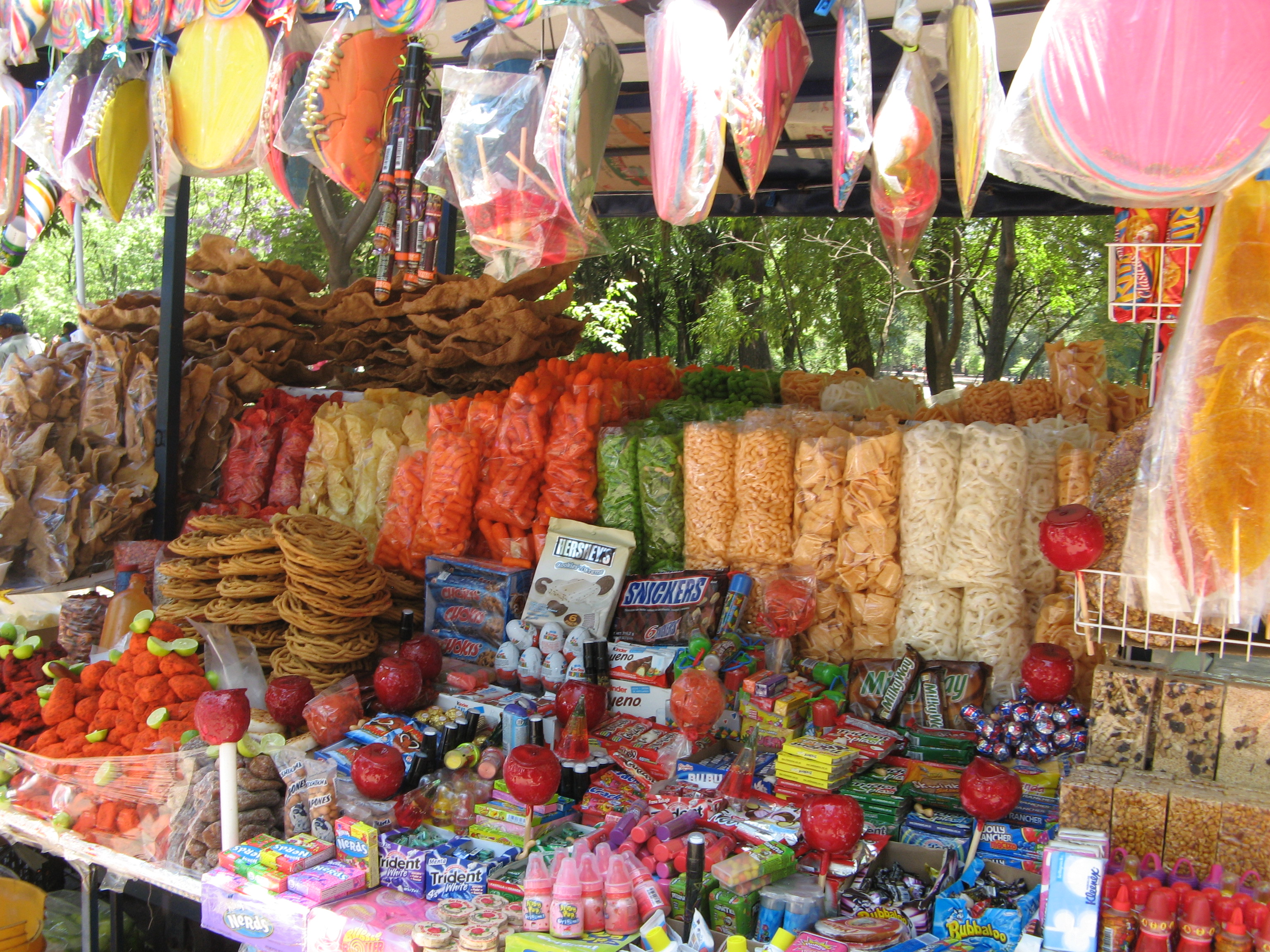
The approach to the zoo had approximately ten zillion things for sale besides photo ops with Spider-Man. Shoes, junk food, a skyscraper of cotton candy . . .


(all three photos by my multitalented spouse, Joy Morgenstern)

Our other visit on Sunday was to El Museo de Arte Moderno. The munchkin (who had a hard time the whole week) was melting down at that point, so we didn’t get to spend much time in the exhibit that interested me most, on the creation of Mexican identity. That’s travel with kids for you, even one who has remarkable museum-staying power for a three-year-old. In fifteen years we’ll come here with her and she’ll want to spend more time in museums than we can stand, plus she’ll want to race us to the top of the Pyramid of the Sun. Actually, she did suggest going to the top, but I thought a few steps were enough.

But I’m getting ahead of myself. Teotihuacán was Day 3, so I’ll write more about it tomorrow.

We’ve just returned from eight days in Mexico City, and boy, are our legs tired. No, we didn’t walk from there, on a variation of the ancient joke. We just walked around there, miles a day, it seemed. I ought to be losing weight here in Mexico, but I think in the battle between More Exercise and Lots of Cheese, the cheese is winning.

We got to the city last Friday evening after a full day Read the rest of this entry »

Ten years ago today, on a perfect Vermont spring afternoon, with the blessings of two beloved congregations and family, mentors, and friends, I was ordained a minister. A spiritual practice of the past few weeks has been to reflect on what called me, what the past ten years have meant, what changes I’d make today in those vows. In the hectic weeks before we left for Mexico, I couldn’t find a copy of my ordination order of service, containing the vows themselves; Sean, who’s serving UUCPA in my place this spring, tried valiantly to find it in my office files but it must be in my home files. It doesn’t matter. I remember the gist, and as I remember them, they were as much vows for life in general as for the Unitarian Universalist ministry. We don’t take vows upon becoming human, but the kind of things I committed to do were the things I want to do with my whole life, not just in my service to our congregations or organizations: Cultivate love and wisdom in myself. Speak truth to power. Remember the holiness of every being and every moment. Pursue justice. Celebrate beauty. Help heal the world’s broken places. Act with kindness and patience. Tend my spirit.

The joint choirs of the Champlain Valley UU Society and the UU Church of Rutland sang “Blessed,” by Lui Collins. I knew then, and I know it even more now, how blessed I was to have found a vocation in which the job description lined up so neatly with “live well.” The tarnish of church politics, my own insecurity, overwork, confused priorities, daily routine, trees too crowded to allow much of a view of the forest–it all builds up, but life in church also provides countless polishing moments to clear it away. The next ten years will no doubt bring many changes, but fundamentally I’m still answering the same call. Unitarian Universalism, the three congregations I’ve served, and especially the hundreds of people who’ve touched my life through this work have my deep thanks.

I’m drawing a cityscape in pastels, a new medium for me, and not really knowing what I was doing, I sketched the outline in black and then filled in the buildings as blocks of color. It looked pretty cartoonish. My teacher came and looked at it and said, “Now put the shadows in,” and once the buildings had shadows, pop! They suddenly looked real. I think a lot of things work that way.

My daughter loves her shadow. Like Robert Louis Stevenson, she thinks of it as a friend. I hope that’s always true.

For the last six weeks, we’ve been fostering four cats from the humane society, a mom and her nursing kittens. Mom is Cleo, and we’ve named the kittens Lunita (after a vague resemblance to Luna, one of our cats in SF), Rayado (=striped), and Ruidosa (=noisy). Today they go back to the humane society so that their potential permanent people can look at them. That is, today’s the day unless the volunteer in charge forgets to call and arrange a time. We’re hoping she will.

Right now I am sitting on the floor in the dark, and every once in a while a soft something brushes my leg. I reach out to pet a kitten, but with no light except the computer screen’s, I miss most of the time. Sometimes I feel a tiny tail between my fingers, or get to rub a furry belly for a moment before whoever it is moves on to explore the spiral staircase or hide behind the curtains.

I’m going to miss these cats.

Back in my first post, I wrote about my intention to draw leaves that are worn down to their skeletal forms. It actually proved very difficult to find any near my home in California, though I did find one with a lot of exposed veins and did some sketching shortly after writing that post.

This week, I’ve been drawing a different kind of skeleton leaf: the pad of a prickly-pear cactus (opuntia), or nopal. Prickly-pears grow here like weeds, and are currently blooming with pink buds that open to bright yellow flowers. I’d be hard pressed to say which is more beautiful, the living plant or its fallen, decayed pads. Here’s my subject, with the drawing underway.

Last week, I was doing a negative-space exercise with my drawing teacher. It’s a good, basic art practice that helps you to really pay attention to what is before your eyes instead of what you think something looks like. (Betty Edwards calls this a shift from left-brain thinking to right-brain thinking and uses this exercise, along with many other good ones, in her Drawing on the Right Side of the Brain.) When I sat down with my nopal skeleton, there was no doubt that I was going to focus on the dark shapes in between the veins, not the veins themselves. It’s not because I have white paper and black charcoal; I could use dark paper and draw the lines in light gray and white. It’s because the spaces are what attract me.

So there I was, drawing my empty spaces, humming happily away at my new friend the nopal, and thinking once again about lacunae, the absences that have such presence. (I wrote about them here on Feb. 11.) I’m just fascinated by the way we are shaped by absences, gaps, the spaces in between. I often think of this phenomenon in psychological terms: for example, how one’s personality takes shape around the things one is anxious to avoid. In my previous post on Barbara Kingsolver’s The Lacuna, I was thinking largely in terms of political history. But when I see a piece of art like Goldsworthy’s “Roof” (to give one example–he has many works that use a similar hole motif), its impact feels like something spiritual. That space draws me out, into itself–not at all in a scary, oh-no-I’m-falling-into-a-black-hole way, but in an intriguing, welcoming way. I recognize that space; it has a counterpart within me, something for which I don’t have any words, but which I know is there the moment I look at Goldsworthy’s piece. (I suppose that for some, these pieces must be disturbing, if they were locked into the cupboard under the stairs as kids. But like a cat, I’ve always liked small, dark spaces.)

Two poems that I had in my notebook back when I was working on a similar theme in college still resonate. One is “Anecdote of the Jar,” by Wallace Stevens. I usually can’t make head or tail of Stevens, but that year, when I read this poem, I thought he’d written it for me and the vessels I was making. My art thesis show was all large hand-built abstract sculptures, not wheel-thrown pottery, but I still made them all vessel forms because of the way vessels evoke that sense of the space inside and around. I thought I knew just what Stevens meant: put a jar in a space and suddenly the space without is shaped around, shaped by, the space within. (All these commentators mentioned in the Wikipedia article could be right about industrialization and Keats, too. But that isn’t what the poem means to me.)

The other poem is the eleventh chapter of the Tao te Ching, Lao Tse: pick your translation. Here’s Gia-fu Feng and Jane English, and here are about a dozen others.I started to write, “the spaces in the nopal make it what it is,” but that implies that “it,” the cactus, is the veins (or “bones” or whatever they are), while the spaces are just air, or emptiness. That would be as nonsensical as a jar that was made only of clay, not of space.  The nopal is all of it, stuff and space alike. Drawing the spaces helps me feel that in my own bones.

Switching gears, here’s the other drawing I’ve been working on for, oh geez, a few weeks now, an hour or two most afternoons while the light is right. It’s the view east from my roof. (The view, ha. It’s just a few degrees of the whole view, of course. The rest is absent . . . most of artmaking being the decision about what to leave out. More on this aspect of lacunae soon too.) I think it’s almost done. It quickly turned out to be about texture more than anything else. The variety of textures of walls and trees in this little chunk of city is incredible.  One thing I notice as I look at this smallified version is that I might want to fix up some of the verticals with a t-square.  There’s nothing wrong with parallel lines not being quite in parallel (look at van Gogh’s city streets and interiors), but it might distract from what I want to be the focus here.

San Miguel is a great place for a religion junkie, a category to which I definitely belong. By all accounts, this town has even more fiestas and religious holidays than most places in Mexico. This week, Semana Santa, is peak season, but there’s a lot to celebrate even before Holy Week gets going.

Read the rest of this entry »

We deliberated for several days about what to do about Pesach this year. Our ideal is to host a Seder and invite friends, but most of our friends are 1500 miles away (or more), and we had trouble reaching the few we do have here. We looked into the San Miguel Jewish community’s Seder, but their response to “would a three-year-old enjoy it?” was not very encouraging. So we decided to just have a Seder for the three of us, with Joy cooking and me in charge of creating an abbreviated Haggadah.

Then, a few hours before the Seder, Joy saw an e-mail from a woman looking for a child-friendly Seder for her and her six-year-old son, K. We always have more food than we need, so we called them, they came, and we were so glad they did. They were really nice, interesting people; they’re UUs too; the munchkin and K hit it off (what a find, a six-year-old who’s happy to play with a three-year-old!); and having them here made our holiday complete. Eating dinner with just our family is lovely, but for the holidays it doesn’t feel quite right.

It was a funny business, creating the Haggadah. I’ve done it almost every year for several years now, for our church Seder, but having to really cut out most of it brought home to me what a crazy conglomeration and compilation it is. It shows all the signs of having been built by accretion; not just the recent, feminism-inspired additions like the orange and Miriam’s cup, but many elements, have been incorporated in response to some need or political moment that’s fallen into the obscurity of history. The four children, for instance; when did that come along, and why? All the lists and formulations, like the singing of the order of the Seder itself, and the “matzah, maror, pesach” bit—where did they come from? Why the four cups of wine? What does Chad Gadya have to do with Passover? Reading a typical Haggadah is like a walk through Jewish history. I’d love to see one that includes the works, with annotations about how each element entered the flexible canon that is the Haggadah.

What follows is what we considered essential and absorbable by our daughter. She has been to four or five Seders in her three years, starting with the one we held with close friends at home when she was a month old, but I don’t think she remembers anything from any previous ones. If she remembers anything from this one a year from now, I’m betting it will be playing with K, and the prizes they won.

(ETA that I notice a lot of people are finding this entry via searches for “unitarian haggadah” or “abbreviated haggadah” or the like. So if you’re wondering if you can use this, yes, and if your family doesn’t do “mad face” or blessings in Cat, adapt it to your own kids. Just please credit me, and make it clear to whoever uses it that it is drastically edited out of the vast realm that is the Haggadah.)

Read the rest of this entry »

I’m making a collage involving an image of shed skin, having been captivated by a passage in a book on reptiles that said most “higher land animals” shed their skin, but whereas mammals like us do it so gradually that it’s mostly imperceptible, snakes are unusual in shedding in “one elegantly complete operation.”

I’ve been thinking a lot about continuity and change (that Mary Catherine Bateson chapter, the one I quoted in a somewhat different context on February 5, tugged on some threads that have been in my mind for a long time), and the idea of changing oneself in “one elegantly complete operation” is intriguing. Do we ever do it? So many radical changes feel paradoxically like returning to our real selves, the person we’ve known we were or wanted to be for a long time . . .

Anyway, for this piece I need something that looks like what a person would leave behind if we shed our skin the way a snake does. After a couple of false starts–draw it? use tissue paper?–I realized that the perfect medium was white glue, white glue as it appears when it’s dried on your hands and you’ve peeled it off, as we all did in school. Well, maybe some of you washed it off with warm water. I reveled in peeling it off, and in fact, my friends and I would deliberately spread a little extra on the backs of our hands for the pleasure of doing it some more.

So I spread a 3- by 8-inch swath of glue on the inside of my left arm this morning, waited twenty minutes, and peeled. OUCH. Swath is right. A swath is what it felt like it was taking out of my skin. I couldn’t even take the advice I’d given to the munchkin just the day before when she was fussing about band-aid removal and pull fast!, because I didn’t want it to tear. Ow ow ow.

Joy said, “You’re suffering for your art.” Glad to do it, but if there’s a next time I might sacrifice the texture (which will probably be invisible in the final piece anyway) and just spread it on a piece of plastic.

Enter your e-mail address to receive e-mail notifications of new posts on Sermons in Stones

Links I like