
You are currently browsing the category archive for the ‘UUCPA’ category.
Continuing my researches on the prayers of contrition found in various traditions.
Buddhism
This is an amalgamation of two translations: one by Robert Aitken Roshi, of the Diamond Sangha in Honolulu, and one found on BeliefNet and attributed only to “anonymous”–which it is–it’s a very old Buddhist text.
All the evil karma, ever created by me since of old,
on account of greed, anger, and ignorance, which have no beginning,
born of my conduct, speech and thought,
I now confess openly and fully.
This Buddhist “Prayer for the Courage to Look Within” was posted by BeliefNet member kuliLinei:
May all sentient beings have the courage to look within themselves and see the good and bad that exists in all of us. May we open our hearts, shining the light of love into the dark recesses where doubt and fear reside. May we have the courage to step into that light and embrace whatever we find, letting it rise to the surface freed by the act of loving kindness.
Christianity
O my God,
I am sorry for my sins because I have offended you.
I know I should love you above all things.
Help me to do penance,
to do better,
and to avoid anything that might lead me to sin. Amen.
I find this one very moving despite the fact that I can’t in any way accept the idea that Jesus’s Passion atoned for us, so that I’d edit out “the most bitter Passion of My Redeemer.”
Forgive me my sins, O Lord,
forgive me my sins;
the sins of my youth,
the sins of my age,
the sins of my soul,
the sins of my body;
my idle sins,
my serious voluntary sins;
the sins I know,
the sins I do not know;
the sins I have concealed for so long,
and which are now hidden from my memory.
I am truly sorry for every sin, mortal and venial,
for all the sins of my childhood up to the present hour.
I know my sins have wounded Thy Tender Heart,
O My Savior, let me be freed from the bonds of evil
through
the most bitter Passion of My Redeemer. Amen.
O My Jesus, forget and forgive what I have been. Amen.
Paganism
. . . or is it Neo-Paganism? I don’t know the origin of this prayer, just that it is published in A Book of Pagan Prayer by Ceisiwr Serith (York Beach, ME: Red Wheel/Weiser, 2002). I found it on BeliefNet. I like the prayer’s being directed to various guides.
A Prayer to the High Gods at Bedtime
As I go to bed, I pray to the High Gods.
I offer you my worship, and ask you to bless my family.
I ask if I have done anything today to offend you.
If I have, I ask for forgiveness and for guidance,
that I might walk the sacred path in peace and in beauty.
As I go to bed, I pray to the gods of my household.
I offer you my worship and ask you to bless my family.
I ask if I have done anything today to offend you.
If I have, I ask for forgiveness and for guidance,
that I might walk the sacred path in peace and in beauty.
As I go to bed, I pray to the Ancestors.
I do you honor and ask you to bless my family.
I ask if you I have done anything to offend you.
If I have, I ask for forgiveness and for guidance,
that I might walk the sacred path in peace and in beauty.
As I go to bed, I pray to all numinous beings.
I do you honor and ask that you extend your blessings over me and mine.
Next Sunday’s service is a service of contrition and reconciliation. It’s my experience that you can’t have the latter without the former, and yet our Unitarian Universalist tradition dropped even a private prayer of confession from its services long ago. We want to be better people–to reconcile ourselves with those we’ve wronged and re-commit to our ideals–but judging from our liturgy, we would prefer to skip the step of acknowledging what those wrongs are. In a workshop he led in Palo Alto last month, my colleague Mark Morrison-Reed proposed a new UU ritual, that of confession, and both I and most of the attendees thought he was really on to something.
So I’ve encouraged members of my congregation to spend time–not just in the service, but in the days leading up to it–in reflecting, as I’ll be doing, on the occasions over the past year when we have done wrong in our own eyes, and to fast overnight, starting after dinner next Saturday. We’ll break our fast together during the service, after a service that offers private periods of contrition, confession, reconciliation, and recommitment.
I promised I would suggest some aids to the process of contrition, and here are two to start with.
If you’re like me, when you set out to reflect on the ways you’ve done wrong, you tend to think of the things you already know about. You know you’re impatient, that you picked a fight with your brother, and that you ought to call your parents more often. So you reflect on those, and feel sorry for those, and maybe even tell people that you’re sorry, but what about the ways you’ve strayed that you haven’t even noticed? For those, what you need is a list of possible faults that you go down, item by item, so that you notice: oh yeah, I also don’t listen very well or give away much money.
The Jewish tradition, in its wisdom, came up with just such a list long ago. It was so long ago, in fact, that the language is a little obscure. The prayer, the Al-Chayt, lists 44 ways one might have sinned, with a noticeable emphasis on the many ways to do someone wrong through spoken words. I’ve looked at several versions and come up with this one that leaves the question of a deity open, uses the term “wrongs” (I’ve seen “sins” and “mistakes” elsewhere), is in first-person singular, and takes a somewhat-educated guess at what the obscure expressions might mean.
For all of the wrongs I have committed, source of forgiveness, pardon me, forgive me, and make my atonement possible.
For the wrongs I did under duress and those I did willingly,
For the wrongs I did through having a hard heart,
For the wrongs I did without thinking,
For the wrongs I did through things I blurted out with my lips,
For the wrongs I did in public and those I did in private,
For the wrongs I did by abusing sexuality,
For the wrongs I did through harsh speech,
For the wrongs I did with knowledge and deceit,
For the wrongs I did through my thoughts,
For the wrongs I did to friends,
For the wrongs I did through insincere confession,
For the wrongs I did together with a group of others,
For the wrongs I did willfully and those I did unintentionally,
For the wrongs I did by degrading parents and teachers,
For the wrongs I did through the ways I exercised power,
For the wrongs I did through desecrating things that are holy,
For the wrongs I did with foolish speech,
For the wrongs I did with vulgar speech,
For the wrongs I did by listening to my evil inclination rather than my good inclination,
For the wrongs I did against those who know I hurt them, and those that do not know I hurt them,
For the wrongs I did through bribing or flattering others, or accepting bribes or flattery myself–
For all these, source of forgiveness, pardon me, forgive me, and make my atonement possible.
For the wrongs I did through denial and false promises,
For the wrongs I did through hurtful words,
For the wrongs I did through scoffing and being scornful,
For the wrongs I did in business,
For the wrongs I did with food and drink,
For the wrongs I did through exploiting others’ financial needs,
For the wrongs I did by being arrogant,
For the wrongs I did purely with my eyes,
For the wrongs I did through meaningless chatter,
For the wrongs I did through having haughty eyes,
For the wrongs I did by refusing to feel shame–
For all these, source of forgiveness, pardon me, forgive me, and make my atonement possible.
For the wrongs I did in throwing off the yoke of my responsibilities,
For the wrongs I did in the way I judged,
For the wrongs I did through violating a friend’s trust,
For the wrongs I did through the begrudging eye of jealousy,
For the wrongs I did through taking lightly what deserves to be taken seriously,
For the wrongs I did by being stiff-necked,
For the wrongs I did eagerly,
For the wrongs I did through passing along gossip,
For the wrongs I did through vowing in vain,
For the wrongs I did through baseless hatred,
For the wrongs I did through reaching out to take what was not mine,
For the wrongs I did through confusion of the heart–
For all these, source of forgiveness, pardon me, forgive me, and make my atonement possible.
The other Jewish source I recommend is Rabbi Rachel Barenblat’s personal Al-Chet, from her terrific blog Velveteen Rabbi. She grants permission to use it–of course, if you use it elsewhere please credit her.
AL CHET SHECHATATI L’FANECHA… …על חטא שחטאתי לפניך
I need to speak these words aloud and to know that the universe hears them.
I get caught in old patterns and paradigms; I am stubborn and hard-headed.
In the last year I have missed the mark more than I want to admit.
Forgive me, Source of all being, for the sin I have sinned before you
By allowing my body to be an afterthought too often and too easily;
By not walking, running, leaping, climbing or dancing although I am able;
By eating in my car and at my desk, mindlessly and without blessing;
By not embracing those who needed it, and not allowing myself to be embraced;
By not praising every body’s beauty, with our quirks and imperfections.By letting my emotions run roughshod over the needs of others;
By poking at sources of hurt like a child worrying a sore tooth;
By revealing my heart before those who neither wanted nor needed to see it;
By hiding love, out of fear of rejection, instead of giving love freely;
By dwelling on what’s internal when the world is desperate for healing.By indulging in intellectual argument without humility or consideration;
By reading words of vitriol, cultivating hot indignation;
By eschewing intellectual discomfort that might prod me into growing;
By living in anticipation, and letting anxiety rule me;
By accepting defeatist thinking and the comfortable ache of despair.By not being awake and grateful, despite uncountable blessings;
By not being sufficiently gentle, with my actions or with my language;
By being not pliant and flexible, but obstinate, stark, and unbending;
By not being generous with my time, with my words or with my being;
By not being kind to everyone who crosses my wandering path.
For all of these, eternal Source of forgiveness
Help me know myself to be pardoned
Help me feel in my bones that I’m forgiven
Remind me I’m always already at/one with You.
My Christmas Eve homily from a few hours ago.
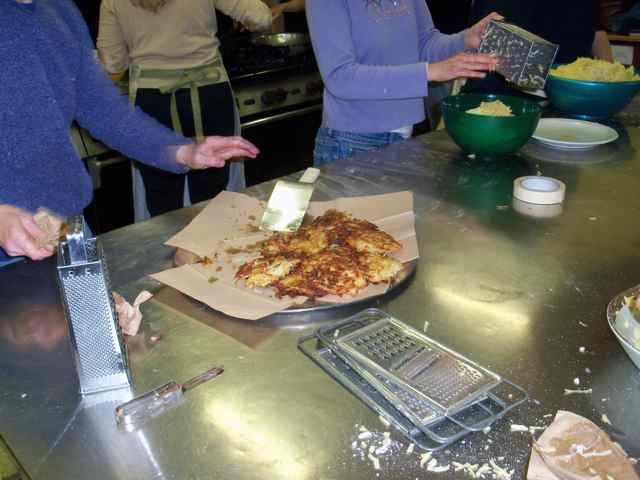
photo by Emma Pease
Last night’s midweek service, which was about Hanukah, was preceded by a latke feast, and I invited people to come even earlier than that to join in making the latkes. Over a dozen did, and we had a great time.
I billed the dish as the World’s Best Latkes and then had to come up with an actual recipe, since the way I really cook these would go more like, “Buy twice as many potatoes as you think your family can eat. Peel and grate. Add enough grated onion to make it look right. Add enough egg for it to stick together . . . ” etc. Not very helpful, though my great-grandmother in the Old Country would approve. Attendees and cooks asked for the recipe, so here is what we did last night. The only way to improve on it would be to make sure you always have a dozen fun people to cook with.
I forgot to tell everyone last night that there’s a reason latkes are the quintessential Hanukah dish: you are supposed to eat fried foods as a tip of the hat to that miraculous oil. That’s what we call a handy theological excuse. Now, in addition to the miracles of a small army defeating a large one and the oil’s lasting for an extra seven days, do you suppose there’s a miracle by which the calories from oil in which latkes were cooked disappear?
Or let’s just appreciate this miracle, pointed out by Rabbi Brad Hirschfield:
that people dared to light that tiny bit of oil and trust that somehow things would work out. Perhaps the enduring miracle which Hanukkah celebrates is that there is always more light than we first imagine and that the fuel to create it is really there when we look hard enough and dare to trust its power.
Amen to that, and Happy Hanukah, everyone!
We state the short version of the purpose of our congregation in every service: to transform ourselves, each other, and the world. I wrote this much longer version in one feverish journal-writing session about a year ago, and shared it in three consecutive newsletter columns this fall.
Yesterday evening’s service was about control and letting go. I played everyone a song by Suzzy Roche about being in a plane in a lightning storm, and repeated my favorite line: “There’s a whole lot, baby, you can’t control, so put your seat back and roll, Mag, roll”–“Mag” is her sister, I’m guessing. (At that point E. said, “Were you thinking about today’s windstorm?” I hadn’t heard about it. Turned out there were 100-m.p.h. Santa Ana winds in Southern California, a historic storm.)
We meditated on the song and on a couple of quotes such as Reinhold Niebuhr’s well-known “serenity prayer,” and I led a meditation in which we literally made fists as we envisioned gripping tightly whatever we seek to control, then relaxed and let go so it could float.
The hardest thing I could have chosen would have been my daughter. I focused on something a little easier, but then I got to my final words, introducing a song we often sing in this service, “Ubi Caritas”–
The words of our song mean, “where there is love, there God is.” It doesn’t say holiness lies in control, or certainty, or permanence. It lies in love, which is sometimes about holding on and sometimes about letting go, and usually about both
–and I choked up, and thought of a passage I’d just read, in the speech Neil Gaiman gave when he accepted the Newbery Medal for The Graveyard Book. He’s speaking of writing the last couple of pages.
And my eyes stung, momentarily. It was then, and only then, that I saw clearly for the first time what I was writing. I had set out to write a book about a childhood–it was Bod’s childhood, and it was in a graveyard, but still, it was a childhood like any other; I was now writing about being a parent, and the fundamental most comical tragedy of parenthood: that if you do your job properly, if you, as a parent, raise your children well, they won’t need you anymore. If you did it properly, they go away. And they have lives and they have families and they have futures.
It is a happy book, and a happy thought that our daughter will go on to have a life and a family and a future beyond us, but my eyes stung, too, reading this paragraph. It’s hard to imagine that I will be ready when she is.
My mother was here for Thanksgiving and, bless her, she urged me and Joy to go out on Saturday night while she took care of the munchkin. We were going to pick a nice restaurant, but Joy wasn’t feeling so well, so we opted for a cafe where we could just sit and have an actual uninterrupted adult conversation. We headed for the Mission District, where cafes are plentiful, and walked around in search of the right place.

My criteria were (1) food substantial enough to constitute dinner for me, since my stomach was fine and empty, and (2) a nice atmosphere. We walked by a place neither of us had been to or heard of before, which, judging from the outside, had atmosphere galore. I like Cuban, and there were veggie options, so in we went. I had an interestingly international veggie plate: samosa (always black-humorous in a Latin American context), Cuban black beans, basmati rice, and salad. The interior decor was very entertaining.

Our table was covered with life-size anatomical drawings of the muscles of the leg. The walls included memorial altars to Roque Dalton and John Lennon–twenty years later, I still painful to see the front page of the next day’s New York Post, which was the Lennon altar’s backdrop. Altered Barbies were much in evidence, some of them engaging in activities that you wouldn’t want your prepubescent Barbie-loving daughter to see. (We missed last month’s Altered Barbie show,so this was a nice consolation.) A very determined octopus threatened to come into the bathroom via the air vent. All in all, atmosphere out the wazoo.
Also, the exterior alone makes it a place that should be on my upcoming tour of public art in the Mission, which seven generous and lucky bidders won in our church auction. I’ve also been looking for a lunch place that has vegan dishes, since one of the seven is vegan, so I asked Radio Habana if they were open for lunch, but alas, no. So, returning to Plan A (a taqueria), today I researched a taqueria that has a lot of vegan options. How burdensome and laborious. It was delicious.
Poet Everett Hoagland will be speaking in the service tomorrow morning. Usually our two services are the same, but he’s going to share two different poem cycles, one at 9:30 and one at 11. We have great music that fits his themes of the cosmic journey and homecoming, and I get to enjoy the service from the vantage point of Worship Associate. Our Worship Associates give a 3-5 minute reflection. I was brought up with poetry as one of our family’s religions, with our household gods bearing names like Shakespeare and Frost, and it’s been fun to reflect on how that has affected my religious and ethical life. I’m really looking forward to seeing and hearing this poet in person.
Here’s what greeted me on my return from study leave:

UUCPA Main Hall walkways with 12,000-watt solar array
Or would have done if I could fly. Actually, I saw them from ground level, and lifted the photo from this article.
A lot of people at our church worked very hard and gave very generously to make this happen. I hope it means that everyone who comes onto the congregation’s campus will immediately know that we respect the earth, its creatures, and those who will come after us.
After this service, one of the wonderful leaders, J., who attended Mark’s talk at our church, and who had said he wished he could come to Thursday’s meeting (“Toward a More Diverse UUCPA”) but had a conflict, came up to me and said, “I wasn’t going to come Thursday because I had a prior commitment. It’s still prior, but this is more important. I’ll be there.”
Do you see why I am filled with confidence? Do you see why I love my congregation and have such faith in their ability to do whatever they set their minds and hearts on? I can’t wait ’til Thursday.

 Sermons in Stones
Recent comments