
You are currently browsing the category archive for the ‘uncategorized’ category.

A sanitation worker in downtown Lima. Photo by Manfredwinslow (public domain)
“We are challenged on every hand to work untiringly to achieve excellence in our lifework. Not all men are called to specialized or professional jobs; even fewer rise to the heights of genius in the arts and sciences; many are called to be laborers in factories, fields, and streets. But no work is insignificant. All labor that uplifts humanity has dignity and importance and should be undertaken with painstaking excellence. If a man is called to be a street sweeper, he should sweep even as Michelangelo painted, or Beethoven composed music, or Shakespeare wrote poetry. He should sweep streets so well that all the host of heaven and earth will pause to say, ‘Here lived a great street sweeper who did his job well.’”
My daughter (age 4 1/2), this afternoon, on seeing a street sweeper:
“That man is being good to the earth. He’s picking up the garbage . . . his mind is like our minds. He says the earth is for walking on, not the earth is just a garbage can.”
To a mind free of prejudice, heroes are everywhere.
A friend left a message on my work phone yesterday whom I hadn’t heard from in over ten years. We spent a lot of time together in 1994, when we were both living around Los Angeles, and then kept in touch for a few years after I moved east, but had lost track of each other. I’d tried finding her on the web and via Facebook, but she has a common name and I never managed to track down an actual address, e-mail address or phone number. I’m very grateful that she found me (searching Unitarian + Amy Zucker did the trick) and “walked across that burning bridge.”
We talked for an hour and only scratched the surface. So much has happened in our lives: illnesses, operations, new careers, divorces and marriages, the arrival of children and grandchildren, the death of the person who brought us together as friends. We still connect in that effortless click of conversation. I feel like someone deposited a wonderful, beribboned gift on my doorstep, when it’s not even my birthday.
The vast majority of Americans favor increasing taxes on the richest few percent, and yet we act as if we are a minority.
This week I watched A Bug’s Life for the umpty-umpth time (we have a pretty narrow range of movies around here. Pixar, Pixar, Disney, Pixar, Pixar, Ghibli, Pixar) and as usual, my favorite scene was the one where Hopper, the grasshopper gang leader, explains to the other grasshoppers (the bad guys) why they have to keep forcing the ants (our heroes) to collect food for them.
You let one ant stand up to us, then they all might stand up! Those puny little ants outnumber us a hundred to one, and if they ever figure that out, there goes our way of life!
We outnumber the rich a hundred to one, so what we need from our leader is for him to remind us of our power. Instead, President Obama is swallowing the grasshoppers’ big lie. It’s going to be up to someone else (that would be us) to show the grasshoppers who’s boss.
I have never had a guest poster here and don’t plan to start (too much administrative overhead), but I was so taken with this sermon that I asked Sharon if I could post it, and she graciously said yes. I love it because it speaks not only to the preparation for ministry, and the ongoing work of ministry, but to all that people are and do. I would wish for each congregation to be a “place that calls us back unrelentingly to who we are, lays us bare, and demands of us that we use our gifts to bless the world in the spirit of love.” I would wish that our families be such places; that our friendships be such places; that we each have such places at the center of our lives. And I’m happy to hear that for one person at least, Starr King School for the Ministry has been one such place.
To read more by/about Sharon, check out her blog, Ministry in Steel-Toed Shoes.
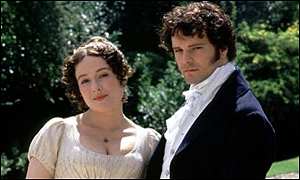
photo credit unknown (BBC)
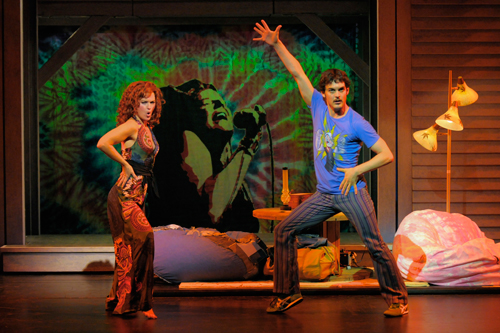
photo by Kevin Berne
My weekend was full of cultchah. After multiple attempts, I got hold of episodes 4-6 of the BBC Pride and Prejudice (the one starring Colin Firth and Jennifer Ehle) and enjoyed it over popcorn yesterday in a blessedly empty house. Well. Wow. A very faithful production, and yet so startlingly relevant and fresh that I kept pausing the DVD to check the book. “Did she really write that?”–“Yep, she did”–hit “play” again. Actually, I think it is less despite its adherence to Austen than because of it that the production works so well. Is there a better novelist in the English language? I hadn’t read the book since high school, and re-read it in preparation for watching the screen version, laughing and shaking my head in wonder all the way. It’s a classic in the best sense of the word.
It does occur to me, though, how vital it is to teach this book to 10th graders as a bit of an anthropological expedition. They just can’t understand the characters without knowing some basic facts about the culture. That a gentlewoman of the time had no acceptable way to “earn a living” except to have money from her father, brother, or husband. If you don’t get this, you’ll think the Bennet girls are just gold-diggers. That a woman who “lived in sin” would never be able to marry a gentleman (i.e., have access to a steady income), nor would her sisters. If you don’t get this, you will think the family is overreacting to Lydia’s running off with Wickham. (Lydia is so stupendously stupid that she doesn’t even know Wickham has been forced to marry her–and yet she’s believable. Austen knows how to situate her people at the absolute edge between character and caricature without tipping them over it. Good acting by Julie Sawalha, too.) These cultural differences are a reason to read the book in high school, not a reason to avoid it, but I’m not sure that even as a bright, literature-loving teenager, I fully understood that reading even fairly recent English literature is all about entering into a culture very different from one’s own.
We watched a lot of movies in high school English class; I suspected it was the teacher’s attempt to stave off burnout, since she’d show us movies of books we weren’t even reading, such as Billy Budd and The Heiress (movie version of Washington Square ). To judge from her comments, maybe her real motivation was to ogle Terence Stamp and Montgomery Clift–or maybe she was just trying to keep us interested. I’m not blaming her. Hell, Colin Firth was a major reason that I hunted down this version, and not just because the man is a superb actor. And as I said, I re-read the book in order to do justice to the movie, so Ms. N. might have had the right approach. Though I’ve never followed up American Lit by reading Billy Budd or Washington Square . . .
Earlier in the weekend we saw another period drama / comedy of manners, from a different period, when we caught the second-to-last performance of the new musical Tales of the City, based on Armistead Maupin’s books about 1970s San Francisco. I am not much of a musical lover, but Joy is, and we had heard raves from a couple of people we know well, so off we went, and it was really fun.
Contrary to what I usually say, my problem with musicals is not that they’re unrealistic. I don’t require the arts to be literal-minded; a friend once explained her dislike of the Marx Brothers (whom I love) by complaining about how unrealistic it was that Harpo always just happened to have the perfect prop in his impossibly spacious pockets, and I realized that what she found most improbable, I found most funny. And as Joy says, sure, people don’t burst into singing and dancing in real life, but wouldn’t it be great if they did? No, what I don’t like about musicals is how actor-y the actors are. So many don’t seem to be able to just sing, dance, speak; they have to add a little fillip of “Look at me, I’m Singing! I’m Dancing! I’m Acting!” that ruins the moment. (Preachers are prone to the same problem, undermining their own words with a layer of self-consciousness. I can be listening to a great sermon and then lose my concentration entirely because the minister has slid from speaking into Speaking. The voice takes on just the tiniest, most innocent kind of falseness, and that falseness detracts from the truth in the words. And believe me, I’ve used that voice myself, mea culpa.) The Tales of the City cast avoided this trap on the whole–though the one who slipped most often was the star of the show, the only actor I’d actually heard of, and who’s won a gazillion Tonys and such: Judy Kaye, who played Mrs. Madrigal. She was excellent overall, though.
I liked it. Fun music, great set, some of Maupin’s funniest lines, spot-on casting (Joy didn’t think this was true in every case, but we agreed that Wesley Taylor, pictured above, was the perfect Michael Tolliver), and yes, as one would hope for a musical set in the 1970s, a scene on roller skates–sadly brief. We wondered whether it will be tried anywhere else, and if it will travel well if so. The books are popular outside San Francisco, so maybe it will be a hit.
The munchkin’s school snacks and lunches come from Chefables, an area business whose sole focus is to provide fresh, local, mostly organic food to preschools. They announced a tour of a local farm, which to our amazement was in our neighborhood. For those who haven’t been reading closely, I live in San Francisco. In the city. Four miles from City Hall, as the crow flies. I had no clue there was a farm within a few blocks.
But there is, so we walked over, an easy 15-minute walk that would have been even easier, except that to avoid walking 50 yards from the freeway we took a route that led straight up a steep hill and then down again, which also took us through a housing project that I’d had only the vaguest idea was there. (Munchkin’s reaction: “Can we come play on this playground?” The project did have a lot of playgrounds. The one that grabbed her attention needs some maintenance, though.) And there we were at Alemany Farm. It’s only 4.5 acres, a great big garden you might say, but what a garden!
Kids from our school and others were there. They got to pull up carrots and eat them–the munchkin happily harvested her favorite veggie, but declined to eat any, for reasons we didn’t learn; pull up beets; learn the right way to pick strawberries (the munchkin did eat her strawberry and said it was delicious); play a Simon Says game that involved acting out sun, water, air, and soil; and eat pizza made right there, along with a salad harvested at the farm a couple of hours earlier. A wall of passionflowers caught my attention, and one of the Friends of Alemany Farm picked one for Munchkin. I learned that broccoli, cauliflower, collard greens, Brussels sprouts, etc. are not only closely related, as I’d thought; they are the exact same plant, same genus, same species. They’ve just been cultivated in different directions.
The farm has an interesting history. It used to be part of the city park that adjoins it, known to our family mostly for its terrific playground (you may notice a pattern here). Later, it was run by the San Francisco League of Urban Gardeners, whose terrific acronym, SLUG, is now tainted by scandal after its managers coerced workers, who were part of a city-funded job training program, into campaigning for Gavin Newsom and Kamala Harris for citywide office, or else lose their pay (neither Newsom, who’s now Lieutenant Governor, nor Harris, who’s now Attorney General, were charged with corruption). SLUG was barred from city contracts, so the farm sat unused for two years, until the Friends of Alemany Farm formed. They have volunteer work days every weekend, and Munchkin and I plan to join one soon. Joy, who has a better recent gardening history than I do but has no desire to do more, has offered to bring the volunteers food.
After the tour and lunch, we invited a school friend back to the house, where I went on a gardening binge and the girls played outside.
Things I’ve wondered for a long time and have finally remembered to look up:
Why is Rhode Island called Rhode Island when it isn’t an island? My wife looked this up on her smart phone after I posed it to our geography-loving nephew at lunch. Now we know. Thanks to Trivial Pursuit, I knew that the full name of the state was Rhode Island and Providence Plantations, but I didn’t realize that one of the islands in Narragansett Bay, the one on which Newport is located, was actually called Rhode Island (it’s now called Aquidneck).
Is Donner Pass named after the Donner Party, or are they called the Donner Party because the pass that did them in was called Donner Pass? The answer to this one gives me the creeps. The pass used to be called something different (Truckee, I think). After the Donner Party (so called for one of its members) tried to get through and, notoriously, starved to the point that some of them ate each other, it started to be called Donner Pass. What a charming thing to name a part of your state after. Still, I’ve wondered that for ages and now I finally remembered it while I was sitting in front of a computer.
Joy says that Lawrence Block says the internet will doom bar arguments. The master of the bar argument, Donald E. Westlake, Block’s late fellow great writer of comic mysteries set in New York, wasn’t going down without a fight. In his last Dortmunder novel (sadly, his last of all), the nameless “regulars” who always carried on hilariously fruitless barside debates in those books were arguing about the internet, and it was clear that none of them would be able to find a webpage with two hands and a map. And I generally think of a question for the umpteenth time, and then by the time I get to a computer, I’ve forgotten it again. But with more and more of us carrying internet-ready computers in our pockets, Block may be right.
I’ve missed out on most of the news here in a mostly media-free week in Tahoe, with occasional updates as family members tune in on their smartphones or laptops: Clarence Clemons’ stroke (oh no!), Terry Pratchett’s decline (sigh), Rep. Weiner’s resignation (about time), the governor’s veto of the proposed budget (no surprise). So I was startled when I checked into Facebook and saw a reference to destruction in Vancouver. Vancouver, lovely city–what happened? An earthquake? Fire? Oh, the Stanley Cup. What an insanely stupid reason to do damage to anything or anyone.
I’m a sports fan, but still, I wonder whether sports have had a net positive or a net negative effect on the world. Considering that for every win there is a loss, the joys of one’s team winning seem like a wash. The beauty of human bodies doing amazing things, which could transcend that zero-sum calculation, goes largely unappreciated: just go to a baseball game, see the visiting shortstop make a gorgeous play, and listen for the sounds that follow, and they’ll mostly be groans instead of “ooh”s. Sports are hailed for teaching people to work in teams, but in a sports context, as in a military one, teamwork comes only because of, and at the expense of, a common enemy. Some would argue that sports sublimate violence that would otherwise take much more destructive forms, but as far as I know that hypothesis hasn’t been tested. If it were true, one would think that the world’s most sports-mad countries would be less inclined than others to make war. I’d count the prostitution of universities to their sports programs as one for the loss column.
What do you think? Is the world a better place for the existence of sports, or would we be better off without them?
We are headed to Tahoe tomorrow night, for a week. I’m very fortunate: a week spent sharing a house with most of my wife’s extended family is a pleasure. Furthermore, it’s something we do every year. Last year we missed it, since we couldn’t convince everyone to put the annual vacation in Mexico and we couldn’t afford to fly back to the Russian River just for a week.
We’re packing a bathing suit and mittens for the munchkin. Bathing suits for the lake and pool, mittens for what, if my plans pan out, will be her first experience of snow. There was a lot of snow in the Sierras this year, and I’m hoping that a fairly short drive up from the lakeside will take us to some. I grew up in New England, and it just seems wrong to me to be four years old and never have played in the snow. She is excited.
While there, I’ll celebrate my birthday, which means it’s probably time to review my 43 goals for year 43. Some I achieved, some I didn’t, some I still want to keep on the life-goals list (maybe even the “year 44” list), some I can let go. Making the list had its desired effect, which was to get me to align my life more closely to the things I care about. I haven’t read so much good fiction in years.
So, I am almost done with 42, and I’m still not sure of the meaning of life, the universe, and everything. Although it has been a year of growing awareness of mortality. That’s polite minister-speak for “I’ve thought a lot about the fact that I’m going to die one day.”
Google Maps tells me that I saved $8.35 by taking transit instead of driving today. Unfortunately, they don’t know about the $55 ticket I got for leaving my car parked all day on the street-cleaning side of the street.
Every once in a while I take the train on Friday, or work at home that day. More often than not, I forget that I also have to move the car between 12 and 2. All in all, having a car in San Francisco is a very expensive proposition, unless you are smarter than I am and never park in the wrong place. (All the small tickets put together don’t equal the time, my first month here, when I pulled into our street so exhausted from a 14-hour day that I parked blocking someone’s driveway. That one cost a boodle.) If I didn’t have a job on the Peninsula, I’d sell the car and depend on City Car Share.

 Sermons in Stones
Recent comments