You are currently browsing the category archive for the ‘religion’ category.
The latest Ask Isabel column answers a parent whose child has learned about a heavy topic–from a church Sunday school.
Ask Isabel: Advice for the Spiritually Perplexed and Vexed
By the way, if you enjoy Ask Isabel, two things you can do to support it is subscribe (it’s free) and share the column on social media, or with any friend who might take an interest.
And the question is on religion and science.


That’s the question asked this week on Ask Isabel. It happens a lot, it’s a tender time, and it’s hard to find people who will help us along on our own journey at these moments. Most want to convert us to something new. Or they congratulate us on seeing things more the way they do. Or they try to talk us out of our “backsliding” (which is what a new stage can look like to the others in our community–see Stage 4 here). Here’s my take.
Ask Isabel: Losing My Religion
If you want to be pinged each week when the new column is up, you can subscribe here. It’s free and spam-free. And you can share any column with friends, on social media, wherever you think someone would benefit from reading it.
Photo by Karl Fredrickson on Unsplash

While the world weeps over the bloody religious conflict in the Middle East, the smaller conflicts that concern folks stateside might seem trivial in comparison. However, I believe that if we practice cross-religious dialogue in safer, easier settings like a good friendship, we can learn skills that can transfer to higher-stakes situations. Imagine a world where religion doesn’t divide us . . .
Today’s letter presents an opportunity to start small.
Ask Isabel: Two friends, two faiths
If you enjoy the column, please subscribe and share!

Tuesdays are Ask Isabel days!
In today’s column, a teenager wonders how to negotiate the gap between praying parents and an atheist friend.
I hope you like it.
One of the things I’ve been doing with my sabbatical is putting foundations under a castle in the air I’ve had in mind for several months: an advice column focused on religion and spirituality. If you’d like it to arrive in your inbox every Tuesday morning, subscribe for free by clicking on the link below. The first one goes out tomorrow!
Ask Isabel: Advice for the Spiritually Perplexed or Vexed
As a congregational minister who has been creating worship online and/or outdoors for two years, and will soon, I hope, be resuming indoor services, I read with interest a recent New York Times opinion piece by Tish Harrison Warren, a priest of the conservative Anglican Church in North America. She ends with the reminder, “A chief thing that the church has to offer the world now is to remind us all how to be human creatures, with all the embodiment and physical limits that implies.” However, the rest of the article did not offer much to those human creatures whose physical limits keep them from getting to the church building.
Warren argues that being in one another’s physical presence is irreplaceable, and with that I wholeheartedly agree. However, she takes that as a reason not to offer any other way to gather. The heart of her complaint is that “offering church online implicitly makes embodiment elective,” which suggests that the only form of human embodiment worth the name is the kind that can attend church in person. Need it be said that that is not the case? Whether we are capable of getting out of bed, traveling with manageable pain, and being in a public space for an hour is not a matter of “consumer preference, like whether or not you buy hardwood floors.” It’s something that some of the congregants with whom I serve simply can’t do, no matter how much they may wish to.
In fact, for us at the Unitarian Universalist Church of Palo Alto, one of the boons of these hard, isolating two years has been that we reached people in this situation whom we had previously excluded despite our best intentions. It has opened my eyes to the ways in which our outreach to members with disabilities was simply inadequate. For many years, we have offered rides to anyone who needs one, but some people didn’t take us up on it, saying that they couldn’t predict until Sunday morning whether they would be up for leaving their apartments. I would assure them that that was fine, that the person offering them a ride understood and could change plans on short notice, yet few people accepted this arrangement, and I thought we had done all we could. Once we began offering online services, I realized that this was the “more” that we could do, because some–not a lot, but a few–people attended that way who had not left home for church services in some years. (We also have attendees from far away, which is a lovely new development, but that raises different issues and I’ll set them aside for now.)
Warren offers, as a solution, visits to homebound members, bringing them the worship experience where they are:
A small team of “lay eucharistic ministers” at our former church volunteered to go to the home of anyone who could not make it to church and wanted a visit. They would meet one-on-one with people, caring for them, reciting a short liturgy together, serving communion and catching up.
That’s a great thing to do. We visit folks, of course; we also have a pastoral singing group that goes to people’s homes. We could, and should, do much more of that. But I can’t see myself departing from the church on Sunday afternoon, personally renewed by our experience of corporate worship, and then visiting someone to whom I have effectively said, “Never mind corporate worship. A personal visit is enough.” Many of the members of my congregation may feel–as hundreds have since March 2020–that while attending via the internet is second best, it is far, far better than missing out entirely.
Homebound folks may feel less inclined to attend online church when most other people are there in person. On the other hand, they may feel more eager to turn on their computers: “Everything’s happening at church! I want to be a part of it.”
Perhaps my and Warren’s different liturgical traditions create different circumstances. If the most important element of one’s worship is the eucharist, perhaps a visit centered on communion is enough to make the congregant feel that they have partaken of worship. However, our Unitarian Universalist worship revolves around making music together, the spoken word, silence, and the living knowledge that one is moving along the path in the company of dozens or hundreds of people. Naturally, one can bring some elements of even this worship to a one-on-one visit. When I spent a couple of days in the hospital years ago, it meant a great deal to me when someone visited me, lit an electric version of our ceremonial chalice (hospitals, like other places where pure oxygen flows, forbid open flames), and shared a reading from our hymnal. I absolutely felt ministered to, and as if I had been to worship. However, as a substitute for corporate worship every week of my life, it would be thin gruel.
Furthermore, those few who are endangered by close contact and thus unable to attend corporate worship in person are often reluctant to admit visitors for the same reason. What about, for example, a member who has a very weak immune system and must curtail visits to their home? I’ve had wonderful conversations with such members of my community via phone or Zoom. Due to their health risks, they may never come to in-person services. So if we cease our online services, they will cease to have a service to go to, period.
It may be that once COVID fades, internet worship no longer attracts more than a handful of people. But we have yet to find out. I hope we’ll find out by offering it (alongside indoor and, probably, outdoor services), and seeing who still attends, not by yanking the plug.
So we will most certainly offer both. It’s not about embodiment being elective. It’s about some people simply not having bodies that can get to the building easily, or at all.
If, as Warren fears and as probably is the case, some people who are capable of attending in person opt to attend online rather than engage with the complexities of physical presence, we’ll deal with that when it arises, compassionately and without judgment. And I’ll be glad that while they are hesitating about whether to attend in person or just stay away from everything to do with church, we will be offering them a third option.
Edited to add: Five minutes after I posted this, I happened to get a phone call from an elderly woman in my congregation who attended almost every Sunday before COVID, and has done so online since. She said that as much as she misses gathering in-person, she may keep attending via the internet. (We already have in-person, outdoor services, thanks to our climate.) The 20-minute drive is just too much for her sometimes. I rest my case.
When Diane Savona said that she would make me a stole on commission for the 20th anniversary of my ordination, she asked, “What sort of images mean the most to you?”
Wow. Where do I start? Even more difficult, where do I stop? I started scribbling in my notebook, which is my way of breaking through Questions Too Big To Answer, and came up with this list:
Burning bush: this became an important image for me in the process of writing a sermon to be delivered to colleagues on one of the great challenges of this work: How to stay present to people at the most painful, intense moments of their lives, and not just shrivel up and float away on the breeze. The best I have come up with, then or since, is that there is something deeply invigorating about entering fully into such moments: that (as I said then) it is in the places of pain and risk that we find the strength and solace to withstand the brokenness of the world, and even be transformed for the better by it. And the burning bush is of course an image from my cradle religion, and was even, it occurs to me now, the logo of Conservative Judaism as I was growing up (or was it the Jewish Theological Seminary, the movement’s rabbinical school?), with the accompanying phrase in Hebrew and English: ” . . . and the bush was not consumed.”
Spirals: these are, essentially, my personal yin/yang, a reminder of balance, because of the way they combine two kinds of motion: forward motion (in the way they move outward, or in the case of a helix like in DNA, onward), and cyclical/repetitive motion (in the way they circle around). In a spiral, one comes around again and again to the same place, but not quite the same place. Which is how life is, I think. I try to communicate this kind of balance to the folks in my congregation: stillness and progress, tradition and change, being and becoming.
Decay/erosion: for several years now, as followers of this blog know, I’ve been drawing and photographing decay. Layers of walls in Oaxaca exposing hundreds, or even millions, of years of change; the patterns left by insects burrowing in wood; wrinkles on faces; etc. I find erosion very beautiful for the way it reveals time and history, and there’s a tension between that beauty and the way our culture (over)values youth and novelty. A big part of my ministry is helping people perceive the beauty in the ordinary or despised.
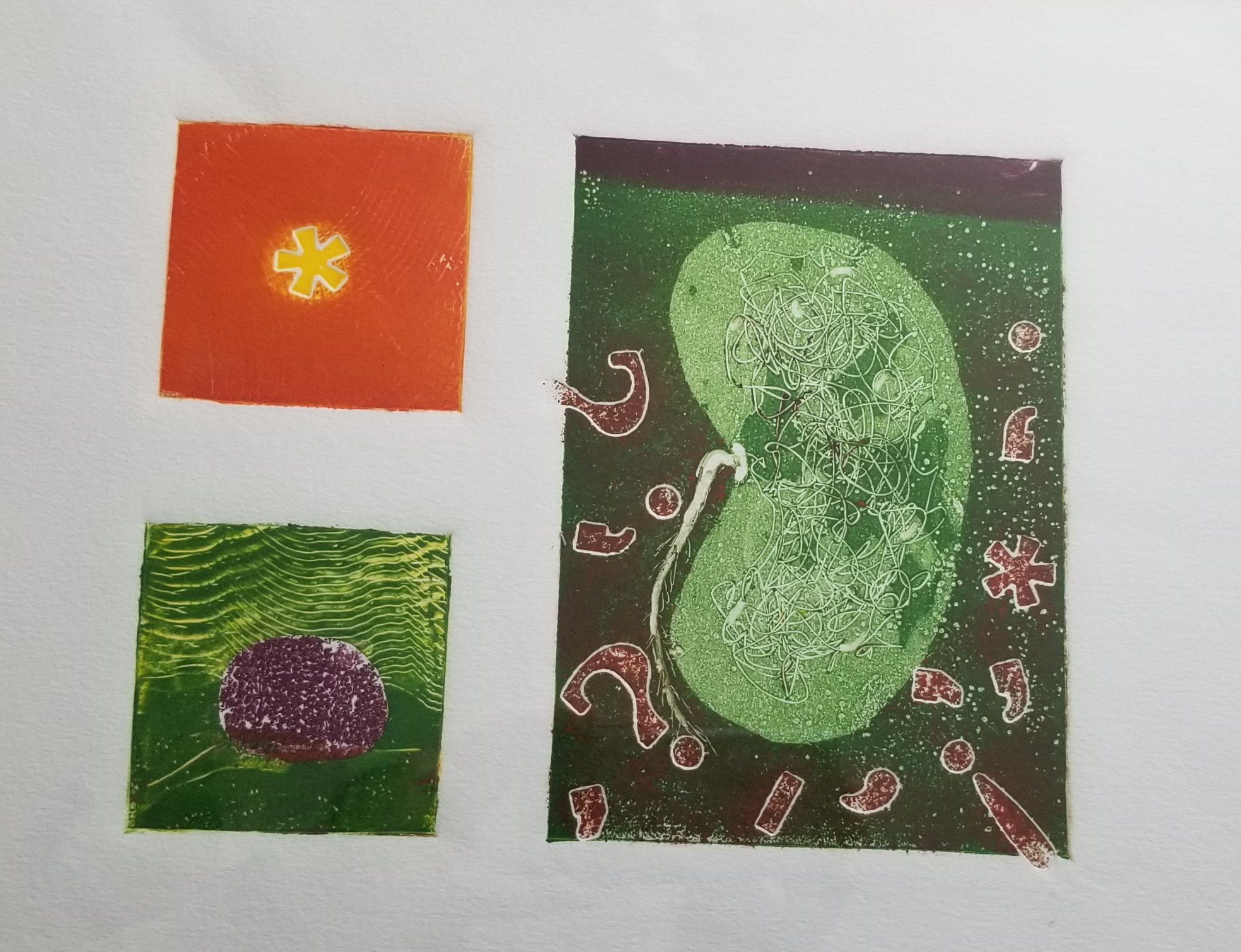
Sun, stone, seed (monoprint, 2018). The lack of centering comes from having to snap the photo of it while it’s attached to the stairway wall. 😉
Seeds/stones: I’m moved and intrigued by how closely many seeds resemble stones. There is so little difference between them, and all the difference in the world. And then there is the way seeds have to split open, essentially die in one form, in order to become more than a stone and actually grow. Whereas stones are just . . . nonliving. (No shade on stones. They’re pretty cool in their own right; note the title of my blog.) I don’t quite know what is so meaningful to me about this image of the seed in the act of sprouting, but it keeps popping up in my own work, as much as I cringe and worry that it is a cliché. There is something there about the way life and death are intertwined that keeps troubling and inspiring me, especially as I get older and try to come to terms with the reality that I am going to die. Also, an early and dear memory of mine is planting the family garden with my dad, and I always got to plant the beans, which are satisfyingly fast and visible in their process; you can often see the remnants of the seed still stuck to the first shoot as it emerges from the crack in the ground.
That’s what I told Diane, and after a bit of further dialogue between us, and many, many iterations that she worked through and recounted to some extent on her blog, she has now finished the design phase. She added so much. Mexico is in there now, and my wife and daughter, and the subtle suggestion of a rainbow, and the subtler suggestion of bees, and a water lily leaf (a.k.a. lotus–despite the fact that I never even got around to saying what was important to me about Buddhism), and roots finding their way through brick- and stonework to the sources of life. I’m so excited to see how it will be further transformed by her stitching.
Several months ago, I decided that in honor of the 20th anniversary of my ordination, which will be April 30, 2020, I was going to commission a stole. At first I looked at the websites of people who make stoles, which include many talented artists who make beautiful pieces. But I soon broadened my search, looking for fabric artists in general, which is a pretty wide net. So it was sheer luck that I happened upon the website of Diane Savona, whose work was so arresting that I put aside stole-related thoughts and just wandered happily through the gallery of her past pieces for a long time. Then I clicked on the link to follow her blog.
As I was to tell her when I finally reached out, not only is she a deeply thoughtful artist with consummate mastery of her craft, but the kinds of themes and issues she explores in her work resonate with many that are important to me. We share a fascination with the way the past is embedded in the present physically and psychically, with the beauty of objects that are obsolete or decaying, with certain objects such as keys and maps, and with art forms that are a mixture of found objects and new creation.
I don’t know whether she would describe her work as spiritual, but I see spiritual themes within it, such as her deeply respectful homage to places touched by tragedy (in the series Maps, which includes Hiroshima, post-Katrina New Orleans, and Japan after the 2011 tsunami). Her pieces in Soft Bodied Specimens and Fossil Garments show a knowledge of and respect for past wisdom, and in This Too Shall Pass she reflects on transience. And in “A Map of Hometown Perceptions” (another of the Maps series), she illuminates the racial segregation of her region in a way that is unflinching and also visually compelling, and that feels akin to my own activism.
I knew right away that I had found the artist I was looking for, but it took a couple of months before I got up the courage to write to her. It felt somehow presumptuous. “Hello, artist who is very busy developing her own ideas. I see you are working on an Opus” (that’s really what her current piece-in-progress is called! I like her sense of humor also) “but could you take a detour to work on a piece of clothing for a stranger?” I knew this fear was irrational, because artists do accept commissions, and if it’s not a good time or the commission doesn’t interest them, they will say no, and no harm done. Also irrational was my feeling that it was somehow degrading to ask an artist to make something for daily (well, weekly) use. She is, after all, a fabric artist, who has chosen a medium that, like pottery or weaving, is closely connected to pragmatic arts, in order to make works as complex and meaning-laded as any sculpture in marble or painting in oils. She is not likely to be offended by the idea that someone would wear one of her pieces.
So I took a deep breath and sent off my proposal. And she wrote back right away, intrigued, and by the time we’d exchanged a couple of e-mails we had arranged a commission. Not only that, but she could finish it by the anniversary, which was something I hadn’t hung a lot of hope on (I hadn’t even mentioned the date at first). And, best of all, she wanted to collaborate quite a lot, beginning by asking me what images were important to me, and then sharing many steps along the design path by checking in and asking what I liked. This is a tricky matter. It’s all very well to point at a design in progress and say “I like this better than that,” but to really know, I needed to know some of her thinking. Was there some significance to this seed or that photo of crumbling wall? She gives such careful thought to the many layers of meaning in images that I didn’t want to choose them only based on their visual impact, but to know their significance. That informed my choices.

Damselfly on a poppy pod (Orangeaurochs from Sandy, Bedfordshire, United Kingdom [CC BY (https://creativecommons.org/licenses/by/2.0)%5D)
Some of the significances were serendipitous. For example, there was a skeletal seed pod in one design and, intrigued by its dramatic shape, I asked what plant it was from. It turned out to be a poppy, and poppies are our state flower. It’s a different genus than the California poppy–which is good, visually, because California poppies’ pods are long and thin, like elongated mini-okra, not as interesting a shape. But it has the same name as its cousin, poppy, and as someone who, somehow, has ended up spending the bulk of my career as a Californian, I like having it there. She wanted to make sure I didn’t mind the association with opium, but it’s fine.
And, speaking of opium, Diane proposed some walls of Oaxaca, sharing photos that she’d found on the internet, I guess, and one of them was very familiar to me. I wrote about it here; it’s an exterior church wall graffitied with the line from Marx, in Spanish, “Religion is the opium (opio) of the people,” and became a family joke immediately because of the first-glance similarity to “Religion is the celery (apio) of the people.” It turned out Diane hadn’t even taken note of the graffiti; she just liked the wall itself. So I asked her to incorporate it if she could, and she has. I don’t want the phrase on my stole, either with “opium” or “celery.” Marx is too down on religion for me, and certainly for a religious ritual item. But having a bit of that wall right at my back will be funny, and a reminder to myself that my purpose as a leader is always to use religion to wake people up, not put them to sleep.
So, you can tell part of what I responded when she asked what images are important to me, but this has gotten long enough, so I’ll say more about that in the next post.
Yesterday, after considerately waiting until 9 or 10 a.m., people in our neighborhood began setting off firecrackers. “Cracker” is not the right word. FireBOOMS. All morning, we had this series of sounds:
Eeeeeeeeeeeeeeeeeeeeeeeeeeee BOOM AAAAAAH!
Eeeeeeeeeeeeeeeeeeeeeeeeeeee BOOM AAAAAAH!
Eeeeeeeeeeeeeeeeeeeeeeeeeeee BOOM AAAAAAH!
Eeeeee as a bomb rose, BOOM as it went off, and then the Munchkin’s scream.
I said, “Is August 28 some kind of holiday we don’t know about?” and Joy said, realistically, “Probably.” There are a lot of holidays here. I’ve speculated many times that I could learn comprehensive Mexican history just by looking up the dates after which streets are named. What did happen on February 6, January 20, etc., that they should be honored in this way?
I haven’t seen a Calle 28 de agosto, so maybe it was a saint’s day? It’s always someone’s saint’s day, in fact many someones’. And sure enough, on the walk home from dinner out with a friend, we saw a parade coming our way. It was clearly religious, so at first we thought, “Funeral,” but at night? It seemed unlikely. The people were singing and carrying cross-topped banners, and one bier of flowers. The holy person portrayed in the banner on the bier looked like any old white European man with a beard, so we wouldn’t have been any wiser, except that another banner read “San Augustin vive para siempre (Saint Augustine lives forever). It turns out that August 28 is the saint day of Augustine of Hippo, a very important person in the history of the church. It’s interesting to note that he was neither white nor European, but a Berber, which means he probably looked a lot like the people who were marching and singing in the parade.

 Sermons in Stones
Recent comments