
You are currently browsing the category archive for the ‘politics’ category.
The hotel I stayed at last weekend has a sign assuring customers that they conserve water by drawing on their lake and their “private well” for their landscaping needs. I estimate that given its surface area and the hot, dry location (Sacramento), the lake loses a couple thousand gallons of water to evaporation each day, helped along by the fountain in the middle, so that is not a point in their favor. The ownership of the well doesn’t seem relevant.
I wondered whether the hotel had taken any steps that are actually effective in reducing water use in a drought-stricken region of our drought-prone state. The shower head was not remotely low-flow. There was no card offering me the option to save water by signaling that I didn’t want my sheets and towels laundered every day. (I was only staying one night, so it was moot, but whenever I stay more than one night I take the conserving option.) The sprinklers were going in the pouring rain.
Other Pacific Central District Assembly attendees, if you stayed at the conference hotel, Red Lion will e-mail you asking about your stay. If you care about water conservation, you could make some suggestions. Or if you don’t have the email, there’s this form.
S. is an electric-vehicle (EV) driver, builder of a platinum-LEED home, and all-around passionate environmentalist in my congregation. He lends his EV out to everyone who’s curious (Joy, my wife, calls him an EVangelist), and one Tuesday in October, he brought it to church for me to try it for a week. It’s a Leaf. It was lots of fun. And I promised I’d write it up, which I am finally doing now that I’m making myself blog daily (except for the Weekend from Hell, which we will ignore).
The first thing you need to know is that I have a serious commute. It’s 32-39 miles, depending on the route. A car has to get me that far in heavy traffic with lots of battery charge to spare, or I’m going to be very nervous. The car had plenty of charge for the job.
It did not always have as much charge as it said it did, or maybe it’s vice versa. For example, we took a seven-mile drive to a restaurant one day. The car said it had 35 miles of charge, so that seemed plenty safe. By the time we’d gotten to the restaurant, our cushion had dwindled; the car was reporting it had dropped 14 miles. Ulp. We made it home, no problem, but this erratic behavior could hamper travel.
Plugging into the 110 outlet in our entryway was enough to charge the battery overnight, but it meant running the cable over the sidewalk, which meant taping it down each time. If we owned an electric car, that would get old very fast. We’d need a charging station in the street, or in our garage, or at least we’d want to use the 220 outlet that’s in the garage. (Our garage is not presently accessible to any car that wants to keep its undercarriage attached.)
At work, I could fully charge in 4-6 hours, because our church rocks and puts its money where its Seventh Principle is by having a free charging station. If you had a commute of any significant length and didn’t have access to a charging station while at work, an EV would be pretty impractical; however, more chargers are popping up all the time, many available to anyone who wishes to use them, for free or a small fee. Mobile apps direct EV users to the network, and there’s a great community feel to it, eco-creative types helping each other out. Our church is on the apps’ maps, and we often have visitors who are there to plug in while they’re working, shopping nearby, etc.–or they live in the neighborhood.
The other cool thing about UUCPA’s charger is that, like many Palo Alto locations, we opt for Palo Alto Green, which means that all our electricity is from renewable sources. So after I charged at work, I was driving a truly zero-emissions vehicle. Even charging at home, with plain old Pacific Gas and Electric, I’m running a much cleaner car than one with a gas engine. Joy, who is an energy analyst for the state of California, says that even if you use electricity generated in the dirtiest way available (that would be coal), driving an EV would still generate lower emissions than a hybrid, gas, or diesel engine. (S. takes care to say, “The manufacture of the EV causes emissions,” proving that there is such a thing as a rigorously honest evangelist.)
A factor that surprised me may be a major barrier to widespread acceptance of EVs around the country: they’re cold. A gas engine engenders so much excess heat as a by-product that when you want to warm the interior, you just run a little air off the engine. Okay, all that heat is part of the problem–but in Vermont, you need it. Heck, you need it in Palo Alto. You can turn on the car’s heater, of course, but making heat from electricity takes a lot of energy, and it cuts into the battery’s time quite a lot. The seat warmers, plus some old-fashioned approaches like a blanket over the lap, were good enough in this climate, even for an easily-chilled person like me, but in a cold climate, EVs will need more efficiency to get both a warm interior and a long-lasting battery.
On the other hand, S. is an early adapter and the Leaf has been around a while, so I was driving one of the least efficient EVs. I’m sure this aspect of the technology will keep improving, as will the infrastructure that is currently reminiscent of the earliest days of ATMs, when they were few and far between and of so many formats that most of them didn’t take your card. Standardization will come soon, as it usually does in technology.
Joy got to go on a tour of the Tesla factory last week–don’t ever let anyone tell you that the job of State of California Regulatory Analyst lacks in glamour and excitement–and reports that they plan to offer an EV for under $30,000 in 2017. Our Prius will be pushing 200k miles by then. Hmmm . . .
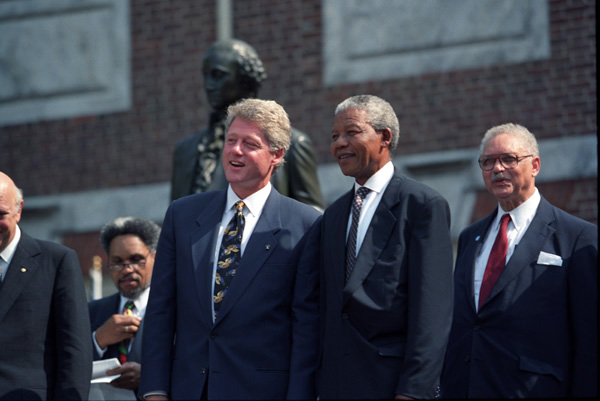
Mandela at Independence Hall, Philadelphia, to receive the Liberty Medal, July 4, 1993
Nelson Mandela was a hero of mine ever since I first heard of him, in the 1980s when I was a teenager growing into political activism. Ending apartheid was just a dream. Sure, we suggested concrete steps, such as divestment, but I for one didn’t think I’d see it end in my lifetime. I thought Mandela would die in prison, his main achievement martyrdom. We’d sing “Free Nelson Mandela” without any real hope that it could happen.
And then it did, and the African National Congress actually took power, and prisoner Mandela was president of South Africa. Of South Africa! And he was a wise, progressive leader who brought tremendous healing to a country that had seemed certain to die of self-inflicted wounds.
Like Martin Luther King, Jr., Mandela is usually mentioned in the context of racial justice, but like him, he was also passionately concerned about economic justice. Having defeated apartheid, he turned to an even larger foe: poverty. One would think that almost 20 years of revolutionary activism, 27 years in prison, and five years as the head of state would entitle him to an honorable retirement, but Mandela never stopped taking on new challenges. In 2005, he went to London before a G8 trade meeting and reminded the leaders and the gathered crowd that the G8 had pledged several years earlier to cut world poverty in half. “Do not look the other way,” he said to them; “Do not hesitate. Recognise that the world is hungry for action, not words. Act with courage and vision.” (Full text)
The statement that poverty is not natural, but a human creation, is so simple and so radical. I hope one day we will look back on his words about poverty and perceive their truth as easily as we now perceive that apartheid was wrong.
Like slavery and apartheid, poverty is not natural. It is man-made and it can be overcome and eradicated by the actions of human beings.
And overcoming poverty is not a gesture of charity. It is an act of justice. It is the protection of a fundamental human right, the right to dignity and a decent life.
While poverty persists, there is no true freedom. . . .
Sometimes it falls upon a generation to be great. You can be that great generation. Let your greatness blossom.
Not everyone is born to a life as large as Nelson Mandela’s, but those last three sentences are going up beside my desk to remind me not to live small when it comes to making justice.
We are honored and inspired by hosting those who are fasting for family unity and immigration justice today. Under the leadership of the UUCPA Immigration Task Force, we have joined thousands of Unitarian Universalists across the country who are currently studying and taking action on the moral issue of immigration. This is a crucial moment in the history of U.S. immigration policy, as Congress weighs the possibilities for real reform. We are proud to stand beside the other member congregations of Peninsula Interfaith Action in making sure the legislation represents our values. Our religious principles guide us to insist upon an immigration system that respects the dignity of all workers; seeks to unite, not divide, families, including those with same-sex partners; allows freedom of movement and empowers those who wish to remain in their countries of origin to find gainful work there; and warmly invites into citizenship those who wish to join our country.
The current system is broken. It demands cheap, migratory labor, then scapegoats those who come here to work. It makes migrants of those who would prefer to stay in their native lands, and expels those who consider the United States their home and want to continue to stay and serve here. It treats people as criminals for seeking to do what is best for their families and to keep those families together.
As the descendant of despised immigrants, I respect the courage and strength of today’s would-be US citizens. As a parent, when I hear stories of parents and children kept apart by economic necessity and by an irrational and destructive immigration policy, I feel a wrenching pain inside. I am joining in the fast today because I feel this solidarity. I hope that the pangs of hunger will make it impossible for me to forget the pain millions of families feel when they are torn apart.
Some tell us that we need to build walls that keep some of us on one side of a border and others on the other side. We recognize that national boundaries may be necessary, but just the same, our hearts can be, and remain, with the people on both sides of the border. If we must choose sides, then as we sing in one of our Unitarian Universalist hymns, “we are standing on the side of love.”
I’m passionately concerned about the environmental catastrophe that is already upon us and only getting worse. We need to reverse climate change as soon as possible, and ending our dependence on fossil fuels is a key step. There seems to be a groundswell for the idea that the best way to do so is to divest from fossil fuels. So I have been reading up on divestment, and finding that no one, least of all Bill McKibben in his article “Divest from Fossil Fuels. Now,” has explained to me yet how this movement would further the goal of reducing fossil fuel use. I’m frustrated, because his organization, 350.org, and Naomi Klein, who’s also working on divestment, have been two bright lights in the environmental movement in recent years. I would love to be convinced that they are not wasting everyone’s time and a whole lot of activist energy on a project that divestment supporter Isaac Lederman, a Princeton student, says ” is attractive primarily because of the symbolic weight it carries.”
Granting that divestment helped end apartheid in South Africa (which is of course debatable, but I think the evidence is strong that it did), is this situation analogous? In one crucial way, it is not: it comes accompanied with no demands. And I fear that that dooms it to being merely symbolic.
In the South African divestment campaign, the message was simple. To corporations: cease operations in South Africa and we will re-invest in you. To the South African regime: end apartheid and we will support you and the return of corporations’ capital to your country. I strongly supported this movement, which was at its peak during my college years. I not only urged my university to divest its Shell holdings (on one occasion, by leading the crowd outside a trustees’ meeting in singing “Blowin’ in the Wind,” I cringe to recall), I stopped buying Shell.
But I can’t stop buying fossil fuels and the energy they produce–not yet. I use them to get to work, to do my laundry, to keep my food cool, to power this computer. (Unlike Mr. McKibben, I can’t afford to convert my home to solar power, though it’s on the list of improvements we’d like to make.) So if I support divestment, I’m asking people to stop funding Exxon’s oil exploration, while I’m pumping its gasoline. While I’m not advocating purity as a moral stance, this is too much cognitive dissonance for me. You scum, stop drilling! And give me that gas!
McKibben argues that these companies have so much political clout because of the value of their stock. That may be true in part. But no matter how low their stock drops, they’ll still drill, because we’re still buying their products, and they’ll still have political clout, because the economy can’t continue without them. Again: yet.
A change movement has to ask, what change are we hoping for and what’s the leverage that will bring it about? In South Africa, the answers were clear. With the Divest from Fossil Fuels campaign, I don’t get it. It seems to just be saying “Fossil fuels companies are horrible” (no argument there) and “If they extract and burn everything they’re trying to extract and burn, the warming of the planet will accelerate” (again, I agree). But as long as we are so dependent on extracting and burning them, nothing will change. A heroin junkie might be completely justified in demanding the arrest of all the heroin dealers, but if it were to happen, he’d be up a creek. He still needs his fix. I still need to get to work, 35 miles away.
The situation is too dire for symbolic gestures. We need to take real action. I love the idea of putting economic pressure on these companies, and the first question to ask–the question their directors and executives will surely ask–is “Pressure them to do what?,” a question that not even McKibben, the man who started the divestment movement, has answered. One colleague of mine has–thank you, Earl Koteen; he suggests that what we are asking fossil fuel companies to do is to switch their operations to sustainable sources and become (alternative) energy companies, as the savvier ones are beginning to do. That sounds promising. Now if only the movement, and not just one of its fans, would make a concrete demand like that, then it might make a difference. Even better, we could do the much more difficult work of funding alternative infrastructures that would allow us to break our fossil fuel addiction.
 I got this letter in the mail today.
Dear miss Amy
In response to your letter printed in S.J. Mer. I don’t know which Bible you teach from but my Bible teaches that marriage is between a man & a woman I Cor. 7-1-5 also that sexual immorality is a sin I Cor. 6-12-15 Homosexuality is a sin I Cor. 6-9 I tim 1-10. Also beware of false teachers Mat. 7-15 I believe that the Bible is God’s word and should be followed not added to or taken away from the Holy Word! May God have mercy on your soul!
No signature, but written on such a sweet card (see photo) that it almost qualifies for Passive Aggressive Notes.
Since she didn’t include her return address or even her name, this woman is clearly not interested in hearing what I (false teacher that I am) think the Bible says about marriage, nor my views on its being God’s holy and complete word. Anyone who wishes to, post in the comments and I’ll be happy to oblige.
On this sacred day of choosing–with gratitude to those who entrusted us with this honored task, who struggled and suffered that we might have the power to choose–may we choose well.
May we choose love over fear, wisdom over cleverness, courage over cowardice, life over death, kindness over callousness, faith over cynicism.
May we know that we choose not just for today, but for many generations to come. May we know that we decide not only for ourselves and our own, but on behalf of all the earth, its peoples and creatures, the waters and lands in which they dwell.
We seek the humility to know our own shortcomings and uncertainty even as we accept the responsibility to decide the fate of others.
May we weigh our choices with full awareness of how precious is all we hold in our hands. As we ourselves are weighed and tested by the choices we make, may we be found worthy.
May we choose as leaders those who will strive to do justice, love mercy, and walk humbly. And, grateful for our differences, may we find in each other qualities worthy of our trust and respect.
One for election season. Given at the Unitarian Universalist Church of Palo Alto, CA
September 30, 2012
Readings
from “The Mad Farmer, Flying the Flag of Rough Branch, Secedes from the Union,” Wendell Berry
From the union of power and money,
from the union of power and secrecy,
from the union of government and science,
from the union of government and art,
from the union of science and money,
from the union of ambition and ignorance,
from the union of genius and war,
from the union of outer space and inner vacuity,
the Mad Farmer walks quietly away.
There is only one of him, but he goes.
He returns to the small country he calls home,
his own nation small enough to walk across.
. . . .
Calling his neighbors together into the sanctity
of their lives separate and together
in the one life of their commonwealth and home,
in their own nation small enough for a story
or song to travel across in an hour, he cries:
Come all ye conservatives and liberals
who want to conserve the good things and be free,
come away from the merchants of big answers,
whose hands are metalled with power;
from the union of anywhere and everywhere
by the purchase of everything from everybody at the lowest price
and the sale of anything to anybody at the highest price;
from the union of work and debt, work and despair;
from the wage-slavery of the helplessly well-employed.
From the union of self-gratification and self-annihilation,
secede into care for one another
and for the good gifts of Heaven and Earth.
from The Righteous Mind: Why Good People are Divided by Politics and Religion, Jonathan Haidt (Random House, 2012; all citations are from the eBook version)
If you really want to change someone’s mind on a moral or political matter, you’ll need to see things from that person’s angle as well as your own. And if you do truly see it the other person’s way—deeply and intuitively—you might even find your own mind opening in response. Empathy is an antidote to righteousness, although it’s very difficult to empathize across a moral divide. (79-80)
Sermon “From Righteousness to Right” Amy Zucker Morgenstern
It’s thirty-seven days to the Election Day, but who’s counting? And if you are like 95 to 97 percent of likely voters (and I certainly hope you are a likely voter), you’ve already made up your mind about the presidential ticket. So you don’t have a lot to do between now and then. Today I am proposing some homework to fill the empty hours.
I’m joking, of course—there’s a lot to do in the next 37 days, and I’m going to propose some specific things two Sundays from now that we all might do to help with the democratic process. But this assignment is just as important. In fact, I believe that doing this is as important to the future of our country as the outcome of the election. It is quite simple:
Pay attention to what people on “the other side” are saying and try, as Jonathan Haidt recommends, to see things from their angle.
Okay, now, you only have to do it for 37 days. It’s not the end of the world.
(And please forgive me, but for simplicity’s sake I am speaking mostly in binaries, as if there were only two parties and two basic worldviews, which is of course not true. The reasons for listening to other’s views apply more broadly, so feel free to translate.)
Why should we do this? Three basic reasons. To increase the chances of all of us making the best decisions; to stop demonizing our political opposites and realize that our concerns overlap with theirs much more than we knew; and to create a national community that is better than the flawed and struggling one we have created so far.
So, to the first point. Do we want to feel right, to have the security of never doubting our own positions? Or do we want to be right? That is, do we want to advocate the public policies that are best for the people of our country and for the world, as best as we can tell? Then we need to make wise decisions. And here Jonathan Haidt has some news for us. He is a psychologist who researches moral decisionmaking, especially in the realm of political decisions, and in the book The Righteous Mind, he gives ample evidence that human beings don’t use reason to reach our moral and political decisions nearly as much as we think we do.
This summer, in a sermon on the religious implications of neuroscience, Dan referred to this fact, and gave the example of reflexes and near-reflexes, such as moving our foot toward the brake before we’re consciously aware of the need to stop. It goes way beyond reflexes. Haidt cites ample research, his own and many other people’s, to prove that to a large extent, we do not reach our moral decisions by reasoning. For example, research subjects are asked to respond to a story in which someone breaks a taboo. They are all alone in the house and doing housework, and, having run out of rags, use a worn old American flag to clean the bathroom. Or in another story, the family dog is killed by a car and the family decides to eat it. The subjects reach a conclusion almost instantly. Most are unable to explain their opposition to these acts in terms of their usual moral categories: no one was harmed, there was no injustice or infringement of someone’s freedom. They can’t give a reason to support their intuition. But they try, they try . . . They invent reasons, such as that someone might see the woman using the American flag to clean with, even though the story explicitly says no one sees her or ever finds out what she did. It appears that, faced with moral choices, we react, almost like that foot on the brake, and then we invent explanations and justifications for our reactions. Haidt concludes:
If you think that moral reasoning is something we do to figure out the truth, you’ll be constantly frustrated by how foolish, biased, and illogical people become when they disagree with you . . . They’re mostly post hoc constructions made up on the fly, crafted to advance one or more strategic objectives. (12-13 eBook)
I’m sorry to tell you this, but I’m not just talking about that cousin or neighbor or friend of yours with the crazy political opinions. I’m talking about you. I’m talking about us all.
Haidt’s metaphor for how we actually make moral decisions is that of a rider, the reason, astride an elephant, the intuition. Our intuitions drive a great deal of our decisionmaking, just as an elephant who wants to go to the left or the right is likely to get her way. The rider can steer, but when the elephant heads one way or another, the momentum to keep going that way is powerful. In fact, it turns out that our riders, our reasoning selves, do an awful lot of rationalizing: not reasoning our way to a good decision, but filling in plausible explanations for why we are making the decision we are, when the real reason is that the elephant led us that way.
Other examples abound. For example, people are given a simple cognitive exercise in which wrong answers are common. What is telling about the research is that
when people are told up front what the answer is and asked to explain why that answer is correct, they can do it. But amazingly, they are just as able to offer an explanation, and just as confident in their reasoning, whether they are told the right answer . . . or the popular but wrong answer. (70, emphasis added)
The same appears to true for moral reasoning. “Moral reasons are the tail wagged by the intuitive dog,” he writes (78, emphasis in the original). “You can’t make a dog happy by forcibly wagging its tail. And you can’t change people’s minds by utterly refuting their arguments” (ibid). So Haidt advises, “Keep your eye on the intuitions, and don’t take people’s moral arguments at face value”—and I would add, including, and most especially, your own. Because if you or I think we’d have done better in these research studies, well, the evidence is not with us. Liberals and conservatives are equally skilled at inventing after-the-fact rationalizations for our intuitive opinions.
And, conservative and liberal, we are particularly bad at looking for evidence that will contradict what we already believe. I will confess right here and now that if I see a story on the web that appears to be going to confirm my opinion, I’m much more likely to click on it than on one that appears to be going to challenge my opinion. I’m more likely to click on a story about some stupid thing done by the person I’m planning to vote against than on a similar story about someone I’m planning to vote for. Research suggests that I am not unusual.
What does this have to do with listening to other people? Well, it is possible to strengthen our inner rider in making real, reasoned decisions instead of rationalizations, and one of the main ways to do so is to encounter thoughtful, challenging opposition to our elephant’s wishes, our intuitions. The friction of conversation, of engagement, rubs off those assumptions and first-intuitions. Good news: studies support this assertion too.
So if we are to make good decisions on these questions that matter so much, then we need to interact with people who disagree with us. This is also supported by my own experience. When I do read the story that supports a different point of view, I come away with a more nuanced view, myself. It doesn’t necessarily change my mind, and I doubt anything I could read would change my mind about whom to vote for for President five weeks from Tuesday. But it helps me to reach a more thoughtful conclusion and, over time, to think things through with more care and complexity.
Unfortunately, interacting with people we disagree with is really not fun. And you may be asking right now, “Do I have to invite creative friction into my life? I hate friction. It feels awful. It’s uncomfortable and unpleasant and makes me want to throw ______ across the room. (Fill in the blank here—“the magazine,” “the newspaper,” “the radio,” “my computer,” “my brother-in-law.”) Can’t we just carry on with our no-politics rule and keep everything civil? That way we’ll all get along and the next family gathering will be much more pleasant.”
Well, I’m glad you asked. Because it brings me to my second reason for engaging with the enemy, I mean, with people of opposing political views, which is that it helps us to understand that we are much more similar to them than we might have thought, and it helps us to honor our own values.
Our first similarity is that we’re all flawed decisionmakers: “very small rider[s] on . . . large elephant[s]” (420). We already knew that others make decisions illogically. When we know the same about ourselves, we can listen to them with more compassion.
And then we might make an even more important discovery: that the moral divide between us is not as great as we think.
You see, we tend to take political beliefs and generalize grand moral views from them. Political differences mean someone is deficient in morals. Republicans are hesitant to support social programs, which must prove that they don’t care about compassion. Democrats are eager to place restrictions on how someone earns and spends their money, which must prove that they don’t care about freedom. And when we know someone who is otherwise very nice and whom we generally respect, and yet whose views are very different from ours, we surmise that they are being foolish or misled.
Haidt proposes that there are six different moral categories, areas of consideration that we use in making our moral, and therefore our political, judgments: caring for the vulnerable and protecting them from harm; fairness; and freedom from oppression; loyalty, a respect for authority, and purity, or what Haidt calls sanctity. (I think he is probably leaving out one or two.) Which ones you draw upon is a good indicator of your political positions; interestingly, conservatives tend to draw upon all six fairly evenly, while liberals draw heavily only on the first three. And there is much more research about this, with many interesting implications we don’t have time for this morning. But what I want to focus on today is that they are moral categories. Someone who has a political viewpoint that we find bewildering probably arrived at it not because they are bad or thoughtless, but because it supports a moral value that they hold dear. And furthermore, when we look at these moral values in this light, we may realize that we share them more than we thought we did.
For example, one of the distinctions between conservative and liberal is how much we are troubled by freeloading. I often think it is the major distinction. If you set up a social program—for example, food stamps—then some people will use it who don’t really need it. This tends to drive conservatives crazy, to the point that they would rather not have the program at all; liberals, on the other hand, tend to consider it a necessary evil and would rather keep the program and tolerate some freeloading. But where I get really concerned, for myself and, here I’ll pick on other liberals, is that we stop caring about freeloading, or even acknowledging that it is a problem. We can’t afford to admit it. If we did, we might allow a chink in the armor around social programs. We might have to concede something to the opponent. That’s how it looks when we are in combat instead of in conversation.
And yet, if I step out of combat and into my own experience, I can say honestly that freeloading drives me crazy too. For example, I hate this: I’m in heavy traffic on the highway, so heavy that it’s practically at a standstill. I and all the other responsible drivers have been sitting there for half an hour. Now along comes someone speeding along the shoulder, in which it is illegal to drive except in an emergency—just zooming past all the rest of us—and he wants to cut in front of me to get back into a lane. No way! I’ve been playing by the rules, like the hundreds of other cars here, and we all want to get where we’re going just as much as this guy does, and no way am I going to let him delay us one moment more. He can darn well get to the back of the line. Geez, every schoolkid knows this: you don’t cut in line.
What if I were to say to my conservative friends, who are so incensed by the prospects of one welfare recipient having a Cadillac or a hidden income on the side: “That makes me angry too”? What might happen? It would be more honest, for one thing. I’d be opening up a part of myself that I had denied, and that’s always good for making better decisions. We would feel less alienated from each other. Maybe we could have a constructive conversation about how to meet our shared goals: get help to those who really need it, minimize cheating by those who don’t. And maybe we would all honor all our values a little more.
We tend to assume that the people whose political views differ from ours have very different moral convictions than we do, and some of Haidt’s work suggests that we do tend to draw on different areas of moral consideration. But let’s look for a moment at the song we sang as our opening hymn. Does “If I Had a Hammer” express liberal or conservative values? You may know the politics of the writers already—hint, they were blacklisted during the McCarthy years—but if you didn’t, could you guess from the words? A vision of our land being one of justice, freedom, and love, where we think of ourselves as family, and where we see danger that calls for a warning? If you think your side has these values but the other one doesn’t, you’re not even going to want to talk to them. If you think these are the values only of the other side, then you might invent reasons that they’re bad. For example—this is for the liberals out there—what if I told you that the songwriters were not leftists but actually very conservative? Would you start thinking that there was something a little fishy about their supposed devotion to justice, freedom, and love?—maybe that those terms meant something very different for the songwriters than they do for you?
Are you finding yourself wanting to know Haidt’s own political views? If you learned they differed significantly from yours, would you be less inclined even to consider the findings of his research?
The research, sadly, says yes. We are less likely to notice facts that contradict our beliefs than those that affirm them, and when presented with contradictory facts, we are more likely to ignore them. Left to ourselves, we sit in an echo chamber, calling out our own convictions and happily listening to them confirm what we already believe.
Which, again, is why we need to listen to people with whom we disagree. Now, there’s no need to go to extremes. Just find a responsible, thoughtful source that has a different political bent than your own. If you’re liberal, don’t start watching Fox News or reading the Drudge Report; try reading the Wall Street Journal or The Economist. If you’re conservative, don’t start logging in daily to Talking Points Memo or watching Jon Stewart; just try getting your news from the New York Times or the Washington Post. Don’t lift the ban on talking politics with the person who thinks you are going to hell for your convictions, or taking the country there. Instead, find that reasonable friend or family member, the one about whom you’ve wondered, “How can someone so smart and kind have opinions like that?,” and ask them, for real, not rhetorically: “What makes you reach that decision? What values are behind it?” And listen, without thinking of how to change their minds or what’s wrong with what they’re saying. What might be very hard is that they might not be ready to listen to you. It’s okay. This is a first step. Just listen.
It will not only improve your relationship, it will improve our country. That’s my third reason for making this recommendation. Not only will we make better decisions if we strengthen our riders by having to reason, not just rationalize; not only will we be truer to ourselves if we acknowledge the many values that go into our decisions, not just one or two or three; but we will be a stronger, better society if we build on all of the moral foundations that we and our neighbors value. A society cannot stand just on a couple of our values—it needs all of the six that Haidt outlines, and maybe more. Too little respect for authority will make our streets unsafe and our schools and workplaces combat zones of all against all. Too little care will create a society that knows only justice and no mercy or kindness. Too many freeloaders will break the system. We need not just the love between our brothers and sisters, not just freedom, not just justice, but all three, and more. Among us all we hold a great deal of moral capital, without which the most wonderful dreams of left or right can’t survive.
As Haidt writes, “Social order is extremely precious and difficult to achieve” (364); “Moral communities are hard to build and easy to destroy” (392). As we move through the difficult next five weeks, at those moments when we feel despair that this country can ever be united or that goodness can ever prevail, let us turn not to the shelter of our own righteousness and self-righteousness, but to our neighbors, all of them, and ask them, “What moral values do you hold most dear?” Let us be ready for what they say to surprise us, hearten us, and challenge us. Let us be prepared to see beyond the walls we have built and find something of value on the other side. Maybe then we can build, together, despite our differences, because of our differences, a society that will be good, and do good, for the world and the future.
(c) 2012 Amy Zucker Morgenstern

San Francisco 2006 Pride Parade, by Dejan Čabrilo (licensed under Creative Commons)
Tomorrow thousands of hetero, cisgender people will show up on Market Street just to show up: to let LGBT people know, by their presence, that they support us and will stand by us. (Okay, most of them are also coming to be part of the fun and fabulosity. But support is part of it.) It’s hard to express how important that presence is. I can only say that our lives would feel lonelier, and the world scarier, if not for these allies.
I hope our presence at “Sheriff Joe Arpaio’s S.M.A.R.T. Tents” earlier tonight–that’s the actual official sign there, what an ego–gave the people in the tents, and the millions more around the country who have reason to fear they’ll end up in such places, the hope and strength that comes from knowing you have allies outside your own vulnerable community. That wasn’t exactly why I was there; I was there for the simple reason that immigration justice groups in Phoenix asked us to be. But I know how good it would feel on Market Street in the morning, if I were at Pride, and I hope we gave immigrants to Arizona, and everywhere else in reach of the AP story, something of that feeling.
The past two weeks have been packed with preparations for our launch of the Unitarian Universalist Abolitionists at General Assembly (GA). The Abolition Team is proposing “Ending Slavery” as the next Congregational Study/Action Issue, and for that we need five speakers at tomorrow’s plenary, before the vote. We left one open speaker’s slot in case we met someone during GA who was so enthusiastic that they should be the fifth; I prepared a piece as a backup. Everyone was very happy with what I wrote, but I will not be reading it tomorrow morning, for the best reason: the Youth Caucus has chosen to support our CSAI, and so they are getting that spot. They make their decision by consensus, so it is momentous.
Here, then, is the piece I wrote. I called it “Bury Us Not in a Land of Slaves,” after the Frances Ellen Watkins poem whose close I find so moving. Harper was a Unitarian poet, abolitionist, and survivor of slavery.
There is a child in a cotton field. He is just a little older than my daughter. They could be schoolmates, or playmates. But he doesn’t play much; he doesn’t go to school. He works, without choice, without pay, far from his family. He is a slave.
He might have picked the cotton of the t-shirt I bought my daughter last month. She looks really cute in that shirt. He would, too, this child who could be her friend, this little boy in Uzbekistan or Texas. But he doesn’t have a new shirt, just as millions of other children harvest cocoa beans, but don’t eat the chocolate; or make bricks, but live in shanties made of tin and cardboard. I don’t want to raise my daughter to believe these children are any less deserving than she is. Yet I am trapped, she is trapped, all of us are trapped, in an economic system where slaves make many of the goods we use.
We know how to spring the trap. It’s called the abolition of modern slavery, and it is overdue. So is our involvement.
I hope with our vote today we will follow in the footsteps of the Unitarian and Universalist abolitionists of an earlier day. I hope no one will ever say of us what was said in 1851 when the other churches in a Massachusetts town rang their bells for freedom: “The bells of the Unitarian church, being clogged with cotton, would not sound.” We know that our true self-interest is served by freedom and justice for all. Let us act so that the generations to come will look back on this GA as the moment when the UUs claimed their better heritage and joined the 21st century abolition movement—or, better, helped to lead it—and made freedom ring out throughout this country and the world.
***
Whether or not the CSAI passes (we’re waiting for the result), we have done a lot at this GA to build a UU abolition movement, and we’ll go forward from here. If you want to know more, please:
write to info AT uuabolitionists DOT org, or
visit the UU Abolitionists website (now due for a post-GA update), or
“like” our Facebook page,
Or sign up for our Twitter feed, @uuabolition.

 Sermons in Stones
Recent comments