You are currently browsing the category archive for the ‘drawings’ category.
Joy said about the drawing I posted earlier, “All self-portraits have that same expression.” True–it’s the expression of someone concentrating. Just to prove it wasn’t the only option, I did this one just now, working fast and having fun, though my tongue started to feel dry.

Robert Arneson actually did this years ago.
I didn’t go to drawing today; it’s rare for all three of us in the family to have a weekday off, and we preserved it as a family day. I did some drawing at home, though, which I seldom do in any sustained way, so I’m pleased.
Usually I have my paper propped up on my knees, but this time it was flat on the table. As a result, what looks pretty correctly proportioned at the angle at which I drew it–

–shows all its distortions when propped up perpendicularly:
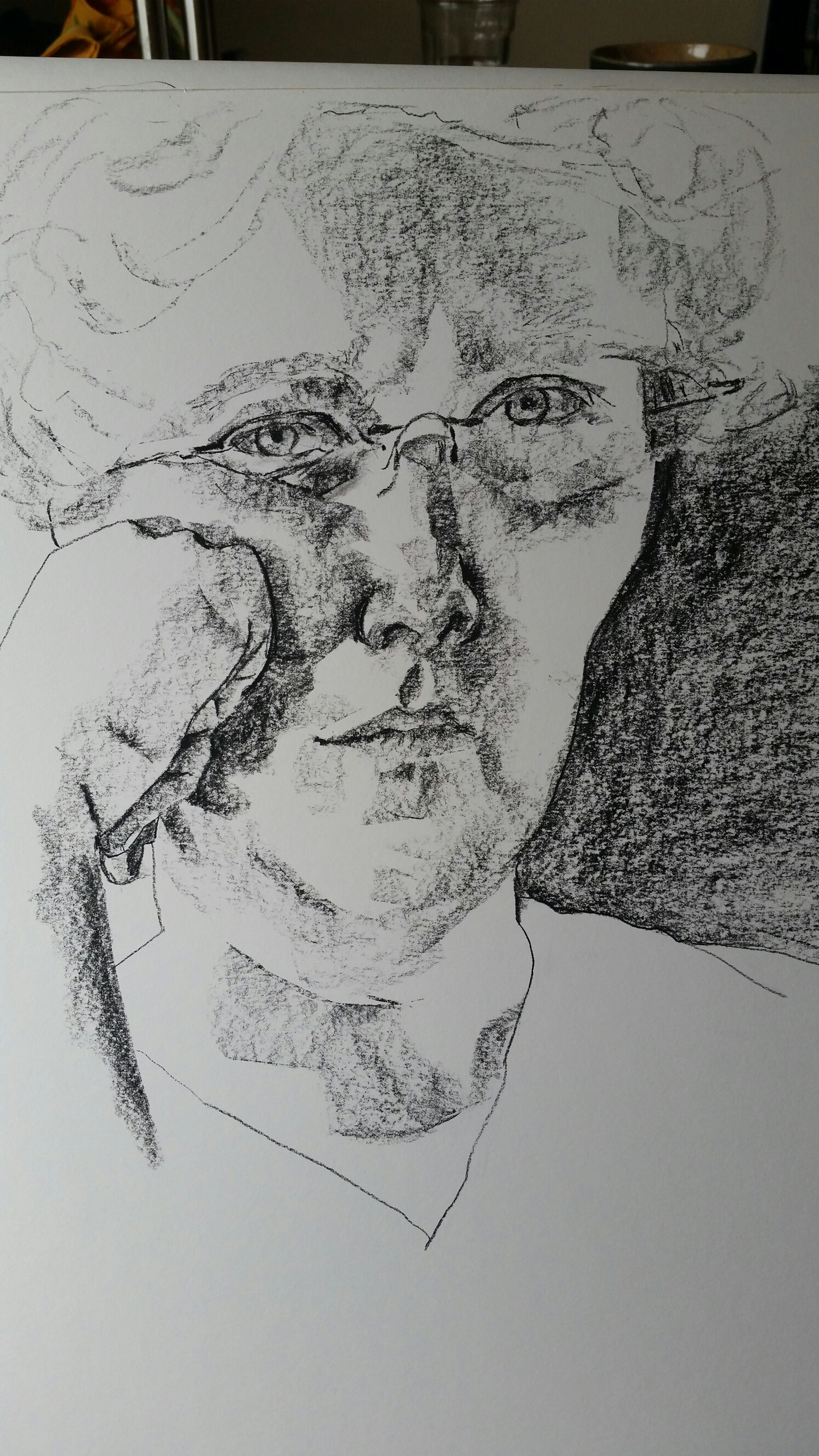
This was also a foray into Bristol vellum-texture paper; I’m looking for something as smooth as the newsprint I’m accustomed to, but of more archival quality. It’s close.
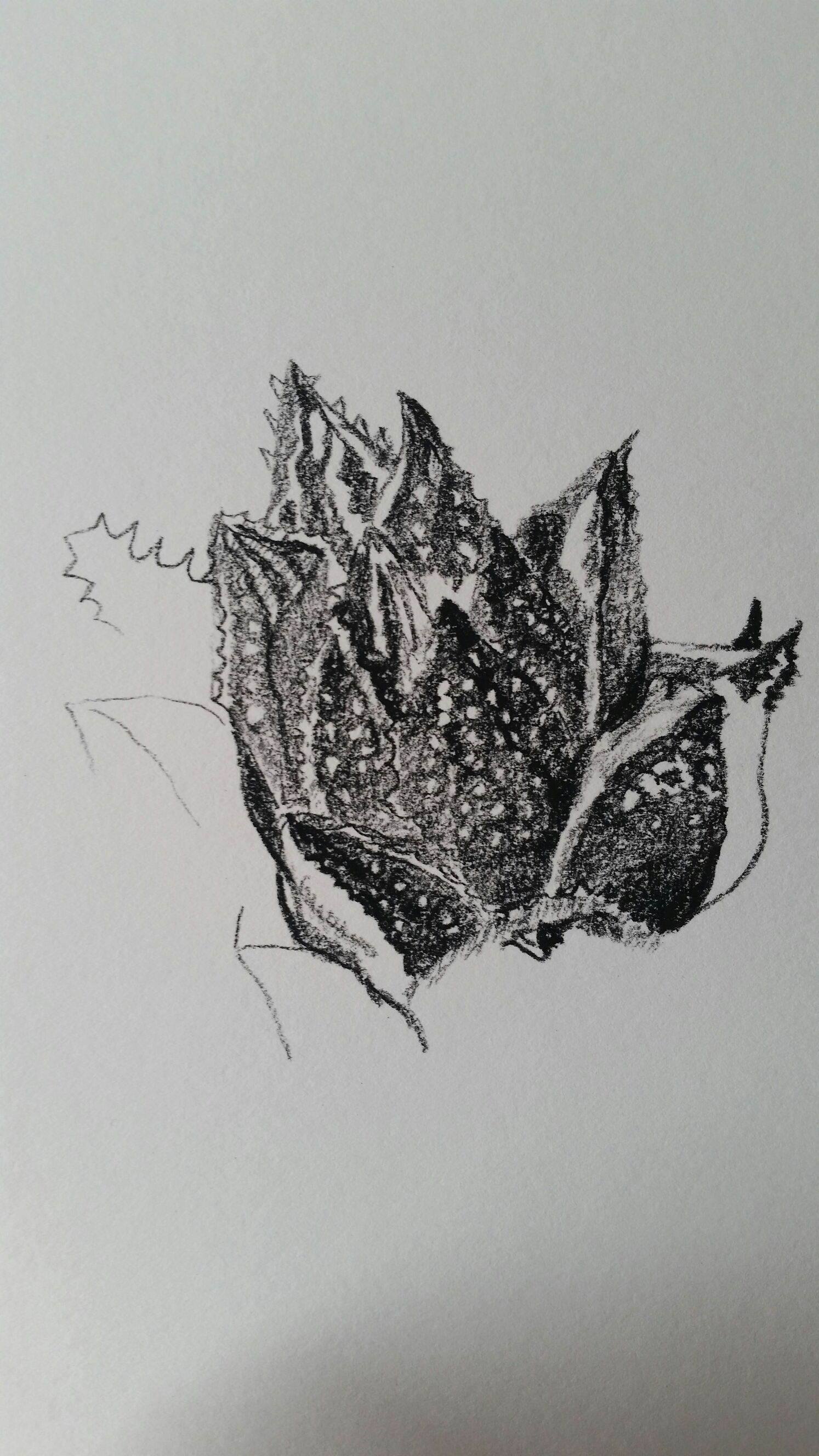
I also spent some time with Munchkin’s Hawthoria succulent, until the attention to detail was driving me squirrelly and I stopped.
When I arrived at drawing this morning, I felt stressed out and grumpy. Drawing straightened me out. It offers two of the best remedies for the blues: work and beauty.
For the warmup one- and two-minute gestures, the model mostly chose poses with a lot of twist, heart-meltingly lovely:
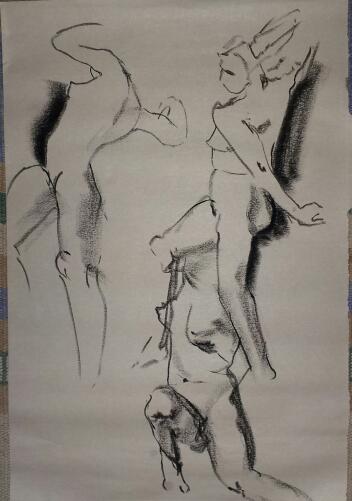
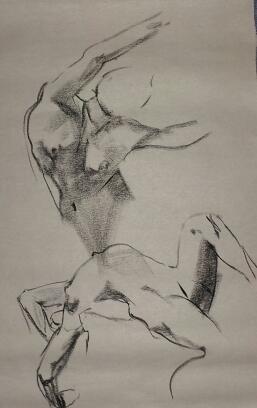

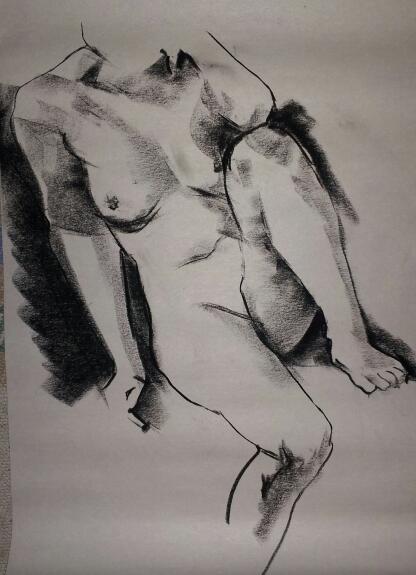
Something good was happening in my drawings of the ten-minute poses, and the last one here (20 min) has some of the best drawing I’ve done in a long time, if not ever. In them, and especially in the last two, I used a slightly different approach to get the edges of the shadows. It’s so obvious that I don’t know why (a) I didn’t do it before, and (b) it makes such a difference, but I didn’t and it does.


A card stuck to a bookcase in my childhood home had this quote (more or less) from T. H. White’s The Once and Future King typed on it.
“The best thing for being sad,” replied Merlyn . . . “is to learn something. That is the only thing that never fails. . .. Learn why the world wags and what wags it. That is the only thing the mind can never exhaust, never alienate, never be tortured by, never fear or distrust, and never dream of regretting. Learning is the thing for you.”
When I was a teenager, I discovered that if I substituted “creative work” for “learning,” this rang even more true for me. Maybe they’re the same thing. Throw in some contemplation of beauty, too, and a bad mood doesn’t stand a chance.
As in previous years, I decided on a spiritual practice for Lent. One recent year, I tried drawing every day, and missed almost as many days as I drew. So this year I decided to draw, too, but not to aim for every day. Just most days, and something fast. Whatever catches my eye is my subject and I jump in for five or ten minutes; for example, on the first day I drew part of the BART station while I was waiting for a train.
Joy said, “Aren’t you supposed to give something up?” and then answered her own question: “I guess you’re giving up not-drawing.” Yes.
The past two Mondays having been school holidays, I have missed my figure drawing sessions to be with the munchkin, so these little drawings have been nice tidbits to tide me over.
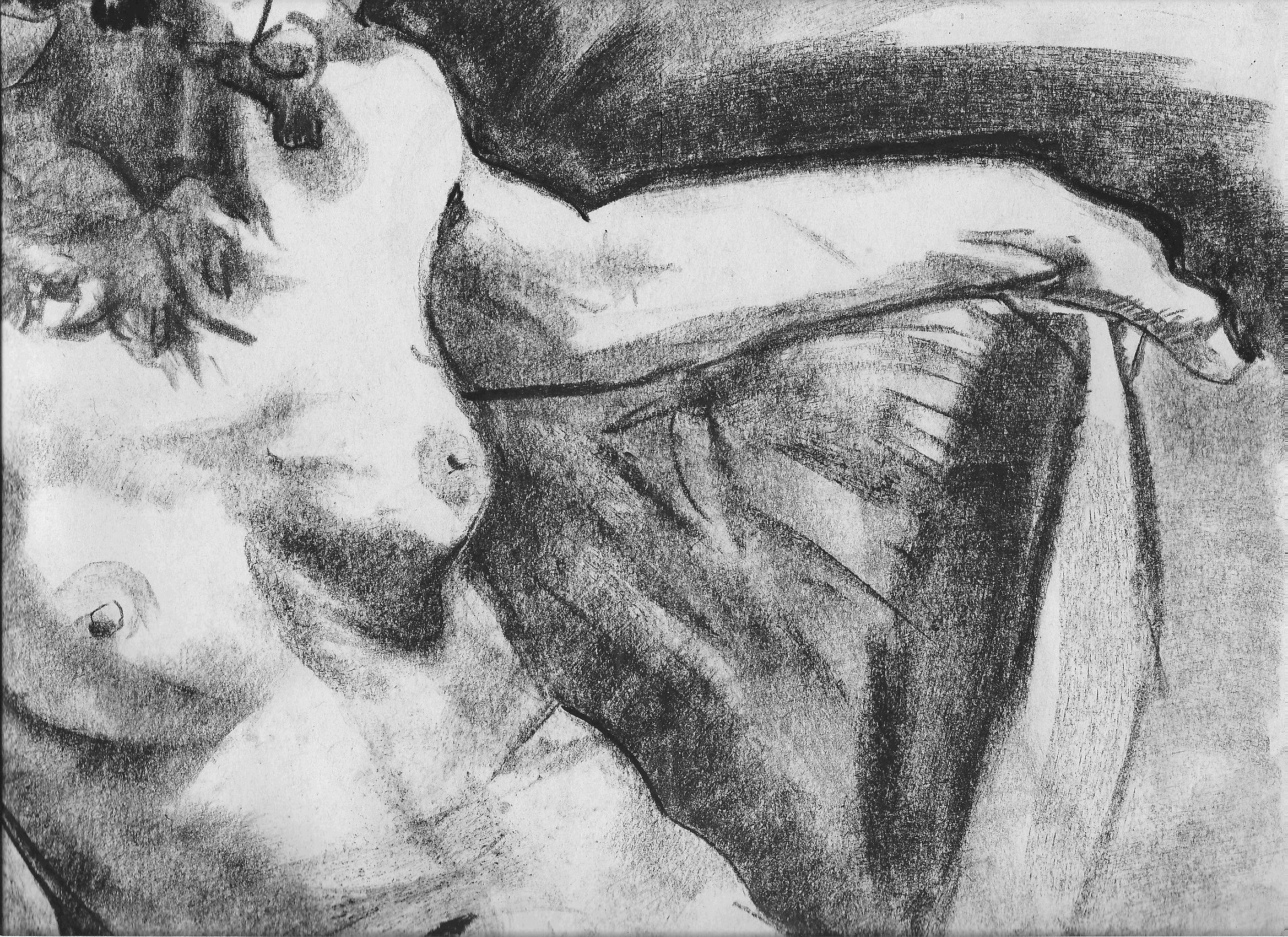
We got a fairly long pose this week, which is rare; the use of the last hour is voted on by the class, and “two poses” almost always wins over “one.” I usually vote for one if I feel like I’m drawing well that week, and this week I did and “one” won and I was very happy to spend 50 minutes on this beautiful pose. My scanner can only take it in in three parts.

……………………….
Why were things clicking this week? No idea. Drawing almost-daily might be helping, or it might have nothing to do with it. I’ve been focusing on light, which is to say, on shadow, and continuing with the close focus (this was the only pose this Monday where I took in most of the body, since I had so much time; on the shorter poses I didn’t attempt it), and those things help.
We interrupt this Mexico City travelogue to bring you a few drawings (click to enlarge).


The landscape in charcoal pencil is now finished. I had intended the picture to be framed by the two largest cupolas, but the composition drifted as I drew, so I cut off the leftmost couple of inches to restore it.
While I was drawing the charcoal-pencil picture, I got fascinated with the colors of the jacaranda, purple doors, and bright turquoise door slightly south of where I was drawing, so the next one made them the focus. I learned a lot about working with soft pastels on this one. I think it’s finished now.
I started drawing this tree, which is in the garden of my drawing teacher, Silvia Velasquez, on Tuesday. I love the way the biography of the tree is written in its shape and skin. It not only grows out of the rock, it’s carried one stone with it. I’m not sure you can make it out yet–to distinguish between the texture of the stones and of the tree itself (and the ivy, and the birdhouse) is one of the challenges I’m setting myself with this drawing. I’m amazed by how many different textures are in the bark–it’s as if it’s several trees, or has lived several lives. Another thing I’m working on is to focus on volumes and planes as I draw, more than on outline; I’ve filled in a lot of linear detail now, but the broader strokes, done with charcoal, are still evident in the stones below and the right-hand branch. Today will be my third morning drawing it, so I’ll post an updated version. I should record stages like this more often–it’s easy with the digital camera, and I’d probably learn a lot.
I can’t wait to get back to this tree!
Back in my first post, I wrote about my intention to draw leaves that are worn down to their skeletal forms. It actually proved very difficult to find any near my home in California, though I did find one with a lot of exposed veins and did some sketching shortly after writing that post.
This week, I’ve been drawing a different kind of skeleton leaf: the pad of a prickly-pear cactus (opuntia), or nopal. Prickly-pears grow here like weeds, and are currently blooming with pink buds that open to bright yellow flowers. I’d be hard pressed to say which is more beautiful, the living plant or its fallen, decayed pads. Here’s my subject, with the drawing underway.

Last week, I was doing a negative-space exercise with my drawing teacher. It’s a good, basic art practice that helps you to really pay attention to what is before your eyes instead of what you think something looks like. (Betty Edwards calls this a shift from left-brain thinking to right-brain thinking and uses this exercise, along with many other good ones, in her Drawing on the Right Side of the Brain.) When I sat down with my nopal skeleton, there was no doubt that I was going to focus on the dark shapes in between the veins, not the veins themselves. It’s not because I have white paper and black charcoal; I could use dark paper and draw the lines in light gray and white. It’s because the spaces are what attract me.
So there I was, drawing my empty spaces, humming happily away at my new friend the nopal, and thinking once again about lacunae, the absences that have such presence. (I wrote about them here on Feb. 11.) I’m just fascinated by the way we are shaped by absences, gaps, the spaces in between. I often think of this phenomenon in psychological terms: for example, how one’s personality takes shape around the things one is anxious to avoid. In my previous post on Barbara Kingsolver’s The Lacuna, I was thinking largely in terms of political history. But when I see a piece of art like Goldsworthy’s “Roof” (to give one example–he has many works that use a similar hole motif), its impact feels like something spiritual. That space draws me out, into itself–not at all in a scary, oh-no-I’m-falling-into-a-black-hole way, but in an intriguing, welcoming way. I recognize that space; it has a counterpart within me, something for which I don’t have any words, but which I know is there the moment I look at Goldsworthy’s piece. (I suppose that for some, these pieces must be disturbing, if they were locked into the cupboard under the stairs as kids. But like a cat, I’ve always liked small, dark spaces.)
Two poems that I had in my notebook back when I was working on a similar theme in college still resonate. One is “Anecdote of the Jar,” by Wallace Stevens. I usually can’t make head or tail of Stevens, but that year, when I read this poem, I thought he’d written it for me and the vessels I was making. My art thesis show was all large hand-built abstract sculptures, not wheel-thrown pottery, but I still made them all vessel forms because of the way vessels evoke that sense of the space inside and around. I thought I knew just what Stevens meant: put a jar in a space and suddenly the space without is shaped around, shaped by, the space within. (All these commentators mentioned in the Wikipedia article could be right about industrialization and Keats, too. But that isn’t what the poem means to me.)
The other poem is the eleventh chapter of the Tao te Ching, Lao Tse: pick your translation. Here’s Gia-fu Feng and Jane English, and here are about a dozen others.I started to write, “the spaces in the nopal make it what it is,” but that implies that “it,” the cactus, is the veins (or “bones” or whatever they are), while the spaces are just air, or emptiness. That would be as nonsensical as a jar that was made only of clay, not of space. The nopal is all of it, stuff and space alike. Drawing the spaces helps me feel that in my own bones.
Switching gears, here’s the other drawing I’ve been working on for, oh geez, a few weeks now, an hour or two most afternoons while the light is right. It’s the view east from my roof. (The view, ha. It’s just a few degrees of the whole view, of course. The rest is absent . . . most of artmaking being the decision about what to leave out. More on this aspect of lacunae soon too.) I think it’s almost done. It quickly turned out to be about texture more than anything else. The variety of textures of walls and trees in this little chunk of city is incredible. One thing I notice as I look at this smallified version is that I might want to fix up some of the verticals with a t-square. There’s nothing wrong with parallel lines not being quite in parallel (look at van Gogh’s city streets and interiors), but it might distract from what I want to be the focus here.


 Sermons in Stones
Recent comments