
You are currently browsing Amy Zucker Morgenstern’s articles.
They are tight, ovoid cones in the trees, but when they fall to the ground they often look like tiny, wizened roses.

Maybe tomorrow I’ll depart from the leaf-a-day plan long enough to draw the cone of a deodar, because I love them. But tonight, the leaves.
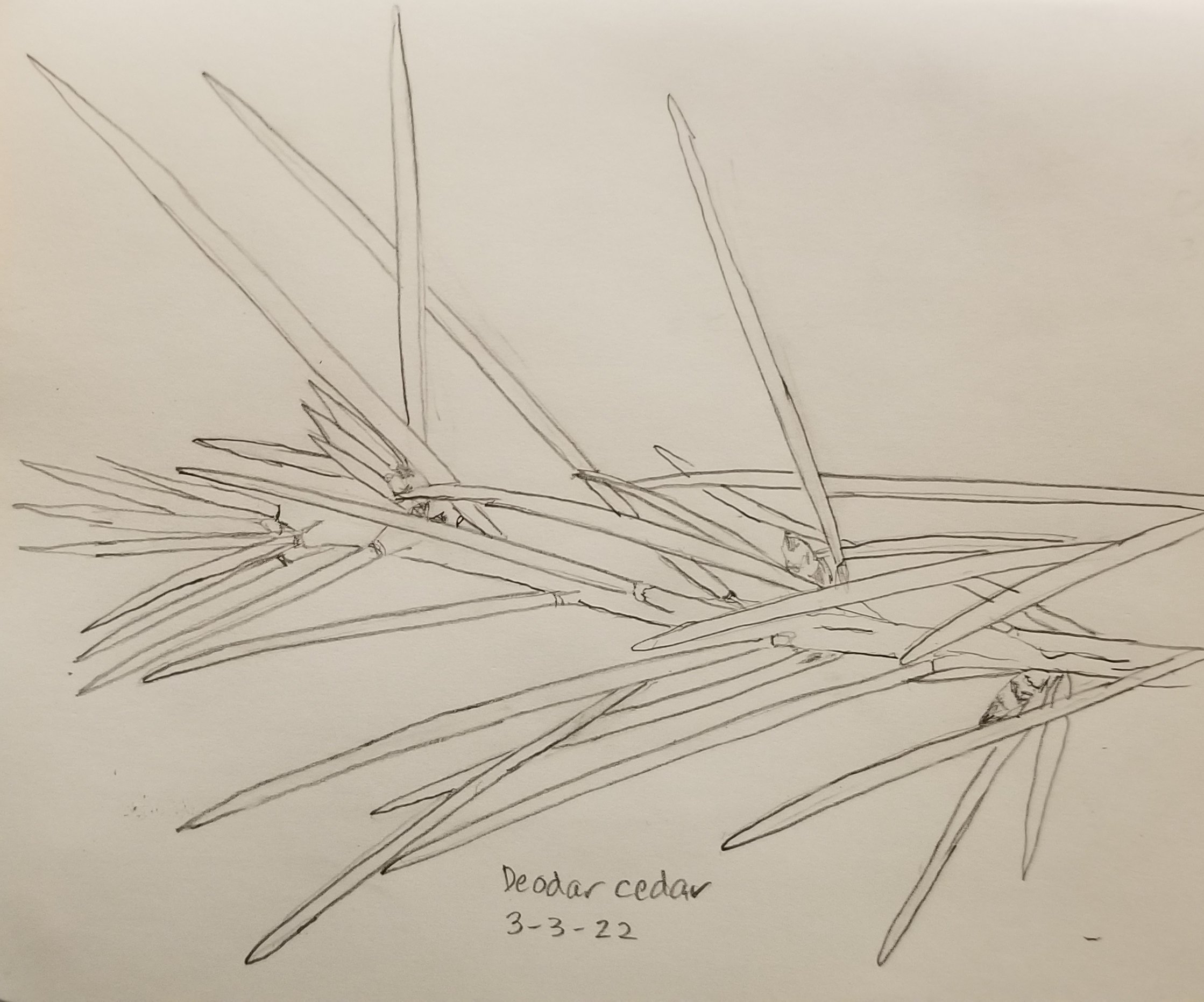

Not a native. The names say it all: Atlas cedar, from the Atlas mountain range in Algeria and Morocco, and Cedrus atlanticus for the same reason. But it has been planted along the Pacific coast of the US. It is said that we have a Mediterranean climate, so maybe the Atlas cedars planted as ornamentals here feel at home.
The search for a good photo of subalpine larch needles led me to this article by Michael Kauffmann, an ecologist whose CV reveals a body of research on conifers of the western North American continent. These particular needles are so short that I thought I was looking at newly emerged leaves–baby needles–but Kauffmann says something else is going on: an extremely varied and subtle response to the needs, not just on any particular slope of foothills, but on a particular branch or twig of the tree. “At any given place on the tree, the subalpine larch allocates needles–how long or how many–to optimize the energy balance based on availability of resources.” He took this photo, and others on the same tree showing needles half the length of these, double their length, triple their length. Nature is amazing.
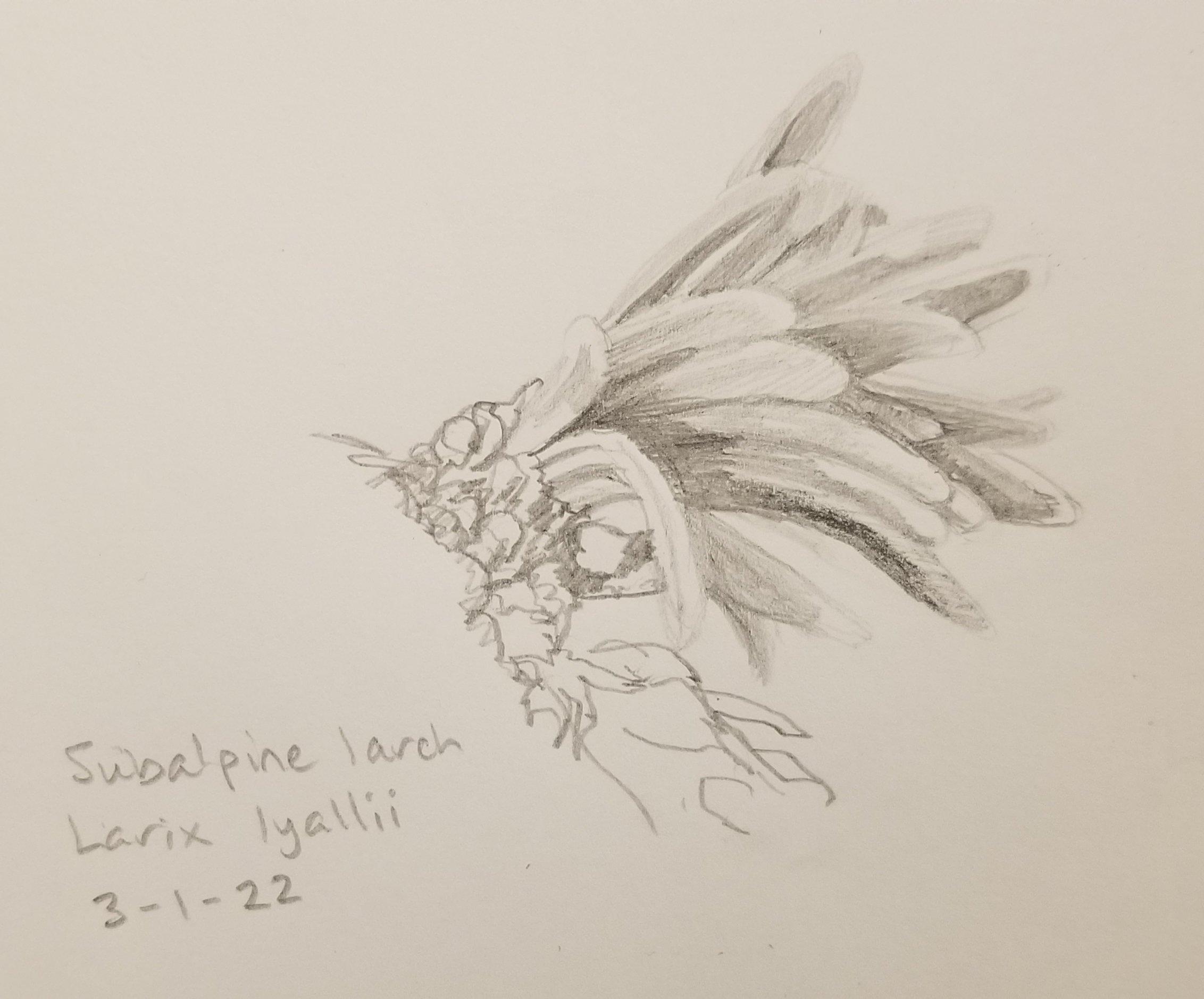
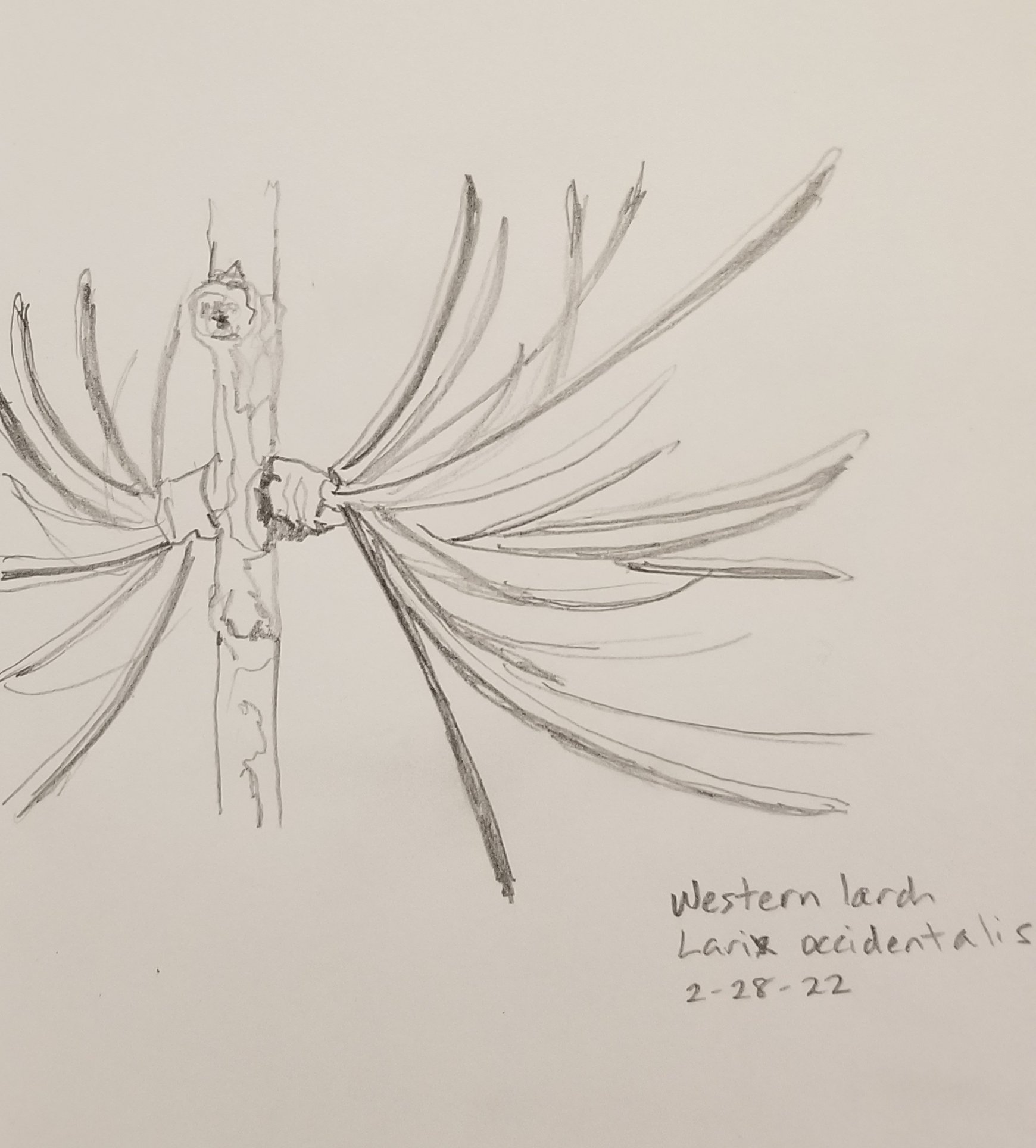
Wikipedia summarizes a few points this way: “With its thick bark, nonflammable foliage and protective cones, the species is very fire resistant. In the late 20th century, after wildfires had been suppressed for almost a century, larches at Seeley Lake and Glacier National Park were endangered by major fires enabled by fuel ladder; normally smaller fires would have depleted the fuel. In more recent years, many smaller fires have been allowed to take their course.”
Still a needle-leaved conifer, you understand. But it sheds its needles all at once, the way most broadleaved trees do.

I love those little starbursts of needles.


It looks like it comes from another world, but it is from this one. These are the first leaves of the Douglas-fir. Strictly speaking, they are cotyledons. A cotyledon (kä-tə-ˈlē-dᵊn) is a leaf produced by the embryo of the plant, the one that emerges from the earth already formed and ready to photosynthesize until the first “true leaves” grow. Often, these embryonic leaves come in pairs, or in a whorl, in the case of the Douglas-fir (I’ve never seen the hyphen before, but the Audobon guide uses it).

The needles at the very end of a twig resemble a sea anemone.
I was so tired that I fell right into bed, planning to post this in the morning. But morning was busy and I forgot all day. So here is yesterday’s tree, immediately before I draw today’s.
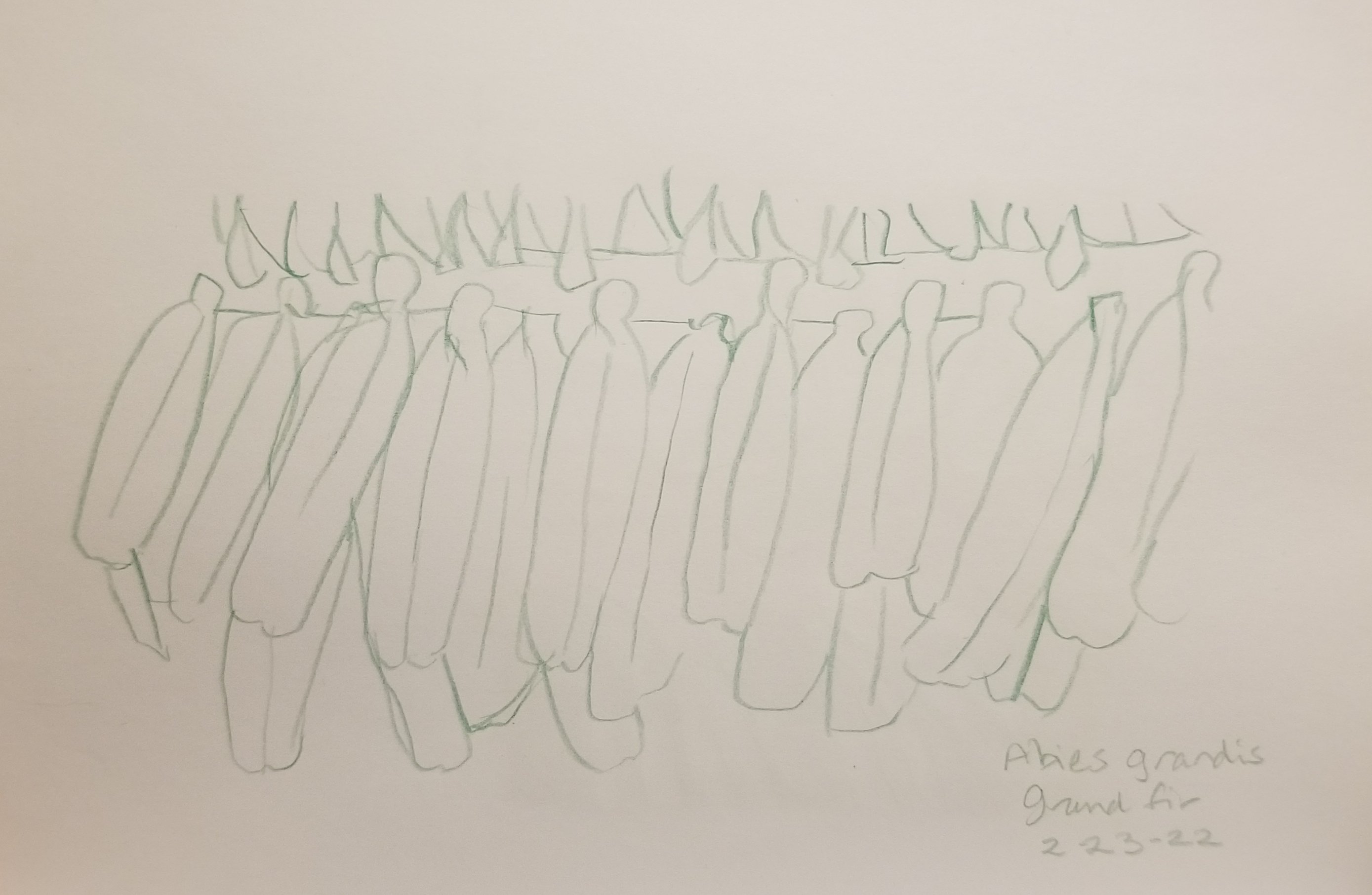
Something I find endlessly fascinating about nature is the way things are patterned but never quite completely regular. What I loved about these needles, in addition to the little twist at the base of each one, was their pattern of alternating short and long, and the zigzag rhythm formed by their placement on the twig. But once I looked closely enough to draw them, the irregularities in the pattern became evident. Drawing them as a schematic seemed like a way to highlight both the pattern and the deviation from it.

 Sermons in Stones
Recent comments